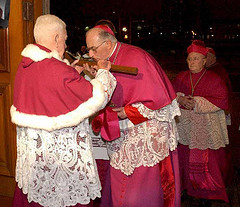
Continuing from the first part, in which I elaborated on the Episcopal Ordination ceremony itself, let us now take a look at the office of the Episcopate itself, that is of a bishop. One may ask, who is a bishop? Bishops are ‘overseers’, which came from the Greek word, Episkopos, which means overseers, as in the early Church, there are those appointed to succeed the Apostles and oversee the Christian communities, to care for them like shepherds care for their flocks of sheep.
Such was the origin of the episcopate, with bishops as those appointed in positions of authority and with oversight over the laity and the religious alike, to keep them faithful to God, and united to the successor of the blessed Apostle Peter, who is our Pope.
This development of the early Church eventually become an office on its own, a separate level from the priesthood, as in the episcopate, there is a fulfillment and completion of the holy orders, which is symbolised by the bishop wearing both the deacon’s dalmatic, and the priest’s chasuble over the dalmatic. This symbolises the union of the ministry of the diaconate and the priesthood in the person of the bishop, who represents the completion of holy orders.
Cardinals and Popes are not separate orders on their own, unlike the diaconate, priesthood, and the episcopate, as these are just different types of bishops, with Cardinals usually being bishops from important dioceses/archdioceses in the world, and the officials of the Roman Curia (the body governing the Universal Church), and the Pope, being the Bishop of Rome, is still a bishop, but is preeminent due to him being the successor of the Apostle Peter, to whom Christ entrusted His Church, and thus the Pope becomes the very Vicar of Christ in this world.
There are also many types of bishops, which I will elaborate further below :
1. Diocesan bishops : These are the ordinary bishops, who head a diocese. A diocese is a division of the Church in a certain geographical area consisting of the faithful in Christ, who may share same culture, language, and customs, or may be of diverse linguistic and cultural origins.
2. Archbishops : These are the bishops who head a more important diocese, either by location, or by history, or by some other reasons. These dioceses therefore are also correspondingly named archdioceses. There are two types of archdioceses :
a. Metropolitan Archdiocese : An archdiocese that has an overseer status over one or more other dioceses (called suffragan dioceses or suffragan sees) which are grouped together into an Ecclesiastical Province (or Province of the Church), and headed by a Metropolitan Archbishop, whose distinguishing feature is that he wears a pallium (a woolen shoulder band with black crosses).
b. Archdioceses (directly subject) : These Archdioceses are important dioceses which has either been historically a metropolitan see or diocese that were elevated to an archdiocese status, but these are not overseeing any dioceses under them, and therefore stand alone on its own, directly subject to the Holy See, to the Pope, instead of through a Metropolitan. The Archdiocese of Singapore is of this type.
3. Auxiliary bishops : These are ‘helper’ bishops, who are appointed in larger dioceses/archdioceses to help with the administration of the diocese/archdiocese’s large Catholic population. May also succeed the diocesan bishop/archbishop upon retirement if selected by the Pope, but this succession is not automatic (not like that of a coadjutor). They are given titular see (diocese/archdiocese) upon their appointment as auxiliary bishop.
4. Coadjutor Archbishops/Bishops : These are bishops/archbishops appointed to dioceses/archdioceses to succeed the diocesan bishop/archbishop, whose age may be nearing 75 or in ill health. Bishops have to submit their resignation to the Pope upon reaching the age of 75, so the appointment of a coadjutor is a way to ensure that the diocese does not become vacant if the diocesan bishop resigns, and is a good way to prepare the coadjutor for the eventual succession and duty as the new bishop of the diocese. Coadjutors are not given any titular sees since they are bound immediately to the see (diocese/archdiocese) which they are to succeed in the future.
5. Titular dioceses/archdioceses : These are usually ancient dioceses/archdioceses, mostly located in North Africa and the Middle East, which due to historical events, had fallen into seclusion and extinction. Some can also be found in Europe and Italy, where some dioceses and archdiocese had been suppressed in the past, and become titular sees. These are now given to Apostolic Nuncios, Apostolic Delegates, and the auxiliary bishops.
6. Major Archdioceses : These are only found in the Eastern Catholic Churches, namely the main diocese in the Syro-Malankar, Syro-Malabar, Romanian, and Ukrainian Eastern Catholic Churches, whose importance place them into this special type of Archdioceses, but not high enough to be given the title of a Patriarchate itself.
7. Patriarchate (Latin and Eastern Catholic) : These are the special Patriarchal sees headed by a Patriarch, which in the Eastern Catholic Churches are the leaders of their respective Churches, in full communion with the Bishop of Rome. They are the Patriarchs of the ancient Pentarchy, of Alexandria, Jerusalem, and Antioch, and historically of Constantinople (modern-day Istanbul). However, in our approach to our sister Church of the Eastern Orthodox (who is not yet in full communion with Rome), we respect their Ecumenical Patriarch of Constantinople, who is the leader of the Eastern Orthodox faithful. Latin Patriarchates also exist in Lisbon, Venice, and Goa, which are headed by Roman Catholic Archbishops, but with special Patriarchal title, due to their distinctive history in the Church. Rome itself was a Patriarchate (of the West) until 2006, but was abolished by Pope Benedict XVI to better reflect the position of the Pope as the leader of the Universal Church, and not just the Church of the West (the Roman Church).
So, therefore, after talking about bishops, who they are, and what types of bishops are there, let us now look into the vestments and the items particular to bishops, all of which are steeped in the tradition of the faith and filled with deep symbolism.
1. Working dress (worn outside Mass and important events, the daily wear of bishops, and also for Cardinals and Popes)
a. Simar
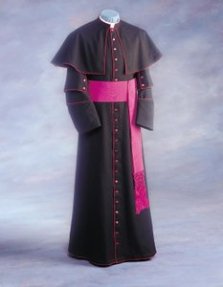
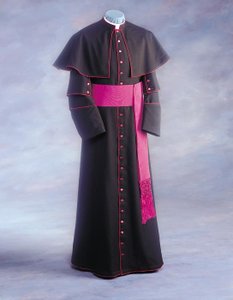
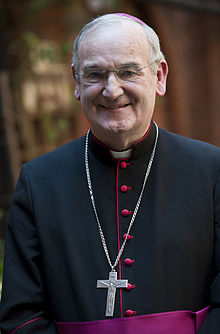
A simar is a special type of cassock worn by the bishops, cardinals, and popes, that is a cassock with a shoulder cape, and a sash (around the waist), which is violet for bishops, scarlet for cardinals, and white for popes. As is well known, the Pope’s simar is white in colour, while bishop’s and cardinal’s simar is black, and with violet lining for bishops, and scarlet lining for cardinals.
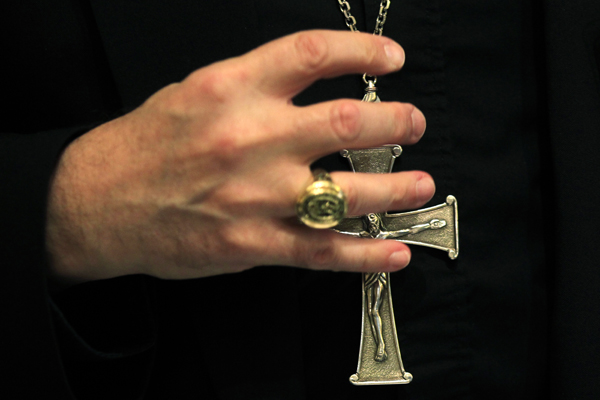
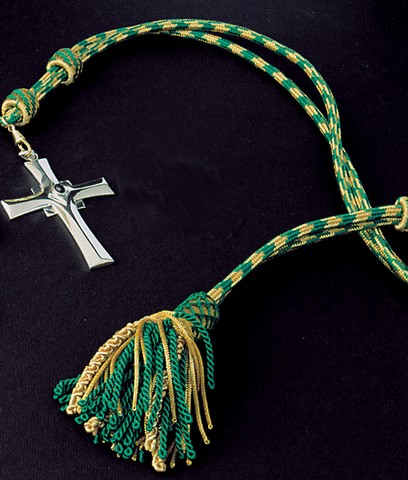
b. Pectoral cross (also part of the pontificalia and the choir dress)
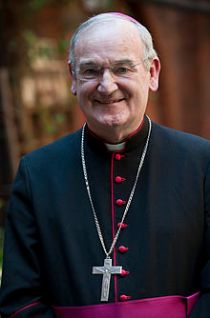
The pectoral cross is worn as its name suggests, on the breast, to represent Christ who protects us from harm, as noted in the prayer of the bishop when he wear the pectoral cross before the Mass, called Munire me digneris : Munire digneris me, Domine Jesu Christe, ab omnibus insidiis inimicorum omnium, signo sanctissimae Crucis tuae: ac concedere digneris mihi indigno servo tuo, ut sicut hanc Crucem, Sanctorum tuorum reliquiis refertam, ante pectus meum teneo, sic semper mente retineam at memoriam passionis, et sanctorum victorias Martyrum. (May You graciously protect me, o Lord Jesus Christ, from all the snares of all my enemies, the sign of the Your most holy Cross: that You would vouch and grant to me and all unworthy of being Your servant, that I may receive the Cross, filled with the remains of Your Saints, in front of my breast, I hold, then it always in mind, but retain the memory of the passion, martyrs and saints victories.).
This is because pectoral crosses are usually precious and contain the relics of the saints, which therefore be further a reminder that the bishop carries with Him at all times, Christ, and His holy Saints, and a reminder of the Cross, through which the salvation of our Lord comes to us.
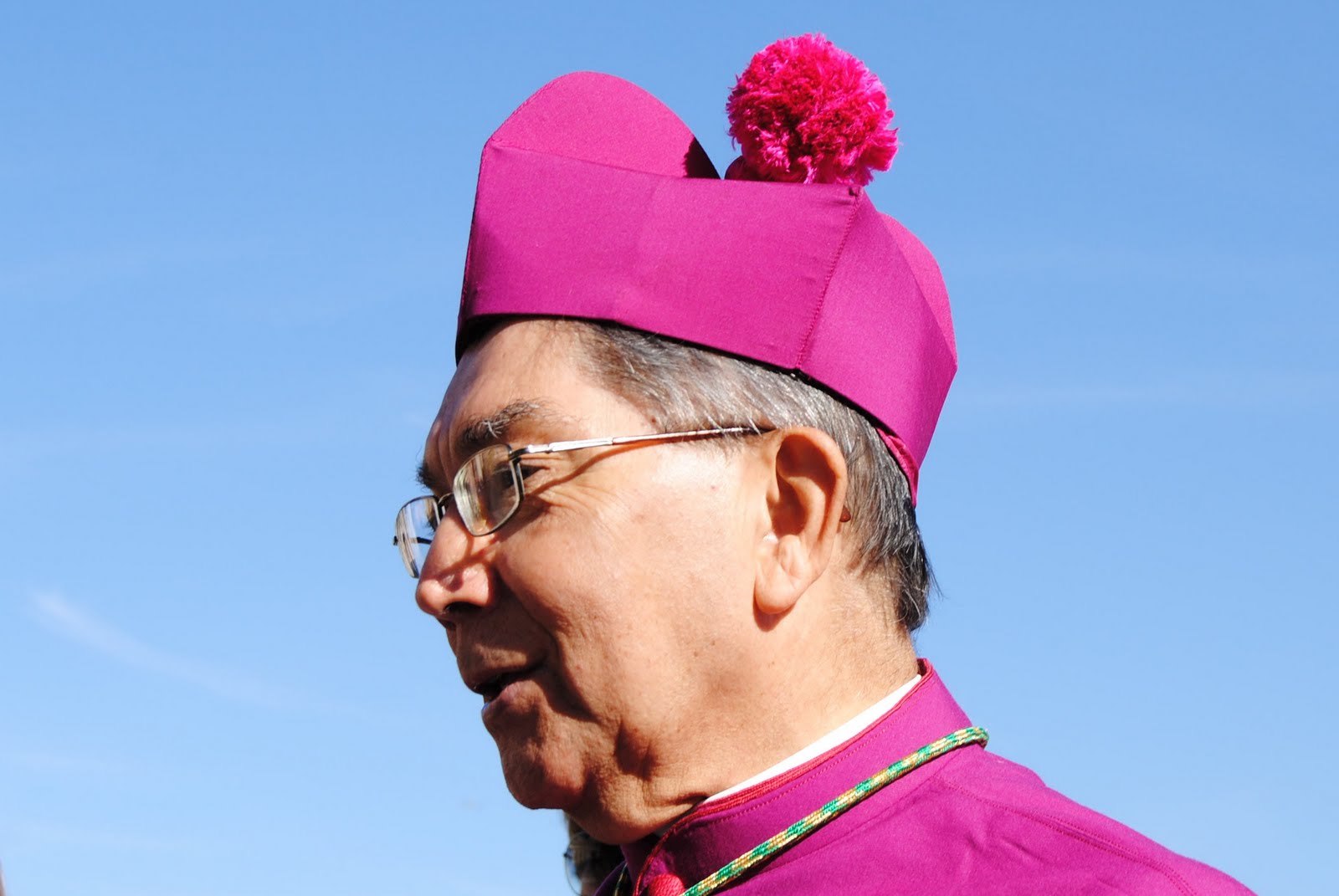
c. Zucchetto (or skullcap)
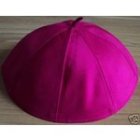
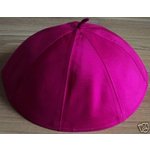
Zucchetto is from the Italian word which means small gourd, because its shape which resembles (half of) a pumpkin. This is a head covering item for the bishops, cardinals, and popes, with the similar pattern of violet for bishops, scarlet for cardinals, and white for popes. This item has a lot in common and may have originated from the Jewish prayer cap, which is somewhat different from the zucchetto in appearance. Originally zucchetto has a practical use in the past, since the clergy in that era were tonsured, that is having their head shaved at the centre, and thus, without the present day heating available, during cold times, the head of the prelate (bishops) would become cold, and the zucchetto came in handy as a covering.
Nowadays, it is a symbol of prayer, and also honor, and therefore, as a sign of humility, it is always removed at the beginning of the Preface of the Eucharistic Prayer and the head of the bishops (including cardinals and Popes) remain bare throughout the Eucharistic Prayer and the Communion.
d. Episcopal ring
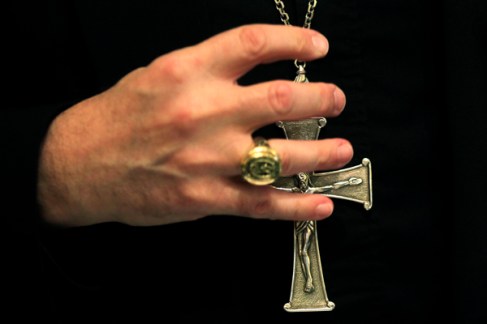
The episcopal ring symbolises the bishop as the shepherd is married to God’s Church, in particular the diocese and the sheep, the faithful in Christ whom he is supposed to guide as the shepherd. The prayer the bishop said when wearing it reflects that this ring is also a symbol of virtue and sanctification, and blessing : Cordis et corporis mei, Domine, digitos virtute decora, et septiformis Spiritus sanctificatione circumda. (With my heart and of my body, O Lord, decorate my fingers with virtue, and sanctify me with the sevenfold blessing of the Holy Spirit around me).
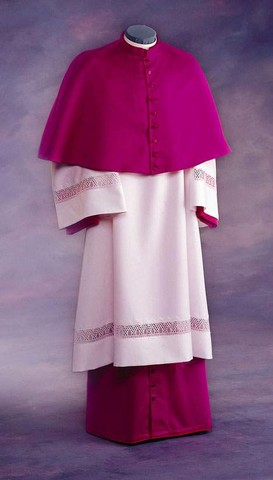
2. Choir dress (worn during the Mass if the bishop is not the celebrant or concelebrant in the Mass, and events like Vespers, and also worn outside for important events)
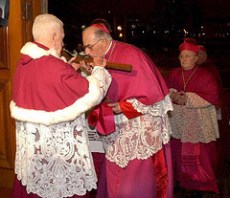
a. Cassock with fascia/sash
This cassock with sash style is similar to the simar, but is entirely violet for bishops and scarlet for cardinals (as opposed to black with violet or scarlet lining)
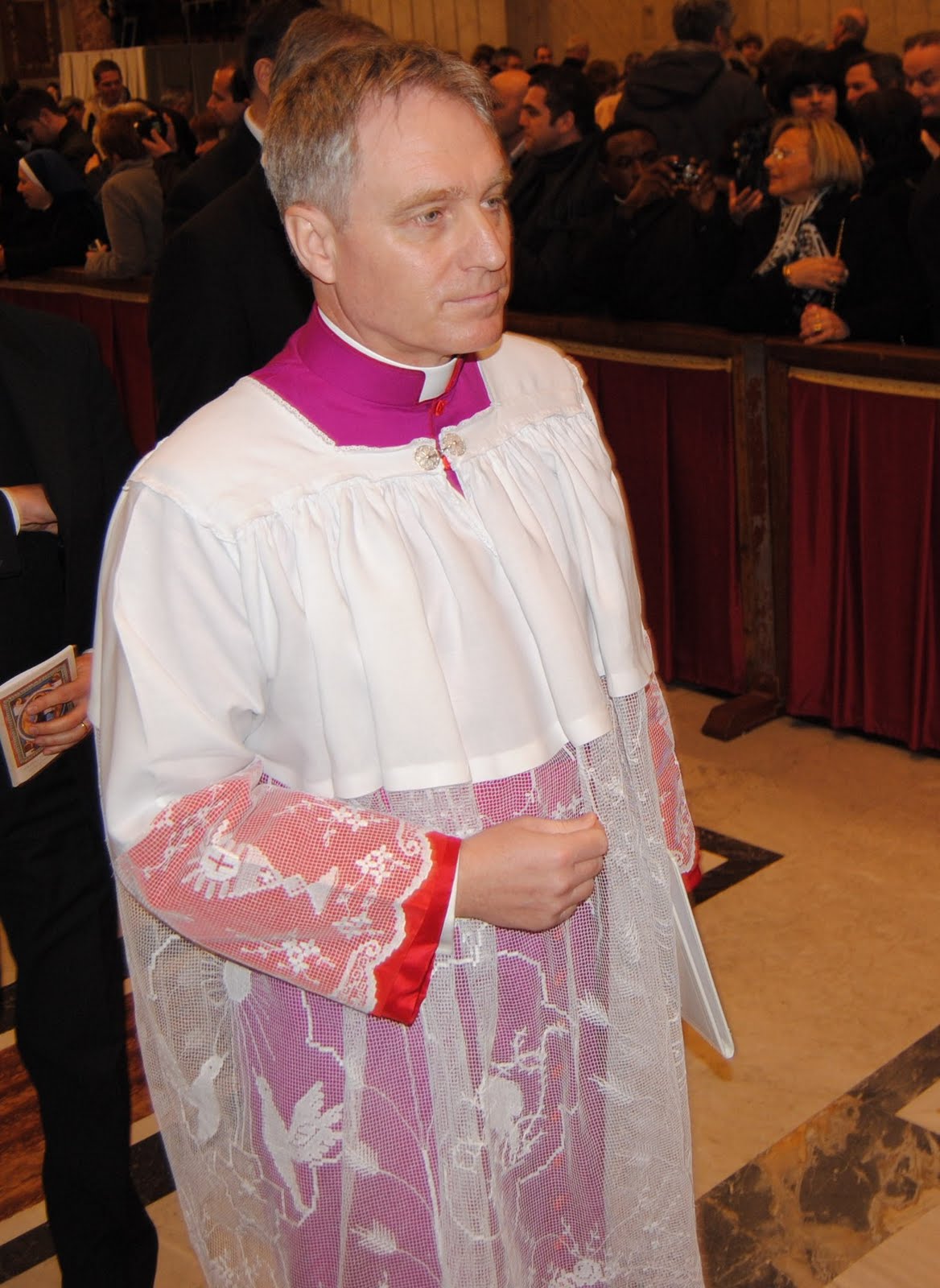
b. Rochet
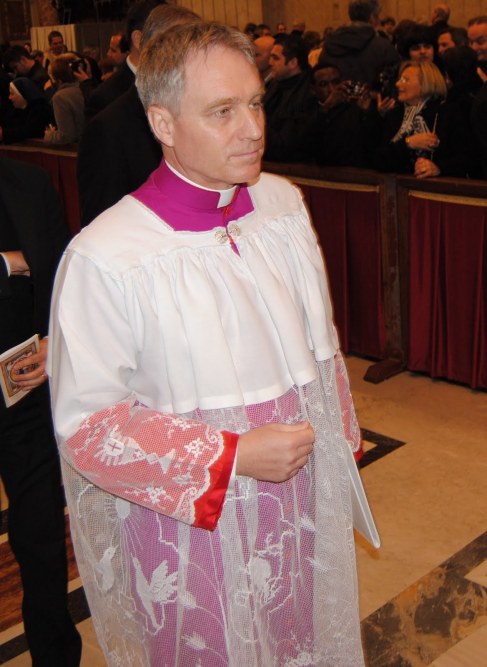
A beautiful, usually thin, either white or translucent, and laced piece of clothing worn over the cassock and the fascia, as seen worn above by Monsignor Georg Ganswein, now Archbishop Ganswein, Prefect of the Pontifical Household.
c. Mozzetta
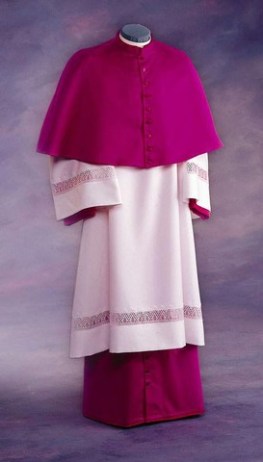
Mozzetta (violet for bishops) is a shoulder cape worn over the rochet and the cassock.
d. Pectoral cross
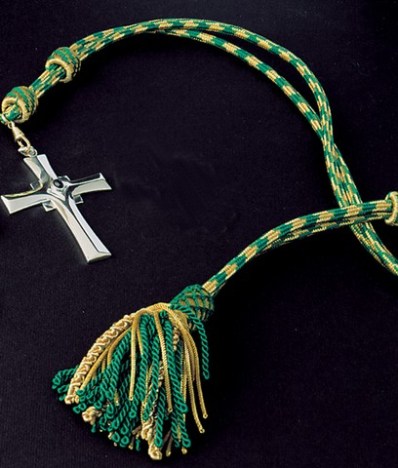
Similar with in working dress, but more often worn with a cord rather than a chain.
e. Zucchetto
Violet for bishops. Similar as in the working dress.
f. Biretta
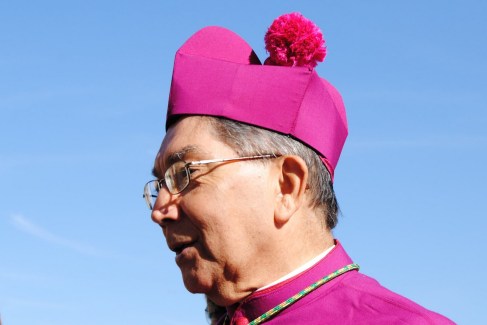
A hat-like item which has the same ancestry as our modern academic mortar board (worn on the graduations in universities), which is violet for bishops and has a pom-pom like object on the top. Only has three peaks, and the unpeaked side is always worn on the left.
3. Bishop’s Pontificalia (worn during the Mass when celebrating)
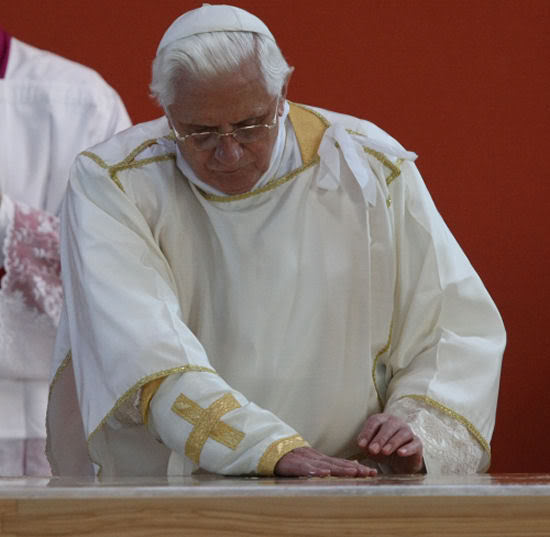
a. Dalmatic

Similar as those worn by deacons, which has squarish-edges as compared to the chasuble (which has more rounded edges), worn over the alb but under the chasuble. Here is the picture of our Pope Benedict XVI wearing the dalmatic during the consecration of a new church in Rome, after he took off his chasuble for the anointing of the altar with holy oils.
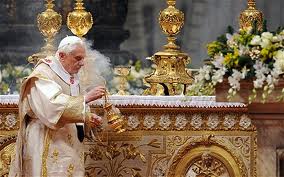
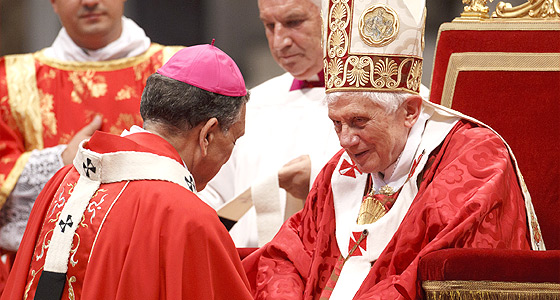
b. Chasuble
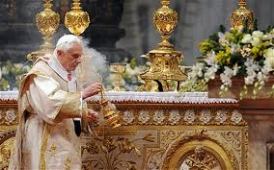
Chasuble as worn by the priests, worn over the dalmatic and the stole, and in this picture, Pope Benedict XVI wore the more traditional Roman-style chasuble, and very visibly underneath the chasuble, is the dalmatic. Only bishops can wear both the chasuble and the dalmatic.
c. Pectoral cross
Worn under the chasuble, not over the chasuble, either the normal chained or corded pectoral cross. Not correctly worn when worn above the chasuble, although many bishops seem to do this. Pope Benedict XVI himself consistently wear the pectoral cross under the chasuble since the beginning of his Pontificate.
d. Episcopal ring
Worn on the finger, which signify his marriage to God and His Church.
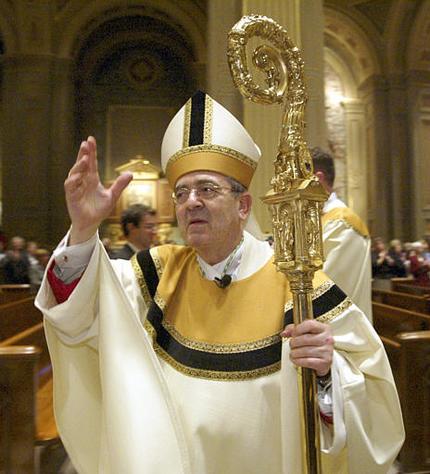
e. Mitre
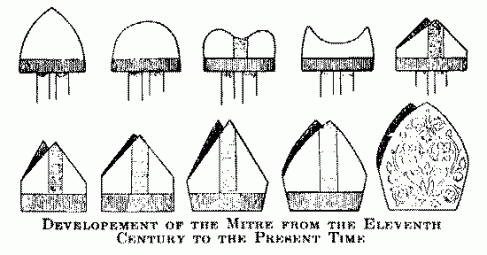
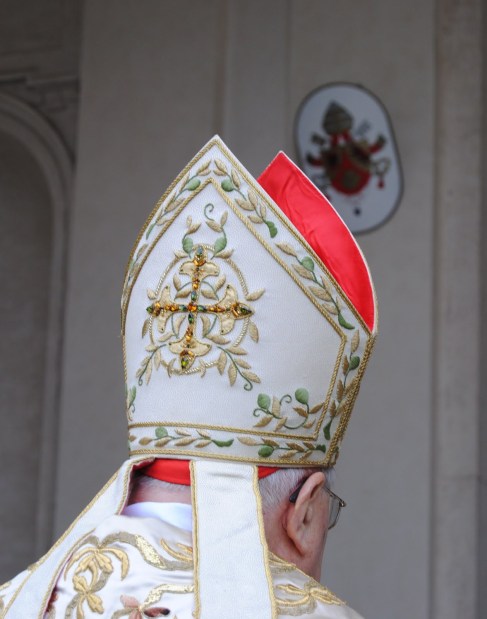
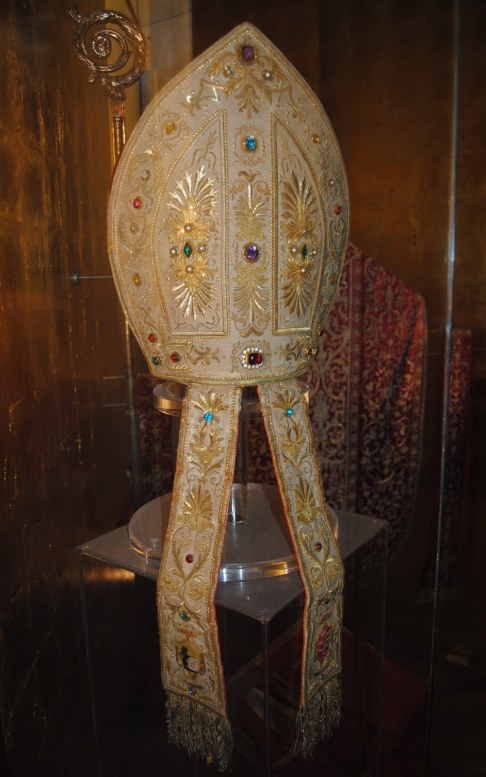
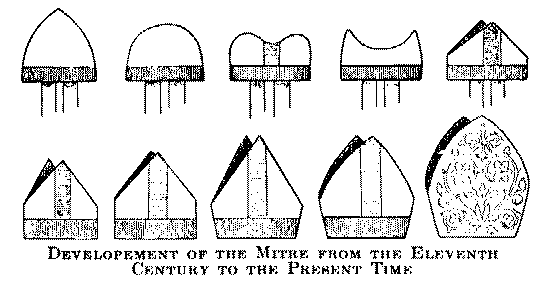
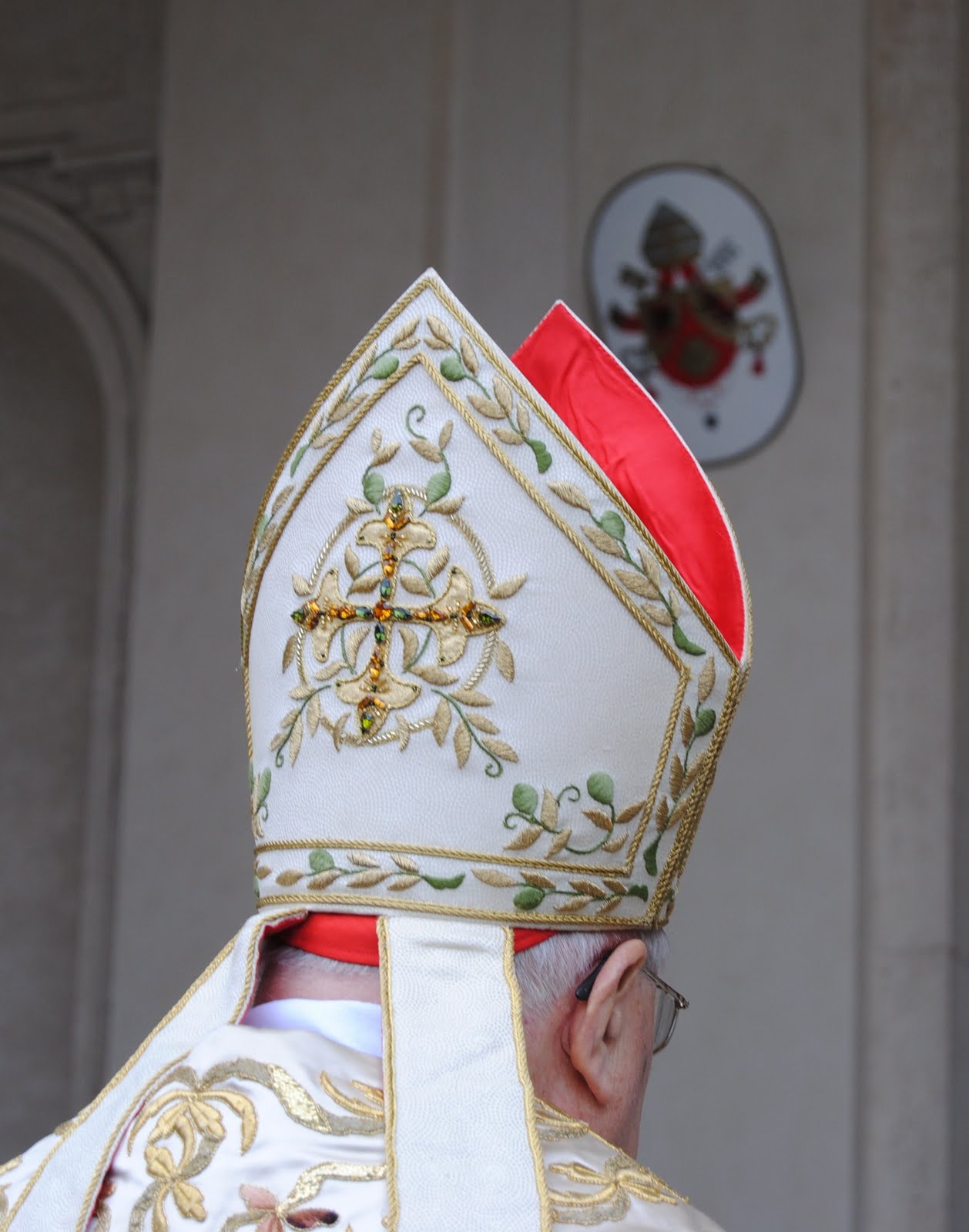
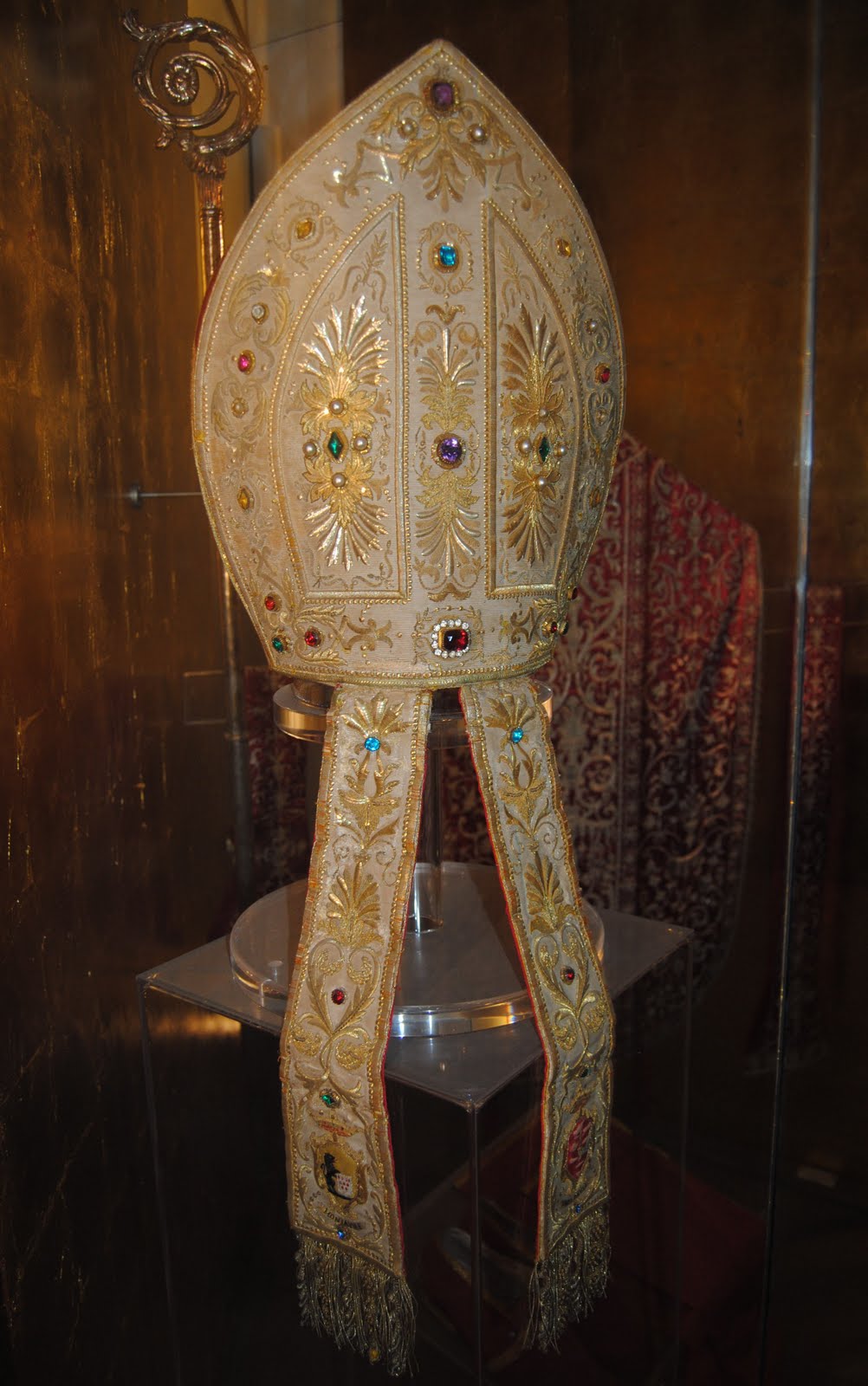
Worn over the zucchetto on the head, and was developed from the camelaucum, or the secular headdress of the late Roman Empire and early Byzantine Empire, where they are also worn by the Popes and the Roman priests, and gradually was restricted only to bishops and abbots.
The mitre symbolises the teaching authority of the bishops, which are symbolised by the two peaks of the mitre, representing the Old and the New Testament, and also recall the flames of the Holy Spirit that inflame the hearts of the Apostles to spread the Good News to all peoples. Therefore, these represents the authority of the bishop to teach the Gospel through the Holy Spirit and based on the Scripture, the Word of God, both the Old and the New Testament. The two lappets behind the mitre themselves also represent the Old and the New Testament, the two sides of the Lord’s Sacred Scripture (which shape looks just like a book marker).
f. Crosier (Pastoral staff)
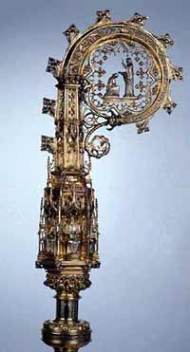
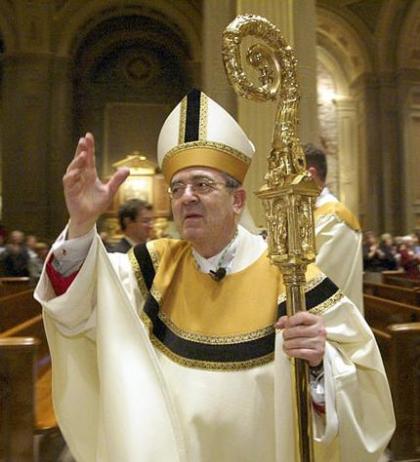
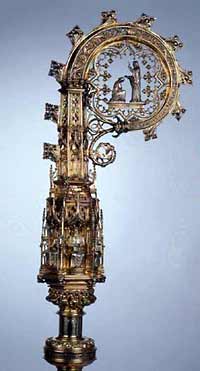
The crosier, or the pastoral staff is the crook-like staff, reminding us on the shepherd’s crook, which they use to shepherd their sheep. Thus, the crosier represents the bishops’ role as the shepherds of the people of God, and guide them in their journey towards the Lord, the Chief Shepherd, the Good Shepherd.
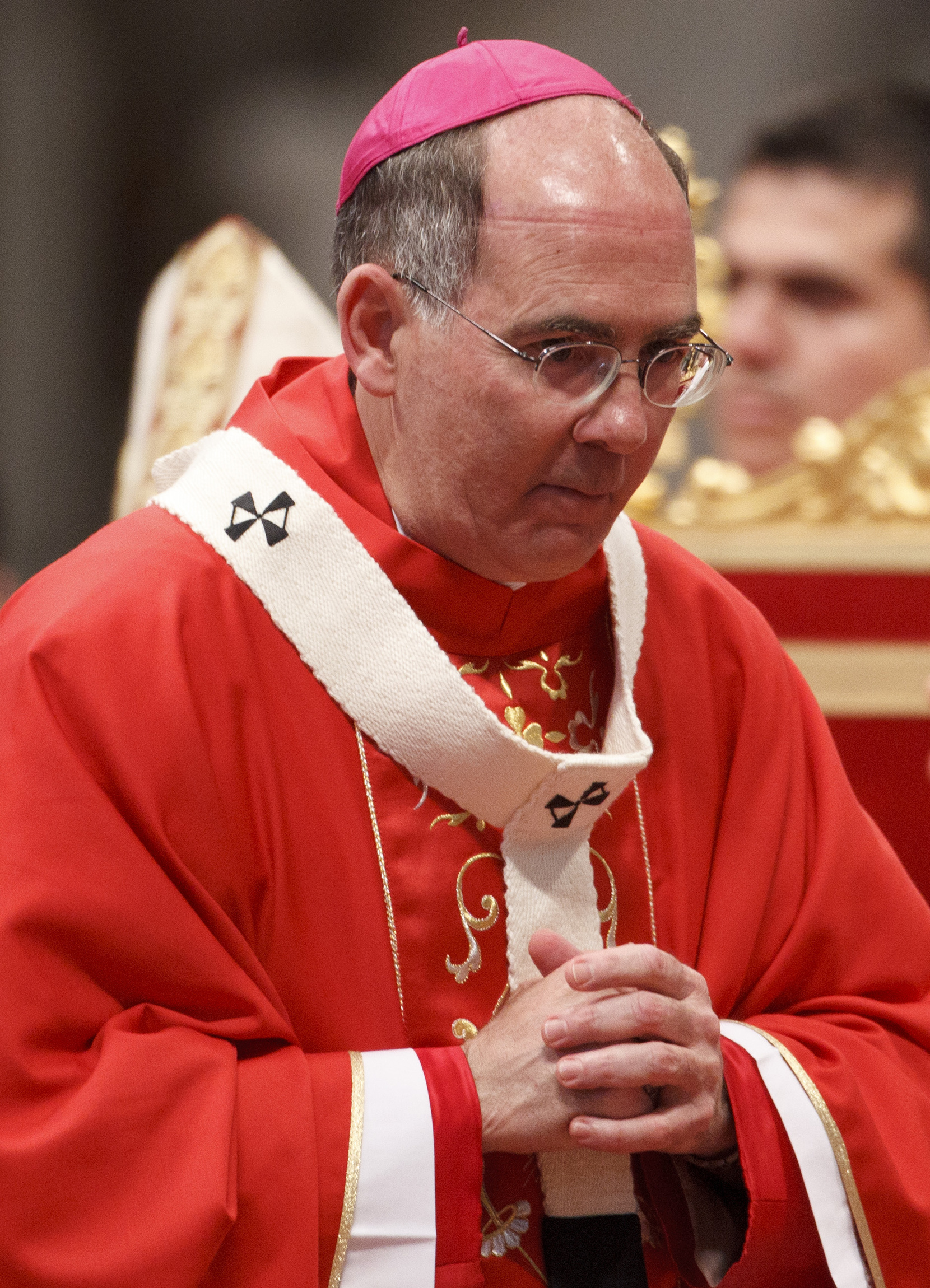
g. Pallium (only for Metropolitan Archbishops and the Pope)
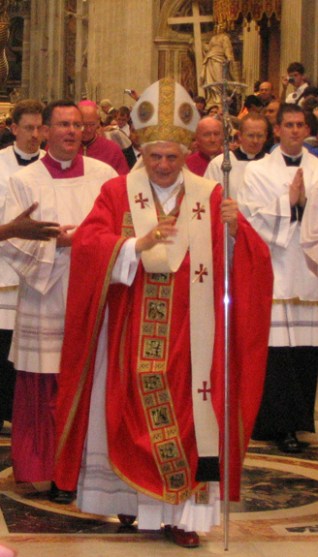
The pallium is a woolen band worn around the shoulder. This represent the metropolitan’s role as the overseer of the faithful, over the sheep of the Lord, that is the faithful people of God, just like Jesus, the Good Shepherd carrying His sheep on His shoulder. Therefore, the pallium represents both the authority of the metropolitan, and the burden presented by his ministry in the service of the Lord.

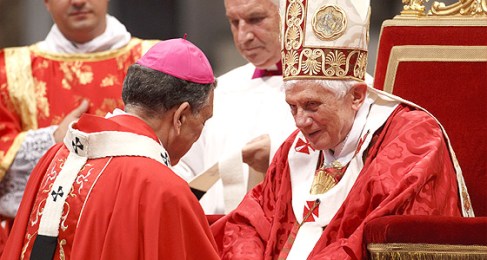
The pallium used to be much wider, as reflected in the earlier pallium that Pope Benedict XVI wore, which used the style not worn since a millenia ago, in the earlier days of the Church. Now the most common form of the pallium is a shorter and narrower woolen band worn around the shoulders, and adorned with three pins that represent the nails that pieced Christ on the cross, and these pins were placed onto the black crosses (red for Pope Benedict XVI’s new, larger pallium and the earlier, much larger pallium), which represent the wounds of Christ.
After all that, and after looking into what a bishop is, what is the nature of the ministry of the bishops, the types of bishops, what they wear and what symbolisms are there in them, let us now take a time to pray, and pray indeed for the soon-to-be ordained Coadjutor Archbishop, William Goh, of the Archdiocese of Singapore.
May God be with him all the days of his new ministry as bishop, and strengthen him at all times, that when his ministry begins this Friday, the Holy Spirit will guide him and keep him faithful to the ministry he has been chosen for, forever and ever. Amen!