Wednesday, 3 September 2014 : 22nd Week of Ordinary Time, Memorial of Pope St. Gregory the Great, Pope and Doctor of the Church (First Reading)

Liturgical Colour : White

1 Corinthians 3 : 1-9

I could not, friends, speak to you as spiritual persons but as fleshly people, for you are still infants in Christ. I gave you milk and not solid food, for you were not ready for it and up to now you cannot receive it for you are still of the flesh. As long as there is jealousy and strife, what can I say but that you are at the level of the flesh and behave like ordinary people.

While one says : “I follow Paul,” and the other : “I follow Apollos,” what are you but people still at a human level? For what is Apollos? What is Paul? They are ministers and through them you believed, as it was given by the Lord to each of them.

I planted, Apollos watered the plant, but God made it grow. So neither the one who plants nor the one who waters is anything, but God who makes the plant grow. The one who plants and the one who waters work to the same end, and the Lord will pay each according to their work. We are fellow-workers with God, but you are God’s field and building.

Wednesday, 27 August 2014 : 21st Week of Ordinary Time, Memorial of St. Monica (Scripture Reflections)

Liturgical Colour : White

Dear brothers and sisters in Christ, today we are presented yet again with the great necessity for us to truly live in the faith, walk in the faith, and act according to our faith. It is necessary for us to embody what we believe in, not in just our external dispositions and appearances, but even more importantly that even in our heart, mind and soul we may be utterly transformed to conform the way of our Lord.

The Pharisees and the teachers of the Law claimed to represent the faith, and they claimed to have great piety and devotion to God, but their hearts were in fact devoid of the love of God. What was in their heart is the love for their own selves and the concern for their own well-being, status, fame and influence. This was why Jesus rebuked them so harshly, for they misused and abused the authority they had been entrusted with.

Then St. Paul in his letter to the faithful in Thessaly also emphasized on the need for action and work rather than mere inaction or passivity in life and in how the faith is lived on. We cannot be mere bystanders or have a passive attitude in living our faith, or else we can indeed be grouped together with the Pharisees and the teachers of the Law, as hypocrites and lazy people who neglected their responsibilities and duties to the Lord and His people.

As we all know, faith without good works is a dead faith, and it does us no good nor help us in our way towards salvation. For those who believe that faith alone is sufficient for salvation, then they have failed to understand that faith itself cannot exist without a concrete and deliberate act on our part to live that faith in reality, through our words, deeds and actions. Faith is real and living only when we have taken steps to implement what we believe in our daily actions and deeds.

Otherwise, faith by mere thinking and understanding alone is not enough, as this kind of faith, not only that it is weak and shaky, but it is also not capable of inspiring others to also follow our suit in faith. Worse still, if our actions and deeds do not match that which we believe in, then we are truly hypocrites, who believe and say one thing in this manner, but do not act on it in the same way, and instead in ways contradicting what we profess to believe.

Brothers and sisters in Christ, today we celebrate the feast of St. Monica, a great woman and saint, who lived during the time of the late Roman Empire. St. Monica was renowned especially because she was the mother of St. Augustine of Hippo, one of the four great original Doctors of the Church, and one of the most crucial pillars and builders of the Church, particularly the Church of the Western Roman Empire, centred in Rome, the heart of Christendom.

However, the virtues of St. Monica did not just come about because she was the mother of a great saint. In fact, it was in her role as a mother and a servant of the Lord that St. Monica had been found worthy of heaven as a holy saint together with her son, whose works and ministries for the Church inspired many around the world at that time, and brought about the salvation of many souls. If that was the role of St. Augustine of Hippo, then St. Monica’s role was equally important, that is the salvation of her son’s soul.

St. Monica was married to a rich Roman nobleman, Patricius, who was still the follower of the traditional Roman religion, the worship of the pagan gods of the Roman Pantheon. St. Monica herself was a Christian, and she was very devoted in her faith, which she showed through her generous charity and works. Her husband had a very bad temper and he was easily angered, but St. Monica worked and prayed hard for his eventual repentance and turning to the way of the Lord.

She also had three children, one of which was to be St. Augustine. St. Monica cared for him greatly and prayed for his sake, that he would grow to be a faithful and devoted servant of God, like that of his mother, having been baptised in early age. However, St. Augustine would go on to disappoint her greatly by immersing himself in the hedonistic and materialistic pleasures of the world, and went on to follow the practice of the syncretist and heretical Manichaean religion.

Although St. Monica was greatly saddened by the actions of her son, she continued to pray and did her best to convince him to return to the faith and repent. It was said that St. Monica wept daily because of her son, and she ceaselessly prayed for his sake, showing the true love of a Christian mother. She followed her son as he went for his journey, and working with another holy saint, St. Ambrose of Milan, she eventually succeeded in turning her son back towards the Lord, who eventually became a great pillar of the Church and the faith.

St. Monica did not give up, and every day, she thought only of her son, and she prayed fervently and without end for the salvation of his soul. This is the kind of faith that we need, one based on dedication, hard works, filled with prayers, tears, hope and action, as what St. Paul had written in the first reading today, and which Jesus had rebuked the Pharisees and the teachers of the Law for, due to their inactivity and hypocrisy in faith.

As we can see, the actions of St. Monica would go on to bring much good for the Church and for countless among the faithful. If not for her hard work, we would not have the wonderful works of St. Augustine, who in turn inspired countless people throughout the ages, and even today, who also followed in the footsteps of St. Augustine and repent their past ways and turn back towards the Lord.

Therefore, brothers and sisters in Christ, as we reflect on the Scripture readings today, and on the actions of St. Monica, let us all think about our own lives, whether we have been truly active in living our faith and dedicating ourselves to God, not just by mere words, but also through actions and deeds. Let us all from now on, live our faith truly and concretely if we have not done so, for the good of all the faithful, that more may turn back towards the Lord and be saved. God bless us all and our endeavours. Amen.

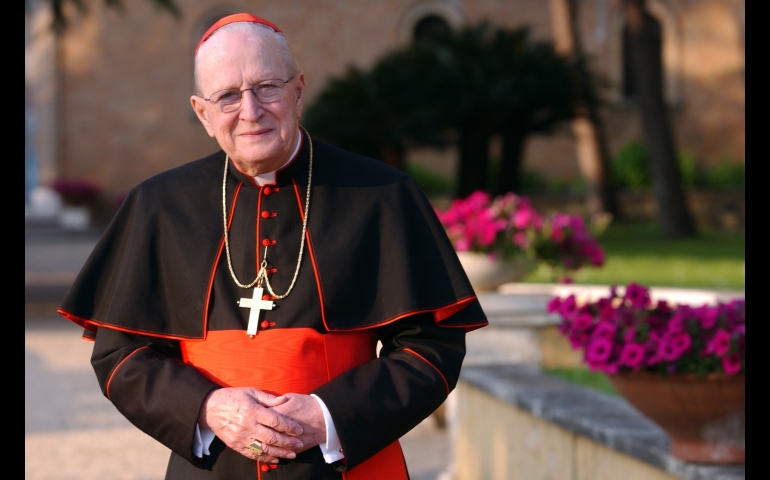
Cardinals Update: Passing of Cardinal Edmund Casimir Szoka, Metropolitan Archbishop Emeritus of Detroit (United States of America), at the age of 86

20140821cnsbr6177

Cardinal Edmund Casimir Szoka, Cardinal-Priest of Ss. Andrea e Gregorio al Monte Celio has passed away on last Wednesday, 20 August 2014 at the age of 86. He was the Metropolitan Archbishop of Detroit, one of the largest and most important Archdioceses in the United States of America, from 1981 to 1990. He was then appointed as the President of the Prefecture of the Economic Affairs of the Holy See, and the President of the Governatorate of the Vatican City State, a post which he held between 1997 to 2006, essentially the top prelate in charge of the day-to-day governance of the smallest country in the world, the Vatican City, where the heart of the Church is.

http://www.gcatholic.org/hierarchy/data/cardJP2-4.htm#169

4538927_G

Cardinal Szoka was created Cardinal in 1988 by Pope St. John Paul II in his fourth Cardinal creation consistory on 28 June 1988. His motto was “To live in faith”. This means an emphasis on truly living the faith in the life he led, and truly, he had been faithful and had already shown that faith through the actions he had done in his long and wonderful life filled with total dedication to the tasks given to him and to the people entrusted to his care.

Cardinal_Edmund_C_Szoka_Credit_Archdiocese_of_Detroit_CNA_8_21_14

We pray for Cardinal Szoka, that he will rest in peace, and God will reward him for all his hard and great work as the long time servant of God as the shepherd of the faithful in Detroit, as well as for all the ministries and good works he had done for the sake of God and His people in the entire Universal Church in his dedication and work in the Roman Curia. May the Lord welcome him into His embrace in heaven and give him eternal rest and happiness that he deserved.

With the passing of Cardinal Szoka, and the recent aging out of Cardinal Carlos Amigo Vallejo, the College of Cardinals now stands at 210 members, with 116 Cardinal-electors and 94 Cardinal non-electors. The number of Cardinal-electors now is 4 below the specified maximum limit of 120.

There are now 4 Cardinal-elector vacancy in the College of Cardinals, 0 vacant Cardinal Suburbicarian Sees (for Cardinal Bishops), 5 vacant Cardinal Titles (for Cardinal Priests) and 9 vacant Cardinal Deaconries (for Cardinal Deacons).

Wednesday, 27 August 2014 : 21st Week of Ordinary Time, Memorial of St. Monica (Gospel Reading)

Liturgical Colour : White

Matthew 23 : 27-32

Woe to you, teachers of the Law and Pharisees, you hypocrites! You are like whitewashed tombs, beautiful in appearance, but inside there are only dead bones and uncleanness. In the same way, you appear religious to others, but you are full of hypocrisy and wickedness within.

Woe to you, teachers of the Law and Pharisees, you hypocrites! You build tombs for the prophets, and decorate the monuments of the righteous. You say : Had we lived in the time of our ancestors, we would not have joined them in shedding the blood of the prophets. So, you yourselves confess to be the descendants of those who murdered the prophets.

And now, finish off what your ancestors begin!

Wednesday, 27 August 2014 : 21st Week of Ordinary Time, Memorial of St. Monica (Psalm)

Liturgical Colour : White

Psalm 127 : 1-2, 4-5

Blessed are you who fear the Lord and walk in His ways. You will eat the fruit of your toil; you will be blessed and favoured.

Such are the blessings bestowed upon the man who fears the Lord. May the Lord bless you from Zion. May you see Jerusalem prosperous all the days of your life.

Wednesday, 27 August 2014 : 21st Week of Ordinary Time, Memorial of St. Monica (First Reading)

Liturgical Colour : White

2 Thessalonians 3 : 6-10, 16-18

We command you, beloved, to stay away from believers who are living in idleness contrary to the traditions we passed on to you. You know how you ought to follow our example : we worked while we were with you. Day and night we laboured and toiled so as not to be a burden to any of you.

We had the right to act otherwise, but we wanted to give you an example. Besides, while we were with you, we said clearly : If anyone is not willing to work, neither should that one eat.

May the Lord of peace give you His peace at all times and in every way. May the Lord be with you all. I, Paul, write this greeting with my own hand. This is my signature in all my letters. This is how I write. May the grace of Christ Jesus our Lord be with you.

Wednesday, 20 August 2014 : 20th Week of Ordinary Time, Memorial of St. Bernard, Abbot and Doctor of the Church (Scripture Reflections)

Liturgical Colour : White

Brothers and sisters in Christ, today we are presented with the very fact of how much the Lord loves us and how He had given us so many opportunities in this life to change our ways and repent, so that we may not be lost but we may gain eternal life and redemption through His most merciful and loving heart. This is what the essence of the parable of the workers in the vineyard is about.

God cares for all of us with all of His heart. And it is truly painful for Him to see all of us scattered and trampled to the dust in the darkness of the world. This is why He was very angry in the first reading we heard today, how the very shepherds whom He had entrusted His peoples to, had abused their power and authority, and ended up causing untold suffering for the people of God, who were manipulated, treated badly and led to the wrong paths by their leaders’ inaptitude and unfaithful nature.

What was said in this Book of the prophet Ezekiel, which happened during the time of the Babylonian exile of Israel, about over five hundred years before the birth of our Lord Jesus Christ, was truly fulfilled during the lifetime of Jesus, as the supposed shepherds of Israel, the Pharisees and elders, the scribes and the Sadducees, all the leaders of Israel had misused their authority and power, in order to satisfy their own desires and ambitions.

These shepherds misled the people by not doing what they had preached to the people. In essence, they became hypocrites who did differently as the words that they had spoken to the people. They cared only for themselves and not for the sake of God’s people whom they ignored and led instead to the darkness. They were expected to be role models of the faithful people of God, and yet they miserably failed God’s expectations of them.

Brothers and sisters in Christ, the Pharisees and the elders of Israel at Jesus’ time were obsessed with one thing, that is the security and prosperity of their own livelihoods. They did not care about any other things so long as their lives were secure and good. And they were very jealous of their power and influence, unwilling to let go their hold over the people, even if prophets would come to rebuke them. In fact, they resented even what Jesus the Saviour had done, and refused to see the truth in Christ.

The Pharisees and the elders of Israel enforced among the people of God, an extremely literal and rigid interpretation of the laws of the Lord revealed through Moses, the Mosaic laws. They were very zealous in pursuing the details of the rigid enforcement of the rules and regulations built up after centuries of interpretations of the Mosaic laws. And Jesus rightly criticised them for these, as these led the people away from the Lord.

Today we celebrate the feast of St. Bernard the Abbot, also known as St. Bernard of Clairvaux. St. Bernard of Clairvaux was a truly renowned saint who was a very devout religious who lived during the Medieval era France, and he was particularly known for his efforts to combat heresy among the faithful and bring unity to the Church of God.

St. Bernard exhibited a very exemplary life and devotion to the Lord through the intercession of the Blessed Virgin Mary, Mother of God. And he was truly very influential among the numerous people whom he had touched with his teachings and love. St. Bernard brought many souls back on the path towards salvation and into salvation itself, not by imposing rules and laws on the people, or by acting all high and mighty, but through love and dedicated service.

St. Bernard of Clairvaux led the people of God through example, by practicing what the Lord had taught us, and he also wrote extensively and taught indiscriminately, to bring the various segments of the lost ones in the Church and beyond back to the Lord through repentance, as well as to reunite the divisions that existed in the Church of God.

St. Bernard gave us all the examples on how to live our faith in our lives meaningfully, away from all the worldly temptations and worries, which were the things that made the Pharisees and the elders of Israel such bad and wicked shepherds, to whom the Lord would no longer entrust His sheep to. The contrast between the works and life of St. Bernard and the leaders of Israel of Jesus’ time serve as a reminder for us, that in living our faith, we cannot be divided between God and this world as the Pharisees had done.

Instead, let us all follow in the footsteps of St. Bernard of Clairvaux and many other holy men and women of the Lord, who had dedicated themselves in service to God’s beloved children, all of us. Let us all help one another on our way towards the Lord that in the end, all of us may reach the Lord and be reunited to Him and His love. May God be with us all. Amen.

Wednesday, 20 August 2014 : 20th Week of Ordinary Time, Memorial of St. Bernard, Abbot and Doctor of the Church (Gospel Reading)

Liturgical Colour : White

Matthew 20 : 1-16a

This story throws a light on the Kingdom of Heaven : A landowner went out early in the morning to hire workers for his vineyard. He agreed to pay each worker the usual daily wage, and sent them to his vineyard.

He went out again at about nine in the morning, and seeing others idle in the town square, he said to them, “You also, go to my vineyard, and I will pay you what is just.” So they went.

The owner went out at midday, and again at three in the afternoon, and he did the same. Finally he went out at the last working hour – the eleventh hour – and he saw others standing there. So he said to them, “Why do you stay idle the whole day?”

They answered, “Because no one has hired us.” The master said, “Go and work in my vineyard.”

When evening came, the owner of the vineyard said to his manager, “Call the workers and pay them their wage, beginning with the last and ending with the first.” Those who had come to work at the eleventh hour turned up, and were each given a silver coin.

When it was the turn of the first, they thought they would receive more. But they, too, each received a silver coin. So, on receiving it, they began to grumble against the landowner. They said, “These last hardly worked an hour, yet you have treated them the same as us, who have endured the heavy work of the day and the heat.”

The owner said to one of them, “Friend, I have not been unjust to you. Did we not agree on one silver coin per day? So take what is yours and go. I want to give to the last the same as I give to you. Do I not have the right to do as I please with what is mine? Why are you envious when I am kind?”

So will it be : the last will be first, the first will be last.

Wednesday, 20 August 2014 : 20th Week of Ordinary Time, Memorial of St. Bernard, Abbot and Doctor of the Church (Psalm)

Liturgical Colour : White

Psalm 22 : 1-3a, 3b-4, 5, 6

The Lord is my Shepherd, I shall not want. He makes me lie down in green pastures. He leads me beside the still waters. He restores my soul.

He guides me through the right paths for His Name’s sake. Although I walk through the valley of the shadow of death, I fear no evil, for You are beside me. Your rod and Your staff comfort me.

You spread a table before me in the presence of my foes. You anoint my head with oil, my cup is overflowing.

Goodness and kindness will follow me all the days of my life. I shall dwell in the house of the Lord as long as I live.

Wednesday, 20 August 2014 : 20th Week of Ordinary Time, Memorial of St. Bernard, Abbot and Doctor of the Church (First Reading)

Liturgical Colour : White

Ezekiel 34 : 1-11

The word of YHVH came to me in these terms, “Son of man, speak on My behalf against the shepherds of Israel! Say to the shepherds on My behalf : Woe to the shepherds of Israel who feed themselves! Should the shepherds not feed the flock? But you feed on milk and are clothed in wool, and you slaughter the fattest sheep.”

“You have not taken care of the flock. You have not strengthened the weak, cared for the sick or bandaged the injured. You have not gone after the sheep that strayed or searched for the one that was lost. Instead you ruled them harshly and were their oppressors.”

“They have scattered for want of a shepherd and became prey of wild animals. My sheep wander over the mountains and high hills; and when they are scattered throughout the land, no one bothered about them or looks for them.”

“Hear then shepherds, what YHVH says : As I live – word of YHVH – because My sheep have been the prey of wild animals and become their food for want of shepherds, because the shepherds have not cared for My sheep, because you shepherds have not bothered about them but fed yourselves and not the flocks, because of that, hear the word of YHVH.”

“This is what YHVH says : I will ask an account of the shepherds and reclaim My sheep from them. No longer shall they tend My flock; nor shall there be shepherds who feed themselves. I shall save the flock from their mouths and no longer shall it be food for them.”

Indeed YHVH says this : I Myself will care for My sheep and watch over them.