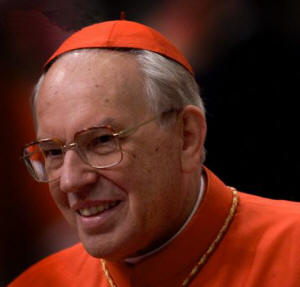
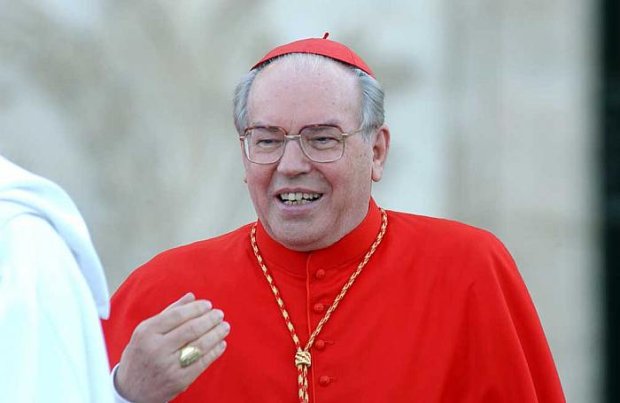
Cardinal Giovanni Batista Re (Italy), Prefect Emeritus of the Congregation for Bishops turns 80, ceases to be a Cardinal-elector

VATICAN POPE HOLY THURSDAY

Today, Thursday, 30 January 2014, Cardinal Giovanni Batista Re of Italy, Cardinal-Bishop of Sabina-Poggio Mirteto, the Prefect Emeritus of the Congregation for Bishops, turns 80, and therefore, according to the rules written in the Apostolic Constitution Universi Dominici Gregis, he loses his right to vote in any future conclave.

Cardinal Giovanni Batista Re was made Cardinal-Priest of Ss. XII Apostoli by Pope John Paul II in the 2001 Consistory of Cardinals on 21 February 2001, the eighth Consistory of his pontificate. Cardinal Re was made a Cardinal in honour of his long service to the Church as the Secretary of the Congregation for Bishops and the College of Cardinals from 1987 to 1989, and works in the Secretariat of State, until in 2000 when he was appointed the Prefect of the Congregation for Bishops. Cardinal Re was promoted as one of the six Cardinal Bishops in the Church in 2002, after the passing of Cardinal Bernardin Gantin of Benin.

RE Giovanni Battista

In his position as the senior Cardinal Bishop under 80 in 2013 Conclave, he is the Acting Dean of the College of Cardinals in the 2013 Papal Conclave which elected Pope Francis as the 266th Pope and Leader of the Universal Church.

http://www.gcatholic.org/hierarchy/data/cardJP2-8.htm#134

May God bless His Eminence Cardinal Re, with a blessed old age and health. May he remain strong in the faith and hopefully can perhaps still continue to work great graces and good works of love and peace in his old age and retirement, as he continued to minister to the people of God.

z2636005Q,Giovanni-Battista-Re--prefekt-Kongregacji-ds--Bisk

The College of Cardinals now stands at 199 members in total, with 106 Cardinal-electors and 93 Cardinal non-electors. There are now vacancy of 14 Cardinal-electors as compared to the maximum number of electors allowed in the Conclave of 120, although Popes John Paul II and Benedict XVI had sometimes surpassed this limit.

Next Cardinal-elector to age out (80) will be Cardinal Jean-Baptiste Pham Minh Man, the current Metropolitan Archbishop of Thanh-Pho Ho Chi Minh (Vietnam), on 5 March 2014.

(Special) Friday, 31 January 2014 : Chinese New Year Day Mass (Gospel Reading)

Liturgical Colour : Red

Matthew 6 : 31-34

Do not worry and say : “What are we going to eat? What are we going to drink? or; What shall we wear?” The pagans busy themselves with such things, but Your heavenly Father knows that you need them all. Set your heart first on the kingdom and justice of God, and all these things will also be given to you.

Do not worry about tomorrow, for tomorrow will worry about itself. Each day has enough trouble of its own.

(Special) Friday, 31 January 2014 : Chinese New Year Day Mass (Second Reading)

Liturgical Colour : Red

James 4 : 13-15

Listen now, you who speak like this, “Today or tomorrow we will go off to this city and spend a year there; we will do business and make money.” You have no idea what tomorrow will bring. What is your life? No more than a mist which appears for a moment and then disappears.

Instead of this, you should say, “God willing, we will live and do this or that.”

(Special) Friday, 31 January 2014 : Chinese New Year Day Mass (Psalm)

Liturgical Colour : Red

Psalm 90 : 1-17

Lord, You have been our refuge through all generations. Before the mountains were formed, before You made the earth and the world, from eternity to eternity – You are God.

You turn humans back to dust, saying, “Return, o mortals!” A thousand years in your sight are like a day that has passed, or like a watch in the night. You sow them in their time, at dawn they peep out. In the morning they blossom, but the flower fades and withers in the evening.

Your fury consumes us like fire, and we are helpless before Your anger. Our evils lie before You, who scrutinize our hidden sins. Our days pass away in Your wrath; our years are gone in no time. Seventy years to our life or eighty if we are strong, yet most of them are sorrow and trouble; speeding by, they sweep us along.

Who knows the extent of Your anger? Who has seen the end of Your wrath? So make us know the shortness of our life, that we may gain wisdom of heart. How long will You be angry, o Lord? Have mercy on Your servant.

Fill us at daybreak with Your goodness, that we may be glad all our days. Make joy endure as the misery did, and the years in which we were afflicted. Let Your work be seen by Your servants and Your glorious power by their children. May the sweetness of the Lord be upon us; may He prosper the work of our hands.

(Special) Friday, 31 January 2014 : Chinese New Year Day Mass (First Reading)

Liturgical Colour : Red

Numbers 6 : 22-27

Then YHVH spoke to Moses saying, “Speak to Aaron and his sons and say to them : This is how you shall bless the people of Israel; you shall say :

‘May YHVH bless you and keep you! May YHVH let His face shine on you and be gracious to you! May YHVH look kindly on you, and give you His peace!’

In that way shall they put my Name on the people of Israel and I will bless them.”

Friday, 31 January 2014 : 3rd Week of Ordinary Time, Memorial of St. John Bosco, Priest (Scripture Reflections)

Liturgical Colour : White (Priests)

Brothers and sisters in Christ, we hear today of the sin of David, the faithful and loyal servant of God. Not just any sin, but a great sin, because not only that David committed adultery with the wife of another man, but he also plotted to have the husband of the woman to be killed in battle, tantamount to direct murder of human life.

Today we are shown the vulnerabilities of our human selves, the temptations of the flesh and the attractions of the world, which assail us day after day without end. Even someone as faithful and obedient as David, was after all still a mortal man, with all of the vulnerabilities and inherent problems that expose one to sin and evil that are in this world.

This world offer us many amenities, joy, and goodness, especially in material goods and pleasures. Humanity can be easily swayed to take up the offer of the world and Satan behind it, and from there, grow towards materialism, desire, greed, lust, and many others. That was what David experienced, as the king of Israel.

Being a king or a ruler brought with it many privileges and goodness, and when he saw Bathsheba in that bath, he was tempted, and he failed. The law of God expressly mentioned the forbidden nature of adultery, and if you remember, that the last of God’s commandments would say that we must not covet the things and properties of others around us. This shows us that David, as the Lord’s most upright servant, should have acted in the way that conformed to the faith, and also obedient to the law.

Power corrupts, and absolute power corrupts absolutely. I repeat this proverb once again, because in this case of king David, it is absolutely true. King David is king over Israel, and his words are law. He has the authority and power over all of his servants. But when he found out of the bitter fruits of his adulterous action with Bathsheba, he was gripped with great fear that his deeds would be discovered, and therefore tried to pull Uriah the husband into a fabricated lie likely made by David himself.

When that failed, because of the valiant and unchanging obedience of Uriah to David, the king resolved to plot to kill him, which he succeeded in doing. That made him to sin not just once by that adulterous act, but also to commit another sin of murder. Thus had David sinned before the Lord his God. Nevertheless, unlike Saul before him, and unlike most of us, what David did was truly remarkable. He was genuinely repentant of his sinfulness, and he showed that he was regretful of having committed such sinful acts before God.

God had chosen David to be king over His people Israel, not because David was powerful or mighty, but instead He chose him because of his humility, his good character, and his righteousness. And that was the moment when these characteristics showed up in David, that although he did sin heavily before God, but he showed genuine remorse, and from then on, he resolved not to commit such sins again.

Brothers and sisters in Christ, today we learn indeed that we all may sin and commit evil things before God, but the most important thing is for us to realise and recognise our sins, and then repent and change our ways, as king David had done. Great sinners are not guaranteed hell as their end, as in fact many great saints had been great sinners.

What differentiates great sinners from great saints is one thing, that is the ability to recognise own sins and then act from it. The saints recognised their weakness and vulnerabilities to sin, and acted upon them, utilising what God has given them, that is the seeds of faith, hope and love in them. They did not fear in showing forth their faith, no matter how small it was, and how great their sins were.

That is in conjunction with what Jesus told His disciples and the people, that even if your faith is as small as a mustard seed, but that is sufficient if you truly utilise that faith, for even a small mustard seed, when grown, will become a large tree and bear fruits. What matters is that if we take concrete steps and actions, so that rather than lingering in our sinfulness, we may come into the light, and through our growing faith, we may bring others too into the light.

Today, we celebrate the feast of St. John Bosco, the patron saint of youth. St. John Bosco was a priest who saw the situation in his surroundings about the youths of the time, many of whom were homeless or even without families, orphans and neglected by the society. He felt sad seeing these children running around the cities at risk from harm and misconduct. Hence, St. John Bosco worked with those children and resolved to guide them that they may not fall to evil.

His many works and dedications, and his contributions to the Church was truly great. He also help founded the religious order now known as the Salesians, and his many other contributions made him a well known saint, and one whom many devoted themselves, asking for his intercession. The example of St. John Bosco should inspire us all, that we should also take action, helping one another, especially those with great risk of falling into the darkness.

Let us therefore, inspired by the examples of St. John Bosco and many other saints, let the faith in us to grow strong and shine brightly, as we act to give our help to bring many towards salvation in the Lord. Let us not ignore the plight of our less fortunate brethren, and show the love of God to them, and just at the same time, our faith too will shine forth, and God who sees all, will reward us. Amen.

Friday, 31 January 2014 : 3rd Week of Ordinary Time, Memorial of St. John Bosco, Priest (Gospel Reading)

Liturgical Colour : White (Priests)

Mark 4 : 26-34

Jesus also said, “In the kingdom of God it is like this : a man scatters seed upon the soil. Whether he is asleep or awake, be it day or night, the seed sprouts and grows, he knows not how. The soil produces of itself : first the blade, then the ear, then the full grain in the ear.”

“And when it is ripe for harvesting, they take the sickle for the cutting : the time for the harvest has come.”

Jesus also said, “What is the kingdom of God like? To what shall we compare it? It is like a mustard seed which, when sown, is the smallest of all the seeds scattered upon the soil. But once sown, it grows up and becomes the largest of the plants in the garden, and even grows branches so big, that the birds of the air can take shelter in its shade.”

Jesus used many such stories, in order to proclaim the word to them in a way that they would be able to understand. He would not teach them without parables; but privately to His disciples He explained everything.

Friday, 31 January 2014 : 3rd Week of Ordinary Time, Memorial of St. John Bosco, Priest (Psalm)

Liturgical Colour : White (Priests)

Psalm 50 : 3-4, 5-6a, 6bc-7, 10-11

Have mercy on me, o God, in Your love. In Your great compassion blot out my sin. Wash me thoroughly of my guilt; cleanse me of evil.

For I acknowledge my wrongdoings and have my sins ever in mind. Against You alone have I sinned.

What is evil in Your sight I have done. You are right when You pass sentence and blameless in Your judgment. For I have been guilt-ridden from birth, a sinner from my mother’s womb.

Fill me with joy and gladness; let the bones You have crushed rejoice. Turn Your face away from my sins and blot out all my offenses.

Friday, 31 January 2014 : 3rd Week of Ordinary Time, Memorial of St. John Bosco, Priest (First Reading)

Liturgical Colour : White (Priests)

2 Samuel 11 : 1-4a, 5-10a, 13-17

In the spring of that year, when kings usually set out to fight, David sent out Joab, his officers and all the Israelite troops. They slaughtered the Ammonites and attacked Rabbah, while David remained in Jerusalem.

One afternoon, David got up from his siesta and took a walk on the roof of the royal house. From the rooftop, he saw a woman bathing, and the woman was very beautiful. David sent to inquire about the woman, and was told, “She is Bathsheba, daughter of Eliam and wife of Uriah, the Hittite.” So David sent messengers to have her brought to him.

As the woman saw she was with child, she sent word to David, “I am with child.” David then sent a message to Joab, “Send me Uriah the Hittite.” So Joab sent Uriah to David. When Uriah came, David asked him about Joab, how the people were and how the war was proceeding; then he told Uriah, “Go down to your house and wash your feet.”

Uriah left the palace and the king had a portion from his table sent to him. Uriah, however, did not go down to his house but slept by the door of the king’s palace with all the servants of his lord. David was told that Uriah did not go down to his house. David invited him to table and he ate and drank until he was drunk. When evening fell, however, he went to lie down on his couch with the guards of his lord instead of going down to his house.

The next morning, David wrote Joab a letter to be taken by hand by Uriah, in which he said, “Place Uriah in the front row where the fighting is very fierce and then withdraw from him so that he may be struck down and die.”

When Joab was attacking the city, he assigned Uriah to a place which he knew was being defended by strong warriors. And the defenders attacked the men of Joab. Some of David’s soldiers and officers were killed; Uriah the Hittite also died.

Thursday, 30 January 2014 : 3rd Week of Ordinary Time (Scripture Reflections)

Liturgical Colour : Green

Dear brothers and sisters in Christ, the key takeouts from today’s readings is that, we must not be afraid! And we must not hide the blessings and graces that God had given us, often without us knowing or acknowledging them, and that we should show to all, the faith that we have in us, rather than be fearful, or reluctant, or hiding them because we are shy or ashamed of doing so.

The Lord has given each and every one of us the gift of faith, hope, and love, and like the parable that Jesus had told His disciples and the people, they cannot be hidden in us or they would be useless and meaningless, and they will wither and die. Instead, whatever had been given to us, we should make best use of them and showcase them for all, that all who sees us and what we do in the name of the Lord, may also believe and therefore be saved.

God had blessed us all who had chosen to be with Him. For all of us who had been baptised either as babies or as adults, we have been given the privilege to become the children, the sons and daughters of God, and God has become our loving Father. This is what King David contemplated on in today’s first reading as he prayed to the Lord, thanking Him for all the blessings and graces that He had received.

Each and every one of us have been given different blessings and good things, and all our talents, our abilities, and our skills are gifts entrusted by the Lord unto us. So it is natural that first, we should be thankful and recognise the great favour that God had entrusted us with. God entrusted these gifts to us for a certain purpose, that is to make this world a better place for each one of us.

Sadly, mankind has this tendency to rejoice and forget to give thanks, and to recognise what good had been given to us. We often forget in our celebration and happiness to give thanks to the Lord for His goodness. We have to remember that without God and His grace, we are actually nothing. The Lord has given us so much that we cannot possibly exist without Him. To Him we owe our life and our every breath, all that we have and all the wealth we have.

And in the wealth of all these gifts and the wonders of His blessings, lie our mission, and our duty. We are the children of the Light, because the Lord who is Light is our Father and our Creator. As the children of the Light therefore, we too should emulate the light in our actions and in our respective lives. We cannot profess as children of the Light and yet act in the same way as children of darkness.

Much is expected from us who have been given a lot, and as Jesus said, that those who are unproductive will be pruned away. Yes, much like that of a fruit tree indeed. A fruit tree is planted to bear fruit and not just for ornamental purposes. If it produces many fruits and if it is also healthy and strong, then the farmer will put even more effort into that tree, to make it produce even more fruits.

Will we then become a fruit tree that is fruitful? Or will we become a fruit tree that is barren? A barren fruit tree has no use at all. It has no fruit that can be sold and make profit from, and therefore there is only something that the farmer would logically do, that is to cut off the tree. If we are like these barren trees, we would therefore also be cast out, and will have no part of God’s grace.

We all have been given a mission by our Lord, that is to spread the love of God among mankind. In each of us had been planted the seeds of faith and love, and if we do not utilise them, they will remain just that, as seeds, dormant and dead. But if we use whatever gifts God had given us, then we will be bountiful and produce much fruits, that is the fruits of love and happiness. The Lord who sees all will see our works and our products, and He will richly bless us.

Brethren, let us therefore from now on, follow the example shown by David, and by the teachings made clear through Jesus, that we will first of all be ever grateful for all the blessings God had given us, that we may have this life. And let us also show our thanks and love to the Lord, through concrete actions and dedication of love to our brethren around us.

Let us all bear fruits, fruits of faith, fruits of hope, and fruits of love. May the Lord who sees our robustness and productivity bless us forever. Amen.