Tuesday, 6 February 2018 : 5th Week of Ordinary Time, Memorial of St. Paul Miki and Companions, Martyrs (Homily and Scripture Reflections)

Liturgical Colour : Red

Dear brothers and sisters in Christ, today from the Scripture passages we heard what is the meaning of becoming true disciples and followers of the Lord. Today we are all called to reflect on how each one of us can be more devoted to the Lord, by obeying Him, listening to Him and doing things He has taught us to do in the right manner and in the right way.

From the Old Testament today we heard the continuation of the reading taken from the beginning of the Book of Kings, in which if yesterday we heard about the festivities and celebrations surrounding the completion and dedication of the Temple of God in Jerusalem, built by king Solomon, then today we heard about how king Solomon prayed on behalf of the people before God.

King Solomon humbled himself before the Lord, thanking Him for all that He has done for His people, and by willingly coming down into the world to dwell among His people. He acknowledged that no matter how big and grand the house he has built for the Lord, there could be no earthly building or establishment that could have contained Him.

King Solomon beseeched God that He might listen to His people in their time of need and forgive them from their sins, so that He might turn to them when they sought after Him in sincere and genuine faith. And that grand edifice of worship that is the Temple was therefore purposed for the sole aim of the placement of God at the very centre of the lives of the people.

God must be at the centre and He must be the focus of our lives, or else we will easily slip and fall into the temptations of sin. And that was exactly what happened at the time of Jesus. In our Gospel passage today, we heard how the Lord Jesus rebuked the Pharisees for their hypocritical attitude in following and enforcing the Law, as they enforced a very strict adherence to the rule of the Mosaic law, but they did that in a way which did not promote true understanding and appreciation of the Law.

The Pharisees wanted the people to follow the rules and the obligations as set by the Law to the smallest details, but all these ended up becoming empty rules and regulations, that the Pharisees themselves were unable to fulfil. And when they did the observations of the Law, they did not do them for the purpose of glorifying God, instead they did them for their own self-advancement and personal glory.

And according to the Lord Jesus, the actions of the Pharisees were even more hypocritical and inappropriate because they say one thing about a certain Law, and yet in a different occasion, they say a different story about the same rule of the Law. He used the example of the law which dictated that all of the people had to take care of their parents, and yet, the Pharisees mentioned that the people had excuse from their obligation just if they offer a sacrifice.

Similarly, on the matter of divorce, while God specifically mentioned that the man and woman whom He has blessed and united as one through holy matrimony cannot be separated by any means, but by arguing in accordance with the rules and regulations as established by Moses and the subsequent leaders of Israel, they argued that people could divorce their wives or husbands by simple matter of administration.

It is clear that in those cases, God was no longer at the centre of their judgments and even in fact, their lives. And that is why they falter and fell into sin. Unfortunately, this has happened to us mankind many times, and if we do not learn from our past history, I am afraid it will continue to repeat again and again in many of us. King Solomon himself in his old age fell from grace, and tempted by his great glory, prestige and might, he grew proud and no longer stayed faithful in the Lord, falling into the persuasion of his many wives and concubines who persuaded him to allow pagan worship and thus bringing the whole kingdom and people of Israel into sin.

Brothers and sisters in Christ, perhaps we should look upon the examples of the holy men and women whose memory we must remember on this day, our devout and courageous predecessors, the Holy Martyrs of Japan, as represented by St. Paul Miki and his many other companions and fellow defenders of the faith, who suffered greatly and died defending their faith.

St. Paul Miki was one of the many Christian converts in Japan, during the late era of the Warring States and the early Tokugawa Shogunate, a few hundred years ago. During that time, great missionary efforts had caused great revolution of the faith in Japan, and hundreds of thousands of people converted to the faith. However, due to the changes in the political and social condition, what was once a flourishing faith growing under favourable circumstances quickly turned into a nightmare for many of the faithful.

Soon enough, many of the Christians were forced to choose between abandoning their faith and thus live, or to remain true to their faith and suffered and eventually to be killed. Many were forced to desecrate the holy images of Christ and the faith, under very intense scrutiny from the authorities, and the Christians living at that time in Japan truly suffered greatly, and many martyrs were made.

Many abandoned their faith for the sake of safety and security of the world, but many, including St. Paul Miki, refused to abandon their Lord and Master, and chose to suffer and die instead. St. Paul Miki and his many other fellow countrymen and foreign missionaries believing in God were persecuted after they were rounded up and arrested. They were forced to march hundreds of kilometres under the most arduous conditions from Kyoto, the capital of Japan to Nagasaki, the place of their martyrdom.

But all these did not dampen their spirits, and it was told that they sung the praises of God in the hymn, ‘Te Deum’, singing throughout their journey, in what is known as one of the most touching and courageous display of faith. They marched to their certain death, and yet, God was always foremost in their mind, and they knew that He has blessed them with life, and despite all that the world levied on them, God will triumph in the end with His saints.

And still, in the end, St. Paul Miki and the fellow priests who were part of the death march imitated Christ to the very end, by forgiving all of their persecutors and torturers, by his words, ‘After Christ’s example, I forgive my persecutors, I do not hate them. I ask God to have pity on all, and I hope my blood will fall on my fellow men as a fruitful rain.” They were then martyred for their faith in Nagasaki, in the year of Our Lord 1597.

Brothers and sisters in Christ, let us all reflect on what we have just discussed today, and particularly, what we have just heard about the courageous faith of St. Paul Miki and his fellow companions, the Holy Martyrs of Japan. They have put their complete trust in God, and He was always foremost in their mind, despite all that they had to go through, and they followed His examples to the very end, obedient to His teachings with clear understanding.

Now then, are we able to do the same? Are we able to walk in the footsteps of the holy martyrs and faithful servants of God? Are we able to put God as the priority and the centre focus of our lives? It is imperative that we should do this, as without God at the heart of all that we do, say and act in our lives, we are bound to lose our way and fall into sin, and if we are not careful, into eternal damnation.

May the Lord, through the courage of His holy martyrs, St. Paul Miki and companions, inspire each and every one of us as Christians, that we may live ever more faithfully and devote ourselves ever more thoroughly with each and every passing day. May the Lord be with us always, and may He strengthen us in faith. Amen.
Tuesday, 6 February 2018 : 5th Week of Ordinary Time, Memorial of St. Paul Miki and Companions, Martyrs (Gospel Reading)

Liturgical Colour : Red

Mark 7 : 1-13

At that time, one day, the Pharisees gathered around Jesus, and with them were some teachers of the Law who had just come from Jerusalem. They noticed that some of His disciples were eating their meal with unclean hands, that is, without washing them.

Now the Pharisees, and in fact all the Jews, never eat without washing their hands, for they follow the tradition received from their ancestors. Nor do they eat anything, when they come from the market, without first washing themselves. And there are many other traditions they observe; for example, the ritual washing of cups, pots and plates.

So the Pharisees and the teachers of the Law asked Him, “Why do Your disciples not follow the tradition of the elders, but eat with unclean hands?” Jesus answered, “You shallow people! How well Isaiah prophesied of you when he wrote : ‘This people honours Me with their lips, but their heart is far from Me. The worship they offer Me is worthless, for what they teach are only human rules.’ You even put aside the commandment of God to hold fast to human tradition.”

And Jesus commented, “You have a fine way of disregarding the commandments of God in order to enforce your own traditions! For example, Moses said : Do your duty to your father and your mother, and : Whoever curses his father or his mother is to be put to death. But according to you, someone could say to his father or mother, ‘I already declared Corban (which means “offered to God”) what you could have expected from me.’”

“In this case, you no longer require him to do anything for his father or mother; and so you nullify the word of God through the tradition you have handed on. And you do many other things like that.”

Tuesday, 6 February 2018 : 5th Week of Ordinary Time, Memorial of St. Paul Miki and Companions, Martyrs (Psalm)

Liturgical Colour : Red

Psalm 83 : 3, 4, 5 and 10, 11

My soul yearns; pines, for the courts of YHVH. My heart and my flesh cry out for the living God.

Even the sparrow finds a home, and the swallow a nest where she may lay her young, at Your altars, o YHVH of Hosts, my King and my God!

Happy are those who live in Your House, continually singing Your praise! Look upon our shield, o God; look upon the face of Your Anointed!

One day in Your courts is better than a thousand elsewhere. I would rather be left at the threshold in the house of my God than to dwell in the tents of the wicked.

Tuesday, 6 February 2018 : 5th Week of Ordinary Time, Memorial of St. Paul Miki and Companions, Martyrs (First Reading)

Liturgical Colour : Red

1 Kings 8 : 22-23, 27-30

Then Solomon stood before the Altar of YHVH in the presence of all the assembly of Israel. He raised his hands towards heaven and said, “O YHVH, God of Israel, there is no God like You either in heaven or on earth! You keep Your Covenant and show loving kindness to Your servants who walk before You wholeheartedly.”

“But will God really live among people on earth? If neither heavens nor the highest heavens can contain You, how much less can this House which I have built! Yet, listen to the prayer and supplication of Your servant, o YHVH my God; hearken to the cries and pleas which Your servant directs to You this day. Watch over this House of which You have said, ‘My Name shall rest there.’ Hear the prayer of Your servant in this place.”

“Listen to the supplication of Your servant and Your people Israel when they pray in this direction; listen from Your dwelling place in heaven and, on listening, forgive.”

(College of Cardinals Update) Cardinal Antonio Maria Veglio (Italy), President Emeritus of the Pontifical Council for the Pastoral Care of Migrants and Itinerant People turned 80 and becomes ineligible to participate in a future Papal Conclave

Cardinal Antonio Maria Veglio, Cardinal Deacon of San Cesario in Palatio, President Emeritus of the Pontifical Council for the Pastoral Care of Migrants and Itinerant People has turned 80 on Saturday, 3 February 2018. Therefore, in accordance to the Apostolic Constitution Universi Dominici Gregis, he can no longer vote in a future Papal Conclave.

Cardinal Antonio Maria Veglio has served the Church for many years in the diplomatic service, as the Apostolic Pro-Nuncio of many countries from 1985 to 1989 (Papua New Guinea, Solomon Islands) and 1989 to 1994 (Senegal, Guinea-Bissau, Cape Verde, Mali) and then later as the Apostolic Nuncio to the same countries from 1994 to 1997 before his appointment as Apostolic Nuncio to Lebanon (1997 to 2001) and Kuwait (1997-2001).

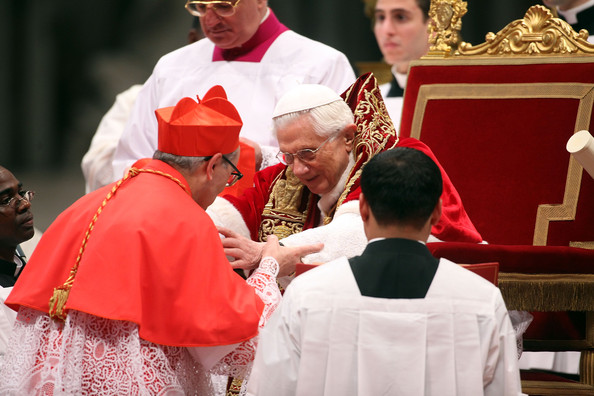
Cardinal Antonio Maria Veglio was appointed Secretary of the Congregation for the Oriental Churches in 2001, and he was appointed as the President of the Pontifical Council for the Pastoral Care of Migrants and Itinerant People, a position he held from 2003 to 2017. He was made a Prince of the Church, as the Cardinal Deacon of San Cesario in Palatio at the Consistory of 18 February 2012 by Pope Benedict XVI, the Vicar of Christ.

We pray for Cardinal Antonio Maria Veglio, that even in his retirement years, he may continue to inspire the faithful and the Church, and keep strongly the teachings of the Church. May he have a good health and be blessed all the days of his life. Ad multos annos!

Currently, there are 119 Cardinal-electors in the College of Cardinals, which means that there is 1 vacancy for Cardinal-electors available at the moment. The next Cardinal to age out will be Cardinal Paolo Romeo, Metropolitan Archbishop Emeritus of Palermo (Italy) on 20 February 2018.

Monday, 5 February 2018 : 5th Week of Ordinary Time, Memorial of St. Agatha, Virgin and Martyr (Homily and Scripture Reflections)

Liturgical Colour : Red

Dear brothers and sisters in Christ, on this day we heard about the moment when the House of God, the magnificent Temple built by Solomon, the king of Israel, was completed and consecrated to the Lord. The Temple was meant to be the dwelling of God among His people, as the Ark of the Covenant bearing the Tablets of the Law was placed in the holiest part of that edifice, and as we heard in the passage today, God Himself came down to dwell among His people.

The grand celebration that followed the completion and consecration of the Temple was truly amazing, as we were told how thousands upon thousands of sacrificial offerings were made, and many days of celebrations followed after the main celebration, with feast, revelry and rejoicing among the people. Such was the grand spectacle of the celebrations that came with the opening of the House of God. And God Himself came to dwell among His people.

However, unfortunately, for all of its amazing architecture and grandeur, the people of God did not remain faithful to Him. Even king Solomon himself would fall into sin and led the people into the worship of the pagan gods and idols. And many successive kings of Judah would continue to sin against God, and doing what were wicked in God’s sight. The Temple was defiled in multiple occasions, and eventually, it was destroyed by the Babylonians at the end of the kingdom of Judah.

But God did not give up on His people, despite having punished them for their lack of faith and waywardness. He gave them opportunity after opportunity to repent from their sins, and He sent them prophets after prophets to call them to turn away from their wickedness. In the end, He fulfilled His promise to us, by sending us the Saviour, in Jesus Christ His Son, Whose works and exploits we heard in our Gospel passage today.

If God once came down to dwell in a House made from gold and finest timber wood, to dwell among His people, then, He had come by Himself in the flesh, in the Real Presence, as the Divine Himself has become tangible and real, no longer hidden from our sight, but revealed to all the people who witnessed His coming, and to many others who knew Him because of the testimony made by all those who saw His coming.

God loves each and every one of us, His beloved children. He has not abandoned us when we are in need, and He always provided for us through His love. However, many of us have not realised that we have been receiving this generous love all these while. And we continue to sin before God, rebelling against Him and by our disobedience we defiled the Temple of His Holy Presence, our bodies, minds, hearts and souls.

Yes, brothers and sisters in Christ, through the Sacrament of Baptism we have been made nothing less than God’s own adopted sons and daughters. And by receiving the Eucharist, we have received the Real Presence of Our Lord in His Most Precious Body and Blood into our bodies, and therefore we have become God’s holy Temple, the Houses in which He dwells.

Yet, many of us defiled this House by our sins and wickedness, by our refusal to listen to the Lord and to His ways. Instead, we rather chose to continue down the path of sin, and immerse ourselves deeper and deeper into the trap laid unto our path by Satan. There are all sorts of defilements and wicked things we have done, by indulging in the pleasures of the flesh, immoral behaviour, corruption and collusion, by our allowance of the devil to come into our lives.

If we continue to do so, we will be destroyed because of our great sin of having defiled the Temple and House of God that is our body, our heart, our mind, our soul, and indeed, our whole being. Is it what we want to happen to us, brothers and sisters in Christ? Surely we do not want it to happen. I am sure that we want to be forgiven our sins instead and want to be reconciled with God.

However, all these will not come to us easily and without challenges. There will be plenty of opposition, difficulties and suffering, and without perseverance and strong courage and commitment, many of us will falter along the way. Many of our holy and devoted predecessors have suffered similarly, even to the point of suffering death. St. Agatha, the saint whose memory we celebrate today, is one of them.

St. Agatha was a native of Sicily and one of the most venerated martyrs of the Roman Empire. She lived during particularly difficult time in the history of the Church, as the Roman state and the authorities actively persecuted Christians and destroyed many of the churches established throughout the Empire, especially under the Emperor Decius. It was told that St. Agatha devoted herself completely to God, living a life of holy virginity consecrated to God.

She rejected the amorous advances of a corrupt and pagan official who was enamoured by her beauty, and the official in his anger, reported St. Agatha to the authorities, who arrested her and tortured her. Despite all that they had done, and all the pains inflicted upon her, she remained strong in her convictions and she refused to abandon her faith in her God. She was martyred defending her faith, and her commitment and courage to the very end inspired many of the Christians generations after her.

Brothers and sisters in Christ, let us all reflect on these which we have just discussed and remember the examples of St. Agatha, her courage and determination to remain true to her faith and obey the Lord despite the temptations and pressures to do otherwise. May the Lord give us the strength to persevere in our own faith journey, that we may draw ever closer to Him. May God bless us all. Amen.

Monday, 5 February 2018 : 5th Week of Ordinary Time, Memorial of St. Agatha, Virgin and Martyr (Gospel Reading)

Liturgical Colour : Red

Mark 6 : 53-56

At that time, having crossed the lake, Jesus and His disciples came ashore at Gennesaret, where they tied up the boat. As soon as they landed, people recognised Jesus, and ran to spread the news throughout the countryside.

Wherever He was, they brought to Him the sick lying on their mats; and wherever He went, to villages, towns or farms, they laid the sick in the marketplace, and begged Him to let them touch just the fringe of His cloak. And all who touched Him were cured.

Monday, 5 February 2018 : 5th Week of Ordinary Time, Memorial of St. Agatha, Virgin and Martyr (Psalm)

Liturgical Colour : Red

Psalm 131 : 6-7, 8-10

The Ark is in Ephrata, we found it in the fields of Jaar. Let us go to where He dwells and worship at His footstool!

Arise, o YHVH, and come to Your rest; You, and the Ark of Your might. May Your priests be arrayed in glorious mantle; may Your faithful ones shout in gladness. For the sake of Your servant, David, do not turn away the face of Your Anointed.

Monday, 5 February 2018 : 5th Week of Ordinary Time, Memorial of St. Agatha, Virgin and Martyr (First Reading)

Liturgical Colour : Red

1 Kings 8 : 1-7, 9-13

Then Solomon assembled before him in Jerusalem the elders of Israel and all the heads of the tribes, as well as the leaders of the ancestral houses of the Israelites, to bring up the Ark of the Covenant of YHVH from the city of David, which is Zion.

All the Israelites assembled near king Solomon in the month of Ethanim, the seventh month. When all the elders of Israel arrived, the priests carried the Ark of YHVH and brought it up together with the Tent of Meeting and all the holy vessels that were in the tent.

After the priests and Levites had brought them up, king Solomon with the entire congregation of Israel that had assembled before him and were with him before the Ark, sacrificed so many sheep and oxen that they could neither be counted nor numbered.

Then the priests laid the Ark of the Covenant of YHVH in its place in the inner Sanctuary of the house – the Most Holy Place – underneath the wings of the Cherubim. The Cherubim had their wings spread out over the place of the Ark, providing a covering above the Ark and its poles.

There was nothing in the Ark except the two tablets of stone which Moses placed there at Horeb, where YHVH made a Covenant with the Israelites when they came out of the land of Egypt. And when the priests came out of the Holy Place, such a cloud filled YHVH’s House that the priests could not continue to minister. Indeed, the glory of YHVH filled His House.

Then Solomon said, “YHVH has said that He would dwell in thick darkness. So the House I have built You will be Your House, a place for You to dwell in forever.”

Sunday, 4 February 2018 : Fifth Sunday of Ordinary Time (Homily and Scripture Reflections)

Liturgical Colour : Green

Dear brothers and sisters in Christ, on this Sunday we listened to the Scripture passages which remind us of the mission which we all as Christians have received from the Lord. As Christians, all of us are called to follow in the footsteps of the Lord Jesus and His Apostles and disciples, whom He had sent to proclaim the Good News, to minister to the people who are in need, those who are sick, those who are poor.

And it is important for each and every one of us to remember that in all that we do in the Name of the Lord, we must do them for the right purpose, with the right intention and in the right manner. Otherwise we will end up losing the purpose and meaning of what we do, and instead of gaining grace and justification, we will end up receiving rebuke and condemnation because of our lack of faith and commitment.

In the first reading today, we heard the passage taken from the Book of Job. Job was a devout follower of God living several millennia ago, many years before Christ came into the world. It was told that he was a very rich man, blessed with a great and loving family, with many worldly and material properties, thousands of animals, flocks, camels and all sorts of things that mankind at that time would have desired.

Satan wanted to test Job and see if he would buckle under pressure of temptation and despair if he were to remove from Job all that were precious and important to him. Thus, Job lost his properties to thieves and brigands, and he lost his family due to tragic accidents in very short period of time. He was very unfortunate and in sad condition, and we can surely notice that in our first reading passage today.

He recognised how our life is truly momentary and fleeting in nature, and he lamented on his then miserable state of life. But in the end, Job remained faithful to God, and despite his misery and despair, he did not blame God for what happened to him. He blamed himself instead, but God told him the truth about everything that had happened, and showed him how God’s purpose is far above even the best of human intellect and understanding.

In the second reading today, St. Paul in his Epistle to the Church and the faithful in Corinth mentioned that as someone who serve the Lord, he did it because he wanted to glorify God and to obey His will, not because he wanted to be rewarded or to gain from whatever it is that he was doing. Ultimately, all of his efforts and works were not about himself, but about serving the community and the faithful people of God.

St. Paul devoted himself wholeheartedly and spent his time to serve the people, making himself the servant of all. He was following in the footsteps of the Lord Himself, Who in the Gospel passage today went from place to place, preaching to the people and teaching them about God’s way, and healed many of their sick ones. Through all of these, we see how to be true disciples of the Lord, by devoting our time, effort and attention to God.

In our world today, it is very easy for us to be tempted and lose our way. There are plenty of temptations, from money, material possessions, power, glory, and all others that can prevent us from finding our way to the Lord, or from being able to give our very best in serving Him. When those who serve the Lord do not put God first and foremost in their mind, it is very easy for them to end up doing things for their own selfish gains and not for God’s sake.

Now, let us ask ourselves, have we been like those who are concerned only for their own benefits and good? Have we done all the things in our life being concerned only about increasing our own wealth, prestige, glory and all other things? Brothers and sisters in Christ, as Christians, all of us should not do this. We should be more like Christ, Who is humble, obedient and devoted to all that has been entrusted to Him.

Let us all pray and discern carefully how we should carry on living our lives from now on. Let us all humble ourselves and recognise that all the things we say and do, we should say and do them for the Lord’s greater glory and not for our own. He has loved us so much, and cared for us so much, that He gave us His Son, Our Lord Jesus Christ, that we may live. Ultimately, it is only by clinging on to Him that we will survive, and not in all of our worldly attachments, which are temporary and fleeting.

May the Lord awaken in us the courage and the strength to live faithfully according to His ways. May He empower us to do more for the sake of our brethren in need, those who are poor, those who are downtrodden, lonely and without hope. Let us show care and concern for them, that we may show them God’s love, that God is always there for all of us. May God bless us all and all of our good endeavours. Amen.