The new document just released today by the Dicastery for Promoting Christian Unity titled ‘The Bishop of Rome – Primacy and Synodality in the Ecumenical Dialogues and in the Responses to the Encyclical Ut Unum Sint’
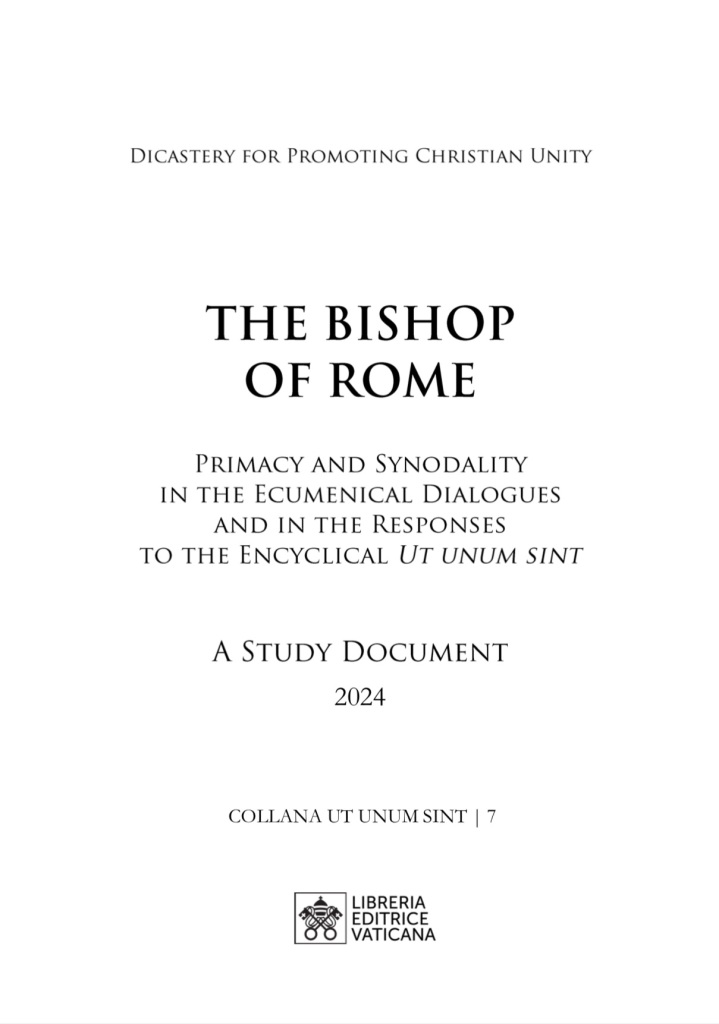
The new document just released today by the Dicastery for Promoting Christian Unity titled ‘The Bishop of Rome – Primacy and Synodality in the Ecumenical Dialogues and in the Responses to the Encyclical Ut Unum Sint’
Liturgical Colour : Green or White (Bishops)
Dear brothers and sisters in Christ, today as we listened to the words of the Sacred Scriptures, we are all reminded of the love of God which He has given to all of us, as He grants us all the most wonderful graces and blessings, constantly reaching out to us and showing us His love throughout all of history. He has loved us all from the very beginning, and He has indeed created us all out of His ever enduring and patient love. He spared us from destruction and eternal damnation because of this same love, and gave us all the perfect gift of love, manifested in His only begotten Son, Our Lord Jesus Christ. Therefore, we are reminded this day that we should not take God’s love for granted, and we are also reminded that we have to love Him and our fellow brothers and sisters in the same way.
In our first reading today, taken from the Epistle of St. Paul to St. Timothy, we heard of the words of the Apostle speaking about the salvation which the Lord has shown all of us, and which He has generously and constantly promised to us, and renewed that promise through all that He had done, through the coming of His Son, Jesus Christ, the Saviour of the world, by Whom the whole world has been shown the sure path to God’s grace and eternal life. This is what St. Paul wanted to remind all of us, the faithful people of God, of just how wonderful God’s love has been, and how fortunate we truly are for having been beloved in such a manner.
This is why all of us are reminded of this great love of God, and what we all as Christians ought to be doing henceforth, in loving God, our Lord and Master, and in loving one another, our fellow brothers and sisters, at all times. We have truly been very blessed to be in God’s love and favour, and we must never squander the opportunities and the great generosity that God has shown us all these while. Otherwise we may lose sight on what truly matters for us in life, especially if we allow ourselves to be swayed by the many temptations and pleasures of the world around us. This is why we must remind ourselves always to be ever committed to the Lord, to His love and kindness.
In our Gospel passage today, we heard another similar reminder through the interaction between the Lord Jesus and a teacher of the Law who was asking Him about the commandments of the Law and which among them were the most important of all. Contextually, there are about six hundred and thirteen commandments and rule throughout the Law of God that was revealed through Moses to the people of Israel, and the teachers of the Law were those who were particularly strict in following and enforcing the Law and commandments of God, and the teacher of the Law who was asking Jesus might have indeed genuinely be curious on which of all those laws were truly most important one among them.
This is where we must also understand that the teachers of the Law were among those who were so particular and strict in their enforcement of the Law of God, that they were at times very inflexible and rigid in their application, and some among them even took pride and becoming haughty at their supposed better understanding and knowledge of the Law of God and all of its precepts and rules. But in doing so, they actually forgot the true significance, meaning and purpose of the Law of God, which is to bring the people of God closer to Him, and to show them all how to love Him and how they ought to love one another in the same way, which was exactly what the Lord Jesus told to the teacher of the Law.
It is a reminder for all of us that for us to be truly faithful to God, we must be filled first and foremost with love for Him. We must put the Lord at the very heart and centre of our lives, and dedicate ourselves wholly to Him. We cannot be truly faithful to Him unless we can do this, and we have to strive to love the Lord our God with all of our hearts and might, by observing His laws and commandments, obeying Him and glorifying His Name. And we cannot fully do so if we do not also love our fellow brothers and sisters, whom the Lord Himself has loved in the same manner that He has loved each one of us. How can we love God wholeheartedly if we have not also loved all those whom He loves as well?
Today, the Church celebrates the Feast of St. Norbert, a great bishop and servant of God whose life and service to the Lord can truly inspire us on how we ourselves can be truly faithful to Him. St. Norbert, also known as St. Norbert of Xanten, was a servant and missionary of the Lord, who was very committed to his ministry of preaching among the people of God throughout various parts of Western and Central Europe, where he proclaimed the Lord and many people followed the Lord through his efforts. He was particularly also concerned about the declining morale and discipline among the clergy throughout the many places that he visited and ministered in.
St. Norbert dedicated himself to help reform the Church and its clergy, in his many attempts to help uproot all the corrupt practices and way of living which many Christians and the clergy at his time had done, in efforts to stem the declining moral and virtues among the people of God and the Church. As part of these efforts, he founded the Canons Regular of Premontre, also known as Norbertians after their founder. He gathered those who were called by the Lord to seek a holy and virtuous life, dedicating themselves to a life of prayer and service. More and more people were inspired by St. Norbert and joined his congregation, and many great fruits were produced of his works in reforming the Church and opposing various heresies in the Church then. And later on as Archbishop of Magdeburg as appointed by the Pope, St. Norbert would continue to carry out his mission and reform works among the people entrusted to him, to the end of his life.
Brothers and sisters in Christ, through the great examples showed by St. Norbert and his life, let us all be inspired to follow the Lord ever more faithfully and to commit ourselves thoroughly to His cause. Let us all remind ourselves and one another not to be swayed easily worldly temptations and desires, but as we recall the ever enduring and generous love which God has always had for us, let us all continue to love Him first and foremost and do our very best so that we may truly be committed to God at all times and be the good and worthy role models for our fellow Christians, our fellow brothers and sisters around us, whom we also ought to love and care for, as much as we can. May God be with us always and may He bless us all in our every endeavours and good works. Amen.
Liturgical Colour : Green or White (Bishops)
Mark 12 : 28b-34
At that time, a teacher of the Law came up and asked Jesus, “Which commandment is the first of all?”
Jesus answered, “The first is : Hear, Israel! The Lord, our God is One Lord; and you shall love the Lord, your God, with all your heart, with all your soul, with all your mind and with all your strength. And after this comes a second commandment : You shall love your neighbour as yourself. There is no commandment greater than these two.”
The teacher of the Law said to Him, “Well spoken, Master; You are right when You say that He is one, and there is no other besides Him. To love Him with all our heart, with all our understanding and with all our strength, and to love our neighbour as ourselves is more important than any burnt offering or sacrifice.”
Jesus approved of this answer and said, “You are not far from the kingdom of God.” And after that, no one dared to ask Him any more questions.
Liturgical Colour : Green or White (Bishops)
Psalm 24 : 4-5ab, 8-9, 10 and 14
Teach me Your ways, o Lord; make known to me Your paths. Guide me in Your truth and instruct me, for You are my God, my Saviour.
Good and upright, the Lord teaches sinners His way. He teaches the humble of heart and guides them in what is right.
The ways of the Lord are love and faithfulness for those who keep His covenant and precepts. The Lord gives advice to those who revere Him and makes His covenant known to them.
Liturgical Colour : Green or White (Bishops)
2 Timothy 2 : 8-15
Remember Christ Jesus, risen from the dead, Jesus, Son of David, as preached in my Gospel. For this Gospel I labour, and even wear chains like an evildoer, but the word of God is not chained. And, so, I bear everything, for the sake of the chosen people, that they, too, may obtain the salvation given to us, in Christ Jesus, and share eternal glory.
This statement is true : If we have died with Him, we shall also live with Him; If we endure with Him, we shall reign with Him; If we deny Him, He will also deny us; If we are unfaithful, He remains faithful for He cannot deny Himself.
Remind your people of these things, and urge them, in the presence of God, not to fight over words, which does no good, but only ruins those who listen. Be for God, an active and proven minister, a blameless worker, correctly handling the word of truth.
Liturgical Colour : Red
Dear brothers and sisters in Christ, today through the readings of the Sacred Scriptures we are all reminded that we are God’s holy and beloved people, and we often may have to endure sufferings and hardships, one after another in the midst of our journey of faith as Christians, as those whom God had called and chosen to be His own people. All of us must always remain firm in our faith in the Lord and we must strive to focus our lives and existences on Him, He Who is the Lord and Master of all of our lives, the Lord and Master of all the living and the dead, the Master of all the Universe. We are all called as Christians to be the bearers of God’s truth and love, and to live lives that are truly good, righteous and worthy of the Lord at all times.
In our first reading today, we heard from the Epistle of St. Paul to St. Timothy in which the Apostle spoke of the reminder for all the faithful through St. Timothy, that all Christians, all of God’s faithful and holy people ought to do their best to stand up for their faith in the Lord, to be ever more committed to walk in the path of God’s righteousness and love. Each and every one of us have been given the various gifts and talents, the opportunities and chances by the Lord for us to reach out to our fellow brothers and sisters, to all those whom we encounter in our every day moments, so that by our interactions with them, and through our commitment to the Lord, our pious and faithful lives, we may inspire many others to believe in God as well and to embrace Him as their Lord and Master.
Then, in our Gospel passage today, we heard from the Gospel of St. Mark in which the Lord Jesus was confronted with a group of the Sadducees who wanted to question and test Him with regards to their beliefs especially that related to the concept of resurrection from the dead. The Sadducees were one of the major and powerful groups that dominated the then Jewish community, composed of those who belonged to the high priestly and priestly caste, the Temple officials and others who were influential and powerful within the community of the people of God. Those Sadducees also represent all those members of the Jewish community who were largely Hellenised or influenced strongly by the Greek culture and customs. This is contrasted to the Pharisees who were the guardians of the Jewish culture and customs.
As the Sadducees were deeply entrenched in the worldly power, politics and hegemony, and as they enjoyed great prestige, position and power among the people of God, hence it is no surprise that they would have been very worldly in their outlook in life, in their beliefs and practices. They did not believe in the afterlife or the resurrection from the dead mostly because they revelled so much in the life they had in this world, all the glory, power and pleasures that they could not imagine an existence or life without all those things and privileges which they had enjoyed in life in this world. That was why they did not believe in the spiritual matters and life beyond this world, as they focused mainly on living their lives in this world and enjoying everything as best as they could.
But in doing so, they have not done as the Lord had entrusted to them to do. They being the leaders and influential members of the Jewish community, they should have become great sources of inspiration and leadership, as role models for all the people to follow, in how they embody their faith in God and the Law and commandments of God. And yet, by their worldliness and their embracing of the corrupt practices of the world, their love for money, wealth and prestige, all these made them to forget about their missions and what they were expected to do. In the end, they were all the examples of how we must always resist the many temptations and coercions, the desires for pleasures of the world that are always all around us.
Each and every one of us must indeed heed the words of the Lord reminding us that we are called to greater existence and holiness in life, to focus on Him and His truth, and not on the many desires and attachments of worldly things, all of which cannot truly grant us true and genuine happiness in life, and as well as in the life that is to come. The Sadducees in our Gospel passage today tested the Lord with the case of the seven brothers who shared a woman as a wife when each one of them passed away one after another without having any child, and this showed that their understanding of the Law and its precepts were superficial and they were driven a lot more by their desires and attachments to this world.
As Christians we must always remember that all of us must always live our lives centred and focused on the Lord in all things. We cannot serve God and worldly desires and temptations both, as the Lord Himself had said in another occasion in the Gospels. We must always strive that our every actions, words and deeds are rooted in the Lord, and we ought to resist whatever it is that may become hurdles and obstacles in our path towards God and His salvation. Otherwise, we may easily be swayed and tempted away from God’s path and fall into the slippery slope of sin, just as those Sadducees and many others of our predecessors had experienced. The temptations, coercions and pressures for us to succumb to sin are always aplenty, and if we are not careful, we may easily lose our path and fall into it.
Today the Church also celebrates the Feast of St. Boniface, a great missionary and bishop who was crucial in his missionary efforts and works in the land of those who still adhered to pagan beliefs and customs, proclaiming the Lord to all of them and convincing many to embrace the Lord as their Master and Saviour. St. Boniface was born in England to a Christian family and was raised in the faith, eventually joining the monastic life against the wishes of his father. However St. Boniface persisted on and continued with his commitment to God, learning more about the faith and building up his experiences, eventually becoming a Christian monk and priest, and was sent as a missionary in the mainland Europe, specifically in the northern and north-western parts of Germany in the area known as Frisia, which back then was still largely pagan.
St. Boniface carried out his missions and works faithfully amidst the challenges and dangers that he had to face at the time, due to the conflicts between the Christian Frankish kingdoms and the still pagan Kingdom of Frisia. He continued his ministry and gained many conversions from among the pagans, tirelessly spending time and effort to proclaim the Lord’s Good News and His salvation to all those whom he encountered during his missionary works. According to a well-known tale, St. Boniface also performed a great miracle, in standing up against the pagans when he struck down a sacred oak that was worshipped by the pagans then, as a gust of wind miraculously helped St. Boniface to topple the great tree, and the people converted to the Christian faith when they, who had expected St. Boniface to be struck down by lightning, was unharmed, convincing them that the Lord, Whom St. Boniface had been proclaiming about, is indeed the one and only True God.
St. Boniface was also entrusted with the leadership of the newly established hierarchy and structure of the Church in the region of his works, appointed and ordained as a bishop, and he continued to labour hard and tirelessly in proclaiming the Lord. He helped to build up the Church in various places of his ministry from ground up, bringing many to the path of God’s grace and salvation. And in the midst of these efforts, work and ministry, St. Boniface was assailed by a group of robbers during one of his missionary trips in Frisia. He was attacked and killed together with his company, and thus died a martyr’s death. He was also credited with these words, which he uttered before his passing, ‘Cease fighting. Lay down your arms, for we are told in Scripture not to render evil for evil but to overcome evil by good.’ And that was how he and his companions died a martyr’s death, ever dedicated to live lives that are worthy of God to the very end.
Therefore, brothers and sisters in Christ, having heard of the life and works of St. Boniface, his commitment to God and his thorough embrace of the missions entrusted to him, and how he had lived worthily as a Christian, and having been reminded of what we must be vigilant against, all of us should strive to do what we can so that our lives may truly be holy and worthy of God, and that everyone who witnesses our works and actions may truly recognise the Lord being present in all of us. Let us all thus continue to glorify the Lord by our lives and may the Lord continue to bless us in our every good works, efforts and endeavours. Amen.
Liturgical Colour : Red
Mark 12 : 18-27
At that time, the Sadducees also came to Jesus. Since they claim that there is no resurrection, they questioned Him in this way, “Master, in the Scriptures Moses gave us this law : if anyone dies and leaves a wife but no children, his brother must take the woman, and with her have a baby, who will be considered the child of his deceased brother.”
“Now, there were seven brothers. The first married a wife, but he died without leaving any children. The second took the wife, and he also died leaving no children. The same thing happened to the third. In fact, all seven brothers died, leaving no children. Last of all the women died. Now, in the resurrection, to which of them will she be wife? For all seven brothers had her as wife.”
Jesus replied, “Is this not the reason you are mistaken, that you do not understand the Scriptures or the power of God? When they rise from the dead, men and women do not marry, but are like the Angels in heaven. Now, about the resurrection of the dead, have you never had thoughts about the burning bush in the book of Moses?”
“God said to Moses : I am the God of Abraham, the God of Isaac and the God of Jacob. He is the God not of the dead but of the living. You are totally wrong.”
Liturgical Colour : Red
Psalm 122 : 1-2a, 2bcd
To You, I lift up my eyes; to You, Whose throne is in heaven. As the eyes of servants look to the hand of their master.
As the eyes of maids look to the hand of their mistress, so our eyes look to YHVH our God, till He shows us His mercy.
Liturgical Colour : Red
2 Timothy 1 : 1-3, 6-12
From Paul, Apostle of Christ Jesus, by the will of God, for the sake of His promise of eternal life, in Christ Jesus, to my dear son Timothy. May grace, mercy and peace be with you, from God, the Father, and Christ Jesus Our Lord.
I give thanks to God, Whom I serve with a clear conscience, the way my ancestors did, as I remember you constantly, day and night, in my prayers. For this reason, I invite you to fan into a flame, the gift of God you received, through the laying on of my hands. For God did not confer on us a spirit of fearfulness, but of strength, love and good judgment.
Do not be ashamed of testifying to Our Lord, nor of seeing me in chains. On the contrary, do your share in labouring for the Gospel, with the strength of God. He saved us and called us – a calling which proceeds from His holiness. This did not depend on our merits, but on His generosity and His own initiative.
This calling, given to us from all time, in Christ Jesus has just been manifested with the glorious appearance of Christ Jesus, Our Lord, Who destroyed death, and brought life and immortality to light, in His Gospel. Of this message, I was made herald, Apostle and teacher.
For its sake, I now suffer this trial, but I am not ashamed, for I know in Whom I have believed, and I am convinced, that He is capable of taking care of all I have entrusted to Him, until that day.
Liturgical Colour : Green or White (Bishops)
Dear brothers and sisters in Christ, on this day as we listened to the words of the Sacred Scriptures, we are all reminded that to be true and genuine Christians, often times we may have to face hardships, challenges and trials, all of which may be part of our path and journey in life. We have also been reminded of the need for all of us to follow and obey God’s Law and commandments, all the things which He had revealed and given to us to be our guide and help in our journey towards Him, as a means to help us to keep a most worthy and virtuous life, that by our every words, actions and deeds, everyone will know that we are indeed Christians, those whom God had called and chosen to be His own. This is what God had entrusted to us, and what God has also expected for us to do in each and every one of our lives.
In our first reading today, we heard from the first Epistle of St. Peter in which St. Peter the Apostle spoke of the great joy that all of the faithful ought to experience and commemorate because of everything that the Lord Himself had done for them, in sending His own Son to be our Saviour, to lift us all up from our sorry state in this world, to uplift us from all of our sufferings and to assure us of the everlasting life that will be ours if we put our faith and trust in Him, and if we continue to uphold the faith which we all should have in Him and in all the things He has done for us. At the same time, St. Peter also reminded the faithful and hence all of us that there will likely be sufferings and challenges facing us, just as there will be joy for us in being the followers and disciples of the Lord.
This is a reminder for all of us that we must always do whatever we can so that our lives and our whole existence will always be focused and centred on the Lord, our God in all things. We must not allow the many temptations and coercions present all around us from tempting and pulling us away from the path towards God and His salvation. We must also not easily lose our faith in Him, especially whenever we are facing hardships and difficulties in the midst of following God and His commandments. There may be time when all the challenges and hardships facing us may tempt us to give in to the pressures of the world all around us, but we should always be strong and we should inspire one another to remain faithful to God.
Then, in our Gospel passage today, we heard something similar to what we have heard from the Epistle of St. Peter earlier on. In this occasion, we first heard of the encounter between the Lord Jesus and a rich man who wanted to follow Him, and when the Lord asked him about having fulfilled and obeyed the commandments of God, the rich man could not commit himself to leave everything that he had behind, all the riches and the properties, all the goods and material wealth that he had possessed and follow the Lord. The Lord then used this example to show His disciples that becoming His disciples and followers is not something that may be as easy as they thought.
The Lord mentioned that it was indeed hard for those who have riches to enter into the kingdom of God. However, we must understand that the Lord was not actually against those who are rich and have more material possessions. Instead, the issue was actually more with those who are so attached to the worldly possessions, glory and pleasures that they are unable to let them go. All these wealth, possessions and worldly things are not in themselves evil, as they can both be used for good and evil things. But it is when we allow our desires and attachments to those worldly matters and pleasures to overcome us and to lead us astray that it becomes a problem, and it is this attachment and desires that the Lord is warning us against.
The Lord wants us all to know that we must always prioritise Him in all things, to live our lives always in His path and doing whatever it is that He has taught us to do. Each and every one of us as His beloved and holy people should always strive to keep ourselves free from sins, from all wickedness and from the excessive attachments and desires of the world. Instead, we should always be full of genuine love, care and concern for our fellow brothers and sisters around us, showing God’s love in all of our words, actions and deeds that we may truly love Him first and foremost, and then show the same love to all the others, our fellow brothers and sisters. Those of us who have been blessed with more, we should share our bountiful blessings with those who have less or none. The more we have been entrusted with, the more then we have been called to share.criticising all the rich people and all those who did have lots of wealth and possessions.
Today, the Church celebrates the Feast of St. Augustine of Canterbury, a great missionary and servant of God who was also the first Archbishop of Canterbury that played a great role in the reestablishment of the Church structures, hierarchy and institutions in the then Anglo-Saxon period England. St. Augustine of Canterbury was born in what is today Italy during the late sixth century, and he was the prior of a monastery in the vicinity of Rome before he embarked on a missionary journey to Britain under the command from Pope St. Gregory the Great, who sent him and other missionaries to various parts of the world to evangelise and to spread the Good News of the Lord to more and more people all throughout the known world.
St. Augustine of Canterbury landed in Britain and began his ministry among the Anglo-Saxons in the region of Kent in southern England. The Christian faith had been established earlier on in Britain prior to the arrival of St. Augustine of Canterbury and his mission, but due to the invasion of the Anglo-Saxons in the two centuries before the coming of St. Augustine of Canterbury, the pagan Anglo-Saxons had undone much of the works which the earlier Christians had laid. St. Augustine of Canterbury initially faced quite a significant set of hardships and challenges in his mission, as while he managed to gain great successes with the conversion of many among the pagan Anglo-Saxons, including the King of Kent himself, but he faced opposition from the other more resistant pagans and from the native British bishops who refused to submit to his authority.
Nonetheless, St. Augustine of Canterbury laboured hard and spent a lot of effort in establishing the firm foundation of the Church in England, establishing the Church institutions and continuing the works of evangelisation through which many more people would come to embrace the Christian faith, as well as preparing for the successor that would continue his works after he had gone from this world. St. Augustine has always worked very hard to do even beyond his calling and ministry, in persevering to do God’s will even amidst the hardest challenges and trials. He is our great role model and inspiration, for all of us to follow in his footsteps in doing our best, sharing our love and faith with one another, in living our lives most worthily and righteously in God’s path at all times.
Brothers and sisters in Christ, today as we listened to the examples of St. Augustine of Canterbury, his commitment and dedication to the mission entrusted to him by the Lord and the Pope, and everything that he had done for the propagation of the Christian faith, let us all continue to be good role models and inspirations for one another, and be the faithful and worthy bearers of God’s truth and Good News at all times. May the Lord continue to help us to persevere amidst all the challenges and trials that we may have to face in our journey. May God bless our every endeavours and may He strengthen one of us in our various vocations and missions in life, that we may be holy and missionary, courageous and evangelising as St. Augustine of Canterbury had done. Amen.
 petercanisiusmichaeldavidkang