Tuesday, 30 April 2024 : 5th Week of Easter, Memorial of Pope St. Pius V, Pope (Gospel Reading)

Liturgical Colour : White

John 14 : 27-31a

At that time, Jesus said to His disciples, “Peace be with you! I give you My peace; not as the world gives peace do I give it to you. Do not be troubled; do not be afraid. You heard Me say, ‘I am going away, but I am coming to you.’ If you loved Me, you would be glad that I go to the Father, for the Father is greater than I.”

“I have told you this now before it takes place, so that when it does happen you may believe. It is very little what I may still tell you, for the prince of this world is at hand, although there is nothing in Me that he can claim. But see, the world must know that I love the Father, and that I do what the Father has taught Me to do.”

Tuesday, 30 April 2024 : 5th Week of Easter, Memorial of Pope St. Pius V, Pope (Psalm)

Liturgical Colour : White

Psalm 144 : 10-11, 12-13ab, 21

All Your works will give You thanks; all Your saints, o Lord, will praise You. They will tell of the glory of Your kingdom and speak of Your power.

That all may know of Your mighty deeds, Your reign and its glorious splendour. Your reign is from age to age; Your dominion endures from generation to generation.

Let my mouth speak in praise of the Lord, let every creature bless His holy Name, forever and ever.

Tuesday, 30 April 2024 : 5th Week of Easter, Memorial of Pope St. Pius V, Pope (First Reading)

Liturgical Colour : White

Acts 14 : 19-28

Then some Jews arrived from Antioch and Iconium and turned the people against Paul and Barnabas. They stoned Paul and dragged him out of the town, leaving him for dead. But when his disciples gathered around him, he stood up and returned to the town. And the next day he left for Derbe with Barnabas.

After proclaiming the Gospel in that town and making many disciples, they returned to Lystra and Iconium and on to Antioch. They were strengthening the disciples and encouraging them to remain firm in the faith, for they said, “We must go through many trials to enter the Kingdom of God.”

In each Church they appointed elders and, after praying and fasting, they commended them to the Lord in Whom they had placed their faith. Then they travelled through Pisidia, and came to Pamphylia. They preached the Word in Perga and went down to Attalia. From there they sailed back to Antioch, where they had first been commended to God’s grace for the task they had now completed.

On their arrival they gathered the Church together and told them all that God had done through them and how He had opened the door of faith to the non-Jews. They spent a fairly long time there with the disciples.

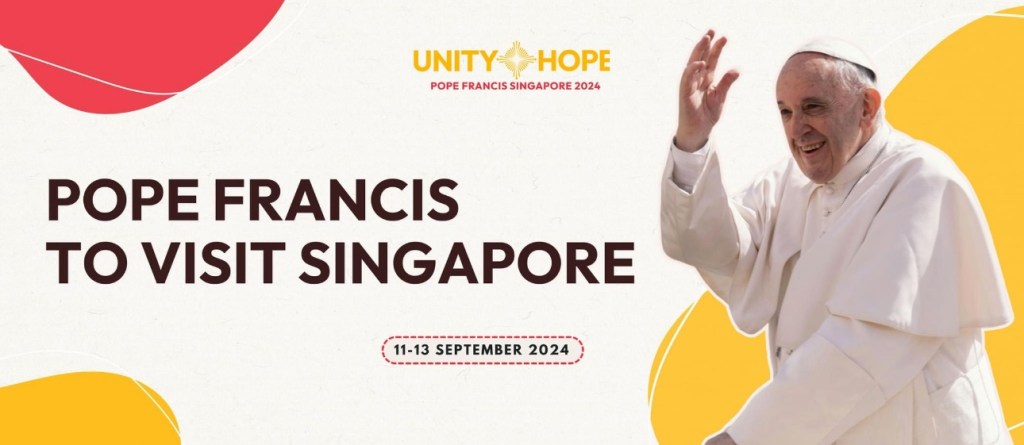
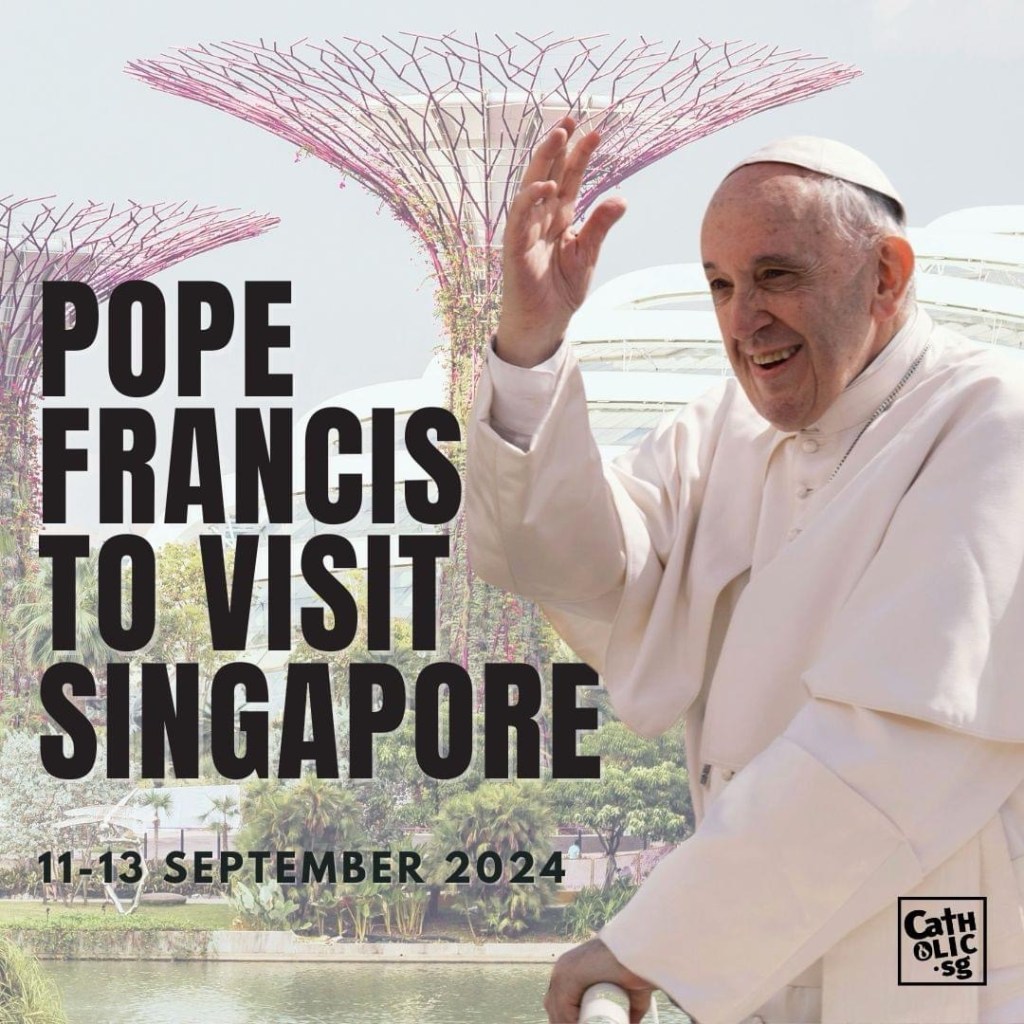
Apostolic Journey of Pope Francis to Singapore (11-13 September 2024)

Apostolic Journey of Pope Francis to Singapore
(11-13 September 2024)

Celebrating with great joy upon the announcement that His Holiness Pope Francis will be visiting Singapore between 11-13 September 2024!

This is the second Papal trip to the Republic of Singapore, the first being that of Pope St. John Paul II on 20 November 1986, 38 years ago.

Official website:
http://popefrancis2024.sg

Saturday, 13 April 2024 : 2nd Week of Easter, Memorial of Pope St. Martin I, Pope and Martyr (Homily and Scripture Reflections)

Liturgical Colour : White or Red (Martyrs)

Dear brothers and sisters in Christ, today as we all listened to the words of the Sacred Scriptures, we are all reminded of the need for all of us to continue to put our trust and faith in the Lord, focusing our efforts and attention on the Lord, doing whatever we can so that in each and every moments of our lives we will always continue to walk in the path that the Lord has shown us and staying faithful to Him. This is because during our journey in life we may encounter many moments when our faith and trust in the Lord may be tested and put on trial, as we face the challenges and difficulties present in our path and the many obstacles we may have to face as we journey together in proclaiming the Good News and truth of the Lord in our daily lives.

In our first reading today, taken from the Acts of the Apostles, we heard of the moment when the order of deacons were instituted in the Church because there were discrepancies in the distribution of the resources and goods for the faithful especially among those who came from non-Jewish or Gentile origins. At that time, we must understand the situation and the context such that the earliest Christian communities lived communally and pooled together their resources just as described by the same Acts of the Apostles. At the time, there were some expectations that the Lord would return again soon, and hence, many among the community of the believers chose to live their lives in shared existence and means, abandoning private ownership and goods, sharing them with one another instead.

However, this system was not sustainable and was ultimately no longer used as the Christian community kept gaining large number of converts to the faith, which resulted in many more resources needed to sustain them all. And while it lasted, this system was also biased as many among the early Christians belonged to the Jewish converts, some of them from the Pharisees who held firmly to the Jewish traditions and customs, and had inherent prejudices against those who did not fully subscribe to their way of observing the Law of God and also against the non-Jewish people or the Gentiles. They favoured their own Jewish background, practices and customs, and it was likely that those entrusted to share the resources shared them more with their own fellow Jewish converts rather than with those converts originating from among the Gentiles.

That was why the Apostles decided to institute the order of deacons, appointing first of all seven men who were deemed worthy from among the faithful, to be the ones to minister to the people of God as the first deacons of the Church. This was how the Lord guided His Church and faithful ones amidst the many challenges that they had to endure as they navigated the intricacies of living amidst the rule of the Romans and having the Jewish authorities harassing and oppressing them at every possible turns. Many of those faithful servants of God, including those deacons had to bear the brunt of the sufferings and persecutions, like that of St. Stephen, who was the very first martyr or protomartyr of the Church, killed because he was oppressed for his faith in God.

Then, in our Gospel passage today, we heard of the moment when the Lord appeared to His disciples at the Lake of Galilee where a storm with strong waves and wind were battering at their boat, and they were all very afraid that the boat would sink and then they perished in that lake. But it was at that time the Lord appeared to them and walked on the water, and He told them all not to be afraid, calming the waves and the wind, bringing them all to safety at the shore where they were going to. This was very symbolic and important reminder for all of us that no matter whatever hardships and dangers, trials and tribulations that we may face amidst our struggles in faith, in our commitment to the Lord, He will always be there by our side, guiding and strengthening us, leading us all to the right path.

This is because the boat with the disciples inside it is a representation of the Church of God, which is often represented as a boat, like that of Noah’s Ark that saved Noah and his family, with the other living things inside it, from the Great Flood. The waves and the wind represented the challenges and trials that the Church of God would be facing, the sufferings, persecutions and hardships that the Christian faithful would have to suffer in the path of their lives and ministry as God’s faithful people and missionaries. But all of us must not be afraid, as the Lord, Who is the Head of the Church is with us, and with Him as the Guide and the Leader of all of us, not even the greatest challenges and trials can overcome us, the Church of God, which He has built in this world. This is why we must always keep our focus firmly directed towards God at all times.

Today, the Church also celebrates the feast of Pope St. Martin I, a great leader of the Universal Church and the last among the Popes who died as a martyr for his faith and commitment to God. Pope St. Martin I is a good example of a great leader of the faithful and a role model for all of us in how we should continue to persevere in faith despite the challenges and trials that we may be facing in life. He was an abbot earlier on in life, and eventually becoming the Apostolic Legate of several Popes at the court of the Roman Emperor in Constantinople before being elected as Pope and Successor of St. Peter the Apostle, as leader of the whole Universal Church. And as Pope, he stood firm amidst the heresies and challenges that were rampant among the Imperial court at the time.

At that time, the heresy of Monothelitism was widespread, in which this heresy believed falsely that Christ, Our Lord and Saviour has only one single will, as contrary to the accepted truth and teaching of the Church that Christ has two wills, that corresponds to the two distinct natures He has, that is Divine and Human, though inseparable due to perfect union of love in the Person of Jesus Christ. Yet, this Monothelite heresy brought many people to abandon the true Church teachings, and had the support of even the then Roman Emperor in Constantinople and other powerful members of the court and society. Pope St. Martin I strongly condemned the Monothelite heresy, and convened the Lateran Council in the year of Our Lord 649 to address this heresy. As a result, he was arrested by the Emperor with false accusation of treason, was imprisoned and eventually banished, where he died as a martyr of the Church.

Brothers and sisters in Christ, the Scripture readings today and the examples of the life and ministry of Pope St. Martin I showed and reminded us all that we are likely to face sufferings, difficulties and hardships amidst our lives and journey of faith as Christians, and unless we remain focused on the Lord, Our Hope and Guide, then it may be easy for us to be swayed and to be tempted to abandon the Church, where we may then end up being swept away by the currents of worldly temptations into our downfall and destruction. Instead, all of these should remind us to keep firmly faithful in our commitment to the Lord, to proclaim Him ever more faithfully at all times. May the Lord be with us always, and may He continue to help and lead us in our journey of faith, and in our respective missions as Christians, now and always. Amen.

Saturday, 13 April 2024 : 2nd Week of Easter, Memorial of Pope St. Martin I, Pope and Martyr (Gospel Reading)

Liturgical Colour : White or Red (Martyrs)

John 6 : 16-21

At that time, when evening came, the disciples went down to the shore. After a while they got into a boat to make for Capernaum on the other side of the sea, for it was now dark and Jesus had not yet come to them. But the sea was getting rough because a strong wind was blowing.

They had rowed about three or four miles, when they saw Jesus walking on the sea, and He was drawing near to the boat. They were frightened, but He said to them, “It is I! Do not be afraid!” They wanted to take Him into the boat, but immediately the boat was at the shore to which they were going.

Saturday, 13 April 2024 : 2nd Week of Easter, Memorial of Pope St. Martin I, Pope and Martyr (Psalm)

Liturgical Colour : White or Red (Martyrs)

Psalm 32 : 1-2, 4-5, 18-19

Rejoice in the Lord, you who are just, praise is fitting for the upright. Give thanks to Him on the harp and lyre, making melody and chanting praises.

For upright is the Lord’s word and worthy of trust is His work. The Lord loves justice and righteousness; the earth is full of His kindness.

But the Lord’s eyes are upon those who fear Him, upon those who trust in His loving-kindness to deliver them from death and preserve them from famine.

Saturday, 13 April 2024 : 2nd Week of Easter, Memorial of Pope St. Martin I, Pope and Martyr (First Reading)

Liturgical Colour : White or Red (Martyrs)

Acts 6 : 1-7

In those days, as the number of disciples grew, the so-called Hellenists complained against the so-called Hebrews, because their widows were being neglected in the daily distribution.

So the Twelve summoned the whole body of disciples together and said, “It is not right that we should neglect the word of God to serve at tables. So, friends, choose from among yourselves seven respected men full of Spirit and wisdom, that we may appoint them to this task. As for us, we shall give ourselves to prayer and to the ministry of the Word.”

The whole community agreed and they chose Stephen, a man full of faith and Holy Spirit : Philip, Prochorus, Nicanor, Timon, Parmenus and Nicolaus of Antioch who was a proselyte. They presented these men to the Apostles who first prayed over them and then laid hands upon them.

The Word of God continued to spread, and the number of the disciples in Jerusalem increased greatly and even many priests accepted the faith.

Wednesday, 13 March 2024 : 4th Week of Lent, Eleventh Anniversary of the Pontificate of Pope Francis (Homily and Scripture Reflections)

Liturgical Colour : Purple/Violet

Dear brothers and sisters in Christ, today as we are all reminded through the readings of the Sacred Scriptures, we are presented with the important reminders of God’s salvation to all of us mankind, as He reached out to us with love, showing us all His compassion and mercy, the desire to forgive us all our many sins and wickedness, and His efforts in calling us all out of the darkness so that we may turn away from this path of evil and sin, embracing His ever generous mercy, compassion and love. During this time and season of Lent that we are currently progressing through, we should put a good and conscious effort to draw ever closer to God, renewing our commitment to follow Him and in doing our best to live out our lives ever more worthily in His path.

In our first reading today, taken from the Book of the prophet Isaiah, we heard of the words of the Lord reassuring His people, the people of Israel, of the love and kindness, the mercy and compassion which He has always had for them, and which He will continue to show, despite their sins and rebelliousness, their refusal to obey His Law and commandments. God has always been patient in caring for those people He loved, and He has always reached out to them, sending unto them His prophets and messengers, reminding them to turn away from the path of sin, evil and wickedness, and calling upon all of them to embrace once again the fullness of His love and grace. The Lord has always loved all of us, and despite our fallen state and corruption by sin, He loves us all equally and if not even greater.

At that time, the people of Israel had been long rebellious and disobedient against God, and they had long chosen to follow the path of evil and sin. They have ignored the messages of the Lord, His reminders and calls which He had made to them through those same prophets and messengers. They rebelled against Him, chose to put their lot and side with the pagan gods and idols of their neighbours and enemies instead. They took for granted all the love, kindness and compassion which God has given to each and every one of them, all the generous blessings that they have received. God despised their sins and wickedness, but that cannot erase the fact that He still loved them all regardless. His love for us endured and is far greater than the power of our sins and wickedness.

Why is that so, brothers and sisters in Christ? That is because God created us all out of love, and He wanted to love us all, and sharing that love with us, and He still loves us so even after we have betrayed and abandoned Him, preferring to listen to and believe in the evil ones rather than to believe in and trust in Him. God does not want us all to be separated from Him, and His love endured through all time. If He had hated us personally, He could have erased us from existence easily by the mere will of His thought alone, as easily as He had created us, and yet, He did not do that, because He saw in us, the ability and the potential to seek forgiveness and to attain full reconciliation in Him.

That is why, He gave us all the opportunities, help, guidance and the many other means through which He hoped that many of us will come to see reason and His truth, and be called to enter once again into His grace and love, and to walk and journey towards His salvation. He has opened wide the doors of Heaven, His path of mercy to us, so that through His most wonderful love and mercy, He would continue to bring us ever closer to Him, and cleanse from us our corruptions and wickedness, that hopefully one day, upon the time of reckoning, we may all be found worthy and just, and can enter into the everlasting kingdom of true happiness and joy with Him, which we shall enjoy forever.

In our Gospel passage today, we continue to be reminded of this through the words of the Lord Himself, Who affirmed His status to His disciples, the truth about Himself as the Son of God, Who has been sent into this world to come into our midst, to dwell amongst us, and to gather each and every one of us so that through Him all of us may be saved and be reunited wholly with God. The Lord highlighted to the people how He as the Son had to obey the Father’s will, in doing everything that He had been entrusted to do. He had done everything so that He can be the perfect example of faith and obedience for all of us, as the role model for us to follow in how we live our own lives with faith.

In that same occasion, the Lord also made it clear to everyone that the time is coming when the moment of reckoning will come for everyone, be it living or dead, for them to render an account of their lives before the great Judge, the Lord Himself, the One Who will mark if a person is either worthy or unworthy of eternity in Heaven, at the Last and Final Judgment. This reminder is also important for us because of the consequences that our sins and wickedness, all those corruptions and evils can do to us, if we let them to continue ruining our lives and refusing to accept God’s forgiveness and mercy right up to the very last moments. We must not be ignorant of this same reminder and call that the Lord has given us all, firstly through the prophets and messengers, and finally through His own Son.

We must remember that ultimately, while God has always been full of love, mercy and compassion upon us, and while He has always readily extended His love and care for us, calling us ever more to follow Him and to come to His embrace, but we must not take all these for granted, as it is by our own stubbornness and foolish rejection of God’s generous love and compassion that many among us and our predecessors have ended up in Hell and eternal damnation. It is by our own conscious choice in choosing sin over God, evil over righteousness that we have ended up in the fallen state and damnation. We must remember this so that we will not continue to walk down this wrong path. We should also make use of this time and opportunity given to us to deepen our relationship with God and to help others to come closer to God as well.

Brothers and sisters in Christ, let us all therefore seek the Lord with renewed faith and contrite hearts, making best use of the opportunities that He has provided to us, especially during this time and season of Lent, so that we may be able to find our way back towards Him. May God continue to love us and help us in our journey of faith back to Him, lead and guide us ever always in the right path, now and forevermore. Amen.

Wednesday, 13 March 2024 : 4th Week of Lent, Eleventh Anniversary of the Pontificate of Pope Francis (Gospel Reading)

Liturgical Colour : Purple/Violet

John 5 : 17-30

At that time, Jesus replied to the Jews, “My Father goes on working and so do I.” And the Jews tried all the harder to kill Him, for Jesus not only broke the Sabbath observance, but also made Himself equal with God, calling God His own Father.

Jesus said to them, “Truly, I assure you, the Son cannot do anything by Himself, but only what He sees the Father do. And whatever He does, the Son also does. The Father loves the Son and shows Him everything He does; and He will show Him even greater things than these, so that you will be amazed.”

“As the Father raises the dead and gives them life, so the Son gives life to whom He wills. In the same way the Father judges no one, for He has entrusted all judgment to the Son, and He wants all to honour the Son as they honour the Father. Whoever ignores the Son, ignores as well the Father Who sent Him.”

“Truly, I say to you, anyone who hears My word and believes Him Who sent Me, has eternal life; and there is no judgment for him, because he has passed from death to life. Truly, the hour is coming and has indeed come, when the dead will hear the voice of the Son of God and, on hearing it, will live. For the Father has life in Himself, and He has given to the Son also to have life in Himself. And He has empowered Him as well to carry out Judgment, for He is Son of Man.”

“Do not be surprised at this : the hour is coming when all those lying in tombs will hear My voice and come out; those who have done good shall rise to live, and those who have done evil will rise to be condemned. I can do nothing of Myself, and I need to hear Another One to judge; and My judgment is just, because I seek not My own will, but the will of Him Who sent Me.”