
Sunday, 14 July 2013 : 15th Sunday of Ordinary Time (Scripture Reflection)

Brothers and sisters in Christ, today we heard the well-known parable of the Good Samaritan. This is a well-known story by Jesus to show that nobody is beyond help, and nobody is beyond salvation, for everyone is truly equal before God, and God loves them all the same.

Why Samaritan? In order to understand this, we need to look into the history of the people of Israel and the region of Jesus’ time, that is two thousand years ago. At that time, the region north of Judea, where most of the Jews lived in, and where Jerusalem is, is called Samaria, the former lands of the northern kingdom of Israel.

The northern kingdom was destroyed about more than seven hundred years prior to the birth of Jesus by the powerful Assyrian Empire, and the people of the northern kingdom were taken away from their homeland and scattered among the nations in exile. In their place, the pagan peoples of Assyria and its constituent nations came in and settled in that region, together with the local people of the land of Canaan.

The people of Samaria, as the region was to be known henceforth, were therefore a mix of people, but considered as evidently ‘non-Jewish’ by the Jewish people who would return from the exile in Babylon, those who settled in Jerusalem, and in the former Kingdom of Judah, in what was then to be known as Judea.

That marked the beginning of distrust between the Jewish people and the Samaritans, as they were called by the Jews at the time. They were considered as pagan and as a people without hope for salvation, because the Jews at the time believe that they, as the chosen people, the chosen race, are the only ones worthy of God, and no others are worthy of the Lord.

Yet, without going further into the long story of the history of the two peoples, we can see in today’s Gospel reading in particular, the disparity between the reaction of the Jews, and that of the Samaritan, when confronted with an injured person, a person in suffering. The Levite and the priest portrayed by Jesus were high ranked members of the Jewish society and were usually held in high regards, and yet they ignored the suffering of the robbed person and went on their way. But the Samaritan, cursed and held in contempt by the Jews, stopped and gave it his all to provide the best aid he could give to the suffering person.

The purpose of the readings today, brothers and sisters, is however not to put Jews against non-Jews, and not to discriminate against either the Jews or the Samaritans. The real purpose is to show that while it is not easy to become the disciples of the Lord, the Lord had not made it so difficult for us to follow His precepts and walk in His ways, just as the first reading from the Book of Deuteronomy had mentioned.

The Lord had given His commandments to the people, as a set of laws to govern how the people of Israel should live their lives, and He had given them to Moses, so that he could make sure that the people of God would continue to keep God’s laws in their hearts, as long as they live, and pass them down the generations, so that their children, grandchildren, and so on would continue to live according to the Lord’s way through His commandments.

But over time, the true meaning of God’s commandments had been lost, and they had been replaced with laws made by men. The laws had become empty rituals and observations that had lost their heart, the centre of all things, and of all the law. What is this thing? This thing is none other than love, for God’s commandments are truly the commandments of love!

To love our God, with all our hearts, with all our minds, with all our strengths, and with all our being, just as we do the same to our neighbours, loving them, our brothers and sisters, forgiving those who had wronged us, and bring love to one another, sharing them so that love will not perish inside us, but grow, nurtured by our love with one another, and together with our love for God, who loves us all, without exceptions.

It is not difficult to love, and it is indeed possible to love without making much effort, but love requires a true sincerity of the heart to be accomplished, because love requires our hearts to be free of the entanglements of evil and its rotten fruits, like hatred, jealousy, sloth, greed, and so many other corruptions that evil had brought into our hearts.

We like to make excuses, brothers and sisters in Christ, excuses so that we will not need to love one another, and even not to love God! Because we like to linger in our own sense of security and pleasure in this comfortable world, so that we will not want to step beyond that sphere of security, to go out of our way, whenever we see someone hurting, someone in pain and suffering, and someone without love.

We like to love ourselves more, to be selfish, and to think of ourselves before that of others. No, brothers and sisters in Christ, we cannot be like that. To be Christian means to be with one another in Christ, to become brethren in our Lord and God. To be Christian means to be like the Good Samaritan, not because he is a Samaritan, but because he showed mercy, love, and compassion to those in need, to those who are suffering, and to give their love to others, that the love in all will grow and blossom.

It is important for all of us to show love in all the things that we do, in all our actions, in all our words and deeds, so that we truly belong to God who is Love, and not to the devil. It is easy for us to just walk away and ignore those in need, just as what was done by the priest and the Levite, abandoning the suffering to their pain, and go on about their own business.

Does it not ring a bell to our own actions, how we often walk away from those in suffering, and pretending not to see what had happened, or pretending to be deaf to the cries of those who are suffering, and who greatly need our help? Even little actions of love from us, can mean a great deal of difference to them.

Let me relate to you, a real-life story, in which a toddler was ran over by a car on the street, because the toddler’s parents were busy shopping in the nearby market, and they did not notice that their child had been separated from them. The toddler did not die instantly from the crash, and indeed had hope of survival from the injuries sustained from the accident, but because nobody was aroused to give their help, the child bled to death on the scene.

Did that accident happen on an empty road? on an abandoned street? No, the accident happened in a very busy road, where lots of people were passing around, and while some glanced at the injured toddler on the street, nobody were aroused to give a hand to help. They just walked on, pretending that nothing had ever happened. The worst are those who would say, either openly or secretly in these ways, “Pity”, “How very unfortunate”, “Where are the parents” “So tragic”, when they could just nudge themselves into taking action, which might have meant a big difference between life and death.

It is not difficult, brothers and sisters, to follow the commandments of the Lord, to be His disciples, because all that we need to do, is to obey Him and His will, and do His bidding, that is to do the works of love, and helping one another, especially those in need, is already good enough. We do not have to make excuses that, “Sorry I cannot help, too busy”, or if we would like to give in terms of financial donation, “Sorry, I am not rich enough, or I am still poor, so why should I give to the poor? Wait until I become rich then I will donate.”

Because acts of love can be as simple as showing love to those who are unloved, those who are ostracised, and those who have been growing up without love. Love is increasingly a more difficult commodity to find in our world today, and it is up to us, to rekindle the love in the hearts of our brothers and sisters. For no matter how great we are, without love, and therefore, without God, as the centre of our life, we are nothing.

Therefore, brothers and sisters in Christ, today, let us pledge ourselves to the Lord, that we will always keep His commandments faithfully, by first believing in Him and loving Him with all our hearts, with all our minds, with all our strengths, and with all our being, and then to love one another, as brothers and sisters, children of the same God, reflecting the love that we have received from the Lord, in our own actions, in our own words, and in all the things that we profess in our lives.

Remember always Jesus Christ, our Lord, whose perfect selflessness and love for all of us, God’s children, made Him to obey fully the will of God His Father, to die on the cross for us, the ultimate form of love, the love one has for one’s friend, that one would give life to another that that other one may live. Christ showed His love for us through none other than His death, a humiliating death on the cross, but which was converted to the cross of glory and hope, when He rose again, and gave us all, the hope of salvation and eternal life, if we believe in Him. May God remain with us always, and we too, remain in His love. Amen.

Thursday, 11 July 2013 : 14th Week of Ordinary Time, Memorial of St. Benedict, Abbot (Scripture Reflection)

Dear brothers and sisters in Christ, today we heard from the readings about the mission that Christ had entrusted all of us with. The mission that He had given to the apostles before He left this world, that is to spread the Good News of salvation to all mankind, and to all the world. Each and every Christians baptised in the Name of the Most Holy Trinity of Father, Son, and the Holy Spirit must uphold this mission and pledge ourselves to its cause, that is the cause of the Lord.

Christ had called all of us to be His disciples, to bring all the people of God back to His loving embrace, to open their eyes and their hearts to God’s divine and everlasting love. The Lord offers His love and His peace freely to all, without exception, even sinners, and especially sinners, because the Lord did come especially for the sake of sinners, those lost sheep lost in the darkness of evil and sin.

Christ gave up His life in sacrifice, as a worthy offering in atonement for all our sins, all of us, without any exceptions. He died for all mankind, past, present, and future so that all may live, and in this new life, be granted eternal life in glory with Him for eternity, as long as we keep to the covenant that He had made with us, a new covenant sealed by His Blood pouring down from the cross.

Our Lord Jesus loves us, brethren, so much that He is willing to suffer all the blows, lashes, and curses, the pain of the nails that pierced his hands and feet, so that all of us do not have to suffer death eternal in hell. For our sins and iniquities the Lamb of God had been slaughtered and sacrificed, innocent and pure as He is, He was made to bear all the sins of the world.

Sadly, as many as those who would accept His call and His words, and followed Him into a new life of purity and holiness, there are even many more who would prefer to remain in their state of sin and darkened life, and preferred the pleasures of the world and Satan to the Lord who loves them. Many would reject Him and reject His messengers and disciples, including all of us who had been called by the Lord to be His apostles in this modern era.

So if Christ is rejected by many, then we will be rejected too, but this does not mean that we should slacken or abandon the mission that has been given to us. Indeed, there are still those who would accept Christ and His Good News, and even among those who have rejected Him and rejected us, there is always still hope, that they will change and receive the Lord. We must remain strong and courageous, and embrace our mission with zeal, devotion, and most importantly, love.

Today, we celebrate the memorial of St. Benedict the abbot, also known widely as St. Benedict of Nursia, the founder of the religious order of St. Benedict, or the Benedictines. He was also an inspiration for our great Pope Emeritus, the beloved Pope Emeritus Benedict XVI, in choosing his regnal name as Pope, together with Pope Benedict XV, his predecessor and the Pope of peace.

St. Benedict of Nursia lived in the first millenium in the late Roman Empire, and he was the founder of a great religious order, the Benedictines, who imposed on them what is well-known as the Rule of St. Benedict. The rule placed a great emphasis on the balance between piety and religiosity and the need for service and good works, which the Benedictines practiced through their charitable acts and service, and a pious and holy lifestyle, dedicated to the Lord in humility and obedience. And important to the Benedictines are also the concept of peace, the need to seek peace in this world, and to be peaceful in one’s own acts.

St. Benedict strengthened the Christian monasticism that was growing up at his era, and he laid much foundations for the future missionary works of the Church and religious orders that helped to preserve the Traditions of the Faith through the tumultous era of the ending of the Roman Empire and the advent of the Dark Ages. Through St. Benedict, the monastic communities had been strengthened, and therefore, the Church itself had been strengthened.

Inspired by the example of St. Benedict of Nursia and other great missionary saints of the monastic orders, we embark on this new journey of the faith in this modern era of secularism and consumerism, where God increasingly take a lesser importance in people’s minds and lives. It is our duty then, to continue the work of faith, to bring the Lord closer to many people around the world who have yet to receive the Good News of the Lord, or even those who had rejected the message of salvation outright.

There will be rejection for sure, for the world will reject us just as it had once rejected Christ Himself. But we must never give up and we must be courageous, to defend our faith, to defend the Lord, and to bring salvation to many who still live in the darkness of evil and sin. May St. Benedict of Nursia intercede for us, and pray for our sake, that God will send His helpers to aid us in our mission in this world. May St. Benedict also intercede for the sake of our beloved Pope Emeritus Benedict XVI, who is fighting for the Church in prayer and solitude. God bless us all, and God bless His Holy Church! Amen.

Thursday, 4 July 2013 : 13th Week of Ordinary Time, Memorial of St. Elizabeth of Portugal (Scripture Reflection)

Dear brothers and sisters, the Lord loves us, He loves all of us without exception, and He wants us to be reunited with Him, but He also wants us to be free from the sins and evil that separate us from Him. That was why He sent us Jesus, His Son, that we may have hope of salvation, through His authority, for He, as the Son of God, one with the Father, has authority over all the creation, and over sin. That was why He was able to forgive those whom He deemed worthy, from their sins, such as the paralytic. The Lord loves us all, and He showed mercy to those who suffer.

Obedience to God and His will is important, because while He gave us free will in order to choose what we want to do for our lives, and He did also give us plenty of freedom in that regard. He gave us plenty of time and opportunities in order to live according to His commandments and His Law, just as Abraham had done his entire life.

Abraham did not withhold from the Lord even his only son, and this son is not just any son, but the very son that the Lord had promised him for a long time, and who had been made the heir of Abraham, as the son of Abraham and Sarah, his wife. Sarah gave birth to Isaac in her old age, in the fulfillment of God’s promise to Abraham. Yet, then that child was requested by the Lord from Abraham, to be a burnt offering for Him.

One may only guess the emotions running within Abraham when he heard of the Lord’s request for Isaac to be a burnt offering. After all the promise and the difficulties that came before Isaac was finally born into the world, this young one was to be burned as a sacrifice for the Lord, and therefore, the entire hope and excitement over Isaac as Abraham’s heir would have been a waste. Certainly, such thoughts must have resonated within Abraham’s mind. Yet, he remained entirely faithful in God and in His plans, and His will, and he gave a full consent to God’s request, bringing Isaac to be sacrificed on the mountains of Moriah.

It is not easy to give up one’s most beloved one, especially to be killed as a sacrifice. But Abraham did it, and he proved his faith to the Lord and his obedience through that action, showing that Abraham valued nothing more than the Lord his God, and put even his own son, only son into risk for the sake of the Lord. But wait, even though we may think that Abraham had gone all the way in giving up his precious one for the Lord, there is indeed another, even far greater case and example of self-sacrifice that had happened in this world.

What is that? Yes, none other than the Lord Himself. He gave us His own Son, Jesus Christ, in sacrifice, the ultimate sacrifice for all of our sins. Through His death came our redemption, and through His life, we are born again in a new life in God. He gave Himself as the ultimate offering for our sins, as His Blood, the Blood of the purest Lamb of all, the Lamb of God, is the only thing worthy for all the monstrosity of our sins, as great is our sins from our forefathers to us, and from us to our children.

Christ Himself taught that there is no greater love than those who gave their lives for their friends, and in giving up His own life, He showed the perfect nature of His love for all. He died for all without exception, and offered everybody His salvation, if only they would repent and believe in Him as their Lord and Saviour. Abraham too showed his great love through his offering of his only son, the promised son, Isaac, to the Lord. Brothers and sisters, we must always love God, and our brothers and sisters, most importantly those who are in great need for our care and our love.

Today, brethren, we also commemorate the memorial and feast of St. Elizabeth of Portugal. St. Elizabeth of Portugal was Queen consort of Portugal, and had been very devout in her devotion to the Lord and to the cause of the faith even before she was Queen, and when she became Queen, she became patron of numerous activities and organisations through which she did much effort to bring love and service to others, particularly those in need, and also preach the Gospel of Christ to those who were still in darkness.

St. Elizabeth of Portugal joined the religious life after she was widowed, and even though she was dowager queen, she did not hesitate to involve herself extensively in numerous acts of charity for the poor and sick, whom she had a special devotion to in her works. She is also a well-known peacemaker, having been a great diplomat and endowed with great intellect and charm. She brokered many peace agreements between warring parties, and even her assistance was asked after she had joined religious life, and even then, she showed her skills in ensuring peace between parties in conflict.

St. Elizabeth of Portugal is an example to all of us, brothers and sisters, that all of us should give love and life through our deeds and actions daily. We must show love in all the things that we do without exception, bringing love to those who need it, and care to those who are poor and suffering. We must also be peacemakers, to bring peace between brothers and sisters who are in conflict, that hate will never take hold in this world, and instead, in its place, love would occupy the hearts of men, that we will once again remember the love God had once given us, through the sacrifice of His Son, our Lord Jesus Christ, His expression of His ultimate and undying love for all of us.

May the Lord strengthen us and empower us with His love, that we will be always courageous and strong, in our increasingly darkened world, that we will become beacons of light, beacons of hope, and beacons of love. May God bless us at all times and be with us always. Amen.

Friday, 28 June 2013 : Vigil Mass of the Solemnity of Saints Peter and Paul, Apostles, Great Feast Day of the Church of Rome (First Reading)

Acts 3 : 1-10

Once when Peter and John were going up to the Temple at three in the afternoon, the hour for prayer, a man crippled from birth was being carried in. Every day they would bring him and put him at the temple gate called “Beautiful”; there he begged from those who entered the Temple.

When he saw Peter and John on their way into the Temple, he asked for alms. Then Peter with John at his side looked straight at him and said, “Look at us.” So he looked at them, expecting to receive something from them. But Peter said, “I have neither silver nor gold, but what I have I give you : In the Name of Jesus of Nazareth, the Messiah, walk!”

Then he took the beggar by his right hand and helped him up. At once his feet and ankles became firm, and jumping up he stood on his feet and began to walk. And he went with them into the Temple walking and leaping and praising God.

All the people saw him walking and praising God; they recognised him as the one who used to sit begging at the Beautiful Gate of the Temple, and they were all astonished and amazed at what had happened to him.

Peter’s Pence Collection, Solemnity of Saints Peter and Paul, Apostles

Peters Pence

In case any of you are wondering what is Peter’s Pence, which is collected every Sunday nearest to the Solemnity of Saints Peter and Paul, Apostles, which falls on 29 June every year (Therefore this year Peter’s Pence is collected on Sunday, 30 June 2013, 13th Sunday of Ordinary Time), Peter’s Pence is a special collection in which the collection will not go into the local church or parish fund, but gathered from all over the world and sent to Rome, to the Holy See. Thus, the collection made during the offertory this Sunday will go directly to Rome.

What is the purpose of the Peter’s Pence collection? Exactly to support the numerous charitable activities and organisations managed by the Holy See, by our Church, all over the world. There are thousands, tens of thousands of charity under the supervision of the Church, and to be able to continue with the action, funds are definitely necessary to provide a solid backing. That is why, Peter’s Pence is done once every year, on the Sunday nearest to the Solemnity of Saints Peter and Paul.

1045213_354782624625355_1349576998_n

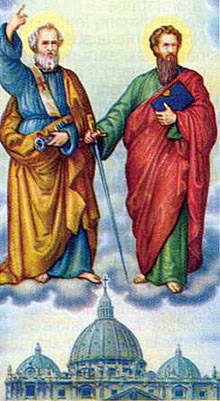
Why Solemnity of Saints Peter and Paul? That is because on that day lie the great celebration of the two great saints and apostles that defined our Church, because they met their martyrdom in Rome. St. Peter, the Prince and leader of all the Apostles, whom the Pope is the successor of today, met his martyrdom in what is now Vatican City, through crucifixion, and St. Paul, the Apostle to the Gentiles, and author of the Epistles in the New Testament, met his martyrdom in Rome, through beheading.

Peter’s Pence itself had its origins in the late dark ages and early medieval period, particularly from England, where it got the name Peter’s ‘Pence’. Pence is the unit of money still in use until today in the United Kingdom and the related monetary units. ‘Peter’ simply point to the fact that the collection or ‘pence’ is intended to be sent to Rome, to the Pope, in order to support various Church activities.

Wednesday, 19 June 2013 : 11th Week of Ordinary Time, Memorial of St. Romuald, Abbot (Gospel Reading)

Matthew 6 : 1-6, 16-18

Be careful not to make a show of your righteousness before people. If you do so, you do not gain anything from your Father in heaven. When you give something to the poor, do not have it trumpeted before you, as do those who want to be seen in the synagogues and in the streets, in order to be praised by the people. I assure you, they have already been paid in full.

If you give something to the poor, do not let your left hand know what your right hand is doing, so that your gift remains really secret. Your Father, who sees what is kept secret, will reward you.

When you pray, do not be like those who want to be seen. They love to stand and pray in the synagogues or on street corners to be seen by everyone. I assure you, they have already been paid in full. When you pray, go into your room, close the door, and pray to your Father who is with you in secret; and your Father who sees what is kept secret will reward you.

When you fast, do not put a miserable face as do the hypocrites. They put on a gloomy face, so that people can see they are fasting. I tell you this : they have been paid in full already. When you fast, wash your face and make yourself look cheerful, because you are not fasting for appearances or for people, but for your Father who sees beyond appearances.

And your Father, who sees what is kept secret, will reward you.

Wednesday, 19 June 2013 : 11th Week of Ordinary Time, Memorial of St. Romuald, Abbot (Psalm)

Psalm 111 : 1-2, 3-4, 9

Alleluia! Blessed is the one who fears the Lord, who greatly delights in His commands. His children will be powerful on earth; the upright’s offspring will be blessed.

Wealth and riches are for his family, there his integrity will remain. He is for the righteous a light in darkness, He is kind, merciful, and upright.

He gives generously to the poor, His merits will last forever and His head will be raised in honour.

Sunday, 16 June 2013 : 11th Sunday of Ordinary Time (Scripture Reflection)

Dear brothers and sisters, today we feel the love and mercy of God reaching out to us, willing to redeem us from our sins and our faults, despite our constant rebellion, and despite our constant complaints and whining. He is a merciful and loving God, that He sent to us His only Son, our Lord Jesus Christ, as our only hope at salvation. For it is through the redemptive action of Christ by His suffering and ultimate sacrifice on the cross, through His priceless Blood, that we are all redeemed, and have hope in salvation, providing that we believe in Him and remain steadfast in our faith in Him.

Salvation lies only in the faith in Christ through the Church, that is, brothers and sisters, by the baptism sealed in the Holy Name of the Father, Son, and the Holy Spirit, in which we are welcomed into the family of the saved ones in the Church of God, our Church. Outside the Church there is no salvation, although Christ did die for all and made all people righteous in redemption, by erasing from them the sins of their forefathers, the rebellion of mankind against the will of God.

The Lord did not come to save the righteous, for they are already saved. He came looking for sinners, for the worst of them, because these are the ones who need salvation the most. If they repent and accept Him as their Lord, they would be saved and be spared from the fires of hell and eternal damnation. The sinful woman, who repented and asked in great humility for forgiveness was a perfect example of this, how the Lord is willing to save those who had repented from their sinful ways and resolved to love God and serve Him henceforth, completing turning their backs to their old, sinful past.

The great and saintly Archbishop Fulton J. Sheen had once said that our relationship to the Lord is akin to that of a candle and a light. A candle and light illuminates its surroundings and reveal the hidden darkness, and unveil all the ugly things that lie hidden in the darkness. The closer something is brought to the light, the more is revealed of that thing in the light. The uglier is the defects, the more visible they become as it is brought ever closer to the light of God.

That is why, just as Christ had told us in the story of the creditor and the two debtors, in which the creditor graciously forgave both debtors from their debts, and as the Pharisees rightfully answer our Lord, that the one with the greater debt would appreciate and love the act more, because of the greater extent of the ‘debt’ that the one has over the other, so does the greater of sinners would then be ever more ready to be redeemed and reunited with Christ, and accepting His mercy.

It does not mean then those with less sin are then less worthy of our God or anything, or that they in any way would not be as pious and humble as those with the greater sin, in approaching the throne of God for forgiveness. Rather, what matters is what is within the hearts of each one of us, that we truly focus all our attentions towards the Lord our God.

What Archbishop Sheen and Christ had said is indeed that the greater is our sin, and the closer we are to the throne of God, the more our sins are being revealed. Therefore, as we approach closer to that throne of mercy, the more we should humble ourselves, because we are ever more reminded of the depth of our sins and our faults, and how unworthy we are before the Lord, who is good and perfect. But the Lord who is good and loving, is willing to make us worthy of Him and redeem us, and cleanse us from the darkness and ugliness that is within us.

That is why, it does not mean that being holy and pious then we become haughty and arrogant of our own holiness and our own sanctity, as indeed, if the words of Archbishop Sheen take hold, its meaning is clear, that those who are closer to God and always remain in His presence, will be even more aware of their sins and their darkness. The holy saints and holy people of God are always reminded of this fact, and the unworthiness of their own soul before the Lord, and that was what strengthened them and empowered them to strive always for holiness and purity of the soul.

Do not be like the Pharisees who were hypocrites, in that they glorify their own sanctity and purity in front of the people, in pursuit of human glory rather that divine approval, and also thought lowly of the sinners like the sinful woman, but he did not give glory to God, unlike the woman, who was in complete awareness of her sins, that she lowered herself before God and served Him in humility.

King David too, who was a great and righteous king of God’s people, Israel, was not free from the temptation of sin. The lust and desire for beautiful woman had corrupted his heart and clouded his judgment that he sinned before the Lord by causing the death of Uriah the Hittite and claimed his wife as his own. But King David also acted like the woman, in that when the prophet Nathan chastised him and brought him to the full awareness of his sins, he submitted to the wrath of God and humbly asked for His mercy and forgiveness, even though he was indeed a great and mighty king.

Therefore, brothers and sisters in Christ, do not fear the Lord, for although He was not happy with our sins, but He was willing to accept us back into His embrace and indeed He wants to embrace us again in His caring love, if we want to repent and change our sinful ways, the way that King David and the woman had brought to God their contrite hearts and their obedience to God.

Let us always be reminded of our sins and our unworthiness before God, and most importantly, remember the love of God, and His desire to be reunited with us, which will be accomplished if we accept His offer of salvation, that He made on the cross, and if we accept that offer, by accepting Him as our Lord and Saviour, we will receive eternal life and blessing in heaven.

May God be with us at all times, and purify our hearts from the taints of sin, empowering us with love and charity, to also help one another to return to God, our Father who loves us. Amen.

Monday, 10 June 2013 : 10th Week of Ordinary Time (Scripture Reflection)

Dear brothers and sisters, peace be with all of you! God is with us and He will take care of us, all the days of our life. His blessings are always upon us, if we walk in His ways and reflect His teachings in our lives. He takes care of our needs, and we do not need to worry, because He is with us, He walks among us, and He never leaves us behind.

Today, we heard Jesus’ teachings on the mountain, which is commonly known as the Beatitudes, in which Jesus praised those who are humble, lowly and those who has done good in God’s Name, for the good of God’s people, and that they will gain great things in their life, because of what they had done, and because of the things they had gone through for the sake of God.

It is not easy brothers and sisters in Christ, to belong to Christ in our world today. There are too many temptations and persuasions from this world for us to deviate from Christ’s way, into a way that is the world’s. Why so? Because the world is full of violence, injustice, and hatred, which the devil perpetuates in this world, so as to keep mankind away from God, through his agents which are always at work in this world.

Peace, my brothers and sisters, is not an easy objective for us to obtain. True peace requires all of us to be able to sit side-by-side and embrace one another as brethren in love, and in complete harmony that is of the Lord, despite our backgrounds, despite our racial profile, despite the differences that are between us, in our thoughts and in our actions. But clearly, as all of you can see, there is too much darkness and hatred in our world, that hinder peace and those who work for the sake of peace.

There are those who perpetuate hatred and violence in our world today, in our own societies, for their own gain and benefit. Why, brothers and sisters in Christ? Surely people will want peace right? But if through the perpetuation of violence and hatred it allows some to continue to gain in their own agenda, in their own efforts, these people will not stop spreading lies and hatred to keep the people of God from achieving the true peace that is our aim.

Too often, it is ourselves that are to blame as well, whenever we failed to do the things that God wants us to do, as He clearly told His disciples on today’s Beatitudes. That we should be bringer of peace, of comfort and justice, and also as bearers of God’s faith to all mankind. Let us reflect into ourselves, whether we have done these things that the Lord wants of us.

When we see those among us in feud among themselves, hitting each other verbally and even physically, causing hurt to one another, are we courageous enough to be the peacemaker? Too often, we are concerned of losing our ‘face’ to others, especially to those who are fighting, so that we are more often content to be the silent bystander.

The same also happens when we see someone who is hungry, who is unloved, and who has been unjustly treated. Very often we want to have nothing to do with any of them, because if we do any good to them, we will be considered ‘uncool’ by our friends and those whom we know. But let us see, do we ask for the opinion of men while doing God’s work? No, right? We should not be accountable to men for things that we do for the good of those around us, and for the glory of God.

Therefore, brothers and sisters in Christ, as we reflect on today’s Beatitudes, let us reflect on our own lives, and make a new commitment to be like those whom Christ blessed for being faithful disciple of the Lord, by practising His commandments as peacemakers, and bringer of love and justice to everyone. Let us not be afraid to lift up our fingers to help others around us who suffer, and surely God will guide us and bless us when we love those who are least among us.

May God be with us and bless us, and make us ever more like Him, who is Love, and reflect in ourselves and our lives, the light of peace, love, justice, and harmony, to all mankind, and with all of them, praise our God who loves us and who wants to bless us all our days. Amen.

Tuesday, 4 June 2013 : 9th Week of Ordinary Time (First Reading)

Tobit 2 : 9-14

That same night, after I had buried the body, I returned home. I washed myself and went out into the courtyard to sleep against the wall; my face was uncovered because of the heat. I did not see that there were sparrows on the wall of the courtyard and, as my eyes were open, the hot droppings from the sparrows fell into my eyes and formed a white film on my eyes.

I went to find doctors to attend to me for medical treatment but the more ointments they smeared on my eyes, the more blind I became because of the film. Finally I became totally blind. I suffered from blindness for four years. All my brothers were burdened because of me. Ahikar kept me for two years before he departed for Elymiade.

My wife Anna worked hard at a woman’s task, weaving. On the seventh day of the month of March she cut the cloth and delivered it to her employers. They paid her wages and gave her, over and above, a young goat for food. When she returned home the kid began to cry. I said to her, “Where does the little kid come from? Did you steal it? Return it to its owners for we are not allowed to eat anything that is stolen.”

But she said, “It is a gift which has been given to me in addition to my wages.” But I said, “I don’t believe it. I tell you to return it to its owners.” I was ashamed of her. She replied, “What about your own almsgiving and your good deeds? I have to put up with all this from you.”