Friday, 9 August 2013 : 18th Week of Ordinary Time, Memorial of St. Teresa Benedicta of the Cross, Virgin and Martyr (Psalm)

Liturgical Colour : Green or Red (Martyr)

Psalm 76 : 12-13, 14-15, 16 and 21

I remember the deeds of the Lord; I recall His marvels of old. I meditate on all Your work, and consider Your mighty deeds.

Your way, o God, is most holy. Is there any god greater than You, our God? You alone are the God who works wonders, who has made known His power to the nations.

With power You have redeemed Your people, the descendants of Jacob and Joseph. You led Your people as a flock by the hand of Moses and Aaron.

Friday, 9 August 2013 : 18th Week of Ordinary Time, Memorial of St. Teresa Benedicta of the Cross, Virgin and Martyr (First Reading)

Liturgical Colour : Green or Red (Martyr)

Deuteronomy 4 : 32-40

Ask of the times past. Inquire from the day when God created man on earth. Ask from one end of the world to the other : Has there ever been anything as extraordinary as this? Has anything like this been heard of before? Has there ever been a people who remained alive after hearing as you did the voice of the living God from the midst of the fire?

Never has there been a God who went out to look for a people and take them out from among the other nations by the strength of trials and signs, by wonders and by war, with a firm hand and an outstretched arm. Never has there been any deed as tremendous as those done for you by YHVH in Egypt, which you saw with your own eyes.

You saw this that you might know that YHVH is God and that there is no other besides Him. He let you hear His voice from heaven that you might fear Him; on earth He let you see His blazing fire and from the midst of the fire you heard His word. Because of the love He had for your fathers, He chose their descendants after them, and He Himself made you leave Egypt with His great power.

He expelled before you peoples more numerous and stronger than you, and He has made you occupy their land : today He has given this to you as an inheritance. Therefore, try to be convinced that YHVH is the only God of heaven and earth, and that there is no other.

Observe the laws and the commandments that I command you today, and everything will be well with you and your children after you. So you will live long in the land which YHVH, your God, gives you forever.

Thursday, 8 August 2013 : 18th Week of Ordinary Time, Memorial of St. Dominic, Priest (Scripture Reflection)

Liturgical Colour : White

Dear brothers and sisters in Christ, we are reminded today, of our own weaknesses, of our own vulnerabilities, and the need for all of us to follow the will of our God, and follow the thinking of our God, trusting in Him fully with all our hearts, our minds, and all our beings, instead of trusting our own instincts and human emotions.

Today we celebrate the feast of St. Dominic, also known as St. Dominic de Guzman, a well known preacher who lived in the high Middle Ages Europe in the twelfth and thirteenth century Europe. He was the founder of the Dominican religious order, also known as the Order of Preacher. St. Dominic was well known for his strong devotion in the Lord, and his unshaken faith, in which he emphasized on the importance of having a strong and vibrant faith in God, as our armour, and put our trust in the Lord, instead of trusting in the power of men.

St. Dominic worked hard to spread the words of the Gospel, preaching to many people of God who had gone astray from the faith, and those in whom the flames of faith had died down. He had made much impact in strengthening the faith and zeal among the faithful at a time when heresies were commonplace in the Medieval Europe, particularly the Albigensian heresy or the Catharian heresy widespread in the Christendom at the time. Not only that, St. Dominic de Guzman was also well-known for being the one who propagated the devotion to the mother of our Lord, the Blessed Virgin Mary, through the Rosary.

St. Dominic and his successors in the Dominican religious order continued the spreading of the holy Rosary, as a potent tool and weapon which we can use, in our fight and constant struggle against the devil, as something that can help us anchor our faith firmly in the Lord, through the inspiration of the faith that His Blessed Mother has, that is the faith of Mary. The Dominican friars, monks, and priests continued until today the works and passions of St. Dominic, bringing more and more lost souls back to the embrace of the Lord who loves them.

Yes, brothers and sisters in Christ, it is important for all of us to continue to have faith in our Lord and in His saving power. Not just any faith, but a strong and immovable faith like that of a rock, faith that will never be shaken by any power of the devil or the temptations of this world. If our faith in the Lord is not strong, the devil can easily sow the seeds of rebellion and distrust in our hearts, and that will make our faith even weaker and less anchored.

That was what happened to the people of Israel during their journey in the desert, when the Lord led them through Moses to walk through the desert of Sinai from Egypt towards the Promised Land of Canaan. Even though the Lord had shown them His power and might through the miracles He had shown them via Moses and Aaron, by the Ten Plagues He had sent to punish their former Egyptian slavemasters, and despite His opening of the Red Sea for them to cross, and finally, even giving them manna, the bread of heaven to eat, and sweet water to drink from rocks, they still rebelled against Him and constantly complained against Him throughout the journey.

They abandoned the Lord immediately after He made them walk through the Red Sea, when Moses went up the Mountain of God and did not come down for forty days, when they decided to take the matter on their own hands, and made a new ‘god’ of gold shaped into a calf, abandoning the Lord their God who had shown them their might, for the pagan idol of gold and the world. They did not have true faith in their heart, nor true love for God, but they merely have amazement, wonder, and even fear for the Lord, for all the things He had done for them, but that is not love or faith.

We must be strong and have our faith firmly rooted in the Lord, that we will not be tempted nor give in to our human weaknesses and vulnerabilities. Ever since our ancestors ate from the tree of knowledge of good and evil, we have been exposed to such weaknesses, negative things such as lust, greed, wrath, anger, pride, and many others. These can derail us from the path towards salvation, that is the path for us to return to our Lord.

What happened to Moses and Peter in the first and the Gospel readings respectively are also examples of what can happen, even to those whose faith are firm and strong in the first place, if we do not keep our faith strong at all times and let it to waver or allow evil to dwell within us and plant his seeds of evil within us. Moses as the leader of the people of Israel and Peter as the leader of all the Apostles, the one to whom God entrusted all His people on earth to.

As the leader of the people, Moses certainly had a great responsibility, and his role as the one who speaks directly to the Lord God made his works even more demanding on him. When the people constantly complained and rebelled against his leadership and the Lord Himself, the strain went too much for him and indeed, at Massah and Meribah, as we heard from the reading today, Moses snapped. In his anger and wrath, he disobeyed the Lord in order to chastise the people. Yes, the Lord in His love still allowed the water to flow through the rocks for His people to drink, but Moses’ disobedience is something that he should not have done. As a result, he was not to enter the Promised Land together with the rebellious people, who had been punished for their lack of faith in the Lord.

Peter, the leader of the disciples of Jesus in his fear that the Lord would suffer and die under the Jewish authorities, rebuked Jesus in that he said that Jesus should not face His death and therefore complete what He was born into this world for. Peter gave in to his fear and uncertainty, and his faith was shaken. But the Lord rebuked Satan who was inside him, and rebuked the one who sowed the seeds of uncertainty in the heart of Peter, and reminded Peter as well, that one ought to put their full trust and attention to the Lord their God and not in the wisdom and power of men.

Yet, despite the apparent weakness of faith of Peter, and his later abandonment of the Lord in his three times denial that he knew Christ, Peter, who was Simon son of John has great faith in his heart, that the Lord who sees all knew about the true faith in Peter. That was why, He named Simon as Peter, which means ‘Rock’ or Cephas in the approximate Aramaic language used by the people of Jesus’ time.

That is because Peter truly is faithful to the Lord, and he truly loved Him, and he showed that in the end by giving up his own life for the sake of the Lord, as the martyr of the faith. He led the people of God in the Church faithfully and dutifully, ensuring that a stable foundation of God’s Church was built, and behold! The Church of God that He established on Peter as foundation remains today as our Church, with our current Pope Francis, as the successor of Peter as the head of the Universal Church.

We too, brothers and sisters in Christ, ought to strengthen our faith and our love for the Lord our God. There are many ways to do this, that our faith will blossom and grow together with our love, both for God and for our fellow men. Pray often, speak to the Lord our God through prayer, that we constantly remain in connection to His will and His words, that we do not easily fall astray of the true path to God.

And following the push by the Dominicans and their founder, St. Dominic, let us pray the rosary often with meaning and devotion, and not just merely chanting the prayers, but that we really mean the prayers in the rosary that we offer to the Blessed Virgin Mary, that she will then deliver our prayers to the throne of her Son, our Lord Jesus Christ, God and King of all the Universe, who will hear us, and succour us at all times.

May the Lord who is faithful and loving be with us always and give us His love and kindness, strengthening us whenever we are weak, and planting the seeds of faith in us, anchoring it on solid rock foundation, that we will withstand whatever assault Satan tries to make, and whatever temptations this world attempt on us, to lead us astray from salvation into damnation. Let us, inspired by the example of St. Dominic, reach out to one another and help one another in our devotion to the Lord, that all of us will be saved together. Amen.

Wednesday, 7 August 2013 : 18th Week of Ordinary Time, Memorial of Saints Xystus II, Pope and Companions, Martyrs; and St. Cajetan, Priest (Scripture Reflection)

Liturgical Colour : Green or Red (Saints Xystus II and Companions); White (St. Cajetan)

Brothers and sisters in Christ, today, the case of the Canaanite widow and her daughter, and how the daughter was healed by Christ our Lord because of her mother’s faith, should stir all of us, all of our hearts. That the woman had shown her great faith and trust in God, placing all of her heart and faith in the power and ability of our Lord, recognising Him as the heir of David, the awaited Messiah of Israel, the Saviour of the world.

Yes, brothers and sisters, the woman, the Canaanite woman, not of the chosen race and the chosen people of Israel, had recognised the Lord and put her entire heart and full faith in Him when so many other people of Israel had failed to do so. Not only that many of these people had failed to put their full attention and faith in the Lord, but they even complained against Him and grumbled against Him, when He had shown them so much love, compassion, care, and kindness.

So great is His love that He listened to their complaints, giving them food, the bread of heaven in the form of manna for them to eat in the morning, and quails for them to eat in the evening, as well as crystal-clear and sweet spring water from rocks for them to drink and satisfy themselves when they complained that they have not enough to eat or drink.

Yes, the Lord even promised them, as He had promised Abraham their forefather, the Promised Land of milk and honey, where the land is so rich that it will yield fruits manyfold and bring with them great riches for God’s people, that is Israel to enjoy for eternity. He fulfilled that promise and brought His people to the land that He had given to them and their descendants.

And yet, they still complained, and they did not truly love the Lord their God, nor did they give Him their full dedication and faith. When the explorers sent by Moses reached the Promised Land and saw the warlike peoples of Canaan living in the land, with giant men and powerful warlords, the people chose to follow their own human instincts and immersed themselves in their own human fear, that they again complained against the Lord for having brought them to that ‘dreaded’ Promised Land filled with enemies and prospects of death.

Despite all the good things that the Lord had given them and would have given them in perpetuity, for eternity, they rejected the kindness of the Lord, because they trusted themselves more, in human power and fear, and not in divine power of our God. And therefore, because of their rebelliousness, they deserved death. The Lord rejected them from His presence and denied them from entering the Land He promised them.

Then we can contrast this, to the widow, the widow who does not belong to the people of Israel, the Canaanite woman dismissed by many in Israel in Jesus’ time as pagans and people doomed to hell. Yet, she proclaimed the Lord and recognised in Him the salvation that is to come for her and the whole world. She asked humbly for His mercy and showed her faith to Him, even when Christ seemingly rebuked her and mentioned that He was only sent to the people of Israel. She answered well and proved her faith to God, and as a result, she received her due reward, the same reward promised to the people of Israel of old, but which they rejected because they trusted more in the power of man rather than in the power of the One and almighty God.

It does not mean that the people of Israel are bad or that they are rejected by God. Remember that Jesus Himself is a Jew, and He belongs to the House of David, because He is His heir, and the widow rightly proclaimed that He is the Son of David, the One to whom God will give eternal kingship, glory, and power over not just Israel, but over all mankind, over all the world. Instead, the readings today highlight that, first, we must be always faithful and trusting in the Lord our God, and we should be fast to praise and slow to complain.

It is our nature to feel that we do not have enough when we actually already have more than enough. It is part of our natural greed and desire for things and material goods. And it is also our nature to first think about ourselves and our needs before that of others, and we are quick to praise ourselves in general, whenever we achieve something, but it is generally considerably more difficult for us to give due thanks and praise to others, when they have done something that had benefited us in one way or another.

This happened to the people of Israel in the desert, that despite the freedom God had given them from the backbreaking and hard labour under slavery in Egypt, despite that He had showed them His might and power in opening the sea, giving them His own Laws and commandments, making sweet and crystal-clear water to gush out from rocks and even giving them food from His own table in heaven in the manna, they did not feel that they have enough, and indeed, complained that their previous life in Egypt had been much better, and even brought the Lord to the test, in doubting whether God could provide for them in their journey in the desert.

Yes, brethren, the path of the Lord is not an easy one, and there will certainly be numerous obstacles lying in our path if we choose to follow the Lord. The evil one certainly does not stay idle and let us, the followers of God, His disciples to just go free without any difficulties. This is why, it is often much easier and much more pleasurable for us, to settle on things that seem to be easier and more relaxed, even though to do that means that we sin against the Lord our God.

We cannot have this mentality, brothers and sisters in Christ, because to settle for such a thing would mean that we prefer the slavery under sin and Satan, instead of the freedom God had offered all of us through His suffering and death on the cross. Do not follow the path of the Israelites who chose to rebel against God and complained against His love and kindness. Our Lord knows what we truly need, brethren, and He will not leave us without love or care, because He always watches over us, at all times.

Today, brothers and sisters in Christ, we celebrate the feasts of Pope St. Xystus II or Sixtus II, as well as St. Cajetan. Both of them are holy and pious men dedicated to God in their own ways. Pope St. Xystus II lived in the middle era of the Roman Empire, and reigned as the leader of the Universal Church during the height of the persecution of Christians in the Roman Empire in the middle of the third century. He reunited the divided factions of the people of God after healing the rifts that existed after heresies wrecked the faithful, and brought them back to God, once again as one people. He was martyred along with several of his companions following a brutal repression and persecution of the faithful by the Emperor Valerian.

St. Cajetan on the other hand was a priest who lived in the middle of the Renaissance Italy, during the sixteenth century. He helped much in the Church’s attempts to combat heresy of the Reformation which spread like wildfire during his lifetime. He dedicated much of his efforts and works to love and serve the poor, the lonely, and those without love, committing himself towards caring for all of them. He founded a religious order, the Theatines, which has a similar vision to him, that especially focus on the virtue of service and committing acts of love to others, as part of the faith.

Therefore brothers and sisters, today, let us be resolved to have the faith of the widow, to seek the Lord with great humility and persistence, and ask Him to show mercy and love upon us sinners. Let us not harden our hearts the way the people of Israel had done when they journeyed through the desert. Let us reflect on ourselves and our own weaknesses, and seek the Lord to enlist His aid, in helping us to overcome these weaknesses.

Let us also follow the example of Pope St. Xystus II in his commitment to the cause of the Lord, and the faith and love, as well as the dedication he had shown him, just as the widow had shown her faith to God, by her recognition of the good that the Lord had done for us. Let us also follow the example of St. Cajetan, in his own devotion to the Lord, which he showed through his love and service, and all the care he had given to all the children of God in need, in need for love, care, and compassion. In doing those things, St. Cajetan showed his love and faith in God. We too can do the same, brothers and sisters in Christ. Show Christ our love, just as He had shown us His love from the cross.

May the Lord bless us all with strength, faith, and perseverance to go on in our lives, no longer complaining but from now on putting our whole and complete trust in the Lord our God who loves us. May Pope St. Sixtus II and St. Cajetan, and all the company of saints and angels in heaven intercede on our behalf before the Lord who is loving and merciful, that He will forgive us our trespasses and deem us worthy of His presence and His kingdom once again. Amen.

Wednesday, 7 August 2013 : 18th Week of Ordinary Time, Memorial of Saints Xystus II, Pope and Companions, Martyrs; and St. Cajetan, Priest (Gospel Reading)

Liturgical Colour : Green or Red (Saints Xystus II and Companions); White (St. Cajetan)

Matthew 15 : 21-28

Leaving that place, Jesus withdrew to the region of Tyre and Sidon. Now a Canaanite woman came from those borders and began to cry out, “Lord, Son of David, have pity on me! My daughter is tormented by a demon.” But Jesus did not answer her, not even a word. So His disciples approached Him and said, “Send her away! See how she is shouting after us.”

Then Jesus said to her, “I was sent only to the lost sheep of the nation of Israel.” But the woman was already kneeling before Jesus and said, “Sir, help me!” Jesus answered, “It is not right to take the bread from the children and throw it to the puppy dogs.”

The woman replied, “That is true, Sir, but even the puppy dogs eat the crumbs which fall from their master’s table.” Then Jesus said, “Woman, how great is your faith! Let it be as you wish.” And her daughter was healed at that moment.

Wednesday, 7 August 2013 : 18th Week of Ordinary Time, Memorial of Saints Xystus II, Pope and Companions, Martyrs; and St. Cajetan, Priest (Psalm)

Liturgical Colour : Green or Red (Saints Xystus II and Companions); White (St. Cajetan)

Psalm 105 : 6-7a, 13-14, 21-22, 23

We have sinned like our ancestors; we have done wrong and acted wickedly. When they were in Egypt, our ancestors had no regard for Your wondrous deeds.

But soon they forgot His works and did not wait for His counsel. They gave way to wanton craving and tempted God in the desert.

They forgot their Saviour God, who had done great things in Egypt, wonderful works in the land of Ham, and awesome deeds by the Sea of Reeds.

So He spoke of destroying them, but Moses, His chosen one, stood in the breach before Him to shield them from destruction.

Wednesday, 7 August 2013 : 18th Week of Ordinary Time, Memorial of Saints Xystus II, Pope and Companions, Martyrs; and St. Cajetan, Priest (First Reading)

Liturgical Colour : Green or Red (Saints Xystus II and Companions); White (St. Cajetan)

Numbers 13 : 1-2, 25 – Numbers 14 : 1, 26-29

YHVH then spoke to Moses, saying, “Send men to explore the land of Canaan that I am giving to the Israelites; send one man from each of the ancestral tribes, all of them leaders.”

After forty days of exploration, they returned. Then all the community broke out in loud cries and wept during the night. Then YHVH spoke to Moses and Aaron saying, “How long will this wicked community grumble against Me? I have heard the grumblings of the people of Israel against Me.

Say to them : As truly as I live, it is YHVH who speaks, I will do to you what you have said in My hearing. All of you of twenty years or more, numbered in the census, who grumbled against Me, your corpses will fall in the desert.”

Sunday, 4 August 2013 : 18th Sunday of Ordinary Time (Second Reading)

Liturgical Colour : Green

Colossians 3 : 1-5, 9-11

So them, if you are risen with Christ, seek the things that are above, where Christ is seated at the right hand of God. Set your mind on the things that are above, not on earthly things. For you have died and your life is now hidden with Christ in God. When Christ, who is your life, reveals Himself, you also will be revealed with Him in Glory.

Therefore, put to death what is earthly in your life, that is immorality, impurity, inordinate passions, wicked desires, and greed which is a way of worshipping idols.

Do not lie to one another. You have been stripped of the old self and its way of thinking to put on the new, which is being renewed and is to reach perfect knowledge and the likeness of its creator. There is no room for distinction between Greek of Jew, circumcised or uncircumcised, barbarian, foreigner, slave or free, but Christ is all and in all.

My Prayer Intention for Sunday, 4 August 2013

1. For all of us. That we will always be reminded that our lives in this world are short, and the times and happiness that we have in our world is temporary. That we may use whatever time given to us in this world to the fullest, to the greatest potential, in serving the Lord and our fellow brethren, with love, compassion, and dedication. May we focus on seeking true happiness and joy in the Lord, and in the happiness and joy of our brothers and sisters, that we may share that happiness and joy with one another.

2. For people working in financial institutions and money-related careers. That they will not lose sight of their true goal in life, that is the Lord and His love, and that they will not succumb to the temptation of money and wealth, remaining faithful to their true vocation in life. May they be able to discern that the true objectives of their career is to make a difference in the lives of others through their own work in its various ways, and not to seek to increase their own personal wealth, especially not in the expense of others.

3. For our leaders and those in positions of power. That they will use their power and the authority entrusted to them by us and by the Lord with full sense of responsibility and clear understanding. That they will first seek to serve others and look for their own good before thinking about their own self. May our leaders be dedicated and loving leaders and people of justice, integrity, and love, who are dedicated to serving the people of God with zeal and commitment.

4. For all of us. That we will treasure all our loved ones, our families and friends, whom we had met in our lives, and those who had made a difference in our lives, in their own ways. May the Lord show us and open our eyes, that we still have those who love us, and we have the Lord Himself who loves us all the time, that we will begin to treasure this life we had been given, and give thanks to Him who had breathed the breath of life into us, mere dust made alive.

May the Lord accept our humble prayers, and may His saints and angels succour always in times of need, in our times of difficulties, reminding us always that the Lord is always with us, walking with us, and supporting us without ceasing. God be with us all and may His blessings and graces remain with us at all times. Amen.

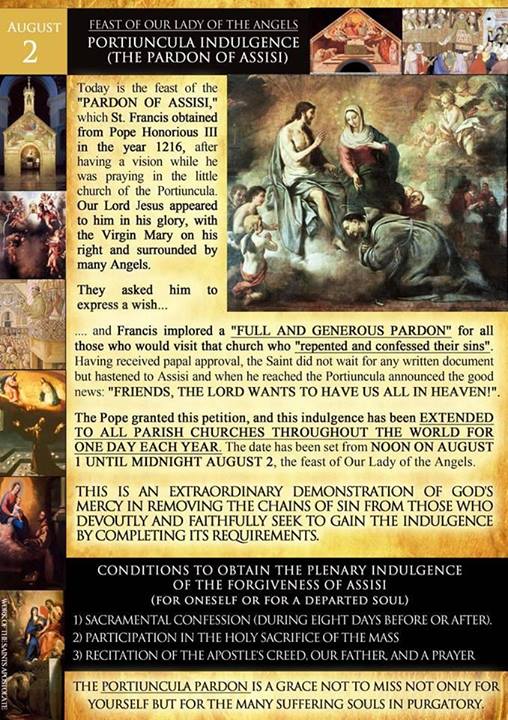
Portiuncula Indulgence (Pardon of Assisi) – on 2 August of each year

Image

The Portiuncula Indulgence, also known as the Pardon of Assisi, is offered every year to all the faithful every 2 August of each year.

The Indulgence include complete reparation from sins and faults, and the total forgiveness granted to us for all our temporal sins, since 1216, when St. Francis of Assisi first requested it through the intercession of the Most Blessed Virgin Mary.

There are three conditions required for the Portiuncula Indulgence :

1. Receiving the Sacrament of Confession within eight days before or after 2 August each year

2. Attendance and full participation at the Holy Sacrifice of the Mass (Full devotion in the Mass)

3. Devout recitation of the Apostle’s Creed, Our Father, and a personal Prayer