Monday, 24 June 2013 : Solemnity of the Nativity of St. John the Baptist (Second Reading)

Acts 13 : 22-26

After that time, God removed Saul and raised up David as king, to whom He bore witness saying : ‘I have found David, the son of Jesse, a man after My own heart, who will do all I want him to do.’ It is from the descendants of David that God has now raised up the promised Saviour of Israel, Jesus.

Before He appeared, John proclaimed a baptism of repentance for all the people of Israel. As John was ending his life’s work, he said : ‘I am not what you think I am, for after me another One is coming whose sandal I am not worthy to untie.’

Brothers, children and descendants of Abraham, and you also who fear God, it is to you that this message of salvation has been sent.

(Special) Sunday, 23 June 2013 : Vigil Mass of the Solemnity of the Nativity of St. John the Baptist (Scripture Reflection)

Dear brothers and sisters in Christ, today we are celebrating the feast of the birth of St. John the Baptist, the relative of our Lord Jesus Christ by virtue of his mother, Elizabeth, being the cousin of Mary, the mother of our Lord. St. John the Baptist is known for his role in preparing the way for Christ, straightening the path for His arrival into this world, preceding the Lord Himself by a few months. He baptised peoples and asked them to repent from their sins, so that they would not fall into damnation, and be open for Christ when He came.

St. John the Baptist is a great saint, brothers and sisters, and he is considered by many to be one of the prophets reborn once again, particularly that of Elijah, sent by the Lord for the sake of Christ, as His messenger, and as His herald, proclaiming His arrival into the world. The events surrounding his birth is not ordinary either, because he was born out of an aging parent, an aging mother who could no longer conceive, but because of the power of the Lord and the Holy Spirit, conceived, and brought John into this world.

Like the passage in the first reading from the book of the prophet Jeremiah, the words themselves spoke about St. John the Baptist and his life, in that he had been chosen by the Lord since his conception, and before he was even born, as the angel told Zechariah, John’s father in the Temple of Jerusalem. He had been chosen from among many, to be the messenger of the Lord’s message and words, and to prepare the way for the Word Himself, Christ, our Saviour, who is also the Word of God.

Being chosen by the Lord, St. John the Baptist did not shy away in fear, but instead fully embraced the tasks that had been entrusted on him, and passionately went into his ministry, preaching to the people of God and repeatedly asking them to repent and return to the Lord who loves them. He worked tirelessly throughout his ministry in this world, and he did not show any fear even to the corrupt authority, the way he chastised King Herod for his improper relationship with the brother of his wife, Herodias.

He did not fear death while doing so, and faced death willingly when he was beheaded by the order of King Herod. In his humility he told his own disciples to follow Christ, and proclaimed to them the Messiah, with his words, “Behold the Lamb of God!”, and many who followed John then followed Christ in turn. He did not seek human glory and praise, and in his humility, told his disciples that while Christ increase, he must decrease.

He recognised his own human weakness and accepted the will of God without hesitation. He followed the Lord and obeyed His will. St. John the Baptist is indeed an example for all of us, how to be the true disciples of the Lord. When we are called by the Lord to be His servants, we must not give in to fear and doubt, but place all of our trust in the Lord, just the way that St. John had done, that we can truly give our all in the work for the sake of the Lord, and for the sake of God’s people, that is all mankind.

We should not give in to doubt as Zechariah, John’s father had done. It may be understandable because it may seem impossible for humans that an elderly woman should be able to bear a child. But to God, nothing is impossible. Therefore, brothers and sisters, we who have received the Good News of Christ, let us be renewed by the Holy Spirit of the Lord, and let us be courageous and passionate in spreading the Good News and salvation of the Lord, inspired by the example of St. John the Baptist.

Remember that God chose us and not we chose Him. He called us from the many, to be His disciples, and those of us who had accepted Him as their Lord and Saviour, gained salvation and life eternal. May God remain with us, bless us, and strengthen us in our task, that is to bring the Word of God to many in this world. St. John the Baptist, pray for us too. Amen.

Imposition of the pallium on the new Metropolitan Archbishops by Pope Francis

On the great Feast day and Solemnity of Saints Peter and Paul, Apostles, the feast day of the Church of Rome, on Saturday, 29 June 2013, 34 new Metropolitan Archbishops will receive the pallium, the symbol of their metropolitan office from Pope Francis, in a Mass at St. Peter’s Basilica.
Pallium (Pallium)
1_0_674753 (Papal Pallium)
Pallium is a woolen band, worn around the shoulders, as a symbol of office, representation of the Good Shepherd, with Jesus carrying the lamb on His shoulder, which is reminiscent of the authority entrusted upon the Metropolitan Archbishops over their flocks. Pallium therefore is a symbol of authority. It is about three fingers wide, and has six black crosses, out of which three are pierced with a golden pin, representing the wounds of Christ pierced by the holy nails on the cross.
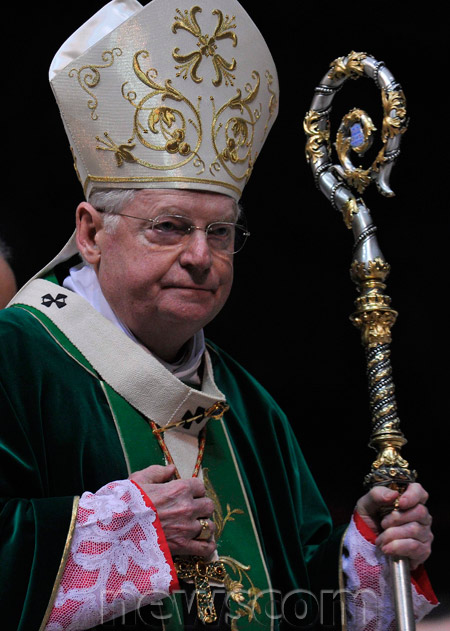
angelo-scola
(Above : image of Cardinal Angelo Scola, wearing the pallium, as the Metropolitan Archbishop of Milan, who received the pallium personally from Pope Benedict XVI in 2011)
Papal pallium from 2005 is different, in order to distinguish the nature of the Papal office, as the Pope is not just any bishop or Metropolitan Archbishop, but is Metropolitan over the entire world, the entire Church, as the Vicar of Christ.
Pope-Benedict-XVI
(Above : Pope Benedict XVI with the Papal pallium in 2012)

The list of the new Metropolitan Archbishops who will receive the pallium below.

1. Patriarch Manuel Jose Macario do Nascimento Clemente, Patriarch of Lisbon (Portugal)
2. Archbishop Dieudonne Nzapalainga, C.S.Sp., Metropolitan Archbishop of Bangui (Central African Republic)
3. Archbishop Carlo Roberto Maria Redaelli, Metropolitan Archbishop of Gorizia (Italy)
4. Archbishop Claudio Dalla Zuanna, S.C.I., Metropolitan Archbishop of Beira (Mozambique)
5. Archbishop Prakash Mallavarapu, Metropolitan Archbishop of Visakhapatnam (India)
6. Archbishop Antonio Carlos Altieri, S.D.B., Metropolitan Archbishop of Passo Fundo (Brazil)
7. Archbishop Marek Jedraszewski, Metropolitan Archbishop of Lodz (Poland)
8. Archbishop Philip Tartaglia, Metropolitan Archbishop of Glasgow (Great Britain)
9. Archbishop Salvatore Joseph Cordileone, Metropolitan Archbishop of San Francisco (USA)
10. Archbishop Rolando Joven Tria Tirona, O.C.D., Metropolitan Archbishop of Caceres (Philippines)
11. Archbishop Rogelio Cabrera Lopez, Metropolitan Archbishop of Monterrey (Mexico)
12. Archbishop Joseph William Tobin, C.Ss.R., Metropolitan Archbishop of Indianapolis (USA)
13. Archbishop Carlos Maria Franzini, Metropolitan Archbishop of Mendoza (Argentina)
14. Archbishop Lorenzo Ghizzoni, Metropolitan Archbishop of Ravenna-Cervia (Italy)
15. Archbishop George Antonysamy, Metropolitan Archbishop of Madras and Mylapore (India)
16. Archbishop Anil Joseph Thomas Couto, Metropolitan Archbishop of Delhi (India)
17. Archbishop John Wong Soo Kau, Metropolitan Archbishop of Kota Kinabalu (Malaysia)
18. Archbishop Murray Chatlain, Metropolitan Archbishop of Keewatin-Le Pas (Canada)
19. Archbishop Sérgio Eduardo Castriani, C.S.Sp., Metropolitan Archbishop of Manaus (Brazil)
20. Archbishop Peter Loy Chong, Metropolitan Archbishop of Suva, (Fiji)
21. Archbishop Alfonso Cortes Contreras, Metropolitan Archbishop of Leon (Mexico)
22. Archbishop Alexander King Sample, Metropolitan Archbishop of Portland in Oregon (USA)
23. Archbishop Joseph Effiong Ekuwem, Metropolitan Archbishop of Calabar (Nigeria)
24. Archbishop Jesus Juarez Parraga, S.D.B., Metropolitan Archbishop of Sucre (Bolivia)
25. Archbishop Fabio Martinez Castilla, Metropolitan Archbishop of Tuxtla Gutierrez (Mexico)
26. Archbishop Ramon Alfredo Dus, Metropolitan Archbishop of Resistencia (Argentina)
27. Archbishop Mario Aurelio Poli, Metropolitan Archbishop of Buenos Aires (Argentina)
28. Archbishop Gintaras Linas Grusas, Metropolitan Archbishop of Vilnius (Lithuania)
29. Archbishop Michael Owen Jackels, Metropolitan Archbishop of Dubuque (USA)
30. Archbishop Duro Hranic, Metropolitan Archbishop of Dakovo-Osijek (Croatia)
31. Archbishop Moacir Silva, Metropolitan Archbishop of Ribeirao Preto (Brazil)
32. Archbishop Jozef Piotr Kupny, Metropolitan Archbishop of Wroclaw (Poland)
33. Archbishop Sergio Alfredo Gualberti Calandrina, Metropolitan Archbishop of Santa Cruz de la Sierra (Bolivia)
34. Archbishop Giuseppe Petrocchi, Metropolitan Archbishop of L’Aquila (Italy)
In addition, the Metropolitan Archbishop of Hue, Archbishop Francois Xavier Le Van Hong, will not receive the pallium directly from the Pope in Rome, but in his home diocese of Hue, through the papal representative. Therefore, in addition to the 34 Metropolitan Archbishops mentioned above, 35 Metropolitan Archbishops will receive the pallium in this year.
35. Archbishop Francois Xavier Le Van Hong, Metropolitan Archbishop of Hue (Vietnam)

Metropolitan Archbishop differs from normal Archbishops in that, they have jurisdiction over other dioceses that are placed under their supervision, in a group called Ecclesiastical Province of the Church. Archbishops of Archdioceses without Metropolitan character has no jurisdiction over any dioceses under them, and they are usually directly subject to the Holy See.

Sunday, 23 June 2013 : 12th Sunday of Ordinary Time (Gospel Reading)

Luke 9 : 18-24

One day, when Jesus was praying alone, not far from His disciples, He asked them, “What do people say about Me?” And they answered, “Some say that You are John the Baptist; others say that You are Elijah, and still others that You are one of the prophets of old, risen from the dead.”

Again Jesus asked them, “But who do you say that I am?” Peter answered, “The Messiah of God.” Then Jesus spoke to them, giving them strict orders not to tell this to anyone. And He added, “The Son of Man must suffer many things. He will be rejected by the elders and chief priests and teachers of the Law, and be put to death. Then after three days He will be raised to life.”

Jesus also said to all the people, “If you wish to be a follower of Mine, deny yourself and take up your cross each day, and follow Me! For if you choose to save your life, you will lose it; but if you lose your life for My sake, you will save it.”

Sunday, 23 June 2013 : 12th Sunday of Ordinary Time (Second Reading)

Galatians 3 : 26-29

Now, in Christ Jesus, all of you are sons and daughters of God through faith. All of you who were given to Christ through baptism, have put on Christ. Here there is no longer any difference between Jew or Greek, or between slave or freed, or between man and woman : but all of you are one in Christ Jesus.

And because you belong to Christ, you are of Abraham’s race and you are to inherit God’s promise.

Thursday, 20 June 2013 : 11th Week of Ordinary Time (Scripture Reflection)

Dear brothers and sisters in Christ, today in the Gospel reading, we heard the very prayer that all of us should know by heart, the Lord’s Prayer, the Our Father, Pater Noster, the prayer that we always say in every celebration of the Mass, the prayer that our Lord Jesus Christ Himself taught us through His disciples, and which show the perfect sincerity in prayer, and indeed, the perfect prayer itself, how a prayer should indeed be prayed.

Prayer should not be a litany of demands and wishes, as I am sure many of us would consciously or unconsciously do. That in prayer, we always put, “We want this, Lord; We need this, Lord; I hope that You can help me in this, Lord; please help us, o Lord”. No, not that it is bad to ask Him all these things, providing that we do so politely and in a sincere love for Him, and not to consider and look at God as a ‘magic genie lamp’ that can fulfill all your wishes with a single whim.

Prayer is a perfect way of connecting with the Lord our God, as a two-way communication between us and our Creator and our Lord. Yes, brothers and sisters in Christ, prayer is a two-way communication, and therefore we should not convert it into a one-way request or demand from us, in which we alone speak and the Lord listens. No, in fact, in prayer, we should take a moment of silence, to let the Lord speak to us. Yes, He speaks to us in a subtle way, in our hearts, and too often, as we live in this ‘noisy’ world, the words that God speaks to us become lost.

A good prayer life will strengthen us, brothers and sisters in Christ, and it will bring us ever closer to God, who is our Father. Why is God our Father? That is because Christ is the Son of God, His very Word, through whom God created the world and all creation. And because Christ had descended unto this world, becoming man like us, and was born as a humble baby in Bethlehem through the Virgin Mary, He became one like us, and therefore, all of us too become the children of God, because Christ is our brother. God is also our Father because He created us, gave us life, and cared for all of us with His perfect love.

We should always give thanks for our Lord’s kindness and love for us, because He provides for all of us with all things He had created for us in creation. He gave us all that we need to live. He has given all that we need to live, our ‘daily bread’, and that is why, we do not need to worry about so many things in our lives. God has taken care of what we truly need in our lives. All things that come beyond these are born out of our greed and our desires, our natural desire to have more and more and never to feel enough.

In prayer too, we need to remember to forgive, just as Christ had told His disciples, ‘love your enemies and pray for those who persecute you.’ That is another important essence of prayer. We do not just pray for our loved ones and for ourselves, for indeed, those who are good and in good grace of the Lord has enough grace for themselves, though it is indeed good to pray for them, for everyone. But what is better is that in our prayer, we should forgive one another, especially forgive the faults and sins of those who had caused us grief and hurt, either physically, emotionally, or in other means that they had brought suffering upon us.

We too are not out of faults and blame, and surely at some point of time in our lives, we had done things that cause hurt and suffering for others, and therefore, we too, should ask for the same forgiveness for our own faults, just as we need to forgive others. The Lord who sees our love and our compassion for our fellow brethren, and our merciful heart will be pleased with us, and will grant us an abundance of graces.

These are the things that should be within our prayers, a humble request for the Lord to forgive us from our faults and our sins, that we be made worthy of Him, and at the same time, asking for forgiveness of our own brethren and our enemies who had inflicted the same suffering upon us. Through forgiveness we will be forgiven, and through love we will be loved as well. Jesus Himself had said that we should forgive one another first before we give our offering to the Lord, so that we will truly bring to the Lord a worthy offering, that is our loving heart, untainted by enmity and hatred.

Let us reflect on the words of the Lord’s Prayer, that from now on, we will truly mean what we say. Too often we just mumble the words of the prayer, just because we had memorised it completely by heart. But do we then mean what we said? Do we understand the meaning of the words that had left our mouths? Do we practice what we had said in our prayer? Let us take this moment to pledge ourselves to God, that from now on we will love Him as our Father, and will truly take every moment of prayer as precious moments during which time we are able to communicate directly with Him.

Do not let ourselves be tempted by the evil one too, brothers and sisters. That is why we pray, that the Lord will deliver us with His power from the power of the evil one, Satan, the old serpent, who tricked our ancestors, and made them to fall into sin and death. Christ had come to free us from the chains of sin, and He delivered us from the slavery of evil, just as He had brought the people of Israel from the tyranny of Pharaoh and Egypt. That was what St. Paul in the first reading today warned us as well, that we will always stay vigilant against the works of the evil one, that we will not falter and fall like Adam and Eve did.

Pray with our hearts, brothers and sisters in Christ, and do not just pray with our mouths. Pray often, and have a healthy prayer life, and keep our hearts and minds completely focused on the Lord, every time that we pray. Remember always the sacrifice of Christ our Lord, through which we gain redemption and salvation, every time we pray. That when we pray, we no longer think of ourselves or our own selfish desires and greatness, but think of God alone, and solely having the intention to praise Him and give Him thanks for all eternity. God bless us all. Amen.

Thursday, 20 June 2013 : 11th Week of Ordinary Time (Gospel Reading)

Matthew 6 : 7-15

When you pray, do not use a lot of words, as the pagans do, for they believe that the more they say, the more chance they have of being heard. Do not be like them. Your Father knows what you need, even before you ask Him.

This, then, is how you should pray :

Our Father in heaven,

holy be Your Name,

Your Kingdom come,

Your will be done on earth as in heaven.

Give us today our daily bread.

Forgive us our debts, just as we have forgiven those who are in debt to us.

Do not bring us to the test, but deliver us from the evil one.

If you forgive other their wrongdoings, your Father in heaven will also forgive yours. If you do not forgive others, then your Father will not forgive you either.

Thursday, 20 June 2013 : 11th Week of Ordinary Time (First Reading)

2 Corinthians 11 : 1-11

May you bear with me in some little foolishness! But surely you will. I confess that I share the jealousy of God for you, for I have promised you in marriage to Christ, the only Spouse, to present you to Him as a pure virgin. And this is my fear : the serpent that seduced Eve with cunning could also corrupt your minds and divert you from the Christian sincerity.

Someone now comes and preaches another Jesus different from the one we preach, or you are offered a different spirit from the One you have received, with a different Gospel from the one you have accepted – and you agree!

I do not see how I am inferior to those super-apostles. Does my speaking leave much to be desired? Perhaps, but not my knowledge, as I have abundantly shown to you in every way. Perhaps my fault was that I humbled myself in order to uplift you, or that I gave you the Gospel free of charge. I called upon the services of other churches and served you with the support I received from them.

When I was with you, although I was in need, I did not become a burden to anyone. The friends from Macedonia gave me what I needed. I have taken care not to be a burden to you in anything and I will continue to do so. By the truth of Christ within me, I will let no one in the land of Achaia stop this boasting of mine.

Why? Because I do not love you? God knows that I do!

Wednesday, 19 June 2013 : 11th Week of Ordinary Time, Memorial of St. Romuald, Abbot (Gospel Reading)

Matthew 6 : 1-6, 16-18

Be careful not to make a show of your righteousness before people. If you do so, you do not gain anything from your Father in heaven. When you give something to the poor, do not have it trumpeted before you, as do those who want to be seen in the synagogues and in the streets, in order to be praised by the people. I assure you, they have already been paid in full.

If you give something to the poor, do not let your left hand know what your right hand is doing, so that your gift remains really secret. Your Father, who sees what is kept secret, will reward you.

When you pray, do not be like those who want to be seen. They love to stand and pray in the synagogues or on street corners to be seen by everyone. I assure you, they have already been paid in full. When you pray, go into your room, close the door, and pray to your Father who is with you in secret; and your Father who sees what is kept secret will reward you.

When you fast, do not put a miserable face as do the hypocrites. They put on a gloomy face, so that people can see they are fasting. I tell you this : they have been paid in full already. When you fast, wash your face and make yourself look cheerful, because you are not fasting for appearances or for people, but for your Father who sees beyond appearances.

And your Father, who sees what is kept secret, will reward you.

Tuesday, 18 June 2013 : 11th Week of Ordinary Time (Scripture Reflection)

Dear brothers and sisters in Christ, if yesterday we heard the virtue of forgiveness and not pursuing hatred into vengeance, by showing mercy and love to one another, today we heard that we must love one another, and not to give into that hatred, that we should love even our enemies, and being our enemies, we need to love them even more, so that our love would truly stand out as being true love, and not love that is not sincere.

But no, brothers and sisters, it does not mean we should forsake or stop showing love to our friends, and to those who are dear to us. In fact we must love them even more, especially because loving someone with whom we had already had good relationship with is easier, and it is natural therefore that we should shower them with more love.

But to love only those whom are already on good terms with us and also love us back is easy, and therefore does not need much effort, as loving our enemies, just as the Lord had told His disciples as we heard in the Gospel reading today. Loving our enemies is the first step for us to discover the true meaning of love. Because love is not just giving ourselves to those whom we deem worthy of our love, and therefore is conditional. Instead, love should be unconditional, and we should offer it to everyone. Yes, even to those who hate us and persecute us. They are in fact in ever greater need for our love.

This is a challenge the Lord posed to us, to love our enemies, just as we love those who love us back, and just as we love ourselves. If we love our enemies, then we have surpassed that barrier, which prevented us from truly appreciating the meaning of love. For love is not to be kept within ourselves, and neither should it remain just within our circle of friends and close ones, but in fact should be shared, that it will grow and bring its blessing to many more people.

Many of those whom we are enemies with are most likely just because of circumstances, and many people in this world indeed remain unloved, and lacking love, they are unable to comprehend the meaning of love on their own, and therefore may resort to committing evil things, which inadvertently may lead to them being our ‘enemies’.

Remember that an enemy is a subjective term. If we consider someone our enemy, then that someone, if he or she responds in kind, we will also be his or her enemy, and therefore, being enemies are in fact reciprocal, and from there, eventually it will likely become worse, as seed of distrust and hatred grew between the parties involved. That is why loving our beloved ones and hating our enemies do not work anymore, because, while we grow ever closer with those who are dear to us, our enemies will also, in time, become our more and more troublesome enemies.

Loving our enemies and praying for those who persecute us however, is a key that breaks the cycle, this cycle of hatred and enmity, and bring forth a renewed chance at a relationship. If someone considers us his or her enemy, but if we do not do the same, and instead act with love towards them, this may even sway them and touch their hearts, that whatever evil had caused that enmity in their hearts will be erased, and therefore allowing our love to come into them, the love that we receive from God, that they too will be loving like us.

Is it not much better to have more friends than enemies? Indeed, in fact, we should not have enmity to anybody at all. We are all the same children of God, equal before His eyes and presence. We should not let the evil one poisons our heart with enmity, fear, wrath, anger, and jealousy, which eventually is the main cause to many cases where relationships turn sour into becoming enemies.

Do not let the evil one spread his lies and his evil upon us. Be friends and loving with everybody, and then we will finally understand the true meaning of love. Just like our Lord Jesus Christ, who did not pick those whom He died for on that cross. Yes, indeed, Christ died for all mankind, and He offered His salvation freely for all who would accept Him as their Lord and Saviour. He forgave His enemies, the chief priests and the Pharisees, those who called for His death, and who had crucified Him.

Forgiveness and love are not easy to be done. To forgive means to forget all the anger, jealousy, and hatred, and all the negative emotions that are bound to accompany us, whenever we are hurt, whenever we are persecuted and treated badly. But, if we ourselves do the same thing in revenge to another, is it not then we ourselves are the enemy here? We are merely perpetuating the cycle of evil.

Love is what God desires of us, because we are His children, and we are ought to be like Him, and God is Love. That is also what He told us through Christ His Son, and through the commandments that He had given to Moses on the holy Mount Horeb, that all of us should love the Lord our God with all our hearts, with all our minds, and with all our strength and being, and then also to love our neighbours, be it those who love us or those who hate us, just as we love ourselves. Just as it is not right to hurt ourselves, is it not also improper for us to hurt our neighbours, our brethren, whom we ought to love? Especially those in the deepest depth of darkness and those without love.

Let us share our love through our actions and through our words, that all of us will be more like our Lord who is Love, and that we will be able to practice what Christ had taught His disciples, to love our enemies, and to pray for those who had persecuted us, and to bring hope to those who are downtrodden. Be like Christ, brothers and sisters, and show Him through our actions to all who see us, that they too may believe and be saved! Amen.