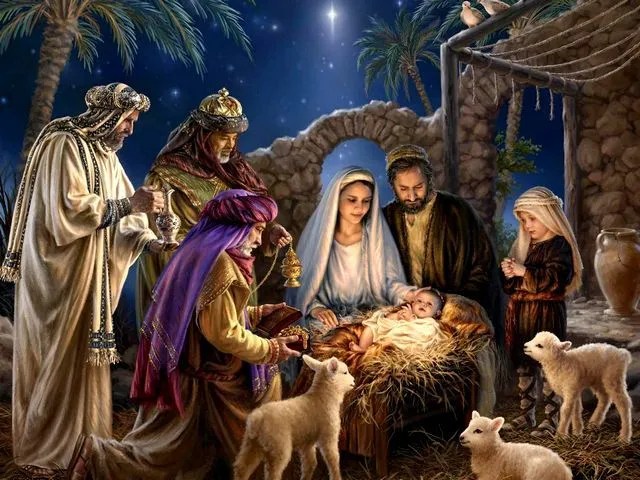
Monday, 14 August 2017 : Vigil Mass of the Solemnity of the Assumption of the Blessed Virgin Mary (First Reading)

Liturgical Colour : White

1 Chronicles 15 : 3-4, 15-16 and 1 Chronicles 16 : 1-2

Then David gathered all Israel together in Jerusalem to bring the Ark of God up to the place he had prepared for it. David called together the sons of Aaron and the sons of Levi. And the Levites carried the Ark of God with the poles on their shoulders, as Moses had ordered according to the command of YHVH.

David then told the leaders of the Levites to assign duties for some Levites to sing and play a joyful tune with their various musical instruments : harps and lyres and cymbals. They brought the Ark of God in and put it inside the tent that David had prepared for it; and they offered burnt offerings and peace offerings to God.

And when David had finished offering the sacrifices, he blessed the people in the Name of YHVH.

Monday, 14 August 2017 : 19th Week of Ordinary Time, Memorial of St. Maximilian Kolbe, Priest and Martyr (Homily and Scripture Reflections)

Liturgical Colour : Red

Dear brothers and sisters in Christ, on this day first listened to the words of God, telling us in the first reading from the Book of Deuteronomy, that all of the people of God ought to believe in the Lord wholeheartedly and obey Him in all of His Laws. That is because He is truly good, and His ways are righteousness and justice. He is the source of all good in this world, and everyone who follows the Lord should live in accordance with His will.

Then, all of us heard about the Gospel passage today, from the Gospel of St. Matthew, in which the disciple of Jesus, St. Peter was asked by the temple tax collectors on whether his Master paid the temple tax or not. Then Jesus told him that those who are the sons and daughters of the kings of the earth, namely the lords and royalties of the worldly kingdoms do not pay taxes, but instead, the strangers and aliens that live in those kingdoms.

But at the same time, He also told St. Peter to obey the laws of the earth, the laws of the worldly kings and rulers, by asking him to obtain a gold coin miraculously from a fish he caught at the lake. Then He asked St. Peter to pay that gold coin as the due for Him and His disciples to the temple tax collectors. This resonates with what the Lord also said in another occasion in the Gospels, namely when He said, "Give to Caesar what belongs to Caesar, and give to God what belongs to God."

What does this mean, brothers and sisters in Christ? It means that as good Christians, all of us must first of all of course be obedient to God and follow all His laws and precepts without exceptions. But at the same time, we must also be good citizens and members of the community. While the Lord did mention that the ways of this world are often contrary to His ways, it does not mean that we should oppose each and every works of the states and countries we belong to in this world.

Rather, as long as the actions and the works of the states and countries we belong to are just and righteous, and working for the good of the common people and everyone, then by all means all of us Christians must be obedient and active in our participation in the world community and amongst our neighbours in our societies as well. However, having said that, we must also be vigilant lest what the world demands from us has become something that departed from righteousness and justice, as in this world, states and countries can indeed become corrupted by the power and the wickedness found in this world.

This is why, all the more that each and every one of us as Christians must not be lukewarm or passive in our faith life, but instead we must be truly devoted and be active in our faith, or else that is when we will end up being swayed away from the path of the Lord's righteousness and justice, into the path of selfishness, wickedness and injustice.

That also means that as Christians, all of us must stand up for the sake of justice. We must defend the rights of the poor and the weak, be loving and compassionate in our dealings to each other, showing care and concern for those who are sorrowful and suffering. And we must be true followers of Christ in all things we say and do, in the footsteps of the saints and martyrs who have predeceased us and gone before us.

Particularly, on this day, what we have heard in the Scripture passage is very apt, as today we mark the feast of St. Maximilian Kolbe, the famous saint and martyr of the Holocaust during the Second World War. St. Maximilian Kolbe was a devout and committed Polish missionary and priest, who worked hard among the people to spread the faith and strong devotion to the Lord and His blessed mother Mary.

He went to many places as a missionary, spreading the faith to the people in faraway places. His commitment and devotion won him many converts who followed the faith because of his preachings among them. But, his most renowned act came about at the time of the Second World War, when the NAZI German government invaded most of Europe, conquering most of Europe and bringing many people, especially the Jews into the terrible concentration camps.

Surely we have heard the great sufferings that those people have endured in those concentration camps, especially in Auschwitz concentration camp, where the worst atrocities happened. It was one of the worst displays of worldly wickedness, evil and entirely selfish desire of mankind, their pride and ambition, arrogance and hatred, in the genocide that had happened in those places.

Yet, the actions of St. Maximilian Kolbe became a great light that become an inspiration to many others in the midst of the great darkness. He was arrested and eventually ended up in the Auschwitz concentration camp as his monastery was closed down due to its publications standing up faithfully for the Lord, speaking out against the great atrocities of the NAZI Germany.

At a place where death awaited people living there daily, St. Maximilian Kolbe helped to encourage many of the prisoners through his preachings and exemplary actions among them. However, his greatest act lies in the moment when he offered himself in exchange of another prisoner who was condemned to death due to the escape of some prisoners. He offered his own life willingly to save his fellow inmate, who was crying out for his family.

And thus it was how St. Maximilian Kolbe showed the love of Christ, in its perfect and ultimate form, in obeying with complete faith, the law and the will of God, over that of his obligations to any worldly rulers and powers. He gave up his own life as the sign of the love of God, which as the Lord Jesus Himself said, that there is no greater love than for someone to give up his life for a friend.

Brothers and sisters in Christ, the examples of St. Maximilian Kolbe and his commitment to the Lord should become our inspiration to live our faith ever more devoutly, in true commitment and with sincerity, to seek out righteousness and justice through our actions and deeds, and by standing up for our faith, for the goodness that God had taught us to do in our lives, and by the selfless giving of ourselves.

Let us thus live righteously from now on, remembering always the examples of the holy saints, men and women who have walked before us in faith. Let us emulate their actions and examples in our own living and actions, and may God bless us all in our endeavours, so that through us, His Name will ever be glorified, and we will always be able to live according to His will. Amen.

Monday, 14 August 2017 : 19th Week of Ordinary Time, Memorial of St. Maximilian Kolbe, Priest and Martyr (Gospel Reading)

Liturgical Colour : Red

Matthew 17 : 22-27

At that time, when Jesus was in Galilee with the Twelve, He said to them, "The Son of Man will be delivered into the hands of men, and they will kill Him. But He will rise on the third day." The Twelve were deeply grieved.

When they returned to Capernaum, the temple tax collectors came to Peter and asked him, "Does your Master pay the temple tax?" He answered, "Yes." Peter then entered the house; and immediately, Jesus asked him, "What do you think, Simon? Who pay taxes or tribute to the kings of the earth : their sons or strangers and aliens?"

Peter replied, "Strangers and aliens." And Jesus told him, "The sons, then, are tax-free. But, so as not to offend these people, go to the sea, throw in a hook, and open the mouth of the first fish you catch. You will find a coin in it. Take the coin and give it to them for you and for Me."

Monday, 14 August 2017 : 19th Week of Ordinary Time, Memorial of St. Maximilian Kolbe, Priest and Martyr (Psalm)

Liturgical Colour : Red

Psalm 147 : 12-13, 14-15, 19-20

Exalt YHVH, o Jerusalem; praise your God, o Zion! For He strengthens the bars of your gates and blesses your children within you.

He grants peace on your borders and feeds you with the finest grain. He sends His command to the earth and swiftly runs His word.

It is He, Who tells Jacob His words; His laws and decrees, to Israel. This, He has not done for other nations, so His laws remain unknown to them. Alleluia!

Monday, 14 August 2017 : 19th Week of Ordinary Time, Memorial of St. Maximilian Kolbe, Priest and Martyr (First Reading)

Liturgical Colour : Red

Deuteronomy 10 : 12-22

So now, Israel, what is it that YHVH, your God, asks of you but to fear Him and follow all His ways? Love Him and serve Him with all your heart and with all your soul. Observe the commandments of YHVH and His laws which I command you today, for your good.

See : the heavens, those that are seen and those that are unseen, the earth and all that is in it, everything belongs to YHVH, your God. Nevertheless, it was on your fathers that YHVH set His heart. He loved them, and after them, He chose their descendants – you – preferring you to all the peoples, as you can see this day.

Purify your hearts, then, and do not be defiant towards YHVH because YHVH is the God of gods and the Lord of lords. He is the great God, the strong and terrible God. When He judges, He treats everyone equally; He does not let Himself be bought by gifts. He renders justice to the orphan and the widow, and loves the stranger, giving him bread and clothing.

Love the stranger then, because you yourselves were strangers in the land of Egypt. Fear YHVH, your God, serve Him, follow Him and call on His Name when you have to make an oath. He is your pride and He is your God, Who has done those amazing things for you. When you went down to Egypt, your ancestors were no more than seventy persons, but now, YHVH, your God, has made you as many as the stars of heaven.

Monday, 7 August 2017 : 18th Week of Ordinary Time, Memorial of Pope St. Sixtus II, Pope and Companions, Martyrs, and St. Cajetan, Priest (Homily and Scripture Reflections)

Liturgical Colour : Green or Red (Martyrs) or White (Priests)

Dear brothers and sisters in Christ, on this day we listened first of all to the story of how the people of God, the Israelites, complained against the Lord and His servant Moses, for having brought them out from the land of Egypt, where they were enslaved by the Egyptians for many years. God saved them all through His mighty power, and through Moses, His servant, He led them out of the land of their slavery into the desert and journeying towards the Promised Land.

But the people were not accustomed to such a journey, and despite all the things that God had done before them, and which He had done for their sake, they refused to obey Him and grumbled against Him. They did all sorts of things in opposition to God, including even in raising up a pagan idol, specifically a golden calf which they claimed to be their god. They grumbled that at least in Egypt, they would be able to enjoy food and had enough to drink, even if they were enslaved.

Even though God had given them the very bread from heaven, in the form of manna, every day without fail, providing them food without end, and also clear and sweet water to drink in the middle of a vast desert, protecting them from their enemies and crushing all those who plotted for the destruction of His people, but the Israelites continued to harden their hearts and they refused to listen to Him, or to Moses.

And in the first reading which we have today, therefore, we heard how Moses reached his breaking point, the moment of his despair and helplessness, having been assaulted and pressured by all those who have complained against him and against God's laws. He was tasked to lead God's people through the desert on their journey to the Promised Land, and yet, it seemed that the journey was really not an easy one at all. He was frustrated, and went on to share his frustrations with the Lord.

This in fact ties in perfectly well with what we have also heard in our Gospel passage today, when we heard about the moment when the disciples were assaulted with great waves and strong winds, as they boarded the ship on their journey across the lake of Galilee. Jesus was not with them, and the disciples were scared at the winds and the waves, their courage surely faltered in the midst of such a storm, which in another Gospel passage, when Jesus was indeed with them, they cried out to Him, fearing for their lives.

When they saw Jesus walking on the sea in the midst of the waves, they refused to believe that He was indeed Whom they had seen. Jesus had indeed walked on the sea towards them, but they thought that the One they saw could not have been the Lord, but instead a ghost. This was pretty much just as how the Israelites refused to believe in God, even though they had seen the wonders and the works of God.

These stories and lessons from the past are reminders for each and every one of us Christians, that our path in life will not be an easy one, but instead will be filled with many obstacles, challenges and difficulties. We will encounter moments of difficulty, temptations from various sources and the pressure will be exerted upon us to make us to give up this journey and struggle that we do in order to reach out to the Lord.

The story of Jesus walking on the sea in the middle of a great storm itself is rich in representations and meanings, through which God wants us to understand better His intentions for us. The disciples represent all of us the followers of Christ, all Christians who have been gathered together, in the Church of God, which is often represented as a boat or a ship. The great waves and the winds represent the challenges and the forces arrayed by the world against us.

It is easy for us to stumble and to panic, if we do not have a strong faith in the Lord, as the Israelites at the time of Moses, and the disciples of the Lord Jesus had done, when they were faced with difficulties and challenges from various sources. But the Lord is in fact always with us, guiding us and journeying with us, only that we often did not realise that He had done so.

Why is that so, brothers and sisters in Christ? That is because we are too focused on ourselves, on our needs and desires, on our own personal human ambitions and wants, which resulted in our inability to shake off the temptations of the world, which Satan always constantly place on our path in order to tempt us into sin, and therefore, to disobey God.

There will always be storms and obstacles in our path, but if we keep our faith in God strong, we will be able to persevere through and find our way forward to Him. This is where we should seek to learn from the examples of the holy Pope St. Sixtus II and his fellow companions, martyrs of the faith and defenders of the Church of God, and St. Cajetan, a holy and devout servant of God, a holy priest of God.

Pope St. Sixtus II lived during a turbulent time of the Church, at a time when the faithful and the Church were persecuted terribly by the Roman authorities. The Roman Emperor Valerian declared a wide-ranging and massive persecution of the Christian faith, and Pope St. Sixtus II led the faithful through that difficult time. It was told that he and many other priests, deacons and the faithful were arrested, imprisoned and eventually ended in their martyrdom, refusing to give up their faith.

Meanwhile, St. Cajetan was a renowned priest who was remembered for his hard works among the people, especially his efforts to help the people who have financial difficulties, establishing institutions that champion the cause of the poor, and place the needs of the less fortunate ahead of profit-seeking and greed. He ministered to the poor and the needy, showing to all of us what each and every one of us can do in order to become better Christians.

Brothers and sisters in Christ, the examples of the faith and dedication of the holy martyrs, Pope St. Sixtus II and his companions, as well as the generosity and charity shown by St. Cajetan, the holy priest of God should inspire each and every one of us Christians to live more and more faithfully in accordance with the will of God, obeying His laws and commandments, and placing our trust in Him.

No matter what, our faith in God must remain strong, for He is ever faithful and loving towards us. Let us all no longer be deterred by the challenges and obstacles we may encounter in life, and let us no longer be dictated by the whim of our human desires and greed, but instead, let us walk only in the path of God from now on, letting go of those things that have hindered us all these while, and find our way to God through perseverance and hard work.

May the Lord help us in our endeavours, and may He bless our works. Let us ask the holy saints, Pope St. Sixtus II and his companions, and St. Cajetan for their intercession before God. Pray for us, o holy saints, that we may overcome our obstacles in life, and persevere in faith as you all had, that one day we may glorify God together with all of you in the eternal glory of heaven. Amen.

Monday, 7 August 2017 : 18th Week of Ordinary Time, Memorial of Pope St. Sixtus II, Pope and Companions, Martyrs, and St. Cajetan, Priest (Gospel Reading)

Liturgical Colour : Green or Red (Martyrs) or White (Priests)

Matthew 14 : 22-36

At that time, immediately, Jesus obliged His disciples to get into the boat and go ahead of Him to the other side, while He sent the crowd away. And having sent the people away, He went up the mountain by Himself, to pray. At nightfall, He was there alone.

Meanwhile, the boat was very far from land, dangerously rocked by the waves, for the wind was against it. At daybreak, Jesus came to them, walking on the sea. When they saw Him walking on the sea, they were terrified, thinking that it was a ghost. And they cried out in fear. But at once, Jesus said to them, "Courage! Do not be afraid. It is Me!"

Peter answered, "Lord, if it is You, command me to come to You on the water." Jesus said to him, "Come!" And Peter got out of the boat, and walked on the water to go to Jesus. But seeing the strong wind, he was afraid, and began to sink; and he cried out, "Lord, save me!"

Jesus immediately stretched out His hand and took hold of him, saying, "Man of little faith, why did you doubt?" As they got into the boat, the wind dropped. Then those in the boat bowed down before Jesus, saying, "Truly, You are the Son of God!"

They came ashore at Gennesaret. The local people recognised Jesus and spread the news throughout the region. So they brought to Him all the sick people, begging Him to let them touch just the hem of His cloak. All who touched it became perfectly well.

Monday, 7 August 2017 : 18th Week of Ordinary Time, Memorial of Pope St. Sixtus II, Pope and Companions, Martyrs, and St. Cajetan, Priest (Psalm)

Liturgical Colour : Green or Red (Martyrs) or White (Priests)

Psalm 80 : 12-13, 14-15, 16-17

But My people did not listen; Israel did not obey. So I gave them over to their stubbornness and they followed their own counsels.

If only My people would listen, if only Israel would walk in My ways, I would quickly subdue their adversaries and turn My hand against their enemies.

Those who hate YHVH would cringe before Him, and their panic would last forever. I would feed you with the finest wheat and satisfy you with honey from the rock.

Monday, 7 August 2017 : 18th Week of Ordinary Time, Memorial of Pope St. Sixtus II, Pope and Companions, Martyrs, and St. Cajetan, Priest (First Reading)

Liturgical Colour : Green or Red (Martyrs) or White (Priests)

Numbers 11 : 4b-15

The Israelites wept and said, "Who will give us meat to eat? We remember the fish we ate without cost in Egypt, the cucumbers, the melons, the leeks, the onions and garlic. Now our appetite is gone; there is nothing to look at, nothing but manna."

Now the manna was like coriander seed and had the appearance of bedellium. The people went about gathering it up and then ground it between millstones or pounded it in a mortar. They boiled it in a pot and made cakes with it which tasted like cakes made with oil. As soon as dew fell at night in the camp, the manna came with it.

Moses heard the people crying, family by family at the entrance to their tent and YHVH became very angry. This displeased Moses. Then Moses said to YHVH, "Why have You treated Your servant so badly? Is it because You do not love me that You burdened me with this people? Did I conceive all these people and did I give them birth?"

"And now You want me to carry them in my bosom as a nurse carries an infant, to the land You promised on oath to their fathers? Where would I get meat for all these people, when they cry to me saying :'Give us meat that we may eat?'"

"I cannot, myself alone, carry all these people; the burden is too heavy for me. Kill me rather than treat me like this, I beg of You, if You look kindly on me, and let me not see Your anger."

Monday, 31 July 2017 : 17th Week of Ordinary Time, Memorial of St. Ignatius of Loyola, Priest (Homily and Scripture Reflections)

Liturgical Colour : White

Dear brothers and sisters in Christ, today we heard the story of how the Israelites rebelled against God in the first reading from the Book of Exodus, telling us about that time when the people of Israel chose to build for themselves a pagan idol, a golden calf to be worshipped as god instead of the One and only True God Who had brought them out from the land of Egypt.

They have rebelled against God and forgotten the love and mercy which He had shown them, when He brought them out of the land of their slavery. They suffered grievously in Egypt under the tyranny of the Pharaoh and the Egyptians, and God remembered them and the promise which He had made with Abraham and their forefathers. God sent ten great plagues upon Egypt which forced the Pharaoh to let the Israelites go free, and when he reneged on that and sent his chariots after the Israelites, God destroyed the entire armies of the Egyptians in the Red Sea.

But despite the wonders that He had shown them, and despite the guidance and help which He had given them throughout their journey, the Israelites still chose to commit sin by raising up for themselves a pagan idol, a god that they established to be their god and saviour, as the one who brought them out of Egypt, just because Moses went up the Mount Sinai for forty days and forty nights to receive God's laws and commandments.

They thought that God had abandoned them, and therefore, they quickly lost faith in Him and turned to alternative sources of comfort and hope, that is in the pagan worship of the false gods and idols, one that they must have been exposed to during their time in Egypt. A golden calf is one among the many deities worshipped and held sacred by the Egyptians, and thus Israel sinned against God.

We may be wondering why did the Israelites do such a thing, that is to rebel against God and to disobey His commandments. But the answer to this is really the fact that the Israelites did not allow the Word of God and His truth to develop inside of them. They witnessed all the miraculous deeds of God and listened to His words and covenant, as delivered unto them through Moses, but they did not allow them to grow in them. Their faith was a superficial faith.

In the Gospel today, Jesus spoke to His disciples about the two parables related to each other, one in which Jesus spoke about the kingdom of heaven being likened to a mustard seed, which is a very small and insignificant seed, compared to other fruits which have much larger seeds. However, from that very small seed, when placed in a fertile soil and provided with the optimum condition for germination and growth, the mustard seed will grow into a large mustard plant, far larger than what we would normally expect for seed of such a small size.

Then, Jesus continued with the story of another parable, of when yeast is added into three measures of flour shaped into a dough, the yeast will cause the whole dough to rise from a flat and small piece of dough into a large, expansive and soft piece of bread. Yeasts are very small and microscopic in size, and yet under the right conditions, the yeast can cause marvellous works to happen, including the fermentation of grapes into wine, and as mentioned, the formation of the leavened bread.

Therefore, after hearing and discussing all of these, what then, is the message which all of us should take note from today's Scripture readings? There are two key messages which we should take heed of, first of all, it is that we must provide a good condition and environment in our lives, in order for our faith to grow and develop within us. As we see from the parables of Jesus, using the examples of mustard seed and yeasts, mustard seed cannot grow and germinate without sufficient water in the soil, oxygen and suitable temperature, and yeast similarly cannot carry out its function unless oxygen is present.

Similarly therefore, our faith cannot grow without us providing a good condition and environment in which that faith we have can flourish. Otherwise, our faith will continue to remain dormant and will be useless to us. Thus, we have to provide a conducive environment, through love and dedication of ourselves to our fellow men, and through our commitment to God. And it is important for us to develop ourselves spiritually, by having an active prayer life, in which we constantly pray from our hearts, seeking to communicate with God.

And then, the second message is that, it does not matter how small we think our faith may be, even when compared to others who are seemingly more faithful and more pious than us, just like the small mustard seed, as long as it is given the right condition for optimum growth, eventually the seed will blossom and become fruitful. Thus, we ourselves do not need to worry or be concerned that we have little faith, for in whatever little faith we may have, as long as we are genuine in that faith, we will find our way forward.

We should thus begin from ourselves and from those who we are interacting with, from our families and friends. We should live our faith actively and sincerely through our daily actions, by loving our brethren, and showing mercy to those who have hurt us. We should increase our charity and generosity to those who are in need, and be ready to provide ourselves out of love for them.

Perhaps, we all should be inspired by the example of St. Ignatius of Loyola, the founder of the Society of Jesus, or also known as the Jesuit order. The Jesuits are now the largest religious order in the Church, with enormous contributions in the field of evangelisation and charity works in the Church. But their origins traced to the humble beginnings under St. Ignatius of Loyola and his companions.

St. Ignatius of Loyola was born a nobleman into an influential family in what is now Spain, destined to lead a life of privilege, wealth and fame, and he was thus brought up in that manner, seeking for worldly glory and fame, as he became a knight involved in conflicts and wars raging at that time. However, as he lay wounded in one occasion after a great battle, it came to him that whatever glory and fame he sought in the world, whatever valour and honour he sought through battle were meaningless and empty.

Thus St. Ignatius of Loyola chose to leave everything behind and devote himself to the works of the Church. He gathered fellow minded men who desired to spearhead the efforts of the Church in evangelisation and charity. As it happened, it turned out that the religious order that St. Ignatius of Loyola founded went on to become a very important player in the Church's effort of Counter-Reformation in resisting and fighting back the tide of heresy of Protestantism throughout Christendom, as well as in the evangelising works of St. Francis Xavier, another Jesuit and companion of St. Ignatius of Loyola.

The examples shown by St. Ignatius of Loyola show us that even though we may think that our faith is small, weak or insignificant, but if we have the desire to grow in our faith, and take the concrete steps necessary, we will be able to cultivate the faith we have in us, and we can have truly great and far-ranging effect, as shown in how St. Ignatius of Loyola, once a young nobleman with worldly ambitions and lacking in faith, after he had devoted himself to God's cause, he began the good works which impacts are still felt even to this very day.

Brothers and sisters in Christ, therefore, let us all ask St. Ignatius of Loyola to intercede for us, that God may move our hearts which are filled with doubts and indecision, so that we may be more courageous and be more capable of taking concrete actions and steps to be ever more faithful and committed to our faith in God. May the Lord bless all of our good works, and may He give us the courage day after day to serve Him with all our might. Amen.