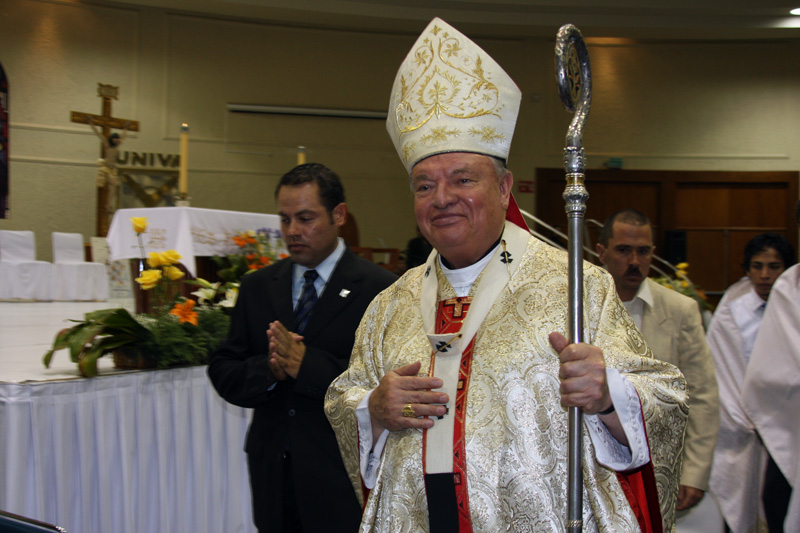
Today, Thursday, 28 March 2013, Cardinal Juan Sandoval Iniguez, Cardinal-Priest of Nostra Signora di Guadalupe e S. Filippo Martire, and Metropolitan Archbishop Emeritus of Guadalajara, Mexico, turns 80, and therefore, according to the rules written in the Apostolic Constitution Universi Dominici Gregis, he loses his right to vote in any future conclave.
May God bless His Eminence Cardinal Sandoval Iniguez, with a blessed old age and health. May he remain strong in the faith and hopefully can perhaps still carry out the mission God had given him.
The College of Cardinals now stands at 206 members in total, with 113 Cardinal-electors and 93 Cardinal non-electors. There are now vacancy of 7 Cardinal-electors as compared to the maximum number of electors allowed in the Conclave of 120, although Popes John Paul II and Benedict XVI had sometimes surpassed this limit.
Next Cardinal-elector to age out (80) will be Cardinal Godfried Danneels on 4 June 2013.
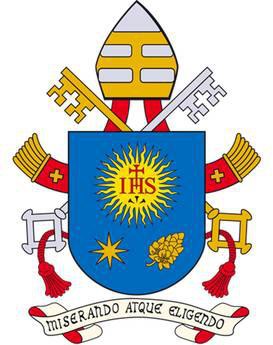
The draft version of Pope Francis’ coat of arms had been finalised, with minor changes that improves greatly upon the draft version. The golden star is altered from a five-pointed star into an 8-pointed star representing the Blessed Virgin Mary, and with the spikenard flower, which is used in perfumes, being the symbol of St. Joseph, more accurately drawn. Finally, the motto “Miserando atque Eligendo” is encased in a scroll.
This should be the finalised official version of Pope Francis’ coat of arms, though variations may exist in different forms.
Jesus enters Jerusalem. The crowd of disciples accompanies him in festive mood, their garments are stretched out before him, there is talk of the miracles he has accomplished, and loud praises are heard: “Blessed is the King who comes in the name of the Lord. Peace in heaven and glory in the highest!” (Lk 19:38).
Crowds, celebrating, praise, blessing, peace: joy fills the air. Jesus has awakened great hopes, especially in the hearts of the simple, the humble, the poor, the forgotten, those who do not matter in the eyes of the world. He understands human sufferings, he has shown the face of God’s mercy, and he has bent down to heal body and soul.
This is Jesus. This is his heart which looks to all of us, to our sicknesses, to our sins. The love of Jesus is great. And thus he enters Jerusalem, with this love, and looks at us. It is a beautiful scene, full of light – the light of the love of Jesus, the love of his heart – of joy, of celebration.
At the beginning of Mass, we too repeated it. We waved our palms, our olive branches. We too welcomed Jesus; we too expressed our joy at accompanying him, at knowing him to be close, present in us and among us as a friend, a brother, and also as a King: that is, a shining beacon for our lives. Jesus is God, but he lowered himself to walk with us. He is our friend, our brother. He illumines our path here. And in this way we have welcomed him today. And here the first word that I wish to say to you: joy! Do not be men and women of sadness: a Christian can never be sad! Never give way to discouragement! Ours is not a joy born of having many possessions, but from having encountered a Person: Jesus, in our midst; it is born from knowing that with him we are never alone, even at difficult moments, even when our life’s journey comes up against problems and obstacles that seem insurmountable, and there are so many of them! And in this moment the enemy, the devil, comes, often disguised as an angel, and slyly speaks his word to us. Do not listen to him! Let us follow Jesus! We accompany, we follow Jesus, but above all we know that he accompanies us and carries us on his shoulders. This is our joy, this is the hope that we must bring to this world. Please do not let yourselves be robbed of hope! Do not let hope be stolen! The hope that Jesus gives us.
The second word. Why does Jesus enter Jerusalem? Or better: how does Jesus enter Jerusalem? The crowds acclaim him as King. And he does not deny it, he does not tell them to be silent (cf. Lk 19:39-40). But what kind of a King is Jesus? Let us take a look at him: he is riding on a donkey, he is not accompanied by a court, he is not surrounded by an army as a symbol of power. He is received by humble people, simple folk who have the sense to see something more in Jesus; they have that sense of the faith which says: here is the Saviour. Jesus does not enter the Holy City to receive the honours reserved to earthly kings, to the powerful, to rulers; he enters to be scourged, insulted and abused, as Isaiah foretold in the First Reading (cf. Is 50:6). He enters to receive a crown of thorns, a staff, a purple robe: his kingship becomes an object of derision. He enters to climb Calvary, carrying his burden of wood. And this brings us to the second word: Cross. Jesus enters Jerusalem in order to die on the Cross. And it is precisely here that his kingship shines forth in godly fashion: his royal throne is the wood of the Cross! It reminds me of what Benedict XVI said to the Cardinals: you are princes, but of a king crucified. That is the throne of Jesus. Jesus takes it upon himself… Why the Cross? Because Jesus takes upon himself the evil, the filth, the sin of the world, including the sin of all of us, and he cleanses it, he cleanses it with his blood, with the mercy and the love of God. Let us look around: how many wounds are inflicted upon humanity by evil! Wars, violence, economic conflicts that hit the weakest, greed for money that you can’t take with you and have to leave. When we were small, our grandmother used to say: a shroud has no pocket. Love of power, corruption, divisions, crimes against human life and against creation! And – as each one of us knows and is aware – our personal sins: our failures in love and respect towards God, towards our neighbour and towards the whole of creation. Jesus on the Cross feels the whole weight of the evil, and with the force of God’s love he conquers it, he defeats it with his resurrection. This is the good that Jesus does for us on the throne of the Cross. Christ’s Cross embraced with love never leads to sadness, but to joy, to the joy of having been saved and of doing a little of what he did on the day of his death.
Today in this Square, there are many young people: for twenty-eight years Palm Sunday has been World Youth Day! This is our third word: youth! Dear young people, I saw you in the procession as you were coming in; I think of you celebrating around Jesus, waving your olive branches. I think of you crying out his name and expressing your joy at being with him! You have an important part in the celebration of faith! You bring us the joy of faith and you tell us that we must live the faith with a young heart, always: a young heart, even at the age of seventy or eighty. Dear young people! With Christ, the heart never grows old! Yet all of us, all of you know very well that the King whom we follow and who accompanies us is very special: he is a King who loves even to the Cross and who teaches us to serve and to love. And you are not ashamed of his Cross! On the contrary, you embrace it, because you have understood that it is in giving ourselves, in giving ourselves, in emerging from ourselves that we have true joy and that, with his love, God conquered evil. You carry the pilgrim Cross through all the Continents, along the highways of the world! You carry it in response to Jesus’ call: “Go, make disciples of all nations” (Mt 28:19), which is the theme of World Youth Day this year. You carry it so as to tell everyone that on the Cross Jesus knocked down the wall of enmity that divides people and nations, and he brought reconciliation and peace. Dear friends, I too am setting out on a journey with you, starting today, in the footsteps of Blessed John Paul II and Benedict XVI. We are already close to the next stage of this great pilgrimage of the Cross. I look forward joyfully to next July in Rio de Janeiro! I will see you in that great city in Brazil! Prepare well – prepare spiritually above all – in your communities, so that our gathering in Rio may be a sign of faith for the whole world. Young people must say to the world: to follow Christ is good; to go with Christ is good; the message of Christ is good; emerging from ourselves, to the ends of the earth and of existence, to take Jesus there, is good! Three points, then: joy, Cross, young people.
Let us ask the intercession of the Virgin Mary. She teaches us the joy of meeting Christ, the love with which we must look to the foot of the Cross, the enthusiasm of the young heart with which we must follow him during this Holy Week and throughout our lives. May it be so.
1. Palm Sunday (Solemn Entry into Jerusalem) : Sunday, 24 March 2013 at 9.30 am Rome time / CET / UTC+1 (St. Peter’s Square)
2. Chrism Mass (Blessing of the Holy Oils) : Thursday, 28 March 2013 at 9.30 am Rome time / CET / UTC+1 (St. Peter’s Basilica)
3. Cena Domini (Mass of the Lord’s Supper) : Thursday, 28 March 2013 at 5.30 pm Rome time / CET / UTC+1 (Casa del Marmo prison)
4. Good Friday (Passion of our Lord Jesus Christ) : Friday, 29 March 2013 at 5 pm Rome time / CET / UTC+1 (St. Peter’s Basilica)
5. Way of the Cross at Colosseum : Friday, 29 March 2013 at 9 pm Rome time / CET / UTC+1 (Colosseum)
6. Easter Vigil (Resurrection of our Lord Jesus Christ) : Saturday, 30 March 2013 at 9 pm Rome time / CET / UTC+1 (St. Peter’s Basilica)
7. Easter Sunday (Resurrection of our Lord Jesus Christ) : Sunday, 31 March 2013 at 10 am Rome time / CET / UTC+1 (St. Peter’s Square)
8. Urbi et Orbi Blessing of Easter (Blessing to the city of Rome and the world) : Sunday, 31 March 2013 at 12 pm (noon) Rome time / CET / UTC+1 (St. Peter’s Square)
Today also marks the Papal Inauguration of the 266th and current Pope, Pope Francis
Matthew 1 : 16, 18-21, 24a
Jacob was the father of Joseph, the husband of Mary, and from her came Jesus who is called the Christ – the Messiah.
This is how Jesus Christ was born : Mary His mother had been given to Joseph in marriage, but before they lived together, she was found to be pregnant through the Holy Spirit. Then Joseph, her husband, made plans to divorce her in all secrecy. He was an upright man, and in no way did he want to discredit her.
While he was pondering over this, an angel of the Lord appeared to him in a dream and said, “Joseph, descendant of David, do not be afraid to take Mary as your wife. She has concieved by the Holy Spirit, and now she will bear a Son. You shall call Him ‘Jesus’ for He will save His people from their sins.”
When Joseph woke up, he did what the angel of the Lord had told him to do.
Alternative reading
Luke 2 : 41-51a
Every year the parents of Jesus went to Jerusalem for Feast of the Passover, as was customary. And when Jesus was twelve years old; He went up with them, according to the custom of this feast. After the festival was over, they returned but the boy Jesus remained in Jerusalem, and His parents did not know it.
They thought He was in the company, and after walking the whole day they looked for Him among their relatives and friends. As they did not find Him, they went back to Jerusalem searching for Him, and on the third day they found Him in the Temple, sitting among the teachers, listening to them and asking questions. And all the people were amazed at His understanding and His answers.
His parents were very surprised when they saw Him, and His mother said to Him, “Son, why have You done this to us? Your father and I were very worried while searching for You.” Then He said to them, “Why were you looking for Me? Did you not know that I must be in My Father’s house?” But they did not understand this answer.
Jesus went down with them, returning to Nazareth, and He continued to be subject to them.
Today also marks the Papal Inauguration of the 266th and current Pope, Pope Francis
Romans 4 : 13, 16-18, 22
If God promised Abraham, or rather his descendants, that the world would belong to him, this was not because of his obeying the Law, but because he was just and a friend of God through faith.
For that reason, faith is the way and all is given by grace; and the promises of Abraham are fulfilled for all his descendants, not only for his children according to the Law, but also for all the others who have believed.
Abraham is the father of all of us, as it is written : “I will make you father of many nations.” He is your father in the eyes of Him who gives life to the dead, and calls into existence what does not yet exist, for this is the God in whom he believed.
Abraham believed and hoped against all expectation, thus becoming father of many nations, as he had been told : “See how many will be your descendants.” This was taken into account for him to attain righteousness.
Today also marks the Papal Inauguration of the 266th and current Pope, Pope Francis
Psalm 88 : 2-3, 4-5, 27 and 29
I will sing forever, o Lord, of Your love and proclaim Your faithfulness from age to age. I will declare how steadfast is Your love, how firm Your faithfulness.
You said, “I have made a covenant with David, My chosen one; I have made a pledge to My servant. I establish his descendants forever; I build his throne for all generations.
He will call on Me, ‘You are my Father, my God, my Rock, my Saviour.’ I will keep My covenant firm forever, and My love for him will endure.
Today also marks the Papal Inauguration of the 266th and current Pope, Pope Francis
2 Samuel 7 : 4-5a, 12-14a, 16
That very night, YHVH’s word came to Nathan, “Go and tell my servant David, this is what YHVH says : Are you able to build a house for Me to live in? When the time comes for you to rest with your ancestors, I will raise up your son after you, the one born of you and I will make his reign secure.”
“He shall build up a house for My Name and I will firmly establish his kingship forever. I will be a Father to him and he shall be My son. Your house and your reign shall last forever before Me, and your throne shall be forever firm.”
“I thank the Lord that I can celebrate this Holy Mass for the inauguration of my Petrine ministry on the solemnity of Saint Joseph, the spouse of the Virgin Mary and the patron of the universal Church. It is a significant coincidence, and it is also the name-day of my venerable predecessor: we are close to him with our prayers, full of affection and gratitude.
I offer a warm greeting to my brother cardinals and bishops, the priests, deacons, men and women religious, and all the lay faithful. I thank the representatives of the other Churches and ecclesial Communities, as well as the representatives of the Jewish community and the other religious communities, for their presence. My cordial greetings go to the Heads of State and Government, the members of the official Delegations from many countries throughout the world, and the Diplomatic Corps.
In the Gospel we heard that “Joseph did as the angel of the Lord commanded him and took Mary as his wife” (Mt 1:24). These words already point to the mission which God entrusts to Joseph: he is to be the custos, the protector. The protector of whom? Of Mary and Jesus; but this protection is then extended to the Church, as Blessed John Paul II pointed out: “Just as Saint Joseph took loving care of Mary and gladly dedicated himself to Jesus Christ’s upbringing, he likewise watches over and protects Christ’s Mystical Body, the Church, of which the Virgin Mary is the exemplar and model” (Redemptoris Custos, 1).
How does Joseph exercise his role as protector? Discreetly, humbly and silently, but with an unfailing presence and utter fidelity, even when he finds it hard to understand. From the time of his betrothal to Mary until the finding of the twelve-year-old Jesus in the Temple of Jerusalem, he is there at every moment with loving care. As the spouse of Mary, he is at her side in good times and bad, on the journey to Bethlehem for the census and in the anxious and joyful hours when she gave birth; amid the drama of the flight into Egypt and during the frantic search for their child in the Temple; and later in the day-to-day life of the home of Nazareth, in the workshop where he taught his trade to Jesus.
How does Joseph respond to his calling to be the protector of Mary, Jesus and the Church? By being constantly attentive to God, open to the signs of God’s presence and receptive to God’s plans, and not simply to his own. This is what God asked of David, as we heard in the first reading. God does not want a house built by men, but faithfulness to his word, to his plan. It is God himself who builds the house, but from living stones sealed by his Spirit. Joseph is a “protector” because he is able to hear God’s voice and be guided by his will; and for this reason he is all the more sensitive to the persons entrusted to his safekeeping. He can look at things realistically, he is in touch with his surroundings, he can make truly wise decisions. In him, dear friends, we learn how to respond to God’s call, readily and willingly, but we also see the core of the Christian vocation, which is Christ! Let us protect Christ in our lives, so that we can protect others, so that we can protect creation!
The vocation of being a “protector”, however, is not just something involving us Christians alone; it also has a prior dimension which is simply human, involving everyone. It means protecting all creation, the beauty of the created world, as the Book of Genesis tells us and as Saint Francis of Assisi showed us. It means respecting each of God’s creatures and respecting the environment in which we live. It means protecting people, showing loving concern for each and every person, especially children, the elderly, those in need, who are often the last we think about. It means caring for one another in our families: husbands and wives first protect one another, and then, as parents, they care for their children, and children themselves, in time, protect their parents. It means building sincere friendships in which we protect one another in trust, respect, and goodness. In the end, everything has been entrusted to our protection, and all of us are responsible for it. Be protectors of God’s gifts!
Whenever human beings fail to live up to this responsibility, whenever we fail to care for creation and for our brothers and sisters, the way is opened to destruction and hearts are hardened. Tragically, in every period of history there are “Herods” who plot death, wreak havoc, and mar the countenance of men and women.
Please, I would like to ask all those who have positions of responsibility in economic, political and social life, and all men and women of goodwill: let us be “protectors” of creation, protectors of God’s plan inscribed in nature, protectors of one another and of the environment. Let us not allow omens of destruction and death to accompany the advance of this world! But to be “protectors”, we also have to keep watch over ourselves! Let us not forget that hatred, envy and pride defile our lives! Being protectors, then, also means keeping watch over our emotions, over our hearts, because they are the seat of good and evil intentions: intentions that build up and tear down! We must not be afraid of goodness or even tenderness!
Here I would add one more thing: caring, protecting, demands goodness, it calls for a certain tenderness. In the Gospels, Saint Joseph appears as a strong and courageous man, a working man, yet in his heart we see great tenderness, which is not the virtue of the weak but rather a sign of strength of spirit and a capacity for concern, for compassion, for genuine openness to others, for love. We must not be afraid of goodness, of tenderness!
Today, together with the feast of Saint Joseph, we are celebrating the beginning of the ministry of the new Bishop of Rome, the Successor of Peter, which also involves a certain power. Certainly, Jesus Christ conferred power upon Peter, but what sort of power was it? Jesus’ three questions to Peter about love are followed by three commands: feed my lambs, feed my sheep. Let us never forget that authentic power is service, and that the Pope too, when exercising power, must enter ever more fully into that service which has its radiant culmination on the Cross. He must be inspired by the lowly, concrete and faithful service which marked Saint Joseph and, like him, he must open his arms to protect all of God’s people and embrace with tender affection the whole of humanity, especially the poorest, the weakest, the least important, those whom Matthew lists in the final judgment on love: the hungry, the thirsty, the stranger, the naked, the sick and those in prison (cf. Mt 25:31-46). Only those who serve with love are able to protect!
In the second reading, Saint Paul speaks of Abraham, who, “hoping against hope, believed” (Rom 4:18). Hoping against hope! Today too, amid so much darkness, we need to see the light of hope and to be men and women who bring hope to others. To protect creation, to protect every man and every woman, to look upon them with tenderness and love, is to open up a horizon of hope; it is to let a shaft of light break through the heavy clouds; it is to bring the warmth of hope! For believers, for us Christians, like Abraham, like Saint Joseph, the hope that we bring is set against the horizon of God, which has opened up before us in Christ. It is a hope built on the rock which is God.
To protect Jesus with Mary, to protect the whole of creation, to protect each person, especially the poorest, to protect ourselves: this is a service that the Bishop of Rome is called to carry out, yet one to which all of us are called, so that the star of hope will shine brightly. Let us protect with love all that God has given us!
I implore the intercession of the Virgin Mary, Saint Joseph, Saints Peter and Paul, and Saint Francis, that the Holy Spirit may accompany my ministry, and I ask all of you to pray for me! Amen.”
God, the Lord of the Universe, who through Jesus Christ Your Son, has brought salvation upon this world. Hear me now I pray, with Your holy angels and holy saints as witness before Your Holy throne in Heaven.
I promise and offer my full and unconditional obedience on Franciscus, our Pope Francis, whom through the Holy Spirit You have inspired the Cardinals to elect, as the one to continue the mission of Peter, Your Apostle, upon whom You entrusted the keys to Your Kingdom, and upon whom You built Your very own Church, that is Your Most Precious Body, in union with all who believes in You, now led by Francis, as one indivisible union, the One, Holy, Catholic, and Apostolic Church.
I call upon the angels and the saints as witness on this promise, and I ask them too to pray for our Holy Father, that he will be strengthened in his new ministry, not just as the Bishop of Rome, but also the Successor of St. Peter, the Prince of the Apostles, as the leader of the Universal Church, all over the world.
May he be strengthened in faith, hope, and love, and exercise great charity as his namesake St. Francis of Assisi had done, and at the same time, profess to defend the Sacred Tradition of the Holy Apostles, and the orthodox Catholic faith, as it is, unchanging, since the beginning, now, and ever shall be, forever and ever! Amen!
On this Holy Gospel I make solemn my oath and promise, and I hope that not only that I will remain faithful to it, but also help our dear Holy Father, Pope Francis, in his mission to evangelise the Word of God to all corners of this world, through whatever means I can, including this humble blog of mine.
Ad multos annos, Papa Franciscus! Pontifex maximus et Beati Petri Apostolorum Principis succesori, Episcopus Romanus.
Tu es Petrus et super hanc petram aedificabo Ecclesiam meam, et portae inferi non praevalebunt adversus eam, et tibi dabo claves regni caelorum. Quodcumque ligaveris super terram, erit ligatum et in cælis, et quodcumque solveris super terram, erit solutum et in cælis.
(You are Peter, and on this Rock, I will build My Church, and the gates of hell will not prevail against It, and I will give you the keys of the kingdom of heaven. Whatever you bind on this earth, it will be bound in heaven, and whatever you loosen on this earth, it will be loosened in heaven).
+Peter Canisius Michael David Kang
(Ut Omnes Unum Sint, ad Maiorem Dei Gloriam – That they all may be One, for the greater glory of God)

 petercanisiusmichaeldavidkang