
Wednesday, 21 August 2013 : 20th Week of Ordinary Time, Memorial of St. Pius X, Pope (Scripture Reflection)

Liturgical Colour : White

Dear brothers and sisters in Christ, today, we listen to the fairness of our God, the upright nature of His words, and the love He showed upon all of us through His constant help throughout time. He showed His love and mercy upon us, and He is just to all of His children. We who have been marred by sin and evil, and the ones who should have been cast with the devil into the eternal fire of hell, had been brought from the domain of death, back into the land of the living, just as the owner of the vineyard had brought those who are unemployed on the streets to work on his field.

Indeed, He has brought us from our oppressors, that is the devil and his angels, at a great price, a price that He paid with nothing other than His own Most Precious Blood, that redeemed all of us, from the price of sin that had been placed on us ever since we first sinned against God and disobeyed against His will and His commandments. He paid for all of us with that Most Precious Body and Blood of His, that we will not die, but live eternal with Him, He who loves us and He who wants to forgive us from our sins and impurities.

He had called us all from the darkness to come into the light, to come for the salvation that He had prepared for us. He made a promise, a covenant with all of us, that we will be rewarded with life eternal in Him, as we enter into our new life in Him, just as the labourers were taken out of their joblessness and life in the streets, into the new life in the service of the Lord in His field, His vineyard. Each of us, brothers and sisters, given a new chance of life, that we may truly receive a reward of eternity at the end of our labours and journey in this world.

Yes, and just like what we heard in the First Reading today, we are like the trees that goes around seeking a tree to be king over all of us, to be that source of leadership and guidance in our respective lives, to be the light guiding us through the darkness of this world. And indeed, while all the regal and great trees, well beloved and renowned, like the fig tree and the vine, did not want to abandon all that they have for the trees’ sake, Jesus is indeed like the bramble vine, who would want to lower Himself to be our king.

Why so? It is because becoming our king is not an easy thing for Jesus, as His ministry in this world would have shown. Many people opposed Him, and many paid a deaf ear to His messages and His teachings, and many openly defied Him and questioned Him, not least of all the leaders of the people, the chief priests and the Pharisees. He stripped everything off Himself to be our King, the king of slaves and the king of the oppressed and the abandoned ones.

That such that even He went through so much, as our leader and our King, and our Master, being crowned with the painful crown of thorns, to indeed signify that He is our king, and not just like any earthly kings, but a true king, one with His people always forefront in His heart and in all His concerns. He loves us, brothers and sisters, and His love for all of us, without exception, is so much that He was willing to endure all our sufferings and supposed punishments, and drink the cup of suffering that had been prepared for Him.

He did not shirk from the huge and burdensome task that awaited Him, and instead He went on, being led like a lamb brought to its slaughterhouse, and although He is innocent, He wanted to endure all those that were intended for all of us. For what, brothers and sisters in Christ? None other than the salvation and the rescue of our souls from the eternal damnation in hell! None other than the eternal separation that we would have to endure for all times, for all eternity, away from our Lord and God who loves us so much.

Yes, Jesus our Lord and God wants us to be with Him, instead of being in the fires and suffering of hell. He cares for us, He showered us with His love and mercy, especially through no other act greater than the surrendering of His own life, as the perfect and unblemished sacrifice for our sins, in His death on the cross. That was why He gave us the one and only means to salvation, that is none other than His own flesh and blood, which He gave to all of us and offered to all of us, at the Last Supper He had with His disciples.

That was exactly what Pope St. Pius X, the great early twentieth century Pope whose feast we are celebrating today, championed, on the emphasis on the Most Holy Body and Blood of Christ, the Most Holy Eucharist through which He had given us the means to salvation. Pope St. Pius X was born Giuseppe Melchiorre Sarto, and he became a priest in his home diocese of mantua, eventually rising up the ranks to be bishop, and then the Cardinal Patriarch of Venice. He was elected as Pope Pius X, the 257th Pope and the 256th successor of St. Peter in 1903.

Pope St. Pius X was truly a great and holy Pope determined to reform the Holy Church and all its practices to better reflect its task as the bearer and medium of God’s salvation to all of us, the member of that One Body of Christ in the Church. Most important of all, He reformed the rules of the Holy Communion, such that then even small children would be able to receive the Most Precious Body and Blood of Christ our Lord. Previously, only full fledged adults were able to receive Holy Communion, but with the reform spearheaded by Pope St. Pius X, those children were opened the way of salvation through the receiving of the Holy Eucharist.

To Pope St. Pius X, there is no better path and way to salvation, and there is no better gate to salvation than that of the Most Precious Body and Blood offered to us, from the Last Supper, down to us through the Holy Mass that we celebrate regularly. In them, we find the fullness and completeness of the Lord’s promise and dedication to us, in suffering the blows meant for us, that we will not die but live a life eternal in the bliss of heaven. For his hard work for the sake of the Lord, through the promotion of the early reception of the Eucharist, and also the regular reception of the Holy Eucharist, he was known as the Pope of the Eucharist.

Pope St. Pius X also reformed much aspect of the Church, ensuring that the Church can reflect better the ways through which it can persevere in the ever-changing and increasingly hostile world, to spread the words of the Lord’s Gospel to all mankind. He reformed the Church music by greatly promoting and reviving the usage of the Gregorian Chant, which beauty for the worship of the Lord, we can still enjoy today. He truly had dedicated his life and work for the sake of God, His Church, and His people, and he is indeed an example that all of us should try to emulate in our own lives.

Therefore, brothers and sisters in Christ, reminding ourselves most importantly of the love and attention God had for us, and the blessings He had given us, through His Son, Jesus, who had shed His own flesh and blood, and His life for us, let us resolve to love Him more and more, let us revere Him in the Most Holy Eucharist by attending the Mass regularly and reverently, and accepting Him into ourselves as we eat His Body and His Blood in the Holy Communion. Pray for us, Pope St. Pius X, that we will grow to love the Lord ever more in the Most Holy Eucharist. May the Lord in the Eucharist remain with us and bless us always. Amen.
Monday, 3 June 2013 : 9th Week of Ordinary Time, Memorial of Sts. Charles Lwanga and Companions, Martyrs (Scripture Reflection)

Brothers and sisters in Christ, today, we heard today about the parable of the tenants in a vineyard, which Jesus told to the people, in order to foreshadow His own sacrifice on the cross as the Son of God, and as the Saviour. Indeed, Jesus Christ, who died for all of us, is the person whom Jesus told as the son of the owner of the vineyard, who was murdered in cold blood by the evil tenants who wanted to grab the vineyard as their own.

How does then, this story relates to the salvific mission of Christ in this world? It may be a bit difficult to see at first, but as you can see, that vineyard is none other than our world! It is a representative of our world, told by Jesus in a parable. To us, to whom the Lord had revealed His truth and knowledge, the truth cannot be further than that. Who are we then in that world? We are the vineyard tenants, who had been entrusted with the care of the vineyard by the owner of that vineyard, the owner of the world, that is our one and only God.

We had been entrusted with this world ever since creation, when God created mankind from dust, and to the first men, God had given the earth with all things inside it under our authority and our care, just like how the owner entrusted the vineyard to the tenants, whom he wished that they work hard and toil in the vineyard, producing much fruits, and bring profits to both the owner and of course, the tenants themselves.

But, just as what happened to the tenants afterwards, the same too had often happened in our world. Instead of being responsible and playing their parts as stated in the tenants’ agreement with their owner, that they should give him part of the profits, they abused their power and authority given to them, and therefore, violating the agreement that were in place between them and the owner.

The same too had happened repeatedly throughout the history of mankind. Man, since their first disobedience, in Adam and Eve our ancestors, by disobeying God’s commands, had become sinful and through sin, we had become increasingly abusive of the authorities granted to us. Through our greed and our desire, we become protective of our entitlements and did not give glory to God of what is His due, and instead, glorifying ourselves, and focus on our own human glory.

But in the parable, the owner did not remain quiet, and he sent many servants whom he entrusted with the dialogue between them and the tenants, that they pass to the tenants the message of the owner, desiring to renew that commitment. Who then are these servants in our world? The prophets! Remember the many prophets that God had sent over the history of mankind, and many of them brought the word of God to the people, but the people remained adamant and proud in their rebellious ways.

They even slaughtered God’s prophets and messengers, much as how the tenants of the vineyard slay the servants of the owner, even as more and more servants were sent their way. They remained solid in their rebelliousness and their pride, unwilling to submit to God’s authority.

Then ultimately the owner sent his own son, arguing that because it was his own son, certainly the rebellious tenants would fear and obey him, just as they should have obeyed the owner. That son, as I had mentioned, is indeed Jesus, that is Jesus Christ our Lord, the Son of God. God so loved the world, and such is His love that He did not want that we who rebelled against Him be condemned to eternal death in hell with Satan the deceiver.

That is why He sent His only Son, Jesus Christ, through whom the world would finally see its salvation. But the people rejected Him, and not only rejection, but they even condemned Him to death, death on the cross. That was exactly how the son of the owner was killed in cold blood by the tenants, because the tenants thought that they would be gaining the inheritance of the vineyard if they killed the son.

The same too happened to us, because in our pride and our stone-hearted nature, many of us rejected Christ and the truth He brought to us. The world itself is against the Lord, because the world is of the evil one, while Christ does not belong to the world, because He is holy as He is perfect. That is why the world also hates those who follow Christ, because those who follow Christ are not like those rebellious tenants. Because by following Christ, we are transformed, from those rebellious tenants in the Gospel we heard today, to the true tenants of the land, by following the way of the Lord.

Life will not be easy for the disciples of the Lord, just as the first reading today told us about Tobit, the Israelite exile, who grew wealthy in foreign lands, but yet, opposition was rampant all around him, and he faced the fact of that opposition directly when his son told him about an Israelite who was strangled on the roadside. That was yet another example on how the world, who represent the rebelliousness of those wayward tenants, hate Christ and those who hear His word and follow Him.

Today, we celebrate the feast of St. Charles Lwanga, a great missionary, who was also martyred for his faith. He did a lot of great work in evangelisation and conversion in his native Uganda, and was martyred for his conversion of Ugandans, whose king persecuted Christians whom he perceived as a threat to the society of the people at the time. St. Charles Lwanga remained faithful even unto death, and through his death, received the heavenly glory of sainthood through martyrdom.

Be courageous and strong, brothers and sisters in Christ, remember that Jesus told us that the owner will not stay silent, and will rise to destroy the evil tenants. Our God is a merciful and loving God, but He is also a just and good God, who dislikes all things evil. Therefore, the Lord will also rise on the last days, to destroy those whom persecuted God’s people. Remain faithful and remain in God’s grace, and He will reward us. Have the strong faith in God like St. Charles Lwanga had, and remain in His favour.

St. Charles Lwanga, pray for us. May God be with us and give us courage to fight against the evils of this world, and may all of us be good tenants of the vineyard of the Lord, responsible and just in our power and authority over what God has given to us. Amen.

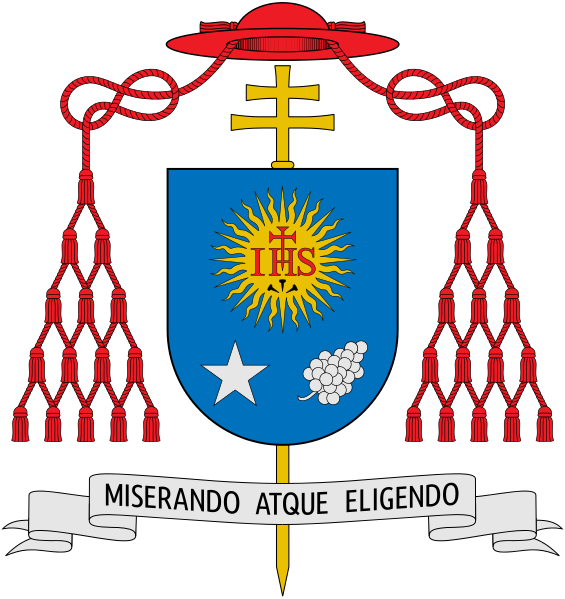
Coat of arms of Cardinal Jorge Maria Bergoglio, S.J., now Pope Francis

Image

This is the coat of arms of Cardinal Jorge Maria Bergoglio, S.J., Metropolitan Archbishop of Buenos Aires, Argentina, who was elected as the 266th Pope and Bishop of Rome last Wednesday, 13 March 2013 and chosen the name Pope Francis.

Pope Francis used his episcopal motto “Miserando atque Eligendo” which means “Lowly but chosen” in English, in line with his views and outlook on humility.

The Cardinal’s fifteen red tassels and the galero on top of it will be replaced by the papal arms standard including the papal tiara/mitre and the crossed keys of the kingdom of heaven (silver and gold).

The symbols that appeared on the shield are first, the IHS symbol surrounded with a sun-like ray is the symbol of the Jesuit order (S.J.) of which Pope Francis is a member of, and the star on the bottom-left, in conjunction with the blue colouration of the shield represents the Virgin Mary, and the grape on the bottom right represents Jesus Christ, as the grower of the vineyard of the Lord.