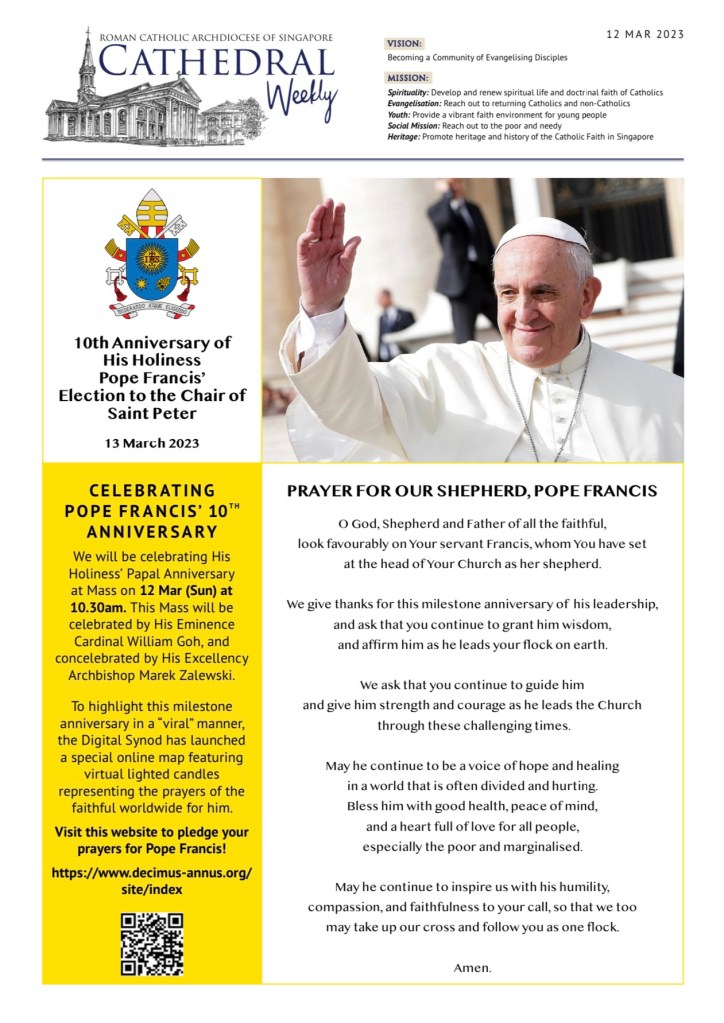
Monday, 13 March 2023 : 3rd Week of Lent, Tenth Anniversary of the Pontificate of Pope Francis, Vicar of Christ and Supreme Pontiff (First Reading)

Liturgical Colour : Purple/Violet

2 Kings 5 : 1-15a

Naaman was the army commander of the king of Aram. This man was highly regarded and enjoyed the king’s favour, for YHVH had helped him lead the army of the Arameans to victory. But this valiant man was sick with leprosy.

One day some Aramean soldiers raided the land of Israel and took a young girl captive who became a servant to the wife of Naaman. She said to her mistress, “If my master would only present himself to the prophet in Samaria, he would surely cure him of his leprosy.”

Naaman went to tell the king what the young Israelite maidservant had said. The king of Aram said to him, “Go to the prophet, and I shall also send a letter to the king of Israel.” So Naaman went and took with him ten silver talents, six thousand gold pieces and ten festal garments.

On his arrival, he delivered the letter to the king of Israel. It said, “I present my servant Naaman to you that you may heal him of his leprosy. When the king read the letter, he tore his clothes to show his indignation, “I am not God to give life or death. And the king of Aram sends me this man to be healed! You see, he is just looking for an excuse for war.”

Elisha, the man of God, came to know that the king of Israel had torn his clothes, so he sent this message to him : “Why have you torn your clothes? Let the man come to me, that he may know that there is a prophet in Israel.” So Naaman came with his horses and chariots, and stopped before the house of Elisha. Elisha then sent a messenger to tell him, “Go to the river Jordan and wash seven times, and your flesh shall be as it was before, and you shall be cleansed.”

Naaman was angry, so he went away. He thought, “On my arrival, he should have personally come out, and then paused and called on the Name of YHVH, his God. And he should have touched with his hand the infected part, and I would have been healed. Are the rivers of Damascus, Abana and Pharpar not better than all the rivers of the land of Israel? Could I not wash there to be healed?”

His servants approached him and said to him, “Father, if the prophet had ordered you to do something difficult, would you not have done it? But how much easier when he said : ‘Take a bath and you will be cleansed.’” So Naaman went down to the Jordan where he washed himself seven times as Elisha had ordered. His skin became soft like that of a child and he was cleansed.

Then Naaman returned to the man of God with all his men.

Friday, 20 January 2023 : 2nd Week of Ordinary Time, Memorial of Pope St. Fabian, Pope and Martyr, and St. Sebastian, Martyr, Week of Prayer for Christian Unity (Homily and Scripture Reflections)

Liturgical Colour : Green or Red (Martyrs)

Dear brothers and sisters in Christ, today as we listened to the words of the Scriptures, all of us are reminded that we have been called as the disciples and followers of Our Lord and Saviour, Jesus Christ, to help and be part of His mission and work, in leading more and more of the people of God back towards Him, just as He has called on those whom He called the Apostles, and entrusted to them specific missions and ministries, as well as to others whom had been tasked with the evangelisation of the true faith. Each and every one of us are part of this great ministry of the Church, as members of the same Body of Christ, the flock of God’s faithful and as partakers of the same Covenant that God has established anew for the sake of us all, His beloved ones. We are therefore reminded of what we are to do as part of this Covenant with God.

In our first reading today from the Epistle to the Hebrews, we heard from the author of that Epistle of the role which the Lord Jesus, Our Saviour has as the Mediator of the New Covenant between God and us. This follows after the past few days of readings in which the same author highlighted the role that Christ had in being our High Priest in offering Himself as the Paschal Lamb, the sacrificial Victim on our behalf for the forgiveness of our sins. It was through this offering of the perfect and most loving gift of the Lamb of God, slain and sacrificed for us, that each one of us have received pardon from our sins, and have received a new hope through the Lord Himself, and also having this New Covenant being established between us and God, our most loving Father and Creator.

In the past, Covenant was made by a formal pact between both parties, and sealed by the sacrifice and offering to a deity, and in this case, God Himself was one of the parties, in the example of the Covenant made between God and Abraham, the father of nations and the Israelites. The same Covenant was renewed between God and His people at Mount Sinai, as Moses acted as the intermediary between God and the people of Israel, placing sacrificial offerings offered to God and also the blood of the lamb being slain was sprinkled on the entire people as a mark of the sealing and confirmation of that Covenant. Then the same had also happened as the Lord Jesus became a Mediator of the New Covenant between God and His people.

That is because He acted as the same intermediary, as the Mediator between His heavenly Father, and all of the people of God, mankind in this world, past, present and future. We have been sundered and separated from God due to our disobedience and sins, and unfortunately because of that, we could not have returned to the Lord our God, as there is no place for us in His Presence as long as we have been tainted and corrupted by sin. Yet, by His ever enduring love and desire to be reconciled with us, He has provided us with the sure path to deliverance through none other than His Son, Who as our High Priest and Mediator, chose to offer Himself, His own Most Precious Body and Blood to be broken and poured out for us.

Thus, on the Altar of His Cross, Jesus our Lord has made anew the Covenant between God and mankind, and by His Most Precious Blood outpoured upon us, He has marked us all as those whom He had chosen and called to be saved. He gave us this grace and gift through baptism, and then which we affirm further through the gift of the Most Holy Eucharist, as we partake in those very Precious Body and Blood of the Lord. During each time we partake of the Most Holy Eucharist, we are reminded of this same Covenant that the Lord Himself has established and renewed for us by His suffering and death on the Cross. We are truly blessed that the Lord Himself has willingly took upon Himself to reach out to us in this way, and to show us His love in the most amazing and tangible way possible.

In our Gospel passage today, we heard of the account of the Lord calling and appointing His Apostles, the chief twelve among all of His disciples and followers. They were meant to be the leaders of the Lord’s followers, and together with the other disciples and followers, they were to do the will of God, and carry out whatever mission that the Lord has entrusted to them. Later on, after the Lord has already risen from the dead and then ascended into Heaven, it was the Apostles, leading the other disciples and followers of God, that established the foundations of the Church and carried out extensive and intensive works of evangelisation throughout the world. That same work is still being carried out today to even more places and touching more peoples, as the Church had done for the past two millennia and more.

Brothers and sisters in Christ, as we reflect on these words from the Sacred Scriptures today, let us all ponder upon what it means for us to be in Covenant with God. A Covenant is a solemn and formal pact between two parties, and in this case it is between God Himself and each and every one of us. God has always shown us just how faithful He has been to us, in remembering us, caring for us, in His constant reminders for us, and in His care for us, that He reached out even the last and the lost and the least among us. Through Christ, He has shown us His ever enduring love, and fulfils His own words, that there is no greater love than for one to lay down one’s life for a friend, and He laid down His own life for us, suffering for us most grievously so that we may not perish, but have eternal life.

Hence, each and every one of us are expected to do our part in this Covenant as well. We are part of God’s same Church and flock, and we ought to carry out the missions and the many opportunities that God had granted to us in proclaiming His truth and love in this world. What are we going to do about it, brothers and sisters? Are we going to remain idle and refusing to embrace the missions and opportunities provided to us, or are we going to listen to His call and promptings, and finally commit ourselves to the path that He has shown us? Let us all consider carefully our choices and paths in life, and do whatever we can in order to live our lives more faithfully as the ones who call ourselves as Christians, as members of His One, Holy, Catholic and Apostolic Church.

Today we commemorate the feast of Pope St. Fabian and St. Sebastian, two great saints and martyrs whose lives hopefully can strengthen and encourage us as well in how we live our lives with faith. Pope St. Fabian lived at the time of great difficulty and challenges for the Church, at the height of persecutions against Christians. Similarly, St. Sebastian was a Roman soldier who lived during the harshest time to be a Christian, under persecution by the Roman state and the Emperors. Yet, each one of them persevered in faith and remained faithful to God all the time. Pope St. Fabian led the Church patiently and faithfully throughout those difficult moments while St. Sebastian carried on his faith even in secret. Eventually both were persecuted, arrested and martyred for their faith, and especially for the case of St. Sebastian, in refusing to abandon his faith in God or worship the Emperor and the pagan gods. They faced suffering and death with great courage, knowing that God was by their side throughout.

May the Lord continue to guide us and strengthen us in our journey throughout life, and may He empower each one of us that we may always strive to live worthily in the path that He has shown us, and resist the temptations to sin and to do whatever is against His teachings and truth. May we be reminded by the examples of the saints and martyrs, in particular that of Pope St. Fabian and St. Sebastian, among many others. May God be with us always, and may He bless us all in our every good efforts, works and endeavours, all for His greater glory, and also for the salvation of many more souls. Amen.

Friday, 20 January 2023 : 2nd Week of Ordinary Time, Memorial of Pope St. Fabian, Pope and Martyr, and St. Sebastian, Martyr, Week of Prayer for Christian Unity (Gospel Reading)

Liturgical Colour : Green or Red (Martyrs)

Mark 3 : 13-19

At that time, Jesus went up into the hill country, and called those He wanted and they came to Him. He appointed twelve to be with Him, and He called them ‘Apostles’. He wanted to send them out to preach, and He gave them authority to drive out demons.

These are the Twelve : Simon, to whom He gave the name Peter; James, son of Zebedee, and John his brother, to whom He gave the name Boanerges, which means ‘men of thunder’; Andrew, Philip, Bartholomew, Matthew, Thomas, James son of Alpheus, Thaddeus, Simon the Canaanean, and Judas Iscariot, the one who betrayed Him.

Friday, 20 January 2023 : 2nd Week of Ordinary Time, Memorial of Pope St. Fabian, Pope and Martyr, and St. Sebastian, Martyr, Week of Prayer for Christian Unity (Psalm)

Liturgical Colour : Green or Red (Martyrs)

Psalm 84 : 8 and 10, 11-12, 13-14

Show us, o Lord, Your unfailing love and grant us Your saving help. Yet Your salvation is near to those who fear You, and Your Glory will dwell in our land.

Love and faithfulness have met; righteousness and peace have embraced. Faithfulness will reach up from the earth while justice bends down from heaven.

The Lord will give what is good, and our land will yield its fruit. Justice will go before Him, and peace will follow along His path.

Friday, 20 January 2023 : 2nd Week of Ordinary Time, Memorial of Pope St. Fabian, Pope and Martyr, and St. Sebastian, Martyr, Week of Prayer for Christian Unity (First Reading)

Liturgical Colour : Green or Red (Martyrs)

Hebrews 8 : 6-13

Now, however, Jesus enjoys a much higher ministry in being the Mediator of a better covenant, founded on better promises. If all had been perfect in the first covenant, there would have been no need for another one. Yet God sees defects when He says : The days are coming – it is the word of the Lord – when I will draw up a new covenant with the people of Israel and with the people of Judah.

It will not be like the covenant that I made with their ancestors on the day I took them by the hand and led them out of Egypt. They did not keep My covenant, and so I Myself have forsaken them, says the Lord. But this is the covenant that I will make with the people of Israel in the days to come : I will put My law into their minds and write them on their hearts. I will be their God and they will be My people.

None of them will have to teach one another or say to each other : Know the Lord, for they will know Me from the least to the greatest. I will forgive their sins and no longer remember their wrongs. Here we are being told of a new covenant; which means that the first one had become obsolete, and what is obsolete and ageing is soon to disappear.

Requiem Mass for His Holiness Pope Benedict XVI from Cathedral of the Good Shepherd, Archdiocese of Singapore

Requiem Mass for His Holiness Pope Benedict XVI will be celebrated by His Eminence Cardinal William Goh, Archbishop of Singapore at the Cathedral of the Good Shepherd on Thursday, 5 January 2023 at 1.15 pm Singapore Time (5.15 am UTC)

Mass will be livestreamed (and available afterwards) from the link above.

Pope Benedict XVI (16 April 1927 – 31 December 2022)

Pope Benedict XVI, 265th Pope, Vicar of Christ and Supreme Pontiff of the One, Holy, Catholic and Apostolic Church has passed away peacefully at 9.34 am Rome time on the last day of the Year of Our Lord 2022, 31 December 2022.

May he rest in peace. Requeiscat in Pace.

Special Request for Prayers for our Pope Emeritus Benedict XVI

A prayer for the health of Pope Emeritus Benedict XVI (from Vatican News)

Let us pray.
Almighty and Eternal God,
You are the everlasting health of
those who believe in You.


Hear our prayers for your sick servant Benedict
for whom we implore the aid of Your tender mercy,


Through Christ our Lord. Amen.

Saturday, 31 December 2022 : Seventh Day Within Octave of Christmas, Memorial of Pope St. Silvester I, Pope (Homily and Scripture Reflections)

Liturgical Colour : White

Dear brothers and sisters in Christ, today as we listened to the words of the Scriptures, on this very last day of the current Gregorian Solar Calendar of this Year of Our Lord 2022, we are all reminded of the need for each one of us to contemplate and reflect on the year that has just passed us by. And at the same time we should also spend some time to consider our options going forward to the next, new year in 2023. We have to spend some time at the end of this year to see how we can make the next and new year better for all of us, in terms of our lives as Christians and as members of our various, diverse communities and peoples, as well as in terms of our mission and calling to serve the communities we are living in.

In our first reading today, we heard from the words of St. John the Apostle in his Epistle to the faithful people of God in which he spoke of the imminent coming of the end times, and also the rise of the antichrists, who were the false prophets and teachers, that misled the people of God to the wrong paths. Back then, there were quite a few of these false leaders and teachers who distorted the teachings of the Lord and His Church for their own benefits and purposes. Those false leaders endangered the unity of the Church and the faithful, causing schisms and heresies to happen, even in the days of the Apostles as St. John himself experienced. In the next few hundred years, more of those heresies and divisions would appear, as people of God chose to embrace falsehoods and lies instead of the truth of God.

This is when as we heard from our Gospel passage today, by the same St. John the Apostle and Evangelist, we are reminded in the midst of this joyful Christmas season of Who it is that we are celebrating about. St. John reminded all of us that it is the Word of God Himself, the Son of God, Incarnate in the flesh that we are all celebrating for, for His coming into this world, appearing before all of us as the Son of Man, the Saviour of all. By His incarnation in the flesh, and by being born of His mother Mary, He has shown us the love of God made manifest and tangible to us. While once mankind can only see and feel the greatness of God from afar, now through Christ, everything had been made real and approachable to us. Through Christ, we have come into the realisation of God’s love made Man, approachable and touchable to us.

It is this truth which those false leaders and prophets, messengers and heretics all tried to subvert and change for their own selfish purposes and desires. Some of them rejecting the Divinity of Christ while others rejected the Humanity of Christ, and others still reject the figure of Christ altogether and instead conflating the Christian faith with other syncretic pagan practices among others. These were what St. John warned the faithful all about, that they should not succumb to the temptations to sin, or to evil, falsehoods and wickedness in any sorts. St. John told all of us that we have to keep adhering to the truth of Jesus Christ, Our Lord and Saviour, the manifestation of God’s love Whom we celebrate this Christmas season. As His disciple and follower we have to commit ourselves wholeheartedly to Him.

Today, we celebrate the feast of a saint and servant of God whose life and devotion to God hopefully can become a great source of inspiration to follow, as we embark on our own journey of faith in this life. Pope St. Silvester I was one of the early Church fathers and leaders, who reigned during the moment of great change for the Church and the world. He succeeded Pope St. Miltiades whose reign coincided with the Edict of Milan, the Edict of toleration of all Christians and their faith as proclaimed by the Roman Emperors Constantine the Great and Licinius. That declaration and Edict marked the momentous time when Christians were no longer persecuted for their faith as they had been in the past three centuries, with the latest being the particularly vicious persecution under the Emperor Diocletian and his fellow Emperors.

Pope St. Silvester I succeeded Pope St. Miltiades and would go on to reign for a long over twenty years period, ushering a time of great renewal for the Church. He led the Church through both a turbulent and great period, characterised by great many conversions and growth of the Church, but at the same time also plenty of divisions within the Church. He led the Church through a time of great building of churches and institutions, but also a time when many heresies and divisions arose in the Church, and the faithful became increasingly more and more divided by their different priorities and ideals, and especially back then, the heresy of Arianism and Donatism, and also Gnosticism threatened the unity of the Church. To combat these divisions and restore unity of the Church, Pope St. Silvester I together with his brother bishops and with the support of the Emperor Constantine convened the first ever Ecumenical Council of the Church in Nicaea.

Pope St. Silvester I did not attend the Ecumenical Council of Nicaea himself, but sent his delegation with his full authority to the Council, which condemned the various heresies particularly that of Arianism, and upheld the true Christian faith as preserved and handed down from the days of the Apostles and the beginning of the Church. Eventually, the true Christian faith prevailed and the Church continued to flourish despite the many challenges and trials that it faced, also thanks to the firm and faithful leadership of Pope St. Silvester I, who became a source of inspiration to all the bishops all throughout Christendom and facing all sorts of pressures and hardships. And as we discern the life and works of Pope St. Silvester I, whose Pontificate was at the end and boundary between the old order of persecutions and hardships for the Church and a new beginning and renewal through freedom, we too should reflect upon our past year and what we are going to do this upcoming new year.

May the Lord continue to guide and strengthen us in our journey, and may He continue to help us to persevere through the challenges in life and also help us to direct our path to the right way as we continue to proceed to the new year with new hope and new expectations. Let us all look forward to the new year with hope and strive to be ever better Christians, in the spirit of Pope St. Silvester I, whose life is an inspiration to all of us. May God bless us always in all of our efforts and deeds, for His greater glory, and may He bless our year ahead with His most wonderful blessings and grace. Amen.

Saturday, 31 December 2022 : Seventh Day Within Octave of Christmas, Memorial of Pope St. Silvester I, Pope (Gospel Reading)

Liturgical Colour : White

John 1 : 1-18

In the beginning was the Word. And the Word was with God and the Word was God; He was in the beginning with God. All things were made through Him, and without Him nothing came to be. Whatever has come to be, found life in Him; life, which for human beings, was also light, light that shines in darkness, light that darkness could not overcome.

A man came, sent by God; his name was John. He came to bear witness, as a witness to introduce the Light, so that all might believe through him. He was not the Light, but a witness to introduce the Light; for the Light was coming into the world, the true Light that enlightens everyone. He was in the world, and through Him the world was made, the very world that did not know Him.

He came to His own, yet His own people did not receive Him; but to all who received Him, He empowers to become children of God, for they believe in His Name. These are born, but not by seed, or carnal desire, nor by the will of man : they are born of God.

And the Word was made flesh and dwelt among us; and we have seen His glory, the glory of the only Son of the Father : fullness of truth and loving-kindness. John bore witness to Him openly, saying, “This is the One Who comes after me, but He is already ahead of me, for He was before me.”

From His fullness we have all received, favour upon favour. For God had given us the Law through Moses, but Truth and Loving-kindness came through Jesus Christ. No one has ever seen God, but God-the-only-Son made Him known : the One, Who is in and with the Father.