Monday, 30 June 2014 : 13th Week of Ordinary Time, Memorial of the First Martyrs of the Holy Roman Church (Scripture Reflections)

Liturgical Colour : Green or Red (Martyrs)

Brothers and sisters in Christ, today we celebrate the feast of the very first martyrs of the faith, most likely those who suffered great persecutions under St. Paul when he was still an unbeliever, Saul, as well as those who were persecuted by the Roman authorities, particularly those who were martyred during the first official persecution by the Emperor Nero, who also martyred the two saints, St. Peter and St. Paul, later known as the patron saints of Rome and the Universal Church.

These faithful people did not abandon their faith in exchange for their safety and life. They chose to remain faithful even though they had to suffer for their faith and for their obedience to the Lord and to His ways. That was why they were honoured and raised to the glory of the altar as the holy martyrs and saints of the Church. These martyrs therefore became the source of great inspiration to countless others who would follow in their footsteps and seek the Lord as they once had done.

As the Gospel reading today highlighted to us, following the Lord is not an easy or a simple matter. For indeed, following the Lord requires from us complete and extensive dedication and commitment, as well as readiness to face difficulties and oppositions from many sides. We already know quite well that this world stands often in direct opposition to the Lord and His ways, and as a result, we who follow Him and His ways, will also stand in the way of the world and its ways too.

This does not mean that we should hate the world or refuse to have anything to do with the world, or withdrawing entirely from the world, as this is not the right way to do things. This withdrawal and ignoring attitude in fact can be seen as our inability to accept the reality of things and our responsibilities and the risks of following the Lord. Indeed, if I am to be bluntly honest, that is tantamount to running away from the difficulties of the world, which were not what the martyrs had done.

The martyrs had a choice, whether they would remain faithful and committed to the Lord, and suffer grievous death and torture, as many of the tales of the martyrs had enlightened us with, or to save their own lives and live comfortably in peace of the world, but forsaking their faith and trampling on the cross, on the Lord Himself. Similar tales were also heard all over the different parts of the world, where persecution of the faithful were rampant and vicious.

They had a choice, to face the truth, or to run away. Running away does not always mean turning one’s back to the Lord or to be an apostate, namely someone who betrays the Lord, but in fact, if we avoid doing our responsibilities and avoid the challenges presented to us in this world, we are no different from those who ran away from their faith to the Lord into eternal damnation.

Brothers and sisters in Christ, today we may think that martyrdom is a thing of the past, and it is no longer relevant in today’s world. However, if we look at it more closely, persecution of the faith and the faithful is still rampant at every part of the globe. Many were still ridiculed and worse still, suffered grievously for believing and walking in the way of the Lord, and yet many of us are still oblivious to this fact.

How do we then overcome this? Yes, how do we overcome our fear of the world and the suffering it may bring to us? None other than by having a good and living relationship with our God, just as the first martyrs of the Church once had. They placed their trust in God, and they therefore did not fear, for they knew that God would take good care of them. They also prayed often, as prayer is the way for us to connect with God, as a two-way conversation between Him and us.

Therefore, brothers and sisters in Christ, let us all emulate the examples of the first martyrs and the many other holy men and women who had lived their lives according to the will of God. Let us walk in their ways and remain truly faithful and dedicated to the Lord our God. God be with us all and may He guide us on our way. Amen.

Monday, 30 June 2014 : 13th Week of Ordinary Time, Memorial of the First Martyrs of the Holy Roman Church (Gospel Reading)

Liturgical Colour : Green or Red (Martyrs)

Matthew 8 : 18-22

When Jesus saw the crowd press around Him, He gave orders to cross to the other shore. A teacher of the Law approached Him and said, “Master, I will follow You wherever You go.”

Jesus said to him, “Foxes have holes and birds have nests, but the Son of Man has nowhere to lay His head.”

Another disciple said to Him, “Lord, let me go and bury my father first.” But Jesus answered him, “Follow Me, and let the dead bury their own dead.”

Monday, 30 June 2014 : 13th Week of Ordinary Time, Memorial of the First Martyrs of the Holy Roman Church (Psalm)

Liturgical Colour : Green or Red (Martyrs)

Psalm 49 : 16bc-17, 18-19, 20-21, 22-23

What right have you to mouth My laws, or to talk about My covenant? You hate My commands and cast My words behind you.

You join a thief when you meet one; you keep company with adulterers. You have a mouth of evil and a deceitful tongue.

You speak ill of your brother, and slander your own mother’s son. Because I was silent while you did these things, you thought I was like you. But now I rebuke you and make this charge against you.

Give this a thought, you who forget God, lest I tear you to pieces with no one to help you. Those who give with thanks offerings honour Me, but the one who walks blamelessly, I will show him the salvation of God.

Monday, 30 June 2014 : 13th Week of Ordinary Time, Memorial of the First Martyrs of the Holy Roman Church (First Reading)

Liturgical Colour : Green or Red (Martyrs)

Amos 2 : 6-10, 13-16

Before them nations are appalled, and every face turns pale. They attack like warriors; they scale walls like soldiers. Marching in line, they move onward without swerving from their course, without jostling one another, everyone of them marches straight ahead; amid a hall of arrows they run, they press without breaking ranks.

They rush upon the city; they leap over the walls; they break into the houses, like thieves enter through the windows. Before them the earth shakes and the heavens tremble, the sun and moon grow dark and the stars lose their twinkle.

Rend your heart, not your garment. Return to YHVH, your God – gracious and compassionate. YHVH is slow to anger, full of kindness, and He repents of having punished. Who knows? Probably He will relent once more and spare some part of the harvest from which we may bring sacred offerings to YHVH, your God.

Blow the trumpet in Zion, proclaim a sacred fast, call a solemn assembly. Gather the people, sanctify the community, bring together the elders, even the children and infants at the breast. Let the bridegroom leave his bed, and the bride her room.

Sunday, 29 June 2014 : Solemnity of St. Peter and St. Paul, Apostles and Feast Day of the Church of Rome (Gospel Reading)

Liturgical Colour : Red

Matthew 16 : 13-19

After that, Jesus came to Caesarea Philippi. He asked His disciples, “Who do people say the Son of Man is?” They said, “For some of them You are John the Baptist, for others Elijah, or Jeremiah, or one of the prophets.”

Jesus asked them, “But you, who do you say I am?” Peter answered, “You are the Messiah, the Son of the living God.” Jesus replied, “It is well for you, Simon Bar-Jona, for it is not flesh or blood that has revealed this to you, but My Father in heaven.”

“And now I say to you : You are Peter, and on this rock I will build My Church; and never will the powers of death overcome it. I will give you the keys of the kingdom of heaven : whatever you bind on earth shall be bound in heaven, and whatever you unbind on earth shall be unbound in heaven.”

Sunday, 29 June 2014 : Solemnity of St. Peter and St. Paul, Apostles and Feast Day of the Church of Rome (Second Reading)

Liturgical Colour : Red

2 Timothy 4 : 6-8, 17-18

As for me, I am already poured out as a libation, and the moment of my departure has come. I have fought the good fight, I have finished the race, I have kept the faith. Now there is laid up for me the crown of righteousness with which the Lord, the just Judge, will reward me on that day; and not only me, but all those who have longed for His glorious coming.

But the Lord was at my side, giving me strength to proclaim the Word fully, and let all the pagans hear it. So I was rescued from the lion’s mouth. The Lord will save me from all evil, bringing me to His heavenly kingdom. Glory to Him forever and ever. Amen!

Sunday, 29 June 2014 : Solemnity of St. Peter and St. Paul, Apostles and Feast Day of the Church of Rome (Psalm)

Liturgical Colour : Red

Psalm 33 : 2-3, 4-5, 6-7, 8-9

I will bless the Lord all my days; His praise will be ever on my lips. My soul makes its boast in the Lord; let the lowly hear and rejoice.

Oh, let us magnify the Lord, together let us glorify His Name! I sought the Lord, and He answered me; from all my fears He delivered me.

They who look to Him are radiant with joy, their faces never clouded with shame. When the poor cry out, the Lord hears and saves them from distress.

The Lord’s angel encamps and patrols to keep safe those who fear Him. Oh, see and taste the goodness of the Lord! Blessed is the one who finds shelter in Him!

Sunday, 29 June 2014 : Solemnity of St. Peter and St. Paul, Apostles and Feast Day of the Church of Rome (First Reading)

Liturgical Colour : Red

Acts 12 : 1-11

About that time King Herod decided to persecute some members of the Church. He had James, the brother of John, killed with the sword, and when he saw how it pleased the Jews, he proceeded to arrest Peter also.

This happened during the festival of the Unleavened Bread. Herod had him seized and thrown into prison with four squads, each of four soldiers, to guard him. He wanted to bring him to trial before the people after the Passover feast, but while Peter was kept in prison, the whole Church prayed earnestly for him.

On the very night before Herod was to bring him to trial, Peter was sleeping between two soldiers, bound by a double chain, while guards kept watch at the gate of the prison. Suddenly an angel of the Lord stood there and a light shone in the prison cell. The angel tapped Peter on the side and woke him saying, “Get up quickly!”

At once the chains fell from Peter’s wrists. The angel said, “Put on your belt and your sandals.” Peter did so, and the angel added, “Now, put on your cloak and follow me.”

Peter followed him out; yet he did not realise what was happening with the angel was real; he thought he was seeing a vision. They passed the first guard and then the second and they came to the iron door leading out to the city, which opened of itself for them. They went out and made their way down a narrow alley, when suddenly the angel left him.

Then Peter recovered his senses and said, “Now I know that the Lord has sent His angel and has rescued me from Herod’s clutches and from all that the Jews had in store for me.”

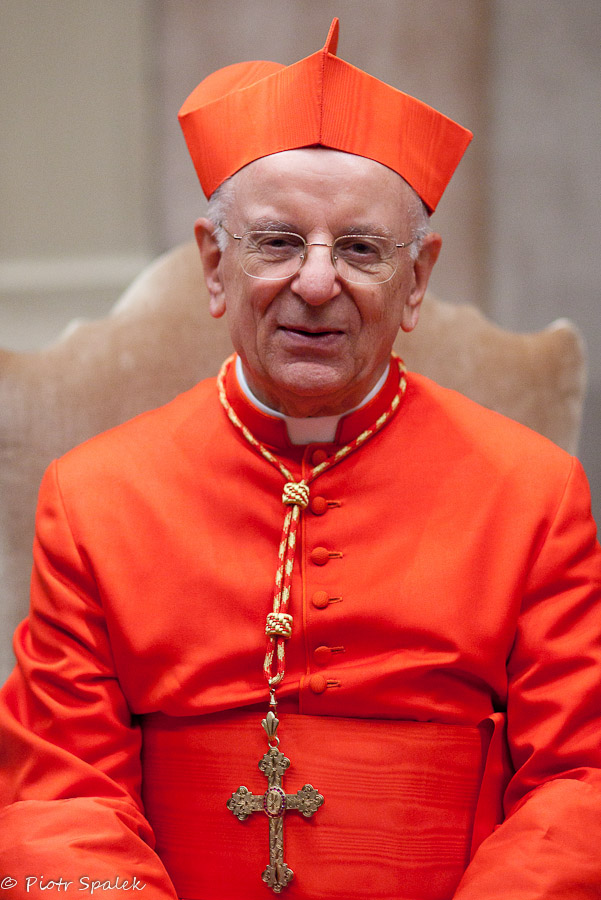
Cardinal Francesco Monterisi (Italy), Cardinal-Archpriest Emeritus of Papal Basilica of St.Paul Outside-the-Walls turned 80, ceases to be a Cardinal-elector

On Wednesday, 28 May 2014, Cardinal Francesco Monterisi, Cardinal Deacon of S. Paolo alla Regola, Cardinal-Archpriest Emeritus of Papal Basilica of St.Paul Outside-the-Walls (Italy), turned 80, and therefore, according to the rules written in the Apostolic Constitution Universi Dominici Gregis, he lost his right to vote in any future conclave.

_MG_4038

Cardinal Francesco Monterisi was made Cardinal-Deacon of S. Paolo alla Regola by Pope Benedict XVI in the 2010 Consistory of Cardinals on 20 November 2010, the third Consistory of his pontificate. Cardinal Monterisi was made a Cardinal in honour of his position as the Archpriest of one of the four Papal Major Basilica, that is the Papal Basilica of St. Paul Outside-the-Walls, which he held since 2009 to 2012 until his retirement from active Church service.

Raymond Leo Burke

http://www.gcatholic.org/hierarchy/data/cardB16-3.htm#675%5B/embed%5D

May God bless His Eminence Cardinal Monterisi with a blessed old age and health. May he remain strong in the faith and hopefully can perhaps still continue to work great graces and good works of love and peace even after he has been retired to the people as the helper of the Vicar of Christ our Pope, as he continues to minister to the people of God.

Francesco_Monterisi1

The College of Cardinals now stands at 215 members in total, with 118 Cardinal-electors and 97 Cardinal non-electors. There are now a vacancy of 2 Cardinal-elector as compared to the maximum number of electors allowed in the Conclave of 120.

Next Cardinal-elector to age out (80) will be Cardinal Claudio Hummes, the Metropolitan Archbishop Emeritus of Sao Paulo (Brazil), on 8 August 2014.

Monday, 18 November 2013 : 33rd Week of Ordinary Time, Memorial of the Dedication of the Basilica of St. Peter and the Basilica of St. Paul Outside the Walls (Scripture Reflections)

Liturgical Colour : Green or White (Dedication of Basilica)

Dear brothers and sisters in Christ, we listen today to the beginnings of a great tragedy, where the people of Israel, was subjected to the attempts of acculturation and Hellenisation, which happened during the years after Alexander the Great conquered much of the known world. They suffered persecution and ridicule, subjected into attempts to corrupt them from the one and true faith in God.

In the second reading, the same happened, with St. Paul being led into custody of the Romans, brought to Rome, the capital of the Roman Empire, to be judged by the Emperor for his supposed crimes. St. Paul was charged by his Jewish opponents, who resisted his attempts to bring the Good News to them. Rather than being killed at Jerusalem, St. Paul chose to appeal to the Emperor, and in doing so, as we listened, he gained a chance to evangelise yet one last time, at the city of Rome, where the centre of our Church now lies.

Today we listened to the tale of both St. Paul and St. Peter, the earlier as mentioned, and the latter, as we listened to the story of Jesus performing the miracle of walking on the water in the middle of the storm. St. Peter took the scene, as he tried to walk on the water and as he doubted, he almost sank into the water. Jesus rescued him and chided him about his lack of faith in Him. So we heard today about both St. Paul and St. Peter, who at the end of their lives, went to Rome to be martyred there.

Yes, in that old and venerable city, the Eternal City, as many would call it. It is where the two greatest saints and pillars of the Church were welcomed into the hands of the Lord through holy martyrdom. Today we mark the commemoration of the dedication of two great basilicas, namely the Papal Basilica of St. Peter, where most of the Pope’s celebrations take place, and the Papal Basilica of St. Paul, also known as St. Paul Outside the Walls, because it was located outside the walls of the ancient city of Rome. It was also where St. Paul stayed during his two year stay in Rome, prior to his martyrdom by the Emperor Nero.

These two saints were exemplary in their actions, just as what some brave people of Israel, God’s first chosen people had done at the time of persecution under the Greek king Antiochus Epiphanes. They stood up bravely and courageously for their faith without being corrupted or tempted by the offers of worldly pleasures and temporary glories offered to them, if they just would betray the Lord and their faith.

Yet these people were also pretty much ordinary people like ourselves, and they too were much like us sinful and weak, as St. Peter himself had shown in that storm in the lake, where his lack of faith to God made him almost sink as he walked on the water towards Jesus. St. Paul was once a great enemy of the faith, and he hounded many hundreds if not thousands of the early believers of the Lord, sending them to their deaths. We too lacked the faith at times, brothers and sisters, and doubt is always in our mind.

And yet, through Christ and His love, they have been transformed into powerful tools of His presence and love. God made them to be the bearers of the Good News and they went on faithfully with their missions to the end. And through their hard and dedicated works, many people were saved. Their works of salvation continues even today, through their successors, our bishops and their priests, and primarily, the Bishop of Rome, our Pope, now Pope Francis, the leader of the entire Universal Church.

It is often that times are truly hard for our Church, especially in the recent times. The ways of the world are increasingly becoming more and more antithesis to what our Church stands up for, that is our faith in God, true and just. The corruptions of this world threaten to sink many people in the storm of this turbulent world. Remember what had happened to St. Peter in that stormy night.

The Lord picked him up by the hand and strengthened his faith. Indeed, St. Peter was to abandon his faith yet another time, when he denied knowing the Lord, not just once, but three times in total! He did so, because his faith in God is wavering, having seen Jesus, the one hope that he and the other apostles had had, captured, tortured, and mocked like a lowly criminal. He abandoned the Lord for the security of the world.

St. Paul too was a leading Jew, who was a Pharisee and very strict in his observation of the Law, and was particularly hostile to the followers of Jesus in the early days of the Church. He hunted them without mercy, and caused the death of many people of the Lord. He took part in the stoning and murder is St. Stephen, the first martyr, and was a great scourge to the faithful.

Then what differentiates them from the people of Israel, who abandoned their faith in God, for the sake of their own security and to secure the favour of the king? And how was St. Peter even different from Judas Iscariot, the traitor? Did they both not betray the Lord? One through direct betrayal and the other by abandoning Him at the time of His greatest sorrow?

That is because, St. Peter professed his true and undying faith in the Lord, and he repented from his past mistakes. Everyone makes mistakes, as is common to us because of our humanity, for we are predisposed to sin ever since we were exposed to it. What is important is that, we learn from those mistakes, face them with courage and faith, and repent, that is change our ways, to conform again to that of God! That was what St. Peter, as well as St. Paul had done.

Judas Iscariot felt the guilt after he had betrayed the Lord, but instead of learning from his mistakes, and accepting the chance of repentance the Lord gave him, he chose the quick way out, that is suicide. He did not repent, and therefore was counted among the lost ones. He also stole the money of the Lord and His disciples and was unrepentant about it, even to the end.

St. Peter professed his love and dedication to the Lord, and he showed it with true sincerity, knowing fully the guilt and the faults he had done, and yet, he still professed that love he has for God, and the Lord gave him, the stewardship over this world, over all of the faithful ones in God, as His Vicar on earth. St. Paul too met a life-changing experience, after the Lord appeared to him on the road to Damascus. He received the empowerment of the Holy Spirit, and the truth about all things were revealed to him in its entirety.

Ever since, both Apostles, as well as the other apostles and disciples of Christ, tirelessly laboured for the sake of God and His kingdom, without end going from one end of the earth to the other, as witnesses to God and His saving power. They laboured hard and the fruits grew aplenty, as the faith spread among many, converting many to the cause of Christ. And despite the storm that threatened to engulf all the faithful, they stabilised the ship, and made it last to the present day.

St. Peter was crucified upside down in Rome, at the site now where the Basilica of St. Peter now stood. He chose to do so because he found himself unworthy to be crucified in the same way the Lord had done. St. Paul too was beheaded in Rome, after the burning of Rome was blamed by the reigning Emperor, Nero, on the followers of Christ. See the dedication, faith, and love that these two saints have for our Lord!

Today, therefore, as we commemorate the two great Basilicas dedicated in their honour, that of St. Peter, the Vicar of Christ, and St. Paul, the Apostle to the Gentiles, let us take this opportunity to reflect, on whether we have taken the same choice or whether we will be ready to commit ourselves to the same choice that both saints had chosen. Remember that saints too were called from sinners. We can opt to choose the easy way, that is what Judas and the people of Israel had done, or take the difficult and challenge-ridden path that the Apostles had once taken, all the way to the end, where the glory of heaven awaits them.

May our Lord Jesus, who helped St. Peter out of the water in his doubt, also help us to overcome our doubts and empower us with love, hope, and faith, that we will be able to make a commitment towards reaching out to the Lord, choosing the right path in the end. May He continue to love us and watch over us. Amen.