
Wednesday, 14 August 2013 : 19th Week of Ordinary Time, Memorial of St. Maximilian Kolbe, Priest and Martyr (Scripture Reflection)

Liturgical Colour : Red

Dear brothers and sisters in Christ, today we listened to the word of God in the readings, in which we are told first of the greatness of God and His kindness and love for His people, in giving to His people, the full promise of His covenant by bringing them into the land promised onto them for possession, just as God had once promised Abraham, their forefather.

Today, we also listened to the end of Moses the great prophet and leader of God’s people, who acted as the conduit of God’s amazing power and brought Israel out of Egypt, through the miracles the Lord performed through Moses and his brother, Aaron. Moses was appointed to be tool through which God exercised His saving power on His beloved people. But Moses too had his flaws, and he disobeyed God in Massah and Meribah, when the people tested the Lord and complained against Him and Moses, His servant.

Through that disobedience, Moses was not allowed to enter the Holy Land, that Promised Land of Canaan, but he was indeed allowed to take a look of the land the people of Israel was about to enter, before the Lord took him into heaven into His presence at the end of his earthly life. Moses, as all men had, met the end of his life that is death. But as Christ had proven, that death is not the end, nor does it have any power over us, because, He had overcome death, and brought new life to all mankind, that is eternal life with God in heaven for those who remain faithful in God.

Although Moses had indeed gone, and no one was ever like him in this world, save for Christ, our Lord who had incarnated Himself as one of us, but there were many prophets that God had sent to His people to guide them from generations to generations. And then, our Lord Himself had commissioned His apostles, the disciples whom He had chosen, to be the new messengers and bearers of the will of God in this world. Yes, they were to be the leaders of the people of God, the shepherds of God’s beloved sheep, in the One, Holy, Catholic, and Apostolic Church He Himself had established and entrusted to the Apostles through Peter.

From the apostles, the authority of leadership of God’s people, as the divine shepherds, came down to bishops and priests throughout the generations, and eventually to our bishops and priests today, who minister to us and lead us in our path towards God, as our leader and guide. They are our role models and to be like Moses of old, when he led the people of Israel from the land of Egypt, to the Promised Land of Canaan.

And like Moses, our priests and bishops too have to deal with all kinds of problems, with our complaints and rejections of the Lord, that they really have much things to deal with in their hands. Yes, brothers and sisters in Christ, their job is not easy, and they always need our constant prayers and assistance. And one of the task that priests need to do is to bring peace and love between one another, just as we listened in the Gospel Reading today, of the need to reconcile between ourselves, between brethren and children of the same God.

Today, we mark the feast of one of those excellent priests of the Lord, the leader of God’s people, the true shepherd, the good shepherd of God’s flock. Yes, that is Saint Maximilian Kolbe, the well-known saint of the Holocaust of Nazi Germany during the World War II era. St. Maximilian Kolbe was a Polish Franciscan friar, who in his great zeal in the service of the Lord, and after witnessing the erosion of the faith in many, established the Militia Immaculata or the Army of Mary, a group intended to foster the love and devotion to the Lord through His mother Mary, and through the work, many people rejoined the Church and had their faith strengthened.

St. Maximilian Kolbe did much good works and service during his life and as a priest of the Lord. He truly became like Moses was for the people of Israel. He ministered to the people of God and through the Militia Immaculata, spread catechism and teachings of the Church to many people, bringing them closer towards the Lord and salvation, by means of printed media and publications such as newspapers and magazines. St. Maximilian Kolbe also went to Japan and established at Nagasaki in particular a base of operations, from where the good works of St. Maximilian Kolbe and his fellow workers spread to the people still in darkness.

St. Maximilian Kolbe protected many thousands of people including the Jews, when Nazi Germany invaded Poland at the beginning of World War II. He protected them from the cruelty of the Nazi holocaust policy, but in the end he himself was captured and imprisoned by the Germans. He was incarcerated in prison with many other people, suffering under very harsh treatment and hard labour in the Nazi concentration camp. Yet, he did not give in to despair, but he in fact encouraged his fellow inmates, singing hymns and saying the Mass for them.

St. Maximilian Kolbe was not obliged to do so, but he did so because of the faith and dedication he had for the Lord and for the people of God. He truly lived his faith and made it a concrete and living faith. One day, the Germans wanted to punish a few people in the prison, because it was found that someone had managed to escape the prison, and therefore these people had to suffer in the escaped prisoner’s place. One Polish military officer who was imprisoned was chosen to be among the ones to suffer death. His pleas for mercy because he had a wife and children brought the attention of St. Maximilian Kolbe, who offered himself in exchange for the man, that is to die in his place instead.

The example of St. Maximilian Kolbe is truly praiseworthy, brothers and sisters in Christ, because through his death, much had been achieved. Yes, his death was not a waste, but it has brought much fruits, that is the fruit of love, the fruit of one’s selfless act of sacrifice, for the love of his fellow men. St. Maximilian Kolbe exemplified the very words of Christ, on who is a true and good shepherd, that is someone who love fully those who had been entrusted to him, his friends and loved ones, and one who even would die for the sake of his friends. That was what St. Maximilian Kolbe had done with his sacrifice for the poor soldier and indeed, our Lord Jesus Christ Himself had done for all of us out of His love.

Yes, brothers and sisters in Christ, we all ought to emulate the example of St. Maximilian Kolbe in our own lives, in our giving of ourselves to our brethren in need. We can do it in a variety of ways, but basically we have to be ready to give our all for our brethren’s sake. As importantly as this, let us support our priests and those who have been appointed as shepherds over us, that they will remain faithful to the mission they have been appointed to, and faithful to the people and the flock they have been entrusted with, just as St. Maximilian Kolbe and many other great saints and martyrs had done.

May the Lord bless us, our priests, and our Church, and may through the intercession of St. Maximilian Kolbe and all the saints, more souls will find their way to heaven, and may in this world that we live in today, justice and peace can be held up ever better, and may the innocent and the weak ones be protected from harm, injustice, and evil. God bless us all. Amen.
Tuesday, 13 August 2013 : 19th Week of Ordinary Time, Memorial of Saints Pontian, Pope and Martyr, and Hippolytus, Priest and Martyr (Scripture Reflection)

Liturgical Colour : Green or Red (Martyrs)

Dear brothers and sisters in Christ, the Lord our God is a loving and merciful God, who is quick to forgive and slow to anger. He cares deeply for all of His children that is all of us. He gave His all to save His lost ones, likened by Christ Himself as the shepherd who went out to seek for the one lost sheep. Yes, brethren, so great is God’s love for all of us, that He was willing to come down to us, as a man, to be one of us, that He may save us all through His great sacrifice, a sacrifice for all our sins and our unworthiness.

The good shepherd gives his life for his sheep and is willing to die in exchange for the life of his sheep. That was exactly what Christ had done for the sake of us all, that is to die on the cross for us, to give up His life, that we may have life in us, through Him and through His action in His saving Passion. In order to look for us, the lost sheep, He was willing to go through painful suffering and rejection, so that He may find us, and not just find us, but also gather all of us, and return us into His most loving embrace.

We have been lost ever since our ancestors disobeyed the will of God and forsook His love, preferring the devil and the pleasures of this world instead of the love of our God. If our God does not love us or care for us, then He could have easily blasted us into oblivion, erasing us from existence. Remember, He is the Almighty God, who is all-powerful and almighty, and He is the God who created the universe. Just as easily as He created us, He can as easily erase us from creation, and therefore eliminate the evils present within us.

Yes, we have been dirtied by the evils within us, and the evils of this world, that we are unworthy for the Lord who is all good and perfect. Yet, He troubled Himself and went all the way, even to incarnate Himself as one of us, through the Blessed Virgin Mary, that He became one of us, sharing our sufferings, sharing our troubles and pains, even though He certainly was not obliged to do that. He was truly like a shepherd who shared the sufferings and experiences of his sheep, be it in the sun or in the rain, in safe times or in times of danger, when wolves are threatening to eat the sheep the shepherd is guarding.

Our loving God protects us from harm and shield us from pitfalls and from our enemies. That was evident in His great providence to His people, Israel. He blessed them, smote their enemies, and gave them food to eat and drinks to satiate their thirst. He brought them through the desert into the land He promised all of them. In His love and kindness, He had poured His love to His people, and protected them as He always had. Yet, the people lacked gratitude, and they made complaints after complaints against the Lord, chiding that He had not done enough good for them.

God kept His patience and continued without end to provide help to His people, by sending them His prophets and messengers. The people hardened their hearts and they rejected God’s messengers, casting them out of their cities and even killed them in cold blood. The Lord thundered His wrath on the rebellious ones and casted them out of His presence, but He kept on hoping in us mankind, that we will find our way back to Him our Father and our Good Shepherd.

To this end He sent us a great new hope, in Jesus Christ, part of the Most Holy Trinity, who became our connector to the Lord our Father, as the bridge that bridged the uncrossable and infinite chasm created as a result of our rebellion against God and His love. Christ is that shepherd who went out of his way to look for the lost sheep, and when the lost ones are found, great rejoicing happens, to the shepherd and the whole flock of the sheep, because the lost ones are no longer lost, but reunited as one once again, with the saved ones.

We have been saved, brothers and sisters in Christ, because we have believed in Jesus our Lord and Saviour, and accepting His offer to salvation, which He granted freely to all who trust in Him and all who put their faith in Him. We have been saved because we have been joined to that One Body of Christ that is the Church, the One and only Church that God had established, to be the united body of His faithful ones, that is the flock of the Lord’s sheep. We have been baptised in the Name of the Most Holy Trinity, and we have been taken away from this world and its evils, and brought together with other faithful ones, into the One, Holy, Catholic, and Apostolic Church, out of which there is no salvation.

Today, brethren, we commemorate the feast of two great saints and martyrs of the early Church, namely Pope St. Pontian or St. Ponziano, Bishop of Rome and successor of St. Peter the Apostle as the Vicar of Christ, and St. Hippolytus, a priest of the Church of God, also known as St. Hippolytus of Rome. Pope St. Pontian lived through the turbulent times of the third century Rome, when the Roman Empire went through a series of military and political upheavals. Pope St. Pontian initially led the Church in a relatively peaceful state, but soon faced a tough persecution of the faithful when a new Emperor came into power and began to persecute Christians once again.

St. Hippolytus lived in the same era, a contemporary of Pope St. Pontian, and in fact they clashed over certain issues during the time prior to their martyrdom. They were bitter rivals, and their rivalry even threatened to split the Church under factions led by each of them respectively. However, over time, they reconciled their differences, and worked together to bring back the lost sheep of the Lord caused by the divisions in the Church and among the faithful. Both St. Hippolytus and Pope St. Pontian were captured and exiled together by the Emperor who persecuted Christians harshly.

Eventually both of them met their end in death, in sacred martyrdom, in the defense of their faith, and in their courageous and vibrant love, which they showed to their fellow men, the flock of the Lord that they have been appointed as shepherds for. They did not fear death, because the Lord who had conquered death through His own death on the cross, has been triumphant, and death will not have the last word. Through their actions and deeds, many of the lost sheep of the Lord, and those who have yet to hear the Lord’s word were inspired to seek the Lord and find His truth, bringing to them the salvation of our Lord.

Brothers and sisters in Christ, even though both Pope St. Pontian and St. Hippolytus had died a long time ago, but the spirit of their hearts and their works are still evident even until today. They have inspired all of us to also be shepherds for one another, to take care for one another, dissolving the differences between us, and seeking for what unites rather than what divides.

Let us seek our God the Good Shepherd, and if we are lost, let us find He who looks for us day and night. Let us not to forget to ask the assistance and help from His faithful servants, the saints, Pope St. Pontian and St. Hippolytus, all the other saints and martyrs, and the holy angels of the Lord. Last but not least, let us also seek the help of the greatest saint of all, the mother of our Lord, the Blessed Virgin Mary. Let us continue to walk in the path of the Lord, and not to be led astray by the temptations of evil, that we will be reunited by the Lord our God in complete and eternal happiness. God bless us all. Amen.

Thursday, 8 August 2013 : 18th Week of Ordinary Time, Memorial of St. Dominic, Priest (Scripture Reflection)

Liturgical Colour : White

Dear brothers and sisters in Christ, we are reminded today, of our own weaknesses, of our own vulnerabilities, and the need for all of us to follow the will of our God, and follow the thinking of our God, trusting in Him fully with all our hearts, our minds, and all our beings, instead of trusting our own instincts and human emotions.

Today we celebrate the feast of St. Dominic, also known as St. Dominic de Guzman, a well known preacher who lived in the high Middle Ages Europe in the twelfth and thirteenth century Europe. He was the founder of the Dominican religious order, also known as the Order of Preacher. St. Dominic was well known for his strong devotion in the Lord, and his unshaken faith, in which he emphasized on the importance of having a strong and vibrant faith in God, as our armour, and put our trust in the Lord, instead of trusting in the power of men.

St. Dominic worked hard to spread the words of the Gospel, preaching to many people of God who had gone astray from the faith, and those in whom the flames of faith had died down. He had made much impact in strengthening the faith and zeal among the faithful at a time when heresies were commonplace in the Medieval Europe, particularly the Albigensian heresy or the Catharian heresy widespread in the Christendom at the time. Not only that, St. Dominic de Guzman was also well-known for being the one who propagated the devotion to the mother of our Lord, the Blessed Virgin Mary, through the Rosary.

St. Dominic and his successors in the Dominican religious order continued the spreading of the holy Rosary, as a potent tool and weapon which we can use, in our fight and constant struggle against the devil, as something that can help us anchor our faith firmly in the Lord, through the inspiration of the faith that His Blessed Mother has, that is the faith of Mary. The Dominican friars, monks, and priests continued until today the works and passions of St. Dominic, bringing more and more lost souls back to the embrace of the Lord who loves them.

Yes, brothers and sisters in Christ, it is important for all of us to continue to have faith in our Lord and in His saving power. Not just any faith, but a strong and immovable faith like that of a rock, faith that will never be shaken by any power of the devil or the temptations of this world. If our faith in the Lord is not strong, the devil can easily sow the seeds of rebellion and distrust in our hearts, and that will make our faith even weaker and less anchored.

That was what happened to the people of Israel during their journey in the desert, when the Lord led them through Moses to walk through the desert of Sinai from Egypt towards the Promised Land of Canaan. Even though the Lord had shown them His power and might through the miracles He had shown them via Moses and Aaron, by the Ten Plagues He had sent to punish their former Egyptian slavemasters, and despite His opening of the Red Sea for them to cross, and finally, even giving them manna, the bread of heaven to eat, and sweet water to drink from rocks, they still rebelled against Him and constantly complained against Him throughout the journey.

They abandoned the Lord immediately after He made them walk through the Red Sea, when Moses went up the Mountain of God and did not come down for forty days, when they decided to take the matter on their own hands, and made a new ‘god’ of gold shaped into a calf, abandoning the Lord their God who had shown them their might, for the pagan idol of gold and the world. They did not have true faith in their heart, nor true love for God, but they merely have amazement, wonder, and even fear for the Lord, for all the things He had done for them, but that is not love or faith.

We must be strong and have our faith firmly rooted in the Lord, that we will not be tempted nor give in to our human weaknesses and vulnerabilities. Ever since our ancestors ate from the tree of knowledge of good and evil, we have been exposed to such weaknesses, negative things such as lust, greed, wrath, anger, pride, and many others. These can derail us from the path towards salvation, that is the path for us to return to our Lord.

What happened to Moses and Peter in the first and the Gospel readings respectively are also examples of what can happen, even to those whose faith are firm and strong in the first place, if we do not keep our faith strong at all times and let it to waver or allow evil to dwell within us and plant his seeds of evil within us. Moses as the leader of the people of Israel and Peter as the leader of all the Apostles, the one to whom God entrusted all His people on earth to.

As the leader of the people, Moses certainly had a great responsibility, and his role as the one who speaks directly to the Lord God made his works even more demanding on him. When the people constantly complained and rebelled against his leadership and the Lord Himself, the strain went too much for him and indeed, at Massah and Meribah, as we heard from the reading today, Moses snapped. In his anger and wrath, he disobeyed the Lord in order to chastise the people. Yes, the Lord in His love still allowed the water to flow through the rocks for His people to drink, but Moses’ disobedience is something that he should not have done. As a result, he was not to enter the Promised Land together with the rebellious people, who had been punished for their lack of faith in the Lord.

Peter, the leader of the disciples of Jesus in his fear that the Lord would suffer and die under the Jewish authorities, rebuked Jesus in that he said that Jesus should not face His death and therefore complete what He was born into this world for. Peter gave in to his fear and uncertainty, and his faith was shaken. But the Lord rebuked Satan who was inside him, and rebuked the one who sowed the seeds of uncertainty in the heart of Peter, and reminded Peter as well, that one ought to put their full trust and attention to the Lord their God and not in the wisdom and power of men.

Yet, despite the apparent weakness of faith of Peter, and his later abandonment of the Lord in his three times denial that he knew Christ, Peter, who was Simon son of John has great faith in his heart, that the Lord who sees all knew about the true faith in Peter. That was why, He named Simon as Peter, which means ‘Rock’ or Cephas in the approximate Aramaic language used by the people of Jesus’ time.

That is because Peter truly is faithful to the Lord, and he truly loved Him, and he showed that in the end by giving up his own life for the sake of the Lord, as the martyr of the faith. He led the people of God in the Church faithfully and dutifully, ensuring that a stable foundation of God’s Church was built, and behold! The Church of God that He established on Peter as foundation remains today as our Church, with our current Pope Francis, as the successor of Peter as the head of the Universal Church.

We too, brothers and sisters in Christ, ought to strengthen our faith and our love for the Lord our God. There are many ways to do this, that our faith will blossom and grow together with our love, both for God and for our fellow men. Pray often, speak to the Lord our God through prayer, that we constantly remain in connection to His will and His words, that we do not easily fall astray of the true path to God.

And following the push by the Dominicans and their founder, St. Dominic, let us pray the rosary often with meaning and devotion, and not just merely chanting the prayers, but that we really mean the prayers in the rosary that we offer to the Blessed Virgin Mary, that she will then deliver our prayers to the throne of her Son, our Lord Jesus Christ, God and King of all the Universe, who will hear us, and succour us at all times.

May the Lord who is faithful and loving be with us always and give us His love and kindness, strengthening us whenever we are weak, and planting the seeds of faith in us, anchoring it on solid rock foundation, that we will withstand whatever assault Satan tries to make, and whatever temptations this world attempt on us, to lead us astray from salvation into damnation. Let us, inspired by the example of St. Dominic, reach out to one another and help one another in our devotion to the Lord, that all of us will be saved together. Amen.

Monday, 5 August 2013 : 18th Week of Ordinary Time, Memorial of the Dedication of the Basilica of St. Mary Major (Scripture Reflection)

Liturgical Colour : Green or White (Mass of the Dedication of a Basilica)

Brothers and sisters in Christ, we hear today of the Lord’s great kindness and compassion to us, His great love to us, that He provides for us daily what we need in our lives. He is our Father, who created us from dust and gave life to us. Yet, He did not just stop there and leave us to our own devices. He continues to care for us, nurture us as we grow, giving us His love that pours out from His heart.

He shows us compassion whenever we are hungry, whenever we are without love, whenever we are oppressed unjustly, and whenever we are under great distress. He is a loving Father who always makes Himself available to all of us. Never will He leave us without help. In His own mysterious ways, He sends us many help along the way in our lives, whether we realise it or not.

He gives us food, the physical food and nutrition we need for our survival, the sustenance of our physical bodies, the same way Christ had fed the five thousand men, and many more women and children. We receive these food through our parents, our families, our friends, and even those whom we buy the food from. He truly works His grace for us through various ways. Have we realised this, and realised His great love for us?

However, He does not only provide us with physical food to sustain us, but also the spiritual food of His love, the spiritual food of His words, which He gave us through Jesus Christ, the Word made flesh. He poured His love into our hearts, that we may not only be physically satisfied, but also spiritually satisfied and whole. That is why we must take good care of our spiritual health. Remember always the rebuke Christ made to Satan when He was first tempted in the desert, that men does not live on bread alone, but from every Word that came from the Lord, that is our spiritual sustenance.

The Lord does not forget us when we are in trouble, nor will He turn us away when we come to Him to seek His help. He sent Moses to deliver His beloved people, Israel, from slavery and suffering in Egypt, delivering through Moses His wrath to Israel’s slave masters, the Pharaoh and the Egyptians. He delivered them through the Red Sea and gave them even food from heaven, the divine manna. Who else may claim that their God feed them with food that came from His own table in heaven?

He also delivered the people of Israel from the threat of utter destruction, by sending an unlikely deliverer, in Judith the widow, who courageously went through the enemy’s camp and slaying the enemy commander with God’s power and grace. He gave power to the weak to bring down the proud and the powerful, and giving freedom to His people living in fear and oppression under tyranny of evil. He does not forget His people, but instead walks among them and support them all the time of their lives.

And most important of all, there is no great gift and providence our Lord had given all of us, without exception, than the gift of Himself, through Jesus Christ His Son, the Word of God made flesh, who descended into the world to become our Saviour, our great Redeemer. Just as the people of Israel was under the tyranny of the Pharaohs, and later under Nebuchadnezzar of Babylon, who sent his general Holofernes to destroy them, so did all of us fall under the tyranny of evil, of sin, and of Satan, our jailor.

He sent us Jesus to be our Saviour, to be the One who broke forever the chains of sin that kept us bound to death that was our fate. It is not that we will not die, but we will no longer suffer eternal death, that is eternal separation from God who is life, if we put our trust in Jesus our Lord and accept Him as our Saviour.

He offered His salvation to all by the outpouring of His love to all of us, the ultimate nourishment for us and our souls, that He gave us through His disciples, the Most Precious Body and Blood of His own Body, in what we now know as the Most Holy Eucharist, that we regularly receive at the Holy Mass in the Holy Communion. Now truly, we should all be able to see and realise how great the love that God has for all of us, His children!

Today, brothers and sisters, we also commemorate the memorial of the dedication of Basilica of St. Mary Major or Santa Maria Maggiore in Rome. This basilica is one of the four Papal Basilicas, and one of the most important sites of Christendom. This basilica was dedicated to the Mother of our Lord, our Blessed Virgin Mary herself, who is also the protector of the city of Rome. Our current Pope Francis went to visit the Basilica to ask for the Lady’s protection and intercession for his Pontificate on the day after his election as our Pope.

You see, brothers and sisters in Christ, we are all blessed that the Lord Himself cared so much about all of us sinners in this world, that He sent to us not only His Son, Jesus to be our Saviour, but also even earlier on, His mother Mary, to be our greatest intercessor before her Son, to be our greatest defender and help, when we are in the darkest depth of sin and evil. That is because the best way to the Lord is indeed by Christ, through Mary His mother. Mary is an example to all of us through her numerous deeds and righteousness, and her dedication to her Son, our Lord Jesus and the love she has for all mankind.

Remember that Christ had entrusted His mother to John, His beloved disciple and vice versa. In this way, Christ did not just give Mary to John, nor did He just give John to Mary to care for one another, because in fact, Christ, through John, gave His own mother to all of us, all mankind, without exception! Mary is our great intercessor, as she pleads for our sake, for our case, before her Son in heaven.

Remember again what happened in Cana, in the wedding, when Christ politely rejected the request to perform His first miracle to help the wedding couple in trouble because they ran out of wine. Yet, at the urging and persistence of Mary, in her own words, asking the servants to follow whatever the Lord said, He eventually helped and performed His first miracle, to the relief of the couple.

Yes, the same can also happen to us, brothers and sisters, as the Lord Himself had said, that if we want something, we should ask for it, and we should knock the door, if we want the door to be opened for us. He is generous for mercy, forgiveness, and love, but only if we ask Him, and persistently ask Him. He will give us all that we need, and provide us with everything we need, be it food, physical or spiritual, and other things that we require. Where does our mother, Mary come in this? She is, as I had mentioned, our greatest intercessor, the greatest of all saints, and the one nearest to the throne of mercy, to the throne of her Son, our Lord Jesus Christ.

Through the intercession of Mary, we can be closer to God, and through her, many souls can be saved and enter the kingdom of heaven. That is why, brothers and sisters, it is important for us to promote the devotion to the Blessed Virgin, our mother and the mother of our God. Ask her for help and for her intercession for our sake before her Son, and our prayers will be heard.

Therefore, brothers and sisters in Christ, today, and henceforth, let us remember always the kindness and love God had showered us with, all the blessings He had given all of us. Let us always thank Him for the daily bread and blessings He had given us, remembering His love, and His dedication for us, that He even gave Himself to us, that we may live and have eternal life with Him in the glory and bliss of heaven. God bless us all. Amen.

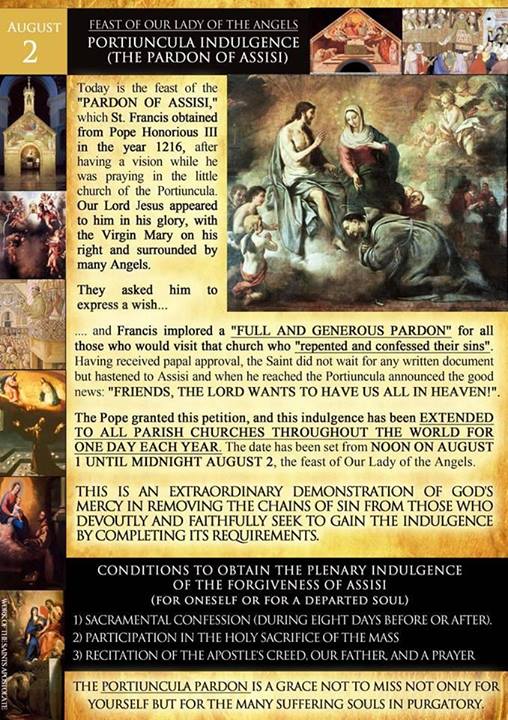
Portiuncula Indulgence (Pardon of Assisi) – on 2 August of each year

Image

The Portiuncula Indulgence, also known as the Pardon of Assisi, is offered every year to all the faithful every 2 August of each year.

The Indulgence include complete reparation from sins and faults, and the total forgiveness granted to us for all our temporal sins, since 1216, when St. Francis of Assisi first requested it through the intercession of the Most Blessed Virgin Mary.

There are three conditions required for the Portiuncula Indulgence :

1. Receiving the Sacrament of Confession within eight days before or after 2 August each year

2. Attendance and full participation at the Holy Sacrifice of the Mass (Full devotion in the Mass)

3. Devout recitation of the Apostle’s Creed, Our Father, and a personal Prayer

Friday, 2 August 2013 : 17th Week of Ordinary Time, Memorial of St. Eusebius of Vercelli, Bishop; and St. Peter Julian Eymard, Priest (Gospel Reading)

Matthew 13 : 54-58

Jesus went to His hometown and taught the people in their synagogue. They were amazed and said, “Where did He get this wisdom and these special powers? Is He not the carpenter’s Son? Is Mary not His mother and are James, Joseph, Simon, and Judas not His brothers? Are not all His sisters living here? How did He get all this?” And so they took offense at Him.

Jesus said to them, “The only place where prophets are not welcome is their hometown and in their own family.” And He did not perform many miracles there because of their lack of faith.

Friday, 26 July 2013 : 16th Week of Ordinary Time, Memorial of Saints Joachim and Anne, Parents of the Blessed Virgin Mary (Scripture Reflection)

Brothers and sisters in Christ, today we listened to the Ten Commandments given by our Lord to His people, the people of Israel, through Moses, His servant, written on the two stones that would bear the very writings of the Lord, the Commandments that He wanted His people to follow for all eternity. The Ten Commandments carry the basic tenets of what being the people and children of God is all about, that is indeed summarised by Christ as the commandments of love.

For the commandments in the Ten Commandments, when looked deeper into, would show that mankind need to love God with all their attention, their hearts, minds, and soul, and with all their strength, that they will obey and worship no other god but the Lord God, our Lord Jesus Christ, the Saviour of the world. Automatically too, they should honour the Holy Name of their God, YHVH, the God who AM, and whose Name has also been revealed to us, Jesus, the Name above every other name, and the Name upon which all knees will bend, be it on earth, in heaven, or in hell.

Loving God with all our hearts and our strength is important, but that is just one half of the entire law and commandment. That is because as Christ had taught His disciples and which we read in the Gospels, we must also love our brothers and sisters, all our neighbours, fellow mankind, just as we have loved our God and ourselves, in the same way, giving to them our love, care, and compassion. That is the other half of the commandments, that will make perfect our observation of God’s laws and commandments.

To love our brethren and our fellow men means to give unconditional love to others, especially to those who are starved of love, to those who hunger for love and compassion, and those who are in the midst of suffering and persecution. But this is not all that love is about, because love is about giving ourselves not just to those whom we love, or just to those who we think need our love, but to love is also to embrace our enemies, those who hate us, those who persecute us, and those who did evil things to us. Love means to be able to forgive them from their faults to us, and to embrace them as our fellow brothers and sisters of the One True God, the Lord Jesus Christ.

That is why the Ten Commandments also included commands such as not to kill nor to covet one another’s goods and properties, as these are likely to be borne out of animosity that arose between two parties in the first place. Hatred leads to animosity, and then it may result in something that hurt one or both parties, or even kill, in the case of murder. The Lord wants all of us to respect one another and let go of our hatred and our animosity, replacing them instead with love, the kind of love that Jesus Christ had shown us, on the cross at Calvary.

For Jesus Himself had forgiven His enemies, the Pharisees and the chief priests, as well as the people who cried for His death. He embraced them from the cross, and His Blood is poured down the cross to wash the sins of all mankind, because He redeemed all men, without any exceptions. He also embraced His enemy, Saul, the reaper of early Christians, who hunted many people who believed in Christ and tortured them. Christ embraced Saul with His love, and made him into the greatest instrument of His works in this world, from an enemy into the most valiant defender of the faith.

We have to nurture love, not hatred; peace, not violence; hope, not despair; light, not darkness; and faith in God; not in Satan and his devices and temptations. We have to plant the seeds of love, hope, and faith in our youths, in our own families, within our circle of friends, and within our respective societies. For actions not done in love, and life lived without love is empty, and neither does any actions or life that are not bound by hope and faith. To be loving is key to achieving salvation.

Today we commemorate the feast day of the parents of the Blessed Virgin Mary, the mother of our God, that is St. Joachim and St. Anne, the grandparents of Jesus Christ our Lord. They are role models for all families, Christian families in particular, in how to bring God’s love into our homes. They brought up the mother of our Lord from her infancy to be the blessed person our mother Mary came to be. They cared for her since her Immaculate Conception inside her mother’s womb, the womb of St. Anne.

The care and love that St. Joachim and St. Anne had shown to Mary, the mother of our Lord, is replicated in her care for Jesus, whom Mary cared since His humble birth at the stables in Bethlehem, protecting Him from King Herod and those who would wish to harm Him. She accompanied Him through His childhood and teenage years, being revealed that Jesus is truly the Son of God when He was left behind in the Temple at the age of twelve. Mary accompanied Christ through His ministries and eventually until His death, and resurrection.

All these are made possible by the tender love and care given to Mary herself by her parents, St. Joachim and St. Anne, who showed her the meaning of love, compassion, and faith in God, that she herself become role models for all of us, the mother of God, and the greatest among all saints and apostles of Christ. St. Joachim and St. Anne are truly role models for us, and we should indeed follow in their footsteps, as well as the footsteps of Mary, the mother of our Lord, towards Christ, who longs to welcome us back into His embrace.

Therefore, brothers and sisters in Christ, let us renew our commitment to our Lord today, and also to renew our commitment to love, that is to love everyone, without exception, even to those who hate us the most and those who wished for our misfortune and death. Let us be gracious and courageous to forgive and to embrace those who do not have love in them, that in doing so, we will obey the commandments of the Lord, as once given to Moses, His servant so that the people of Israel will know the Lord’s laws, and so may we too, obey the same law, that is the law of love.

May the Lord bless us all with abundance of graces and blessings, and plant the seeds of love, hope, and faith within us, that they may blossom, and through our words, actions, and deeds, may we spread love, joy, and hope to all mankind, bringing everyone closer to God who is our Lord and Father. St. Joachim and St. Anne, pray for us too. Amen.

Friday, 26 July 2013 : 16th Week of Ordinary Time, Memorial of Saints Joachim and Anne, Parents of the Blessed Virgin Mary (Gospel Reading)

Matthew 13 : 18-23

Now listen to the parable of the sower. When a person hears the message of the kingdom, but does not take it seriously, the devil comes and snatches away what was sown in his heart. This is the seed that fell along the footpath.

The seed that fell on rocky ground stands for the one who hears the word, and accepts it at once with joy. But such a person has no roots, and endures only for a while. No sooner is he harassed or persecuted because of the word, than he gives up.

The seed that fell among the thistles is the one who hears the word, but then the worries of this life and the love of money choke the word, and it does not bear fruit.

As for the seed that fell on good soil, it is the one who hears the word and understands it; this seed bears fruit and produces a hundred, or sixty, or thirty times more.

Friday, 26 July 2013 : 16th Week of Ordinary Time, Memorial of Saints Joachim and Anne, Parents of the Blessed Virgin Mary (Psalm)

Psalm 18 : 8, 9, 10, 11

The law of the Lord is perfect : it gives life to the soul. The word of the Lord is trustworthy : it gives wisdom to the simple.

The precepts of the Lord are right : they give joy to the heart. The commandments of the Lord are clear : they enlighten the eyes.

The fear of the Lord is pure, it endures forever; the judgments of the Lord are true, all of them just and right.

They are more precious than gold – pure gold of a jeweller; they are much sweeter than honey which drops from the honeycomb.

Friday, 26 July 2013 : 16th Week of Ordinary Time, Memorial of Saints Joachim and Anne, Parents of the Blessed Virgin Mary (First Reading)

Exodus 20 : 1-17

God spoke all these words. He said, “I am YHVH your God who brought you out of the land of Egypt, out of the house of slavery.

Do not have other gods before Me.

Do not make yourself a carved image or any likeness of anything in heaven, or on the earth beneath, or in the waters under the earth; you shall not bow down to them or serve them. For I, YHVH your God, am a jealous God; for the sin of the fathers, when they rebel against Me, I punish the sons, the grandsons and the great-grandsons; but I show steadfast love until the thousandth generation for those who love Me and keep My commandments.

Do not take the Name of YHVH your God in vain for YHVH will not leave unpunished anyone who takes His Name in vain.

Remember the Sabbath day and keep it holy. For six days, you will labour and do all your work, but the seventh day is a sabbath for YHVH your God. Do not work that day, neither you, nor your son, nor your daughter nor your servants, men or women, nor your animals, nor the stranger who is staying with you. For in six days YHVH made the heavens and the earth and the sea and all that is in them, but on the seventh day He rested; that is why YHVH has blessed the sabbath day and made it holy.

Honour your father and your mother that you may have a long life in the land that YHVH has given you.

Do not kill.

Do not commit adultery.

Do not steal.

Do not give false witness against your neighbour.

Do not covet your neighbour’s house. Do not covet your neighbour’s wife, or his servant, man or woman, or his ox, or his donkey, or anything that is his.”