
Wednesday, 24 July 2013 : 16th Week of Ordinary Time, Memorial of St. Charbel Makhluf, Priest (Scripture Reflection)

Brothers and sisters in Christ, today we listened to the parable of the sower, the well-known parable in the Gospel Reading, and also the rebelliousness of Israel during their journey in the desert, in the First Reading today, complaining to the Lord that they had a much better and fulflling life in Egypt in slavery compared to their freedom in the desert.

The parable of the sower tells us that while the Word of God is truly available for all people to witness, to see, and to listen, but ultimately, it is how we as a person take in that Word of God and nurture it, that the Word of God, that is our faith, likened to the seed spread by the sower, can find good soil in our hearts and grow.

As all of you would have guessed, yes, the sower is none other than the Lord Himself, who gave His light to the world through His Son, Jesus Christ, and from Him, the teachings came down upon us through His Apostles and their successors, our bishops and priests, who are also sowers and labourers in the fields of the Lord. We are the soil, the ground on which the seeds land on, and where the seeds will be able to grow, if the conditions are met and suitable, or perish if the conditions are unfavourable for the growth of the seeds.

The seeds that fall on the path, and then eaten by the birds are likened to those of us, whose faith and devotion to the Lord are weak, and therefore, the devil came and took away the seeds of faith from our hearts. He and his angels come like the birds, eating away the seeds of faith God has planted in us, because the seeds did not take root, and therefore, the faith easily became lost. This is what happened if we keep the Lord out of our hearts and the devil may therefore enter and occupy our hearts, corrupting us to do his purpose, that is sin and evil.

The seeds that fall on the rocky ground did not manage to grow long enough before they withered because of the scorching sun, their faith grew quickly like the seeds, because the soil is shallow, just as their faith is shallow, without deep roots to sustain their faith, and their growth. When difficulties and challenges of the world present themselves, with all the temptations of the world, those whose faith is likened to the seeds that fell on the rocky ground, will quickly lose their faith, just as the seeds’ plants withered.

This one particularly most closely represent the situation portrayed in the First Reading today, and the general attitude of the people of Israel during the duration of the Exodus from Egypt. The people of Israel were easily awed and made astonished by the display of the power of God, especially by the plagues and miracles made by Moses in the power of the Lord, against the Egyptians, and during the sojourn of Israel in the desert. Yet, just like the seeds on the rocky ground, which do not manage to have deep roots on the shallow soil, the faith of Israel was indeed shallow and weak.

They were terrified and amazed by miracles and shows of power of God, but their faith did not have strong roots, and when difficulties and trials came, with hunger and the suffering in the desert, they abandoned their faith in God and even tested God, whether He could help them and deliver them from the sufferings they faced. They became angry at the Lord and His servant, Moses, and they made complaints after complaints, even after the Lord had repeatedly made visible His power and authority to the people of Israel.

Their disobedience led to great sins, and the people worshipped pagan gods, beginning from the golden calf that the people had forced Aaron to make when Moses stayed with God on His mountain for forty days and forty nights. They did not give their trust and love for God, and instead believing more in their own power, the power of men. They did not love God but love His miracles. They did not love Him but love the food He provided them. This is a lesson for all of us, brothers and sisters in Christ, that we did not become like them, to dwell in superficial things and the things of this world, satisfying our own desires, but lacking love for God. We have to love God as the first priority in our lives.

Then, let us also be wary of the worries of the world, because like the seeds that fell on thistles, the thistles grew around the plants and killed them. They are those of us who failed to keep up our faith, because they have been bombarded by countless worries and evils of the world, which brought much stress and worry to them, so that they have ended up forgetting the Lord their God. They have been blinded by their worry that they became blind to the Lord, and choked by those worries.

Those worries of the world, of what we are to eat today, of what we are to wear today, to our work or to party, or even what are we going to do today, and where are we going today, should not be our priorities in life. Indeed, that is because these worries will tend to divert our attention, which should be given to the Lord and doing good for the people of God, into thinking solely for our own sake, which breeds strong sense of selfishness. We must be selfless, brothers and sisters, and give ourselves in service to our brothers and sisters in need of love, in need of help.

We must strive to be like the seeds that fall on rich soil, on deep ground, well watered and filled with ample nutrition, that allows the plants to grow to great heights and remain healthy. The same too should happen to us and our faith and love to the Lord. We must nurture our faith at all times, as we journey through this life, and nurture it with good works, with a healthy prayer life, and devotion to the Lord and through the intercession of His saints. If we do so, we will grow stronger in our faith, and the love that is in us will blossom, and many will feel the love of God through us.

Today, we commemorate the feast day of St. Charbel Makhluf, a Maronite monk who passed away just over a century ago. He was a devout and very pious Maronite, who joined the religious order of monkhood, to dedicate himself fully to the Lord in prayer and love. Despite a relatively uneventful life, after his death, he became a source of many miracles, both through his intercessions and his uncorrupted body.

St. Charbel Makhluf is an example for all of us Christians, the children of God, to follow, so that we too can follow his example of holy life dedicated to God and the love that he expressed in his life through his actions, that we nurture the faith that is in us through strong devotion to God and constant prayers, so that we will always keep ourselves attuned to the will of God. That we may bear much fruits, hundredfold and manyfold of what has been planted, what has been given to all of us.

May God bless us, and may He strengthen us in our faith and our love, for Him and our fellow brethren, and inspired by the example and holiness of St. Charbel Makhluf, may we bear fruits, fruits of love and compassion, the blessed fruits of the Holy Spirit, for the good of everyone, and for our salvation. Amen.
Tuesday, 23 July 2013 : 16th Week of Ordinary Time, Memorial of St. Bridget of Sweden, Religious (Psalm)

Exodus 15 : 8-9, 10 and 12, 17

At the blast of Your nostrils the waters piled up, the surging waters stood firm in a heap; the deeps congealed in the heart of the sea. The enemy said, “I will give chase and overtake, I will divide the spoil and make a feast of it. I shall draw my sword and my hand will destroy them.”

A breath of Yours and the sea covered them; they sank like lead in the mighty waters. You stretched out Your right hand; the earth swallowed them.

You will bring them in and plant them on the mountain of Your inheritance, the place You chose to dwell in, o YHVH, the sanctuary prepared by Your hands.

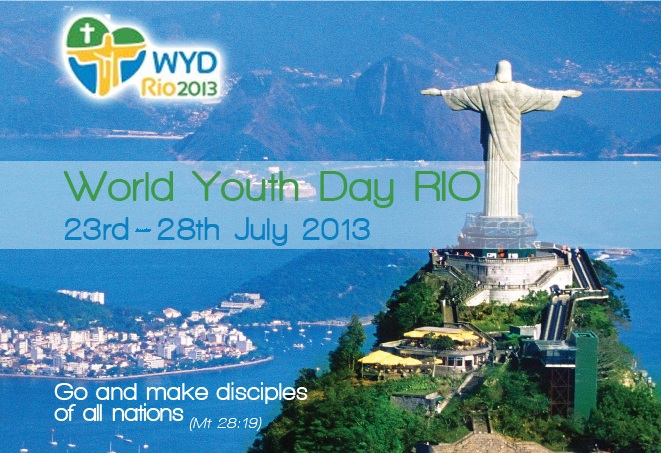
(Reminder) Official Schedule of Pope Francis in World Youth Day 2013 (23-28 July 2013) in Rio de Janeiro, Brazil

wyd-rio-2013


http://www.romereports.com/palio/popes-brazil-schedule-released-as-rio-gets-ready-for-world-youth-day-english-9964.html#.UYjtL8rTc78

http://attualita.vatican.va/sala-stampa/bollettino/2013/05/07/news/30948.html

Pope Francis’ complete schedule for the World Youth Day 2013 celebrations in Rio de Janeiro, Brazil had been released by the Vatican. As the schedule above is in Italian, I will translate it as best as I can into English here.

The Schedule (The times depicted are local time, Rome time = UTC+2 and Rio de Janeiro time = UTC-3) :


Monday, 22 July 2013

08.45 am (Rome Time) : Departure from Rome’s Ciampino Airport to Rio de Janeiro

04.00 pm (Rio Time) : Arrival at the Galeao International Airport in Rio de Janeiro

05.00 pm : Welcome ceremony for Pope Francis at the Guanabara Palace in Rio de Janeiro

05.40 pm : Visit by Pope Francis to the President of Brazil at the same Guanabara Palace


Pope Francis will then stay at a private residence in the Sumare region of Rio de Janeiro. No event scheduled for Tuesday, 23 July 2013


Wednesday, 24 July 2013 

08.15 am (Rio Time) : Pope Francis will depart his residence at Sumare by helicopter to visit the famous Basilica of the National Shrine of Our Lady of Aparecida

09.30 am : Pope Francis arrives at the Basilica of the National Shrine of Our Lady of Aparecida
10.00 am : Pope Francis will venerate an image of the Virgin Mary at the Basilica located in the Hall of the Sanctuary of the Twelve Apostles

10.30 am : Holy Mass led by Pope Francis at the Basilica of the National Shrine of Our Lady of Aparecida

01.00 pm : Pope Francis will have lunch with the Bishops of the Ecclesiastical Province of Aparecida and the seminarians of the Seminary of Aparecida

04.10 pm : Pope Francis will return to Rio de Janeiro from Aparecida by helicopter

05.25 pm : Pope Francis is scheduled to return to Rio de Janeiro by helicopter

06.30 pm : Pope Francis will visit the St. Francis Assisi Hospital in Rio de Janeiro


Thursday, 25 July 2013
07.30 am : Private Mass led by Pope Francis in his official WYD 2013 residence in Sumare, Rio de Janeiro

09.45 am : Pope Francis will receive the keys of the city of Rio de Janeiro and he will also bless the Olympic Flags of Rio de Janeiro (will be host for 2016 Olympics) at the city square of Rio de Janeiro

11.00 am : Pope Francis will visit the slum community of Varginha (Manguinhos)

06.00 pm : Pope Francis will receive youths attending the WYD 2013 at the Copacabana waterfront area, Rio de Janeiro


Friday, 26 July 2013

07.30 am : Private Mass led by Pope Francis in his official WYD 2013 residence in Sumare, Rio de Janeiro

10.00 am : Pope Francis will conduct confession sessions with youths attending WYD 2013 in the Quinta da Boa Vista Park of Rio de Janeiro

11.30 am : Pope Francis will meet some young prisoners at the Archbishop’s Palace at Rio de Janeiro

12.00 pm : Pope Francis will lead Angelus prayer from the balcony of the Archbishop’s Palace

12.15 pm : Pope Francis will greet the organising committee and benefactors of WYD 2013 in the Archbishop’s Palace, Rio de Janeiro

01.00 pm : Pope Francis will have lunch with youths at the Archbishop’s Palace

06.00 pm : Way of the Cross led by Pope Francis at the Copacabana waterfront, Rio de Janeiro


Saturday, 27 July 2013

09.00 am : Holy Mass with the bishops, priests, seminarians, and religious at the Cathedral of the Archdiocese of San Sebastian Rio de Janeiro (Cathedral of Rio de Janeiro)

11.30 am : Pope Francis will meet with the leaders of Brazil in the Municipal Theatre of Rio de Janeiro

01.00 pm : Pope Francis will have lunch with the Cardinals of Brazil, the President of the Episcopal Conference of Brazil, bishops of the Rio de Janeiro region, and the Papal entourage of WYD 2013 in the Sumare residence, Rio de Janeiro

07.30 pm : Pope Francis will lead the prayer vigil with the youths at Guaratiba, Rio de Janeiro


Sunday, 28 July 2013

10.00 am : Holy Mass of the Closing of WYD 2013 at Guaratiba, Rio de Janeiro.

12.00 am : Pope Francis will lead the recitation of the Angelus prayer at Guaratiba

02.00 pm : Pope Francis will have lunch with the Papal entourage of WYD 2013 in the Sumare residence, Rio de Janeiro

04.00 pm : Pope Francis will meet with the leaders of CELAM, the Latin American Episcopal Conference at Sumare, Rio de Janeiro

04.40 pm : Pope Francis leaves the Sumare residence

05.30 pm : Pope Francis will meet with the volunteers of the WYD 2013 at Hall 5 of Rio Centre, Rio de Janeiro

06.30 pm : Farewell ceremony at the Galeao International Airport of Rio de Janeiro

07.00 pm : Departure from the Galeao International Airport to return to Rome


Monday, 29 July 2013

11.30 am (Rome Time) : Arrival at the Ciampino Airport of Rome

Sunday, 21 July 2013 : 16th Sunday of Ordinary Time (First Reading)

Genesis 18 : 1-10a

YHVH appeared to Abraham near the oak of Mamre. Abraham was sitting at the entrance to his tent, in the heat of the day, when he looked up and saw three men standing nearby. When he saw them he ran from the entrance of the tent to meet them. He bowed to the ground and said, “My Lord, if I have found favour in Your sight, do not pass You servant by. Let a little water be brought. Wash Your feet and then rest under the trees.”

“I shall fetch some bread so that You can be refreshed and continue on Your way, since You have come to Your servant.” They then said, “Do as you say.” Abraham hurried into the tent to Sarah and said to her, “Quick, take three measures of flour, knead it and make cakes.”

Abraham then ran to the herd, took a fine, tender calf, gave it to the servant who hurried to prepare it. He took butter and milk and together with the calf he had prepared, laid it all before them. And while he remained standing, they ate. They then asked, “Where is Sarah, your wife?” Abraham answered, “She is in the tent.” And the Visitor said, “At this same time next year I will return and Sarah by then will have a son.”

Saturday, 20 July 2013 : 15th Week of Ordinary Time, Memorial of St. Apollinaris, Bishop and Martyr (Scripture Reflection)

Brothers and sisters in Christ! Christ had delivered us from the hands of the devil and bring us to the land of the living, that is new life in Him, and the hope of eternal life together with the saints and the angels of the Lord, for eternity. He had come, He had been victorious, and He had conquered, a glorious king triumphant over His enemies, that is Satan and his followers, his fallen angels.

He did not let His people to live forever in suffering and oppression, as He once rescued the people of Israel, the people He had first chosen among the nations, from the oppression and tyranny of the Egyptians. So the same He had done too, for all of us, all mankind, without exception, to free us all from the tyranny of the true evil, that is Satan and all sins.

He sent forth His Son to be our hope, our rescuer, and our Redeemer. Jesus Christ, the Son of God, born as a humble man, had died on the cross for all of us, that through His death, and ultimately, His glorious resurrection, He broke forever the yoke of sin on all of us. Our debts of sin were paid by the ultimate price of His Most Precious Body and Blood, which He offered freely on the cross for all of us, God’s beloved children.

To those who follow the ways of the Lord, and those who repented their sins and turned back to face the Lord their God, with all their hearts, with all their strength and power, and in the true spirit of repentance in sincerity, the Lord will reward them with forgiveness, love, and His eternal embrace. He will welcome them into His kingdom and bring all of them into the land of eternal happiness, just as He had once promised the people of Israel and Abraham, their father, that they will inherit the land of prosperity, of flowing milk and honey.

But those who ignored His call and His mercy, and those who disobeyed Him will receive what is their due, that is punishment for sins and death, a fate that awaited all of us, because of our rebellion against God through sin, but which our Saviour, Jesus Christ had voided for all of us through His sacrifice on the cross, but a fate that will not be voided for those who reject Christ and persecute His people.

Brothers and sisters in Christ, let us not harden our hearts the way that Pharaoh had done in his refusal to let the people of Israel go free from their slavery. Let us rather open our hearts to God’s love and His Holy Spirit, so that the Spirit will come into us and dwell within us, transforming us from the children of darkness and sin, into children of God, that is of love and light. He is a loving God and a merciful Lord, who will forgive us from our faults and rebellion, but only if we would open our hearts. He is a just God, and One who hates all evil and sin, and therefore, if we harden our hearts and close them against Him, there will be only one sentence that awaits us, which is death, eternal damnation in hell.

Today, brothers and sisters, we commemorate the feast day of St. Apollinaris, a bishop of the early Roman Empire, one of the early leaders of the Church, who was martyred in his ministry and kept his faith to the Lord till the end faithfully. St. Apollinaris with great zeal preached the Good News of the Lord throughout many parts of the then Roman Empire, across the Mediterranean Sea, not unlike what St. Paul, the Apostle to the Gentiles had done just decades before St. Apollinaris did.

St. Apollinaris persevered with great courage and faith, despite numerous difficulties he received along his mission and his preaching. Many opposed him, not least the pagan priests and rulers, who viewed his teachings as a threat to their influences in the society, and who also viewed him as both a rival and a rebel to the Imperial authority.

Why rebel? Because St. Apollinaris preached the Word of God in Christ Jesus, that is the Saviour of the world, in the belief in the One, true and only God, which contradicted directly with the pagan worships at the time, particularly when the contemporary Roman Emperors were increasingly worshipped as divine even when they were still living. As Christians do not worship anyone other than God, they were somewhat seen as traitors by the Romans, for rejecting that the Emperor is divine.

As such, St. Apollinaris, who preached the Gospel and led the early Christians as bishop, the path was really tough, and persecutions and rejections were very common. In the end, even St. Apollinaris, following the Apostles and disciples of Christ before him, was put to death in sacred martyrdom. Following Christ is never easy, brothers and sisters, because we have to carry our own crosses, with Christ, on the long path to salvation. Yet Christ had made the path straight for us, if we believe in Him and remain faithful in Him, that we will not go astray, and remain in the true path towards the Lord and eternal happiness.

The people of Israel too endured suffering in the desert in their journey. Following the Lord is not easy, but in the end, if we remain faithful, the Lord would reward us greatly, with none other than everlasting life and eternal happiness, that our lives of suffering would truly be worth living for the sake of the ultimate reward at the end.

But if we are not faithful, and go astray in our path, then we risk death as our ultimate end. The people of Israel constantly grumbled about their suffering and disobeyed the Lord many times, through Moses, whom they disobeyed so often as their hearts were hardened against the Lord. They did not live to see the Promised Land, and died in the desert as their punishment. So, the lesson is that, all of us should do our best, to remain faithful always and ever loving to the Lord our God. Our Lord who loves us wants our love in return, that we remain in Him just as He remain in all of us, within our hearts.

May the Lord strengthen our faith, and through the example of St. Apollinaris, may we be inspired to always persevere in our mission to bring the Good News to all nations, to the ends of the earth, without fear, and with zeal and fire of the faith in our hearts. St. Apollinaris, pray for us, and may God bless us all. Amen.

Friday, 19 July 2013 : 15th Week of Ordinary Time (Scripture Reflection)

Brothers and sisters in Christ, today we heard the story of salvation, the liberation of the people of Israel from their slavery in Egypt. They had been brought with great power from the yoke of the Pharaohs into the new journey towards their Promised Land. In his stubborn mind and hardened hearts, the Pharaoh refused to let the people of Israel go repeatedly, valuing them greatly as assets for his great Empire, as the builders of his cities and the labour force for many of his projects. In his ambition, pride, and arrogance, he thought that he could do away with the anger of God, but as history told us, he could not.

God smote Egypt hard with plagues of fire, ice, locusts, darkness, and many others, but their lack of repentance made God to deal with them firmly in a last punishment. A punishment originally crafted by the Pharaoh to be aimed to the Israelites, was overturned by the Lord to be aimed at the people of Egypt instead, and not even Pharaoh was spared. That punishment was the death sentence for all the firstborn sons, first intended for the Israelites, but then changed by the Lord to be the firstborn sons of their Egyptian slave masters.

Those who obeyed His will gave a sacrifice of the blood of the lamb, an unblemished lamb, as a sign of their salvation, and God passed over the houses of the faithful, marked by the blood of the lamb, that none of their firstborn sons were killed by the angel of death passing through the land of Egypt at that night of the first Passover. He showed His mercy and love to the people of Israel and gave them His care.

That covenant God had with His people was renewed, in a new salvation, a new liberation. Just as once the Lord had brought His hand to save His people from slavery in Egypt, and freed them from the yoke of the Pharaohs, He made His move once again, to save mankind, and liberate all of them, without exception, from the yoke of Satan, from the slavery of evil and sin.

For that purpose, He sent none other than Jesus Christ, our Lord and God, to be our Saviour. He sent His own Son, to be born of the Virgin Mary, to be a humble man, one of us, to suffer with us, to be with us, and most importantly, to give Himself up for us, as the Lamb of God. Just as the lamb was sacrificed and its blood became the symbol of salvation for the people of Israel, so had the Lamb of God gave His Blood, the Most Precious Blood, freely for our own salvation. His Blood pouring down from the cross cleanses all of us and made us whole once again.

To those who believe and accepts His Blood, the same happened as what had happened at that First Passover. Those who receive the Most Precious gifts of the Lord, that is His own Body and His own Blood, just as the lamb sacrificed at the First Passover had given its body and blood for the people of Israel, will be saved, because, when we receive the Lord in the Eucharist, we take in the Lord Himself through His Body and Blood in the bread and wine transformed, into ourselves, and in us, the Lord will be able to see an unmistakeable mark, mark that we all belong to Him.

The Lord who sees that we belong to the Lord will then ‘pass over’ us, and we are free, free from death and the fate that awaited us, just as the people of Israel had been passed over by the Lord and His angels of death, because we have received the Lord and accepted Him as our Lord and Saviour. We who put our faith and complete trust in the Lord will not taste death but will be given eternal life. But to those who rejected Him and His free offering of Himself, He will show His wrath and anger, and they will face damnation in hell, and because they rejected Him, they too, will then be rejected.

He is the Lord of the Sabbath and the Lord of all laws, and He had rebuked the Pharisees, who had been trapped in their own petty observances of the law, which included the laws made by men, so that they entirely missed the purpose of the Law that God had given the people of Israel. That Law was meant for the people so that they will love God, and give themselves entirely, with all their hearts, with all their soul, and with all their being, to the Lord, the offering of oneself, which the Lord valued much more than the offering of sacrifices of lambs and goats.

That is why, brothers and sisters in Christ, let us reaffirm our commitment and dedication to the Lord, pouring out to Him our hearts and our sincere love for Him, that He will also bless us with everlasting grace and blessing. Let us follow Him and obey His will always, through both our complete faith in Him, and also through love that we show to our fellow brothers and sisters in this world, particularly those in the greatest need for our help.

Let us not be complacent, brothers and sisters, but use all the opportunities in our power to bring salvation closer to many of those who have yet to manage to listen to the Word of God. Let us be proactive in carrying out our faith, that it will always remain alive and will not be stagnant. Let us reflect life, hope, and love in all the things we say, in all the things we do, and in all our deeds. May God who has liberated us from sin and evil, bring us ever closer into His embrace. Amen.

Thursday, 18 July 2013 : 15th Week of Ordinary Time (Scripture Reflection)

Brothers and sisters in Christ, come to Christ our Lord whose yoke is light, and come to the Lord who had liberated us from the yoke of sin and death. He has liberated all of us from our fate that is death through His own death on the cross, and His resurrection give us all new hope of life, in the eternal bliss of heaven.

Yes, following the Lord has its own crosses, that is difficulties, because this world that is filled with evil will certainly oppose us with all of its might, that they will try to destroy us just as they had tried to destroy our Lord Jesus Christ by condemning Him to death, the humiliating death on the cross. Yet, Christ had triumphed, and not even death could hold Him captive, but He gloriously turned hell upside down, releasing the souls of the faithful from the slavery in hell and death.

For Christ is like the new Moses, whom the Lord had sent to liberate all the people, all mankind, all of creation, instead of just the people of Israel. If Moses was sent to liberate the people of Israel from slavery in Egypt under the Pharaohs, Christ was sent to liberate everyone, without exception from our slavery under sin, with Satan as the jailer.

Following Christ will be difficult, and there will be lots of oppositions from those in the world, particularly from the allies of evil. But this is nothing if compared to the suffering and difficulties that we will face for eternity, if we do not follow Christ and choose to follow the devil instead. That is also to represent how light is the yoke of Christ, compared to the yoke of the devil, because while the yoke of Christ leads eventually to eternal happiness, and only a temporary suffering, the yoke of the devil leads to never-ending eternal death and suffering, from the complete separation of man from God.

But yet, many people seem to prefer the heavier yoke of the devil than the lighter yoke of Christ, why? That is because the yoke of the devil looks more attractive in our hearts. It looks better and also feels better than the yoke of Christ. The yoke of the devil looks sweeter, better, and more promising, and the devil had also sweetened it further with all the pleasures and offerings this world can give, whereas in the yoke of Christ, we can only see suffering, although it is a suffering accompanied by the love of God.

That was why the same had happened to the people of Israel, when they followed Moses through the desert towards the Promised Land. They rebelled and rebelled constantly against the leadership of Moses and against God Himself. They saw the desert as the sure place of death, while their life in Egypt, under slavery, they deemed to be better than the nomadic life in the desert. Yes, even in slavery! They were glad to remain in slavery rather than be free, so that they could enjoy their ‘good’ life in Egypt.

That good life in Egypt, my brothers and sisters, is truly equivalent to our current life in the state of sin. Because sinning is actually enjoyable, and the devil put no stops to ensure that we remain in our state of sin and indifference towards the merciful God. We constantly rebel against the will of God and the teachings of His prophets and apostles, as we have always done, just like the people of Israel themselves had done in the desert. They complained of their temporary suffering, as we does now, but they failed to realise that true happiness lies at the end of that suffering. Remember, the yoke of Christ is light, and it leads to salvation, while the yoke of the devil leads only to death and eternal suffering.

Therefore, brothers and sisters in Christ, do we resolve now to take up our crosses while following He who was crucified? That is to take up the Cross of Christ? Or do we slacken and let the devil has the better of us and lead us to eternal damnation? If we are to follow Christ, as He Himself had said, we must be ready to take up our crosses and suffer the rejection by evil and the world. But that is nothing, compared to if we are rejected by our Lord Himself, in which, then, there will be no hope left.

Let us resolve to follow the Lord and be ready to face all the consequences of following Him, facing it with faith, courage, and devotion, without ever going out of our way or being led astray. May the Lord who is merciful look kindly upon us, and help us during this journey of the faith, and guiding us through the persecutions and sufferings that will be inflicted upon us.

May the Lord bless us all and protect us, so that all of us will persevere, and fall not into eternal damnation in hell, but achieve eternal life in bliss in heaven, with our Lord who loves us. Amen.

Wednesday, 17 July 2013 : 15th Week of Ordinary Time (Psalm)

Psalm 102 : 1-2, 3-4, 6-7

Bless the Lord, my soul; all my being, bless His Holy Name! Bless the Lord, my soul, and do not forget all His kindness.

He forgives all your sins and heals all your sickness; He redeems your life from destruction and crowns you with love and compassion.

The Lord restores justice and secures the rights of the oppressed. He has made known His ways to Moses and His deeds to the people of Israel.

Tuesday, 16 July 2013 : 15th Week of Ordinary Time, Memorial of Our Lady of Mount Carmel (Psalm)

Psalm 68 : 3, 14, 30-31, 33-34

I am sunk in the miry depths where there is no foothold; I have come into deep waters, swept and engulfed by the flood.

But I pray to You, o Lord, at a time most favourable to You. In Your great love, o God, answer me with Your unfailing help.

But I myself am humbled and wounded; Your salvation, o God, will lift me up. I will praise the Name of God in song; I will glorify Him with thanksgiving.

Let the lowly witness this and be glad. You who seek God, may your hearts be revived. For the Lord hears the needy and does not despise those in captivity.

Alternative Reading (from the Mass of the Blessed Virgin Mary)

Luke 1 : 46-47, 48-49, 50-51, 52-53, 54-55

My soul proclaims the greatness of the Lord, my spirit exults in God my Saviour!

He has looked upon His servant in her lowliness, and people forever will call me blessed. The Mighty One has done great things for me, Holy is His Name!

From age to age His mercy extends to those who live in His presence. He has acted with power and done wonders, and scattered the proud with their plans.

He has put down the mighty from their thrones, and lifted up those who are downtrodden. He has filled the hungry with good things, but has sent the rich away empty.

He held out His hand to Israel, His servant, for He remembered His mercy, even as He promised to our fathers, to Abraham and his descendants forever.

Tuesday, 16 July 2013 : 15th Week of Ordinary Time, Memorial of Our Lady of Mount Carmel (First Reading)

Exodus 2 : 1-15a

Now a man belonging to the clan of Levi married a woman of his own tribe. She gave birth to a boy and, seeing that he was a beautiful child, she kept him hidden for three months. As she could not conceal him any longer, she made a basket out of papyrus leaves and coated it with tar and pitch. She then laid the child in the basket and placed it among the reeds near the bank of the Nile; but the sister of the child kept at a distance to see what would happen to him.

Now the daughter of Pharaoh came down to bathe in the Nile; her attendants meanwhile walked along the bank. When she saw the basket among the reeds, she sent her maidservant to fetch it. She opened the basket and saw the child – a boy, and he was crying! She felt sorry for him, for she thought : “This is one of the Hebrew children.”

Then the sister of the child said to Pharaoh’s daughter, “Shall I go and get one of the Hebrew women to nurse the baby for you?” Pharaoh’s daughter agreed, and the girl went to call the mother of the child. Pharaoh’s daughter said to her, “Take the child and nurse him for me and I will pay you.” So the woman took the child and nursed him and, when the child had grown, she brought him to Pharaoh’s daughter who adopted him as her son. And she named him Moses to recall that she had drawn him out of the water.

After a fairly long time, Moses, by now a grown man, wanted to meet his fellow Hebrews. He noticed how heavily they were burdened and he saw an Egyptian striking a Hebrew, one of his own people. He looked around and seeing no one, he killed the Egyptian and hid him in the sand.

When he went out the next day he saw two Hebrews quarrelling. Moses said to the man in the wrong, “Why are you striking a fellow countryman?” But he answered, “Who has set you prince and judge over us? Do you intend to kill me as you killed the Egyptian?” Moses was afraid and thought, “What I did must be known.”

When Pharaoh heard about it, he tried to kill Moses, but Moses fled from Pharaoh and went to live in the land of Midian.

Alternative Reading (from the Mass of the Blessed Virgin Mary)

Zechariah 2 : 14-17

“Sing and rejoice, o daughter of Zion, for I am about to come, I shall dwell among you,” says YHVH. “On that day, many nations will join YHVH and be My people, but My dwelling is among you.”

The people of Judah will be for YHVH as His portion in His holy land. He will choose Jerusalem again. Keep still in YHVH’s presence, for He comes, having risen from His holy dwelling.