(Special – Singapore) Saturday, 14 February 2015 : Solemnity of the Anniversary of the Dedication of the Cathedral of the Good Shepherd (Homily and Scripture Reflections)

Liturgical Colour : White

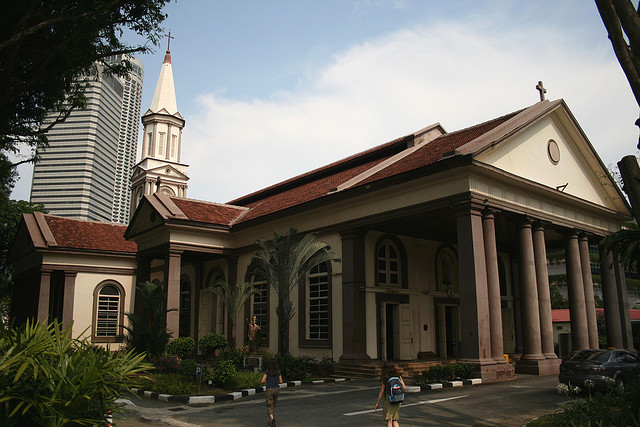
Dear brothers and sisters in Christ, my brethren in faith throughout the Archdiocese of Singapore, today we celebrate this special occasion on Mass on the fourteenth day of February of this year, as the celebration of the Anniversary of that day when the mother church of this See, that is the direct heir of the See of Malacca and the progenitor of the Church in much of Asia and beyond, was consecrated and blessed more than a hundred years ago.

In the year of our Lord, 1897, then Bishop of Malacca, Bishop Edouard Gasnier, M.E.P., consecrated the Cathedral building, which had been built and completed just over half a century earlier in 1846. This great building and house of the Lord has been built as the heart and the beginning of the great missionary work in the small island of Singapore, which had just been founded by the British after hundreds of years of isolation and being a backwater and relatively forgotten island.

In this Cathedral, we have the proof of God’s continuing guidance to the works of His faithful servants in the Church, spreading His Good News to all the corners of the earth. The salvation of God is offered to all who wants to listen to His word, and all those who receive the word and believe, they are all saved. And the work of God continues even to this day, with many of His servants, all of us included, continuing to give praise to God and carry out His works daily amongst our brethren in this world.

Brothers and sisters in Christ, do you know why the Cathedral of this Archdiocese of Singapore was named the Cathedral of the Good Shepherd? That was because when it was first built, one of those who had great role in the establishment of that church was St. Laurent Imbert, a missionary priest who went on to become the Apostolic Vicar to Korea, supervising the missionary work in that fertile land where many people still lived in ignorance of the Lord.

St. Laurent Imbert faithfully carried out his mission, and despite the fierce and harsh opposition from the pagan Korean government, he did not fear and continued to do his best to minister to the people of God. And when the persecution by the government reached a new high, and the government offered the liberation of those they have counted for death, if the bishop was to surrender himself, St. Laurent Imbert voluntarily surrendered himself and was martyred for his faith.

In one of his last letters before his martyrdom, he explained the reason behind his decision, that is of the Good Shepherd, imitating what our Lord had done Himself. The Good Shepherd lay down His life for His sheep. And indeed our Lord and God had laid down His life for our sake, that all of us, His sheep may be freed from the certainty of death caused by our sinfulness.

In the memory of St. Laurent Imbert and our Lord’s own sacrifice as our Good Shepherd therefore we dedicate today’s celebration, just as this Cathedral was dedicated to the Lord over a hundred years ago. And what is the relevance of this celebration to all of us? That is because the readings today on the feast of dedication of a Cathedral also reminds us all that we are the Temple of God, the place where God Himself resides.

Many of us seem to forget that all of us who believe in the Lord and who keep faith in Him, having received His Most Precious Body and Blood in the Eucharist, have essentially the Lord Himself dwelling in us, in body and flesh, and in spirit and love. Thus, we have to remember always that we belong to God and He is in us. We must shun all forms of sin and wickedness and walk only in His path, as St. Laurent Imbert and all the other faithful saints and martyrs of God had.

May this joyous occasion and celebration be a time for us to reawaken the love and dedication we have for the Lord, and may all of us be able to shun evil and sin, and gain into ourselves the justification and grace which God had promised all those who are faithful to Him, our loving God and our Good Shepherd. God bless us all. Amen.

(Special – Singapore) Saturday, 14 February 2015 : Solemnity of the Anniversary of the Dedication of the Cathedral of the Good Shepherd (Gospel Reading)

Liturgical Colour : White

John 2 : 13-22

At that time, as the Passover of the Jews was at hand, Jesus went up to Jerusalem. In the Temple court He found merchants selling oxen, sheep and doves, and moneychangers seated at their tables.

Making a whip of cords, He drove them all out of the Temple court, together with the oxen and sheep. He knocked over the tables of the moneychangers, scattering the coins, and ordered the people selling doves, “Take all this away, and stop turning My Father’s house into a marketplace!” His disciples recalled the words of Scripture : ‘Zeal for Your House devours Me like fire.’

The Jews then questioned Jesus, “Where are the miraculous signs which give You the right to do this?” And Jesus said, “Destroy this temple and in three days I will raise it up.” The Jews then replied, “The building of this temple has already taken forty-six years, and will You raise it up in three days?”

Actually, Jesus was referring to the Temple of His Body. Only when He had risen from the dead did His disciples remember these words, then they believed both the Scripture and the words Jesus had spoken.

(Special – Singapore) Saturday, 14 February 2015 : Solemnity of the Anniversary of the Dedication of the Cathedral of the Good Shepherd (Second Reading)

Liturgical Colour : White

1 Corinthians 3 : 9-13, 16-17

We are fellow workers with God, but you are God’s field and building. I, as a good architect, according to the capacity given to me, I laid the foundation, and another is to build upon it. Each one must be careful how to build upon it. No one can lay a foundation other than the one which is already laid, which is Jesus Christ.

Then if someone builds with gold upon this foundation, another with silver and precious stones, or with wood, bamboo or straw, the work of each one will be shown for what it is. The day of Judgment will reveal it, because the fire will make everything known. The fire will test the work of everyone.

Do you not know that you are God’s Temple, and that God’s Spirit abides within you? If anyone destroys the Temple of God, God will destroy him. God’s Temple is holy, and you are this Temple.

(Special – Singapore) Saturday, 14 February 2015 : Solemnity of the Anniversary of the Dedication of the Cathedral of the Good Shepherd (Psalm)

Liturgical Colour : White

Psalm 84 : 9-14

Would that I hear God’s proclamation, that He promise peace to His people, His saints – lest they come back to their folly. Yet His salvation is near to those who fear Him, and His Glory will dwell in our land.

Love and faithfulness have met; righteousness and peace have embraced. Faithfulness will reach up from the earth while justice bends down from heaven.

The Lord will give what is good, and our land will yield its fruit. Justice will go before Him, and peace will follow along His path.

(Special – Singapore) Saturday, 14 February 2015 : Solemnity of the Anniversary of the Dedication of the Cathedral of the Good Shepherd (First Reading)

Liturgical Colour : White

Ezekiel 43 : 1-2, 4-7

He took me to the gate, facing east. Then I saw the Glory of the God of Israel approaching from the east with a sound like the sound of the ocean, and the earth shone with His Glory.

The Glory of YHVH arrived at the Temple by the east gate. The Spirit lifted me up and brought me into the inner court : the Glory of YHVH was filling the House. And I heard someone speaking to me from the Temple while the Man stood beside me.

The voice said, “Son of man, you have seen the place of My throne, where I will place the soles of My feet, and live among the Israelites forever, and the people of Israel, they and their kings, will no longer defile My holy Name with their prostitutes and the kings.

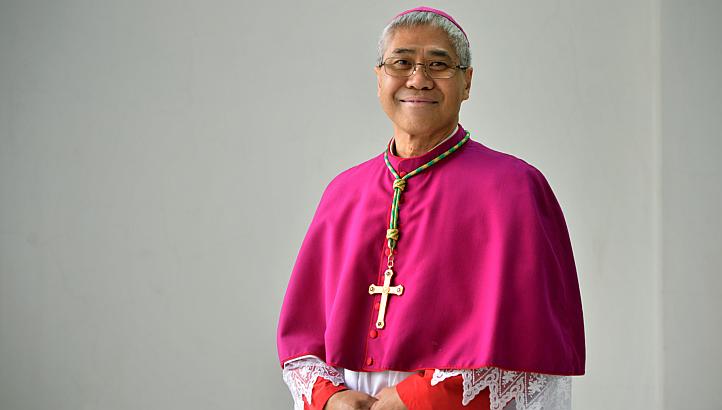
Installation, Inauguration, and Thanksgiving Mass for Archbishop William Goh Seng Chye, the new Archbishop of Singapore

Image

The new Archbishop of Singapore, Archbishop William Goh Seng Chye, having taken over officially on Saturday, 18 May 2013 after the Holy See accepted the resignation of the now Archbishop Emeritus Nicholas Chia Yeck Joo, will be installed at the cathedra of the Cathedral of the Good Shepherd, the mother church of the Church in Singapore.

Image

Archbishop William Goh was the Coadjutor Archbishop of Singapore and being a coadjutor, in conjunction with the Code of the Canon Law, has the right to immediately succeed the Archbishop upon his resignation being accepted by the Holy See.

This Installation Mass will also be an Inauguration Mass for the ministry of the new Archbishop and also a thanksgiving for both the new Archbishop and for the service of the now Archbishop Emeritus Nicholas Chia.


Details on the Mass :

Location : Cathedral of the Good Shepherd, ‘A’ Queen Street, Singapore

Time : Friday, 24 May 2013 at 10.30 am (on Vesak Day – Public Holiday)


As Archbishop William Goh has officially taken over the duty as the Ordinary of the Archdiocese, he immediately resides in the official residence of the Archbishop in the Archbishop’s House, located within the Cathedral grounds.

Image

Meanwhile, Archbishop Emeritus Nicholas Chia will transfer his residence to the Catholic Spirituality Centre in Hougang, Singapore, where Archbishop William Goh had resided during his term as the Coadjutor Archbishop.


God bless our new Archbishop and we also pray for our Archbishop Emeritus, that in his retirement he will continue to do great works for the sake of the Lord.

Ad multos annos, His Excellency Archbishop William Goh!

Pope Francis’ Schedule for April and May 2013

http://www.news.va/en/news/liturgical-celebrations-to-be-presided-over-by-p-2


APRIL
7 April, Second Sunday of Easter, or Divine Mercy Sunday: 5:30pm, Mass in the Basilica of St. John Lateran for the Bishop of Rome to take possession of the Roman cathedra.
14 April, Sunday: 5:30pm, Mass in the Basilica of St. Paul Outside-the-Walls
21 April, Sunday: 9:30am, Mass and priestly ordinations in St. Peter’s Basilica.
28 April, Sunday: 10:00am, Mass and confirmations in St. Peter’s Square.
 
MAY
4 May, Saturday: 6:00pm, Recitation of the Rosary in the Basilica of St. Mary Major.
5 May, Sunday: 10:00am, Mass for Confraternities in St. Peter’s Square.
12 May, Sunday: 9:30am, Mass and canonizations of Blesseds Antonio Primaldo and Companions; Laura di Santa Caterina da Siena Montoya y Upegui; and Maria Guadalupe Garcia Zavala.
18 May, Saturday: 6:00pm, Pentecost Vigil in St. Peter’s Square with the participation of ecclesial movements.
19 May, Pentecost Sunday: 10:00am, Mass in St. Peter’s Square with the participation of ecclesial movements.

My Guide to the Papal Conclave : Part III (From the election of the new Pope to the Urbi et Orbi blessing by the new Pope)

Part II here : https://petercanisiusmichaeldavidkang.com/2013/03/09/my-guide-to-the-papal-conclave-part-ii-from-the-beginning-to-the-election-of-the-new-pope/


1. After the new Pope had accepted his election as Pope and leader of the Roman Catholic Church, there are several scenarios :


a. If he is already a bishop : The new Pope will immediately be the Bishop of Rome and leader of the Universal Church, the Successor of St. Peter the Apostle. Then he will immediately accept the homage of the Cardinal-electors gathered in the Conclave, after he changes his cardinal’s robes for the new, white papal robes in the Room of Tears.

b. If he is not yet a bishop : The new Pope will need to be immediately ordained a bishop following the proper order of the Ordination of bishops, and the senior Cardinal Bishop by seniority in the Conclave should be the principal consecrator. The new Pope can only receive homage of the Cardinals after his ordination to the episcopate (after he had been ordained a bishop).


2. The new Pope then leaves the Sistine Chapel main hall where the voting took place, into the special ‘Room of Tears’, where three sets of differently-sized white papal robes had been prepared for him to adjust to his size. The new Pope changes from his cardinal’s red robes into the white papal robes and then return to the main hall of the Sistine Chapel.


3. The new Pope, after dressed in the white papal robes (with the red mozzetta and the large state stole) will then receive the homage of all the Cardinals gathered in the Sistine Chapel.


4. New addition in 2013 Conclave : After the homage, the new Pope will proceed with all the Cardinal-electors from the Sistine Chapel to the Pauline Chapel. The new Pope will enter the Pauline Chapel alone, and pray before the Blessed Sacrament in the Chapel.


5. In the meanwhile, the most senior Cardinal in the order of deacons, that is the Cardinal Protodeacon (Cardinal Jean-Louis Tauran for the 2013 conclave) will then appear at the Loggia or the balcony of St. Peter’s Basilica to deliver the announcement of the election of a new Pope.


The formula :

The Cardinal Protodeacon will first greet the assembled people in St. Peter’s Square and throughout the world (done in 2005 conclave in different languages) :

1. Italian : Fratelli e sorelle carissimi

2. Spanish : Queridísimos hermanos y hermanas

3. French : Bien chers frères et sœurs

4. German : Liebe Brüder und Schwestern

5. English : Dear brothers and sisters


Then he continues :

Annuntio vobis gaudium magnum

I announce to you a great joy


Habemus Papam!

We have a Pope!


Eminentissimum ac Reverendissimum Dominum

The most eminent and reverend Lord


Dominum (New Pope’s first name/baptismal name) Sanctae Romanae Ecclesiae Cardinalem (New Pope’s surname)

Lord (New Pope’s first name/baptismal name) Cardinal (New Pope’s surname) of the Holy Roman Church


Qui sibi nomen imposuit (New Pope’s chosen regnal name and number)

Who takes for himself the name of (New Pope’s chosen regnal name and number)


5. After this, after a moment, the new Pope, led by a processional crucifix, made his appearance at the same balcony of St. Peter’s Basilica. He then may deliver his first address as Pope to the people gathered at the Square, and to the world.


6. After the address, then the new Pope will give his Urbi et Orbi special blessing (For the city of Rome (Urbi) and the world (Orbi)), with which is attached plenary indulgence, that is the forgiveness of all temporal sins, providing the people participates in full faith and repentance.


The text of the Urbi et Orbi blessing (Latin):

Sancti Apostoli Petrus et Paulus: de quorum potestate et auctoritate confidimus ipsi intercedant pro nobis ad Dominum.

(Amen)

Precibus et meritis beatæ Mariae semper Virginis, beati Michaelis Archangeli, beati Ioannis Baptistæ, et sanctorum Apostolorum Petri et Pauli et omnium Sanctorum misereatur vestri omnipotens Deus; et dimissis omnibus peccatis vestris, perducat vos Iesus Christus ad vitam æternam.

(Amen)

Indulgentiam, absolutionem et remissionem omnium peccatorum vestrorum, spatium verae et fructuosae poenitentiæ, cor semper penitens, et emendationem vitae, gratiam et consolationem Sancti Spiritus; et finalem perseverantiam in bonis operibus tribuat vobis omnipotens et misericors Dominus.

(Amen)

Et benedictio Dei omnipotentis, Patris et Filii et Spiritus Sancti descendat super vos et maneat semper.

(Amen)


Text of Urbi et Orbi blessing (English)

May the Holy Apostles Peter and Paul, in whose power and authority we have confidence, intercede on our behalf to the Lord.

(Amen)

Through the prayers and merits of the Blessed Mary ever Virgin, of Blessed Michael the Archangel, of Blessed John the Baptist, and of the Holy Apostles Peter and Paul, and of all the saints, may Almighty God have mercy on you, and with your sins forgiven, may Jesus Christ lead you into everlasting life.

(Amen)

May the Almighty and merciful Lord grant you indulgence, absolution, and remission of all your sins, time for a true and fruitful penance, an always repentant heart and amendment of life, the grace and consolation of the Holy Spirit, and final perseverance in good works.

(Amen)

And may the blessing of Almighty God, the Father, the Son, and the Holy Spirit, descend on you and remain with you always.

(Amen)


7. Then the new Pope takes his leave of the people, and return inside St. Peter’s Basilica. The long process of electing a new Pope is over, and the new Pope is now in charge in leading God’s Church in his given mission as the Successor of St. Peter the Apostle.


8. The Papal Inauguration Mass will take place several days after the election (does not have to be on a Sunday), to allow for the foreign dignitaries invited to the event to be able to arrive, to attend the Papal Inauguration Mass. The new Pope will receive his signs of office in this Inauguration, namely, the pallium and the Ring of the Fisherman. The Papal Inauguration most likely will take place at St. Peter’s Square.


9. The new Pope will take possession of his Cathedral, in an enthronement ceremony at the Cathedral of the Diocese of Rome (The Pope is the Bishop of Rome, and contrary to popular perceptions, St. Peter’s Basilica is not a Cathedral). The Cathedral of Rome is the Archbasilica of St. John Lateran

Complete name (Latin) : Archibasilica Sanctissimi Salvatoris et Sanctorum Ioannes Baptista et Evangelista in Laterano, Omnium urbis et orbis Ecclesiarum Mater et Caput

Complete name (English) : Archbasilica of the Most Holy Saviour, Saint John the Baptist, and Saint John the Evangelist in Lateran, Head and Mother Church of All the City and the Whole World

Available videos on the Episcopal Ordination of Coadjutor Archbishop William Goh of Singapore

The part of the laying on of the hands on the Coadjutor Archbishop by the principal consecrator, Archbishop Leopoldo Girelli, and the co-consecrators and the other bishops present. Pouring of the Holy Spirit (passing of the Apostolic authority), and finally the imposition of the bishop’s pontificalia on the Coadjutor Archbishop, and his enthronement at his cathedra with his new coat-of-arms.

Also included is the special anthem composed by the Cathedral Choir master, titled Ut Vivant, in conjunction with the Coadjutor’s motto, Ut vivant (that they may live).


The speech made by Coadjutor Archbishop William Goh at the end of the Ordination Mass, thanking all present and all who had a hand in making the event a success, and he laid out the vision he has for the Church in Singapore.


(If there is any full video of the event available either on the internet or for purchase, I will update as soon as there is any news available on the matter).

Friday, 22 February 2013 : Feast of Chair of St. Peter the Apostle (Scripture Reflection)

Today, one might ask, why do we celebrate the feast of a chair? Why the chair of St. Peter? As we all should know, that all dioceses in the world has Cathedrals, one in each diocese, and in the Cathedral, there is a special ‘chair’ that only the ordinary or the bishop of the diocese can sit on. This is because that chair is the Cathedra, the bishop’s throne or seat, which represents his authority, which is given from the Lord Himself.

Where does this authority come from? Right, you all should know indeed, that it came eventually, down the centuries and millenia from the early leaders of the Church, who themselves receievd that power and authority from the Apostles, whose leader is Peter, who was then known as Simon, son of Jonah, or Simon Bar-Jona, the fisherman.

Simon answered out of great courage and speak out the truth sincerely about Christ, who is indeed the Messiah and the Son of the living God, who has come to save the world, although maybe none at that time has yet to understand that He has to do this through His suffering and ultimately death on the cross. But indeed, for the great act of faith that Simon showed, Christ entrusted him with His authority and power, as His vicar on earth, simply through the words that He mentioned, that He will give Simon the keys of the kingdom of heaven, and He will build His Church, that is all the faithful in Him, united as one Body, on him as the foundation.

Hence, that is why Christ renamed Simon as Peter, whose Aramaic (the language spoken at the time of Jesus) origin was Kephas/Kepha, which means rock, that was then translated to Greek as Petros, and then to Latin as Petrus, which all means rock. The Gospel indeed has some pun to the word as Christ did say, “You are Peter and on this Rock…”, which one may interpret as the play on the word Petros/Petrus/Kepha, and there are those, who said that the rock does not refer to Peter at all.

No, this cannot be, since that Rock does refer to Peter, and why? It is because of his great faith in Christ, that is like a great rock, will become the most suitable foundation of His Church on this world, for Peter himself later on, as the leader of the Church, rooted himself firmly in Christ, even to his death in Rome.

It does not mean that Peter did not falter in his faith and dedication to the Lord. As everyone should know, that Peter was well-known for his betrayal of the Lord, even after he said during the Last Supper that he would never leave or abandon the Lord, but when Jesus was tried and mocked, and someone suspected Peter of being Christ’s accomplice, he denied Christ three times, out of fear and uncertainty, seeing that the Lord he has always believed in, has now been judged and soon to be sentenced to death.

Nevertheless, it is not Peter’s failures that we should focus on, but rather, what happens after, as he should indeed be a role model to all of us, that after whenever we fall, we must rise up again and rise up ever stronger than before, even stronger than before we fall. It was Peter who led the Apostles in the days after the Crucifixion and the Resurrection of Christ, and it was to him that Christ asked, “Peter, do you love Me.”, also three times.

Just as we often heard indeed in the Bible that God is merciful and willing to forgive all who had erred but yet willing to fully turn themselves back towards Him again, the same thing was what Christ did to Peter. Peter knew that he had been forgiven, and he gave Christ the promise of undying and eternal love, and that he will never fail Him again as before. Christ then entrusted the care of all His sheep in this world, all those who believe in Him, in Peter, whom He then affirm as the leader of all the faithful, and His representative in this world.

It is at that point that Christ entrusted the keys of the kingdom of heaven, and built His Church, which began on Pentecost, with the coming of the Holy Spirit on the Apostles. It was Peter who defended Christ and gave a fiery speech, asking the people to believe in Christ, and caused many to convert to the cause of God, and therefore, marked the very beginning of the Church.

Through Peter, we have many of his successors, who are the Bishops of Rome. Why the Bishop of Rome? This is because, in the established tradition and the letters following the events of the New Testament, Peter would travel to Rome eventually and settled there, before being martyred by the Emperor Nero of the Roman Empire sometime in 67 AD, not long after the other great Apostle Paul, the Apostle of the Gentiles, who is also associated together with the Bishop of Rome.

St. Peter in his great humility, when he was about to be crucified, through which he will face his martyrdom, refused to be crucified in the same way as the Lord did, and thus chose to be crucified upside down. This is what we know now as the ‘upside-down’ cross, or the cross of St. Peter.

Many had misunderstood this ‘upside-down’ as the symbol of the Antichrist, when the Pope, for example Blessed Pope John Paul II utilised it on his chair during his visit to the Holy Land, which in fact is the symbol of his own authority as the successor of St. Peter, and the symbol of Peter’s humility in being crucified upside-down that he would not die the same way as Christ, as he felt unworthy to do so. Now that all of you know about this, tell those who has yet to know about this, that they too may know and not linger in falsehood, but remain in the truth.

The chair of St. Peter can be seen at the back of the High Altar below the famous Holy Spirit stained glass on the walls of St. Peter’s Basilica in the Vatican, which was built on the spot where St. Peter was buried after his martyrdom. This chair, which is armless, and made of wood and inlaid with precious metals, contains the materials from the original chair that was known to have been used by St. Peter himself when he was in Rome. In a sense, this was St. Peter’s cathedra, and thus, the very first seat of authority that was present in this world.

Many of the Bishops of Rome who succeeded Peter had been great Popes, and many too had been saints and great saints, contributing greatly to the growth of the Church of Christ to whom they are entrusted to, through Peter. Of course there are also some Popes who had been bad Popes, and were great sinners. We condemn what they did, which in one way or another have done bad to the Church of Christ and to the faithful, due to their failure to faithfully carry out the mission that has been entrusted by Christ to them through Peter.

The Popes, who are the Bishops of Rome, are human too, as St. Peter was, and therefore was also prone to sins and errors as other mankind are, but we had indeed gone a long way since St. Peter was entrusted with the keys of kingdom of heaven. After the Council of Trent, and the succeeding councils, the Church has rediscovered itself, and led by the Pope, who is the leader of all the faithful in Christ, we continue in our mission that Christ had given us, that is to spread the Gospel, the Good News to all, and to baptise everyone in the name of the Father, the Son, and the Holy Spirit.

Let us pray for our Pope, the successor of St. Peter the Apostle, that he will continue to carry out his mission entrusted to Him by Christ, and use the authority he was given to unite all the faithful in Christ. Now that our Pope, our beloved Pope Benedict XVI has decided to step down due to ill health, we pray for him that God will continue to watch over him in his retirement, and we pray for whoever his successor as the Bishop of Rome, St. Peter’s successor, will be. It is out  of the same humility that our Pope has decided to step aside, because he felt that someone else can better fulfill the roles and mission entrusted to the Popes since St. Peter, just like Peter himself humbly asked to be crucified upside-down to not die the way Christ died for the salvation of the world.

St. Peter the Apostle, you to whom Christ entrusted the keys of the kingdom of heaven, and upon whom He built His Church, pray for us, pray for our Pope Benedict XVI, your successor, and his successors, and pray for the new Coadjutor Archbishop of Singapore, Msgr. William Goh Seng Chye, who will be ordained today, and who will receive the authority given to him through the endless succession that came from you, and from Christ, who gave you the authority over the Church and the world. Pray for us, St. Peter. Amen.