Friday, 29 August 2014 : 21st Week of Ordinary Time, Memorial of the Passion of St. John the Baptist (Gospel Reading)

Liturgical Colour : Red

Mark 6 : 17-29

For this is what had happened : Herod had ordered John to be arrested, and had had him bound and put in prison because of Herodias, the wife of his brother Philip. Herod had married her, and John had told him, “It is not right for you to live with your brother’s wife.”

So Herodias held a grudge against John; and wanted to kill him, but she could not, because Herod respected John. He knew John to be an upright and holy man, and kept him safe. And he liked listening to him, although he became very disturbed, whenever he heard him.

Herodias had her chance on Herod’s birthday, when he gave a dinner for all the senior government officials, military chiefs, and the leaders of Galilee. On that occasion the daughter of Herodias came in, and danced, and she delighted Herod and his guests.

The king said to the girl, “Ask me for anything you want and I will give it to you.” And he went so far as to say with many oaths, “I will give you anything you ask, even half my kingdom.”

She went out and said to her mother, “What shall I ask for?” The mother replied, “The head of John the Baptist.” The girl hurried to the king and made her request, “I want you to give me the head of John the Baptist, here and now, on a dish.”

The king was very displeased, but he would not refuse in front of his guests because of his oaths. So he sent one of the bodyguards with orders to bring John’s head. He went and beheaded John in prison; then he brought the head on a dish and gave it to the girl. And the girl gave it to her mother.

When John’s disciples heard of this, they came and took his body and buried it.

Monday, 4 August 2014 : 18th Week of Ordinary Time, Memorial of St. John Vianney, Priest (Scripture Reflections)

Liturgical Colour : White

Dear brothers and sisters in Christ, today we hear in the Old Testament, about the false testimony of Hananiah, the false prophet, who claimed to represent the voice and will of God by telling sweet lies to the people to lull them into a false sense of security and laxity in their behaviour. In the Gospel, meanwhile, we heard the story of when Jesus came to the disciples in a storm at the middle of the lake, to the disbelief of the disciples.

The two stories were seemingly unrelated, but in fact they all are about how we mankind often have little faith in the Lord, and that we prefer to put our trust on earthly things that can often only provide temporary and not a lasting comfort to us. Both of them tell us how if we have little faith, we will sink and fall into the darkness, and therefore end up in agony.

The false prophet Hananiah spoke falsely about the Lord and His will, pretending that the Lord tolerated the wickedness of His people, while the truth was in fact He disdained such wickedness and debauchery among His people. For your knowledge, the time when this happened was when the kingdom of Judah, the southern kingdom of Israel was in the last bit of its life under king Zedekiah, destined to be the last ever king of Judah.

The power of the king of Babylon, what is now known as the Neo-Babylonian Empire under the great king Nebuchadnezzar, who brought that Empire to great prominence. This king conquered many nations, including the Assyrian Empire that had once brought the northern kingdom of Israel to its destruction. And the Neo-Babylonian Empire did not stop there, but continued to expand and seek to conquer more, and their sights came to Judah.

The kingdom of Judah at that time was little more than that of a small kingdom cowering at the power of its neighbours, particularly that of Babylon, after having put to the mercy of its power just a few years earlier when King Nebuchadnezzar attacked the city, and ransacked the Temple, bringing the king of Judah, Jehoiachin and many of the people of God to Babylon. Jehoiachin was the nephew of Zedekiah, and the penultimate king of Judah.

It is against this backdrop that the two prophets clashed to gain the trust of the people, and to gain their attention over what was to come. The prophet Jeremiah, the true prophet of God, spoke of time of trouble and destruction, as well as suffering because of the disobedience of the people of God, while the false prophet Hananiah spoke of comfort and liberation. This cannot be more different, and there is truly no way for God to give His people an entirely opposing message.

Yes, one of the message was true, and that was Jeremiah’s. It is a reminder for all of us that, while God loves us and cares for us, that does not mean our paths will be free from harm and danger. In fact, following the Lord would mean difficulties and challenges to be lined up along the path. This is like a storm that we have to face in life, the storm of troubles and challenges, much like what the disciples encountered in the Lake of Galilee that time.

Our life is truly like the boat, and it is barely floating amidst the stormy seas, which is nothing better than anything else to represent the state of our lives in this world. The prophets we heard of today are like the navigator, who tells the captain what to expect ahead on the ship’s journey. Jeremiah told the truth, that with all the challenges and temptations of the world, and by the fact that we are sinners, the journey ahead would be difficult.

The false prophet told lies about the path ahead, showing that everything would be fine and good. The earlier scenario presented by Jeremiah would have jolted every sensible and good sailor, what a terrible condition they had gotten themselves into, and therefore would prompt them to strengthen their guard to prevent themselves from sinking in the midst of the storm. And the latter scenario would have easily lulled many who would drop their guard and therefore carried greater risks of being blown apart by the winds and battered by the waves.

Brothers and sisters in Christ, shall we all be vigilant and reflective in our lives? Shall we heed the warnings of the prophet Jeremiah and the other prophets, that we would not lose our way in life? It is truly very easy for us to get distracted in life, by many things, including our own fear and uncertainties, our own desires and other things, which precisely are the reasons why Peter lost faith in himself and God, and ended up sinking.

We must have a firm and strong faith, based on a close and vibrant relationship with God, fostered with prayer and devotion, so that our lives, that is the ship, will be anchored strongly in God, a solid rock foundation, upon which our anchor will hold, and our ship will be able to hold even against the strongest of waves and storms. This is absolutely necessary if we are to reach our destination and not sink.

Today we celebrate the feast of a great saint, that is St. John Maria Vianney, also known as the Cure of Ars, the patron saint of all priests and all who devoted themselves in a holy life to God. This simple and holy priest lead a truly simple but very inspiring and exemplary lifestyle, deeply devoted to his calling to be a priest of God, in service of mankind and the people of God.

St. John Vianney was a parish priest, a simple parish priest, and yet he was wholly devoted to the spiritual development of his parishioners and all those who came to meet and visit him. He was also deeply in commitment to bring better life to those who have fallen into sin, committing himself to enforce a high degree of spiritual purity, and emphasized on confession for those who had committed sin in life.

His life and works were an inspiration to many, and more and more people came to know of St. John Vianney, and yet he remained humble as he was, and he continued to work hard for the sake of the faithful and for God, until the very last days of his life. His life was truly an example to all of our priests and all those who had been called to be the servants of the Lord in this world, that they ought to be equally committed and holy in life as this saint had once been.

Brothers and sisters in Christ, this however does not mean that St. John Vianney should not be an inspiration to us all as well. In fact, we should also take the examples of St. John Vianney into our own lives, reflecting together with what we had received in the Holy Scriptures today. Let us strengthen our faith in God by following the inspirations and examples of St. John Vianney, that our ship of life will not sink even against the greatest of storms.

Let us all help one another, and pray for one another, that all of us will eventually find our way to the Lord, difficult as it may be, persevering against all forms of challenges and temptations in life, that are all the storms facing us. May God be with us all and bless us forever. Amen.

Monday, 30 June 2014 : 13th Week of Ordinary Time, Memorial of the First Martyrs of the Holy Roman Church (First Reading)

Liturgical Colour : Green or Red (Martyrs)

Amos 2 : 6-10, 13-16

Before them nations are appalled, and every face turns pale. They attack like warriors; they scale walls like soldiers. Marching in line, they move onward without swerving from their course, without jostling one another, everyone of them marches straight ahead; amid a hall of arrows they run, they press without breaking ranks.

They rush upon the city; they leap over the walls; they break into the houses, like thieves enter through the windows. Before them the earth shakes and the heavens tremble, the sun and moon grow dark and the stars lose their twinkle.

Rend your heart, not your garment. Return to YHVH, your God – gracious and compassionate. YHVH is slow to anger, full of kindness, and He repents of having punished. Who knows? Probably He will relent once more and spare some part of the harvest from which we may bring sacred offerings to YHVH, your God.

Blow the trumpet in Zion, proclaim a sacred fast, call a solemn assembly. Gather the people, sanctify the community, bring together the elders, even the children and infants at the breast. Let the bridegroom leave his bed, and the bride her room.

Saturday, 11 January 2014 : Saturday after the Epiphany (Scripture Reflections)

Liturgical Colour : White

We may be confused at first, when we listened to the first reading today, how that there are two kinds of sin, one that does not lead to death and one that leads to death. But indeed, there are indeed two kinds of sin that we know of in the Church, one being the venial sins, the lesser sins that are not very serious, and the other being the mortal sins, sins that are both heavy and serious in consequences.

But this does not mean that we should not take all sins seriously. Indeed, every kind of sins are serious and deadly, no matter how light or small they are. We cannot treat sinfulness lightly or we may end up in death. What is this death? As we all know, that the Lord is the Lord of life, and in Him, we have hope of eternal life, and liberation from the power of sin and death.

If we sin, that we are no longer worthy of the Lord, who is perfect in goodness. Yes, goodness that is not marred by sin. Sin, no matter how small, prevents us from truly reuniting ourselves with the love of God. And you all know that even if you build a building slowly, brick by brick, it will eventually become a large building. So it is the same as our sins then.

That is why as the Church had taught us, it is important for us to go to confession frequently, and not just that, but resolve to live a life without sin, as best as we can, every single day of our life. Confession should not be taken lightly, nor should we fear it. That is because the priests who hear our confession has been given with the authority from on high to forgive sins, just as with Jesus Christ, our Lord, who is Lord over all and had the authority to forgive sins, which He imparted to His disciples and from them, to our priests.

Do not fear, for the priests are also charged with the maintenance of the seal of confession, that is nothing that is shared by us to the priests should ever be made known to anyone else other than the priest. We should not fear to confess even our most secret sin. After all, the Lord is a loving and forgiving God, who will see that we are sorry for having sinned against Him and if we truly repented our sinfulness.

Sin is serious, brothers and sisters in Christ, and we should be conscious of our own sins, and understand the malice of sin above all else. Venial sins or small sins may not be a big hinder to our relationship with God, but they do make up to a big mountain of sin if we continue to do them without considering our state of sin.

We should indeed adopt the example of St. John the Baptist, who in great humility proclaimed the greatness of God, how great He was as compared to himself who is just mere servant of God. He readily said to his own disciples how he should decrease in importance while the Lord rose in importance. He did not let His human pride to get in the way, unlike many of us.

We often let fear and our human pride in the way of forgiveness. We do not let the Lord to come and absolve us from our sinfulness. We stood by our pride and let the devil to urge us to continue with our rebellion against God. No, this is not the way we should follow. Instead, cast aside our pride and fear, and instead put in a complete trust in the Lord and in His love and forgiveness.

Let us therefore, brothers and sisters in Christ, from now on, follow the steps of St. John the Baptist, lowering ourselves humbly before God, and asking for His forgiveness from our sins, that we will be made righteous once again through our. Lord Jesus Christ, who sanctified and made holy all those who believe in Him. Let us be thrall of sin and evil no more, and let us from this day henceforth, be free and liberated!

Go often to confession and confess our wrongs to God, for our loving Father will surely hear us, forgive us, and embrace us with His love. God forgive our sins and be with us all always. Amen.

Christmas Message and Reflections, Anno Domini 2013

Christ our Lord is born in Bethlehem, in the city of David. Alleluia!

He who is the king of kings is born among us and dwell among us His people. Alleluia!

Jesus Christ our Lord and Saviour is born to us, out of His love that in Him we may have new hope. Alleluia!

Brothers and sisters in Christ, today we celebrate with the entire Church and with the entire world, the coming of one Man, but not like any man, because He was truly special. Jesus our Lord was born in Bethlehem, in the city of David, as prophesied throughout the ages, as the Messiah who would come to save all of God’s multitudes of peoples.

Christmas is a time for joy, and not just our own joy, but everyone’s joy, because Christ the Messiah is born for us, for our sake. In Christ is the culmination of God’s long-planned salvation for all of us. Mankind waited years and many, many years just for the coming of the deliverer, much like the people of Israel waited many years for the coming of the promised deliverer, suffering for hundreds of years in slavery in Egypt.

With Christ, a new hope for all mankind had dawned, and the royal baby, whose birth we celebrate today is the Saviour. He came into this world not for leisure or for a picnic, but for the deliverance of us all, none other than through His own sacrifice on the cross. Yes, that was the very reason why God came down upon us, incarnate as Man born of the Blessed Virgin Mary, His mother. He came to liberate us forever, from the slavery under sin and the power of evil, and to give us our inheritance, promised to us since the beginning of time. And this is joy!

Christmas is not just joyful because it is a holiday time, or a rime to relax from our work. And Christmas is also not just joyful because of all the partying and all the festivities that our societies often rejoice in. Christmas is not just about the gifts or merely about the shopping spree and the massive discounts that the shops offer us. Christmas is about Christ, and it is about Him. It is His birthday, and yet many of us often seem to forget that reality.

We spend long hours hunting for gifts and spend lots of time decorating our homes and our places, but do we all know the reason why we even do all of these. That is because we have been long immersed in the secularised version of Christmas that took Christ out of Christmas, and made it no different than other festivals and celebrations.

Yet, Christmas, besides that of Easter should be the greatest of our celebrations in the whole of our lives. That is because just as we are often exposed to the fact that Christmas is a season of giving, it is truly a season of giving, but it represents ultimately, the gift of our Lord to us, in Jesus Christ. Remember what is said in the Gospel of John, that God so loved the world, that He gave us His only Son, that all who believe in Him will not die, but receive eternal life.

Christ is the Lord’s gift to us, the ultimate gift of all. And Christmas marked that gift’s entry into the world, when God’s gift is made manifest and true to us. God fulfilled His promises to us, and He gave us the perfect gift, to liberate us from the power of sin and death. In Easter too, is the time of remembrance of the time when Christ gave Himself as a perfect and worthy sacrifice as the reparation for all of our sins.

So, we cannot omit or ignore Christ at all, whenever we make any festivities and celebrations this Christmas. To ignore Christ at His own birthday is pagan, and to exclude the values that Christ had taught us at Christmas is pagan. We cannot be too engulfed in our own joy and happiness, that we forget those who are less fortunate than us. Yes, those who cannot even afford to get their daily food and daily sustenance, much less still to celebrate Christmas in the way that we do.

This brings us yet into another important point to consider about Christmas. Christmas is not about the glamour and the wealth being displayed around, not in the lavishness or size of the gifts that we receive. Yes, Christmas can include all of these, but we cannot miss the true essence of Christmas, that is love. For it is God’s love for us that brought Christmas to us, and it is God’s love that enables us to even rejoice and be glad on this great and sacred day.

Christmas is about love, and about us understanding fully the love of God for us, and the love He had for this world, and also about us sharing, this love that God had shown us, which He had also poured generously on us, with one another. We cannot profess to be Christians, that is to be the believers of Jesus Christ our Lord, if we do not profess love. And what time is better to show that this Christmas? It is a season of giving indeed, but not just of material goods. Instead, let us resolve to also give of our hearts, to share the love, the joy, and the happiness we have with one another.

Seek out those who are without love, and those who are less fortunate than us. We do not have to go far! And indeed, it does not always mean that we have to go to the streets and seek out beggars in order to do so. We can do those things certainly, but what about our own homes, our own families, and our own circle of friends and acquaintances?

Yes, if we know anyone who is forsaken and devoid of love in our own communities, even within our own families, and those who are unloved, and indeed, those who held grudge and hatred against us, this is the time, the perfect time to show the love of God, and share with them what joy we have. For are we not the children of the same God? The same God who had resolved to come upon us to be our salvation through His birth, death, and resurrection?

Dear brothers and sisters in Christ, this Christmas day and the Christmas season is the best day and time to begin life anew. If we have not been professing love, that is Christian love, then let us reflect on the love that God showed us through His Son. Follow what God had done, and show that same love to one another. This is a good time to forgive one another, and let go of our anger, hatred, jealousy, and any kind of ill feeling, and instead rejoice together with the angels and saints as they proclaim the glory of God who was born on Christmas day.

We cannot celebrate Christmas yet, and we are not ready to rejoice too, if we still hold grudge against one another, or against any of our brother and sister in Christ. That is why we often have penitential services and confessions during the Advent season, that is to clear up our sinfulness and to be ready for the celebration of Christmas. If you have not done so, then do not wait, but use this very opportunity to do so, and then rejoice together at the coming of our Lord.

Therefore, may this Christmas be a season of renewal for us all, that we will be renewed in faith and in love. And as much as it is a season of renewal, let it be a season of joy, but that of true joy, and not the masked joy of secularised Christmas celebrations. Yes, let this time be a time of joy, rejoicing in the coming of Jesus Christ our Lord, born a baby in Bethlehem to be the Saviour of all. Let us never forget this, and keep Christ always at the centre of our lives, and at the very centre of our hearts.

May the Almighty God, who had loved us so much so as to give His only begotten Son, Jesus Christ, continue to love us, and bless us, that we will be stronger and ever stronger in our faith, our hope, and our love. That our faith and trust in Him will only get stronger and stronger, that our hope in Him and the eternal life He promised will only get firmer and firmer, and that the love He had shown us, we too will be able to replicate in our own lives.

Have a blessed Christmas, and rejoice in the Lord! Rejoice in the coming of our Lord Jesus, Saviour of the world. Merry Christmas! Buon Natale!

Wednesday, 28 August 2013 : 21st Week of Ordinary Time, Memorial of St. Augustine, Bishop and Doctor of the Church (Scripture Reflection)

Liturgical Colour : White

Brothers and sisters in Christ, today we have the continuation of the litany of woes attributed by Christ to the Pharisees, the chief priests, and the teachers of the Law, whom Jesus referred as the crooks leading the people of God, not into salvation, but into eternal damnation in hell. They practised not what they had preached, and neither did they keep themselves holy for the Lord, and their prayers were empty litanies of praise for themselves instead of humble supplications for the mercy and forgiveness by the Lord for their sins.

They liked to show off their piety in public prayers, praying openly to God with hands lifted up high even in public places like market places. People would then praise them, honour them, follow them, and even emulate them, for their ‘exemplary’ actions and their ‘piety’. In this sense, they gained worldly glory and worldly power, from the people, and as a result, they left the Lord without glory, and without due honour. They had made themselves even greater than the Lord.

This was what the Lord criticised from them, and rebuked them with the woes given to them. They have also made the Lord as nothing more than a lawgiver or the fearsome God who must be obeyed or else the people would receive punishment for their failure to follow the Law. The Pharisee and the teachers of the Law thought themselves as holy, and looked down on those whom they considered as hopeless ones, the sinners, the prostitutes and the lowest ends of the society.

Yet, it was precisely these people whom the Pharisees had condemned for their sins that in fact had the great humility to reach out with contrite hearts, seeking the forgiveness of the Lord, as many of the sick, the bleeding widow, the prostitutes, had done, while the Pharisees and the teachers of the Law had not done so. They kept their heads upheld high, and hardened their hearts against the Lord and against His people, the very sheep entrusted to them as shepherds to lead towards the Lord, as the chief shepherd.

The Lord who will judge everyone on the last day, will judge them and cast them out of His presence, as they had not ony failed in their given mission to lead the people of God with responsibility and upright ways, but they even brought the people closer to damnation instead of salvation. They had even mocked and opposed those whom the Lord had sent to them to wake them up and remind them of their true task and their true purpose, the purpose of their positions in the society.

Just as their ancestors had opposed, mocked, and slaughtered the prophets and messengers of God, so they had opposed, mocked, questioned, tested, and eventually condemned Christ, the very One sent to this world to redeem it. This was because both them and their ancestors had hardened their hearts and kept the love of God out of their hearts. They turned a deaf ear against the advice of the prophets and their pleading that they change their ways.

Just as their ancestors during their sojourn in the desert, they not only turned away from the Lord their God, but also openly opposed Him and put Him constantly to the test, in the same way as how the Pharisees had tested Jesus many times, desiring and longing for Him to make a mistake that they can capitalise on. Smart? Oh certainly, by human standards, yes indeed, the work of Satan made manifest!

Brothers and sisters in Christ, that does not mean however, that wicked men and women has no hope absolutely in salvation in God. They indeed have much opportunity and chance to return to the Lord their God and return towards the path leading to salvation, providing that they really have a total change in their hearts, from one that was hardened against God, into those that are open for the wonders and warmth of His love. And today, as we commemorate the occasion, there is no better example than St. Augustine of Hippo, the great saint and Doctor of the Church.

St. Augustine of Hippo was truly a great man of the faith, whose works and dedications for the Church were invaluable. He was indeed once a great sinner, ever since he was young. Although he was raised as a Christian by his mother, whom we know as St. Monica, whom feast day we just celebrated yesterday, St. Augustine lapsed and left the Church to follow the heretical Manichaean syncretic religion that was widespread during that time at the late Roman Empire.

St. Augustine early in his life lived a life of pleasure and debauchery, and walked away, far away from the path of righteousness in God. He sought meaning in life, and yet he was not able to find it in all the pleasures of the world that he had experienced. His mother, St. Monica prayed hard for him, that he would return to God, and repent all of his wayward life. She never gave up on him, even though he did all things evil imaginable, seeking the pleasures of the world, and tried to find comfort in reason and rhetorics.

Eventually St. Augustine returned to God and made a full conversion back to the cause of Christ, not least because of the role his mother had played, and even more so, the very conviction by St. Augustine himself as he journeyed through his life, through tumult and times of confusion. In the end, he became a great defender of the faith, the bishop of Hippo, and through his writings, many people, even today, still benefit from his enlightenment on us on our faith, and on the tradition of the faith of the Apostles.

He is truly worthy of his title of the four greatest Doctors of the Church, and indeed a pillar of the Church and the faith. However, do note that he was once too a great sinner. Precisely, brethren, even sinners are not out of range for salvation. Indeed, great saints were often once great sinners too. In fact, as what Archbishop Fulton Sheen, the renowned Archbishop once had said, that the greater the sin one has in them, the closer one is to the throne of God, that is the throne of mercy. With greater sin and greater understanding of one’s sin does bring one to closer realisation of one’s mortality and weakeness, and can spur us into seeking God’s mercy, as St. Augustine had once done.

Therefore, brothers and sisters in Christ, we who are sinners should follow the example of St. Augustine, who sought God after he had done great sins before God, and who was turned from the path of sin into the path of salvation in God. He felt empty when He lacked God in his heart, and went all the way to find the fulfillment, which eventually he found in God, who gave him true and complete satisfaction and providence. The same too should happen to us, and let us not be like the Pharisees and the teachers of the Law, whose mouth is full of pious words and prayers, and yet their hearts are empty, lacking God in them.

May St. Augustine of Hippo be our source of inspiration, as does his mother, St. Monica, that we who are in this world, great sinners before God, may acknowledge our unworthiness and our sins, and seek to ask forgiveness from our merciful and loving God, He who is the Divine Mercy, and He who cares and loves for all of His children. St. Augustine, pray for us, intercede for us before God, that just as once He had forgiven you and turned you into a great pillar of the faith, may the same also happen to us. God bless us all with His love. Amen.

Wednesday, 28 August 2013 : 21st Week of Ordinary Time, Memorial of St. Augustine, Bishop and Doctor of the Church (Gospel Reading)

Liturgical Colour : White

Matthew 23 : 27-32

Woe to you, teachers of the Law and Pharisees, you hypocrites! You are like whitewashed tombs, beautiful in appearance, but inside there are only dead bones and uncleanness. In the same way, you appear religious to others, but you are full of hypocrisy and wickedness within.

Woe to you, teachers of the Law and Pharisees, you hypocrites! You build tombs for the prophets, and decorate the monuments of the righteous. You say : Had we lived in the time of our ancestors, we would not have joined them in shedding the blood of the prophets. So, you yourselves confess to be the descendants of those who murdered the prophets. And now, finish off what your ancestors began!

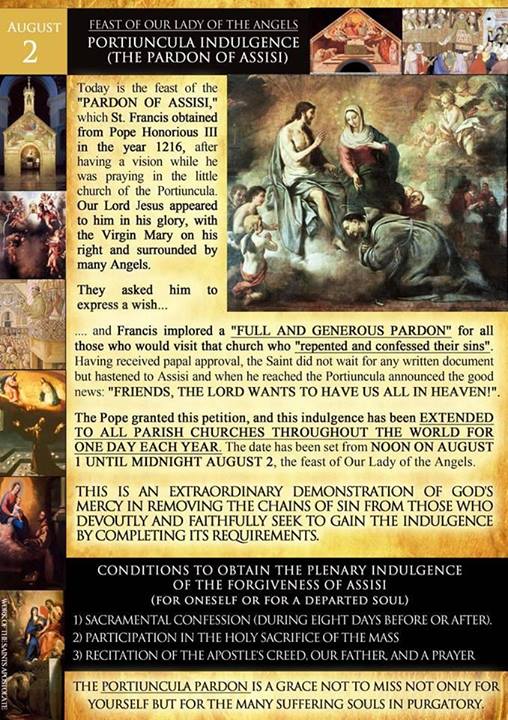
Portiuncula Indulgence (Pardon of Assisi) – on 2 August of each year

Image

The Portiuncula Indulgence, also known as the Pardon of Assisi, is offered every year to all the faithful every 2 August of each year.

The Indulgence include complete reparation from sins and faults, and the total forgiveness granted to us for all our temporal sins, since 1216, when St. Francis of Assisi first requested it through the intercession of the Most Blessed Virgin Mary.

There are three conditions required for the Portiuncula Indulgence :

1. Receiving the Sacrament of Confession within eight days before or after 2 August each year

2. Attendance and full participation at the Holy Sacrifice of the Mass (Full devotion in the Mass)

3. Devout recitation of the Apostle’s Creed, Our Father, and a personal Prayer

World Youth Day 2013 Rio de Janeiro in numbers (Official)

Official figures for World Youth Day 2013 in Rio de Janeiro, Brazil (WYD 2013)

3.7 million people attended the Closing Mass at Copacabana Beach
3.5 million people attended the Vigil with the Pope at Copacabana Beach
600, 000 people attended the opening Mass of the World Youth Day 2013 at Copacabana Beach
The total contribution by tourists and pilgrims during the event reached US$ 1.8 billion
1.2 million people attended the Welcoming Ceremony for the Pope at Copacabana Beach
2 million people attended the Via Crucis at Copacabana Beach (the Way of the Cross)
427,000 registered pilgrims
175 countries represented by the pilgrims from all over the world
356,400 pilgrims registered with accommodations
356 400 vacancies available for hosting family homes and institutions (vacant unregistered spaces)
72.7% of the visitors and pilgrims visited Brazil for the very first time
70,000 downloads on the official website of WYD Rio2013 (http://www.rio2013.com/en)
Over 200,000 hits on the site’s official WYD Rio2013 (http://www.rio2013.com/en)
More than 1.1 million Facebook likes on WYD Rio2013 site (http://www.rio2013.com/en)
10,000 downloads in the official WYD Rio2013 Flickr site
644 bishops registered (including 28 cardinals) for WYD 2013
7,814 priests registered for WYD 2013
632 deacons registered for WYD 2013
6400 journalists accredited to cover the WYD to 57 countries
264 places of catechesis, in 25 languages​​
60,000 volunteers helped out in WYD 2013 Rio de Janeiro
More than 800 participating artists from Central Acts
100 confessionals were exhibited at the Fair Vocational and Largo da Carioca
4 million Communion host produced for the whole WYD 2013 event – 800,000 for the Closing Mass alone (insufficient for the actual 3.7 million people attending)
345 tons of organic waste and 45 tons of recyclables during WYD Rio2013 (10% less than that recorded in the New Year celebration of Rio de Janeiro)
55% of the public enrolled at WYD are female
60% of the public enrolled at WYD are between 19 and 34 years (young adults and late teenagers)

Sunday, 16 June 2013 : 11th Sunday of Ordinary Time (Psalm)

Psalm 31 : 1-2, 5, 7, 11

Blessed is the one whose sin is forgiven, whose iniquity is wiped away. Blessed are those in whom the Lord sees no guilt and in whose spirit is found no deceit.

Then I made known to You my sin and uncovered before You my fault, saying to myself : “To the Lord I will now confess my wrong.” And You, You forgave my sin, You removed my guilt.

You are my refuge; You protect me from distress and surround me with songs of deliverance.

Rejoice in the Lord, and be glad, you who are upright; sing and shout for joy, you who are clean of heart.