These are the official pictures of the Fisherman’s Ring and Papal Pallium that will be given to Pope Leo XIV at the Papal Inauguration Mass on Sunday, 18 May 2025 at St. Peter’s Square, Vatican City.
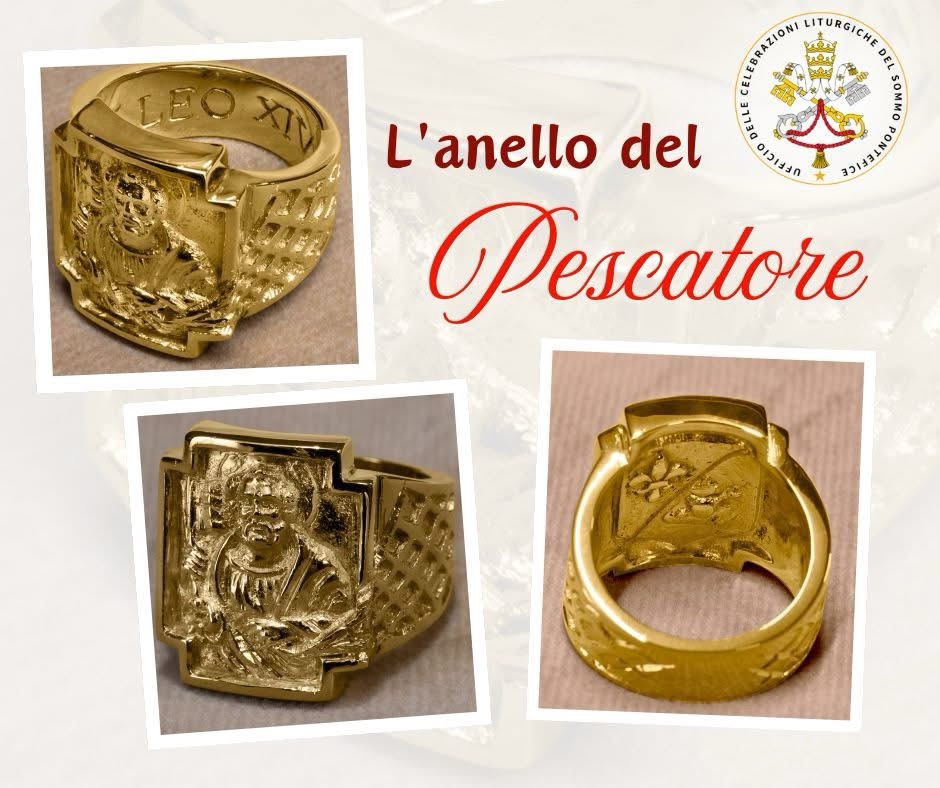
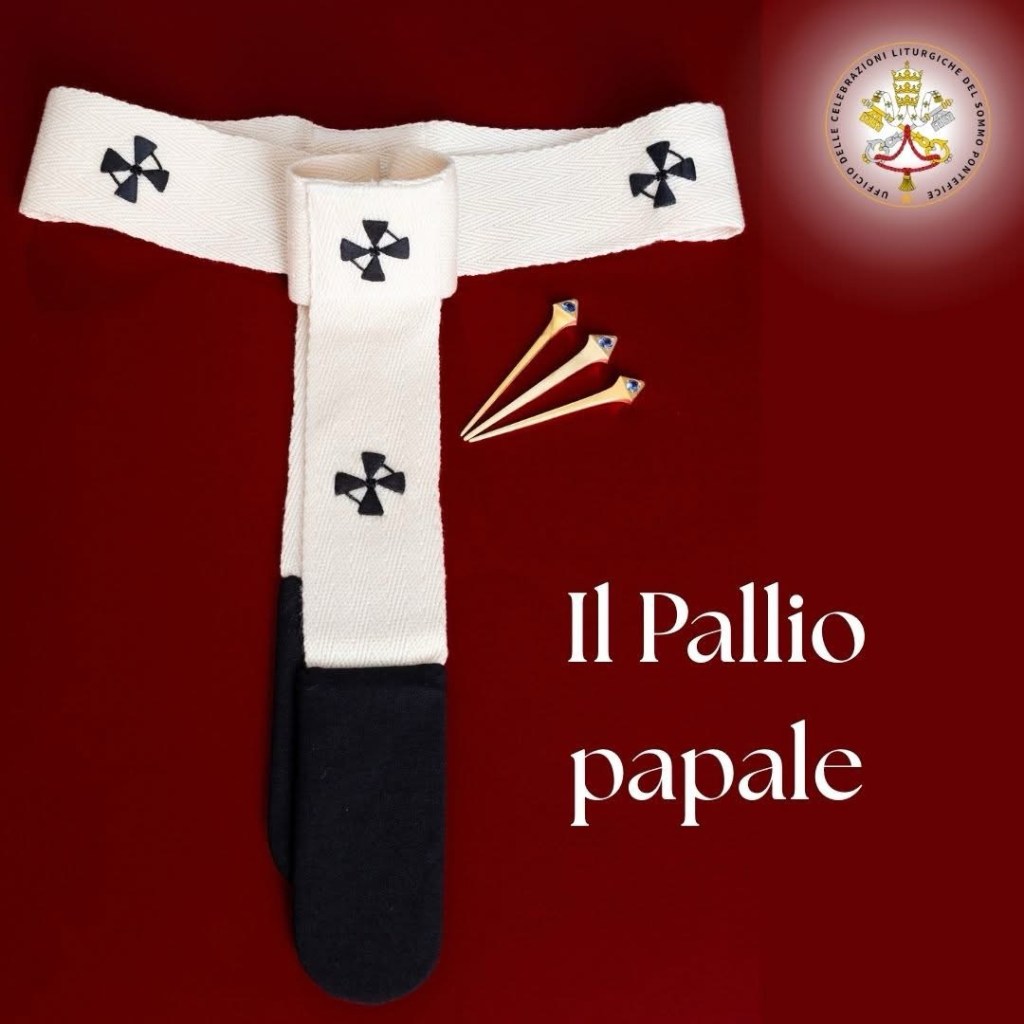

These are the official pictures of the Fisherman’s Ring and Papal Pallium that will be given to Pope Leo XIV at the Papal Inauguration Mass on Sunday, 18 May 2025 at St. Peter’s Square, Vatican City.
Liturgical Colour : White
Brothers and sisters in Christ, today we celebrate a very important feast in our Church and in our faith, that is the feast of the Chair of St. Peter the Apostle. Some of you may ask, why do we celebrate the feast for a chair? What is its importance? That is because the Chair mentioned here is the Cathedra of St. Peter, the Cathedra Sancta Petri, the seat of St. Peter which is today at Rome, at the heart of Christendom.
The Cathedra symbolises the seat of the bishop, and therefore represents the teaching authority of the bishop in teaching the faith. This also applies therefore to St. Peter, who was the very first Bishop of Rome, and the Vicar of Christ, leader of all the Universal Church, the one whom Jesus had entrusted to lead and guide His beloved people, the faithful ones in the Church.
Therefore today, we commemorate the faith of Peter, the teaching authority and the very authority that had been granted to Peter by the Lord Himself. Peter had been set aside by the Lord to be the universal shepherd, the one and only leader of all His faithful, because of his frank and sincere profession of faith, which he made and which we witnessed in today’s Gospel.
Peter showed his faith by proclaiming without fear that Jesus is truly the Lord, the One whom God had sent into this world to save it. Peter is the rock upon which God had established His Church, to be the strong foundation for that Church, and as a focal point for all of His faithful, a point of reference and unity. That is why, our Pope, as his successor, is the leader of the entire Universal Church.
Peter was not perfect, and he had his flaws just as all of us do. He had wavered in his faith many times, and as you all knew, that he even denied knowing his Lord, not once but three times. And yet he was still chosen, and the Lord forgave him after His resurrection, asking him three times to show his love for Him, and in doing that forgave him and gave him a new task in life.
And Peter, being appointed to such an elevated position, did not take pride in it, but instead remained humble and serve the Lord with zeal and humility. Peter gave himself completely to the service of God, until the end, when he gave up his life in martyrdom in Rome. He worked hard for the spread of the Good News and for the good of the people of God.
When he was persecuted and about to die, when the Roman Emperor Nero pressed hard on Christians, Peter accepted the death gracefully and with great humility. He remained faithful to the end, and showing his faith, love and devotion to the Lord, when he was about to be crucified, he asked not to be crucified in the same way as Jesus and thus was crucified upside down.
Brothers and sisters in Christ, in this humble little man, Simon Peter the fisherman of Galilee, God had found a great servant and a holy person. He was called by Jesus to follow Him, and without question, he went to follow Jesus. Despite all the tribulations, temptations and downfalls that he had experienced, Peter persevered, and became the beacon of light for all the faithful.
As is often mentioned in the Scriptures, it is not man who decide to be worthy of. God, but it is in fact God who made mankind worthy and chose them to be His instruments for the salvation of mankind. Such was why the Apostles, in particular Peter were chosen. In them, who were lowly and humble men, God found the love and dedication which others did not or did not yet have.
Today, we celebrate this feast of the Chair of St. Peter to commemorate that glorification of the humble man, taken from Galilee to be the chief servant of the Lord, and became the foundation upon which the Church we know of today was built on. This small man God had made to be His right hand man, and to be the chief of the shepherds of His people, to fish them from all over the world, and bring them to Him.
Such was indeed the very heavy responsibility that Christ had entrusted to Peter, to be the cornerstone and the foundation of the Church that He had established in is world. And that responsibility is passed on through his successors down to his current successor, currently our Pope Francis, the Vicar of Christ, and leader of the entire Universal Church.
Brothers and sisters in Christ, let us today therefore pray for the Pope and all those who support him in his works, that he may persevere in the mission which the Lord had given him, that is to continue the works of St. Peter the Apostle. Just as St. Peter had been told to be a fisher of man, our Pope as his successor too is a fisher of man, still continuing the same mission Christ entrusted to Peter as the mission of His Church.
Yes, and we also have part to play in that mission, brethren, to be the fishers of men as well. It is also our mission to be the ones to spread the Good News to all parts of the world, especially to those who have yet to see the light of God. Let us keep alive our faith in God, and let us obey the teachings of the Church, which Peter and his successors has kept throughout time.
Today we commemorate the authority of Peter as the leader of the faithful, and it also serves as a reminder to keep us faithful to the Lord as Peter had been. It is alright for us to falter at times, because just like Peter, we are all also human beings, we are imperfect and we sin, we make mistakes. What is crucial is, can we turn that imperfection to perfection in Christ? Can we devote ourselves fully to God and change our ways as Peter had done?
May our Lord Jesus Christ see our love and devotion, and bless us as He had blessed Peter His Apostle. May our faith too grow strong with a strong foundation, that we will never go astray from the path of the Lord, and remain faithful to Him all our lives, and may return to Him if we have fallen away from His path. God bless us all. Amen.
Liturgical Colour : Red
Matthew 4 : 18-22
As Jesus walked by the lake of Galilee, He saw two brothers, Simon called Peter, and Andrew his brother, casting a net into the lake, for they were fishermen. He said to them, “Come, follow Me, and I will make you fish for people.”
At once they left their nets and followed Him. He went on from there and saw two other brothers, James, the son of Zebedee, and his brother John in a boat with their father Zebedee, mending their nets. Jesus called them.
At once they left the boat and their father and followed Him.
The Ninth General Congregation of the College of Cardinals have been concluded this Saturday morning, 9 March 2013, and as the date of the beginning of the Conclave came closer (Tuesday, 12 March 2013), Fr. Federico Lombardi, head of the Holy See Press Office clarifies certain matters involving the sede vacante period and the upcoming Conclave.
The Conclave will be preceded by a Solemn Mass for the Election of the Roman Pontiff or the Missa pro Eligendo Pontifice/Papa on Tuesday morning, 12 March 2013 in St. Peter’s Basilica, and then on the same day, Tuesday, in the afternoon, the Cardinals will proceed into the Sistine Chapel to officially begin the Conclave.
The famous chimney which will release the signal whether a new Pope had been elected, had been installed on the roof of the Sistine Chapel on Friday morning, after long work by the technicians in the installing the two stoves where the ballots will be burned after the ballots, and the chimney itself, linked directly to the stoves inside the Sistine Chapel.
The Ring of Fisherman, two papal stamps bearing the image of the Ring of the Fisherman, and the master lead seal, also bearing the Ring’s image, which is used for major documents, have been decommissioned by defacement of the Ring’s image, and therefore while the Ring of the Fisherman has not been completely destroyed,
A commission has been created to ensure that the Conclave has indeed been sealed entirely from the outside world, with no external portal of entry and ensuring that no one tampers with the seal of the Conclave until a new Pope had been elected. Strong frequency and signal jammers had also been installed to prevent any wiretapping and bugging of the Sistine Chapel and the areas where the Cardinals will reside throughout the Conclave.
It is noted that if the Conclave has not been successful to elect a new Pope after three full days (a new Pope can only be elected if he receives more than two-thirds of all the votes of the Cardinal-electors, or 77 votes), the voting sessions will be adjourned for a day of prayer and reflection, so that in the event of the upcoming voting sessions, the Cardinals can gain a new inspiration of the Holy Spirit and therefore hopefully elect a new Pope as soon as possible.
The Motu Proprio released earlier by Pope Benedict XVI in 2007 has modified the rules of the election as written in the Apostolic Constitution Universi Dominici Gregis, as it no longer allows the Cardinal-electors to revert to an absolute majority system once a certain number of days have passed (many days), and the Motu Proprio once again made the election of the new Pope by two-thirds majority alone.
The bells of St. Peter’s Basilica and also the other bells of the churches throughout Rome will also be rung once the new Pope had been elected, just as they were in 2005 conclave, to reinforce and affirm the white smoke signal released through the chimney of the Sistine Chapel.
About 45 minutes or more may pass between the election of the new Pope and his appearance on the Loggia or the balcony of the St. Peter’s Basilica, as there are rites that the new Pope had to go through in the time between, beginning with the acceptance of the election, the entry into the Room of Tears where the Pope will change into his new white Papal cassock, and then homage from all the Cardinals, and of course the announcement of the Habemus Papam by the Cardinal Protodeacon, Jean-Louis Tauran himself, before the new Pope will make his appearance on the balcony.
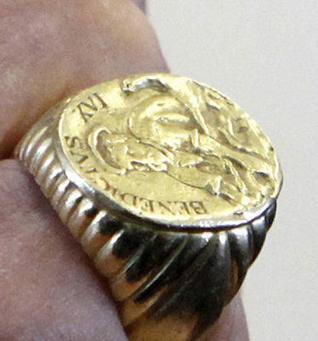
What is the Ring of the Fisherman? or also called the Fisherman’s Ring? and why fisherman?
This is because, Peter, the leader of the Apostles, whom our Popes are successors of, including our retiring Pope Benedict XVI, was once a fisherman at Lake Galilee in Israel. Then Jesus, our Lord, came and called him and his brother Andrew, to follow Him, and then He made Peter, a fisher of man, through His Church, which He entrusted to him to lead. This is why, the picture on the Fisherman’s Ring represents Peter as fisherman as seen in the image above. Also engraved is the regnal name of the Pope, Benedictus XVI in Latin.
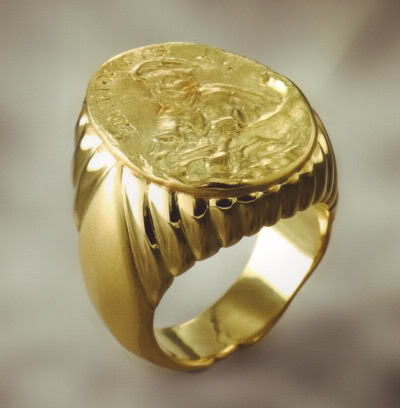
This ring was used in the past to seal important Papal documents such as letters and most importantly papal bulls. The seal used was wax seal, in which hot wax was poured and the ring is pressed onto the hot wax while it is still hot, and therefore, the image engraved on the ring, will be reflected on the wax seal, signifying the legality of the documents and papal bulls published, with the authority of the Pope, as successor of St. Peter and leader of the Universal Church, one Church of Christ.
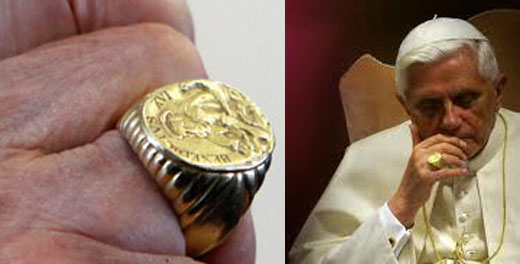
This ring, which symbolises the authority of the Pope, given to him at the Installation of the Pope (Papal Installation), is destroyed upon the Pope’s death, and in Pope Benedict XVI’s case, it will be destroyed after the sede vacante starts with a silver hammer in the presence of witnesses, to prevent any misuse of the Ring during the sede vacante to validate documents not released by the Pope.
http://www.ewtnnews.com/catholic-news/Vatican.php?id=7113
Pope Benedict XVI, after his retirement at 8.00 pm on Thursday, 28 February 2013, will be known as the Bishop Emeritus of Rome, and therefore can be addressed as such, as His Holiness Benedict XVI, Pope Emeritus, or Roman Pontiff Emeritus.
Pope Benedict XVI will also abandon his red papal shoes and wear a brown shoes given to him at Leon, Mexico, and he will also wear a white cassock as he wear now, but without the shoulder cape or more appropriately known as the pellegrini (not mozzetta as mentioned here, as mozzetta is of a very different type, and red in colour for Popes).
He will also wear the Episcopal ring he had from the time when he was Cardinal Ratzinger (given by Pope Paul VI in 1977), as the Ring of the Fisherman he received in 2005 will be destroyed, similar to what happened when a Pope passed away.
The Vatican has announced that there is indeed a possibility that the Conclave may begin earlier than the earlier announced 15-20 March 2013 timeframe. This is because unlike normal period of sede vacante (or vacant See ‘of Rome’) due to the death of the previous Pope, Pope Benedict XVI’s decision to retire and renounce the Papacy has been announced well ahead of the actual date of beginning of the sede vacante.
Thus, the Cardinals have ample time to prepare for the Conclave and travel to Rome by the time the See becomes vacant on 28 February 2013 at 8.00 pm Rome time. This would then allow the Conclave to begin much earlier, perhaps in early March 2013, and will allow a new Pope to be elected immediately, and then the new Pope can already be installed (at St. Peter’s Square ceremony of the imposition of the pallium and the Fisherman’s Ring) and enthroned (at the Basilica of St. John Lateran, the Cathedral of Rome), before the Holy Week begins on Palm Sunday (24 March 2013).
If the Conclave begins only on the 15th of March or even later, there would be no time left available for the Pope to be properly installed and enthroned before the busy Holy Week begins. Another advantage is also that the Cardinal-electors (especially the residential Archbishops and bishops of Archdioceses and dioceses around the world) can return to their home and celebrate the Holy Week with their diocese/archdiocese, rather than be stuck in Rome due to the late Conclave.
 petercanisiusmichaeldavidkang