Saturday, 11 January 2014 : Saturday after the Epiphany (First Reading)

Liturgical Colour : White

1 John 5 : 14-21

Through Him we are fully confident that whatever we ask, according to His will, He will grant us. If we know that He hears us whenever we ask, we know that we already have what we asked of Him.

If you see your brother committing sin, a sin which does not lead to death, pray for him, and God will give life to your brother. I speak, of course, of the sin which does not lead to death. There is also a sin that leads to death; I do not speak of praying about this. Every kind of wrongdoing is sin, but not all sin leads to death.

We know that those born of God do not sin, but the one who was born of God protects them and the evil one does not touch them. We know that we belong to God, while the whole world lies in evil.

We know that the Son of God has come and has given us power to know the truth. We are in Him who is true, His Son Jesus Christ. He is the true God and eternal life.

My dear children, keep yourselves from idols.

Friday, 10 January 2014 : Friday after the Epiphany (First Reading)

Liturgical Colour : White

1 John 5 : 5-13

Who has overcome the world? The one who believes that Jesus is the Son of God. Jesus Christ was acknowledged through water, but also through blood. And the Spirit, too, witnesses to Him for the Spirit is truth. There are then three testimonies : the Spirit, the water and the blood, and these three witnesses agree.

If we accept human testimony, with greater reason must we accept that of God, given in favour of His Son. If you believe in the Son of God, you have God’s testimony in you. But those who do not believe make God a liar, since they do not believe His words when He witnesses to His Son.

What has God said? That He has granted us eternal life and this life is in His Son. The one who has the Son has life, the one who do not have the Son of God do not have life.

I write to you, then, all these things that you may know that you have eternal life, all you who believe in the Name of the Son of God.

Thursday, 9 January 2014 : Thursday after the Epiphany (First Reading)

Liturgical Colour : White

1 John 4 : 19 – 1 John 5 : 4

So let us love one another, since He loved us first. If you say, “I love God” while you hate your brother or sister, you are a liar. How can you love God whom you do not see, if you do not love your brother whom you see? We received from Him this commandment : let those who love God also love their brothers.

All those who believe that Jesus is the Anointed, are born of God; whoever loves the Father, loves the Son. How may we know that we love the children of God? If we love God and fulfill His commands, for God’s love requires us to keep His commands. In fact, His commandments are not a burden because all those born of God overcome the world.

And the victory which overcomes the world is our faith.

Wednesday, 8 January 2014 : Wednesday after the Epiphany (First Reading)

Liturgical Colour : White

1 John 4 : 11-18

Dear friends, if such has been the love of God, we, too, must love one another. No one has ever seen God, but if we love one another, God lives in us, and His love comes to its perfection in us.

How may we know that we live in God and He in us? Because God has given us His Spirit. We ourselves have seen and declare that the Father sent His Son to save the world. Those who confess that Jesus is the Son of God, God remains in them and they in God.

We have known the love of God and have believed in it. God is love. The one who lives in love, lives in God and God in him. When do we know that we have reached a perfect love? When in this world, we are like Him in everything, and expect with confidence the Day of Judgment.

There is no fear in love. Perfect love drives away fear, for fear has to do with punishment; those who fear do not know perfect love.

Tuesday, 7 January 2014 : Tuesday after the Epiphany, Memorial of St. Raymond of Penyafort, Priest (First Reading)

Liturgical Colour : White

1 John 4 : 7-10

My dear friends, let us love one another for love comes from God. Everyone who loves is born of God and knows God. Those who do not love have not known God, for God is love.

How did the love of God appear among us? God sent His only Son into this world that we might have life through Him. This is love : not that we loved God but that He first loved us and sent His Son as an atoning sacrifice for our sins.

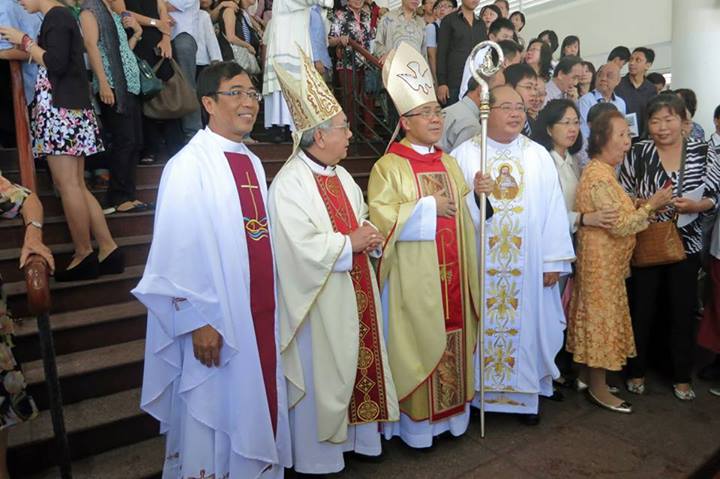
Ordination of New Priests of the Archdiocese of Singapore : Fr. Edward Seah and Fr. Benedict Chng

Image

Today, Tuesday, 8 August 2013, two new priests of the Roman Catholic Archdiocese of Singapore has been ordained by the Archbishop of Singapore, His Excellency Archbishop William Goh Seng Chye. Also present was the Archbishop Emeritus of Singapore, His Excellency Archbishop Nicholas Chia.

The ordination Mass was held at Church of the Holy Family earlier this morning. Let us pray for Fr. Edward Seah (left of the Archbishops) and Fr. Benedict Chng (right of the Archbishops), that in their new positions as the priests of God’s Church and shepherds of God’s people, they will always remain dedicated and committed to the people of God and remain holy and loving as God is.

God bless Fr. Edward Seah and Fr. Benedict Chng! Ad multos annos!

Tuesday, 30 July 2013 : 17th Week of Ordinary Time, Memorial of St. Peter Chrysologus, Bishop and Doctor of the Church (Scripture Reflection)

Brothers and sisters in Christ, today we listened to Jesus explaining the meaning behind the parable of the weeds and the sower which He had told to His disciples and the people of Israel. He told them that the fate awaiting the wicked ones is death and eternal suffering in hell, while the fate awaiting the righteous ones is eternal joy and bliss in heaven, with our Lord, reunited in perfect goodness and glory of God.

The seeds of the weeds spread by the devil is the evil and corruption he had spread in this world to lead mankind astray from their path towards the Lord. The seeds of evil are greed, wrath, hatred, lust, jealousy, despair, arrogance, and pride. They are our weaknesses that made us prone to fall into the damnation reserved for the devil and his fallen angels, the fate of the weeds. This is because, as we all know, weeds are dangerous, because they compete with the healthy plants for nutrition, and when the weeds grow large, they also may likely strangle the healthy plants and kill them.

The same therefore is bound to happen to all of us, if we do not take precautions against the devil and his mischievous tools, all the tools in the world that he possesses to be employed against us, the beloved children of God. The devil is the sower of the evil weeds of sin, that if we are not careful, will grow within us and around us, and choke the good that is in us, turning us from the path of salvation into the path towards doom.

Our Lord and God, as Moses had said in the first reading we heard today, is a merciful and loving God, One who is slow to anger and rich in kindness and compassion. He is sure to welcome us back into His embrace if we are to be repentant and truly regret our sins and our wrongdoings before Him. We must not be shy to admit that we have sinned before God, because He is our loving Father, and He wants to rescue us from certain death.

But He is also a jealous God, a God who is just and against any form of sin. That is because He is perfect goodness and sin is corruption that had marred our perfection ever since the times of Adam and Eve, when Satan tricked Eve into eating the fruit of the tree of knowledge of good and evil and disobeyed the Lord in the process. It is because of our disobedience that we deserved death, and Adam and Eve deserved death and annihilation, and yet God showed them mercy and although they were punished to live in great difficulty on earth, they were not annihilated.

Death did claim them and our ancestors in the end, but death would not have the final say. That was because the Lord Himself gave His all so that we may have a new hope for eternal life in Him, to return us to our true inheritance, as what God had originally intended for us at creation. He did not desire us to suffer or die, but He wants us all to live, forever with Him in the bliss of heaven, to spend all our time in the beautiful Gardens of Eden.

He sent us His only Son, Jesus Christ, to be the fulfillment of His long-awaited promise, that He would send a redeemer to all mankind. The ultimate proof of His love and care for us. So great is His love that He is willing to suffer in our place, to die in our place, and to be our light of hope. He is the light of hope and salvation, because He did not remain in the land of the dead, but by the power of the Lord, He broke free the chains of sin and death that had held us for generations, and risen from the dead He became the source of salvation for all who believe in Him.

We must sow the seeds of faith, of hope, and of love in our hearts, brothers and sisters in Christ, so that we will be ever ready to combat the seeds of evil that Satan and his cronies always try to sow within our hearts. Do not be afraid, for he no longer has any power or authority over us, ever since Christ broke that bond that enthralled us to the evil one. We must however remain ever vigilant and ever careful, lest the devil successfully subvert our thoughts and our hearts to be against the Lord and His will.

Let us strive to be the wheat and not the weeds, and may the seeds of faith, hope, and love that is within us grow strong, that they become the nutrients and fertiliser that help us, the wheat to grow strong and bear much fruits, that the Lord who sees us, will be pleased and He will then tell His angels to come and collect us from amongst the weeds and bring us to Him, to enjoy forever His grace, His blessings, and His loving embrace.

Today, brothers and sisters, we also commemorate the Feast of St. Peter Chrysologus, who was made a Bishop of Ravenna in the ending years of the Roman Empire during the early Church. He was well known for his inspiring speeches and preaching, that called all Christians to be faithful to God and defend themselves against any form of heresies that threatened to corrupt their soul and their true faith in God.

At the time of St. Peter Chrysologus, at the heyday of the Roman Empire, there existed numerous heresies of the faith, many of which were really serious threat on the unity of the Church and the faithful, and some of them had ideas diametrically opposite to the truth of the Apostolic Fathers, the truth that is of Christ. Many of them, corrupted by the seeds of evil, the weeds planted by the evil one, subverted the words of the Lord and the message of salvation to serve their own ends, and ultimately, serve the cause of evil.

Many people fell victim to the corrupting nature of these heresies, which attacked the truth about our faith in the Lord, in the Lord Himself, and even His Blessed Mother, Mary. St. Peter Chrysologus, as the then Bishop of Ravenna in today’s Italy, was faced with the same problems and challenges that faced the Church of his time. Yet, he did not waver nor did he become afraid to confront those challenges. Instead, he faced them courageously, and with great zeal and inspiration, through his sermons, he converted the faithful back to the truth of Christ, getting rid of the weeds that choked the life out of the faith of the people of God.

Today, my brothers and sisters in Christ, the need is ever greater for more people like St. Peter Chrysologus, in defending our faith and ourselves, from the corruption that comes from Satan. We must be courageous in standing up for the Lord in the face of the devil and bluntly reject all his approaches and his temptations to us. We must stand up for the Lord and His love, His compassion for us. Never let go of the Lord and embrace evil, no matter how difficult the challenges of life are. We must always be strong, as St. Peter Chrysologus had been.

Therefore, brothers and sisters in Christ, let us today renew our commitment to God, to the Lord who loves us, to God who cares for us every day of our life, and commit ourselves to glorify His Name among men, and to never give in to the allures of the evil one, and be courageous to reject all of his approaches. May the Lord who is love and who is mercy, forgive us our sins, purify us and make us whole once again. St. Peter Chrysologus, pray for us sinners and intercede for us before the Lord our God. Amen.

Saturday, 27 July 2013 : 16th Week of Ordinary Time (Scripture Reflection)

Dear brothers and sisters in Christ, we who believe in Christ had been marked by the Lord our God, with a special mark, for each one of us, to distinguish us from those who do not believe and do not have faith and love for the Lord. That mark is none other than His own Precious Blood, the Blood of the Lamb of God, which He gave to us to mark His faithfulness and love for us, to mark the New Covenant He has established with all of us, with all mankind, a covenant that will never be broken.

The Blood of the covenant of Christ reminds us of the first reading today, when Moses sealed the covenant between the people of Israel and the Lord their God with the blood of animals, the blood of lambs and goats sacrificed on the altar made to God. The blood sealed the promise that God had made with their father Abraham, that his descendants would prosper and enjoy God’s blessing and be led to the Land of Promise.

On the other hand, the covenant involve a two-way promise and vow, and therefore, just as the Lord has vowed to bless His people and care for them, so the people too must keep their part of the covenant, to obey the laws of the Lord, and live according to His will. If they remain faithful to their part in the covenant, their lives will truly be happy and blessed, and they will receive the fullness of their covenant with God.

But if they break their part of the covenant, by disobeying the Lord and doing wicked things not in conjunction with the Lord’s will, then they will not receive the blessings that the Lord had promised them, and instead, they will truly suffer for having turned their back on the Lord and His covenant, the covenant of love He had offered freely to Abraham and his descendants that they will be blessed.

That was exactly what many of the people of Israel did, even just after Moses had sprinkled the blood of the covenant on them, as they complained against Moses and the Lord for having brought them in the journey through the desert to the Promised Land.

They complained because they did not keep themselves strong enough in the faith that the devil could come to them and sow the seeds of discord and evil in their hearts, and the seeds of desire and greed, desiring ever more things from the Lord, complaining to the Lord when they did not receive enough, even though the Lord had fed them with bread from heaven, the manna, and with quails and birds for them to eat, and also provide them with sweet and clear spring water to drink.

No, brothers and sisters in Christ, this is not the way that we should follow, the rebelliousness and the hard-hearted people of Israel during their sojourn in the desert. We must instead follow the path of Christ, of love and dedication, which we should give to the Lord and to our fellow men, and also thanksgiving to the Lord when it is due. That is because the Lord had given us much, very much indeed, that He gave us nothing else more precious, nor that there will ever be anything that is to be more precious, than His own Son, Jesus Christ, to be our Saviour, and new hope of life eternal.

We must fortify ourselves, brethren, in our hearts and minds, that we will not succumb to the evil one. Prevent the sower of evil from sowing seeds of evil and sin within our hearts. Do not let him to reign free over us, and enslave us to the chains of sin and death. The devil will always try and utilise everything that is within his power to corrupt us and turn us from the path of the Lord, that is salvation, towards the path to hell and eternal damnation.

We must have a strong and healthy prayer life, that our heart will be defended from the assaults of the evil one. In doing so, our faith and dedication to the Lord will be complete.” But remember, brothers and sisters in Christ, that faith cannot stand on its own, and without good and positive acts in our words, deeds, and actions, our faith will be dead and empty. Yes, as empty as that of the people of Israel in the desert. They had been given manna, the bread from heaven and quails as food during their desert journey, and yet they still complained and blasphemed against His Name.

Our Lord is faithful, just as He is loving, brothers and sisters in Christ. He loves us all so much, that He shed His own Body and His own Blood, through the cross, that all of us be redeemed in a new covenant that He established by His own sacrifice, for our sake. This is no blood of the lambs and goats that die, brothers and sisters, but here is the Blood of the Lamb of God who lives, the Lamb who has triumphed and conquered Satan and evil. This Blood, the divine blood given to us out of the Lord’s own will, is the blood that purifies and cleanses, washing our beings white and pure again from all the filth and darkness of sin within us.

We receive this Blood and the Body, in the Eucharist, which the priests turned from the humble bread and wine, into the very Being of our Lord and Saviour, who died as the lamb of sacrifice, the True Lamb, who is the only one worthy to redeem us from all the weights of our faults and evil, all the horrible things we had committed, things abhorred by the Lord our God. He established this new covenant, a covenant not only with the people of Israel of old, but with all mankind, without exception. He established this new covenant, especially for sinners. The greater the sin that a sinner has, the more the Lord wants to come to redeem him or her from their fate that is death and hell.

He paid for this new covenant and sealed it with His own Blood, not blood of any animals, but the most precious Blood possible, the divine blood of the Lord, poured down on us from the cross, given to us to drink in the Eucharist, in the form of wine transubstantiated into His Blood. We who partake in this divine gift is sealed in the new covenant with God, through Christ, and as long as we remain faithful to God, we will ever be in God’s grace, and we will receive the gift of eternal life Christ had promised all those who believe in Him.

Our Lord loves us so much and He wants all of us saved, from our fate of certain death in sin. He has given His best and His all in His part on the covenant. But as I have mentioned, a covenant is made between two parties, in which both parties have to commit to the covenant that it is made valid and true. Therefore, brothers and sisters in Christ, are we ready to commit ourselves to Christ, to His love? Are we ready to take up our own crosses and follow Christ, so that we will make whole the new covenant of the Lord?

Are we ready to commit ourselves to the Lord present in the Most Holy Eucharist? In His Body and Blood that He gave us that He may be in us and we in Him? Let us from now on strive to be the loving partner of our God in that holy covenant, and play our part, that is following the Lord’s commandments that is love. Love our God and love our fellow brethren as we love ourselves. For God is love! Amen.

Sunday, 14 July 2013 : 15th Sunday of Ordinary Time (Gospel Reading)

Luke 10 : 25-37

Then a teacher of the Law came and began putting Jesus to the test. And he said, “Master, what shall I do to receive eternal life?” Jesus replied, “What is written in the Scripture? How do you understand it?” The man answered, “It is written : You shall love the Lord your God with all your heart, with all your soul, with all your strength and with all your mind. And you shall love your neighbour as yourself.”

Jesus replied, “What a good answer! Do this and you shall live.” The man wanted to justify his question, so he asked, “Who is my neighbour?” Jesus then said, “There was a man going down from Jerusalem to Jericho, and he fell into the hands of robbers. They stripped him, beat him and went off, leaving him half-dead.”

“It happened that a priest was going along that road and saw the man, but passed by on the other side. Likewise a Levite saw the man, and passed by on the other side. But a Samaritan also was going that way, and when he came upon the man, he was moved with compassion. He went over to him, and cleaned his wounds with oil and wine, and wrapped them in bandages. Then he put him on his own mount, and brought him to an inn, where he took care of him.”

“The next day he had to set off; but he gave two silver coins to the innkeeper, and said, ‘Take care of him, and whatever you spend on him, I will repay when I return.'”

Jesus then asked, “Which of these three, do you think, made himself neighbour to the man who fell into the hands of robbers?” The teacher of the Law answered, “The one who had mercy on him.” And Jesus said, “Then go and do the same.”

Friday, 5 July 2013 : 13th Week of Ordinary Time, Memorial of St. Anthony Zaccaria, Priest (Scripture Reflection)

Brothers and sisters in Christ, today we reflect on the calling of Matthew, who was a tax collector, and according to the Pharisees, a sinner. He was called from his custom-house and followed Christ, eventually to become one of the Twelve Apostles and one of the Four Evangelists, who wrote the Gospel of Matthew, which passage we are reading today.

Why did the Pharisees consider the tax collectors as sinners? We should understand the history and condition of the region at the time, of the region called Palestine today, and Judea at that time. At the time of Jesus, Judea was still a semi-independent kingdom, led by a king, Herod Antipas at that time, the son of Herod the Great, who tried to kill Jesus as a baby. But despite the semblance of independence generated by the presence of a ‘king of the Jews’ in Herod, the Romans, which had become an Empire by that time, had the overall command and control as the master of the people of Judea.

The Romans established an efficient taxation system throughout their Empire, and that made up the main source of their annual income, and Judea is no exception to the rule. The people of Judea, including the Jews, had to pay their taxes to the Roman authorities, and this was greatly despised by the Jews, particularly the Pharisees and the teachers of the Law. Not just because it showed a subordination to the greater Roman authority, but it seemed that it also contradicted the fact that one should obey and give honour to the Lord alone.

The Roman coins used in the tax payment itself could be considered blasphemous by the Jews at the time, because every single coins were engraved with the facial image of the Emperor, and therefore could be considered as tantamount to idolatry, worship of the Emperor, as what was indeed happening in Rome at that time, as Emperors increasingly became more autocratic, they also attributed more divinity towards themselves, and would in time be established as the cult of the Emperors, where the Roman Emperors were worshipped as divine, living in the flesh.

All these sparked the notion that paying taxes to the Romans was a detestable idea at best, and the people did not like it for certain, for other than the religious reasons, taxes also burdened them financially, and that was why, out of all people, the tax collectors were always considered to be at the bottom of the society and were considered, particularly by the ‘pious’ Pharisees, to be morally corrupt and unworthy as well as incapable of redemption.

The tax collectors were treated and condemned as sinners, even though they might actually be good people. Remember that tax collectors often had no choice to be one, because they themselves had to earn a living, and it was indeed not an easy job to be done, as I had mentioned, being tax collectors meant that one had to endure the hatred and displeasure of the general population, the priesthood, and many other people, and endure the label of evil placed unfairly onto them.

The Jewish people themselves were very nationalistic in nature, and were very proud of their descent from Abraham, their forefather both in blood and faith. They kept mostly to themselves and married one another, in order to prevent themselves from being tainted by the pagans around them. This had happened since the time of Abraham himself, as you would have noted in our first reading today, who asked Eliezer his servant to find a wife for his son, Isaac, from among his own people, his own family, and not among the women of Canaan.

This had further made the contempt given to the tax collectors and other Roman collaborators even greater. They were barely tolerated in the society, cursed and rejected by many. They may be able to survive financially, but in terms of their lives, it was truly miserable. This was the condition that formed the backdrop of the situation as it was when Jesus called Matthew to be His disciple, and when He ate with him and his fellow tax-collectors in his house with the Pharisees.

Jesus then highlighted His mission in this world to His disciples, the Pharisees, and the tax collectors, that is to heal the world and those afflicted in this world, those who are condemned to damnation in hell, those who are suffering, those who are immersed deeply in the darkness of sin. That is because these are the ones who really need help and assistance in order to ensure that they will not fall into hell. God loves all, everyone, especially the greatest of sinners, who are in greatest need for God’s mercy and love.

That is because those of us who had been saved, and had been following the commandments of the Lord will remain safe, as long as we keep the Lord’s commandments and stay in His grace. As long as we remain faithful to the Lord, no harm can come our way. That is why it is those who are ‘sick’ from sin and evil would need much more assistance and help than we do. But we should not let Christ do that alone, but we ourselves, as the children of God, can also play our part in ensuring the salvation of all, especially those whose sins are the greatest.

The Pharisees themselves, who considered themselves most pious and blessed of all the children of God because of their strict adherence to the Law of Moses, were in fact in great need of salvation themselves. They had indeed observed ‘sacrifices’ so much that they had forgotten ‘mercy’, and forgotten love. God desires not sacrifices from man, but their love, both towards Him and towards His other children, our brothers and sisters.

The Pharisees did not love and do the true will of God, and instead became too focused on their own strict laws made by men, and even condemned those so-called sinners such as prostitutes and tax collectors as morally bankrupt and evil, while in fact, it is they themselves who were deep in the darkness, and worse still, blind to their own inadequacies and iniquities.

Today, brothers and sisters, we also commemorate the feast day of St. Anthony Zaccaria, a priest who lived in the late Renaissance era Italy. He was a priest who placed a great emphasis on the love of God and the teachings of the Church as espoused by St. Paul and the Apostles. He put the emphasis on acts of love and mercy, in addition to devotions and prayers, that made the faithful become even more devout and strong in their faith.

St. Anthony Zaccaria showed to the people of his time that to love God, is to both worship Him in prayer and supplication, in the offering of the ‘sacrifice’ of our hearts, the true sacrifice that our Lord wants from us, and also to make our love evident through our own deeds and actions, so that the love that is in us will not be an empty love, but a vibrant love in both word and action.

Therefore, following the zeal and example of St. Anthony Zaccaria, let us be loving person, loving children of God our Father, who is Love. May all of us truly show our love for Him through our complete dedication to Him, and also our loving service to our neighbours, particularly those in greatest need of help.

May the Lord be with us and remain with us, blessing us with His love and mercy at all times. St. Anthony Zaccaria, pray for us. Amen.