Saturday, 17 October 2020 : 28th Week of Ordinary Time, Memorial of St. Ignatius of Antioch, Bishop and Martyr (First Reading)

Liturgical Colour : Red

Ephesians 1 : 15-23

I have been told of your faith and your affection toward all the believers, so I always give thanks to God, remembering you in my prayers. May the God of Christ Jesus our Lord, the Father of glory, reveal Himself to you, and give you a spirit of wisdom and revelation, that you may know Him.

May He enlighten your inner vision, that you may appreciate the things we hope for, since we were called by God. May you know how great is the inheritance, the glory, God sets apart for His saints; may you understand, with what extraordinary power, He acts in favour of us who believe.

He revealed His Almighty power in Christ when He raised Him from the dead, and had Him sit at His right hand in heaven, far above all rule, power, authority, dominion, or any other supernatural force that could be named, not only in this world, but in the world to come as well. Thus has God put all things under the feet of Christ and set Him above all things, as Head of the Church, which is His Body, the fullness of Him, Who fills all in all.

Sunday, 27 January 2019 : Third Sunday of Ordinary Time (Second Reading)

Liturgical Colour : Green

1 Corinthians 12 : 12-30

As the body is one, having many members, and all the members, while being many, form one body, so it is with Christ. All of us, whether Jews or Greeks, slaves or free, have been baptised in one Spirit, to form one Body, and all of us have been given, to drink from the one Spirit. The Body has not just one member, but many.

If the foot should say, “I do not belong to the body for I am not a hand,” it would be wrong : it is part of the body! Even though the ear says, “I do not belong to the body for I am not an eye,” it is part of the body. If all the body were eye, how would we hear? And if all the body were ear, how would we smell?

God has arranged all the members, placing each part of the body as He pleased. If all were the same part where would the body be? But there are many members and one body. The eye cannot tell the hand, “I do not need you,” nor the head tell the feet, “I do not need you.”

Still more, the parts of our body that we most need are those that seem to be the weakest; the parts that we consider lower are treated with much care, and we cover them with more modesty because they are less presentable, whereas the others do not need such attention. God, Himself, arranged the body in this way, giving more honour to those parts that need it, so that the body may not be divided, but, rather, each member may care for the others. When one suffers, all of them suffer, and when one receives honour, all rejoice together.

Now, you are the Body of Christ, and each of you, individually, is a member of it. So God has appointed us in the Church. First Apostles, second prophets, third teachers. Then come miracles, then the gift of healing, material help, administration in the Church and the gift of tongues.

Are all Apostles? Are all prophets? Are all teachers? Can all perform miracles, or cure the sick, or speak in tongues, or explain what was said in tongues?

Alternative reading (shorter version)

1 Corinthians 12 : 12-14, 27

As the body is one, having many members, and all the members, while being many, form one body, so it is with Christ. All of us, whether Jews or Greeks, slaves or free, have been baptised in one Spirit, to form one Body, and all of us have been given, to drink from the one Spirit. The Body has not just one member, but many.

Now, you are the Body of Christ, and each of you, individually, is a member of it.

Sunday, 9 November 2014 : 32nd Sunday of Ordinary Time, Feast of the Dedication of the Lateran Basilica, Archbasilica of the Most Holy Saviour and Saints John the Baptist and the Evangelist at the Lateran (Homily and Scripture Reflections)

Liturgical Colour : White

Dear brothers and sisters in Christ, on this day we celebrate a great feast of the whole Universal Church, and especially the Church of Rome, the heart of Christendom, as established by the Vicar of Christ, the Supreme leader of the entire Body of Christ, the Church, St. Peter the Apostle, who established his seat in the once Imperial capital of the Roman Empire, the city of Rome, and where he was martyred for his faith in God.

He is the very first Bishop of Rome, and the very first one to lead the growing faithful community there in the Imperial capital. St. Peter the Apostle is indeed also accredited with the establishment of several other important and key dioceses throughout the Empire, and indeed, the See of Antioch also had St. Peter as its first bishop and leader. However, it was in Rome, where St. Peter truly established his seat and served the people of God until he was martyred in the reign of the Roman Emperor Nero.

And when we talk about the Church, we know of the various hierarchy of structures and personnels that made up the whole universal Church, and the administrative divisions in it, which in fact mirrored closely the division of the civil administration of the Roman Empire. The name diocese, was taken from the name used to describe a provincial division of the late Roman Empire, and this is taken into the structure of the Church as a group of the faithful led by a bishop, with many priests and the laity both under his care and supervision.

Bishops are overseers and leaders of God’s people, and they also supervise and coordinate the actions and works of the priests, the holy servants of God. And the premier and the foremost of all bishops is the Bishop of Rome, who as the bishop of the very diocese where St. Peter the Apostle had established himself and martyred, is the successor of that holy saint and shepherd which our Lord Jesus Himself had entrusted with all of His faithful on earth.

St. Peter affirmed his faith in the Lord with his threefold declaration of faith, a reminder that he had once denied his Lord and God three times during the Passion. And Jesus forgave him, and entrusted him with the entire the Church, as His Vicar, by the words, “Feed My sheep.” The Bishops of Rome, the Popes, therefore inherit the same commandment which Jesus had given to Peter, to lead His entire Universal Church.

And as bishop, indeed, he has a cathedral too, the Bishop of Rome having the Cathedral of Rome as his seat. We have to take note that the Cathedral mentioned here does not refer to the largest or the most beautiful churches present in the diocese, but rather the place, the very church where the seat of the bishop is. And this seat is the bishop’s throne, or the Cathedra, where a Cathedral gets its name from.

For many of us, we may think that the Basilica of St. Peter in the Vatican is the Cathedral of the Pope and the principal church of Christendom. However, this was wrong. Indeed, the Basilica of St. Peter has a special importance, both as a Papal Basilica, of which there are only four in the whole world, and then because it itself is located on top of the Vatican necropolis, which was the very spot where St. Peter was martyred during the reign of the Emperor Nero.

The Basilica therefore housed the remains of St. Peter, and is also the regular residence of the Popes, and where he celebrates the majority of his liturgical functions in Rome. However, the Pope’s Cathedra as the Bishop of Rome is not located at the Basilica of St. Peter, but rather at the Basilica of St. John Lateran, located in Rome, and not in the Vatican City.

Basilica of St. John Lateran was the site of the original Lateran Basilica donated by the Roman Emperor Constantine the Great, who was the first Christian Roman Emperor, and it became the official residence of the Popes, the adjacent Lateran Palace, and the Basilica became the Cathedral of the Bishop of Rome. The reason why the Popes no longer stay at the site, was because of the upheavals of two centuries ago, where worldly conflicts forced the Pope to abandon the Lateran for the safety of the Vatican, where he resided from then on.

As the Cathedral of the Diocese of Rome, the first and principal diocese of the Church, therefore it is also the Mother Church of the entire and whole Christendom, the very first and most important of all churches in the world, superseding even the Basilica of St. Peter, and noticed in its official name, the Archbasilica of the Most Holy Saviour and Saints John the Baptist and the Evangelist at the Lateran. It is the only Archbasilica in the world and was dedicated first to the Lord, who is the Saviour of the whole world, and then to both St. John the Baptist and St. John the Evangelist.

Today, we celebrate the day of the dedication of that sacred and hallowed Cathedral, the heart of the entire Christendom as the seat of the Popes. Dedication of a church is a very important event, for it is the moment when the particular location is consecrated and blessed, as a sacred and worthy space, for all the faithful to celebrate together the Holy Sacrifice of the Mass, the commemoration of the Lord’s Passion and death on the cross.

This is what the first reading today is all about, the vision of Ezekiel who saw the great and holy Temple of heaven, filled with divine glory and majesty, and he saw a torrent of water coming out from the Temple. This is what the hymn which we sung at Easter, Vidi Aquam, was taken from. ‘I saw water pouring out from the Temple…’ and what is this water? It is the holy water of our baptism, a reminder for us all to be holy and pure as we are at the moment of our baptism.

This is why we have the custom of signing ourselves with the sign of the Cross and the holy water when we enter the church. This is to remind us that we are coming into the holy place of God, which had been dedicated, consecrated and blessed for holy use of the Mass. Remember that Moses was asked to remove his sandals when he came to see the burning bush in the mountain of God? That is because the sandals represent all the vile and unworthy things of the world, which ought not to be present in the holy presence of God.

And therefore, similarly, when we come to the church, we should come with only a single intent, that is to be with our Lord, and to be fully present there, with all of our heart, soul and body completely present, ready to give thanks and praise to the Lord for His love, which we commemorate in the Holy Eucharist in the Mass. We should never even have the mind to do other things inappropriate for us to do when we are in the holy place and presence of God.

Therefore, it is absolutely saddening and disheartening if we see our own behaviours when we come for the Holy Mass, especially when those behaviour represent our disrespect to the Lord and His holiness, in His very temple no less! How many of us are guilty of talking and gossiping, as well as chatting things that are most of the time irrelevant to the celebration of the Holy Mass?

How many of us look to our gadgets and to our smartphones, to our mobile phones and others, instead of looking at the One whom we all should look towards, the Holy One who had given up Himself in death, so that we may not suffer the consequences of death, but gain life in His resurrection from the dead. How many of us therefore profaned His holiness and presence with our insolence and lack of respect for the Lord?

Brothers and sisters in Christ, our actions as I have just mentioned cannot be separated from our own internal disposition. Why is this so? If we look carefully, at the second reading today, taken from letter of St. Paul to the Church in Corinth, he also mentioned that our body is also a holy temple, that is the Temple of the Holy Spirit. This echoes the same words of Jesus, who also taught that our bodies are the Temples of the Holy Spirit, and therefore they should be pure and devoid of all forms of sins and iniquities.

What did Jesus do in the Gospel reading, brothers and sisters? Precisely, He drove out all of the merchants and the money changers who set up their stalls in front, at the courtyard of the Temple of Jerusalem, the House of God. The courtyard itself, even though it is not part of the main temple building, as a whole, still considered as an integral part of the Temple complex, and therefore, what the merchants and the money changers had done there, were abominable in God’s eyes.

What did the merchants do? They sold the animals to be sacrificed in the Temple to the people who wanted to offer those sacrifices, and they did so, by selling those animals at a high price, so that they gained much profits and benefits over the suffering of the people. The money changers did similarly, with charging the people for their money exchange services at exorbitant rates, gaining much more from those transactions.

What those people had done, had profaned the Temple of God, its holiness was marred by the wickedness of men. And our Lord who is a just God certainly did not take a kind look upon these wickedness, and that was why, Jesus our Lord literally went berserk in His wrath, because of the great evil committed by these in His holy Temple. He drove them out with whips and shouts, casting them out of His house and cursed them.

How is this relevant to us? Our bodies are the Temples of the Holy Spirit, the place where our Lord Himself came to dwell in us, and we know this because we who are faithful to Him, He will sanctify us and make us pure and justified. But if we do things as what the merchants and the money changers had done, then we are all going to receive great punishment and condemnation for our fornication and corruption of the holiness of the Temple of our body with sin.

How is this so? If we act in ways such as to serve our own desires, acting selfishly, thinking only of ourselves, just as the merchants and the money changers overcharging the people to gain profits for themselves, or if we act in disrespect of others, disregarding the teachings and reminders of the Lord, just as we had often disrespected the holiness of the sacred space in the church, the holy place of God, then our due is to be condemned and to suffer for those sins we have committed.

Therefore, today, as we celebrate with the entire universal Church, the feast of the dedication of the great Basilica of St. John Lateran, the Mother Church of all Christendom, the seat of authority and the site of the Cathedra of the Successors of St. Peter, let us be reminded of two very important things, that we must not leave today without.

First, we have to make sure that we respect the holy places and act appropriately in the places of divine worship. We have to truly be focused in the celebration of the Holy Mass, that we should dispose of any distractions or any attitudes incompatible with maintaining holiness in such solemn space, consecrated and dedicated to God. Let us remember that first and foremost, we have to come to celebrate the Holy Mass regularly, and when we do so, we have to be truly committed.

Then secondly, and even more important for us, is that we have to realise that all of us are also Temples of the Lord, Temple of the Holy Spirit. We have to keep this in mind, every single seconds of our lives. This is so that before we do every single act, or emit every single word from our mouth, we may think it through twice, or even more than twice, so that we can consider well before we act or say anything, that we may avoid ourselves from committing a sin before God.

May Almighty God, our Lord and Father, bless us all with faith and perseverance, that amidst this sinful and darkened world, we may become sources of light for the world to see, that all of us, the Temples of the Lord, may be consecrated in holiness, just as the Basilica of St. John Lateran, the Mother Church of our Faith has been consecrated in holiness and love by the Lord, to be the anchor upon which the Church keeps its faith strongly, that all of us may also remain forever faithful, and keep the sanctity and holiness of the Temple of God that is our bodies, our hearts and our souls. God be with us all. Amen.


First Reading :

https://petercanisiusmichaeldavidkang.com/2014/11/08/sunday-9-november-2014-32nd-sunday-of-ordinary-time-feast-of-the-dedication-of-the-lateran-basilica-archbasilica-of-the-most-holy-saviour-and-saints-john-the-baptist-and-the-evangelist-at-the-lat/

Psalm :

https://petercanisiusmichaeldavidkang.com/2014/11/08/sunday-9-november-2014-32nd-sunday-of-ordinary-time-feast-of-the-dedication-of-the-lateran-basilica-archbasilica-of-the-most-holy-saviour-and-saints-john-the-baptist-and-the-evangelist-at-the-lat-2/

Second Reading :

https://petercanisiusmichaeldavidkang.com/2014/11/08/sunday-9-november-2014-32nd-sunday-of-ordinary-time-feast-of-the-dedication-of-the-lateran-basilica-archbasilica-of-the-most-holy-saviour-and-saints-john-the-baptist-and-the-evangelist-at-the-lat-3/

Gospel Reading :

https://petercanisiusmichaeldavidkang.com/2014/11/08/sunday-9-november-2014-32nd-sunday-of-ordinary-time-feast-of-the-dedication-of-the-lateran-basilica-archbasilica-of-the-most-holy-saviour-and-saints-john-the-baptist-and-the-evangelist-at-the-lat-4/

(Usus Antiquior) Dedication of the Archbasilica of our Saviour, Twenty-Second Sunday after Pentecost, Feast of St. Theodore, Martyr (II Classis) – Sunday, 9 November 2014 : Homily and Scripture Reflections

Dear brothers and sisters in Christ, today we celebrate with the entire Universal Church, the feast of the dedication of the greatest church in Christendom, the very heart of our Faith, the very seat of the Successor of St. Peter in this world, that is the Basilica of St. John Lateran, also known by its official name of the Archbasilica of the Most Holy Saviour and Saints John the Baptist and the Evangelist in the Lateran.

The Basilica of St. John Lateran is where the Bishops of Rome, the Popes have their Cathedra at. Cathedra is the seat of the bishop, the seat of authority and his throne, representing the teaching authority which had been handed down to him by his predecessors, in an unbroken chain of Apostolic succession. And for the Pope, as the Bishop of Rome, this succession originated from none other than St. Peter the Apostle, the Prince of Apostles, leader of the Universal Church and the Vicar of Christ.

Therefore today we celebrate both the authority of the Popes as the successors of St. Peter the Apostle, and more particularly, their seat of authority as the Bishop of Rome, the Cathedral of the Popes, the Cathedral of Rome itself, that is the Archbasilica of our Saviour, the Basilica of St. John Lateran, which is rightly often called, the Mother Church of the entire Christendom, because it is exactly the pivot and the centre, around which the entire Universal Church spins.

Today is the commemoration of the very date this Basilica was dedicated and consecrated to the Lord, a very important event which marked the moment when the building of the church was made holy and sacrosanct, blessed and dedicated to the Lord, to be a place of holy worship, worthy of the celebration of the Holy Sacrifice of the Mass.

And in the Epistle today, we heard on how the Lord is willing to come down from heaven to dwell with us, and this He had done, through His Son Jesus Christ, the One who saved us all through His suffering and death on the cross. He is the tabernacle of God who came down from heaven, to dwell among us forever. What is a tabernacle? Surely we are all aware that the tabernacle is the holiest place in the Church, where the very Holy and Real Presence of God in the Eucharist is housed.

Therefore, Jesus Christ who came into the world, both the Son of Man and Son of God, both fully human and fully divine, is the Word of God made flesh, who took up the humanity and the flesh of mankind to manifest the perfect love of God in this world. Through Him, God has dwelled among men forever, and this He kept true, even until now and beyond, because He has given us His own Body and Blood through the Eucharist, and for us who receive them worthily, the Lord dwells in us, and we dwell in Him.

We have to realise therefore, today, as we celebrate this feast of the dedication of the Archbasilica of St. John Lateran, we should realise also that just as the holiness and sanctity of that sacred place was created by its dedication and there is a need to maintain that holiness, then we too must realise that as I have mentioned, that because the Lord has dwelled among us, we are also the tabernacles of God, that is the Temple of the Holy Spirit.

We are all therefore also meant to be the Temples of God. As such, we have to maintain the purity and holiness of our lives, of our bodies and hearts, or else, the corruption of sin would come to pollute the purity of the Temple of our body and heart. If we allow this fornication and corruption to affect this holy Temple, then our lot will be condemnation and destruction by the Lord, who will destroy us for our sinfulness.

How do then we do this, brothers and sisters in Christ? That means all of us should avoid any kinds of actions and attitudes that cause sin to develop and corrupt our hearts. We should keep ourselves clean and pure, by doing what is good in the sight of God, and abandoning all forms of fornications and evils from everything we do, and from everything we say.

Our Lord loves us, brothers and sisters in Christ, and He actively seeks all those who have sinned and have fallen into the darkness, like that of a shepherd looking for his lost sheep. The Gospel today clearly showed this to us, as Jesus showed His love and mercy for Zachaeus, the rich merchant and tax collector, who was seen by the Pharisees as a great sinner for his actions.

Yet it was his sincere desire and effort to seek the Lord, even to climb up a tall tree just so that he could see Him, that brought him into salvation. Jesus also praised him for his faith, and for his commitment to doing what is good and righteous, even to the point of declaring his love for the Lord publicly, and vowed to give to the poor, his love and care.

Therefore, the example of Zachaeus in the Gospel today can be an inspiration for us all, that it is never too late for us to begin a new life in Christ. Although we may have sinned greatly in the past, but with the help of the Lord and sincere effort from our side, we can attain a new holy, pure and committed life to God, and therefore create for ourselves, the holy Temple of God, that is our body, heart and soul.

Today we also celebrate the memory and feast of St. Theodore, a holy martyr of the faith, who was once a soldier in the Roman Army, at the time of the late Roman Empire. He was one of the faithful, and in the still pagan Roman Empire, and especially in the Roman Army, that was a difficult thing to do. He remained true to his faith, and when the Emperor at the time, who was very staunchly pagan and anti-Christian, ordered all those in the army to give idol offering to the pagan gods, St. Theodore refused to do so.

St. Theodore therefore was martyred for his faith, in the zealous and unbending devotion to God, like a true soldier of the Lord indeed. He was therefore the patron saints of warriors and crusaders, the holy warriors fighting in the Name of the Lord. Many who seek help against the forces of evil and darkness pray for the intercession of St. Theodore, the holy and brave martyr of God.

Therefore, on this holy and joyous occasion, let us all ask for the intercession of St. Theodore the martyr, and also all the saints of God, and most especially the Blessed Mother of our God, our Blessed Virgin Mary, to pray for us and intercede for our sake, that we may be strengthened against the forces of evil trying to corrupt us, our bodies, our minds, our hearts and souls, which are the Temples of the Lord’s Holy Presence.

Let us all always be mindful of our words, actions and deeds, that we think twice, thrice and even more, before we even think of committing any sin or any acts deplorable to God. Let us all follow the example of Zachaeus, to declare our love for the Lord and devote ourselves completely and entirely to Him without fear, and give the best of our effort to follow the Lord and walk in His ways.

May Almighty God guide us in this battle of life, so that just as He had sanctified the Basilica of St. John Lateran as the Mother Church of all of His Church and the whole of Christendom, He may also sanctify us as the Temples of His Presence within us, through the Most Holy Eucharist which we receive into ourselves. May God bless us for our faith, and keep us in His love always, forever and ever. Amen.


Epistle :

https://petercanisiusmichaeldavidkang.com/2014/11/07/usus-antiquior-dedication-of-the-archbasilica-of-our-saviour-twenty-second-sunday-after-pentecost-feast-of-st-theodore-martyr-ii-classis-sunday-9-november-2014-epistle/

Gospel :

https://petercanisiusmichaeldavidkang.com/2014/11/07/usus-antiquior-dedication-of-the-archbasilica-of-our-saviour-twenty-second-sunday-after-pentecost-feast-of-st-theodore-martyr-ii-classis-sunday-9-november-2014-holy-gospel/

Saturday, 7 December 2013 : 1st Week of Advent, Memorial of St. Ambrose, Bishop and Doctor of the Church (Scripture Reflections)

Liturgical Colour : Purple/Violet or White (Bishops)

Brothers and sisters in Christ, today we celebrate mission and the fruits of the mission that Jesus Himself, our Lord, has commissioned the disciples to do. The Lord sent out His call to repentance and salvation to all the nations, and through His disciples, in the missions He gave them, He offered all peoples, literally all mankind, the opportunity to be saved and to be made whole again, through Christ.

He made salvation readily available to all the nations, and through His disciples as His mouthpiece and as His representatives in the world, He spread the seeds of faith, hope, and love in this world. And those seeds that they spread in this world grow tall and strong, despite oppositions and persecutions that faced the Lord and His followers. These seeds would either grow or wither, depending on how each individuals respond to the Lord and His actions.

Some of us readily responds to the seeds God has planted in us, and yet there are others who ignored these gifts or even outrightly rejected them. That is why, these seeds of faith, hope, and love, cannot be left alone to fend for its own. Most likely in that case, the seeds will not grow, or will grow and then wither. That is because we need to make sure that we are healthy in spirit if we are to receive the grace from the Lord.

We need guidance, and we need helpers. That is why Jesus commissioned His disciples, to go ahead of Him, proclaiming His coming and His teachings to the people. Firstly only to the people of Israel, which many of them listened to those words and teachings of Jesus, but they did not truly believe in Him. They abandoned Him when He was betrayed and put to death by the Jewish authorities.

Then, He sent the disciples to all the nations after His death and resurrection, and as a parting statement and mission before He ascended into heaven, He sent forth the disciples to proclaim the Good News to all nations, bringing the words about salvation to all the furthest ends of the earth. And this they did, faithfully, persevering through oppositions, oppressions, and rejections, until they met martyrdom at the end, as part of their mission.

The disciples appointed many successors, who were to continue the good works they had begun, continuing to spread the seeds of faith, hope, and love throughout the world. The world was a great, fertile ground, where those seeds may grow, grow aplenty and strong. But at the same time, great challenges also awaited in the midst of all the goodness and all the opportunities.

Firstly, as Jesus mentioned, that the harvest is plentiful but the labourers are few. These labourers are literally those who had given themselves in the service of the Lord, in spreading His Good News, following in the footsteps of the Apostles. They are today represented by our priests, bishops, our Pope and the Cardinals, all the religious priests and brothers, all missionaries, nuns, sisters, and all who devoted themselves to a life of dedication to God. Each of them devoted themselves as labourers and servants of the Lord in different ways and yet they laboured for the same purpose, that is to make disciples of all the nations as Jesus had commissioned His Apostles.

In the past, we have plenty of priests and many aspirants to the priesthood and religious life. Many people lined up to join the Seminary or religious life, in total and complete devotion to the Lord. Seminaries were full, and churches were full. Priests were in abundance, in great numbers, and even though demands of them continued to increase over time, there was no concern of shortage as we have now.

Today, our world is increasingly becoming more and more hostile to the faith, to the development of our faith, and to the dedicated life in God, in general. The temptations and challenges of this world has become greater, greater, and ever greater. The world offered increasingly more and more tempting options that lured people away from a life of devotion in God. After all, being someone who is affluent in the world offers much greater opportunities and easier life as compared to those who dedicated themselves as the labourers of the Lord, as the servants of the Good News, the missionaries, priests, and so on and so forth.

The call of the Lord for more people to come and serve Him and help Him in bringing the people of God together towards Him, as harvesters seeking the harvest awaiting harvest, increasingly becoming more and more subdued behind the screen of noise of the world. Life as a servant of God becomes more and more of a challenge, as in every corner, the servants of the Lord face numerous obstacles, be it opposition, rejection, temptation, or lack of inner self-discipline and self-control.

And then, in the end, we ourselves have often are to blame ourselves too, whenever we fail to do our part to help, or we may even hinder the process of salvation. That is because, the Lord also calls upon all of us to also play a part in the mission He had commissioned the Apostles for, that is to continue proclaiming the word of God in all the nations. We like to remain idle, and do not profess the Lord in our actions and words. Indeed, we often show things contrary to the teachings of the Lord in our behaviour, that in fact keep people away from truly believing in God.

After all, how can they believe if they see that we ourselves do not believe and do not put complete and pure faith in what we believe in? And today, we celebrate the feast of a great saint, one who did not make compromises about the faith, and one who truly act what he preached, and as a result, gained bountiful harvests for the Lord through the salvation of many souls of the people of God.

Today is the feast of St. Ambrose, the well-known Bishop of Milan in the fourth century after the birth of Christ. St. Ambrose was well-known for his piety, his devotion to the Lord, his exemplary faith, and his unyielding and unbending faith, and his fearlessness to stand up against even the authorities especially when they had subverted and corrupted the faith to suit their own purposes, as I will explain soon.

St. Ambrose lived at a time of turbulence, when the Roman Empire is gradually heading to its ultimate demise, especially in the west, where St. Ambrose had his bishopric, that is the Diocese of Milan, the most important diocese besides Rome in the West, and which is still one of the most important see in the world today. St. Ambrose was an exemplary leader and shepherd of God’s people that few people could hope to equal.

St. Ambrose began his life as a layperson, who was appointed as governor of the region where Milan was in, and he was very well-liked by the people, due to his piety, his character, and the devotion that he had showed the people entrusted under his rule. This made him the clear favourite when the election of the Bishop of Milan took place, and St. Ambrose, while still a layperson, was literally called in to serve the people of God as their shepherd, their bishop.

St. Ambrose did a very good job, and as immediately as he began his tenure as the Bishop of Milan, he set out to root out heresies there, particularly the aberrant teachings of Arianism, which doubted the divinity of Christ. St. Ambrose went on hard on the heresy, persuading and pleading many of those who had left their faith in God, so that they may return to the Lord in the true and pure faith, untainted by heretical teachings such as Arianism.

Not only that, St. Ambrose himself also censured the Empress, because she herself believed in the heretical teachings of Arianism, and tried to destroy the presence of the true faith in Milan and in the Empire, and bend them to conform to the will of the Empress, following her heretical thoughts. St. Ambrose openly condemned the Empress without fear, knowing that heresy has no place in the hearts of the faithful.

St. Ambrose eventually won the day, and the true faith prevailed. And on another occasion, with the another Emperor, Theodosius I, St. Ambrose in fact censured the Emperor himself, by denying him from receiving communion, because he had razed and destroyed the lives of innocent peoples, when they rebelled against him asking for help and assistance. Instead, they were brutally assaulted and executed.

St. Ambrose did not fear at all even to censure the most powerful man on earth, and he stood his ground until the Emperor eventually came to him in sackcloth and in the spirit of repentance, asking the Lord for forgiveness for the sins he had committed in God’s eyes. The Emperor had to publicly acknowledge his sins in public and wore sackcloth and mourning clothes until he had shown his public act of repentance, only after which he was received back into the Church by St. Ambrose. It can be seen here, how exemplary St. Ambrose was, in daring to stand up to authorities in order to defend our faith.

So, after we heard the case of St. Ambrose of Milan and that of his persistence and zeal which made the faith in God truly concrete and real, through the zeal he had in His ministry, he was truly a very good and inspiring servant of God. But is this limited only to the holy men and women? No! All of us in fact also have a role to play. We are the agents of the Lord just as much as the disciples were.

We may not have to go to the extent of what St. Ambrose had done, and it may indeed be difficult to replicate what he had done. What we can do is indeed, starting from simple things, such as through our own deeds. If our faith in God is truly genuine, as that of St. Ambrose’s, and if our hearts are touched by the love that God has given us, I assure you that, we will bring rich harvests to the Lord, and the Lord will reward us with kindness and justice.

Therefore, brothers and sisters in Christ, today, as we reflect on the life of St. Ambrose of Milan, and coupled with what was said in the Holy Scriptures today, let us resolve to seek to advance the cause for evangelisation, and for the conversion of many nations to the Lord. We should also resolve take part in the process, and not just standing in the sidelines, watching and doing nothing.

Remember, brothers and sisters in Christ, idleness does not reward us with anything. If anything at all, we will be scrutinised for our failure to act according to what the Lord had instructed us to do, through His disciples. Follow in the footsteps of the Apostles, and in the footsteps of St. Ambrose. We may not be able to do much, but it is the intention which counts. We ought to take part and support evangelisation where possible, and as much as within our capabilities.

Be brave, be courageous, and be fearless as St. Ambrose was! Do not worry for the Lord is with us, behind us, supporting us, in all the things that we do in His Name. May God bless us all, and bring more and more souls towards salvation. Amen.

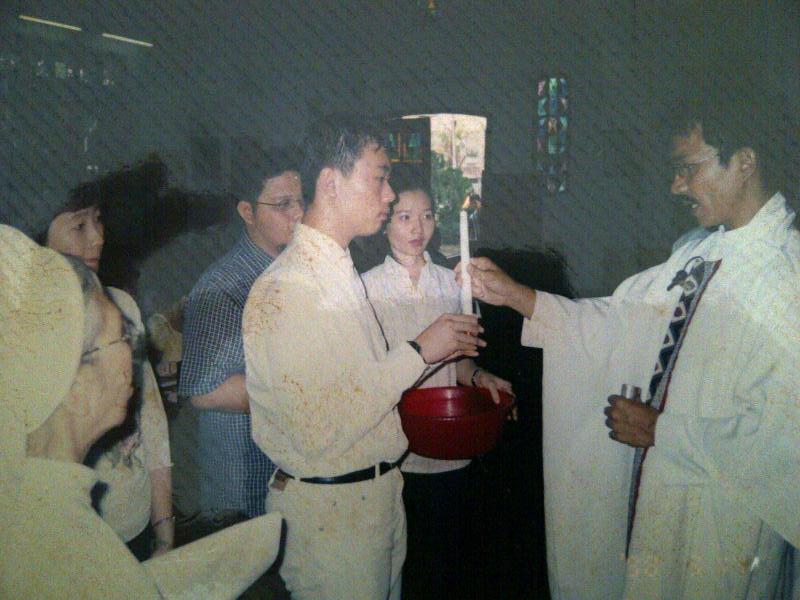
9th Anniversary of my baptism and entry into the Church of God (19 September 2004 – present)

9 years ago, on the Feast of St. Januarius, 19 September 2004, I was received into the Church through the Sacrament of Baptism.

As St. Paul before me, I have been called from the darkness into the light. Once a sinner, God had called me to be one of His children, unworthy as I am.

May my patron saints, St. Peter Canisius and St. Peter my namesake, and St. Michael the Archangel who strengthens me, continue to pray for me, and pray for all the other children of God in this world! That they will especially pray for those who are still on the journey to seek the Lord and in the process to enter the Church of God!

Image

(I baptise you in the Name of the Father, and the Son, and the Holy Spirit)

Image

(As Christ was anointed Priest, Prophet, and King, so may you live always as a member of His Body, sharing everlasting life)

Image

(Receive the light of Christ!)


Pray for me always, brethren! And pray for our brethren in need of our love too!