Monday, 1 April 2013 : Monday of the Easter Octave (First Reading)

Acts 2 : 14, 22-33

Then Peter stood up with the Eleven, and, with a loud voice, addressed them, “Fellow Jews and all foreigners now staying in Jerusalem, listen to what I have to say. Fellow Israelites, listen to what I am going to tell you about Jesus of Nazareth. God accredited Him and through Him did powerful deeds and wonders and signs in your midst, as you well know.”

“You delivered Him to sinners to be crucified and killed, and in this way the purpose of God from all times was fulfilled. But God raised Him to life and released Him from the pain of death, because it was impossible for Him to be held in the power of death. David spoke of Him when he said: ‘I saw the Lord before Me at all times; He is by My side, that I may not be shaken. Therefore My heart was glad and My tongue rejoiced; My body too will live in hope.'”

“‘Because You will not forsake Me in the abode of the dead, nor allow Your Holy One to experience corruption. You have made known to Me the paths of life, and Your presence will fill Me with joy.'” Friends, I don’t need to prove that the patriarch David died and was buried; his tomb is with us to this day. But he knew that God had sworn to him that one of his descendants would sit upon his throne and, as he was a prophet, he foresaw and spoke of the resurrection of the Messiah.

So he said that ‘He would not be left in the region of the dead, nor would His body experience corruption.’ This Messiah is Jesus and we are all witnesses that God raised Him to life. He has been exalted at God’s right side and the Father has entrusted the Holy Spirit to Him; this Spirit He has just poured upon us as you now see and hear.

(Easter Vigil) Saturday, 30 March 2013 : Easter Vigil of the Resurrection of the Lord, Holy Week (Third Reading)

Exodus 14 : 15 – Exodus 15 : 1

YHVH said to Moses, “Why do you cry to Me? Tell the people of Israel to go forward. You will raise your staff and stretch your hand over the sea and divide it to let the Israelites go dryfoot through the sea. I will so harden the minds of the Egyptians that they will follow you. And I will have glory at the expense of Pharaoh, his army, his chariots and horsemen. The Egyptians will know that I am YHVH when I gain glory for Myself at the cost of Pharaoh and his army!”

The Angel of God who had gone ahead of the Israelites now placed Himself behind them. The pillar of cloud changed its position from the front to the rear, between the camps of the Israelites and the Egyptians. For one army the cloud provided light, for the other darkness so that throughout the night the armies drew no closer to each other. Moses stretched his hand over the sea and YHVH made a strong east wind blow all night and dry up the sea.

The waters divided and the sons of Israel went on dry ground through the middle of the sea, with the waters forming a wall to their right and to their left. The Egyptians followed them and all Pharaoh’s horses, his chariots and horsemen moved forward in the middle of the sea.

It happened that in the morning watch, YHVH in the pillar of cloud and fire, looked towards the Egyptian camp and threw it into confusion. He so clogged their chariot wheels that they could hardly move. Then the Egyptians said, “Let us flee from the Israelites for YHVH is fighting for them against Egypt.”

Then YHVH said to Moses, “Stretch your hand over the sea and let the waters come back over the Egyptians, over their chariots and horsemen.” Moses stretched out his hand over the sea.

At daybreak the sea returned to its place. As the Egyptians tried to flee, YHVH swept them into the sea. The waters flowed back and engulfed the chariots and horsemen of the whole army of Pharaoh that had followed Israel into the sea. Not one of them escaped. As for the Israelites they went forward on dry ground in the middle of the sea, the waters forming a wall on their right and their left.

On that day YHVH delivered Israel from the power of the Egyptians and Israel saw the Egyptians lying dead on the seashore. They understood what wonders YHVH had done for them against Egypt, and the people feared YHVH. They believed in YHVH and in Moses, His servant.

Then Moses and the people sang this song to YHVH : I will sing to YHVH, the glorious One, horse and rider He has thrown into the sea.

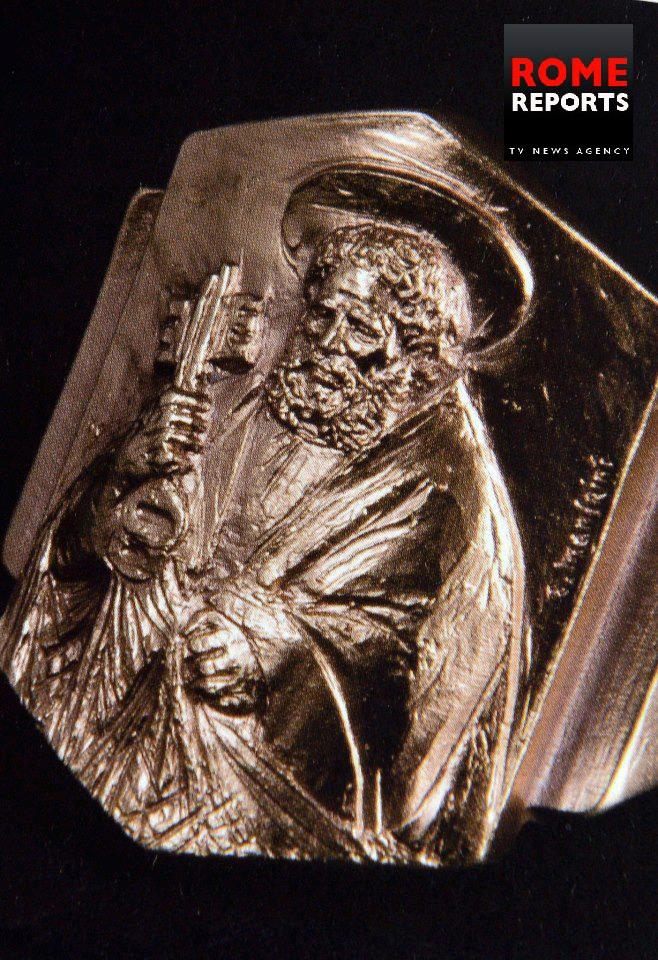
Ring of the Fisherman for Pope Francis, 266th Pope, Successor of St. Peter the Apostle, leader of the Universal Church

Image

Another image from Rome Reports

6719_10151417713052928_1657486910_n

Pope Francis’ Ring of the Fisherman, which is one of the symbol of the authority as the Pope, as both a bishop (episcopal ring) and the Successor of St. Peter the Apostle, leader of the entire Universal Church. It will be given to Pope Francis at the celebration of the Papal Inauguration Mass, on the Feast of St. Joseph, Tuesday, 19 March 2013, together with another symbol, that is the pallium.

The ring’s image closely follow that of Pope Benedict XVI’s Ring of the Fisherman, with slight difference in the shape of the ring, and the ring being made of gold-plated silver instead of gold. Depicted on the ring is the image of St. Peter holding onto the keys of the kingdom of heaven, and fishing, as he was a fisherman, but called by God to be a ‘fisher of man’.

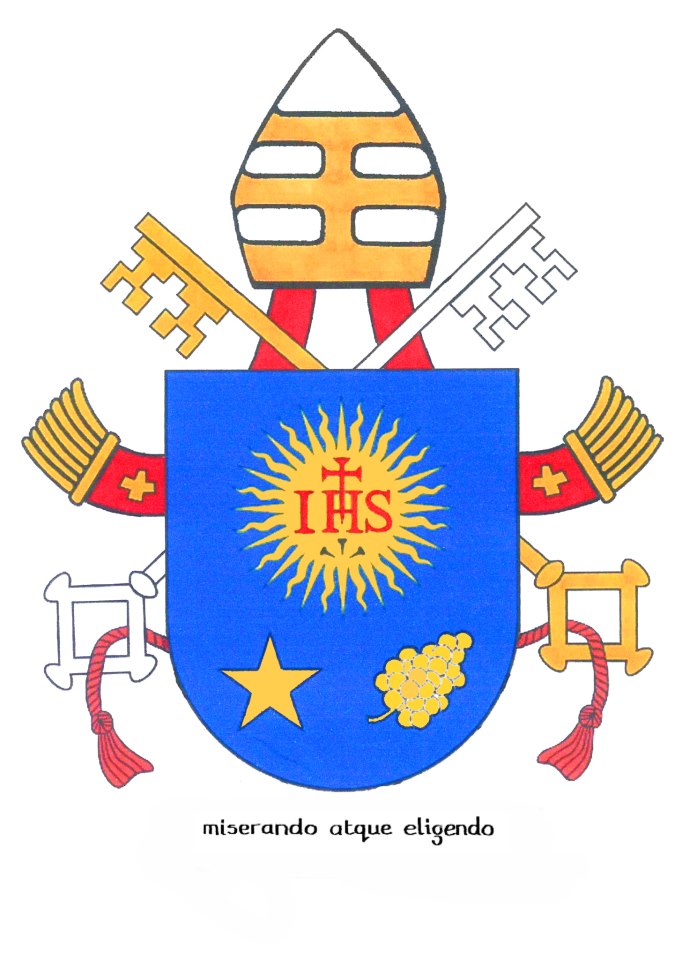
Official coat-of-arms of Pope Francis, the 266th Pope, Leader of the Universal Church

Image

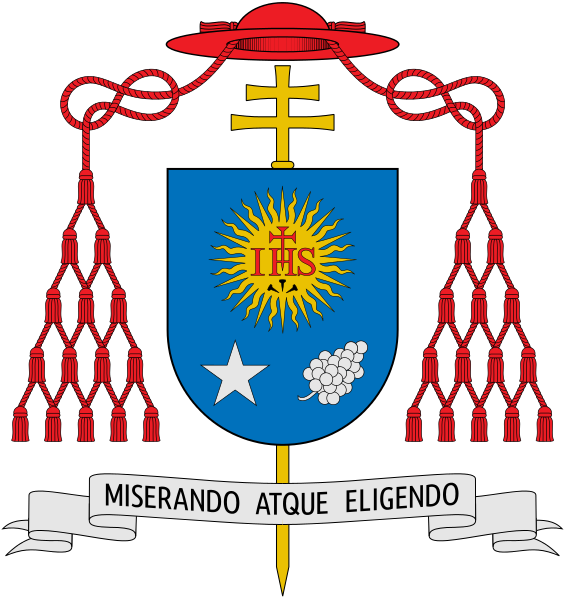
The official coat-of-arms of Pope Francis, which followed closely the model established by Pope Benedict XVI, in placing the ‘three-tiered’ ‘papal mitre’ instead of the papal tiara, and following the same shield model as that of his Cardinalate and episcopal coat-of-arms, but with altered colours for the star and the grapes, from silver to gold.

Image

Pope Francis used his episcopal motto “Miserando atque Eligendo” which means “Lowly but chosen” in English, in line with his views and outlook on humility.

The Cardinal’s fifteen red tassels and the galero on top of it, is replaced by the papal arms standard including the three-tiered papal mitre and the crossed keys of the kingdom of heaven (silver and gold).

The symbols that appeared on the shield are first, the IHS symbol surrounded with a sun-like ray is the symbol of the Jesuit order (S.J.) of which Pope Francis is a member of, and the star on the bottom-left, in conjunction with the blue colouration of the shield represents the Virgin Mary, and the grape on the bottom right represents Jesus Christ, as the grower of the vineyard of the Lord.

Cardinal Angelo Scola, Archbishop of Milan, the Papabile

http://www.eitb.com/en/news/world/detail/1282802/candidates-new-pope–profile-cardinal-angelo-scola/

From the article (My commentary at the end) :


Election of new pope

Profile of Cardinal Angelo Scola, Archbishop of Milan

APTN

03/11/2013

A conservative, and theologically close to both Pope Benedict and his predecessor John Paul II, Cardinal Scola is regarded as one of the leading European candidates to become Pope.

Cardinal Angelo Scola, the archbishop of Milan.

Cardinal Angelo Scola, the archbishop of Milan, shot to the top of a list of possible successors to Pope Benedict XVI almost immediately the resignation was announced.

A conservative, and theologically close to both Pope Benedict and his predecessor John Paul II, Cardinal Scola is regarded as one of the leading European candidates to become Pope.

Some observers tipped him to succeed after the death of John Paul II in 2005, but the conclave instead chose Cardinal Joseph Ratzinger who became Benedict XVI, the 265th pope.

But if there was rivalry between the candidates in 2005, it had little effect on their close relationship, and Scola remained a favourite of Pope Benedict’s, who appointed the Cardinal archbishop of the Milan Diocese in June 2011.

In the small town of Malgrate on Lake Como in northern Italy, many of the 5,000 residents are backing their hometown boy to become Pope. Scola was born in Malgrate on 7 November 1941 to a truck driver and a homemaker.

He entered the priesthood in 1970, became a Cardinal in 2003, serving first as Patriarch of Milan until he was elevated to his current post of archbishop.

Scola’s cousin, Angelo Colombo, remembers that during World War II he would spend time at his cousin’s home because Scola’s father was a truck driver and could get access to flour and bread.

Colombo said he would go to Scola’s family home, and his aunt and the future Cardinal would always share their food. When he asked if he thought his cousin would make a good Pope, Colombo laughed and responded: “he was a tough boy”.

Scola spent the early years of his life in a small home on Malgrate’s Salita Sant’Antonio. Alfredo Cagliandi was a classmate of Cardinal Scola and lived in the apartment below him.

“We would invite Angelo to come and play and he would repeatedly respond ‘I am sorry, but I don’t have time.’  He was too busy because was already involved in something religious,” said Cagliandi, who still lives in Malgrate.

Scola spent the first two decades after his 1970 ordination in the lecture halls and libraries of renowned Catholic universities and theological training grounds, notably in Fribourg, Switzerland, and the Lateran Pontifical University in Rome.

While pursuing theological studies, Scola was involved in Communion and Liberation, a conservative Italian Catholic group which blends political activism with faith-based fervour as it seeks to make its weight felt in the country’s decision-making.

Back in Scola’s home town, the local priest Father Andrea Lotterio proudly showed off the baptismal font where he says the town’s babies are still baptised today, noting that Scola was baptised there in 1941.

Father Lotterio said Scola has pleased the residents of Malgrate by never losing his strong ties to his hometown. “He has maintained his relationships with many local citizens, with his friends, with his relatives,” Lotterio said. “So much so that in this town he is called Don Angelo, instead of Cardinal or Patriarch of Venice.”

Pope Benedict resigned as leader of the Catholic Church on Thursday, becoming the first pope in 600 years to resign. For the time being, the governance of the Catholic Church shifts to Cardinal Tarcisio Bertone, the camerlengo, or chamberlain. Bertone, along with the College of Cardinals will guide the church and make plans for the conclave to elect the 266th leader within the next few weeks.


Commentary and additions:

Indeed, Cardinal Angelo Scola has many strengths and characteristics that we need as the new Pope to lead the Roman Catholic Church, the one and Universal Church. He does have his weaknesses, but his strengths more than made up for him. After all, it is human to have weaknesses and to make mistakes.

Cardinal Scola is media-savvy, able to reach out into the hearts of many, including youths and those in the world, who are longing for the Lord to come to them. Being media-savvy, and also internet-savvy, Cardinal Scola is not shy of using modern media tools, such as the internet, twitter, YouTube, his own site, and many other means to evangelise to the world, and to reach out, especially to youths.

Cardinal Scola also has a positive outlook and optimism in the Church, and indeed, instead of being pessimistic on the Church, and instead of looking at a Church in trouble, he dismissed all this, and all the lies that the media had brought about the Church, that the Church instead of being in chaos and trouble, is in fact growing, and filled with vibrant and strong faith and love in God, and Cardinal Scola has the capacity to tap into all these energies.

Cardinal Scola also came from a poorer family background, and he understood the plight of the poor and the less fortunate. His hometown people has often remembered him as someone who not only did not forget about where he came from, and where he was born, but also someone who constantly gives them his care and his love, in imitation of Christ and His care for the poor.

Cardinal Scola speaks Italian, English, French, and Spanish, and although his English is not that good, but he has quite a strong command of these languages, which are essential in the Pope’s ministry as the leader of the Universal Church.

Cardinal Scola’s initiatives to reach out to the Christians in the Holy Land and in other areas where Christians are minorities, and his involvement in interreligious dialogue and cooperation, and even with atheists, had been fruitful and crucial in strengthening Christians in the areas where they had been persecuted, and where persecutions are ongoing.

His experience in the Archdiocese of Milan, Patriarchate of Venice, and Diocese of Grosseto clearly showed that he is a pastoral leader with a humble and yet intellectual mind, that matches that of our beloved Pope Emeritus Benedict XVI. Yet, his experiences in the Roman Curia too were many, with works as leader of Pontifical Institute of Marriage and the Family, which he also took a strong stand with the Church in the sanctity of both marriage and the family.

His intellect, knowledge, and publications especially in topics like bioethics, in the midst of the attacks against Church’s stand on bioethics, cloning, and contraceptions will be essential for the future leader of the Church, and his ability to connect and reach out to people, more than Pope Emeritus Benedict XVI, will be valuable asset to have in the new Pope.

Nevertheless, now that the Conclave will begin soon, we continue to pray that God will pour His Holy Spirit on all the Cardinal-electors, that they can make a wise and inspired decision, to elect someone whom the Lord has chosen, as the best possible person to succeed His Apostle, Peter, and lead the whole Universal Church, that God Himself built in this world, to be the manifestation of His love, justice, and presence.

Summary of the Tenth and the Last General Congregation of the College of Cardinals, and details on the Conclave

New Cardinals have been elected to lead the Particular Congregations (elected every 3 days) in the Conclave. Cardinal Antonios Naguib for the Cardinal Bishops; Cardinal Marc Ouellet for the Cardinal Priests; Cardinal Francesco Monterisi for the Cardinal Deacons. New leaders will be elected if after three days in the Conclave, the Conclave has not yet ended with the election of a new Pope. Their task is to guide the Cardinal Camerlengo, who is Cardinal Tarcisio Bertone.

28 Cardinals had spoken in the Tenth General Congregation, and a total of 161 Cardinals had already spoken in all the past General Congregations. Not all Cardinals who wanted to speak has spoken, as the number of Cardinals that spoke had made the Cardinals to vote whether to continue or to stop the General Congregation at that point (likely because it has taken too much time).

In the meanwhile, during the Sede Vacante, certain offices that represent the Holy See, particularly diplomatic representation, Nuncios, Delegates, and many other offices of the Holy See continue to function as per normal, even when the Apostolic See is vacant, and the Cardinals waiting to elect a new Pope. The Cardinal Camerlengo, Cardinal Tarcisio Bertone is the leader during the period of the Sede Vacante, having limited powers, with the College of Cardinals, in order to settle all matters, and all things pertaining to election of the new Pope.

This Monday evening at 5.30 pm Rome time / CET / UTC+1, all the personnels, about 90 of them, who are also ‘locked’ together with the Cardinal-electors in the Conclave, including doctors, nurses, bus drivers, and other staffs involved in maintenance of the Cardinals’ residence at Domus Sancta Marthae, will take their solemn oath of secrecy, in the presence of the Camerlengo of the College of Cardinals, Cardinal Tarcisio Bertone, and also in the presence of the Secretary of the College of Cardinals, Archbishop Lorenzo Baldisseri, Master of Pontifical Liturgical Celebrations, Monsignor Guido Marini and other officials.

The swearing of the oath of secrecy by the auxiliary personnel will not be live on Vatican Television (Therefore, may not be viewable in Vatican Player).

The Mass for the Election of the Roman Pontiff or Missa pro Eligendo Pontifice, which will begin the Conclave process, will be celebrated in St. Peter’s Basilica on Tuesday morning at 10 am Rome time / CET / UTC+1, and will be in Latin, but also with translations in Italian and English available in the Vatican official website.

Cardinal Dean of the College of Cardinals, Cardinal Angelo Sodano will be the celebrant of the solemn Mass, the concelebrants will be all the Cardinal-electors and the Cardinal non-electors currently present in Rome. The homily will also be available a short period of time just before the Holy Mass on Tuesday morning (Rome time), likely from the Vatican website.

The Cardinals will enter into the Conclave in the Sistine Chapel from the Pauline Chapel, from Cardinal Prosper Grech, who will deliver the second meditation to the Cardinal-electors, followed by the Cardinals in reverse order of precedence (first by order : bishop, priest, and deacon – reverse this), and then within these order, the Cardinals in order of creation (earlier created then later created, and also within the same consistory, those whose names are earlier in the order of creation have higher precedence – also reverse all this).

The last will be the Master of Pontifical Liturgical Celebrations, Monsignor Guido Marini, and Cardinal Giovanni Batista Re, the senior Cardinal Bishop who is an elector, who will be the leader of the Conclave in absence of Cardinal Sodano, the Dean, who is a non-elector (above 80). The Cardinals will proceed into the Sistine Chapel singing the Litany of the Saints, and the hymn Veni Creator Spiritus. After the oath-taking by the Cardinal-electors, Monsignor Marini will order the traditional “extra omnes”, or “all out!” order to all except the Cardinal-electors.

The entry into the Sistine Chapel will begin on Tuesday afternoon, at 4.30 pm Rome time / CET / UTC+1, and will be broadcasted live.

The first smoke signal from the chimney of the Sistine Chapel will be at sometime around 8 pm Rome time, and will not likely be a white smoke (It is unlikely that the new Pope will be elected in the first ballot, as there will only be one ballot session on Tuesday).

The Vatican camera (available in Vatican Player at http://www.vatican.va/video/) will be fixed on the chimney through this period and available live.

The senior Cardinal Bishop-elector, Cardinal Re, will be the one in place of the Cardinal Dean, who is a non-elector, asking the newly elected Pope whether he accepts the election and also ask him the regnal name that he will assume as the Pope.

A new addition for the 2013 Conclave is that, after the Pope receives the homage from all the Cardinal-electors in the Sistine Chapel, he will proceed with all the Cardinal-electors, to the Pauline Chapel, and the new Pope alone will enter the Chapel to pray before the Blessed Sacrament in the Chapel. In the meanwhile, the Cardinal Protodeacon, Cardinal Jean-Louis Tauran, will announce the traditional Habemus Papam announcement.

It took about one hour in 2005 Conclave from the white smoke appearance until the new Pope made his appearance on the balcony of St. Peter’s Basilica (also known as the Loggia). As the new addition of prayer in the Pauline Chapel is made for the 2013 Conclave, we can expect a time frame of slightly longer than 1 hour between the white smoke, and the appearance of the new Pope on the balcony.

Sunday, 10 March 2013 : 4th Sunday of Lent, Laetare Sunday, 2nd Scrutiny for Baptism (Scripture Reflection)

Forgiveness. Something that is easy to be said, but difficult to be done. Something that we want to do, but hard to do, because either we lack love in our hearts, or have the hatred and darkness in our hearts that block us and prevent us from carrying out acts of forgiveness and mercy.

Today, our Lord Jesus Christ showed us the virtues of forgiveness and mercy, just as what God the Father had done for us, through the parable of the prodigal son. It shows the extent of God’s boundless and infinite love for us, who are sinners, but yet He is willing to take all of us as His children. After all, are we not His most beloved of all creation? The very beings created in His image? Though indeed, we were marred by our rebellion, beginning from the rebellion of our foreparents Adam and Eve, who fell into Satan’s temptation.

But God again shows that no sinner is beyond His mercy and salvation. That is why, out of His great love for all of us, the only One worthy to redeem us, His Son, Jesus Christ, was given to us as a ‘Sacrificial Offering’, the perfect offering that redeemed us every single cents of our debts, that is our sins and faults.

We who had been saved by Christ through His Sacrifice, and through our baptism, either when we were infants or when we were already adults, when God took us to be His sons and daughters, are like the elder son of the father in the parable, who had already had a share in the wealth and all the properties of the father, who is God represented. We should not act like the Pharisees, who thought themselves of worthy, and that others who had ‘erred’ in their eyes, they labeled as sinners and unworthy to share their salvation and faith.

For the Pharisees in the blind man case, represented exactly the sentiments of the elder son, where pride, arrogance, and power trumped over humility, love, and compassion. Just like the elder sons of Jesse, whom the Lord asked the prophet Samuel to visit to appoint the new king of Israel, they had been rejected although they were strong, powerful, and has that aura of command, being the elder and thus more mature sons according to the society’s norms.

No, the Lord seeks not these kind of strength, pride, and power, for these things often corrupted men and deviates their heart from their true love for God, and instead to love mankind, the world, and all the temptations of power and glory that Satan offered through the world. God desires indeed the qualities found in David, whom he chose as the new king of Israel to replace the disobedient Saul.

For David is humble and loving, and he truly loved the Lord with all his heart and after his anointing, he set out to do good throughout all his life, for God’s sake. And except for the sin he committed in murdering the husband of his future wife (he is still like us after all, a sinner), he was committed to a life of dedicated love to God, and to all his fellow men, whom he ruled justly.

It is through humility and love that we can learn the true nature of God, that is love, mercy, and compassion. For if we let ourselves be blinded by our pride, jealousy, our hatred, and all things of evil and sin, we blind ourselves, not only from the truth in our fellow men, but also blind ourselves from God. This is exactly what happened to the Pharisees and the people gathered, who condemned the blind man, cured by Jesus, failing to see God’s work in Jesus, and failing to listen to the testimony of the blind man, which is truth.

For they are too embroiled in their own self-vanity, pride, and preservation, and jealousy against all who intruded into their sphere of control and power (who was indeed Jesus), that they rejected God directly, out of these sheer darkness in their hearts. For them, these had closed their hearts from God’s love, but still, God gave His life to save all, including them, and He forgave them in the end at Calvary. This is how great the love that God has shown us, that He gave Himself for us.

Therefore, brothers and sisters in Christ, let us strive that we will not be like the ungrateful and arrogant elder son, who think highly of himself and failing to see God’s love in all, and for all, even for the greatest sinners, represented by the younger son. Because he has been always with the Father as we are with the Father through Christ and through our baptism, but we have to reach out and help out those who are still struggling, and those who had lost their way to God.

Help one another, strengthen one another in faith, and bring the Good News to others who had yet to receive it. Let us, brothers and sisters in Christ, as One community, One Church in Christ, do our best to show God’s mercy, forgiveness, and love, through our charity and our actions, which will make God’s love manifest in this world. That more can be saved, through our action, not out of jealousy, not out of pride, but out of love, and humility, and let us rejoice together when anyone returns or comes to the Lord, acknowledging Him as their Saviour.

May God bless us all, and bless those who had rejected Him, those who had hated Him, and those who had closed their hearts to His love. Amen.

Saturday, 2 March 2013 : 2nd Week of Lent (Scripture Reflection)

The parable of the prodigal son is indeed a well-known parable and story, that many have heard, which symbolises God’s eternal love for us and His great mercy. Do not be mistaken however, that God will simply just overlook any kind of error and sin because of His love for us. For God first and foremost is Holy and therefore He hates sin in all its forms. He hates evil and things that marred the holiness of His creations. He does have mercy, and His great and the incomprehensible degree of His love allows Him to forgive us, just like the father of the prodigal son.

But how does this forgiveness come about? It is not by being idle and wait for God’s forgiveness. If we stay idle, or worse if we continue to dwell in the world of sin, God will not forgive us, but rather condemn us for our continued rebellion against His love. Remember, that, in the parable of the prodigal son, it is the son, who in great humility and repentance, decided to turn back home and seek his father.

Instead of being haughty and proud, he lowered himself and even declared his unworthiness before the father. The father forgives him first because the younger son is back after being lost into the world, and then because he so humbly had submitted himself to the father’s judgement and in full humility even declared his unworthiness, which made the loving father to love him even more.

Forgiveness is not easy, but the Lord is willing to forgive as long as His children who have sinned, and thus rebelled against Him just like the prodigal son, are to humbly seek His mercy and love. God is kind as He is just, and He will show us great blessings and graces if we are obedient and try our best to remain in His favour, by first listening to the Word of God, and the commandments of love as brought by Christ, and to make our faith manifest through our good works and service for the good of all mankind, starting from those around us.

But do not forget, that God in His great mercy, do not just forgive us like that, for if we are forgiven but we ourselves continue to accuse others who had made mistakes to us, is it not contradictory? Just as Christ had said, love one another as I have loved you, and do upon others as what you wish to be done to you.

Therefore, brothers and sisters in Christ, let us first forgive one another first, forgive those who had made you hurt, those who had ostracised you, and then let us ourselves not hurt others, not ostracise others, and not made others’ lives to suffer. Only then, let us offer ourselves, our sinful beings in humility at God’s feet. He, who is our Father, will lift us up again, and makes us whole again, and once again worthy of Him.

If only love, kindness, and forgiveness can be ever present in everyone in our world today, that world would have been much nicer, is it not? All of us Christians, are just like the elder son of the father in the parable, as we had been brought closer to God through our baptism, and had been taught the faith and the love of God through our priests and our fellow brethren in faith. However, let us not be like the elder son who in jealousy became angry with the father because he seemed to overlook him due to the return of the prodigal younger son.

Because, we, who are like the elder son, have been saved in Christ, provided that we remain faithful to Him and practice our faith through our works and service for others as the Lord commanded us. However, there are many out there, who have yet to listen and receive the Good News of the Lord, and many still are also former believers in Christ, who had lapsed in their faith along the way, and had fallen into the traps of evil, through worldly pleasures, consumerism, secularism, and many others. They are the younger son, the lost prodigal son.

Rather than be annoyed and be jealous of them, when the Lord welcomes them into His kingdom like what the elder son did, let us instead help the Father, in seeking these lost sheep, these lost children of God, for through us, God can work wonders in our world. Let us help one another, particularly these lost ones, in finding together our way to the Lord, who will welcome all of us with His love and outstretched hands, the hands which had been pierced with nails on the cross to redeem us from death and eternal damnation, and into eternal life and union with Him.

Let us pray, brothers and sisters in Christ, that first we will always remain faithful to God, obey His commandments, and do what we can, and whatever is within our abilities to help one another, to love one another, and to reach out especially to those who hunger for God.

Then, let us also pray for our Holy Church, which is now without a shepherd, that God will appoint soon a new shepherd to guide His holy people, that through the Church, God’s work will be made manifest and real in this world, guiding all peoples back towards the Lord from their sinful past. May God, who is our loving Father, bless us all, and remain with us, and always be ready to welcome us back if we had gone astray and then humbly seek His mercy. May God place into our hearts the heart of mercy, the heart of love, and the heart of compassion for others. Blessed be God, forever and ever! Amen.

Tuesday, 26 February 2013 : 2nd Week of Lent (Scripture Reflection)

Humility is one of the greatest virtues a Christian can have, and to be humble is one of the calling for us Christians, to accomplish. To be humble people of God, humbling ourselves before one another as brothers and sisters in Christ, and also humbling ourselves before God. In our humility, God will be able to find the true greatness in us, that is our faith, and love for Him. Pride often closes our heart to the Lord, and distance ourselves from Him, and we will be therefore judged unworthy.

It is in humility that we learn to be able to receive the love of God, and to also render forgiveness and justice upon others, since in humility, we realise our own personal weaknesses as human beings, as imperfect creatures that are bound to sin, mistakes, and faults. Therefore, if we humbly place ourselves, and act in humility and love, we will know that we too are just like others around us, who are our brothers and sisters, no matter our rank, our wealth, or our affluence. For everyone is equal in the eyes of the Lord.

If we fully realise the fullness of our weaknesses, our frailty, and our unworthiness before God, we will be able to act more justly on others, and to render loving acts and kindness to everyone, especially those whom we hate, who are less fortunate than us, that through these acts, they too can be transformed, from hatred into love, and from the poverty of the material, into the wealth of the soul. Why is this so? because we understand the nature of our frailty, our disposition towards sin and failures, that we will not easily mete out judgments on others, as we too have the same kind of weakness, and if we judge someone based on their failures, eventually, we ourselves will also be judged.

If we judge someone first, that someone will not look kindly upon us, and even may hate us. In doing so, not only that we have judged someone perhaps unjustly, but also may cause someone to fall into hatred and therefore sin. Instead, if we refrain ourselves from quick judgment and take the time to reflect upon our actions or possible course of actions, we will realise that the only way to end this endless cycle of judgment, hatred, violence, and more judgment is that to break free from it, through acts of love and justice.

Let us also in addition to that, also in humility, bow down before the Lord and wash ourselves away from our sins. Especially, in this season of Lent, which is perfect for this purpose, as we, through fasting, abstinence, and doing penance, can undergo a thorough spiritual cleansing and purification, to rid ourselves of the evils and faults that plagued us, and ensured that we are found worthy in the end, after a long battle with evil and sin, and the darkness and corruption they brought to our hearts, and to our minds. Let us also fill ourselves with love, and through that love, exercise loving acts, that all those whom we work on, will experience the love of the Lord, and therefore will also be called to salvation and purification of their sins through repentance, just as we are. That they all too may live!

Many will use the Gospel passage today as their main weapon to attack our Church mindlessly, as many literally interpret the Scripture so much that they lose the true meaning of the passage, and through their misunderstanding of the Church of God, they instead become the agents of Satan unknowingly in attempting to destroy and damage God’s Holy Church and God’s Holy people.

For indeed Jesus said that we should not call anybody in this world our father, Rabbi or Master, or leader, because indeed, we have only one such figure in all universe, that is God, God the creator, and God who saved us from eternal death, and brought us to eternal life through His Son, Jesus Christ. However, we understand that, as we know, our priests, whom we call Father, are called that because they are our spiritual fathers, just as we have our biological fathers who took care of our needs since our birth. And while biological fathers take care of our needs, our spiritual fathers ensured that we grew ever stronger in our faith and love of God. But most importantly, we call them so, because they are in representation of Christ Himself, in persona Christi, through the authority and power given to them through the Apostles. We call them Father ultimately not because we revere them as much as the Lord, but we revere the Lord through them, whom we call Father.

That is why, our Pope, whom we call Holy Father, while many will aggressively attack such a title, is nothing more than what I have mentioned. He, as the Bishop of Rome, as the leader of all the faithful in Christ, the successor of Blessed St. Peter the Apostle, to whom Christ entrusted His Church and all His ‘sheep’, is even closer in union with Christ, with God who is our Father. When we call the Pope our Holy Father, this is because we revere the Lord, our God, of whom the Pope is the Vicar, the representative in this world.

Therefore, brothers and sisters in Christ, if anyone would ever ask you the question, why you call your priests and so and so father, now you know how to answer them and enlighten them on the truth. That instead of succumbing to the evil one, we rise and fight against him, in the Name of God the Most High, our Saviour Jesus Christ. May God bless us all, that all of us may grow ever stronger in faith, in hope, and in love. That we can use this Lenten season to the best we can, to purify ourselves from our unworthiness before God, and to make ourselves ever closer to God, and help bring one another together closer to God. Amen.


Tuesday, 26 February 2013 : 2nd Week of Lent (Gospel Reading)

Matthew 23 : 1-12

Then Jesus said to the crowds and to His disciples, “The teachers of the Law and the Pharisees have sat down on the chair of Moses. So you shall do and observe all they say, but do not do as they do, for they do not do what they say. They tie up heavy burdens and load them on the shoulders of the people, but they do not even raise a finger to move them.”

“They do everything in order to be seen by people : they wear very wide bands of the Law around their foreheads, and robes with large tassels. They enjoy the first paces at feasts and reserved seats in the synagogues, and they like being greeted in the marketplace, and being called ‘Master’ by the people.”

“But you, do not let yourselves be called Master, because you have only one Master, and all of you are brothers and sisters. Neither should you call anyone on earth Father, because you have only one Father, He who is in heaven. Nor should you be called Leader, because Christ is the only Leader for you.”

“Let the greatest among you be the servant of all. For whoever makes himself great shall be humbled, and whoever humbles himself shall be made great.”