Sunday, 19 October 2014 : 29th Sunday of Ordinary Time, Mission Sunday and Memorial of St. John de Brebeuf and St. Isaac Jogues, Priests and Martyrs; and St. Paul of the Cross, Priest (Gospel Reading)

Liturgical Colour : Green

Matthew 22 : 15-21

At that time, the Pharisees went out and considered how they could trap Jesus by His own words. They then sent out their disciples, with members of Herod’s party, for this purpose.

They said to Jesus, “Master, we know that You are an honest Man and truly teach God’s way. You are not influenced by others nor are You afraid of anyone. So tell us what You think : is it against the Law to pay taxes to Caesar or not?”

But Jesus understood their bad intentions, and said to them, “Hypocrites, why are you testing Me? Show Me the coin with which you pay the taxes.” They showed Him a silver coin, and Jesus said to them, “Whose head is this, and whose name?”

They answered, “Caesar’s.” Then Jesus replied, “So give to Caesar what is Caesar’s, and give to God what is God’s.”

Sunday, 19 October 2014 : 29th Sunday of Ordinary Time, Mission Sunday and Memorial of St. John de Brebeuf and St. Isaac Jogues, Priests and Martyrs; and St. Paul of the Cross, Priest (Second Reading)

Liturgical Colour : Green

1 Thessalonians 1 : 1-5b

From Paul, Sylvanus and Timothy to the church of Thessalonica which is in God the Father and in Christ Jesus, the Lord. May the peace and grace of God be with you.

We give thanks to God at all times for you and remember you in our prayers. We constantly recall before God our Father the work of your faith, the labours of your love and your endurance in waiting for Christ Jesus our Lord.

We remember, brothers and sisters, the circumstances of your being called. The Gospel we brought you was such not only in words. Miracles, Holy Spirit and plenty of everything were given to you.

Sunday, 19 October 2014 : 29th Sunday of Ordinary Time, Mission Sunday and Memorial of St. John de Brebeuf and St. Isaac Jogues, Priests and Martyrs; and St. Paul of the Cross, Priest (Psalm)

Liturgical Colour : Green

Psalm 95 : 1 and 3, 4-5, 7-8, 9-10a, 10c

Sing to the Lord a new song, sing to the Lord, all the earth! Recall His glory among the nations, tell all the peoples His wonderful deeds.

How great is the Lord and worthy of praise! Above all gods He is to be feared. For all other gods are worthless idols, but YHVH is the One who made the heavens.

Give to the Lord, you families of nations, give to the Lord glory and strength. Give to the Lord the glory due His Name; bring gifts and enter His courts.

Worship the Lord with holy celebrations; stand in awe of Him, all the earth. Say among the nations, “The Lord reigns!”

He will judge the peoples with justice.

Sunday, 19 October 2014 : 29th Sunday of Ordinary Time, Mission Sunday and Memorial of St. John de Brebeuf and St. Isaac Jogues, Priests and Martyrs; and St. Paul of the Cross, Priest (First Reading)

Liturgical Colour : Green

Isaiah 45 : 1, 4-6

Thus says YHVH to His anointed, to Cyrus : “I have taken you by the right hand to subdue nations before you and strip kings of their armour, to open the gateways before you so that they will be closed no more.”

“For the sake of Jacob My servant, of Israel My chosen one, I have called you by your name and given you your mission although you do not know Me. I am YHVH, and there is no other; there is no God besides Me. I armed you when you did not know Me, so that, from the rising to the setting of the sun, all may know that there is no one besides Me; I am YHVH, and there is no other.”

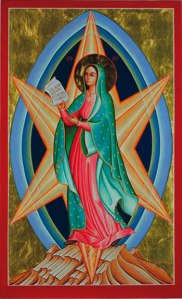
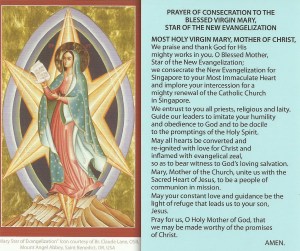
Prayer of Consecration to the Blessed Virgin Mary, Star of the New Evangelisation

marystarofevanglisationicon

On 7 October 2014, on the Feast of our Lady of the Rosary, His Excellency Archbishop William Goh Seng Chye, the Archbishop of Singapore dedicated and consecrated the Archdiocese of Singapore and all the efforts of the New Evangelisation in Singapore to the Blessed Virgin Mary, Star of the New Evangelisation.

Although this refers to the Archdiocese of Singapore, I believe that everyone else in the world, within the Church of God may also pray the same prayer for the sake of evangelisation of the Good News everywhere in this world.


Here is the text of the prayer, to be prayed daily from 7 October 2014 to 7 October 2015, the Feast of our Lady of the Rosary.


10669256_842249659148292_6829732685043142899_o

Most Holy Virgin Mary, Mother of Christ.

We praise and thank God for His mighty works in you. O Blessed Mother, Star of the New Evangelisation; we consecrate the New Evangelisation for Singapore to your Most Immaculate Heart and implore your intercession for a mighty renewal of the Catholic Church in Singapore. We entrust to you all priests, Religious and laity. Guide our leaders to imitate your humility and obedience to God and to be docile to the promptings of the Holy Spirit.

May all hearts be converted and re-ignited with love for Christ and inflamed with evangelical zeal, so as to bear witness to God’s loving salvation. Mary, Mother of the Church, unite us with the Sacred Heart of Jesus, to be a people of communion in mission.

May your constant love and guidance be the light of refuge that leads us to your son, Jesus. Pray for us, O Holy Mother of God, that we may be made worthy of the promises of Christ. Amen.

Saturday, 18 October 2014 : 28th Week of Ordinary Time, Feast of St. Luke the Evangelist (Gospel Reading)

Liturgical Colour : Red

Luke 10 : 1-9

At that time, the Lord appointed seventy-two other disciples, and sent them two by two ahead of Him to every town and place, where He Himself was to go. And He said to them, “The harvest is plentiful, but the workers are few. So you must ask the Lord of the harvest to send workers to His harvest.”

“Courage! I am sending you like lambs among wolves. Set off without purse or bag or sandals; and do not stop at the homes of those you know. Whatever house you enter, first bless them, saying, ‘Peace to this house!’ If a friend of peace lives there, the peace shall rest upon that person. But if not, the blessing will return to you.”

“Stay in that house, eating and drinking at their table, for the worker deserves to be paid. Do not move from house to house. When they welcome you to any town, eat what they offer you. Heal the sick who are there, and say to them : ‘The kingdom of God has drawn near to you.'”

(Usus Antiquior) Sixteenth Sunday after Pentecost, Feast of St. Wenceslaus, Martyr (II Classis) – Sunday, 28 September 2014 : Homily and Scripture Reflections

Dear brothers and sisters in Christ, today we celebrate together the feast of St. Wenceslaus, martyr of the faith, Duke and ruler of Bohemia, a holy, devoted and pious leader of his people, and ultimately, the humble and good servant of our Lord Jesus Christ, and who walked in His path so faithfully, that he brought good things to those entrusted under his care, and he even obeyed Him all the way unto death in the hands of his enemies.

The key of our readings from the Holy Scriptures on this holy day is that we ought to be exemplary and faithful in our lives, so that in every things that we do, we do it in e Name of our Lord Jesus Christ, and that through our every words and deeds, we may give glory to our Lord, and so all those who see us will know who the Lord is, and that we belong to Him, and we are saved by our works.

For the Scriptures had said, that even the Gentiles would come to proclaim the Lord as Lord and God, even though they once did not know who He was, until the Apostles came to them and deliver to them the Good News of God’s salvation which He had first proclaimed to the world through the coming and the works of Jesus, His Son. The Apostles became living witnesses of His works, and thus from them, they passed on that knowledge to others, who in turn became witnesses of the faith.

Jesus Himself showed to His people, how to live as a faithful and good servant of our Lord. The cardinal virtues of faith, hope and love are always indeed at the forefront, and we should always keep these in mind. And in all things, we ought to think not of ourselves first, but we ought to keep the Lord ever first in our minds and our hearts, and then also our brethren around us.

Jesus criticised the Pharisees and the elders of the people of God, who failed to look beyond the words of the Law of God, on the matter pertaining to the sabbath day and its observations. They failed to understand the meaning of those laws which God had given His people, and instead, they oppressed the people by their strict and unbending word-to-word obedience to the law. But, as Jesus made it clear to them their folly, that what they did was in fact feeding on their own ego and obeying their own human-made laws and not the law of God.

For the Law of God is in essence, love. And love will not cause or bring unnecessary suffering among the people whom He loved greatly. What He seeks after all is not empty promises and empty profession of faith, or empty observances of the laws and the events, but rather, a true and sincere love which mankind, His people, has for Him. He seeks for our hearts and our love, not our appearances!

Brothers and sisters in Christ, this is why St. Paul and the Apostles, as well as all the saints and holy men and women of God were witnesses to the love of God, and what He desired out of us. They showed not by mere words or appearances, as the Pharisees and the elders had once done. Where these people showed off their supposed ‘piety’ in the common places by praying loudly and openly in the sight of the people for their praise, the Apostles and disciples of Christ toiled and worked, in the defense of their faith and in the effort to bring the Good News to the people, to us all.

And St. Wenceslaus, the saint whose feast we celebrate today is no different indeed. He was born into privilege, into the ruling house of Bohemia and Moravia, which today corresponds to the territories of both the Czech Republic and Slovakia, and St. Wenceslaus became the Duke of Bohemia, a great lord and a respected position in Christendom.

St. Wenceslaus was one of the first Christian rulers of his people, together with his father. Many of the people under his care remained as pagans and beyond the reach of the Church. St. Wenceslaus was a wise and great ruler, who truly cared for his people. He built many churches and other facilities, designed to help the people of God, both in things physical and spiritual. He helped the faith to grow and spread among the faithful, bringing countless souls closer to salvation.

He led by example, and practiced his faith by real and concrete example, serving the people of God humbly even though he is mighty and powerful. He brought the people he has been entrusted with closer to the love of God, as a faithful shepherd and servant of God. He had his enemies of course, and those plotted against him, assassinating him while he was on his way to a celebration, the enemies of all the faithful and the agents of Satan who had done this to remove this holy servant of God.

Yet they have failed in the end, as the examples of St. Wenceslaus shone very brightly for all to see and follow, and he was made a saint, truly because of his great virtues in life, and he now is our intercessor in heaven, who together with the many other holy men and women, pray for us unceasingly before our Lord, that we too may repent from our sins, and endeavour to be faithful in all of our actions.

Therefore, brothers and sisters in Christ, let us all be examples to one another, that in our actions and deeds, we show our faith in God, and we show how devoted we are to the Lord, not just by empty promises and professions, but through real action, founded upon the three cardinal virtues of our faith, that is faith, hope and love, and love for God as well as love for our fellow men. God bless us all, brethren, now and forever. Amen.

Saturday, 20 September 2014 : 24th Week of Ordinary Time, Memorial of St. Laurent Imbert, Bishop and Martyr; St. Jacques Chastan, Priest and Martyr; St. Andrew Kim Taegon and Companions, Martyrs (Homily and Scripture Reflections)

Liturgical Colour : Red

Dear brothers and sisters in Christ, in today’s readings we heard two great exhortations, by St. Paul in his letter to the faithful and the Church in Corinth on the nature of the resurrection of the faithful and then the parable of the sower and the seeds by Jesus who told them what happened to the various seeds that ended up in different conditions.

In the two readings, we can see a great link and similarity, as both of them refer to the growth and the sowing of seeds, and what are these seeds? They are none other than the seeds of faith, hope and love, the three cardinal virtues of Christian life, as these have been planted in us, within our hearts and souls. And the purpose for these seeds are so that we may truly be transformed from our sinful, mortal and earthly bodies, to be truly worthy of our Lord and God, in a new spiritual body as mentioned by St. Paul, that is a body filled with the wonderful flowers and fruits of faith, of hope and of love.

But Jesus our Lord mentioned in His parable of the sower, that this would not be an instantaneous, automatic or easy process. He clearly highlighted the problems, dangers and great challenges that line up against us, to prevent us from achieving that state of spiritual maturity and worthiness, that we end up to continue living in sin and darkness rather than be accepted into the light.

Mankind had lived in this world and as such are bound to the ways of this world, that is the way of the flesh, and the ways of the world. That had been the way of mankind ever since the days of our first ancestors, after they had sinned and been cast away from the presence of God, and had to endure the sufferings of the earth. Ever since then, mankind had lived on earth and obeyed the ways of the world rather than the ways of the Lord.

What we need in order to escape this bonds and prison of the world is by cultivating and growing the seeds of faith, hope and love which God had planted in us, through His Spirit. It is however, as mentioned, not going to be an easy path. The parable of the sower in fact showed us that the devil is always at work in order to prevent us from ever achieving salvation in God, and instead perish with him together in hell.

Jesus mentioned that the seeds fell on first the roadside and got eaten by the birds. In this case, He also explained how Satan is always at work as he desired our total annihilation, as a form of his vengeance and continuous rebellion against God. As we mankind are God’s greatest and most beloved creation, there is indeed nothing more sinister and evil for Satan to commit his defiance against God other than by subverting mankind and bringing them into sin.

And Satan has much in his possession in order to execute this extremely well. This is because many of us are like the seeds that fall on the rocky ground. We listened to the word of God and we received the words of the Good News of Christ, but these did not take root in our hearts. It is like we heard these words from our ears, but it then remains just a superficial attachment in any, and indeed, in our actions, in our own words and deeds, they represent nothing that the Lord had taught us.

This is a fertile ground for Satan to make his attack upon us, and it is easy for him to sow the seeds of dissent and unfaithfulness in our hearts. And indeed, the same also applies to the kind of those who are like the seeds that grow on the soil with thistles. Thistles are plants that can spread and grow on the surfaces of other plants, taking precious nutrients as a parasite to the host plant, which then eventually is suffocated, impoverished and therefore die.

This is one main way through which Satan made his attacks, that is through the pleasures of the flesh, and the desires of men. He made his attack on us through these, so as to ensnare us on our way to reach the Lord, and therefore fail to reach salvation in God. The thistle represents the temptations and the corruptions which Satan is trying very hard to impose on us, so that we may obey him instead of God.

For us to truly be able to achieve salvation, we have to take heed of what Jesus and St. Paul had conveyed to us on this day. This is namely that we have to abandon our earthly ways, and all the things we used to do in this world, which are not in accordance with the will of God, which He had revealed through Jesus His Son. In this manner, then we can have that rich soil in us, upon which the Word of God and the seeds of faith, hope and love in us may form deep roots and grow strong.

And perhaps, by sharing the lives of the saints which feast we are celebrating today will inspire us even more to follow God with all of our hearts. Today, we celebrate the feast day of St. Laurent Imbert, Vicar Apostolic of Korea, one of the first shepherds of the Church and the faithful in Korea, and also St. Jacques Chastan, another missionary to Korea, with his many companions in martyrdom, both missionary, laity and priests alike, the Martyr Saints of Korea.

Korea at that time, as it had been for about two hundred years, ever since the Faith first came there, was truly a very hostile place for the Church and the faithful. There were open and state-led persecution of the Christian faithful, who were seen as disloyal, traitors and enemies of the state. Many were made to choose between keeping their faith and death. Many abandoned Christ, but there were also many of those who remained faithful to the Lord and suffered holy martyrdom.

St. Laurent Imbert was the Vicar Apostolic of Korea, a missionary part of the French mission to Korea. He faithfully worked in shepherding the people entrusted under his care, and more and more come to believe in Christ and achieved salvation through his dedication. St. Laurent Imbert however, heard that the persecution of the faithful might cease, if he and the other leaders of the faithful would surrender themselves to the authorities.

The suffering of the faithful at the time was really great, and many were brought to martyrdom every day. Thus, in the spirit of the words of Jesus, St. Laurent Imbert, who was in hiding at the time, told his people, that he would surrender himself to the authorities, in exchange for the safety and protection of his flock. He mentioned the good shepherd, where Jesus mentioned that the good shepherd lay down his life for his sheep.

St. Laurent Imbert followed the example of Jesus and in his love and faith for his flock, he thought only of the best for them. Thus, he even willingly surrendered himself, even while knowing that his fate most likely would be death. He thus gave a great example to the faithful, which we too should follow and emulate in our lives. Even though the martyrdom and persecution would continue even after the martyrdom of St. Laurent Imbert, as the authorities reneged on their promises, the blood and faith of these holy martyrs continued to cause more and more faith to blossom and prosper among the persecuted people of God.

Therefore, brothers and sisters in Christ, let us all come to a greater realisation of how great is the amount of effort and work that we should input into our lives, so that we may grow deeper and stronger in our faith, our hope and our love, that we may indeed bear fruit, that is the fruits of the Holy Spirit.

May all of us be ever more faithful and devoted to our Lord, so that our Lord may find us worthy of Himself and reunite us with Him together in the company of St. Laurent Imbert, St. Jacques Chastan, St. Andrew Kim Taegon and all the holy martyr saints of Korea, and together with the other holy men and women, as well as the angels. God bless us all. Amen.

Saturday, 20 September 2014 : 24th Week of Ordinary Time, Memorial of St. Laurent Imbert, Bishop and Martyr; St. Jacques Chastan, Priest and Martyr; St. Andrew Kim Taegon and Companions, Martyrs (Gospel Reading)

Liturgical Colour : Red

Luke 8 : 4-15

As a great crowd gathered, and people came to Jesus from every town, He began teaching them with a story : “The sower went out to sow the seed. And as he sowed, some of the seed fell along the way, was trodden on, and the birds of the sky ate it up. Some seed fell on rocky ground, and no sooner had it come up than it withered, because it had no water.

Some seed fell among thorns; the thorns grew up with the seed and choked it. But some seed fell on good soil and grew, producing fruit, a hundred times as much!” And Jesus cried out, “Listen then, if you have ears to hear!”

The disciples asked Him, “What does this story mean?” And Jesus answered, “To you it has been given to know the mystery of the kingdom of God. But to others it is given in the form of stories, or parables, so that seeing they may not perceive, and hearing they may not understand.”

“Now, this is the point of the parable : The seed is the word of God. Those along the wayside are people who hear it, but immediately the devil comes and takes the word from their minds, for he does not want them to believe and be saved. Those on rocky ground are people who receive the word with joy, but they have no root; they believe for a while, and give way in time of trial.”

“Among the thorns are people who hear the word, but, as they go their way, they are choked by worries, riches, and the pleasures of life; they bring no fruit to maturity. The good soil, instead, are people who receive the word, and keep it in a gentle and generous mind, and persevering patiently, they bear fruit.”

Saturday, 20 September 2014 : 24th Week of Ordinary Time, Memorial of St. Laurent Imbert, Bishop and Martyr; St. Jacques Chastan, Priest and Martyr; St. Andrew Kim Taegon and Companions, Martyrs (Psalm)

Liturgical Colour : Red

Psalm 55 : 10, 11-12, 13-14

My enemies turn back when I call on You for help; now I know that God is for me.

In God whose word I praise, in God I trust without fear. What can mortals do against me?

I am bound to You by vows, o God; I shall offer my thanksgiving. For You have rescued my soul from death and my feet from stumbling, that I might walk in God’s presence in the light of the living.