Sunday, 18 October 2015 : Twenty-Ninth Sunday of Ordinary Time, Mission Sunday and Feast of St. Luke, Evangelist (Second Reading)

Liturgical Colour : Green

Hebrews 4 : 14-16

We have a great High Priest, Jesus, the Son of God, Who has entered heaven. Let us, then, hold fast to the faith we profess. Our High Priest is not indifferent to our weaknesses, for He was tempted in every way just as we are, yet without sinning.

Let us, then, with confidence approach the throne of grace; we will obtain mercy and, through His favour, help in due time.

Sunday, 18 October 2015 : Twenty-Ninth Sunday of Ordinary Time, Mission Sunday and Feast of St. Luke, Evangelist (Psalm)

Liturgical Colour : Green

Psalm 32 : 4-5, 18-19, 20 and 22

For upright is the Lord’s word and worthy of trust is His work. The Lord loves justice and righteousness; the earth is full of His kindness.

But the Lord’s eyes are upon those who fear Him, upon those who trust in His loving kindness, to deliver them from death and preserve them from famine.

In hope we wait for the Lord, for He is our help and our shield. O Lord, let Your love rest upon us, even as our hope rests in You.

Sunday, 18 October 2015 : Twenty-Ninth Sunday of Ordinary Time, Mission Sunday and Feast of St. Luke, Evangelist (First Reading)

Liturgical Colour : Green

Isaiah 53 : 10-11

Yet it was the will of YHVH to crush Him with grief. When He makes Himself an offering for sin, He will have a long life and see His descendants. Through Him the will of YHVH is done.

For the anguish He suffered, He will see the light and obtain perfect knowledge. My Just Servant will justify the multitude; He will bear and take away their guilt.

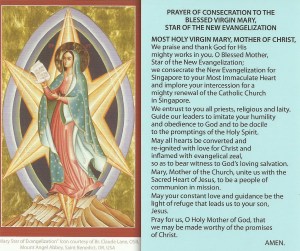
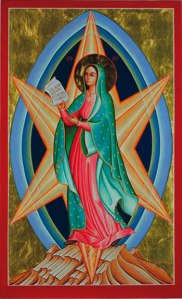
Prayer of Consecration to the Blessed Virgin Mary, Star of the New Evangelisation

marystarofevanglisationicon

On 7 October 2014, on the Feast of our Lady of the Rosary, His Excellency Archbishop William Goh Seng Chye, the Archbishop of Singapore dedicated and consecrated the Archdiocese of Singapore and all the efforts of the New Evangelisation in Singapore to the Blessed Virgin Mary, Star of the New Evangelisation.

Although this refers to the Archdiocese of Singapore, I believe that everyone else in the world, within the Church of God may also pray the same prayer for the sake of evangelisation of the Good News everywhere in this world.


Here is the text of the prayer, to be prayed daily from 7 October 2014 to 7 October 2015, the Feast of our Lady of the Rosary.


10669256_842249659148292_6829732685043142899_o

Most Holy Virgin Mary, Mother of Christ.

We praise and thank God for His mighty works in you. O Blessed Mother, Star of the New Evangelisation; we consecrate the New Evangelisation for Singapore to your Most Immaculate Heart and implore your intercession for a mighty renewal of the Catholic Church in Singapore. We entrust to you all priests, Religious and laity. Guide our leaders to imitate your humility and obedience to God and to be docile to the promptings of the Holy Spirit.

May all hearts be converted and re-ignited with love for Christ and inflamed with evangelical zeal, so as to bear witness to God’s loving salvation. Mary, Mother of the Church, unite us with the Sacred Heart of Jesus, to be a people of communion in mission.

May your constant love and guidance be the light of refuge that leads us to your son, Jesus. Pray for us, O Holy Mother of God, that we may be made worthy of the promises of Christ. Amen.

100,000 views for my blog! Thanks to all the visitors and Praise be to God!

As of last Sunday, 7 July 2014, my blog has reached its 100,000th view by visitors from different parts of the world. I thank all those who had spent their time to come and read what I had published in this blog.

May God be with us all, bless us and guide us always. And may He guide me and bless me so that I can continue to write, to publish and to work for His greater glory.


Blog world map - 13 July 2014


Blog statistics (as of Sunday, 13 July 2014) :

Total views : 106,903

Total visitors : 64,237
Statistics by countries (views) – 104,780 views tabulated

1. United States of America (USA) : 30,179

2. Philippines : 19,667

3. Singapore : 17,364

4. United Kingdom (UK) : 6,318

5. Canada : 3,583

6. India : 2,801

7. Australia : 2,675

8. Italy : 1,850

9. Ireland : 1,385

10. Germany : 1,233

11. Malaysia : 1,059

12. Indonesia : 1,028

13. Hong Kong (SAR of China) : 871

14. France : 861

15. South Africa : 798

16. Poland : 688

17. Nigeria : 654

18. Kenya : 530

19. New Zealand : 520

20. Japan : 493

21. Netherlands : 464

22. United Arab Emirates : 400

23. Brazil : 378

24. Belgium : 338

25. Spain : 312

26. Thailand : 289

27. Malta : 275

28. Trinidad and Tobago : 272

29. Ghana : 260

30. Switzerland : 249

31. Saudi Arabia : 245

32. Uganda : 238

33. Vietnam : 233

34. Sri Lanka : 223

35. Austria : 211

36. Portugal : 210

37. Sweden : 208

38. Hungary : 205

39. Mexico : 195

40. Pakistan : 193

41. Republic of Korea (South Korea) : 184

42. Croatia : 177

43. Tanzania : 163

44. Republic of China (Taiwan) : 153

45. Israel : 141

46. Greece : 136

47. Finland : 134

48. Norway : 132

49. Argentina : 130

50. Romania : 128

51. Cameroon : 123

52. Czech Republic : 122

53. Russian Federation (Russia) : 116

54. Colombia : 114

55. Slovakia : 112

56. Lithuania : 99

57. Guam (USA) : 93

58. Jamaica : 87

59. Zimbabwe : 84

60. Barbados : 80

61. Qatar : 77

62. Vatican City (Holy See) : 76

63. Slovenia : 76

64. Turkey : 74

65. Zambia : 69

66. Botswana : 67

67. Puerto Rico (USA) : 61

68. Lebanon : 53

69. Bulgaria : 49

70. Panama : 48

71. Denmark : 48

72. Peru : 46

73. Kuwait : 45

74. Namibia : 44

75. Chile : 42

76. Macau (SAR of China) : 42

77. St. Vincent and the Grenadines : 40

78. Cote d’Ivoire (Ivory Coast) : 39

79. Fiji : 37

80. Papua New Guinea : 35

81. Mauritius : 34

82. Ukraine : 34

83. Grenada : 34

84. Cyprus : 34

85. Bangladesh : 33

86. Malawi : 33

87. Egypt : 32

88. Albania : 31

89. Bahamas : 31

90. Bahrain : 29

91. Senegal : 26

92. Cambodia : 26

93. Bosnia and Herzegovina : 26

94. Paraguay : 24

95. Serbia : 24

96. Costa Rica : 24

97. Brunei Darussalam : 23

98. Dominica : 22

99. Venezuela : 22

100. Saint Lucia : 22

101. El Salvador : 21

102. Antigua and Barbuda : 21

103. Latvia : 20

104. Dominican Republic : 20

105. Jordan : 20

106. American Samoa (USA) : 20

107. Belize : 20

108. Guatemala : 19

109. Rwanda : 18

110. Tonga : 17

111. Ethiopia : 17

112. Oman : 17

113. Aruba (Netherlands) : 17

114. Myanmar (Burma) : 17

115. Federated States of Micronesia : 16

116. Morocco : 15

117. Bermuda (UK) : 14

118. Honduras : 13

119. Guyana : 13

120. Luxembourg : 13

121. Northern Mariana Islands (USA) : 12

122. Gibraltar (UK) : 12

123. British Virgin Islands (UK) : 11

124. Estonia : 11

125. Yemen : 11

126. Bolivia : 10

127. Belarus : 10

128. Seychelles : 10

129. Marshall Islands : 9

130. Nicaragua : 9

131. Mozambique : 9

132. Virgin Islands (USA) : 9

133. Nepal : 9

134. Jersey (UK) : 8

135. Iraq : 8

136. Armenia : 8

137. Turks and Caicos Islands (UK) : 7

138. Djibouti : 7

139. Uruguay : 7

140. Haiti : 7

141. Burundi : 7

142. Madagascar : 7

143. Ecuador : 7

144. Moldova : 6

145. Samoa : 6

146. Maldives : 6

147. Liberia : 6

148. Sierra Leone : 5

149. Tunisia : 5

150. Guernsey (UK) : 5

151. French Guiana (France) : 4

152. Uzbekistan : 4

153. Gambia : 4

154. Saint Kitts and Nevis : 4

155. Libya : 4

156. Cayman Islands (UK) : 4

157. Benin : 4

158. Liechtenstein : 4

159. Cook Islands (UK) : 4

160. Swaziland : 4

161. Timor-Leste (East Timor) : 4

162. Azerbaijan : 3

163. Solomon Islands : 3

164. Macedonia : 3

165. Laos : 3

166. Burkina Faso : 3

167. Lesotho : 3

168. Sudan : 3

169. Monaco : 3

170. French Polynesia (France) : 3

171. Iceland : 2

172. Togo : 2

173. Palestine : 2

174. Martinique : 2

175. Democratic Republic of the Congo (Zaire) : 2

176. Equatorial Guinea : 2

177. Isle of Man (UK) : 2

178. Georgia : 1

179. Faroe Islands (Denmark) : 1

180. Greenland (Denmark) : 1

181. Iran : 1

182. New Caledonia : 1

183. Afghanistan : 1

184. Mongolia : 1

185. Montenegro : 1

186. Kazakhstan : 1

187. Suriname : 1

188. People’s Republic of China (China) : 1

189. Kiribati : 1

Sunday, 1 June 2014 : Seventh Sunday of Easter, World Communications Sunday (Scripture Reflections)

Liturgical Colour : White

Brothers and sisters in Christ, today in the readings we all see the power of prayer, and how we need to pray, constantly and consistently throughout our lives. We must be filled with prayers every single moments of our lives, so that we will be in constant touch and communication with the Lord our God, who loves us.

Today we celebrate the Seventh Sunday of Easter, and at the same time we also celebrate World Communication Sunday, which indeed ties in smoothly with the readings of the Scripture we have today. Communication is one thing that I find to be increasingly lacking in these days and in the world today, and people increasingly becoming less and less communicable due to various reasons, but more importantly because of the rise of virtual communication.

The rise of the social media such as Facebook, Twitter and many other forms of internet or media-based communication had eroded the traditional sense and meaning of communication, to the point that many had forgotten what it meant by communicating with others. Especially teenagers today had often forgotten the important communication skills as they get more and more glued to their smartphones and gadgets that prevent them from interacting with others in a proper way.

Brothers and sisters in Christ, not just that, but the sinister effect of excessive technological innovations and developments is that mankind increasingly becoming isolated and uncommunicable to not just their fellow men, but also to God their Lord and Creator. Imagine how hard it must be for many who are so engrossed with their online activities, games, and applications to be able to take some time to spend it with God, not to mention significant amount of time they should have spent with God.

See how Jesus prayed to His Father in today’s Gospel, see the sincerity and the focus that Jesus showed as He prayed to the Father for the sake of His disciples and all of mankind. He prayed to the Father to bless them and to guide them through life, and show His favour upon them. His prayers are the example of how we too, should pray. Our prayer must bring glory to God and not to ourselves, and our prayer must be a sincere and genuine relationship and communication with the Lord, a two-way talk that is from heart-to-heart.

The Apostles too, gathered together and prayed regularly, as we witnessed in the first reading today. There are two types of prayers indeed, one that is personal and the other which is communal. Both are equally important, and we should not proceed forward in our faith if we exclude any of the two, or even both from our lives. We have to pray in person, in one-by-one contact with our Lord, but we must also be praying together as a united Christian community to our God.

Remember, brethren, that our faith is both personal and communal. We cannot say that we just keep to ourselves and pray alone to God without regards for the community, for we have been united to one another, all the believers in Christ, as part of His one Body and Spirit, and therefore we cannot disregard our brethren in faith in our communication with God. However, at the same time, we also cannot disregard having a personal relationship with God and establish a good and working communication with Him either.

In today’s world, as I had mentioned earlier, the increasing prevalence of alternative forms of communication through various means is a great danger when these are used without careful deliberations and considerations by the users, as they do not just erode our ability to properly communicate with each other, but also erode the relationship we have with our Lord and God. How many of us can spend time with God and sacrifice the time we normally use to play our games and using our social media platforms? Not many of us, if I would say it.

So today, brothers and sisters in Christ, we are challenged on our way of communication, and also through our way of praying, that whether we have spent the necessary time with God, communicating effectively and sincerely with Him, rather than spending the time meaninglessly to enjoy the decadence of the world which is quite evident these days.

Have we been an effective and responsible communicator? And with regards to the use of social media, have we been responsible in its use? We have to realise that as much as social media can be harmful and destructive in its use, as the many examples in our world today can testify, it also has its potential and great uses, which many of us have yet to employ.

The social media and other forms of communications we have today provide us with enormous potential for evangelisation and spreading the Good News of the Lord, if we use it purposefully and meaningfully. With the internet, we can easily spread the Good News from one person to many people around the world with the click of the mouse and the typing of a keyboard, where this would have been impossible if we rely just on the word of mouth, direct contact, or any other forms of traditional communication.

This said, it is why we need to be careful and be prepared, that everything that we do or say will bring glory to God, and not end up causing more harm than good, both to ourselves, and also to others. Therefore, brothers and sisters in Christ, as we celebrate this day, let us all come together and pray, communicating with the Lord our God, just as Jesus had done, asking Him to bless us and guide us in our lives.

Let us all pray that we will be responsible and purposeful in our communication with others, and use whatever are in our means, in order to bring greater glory to God and reveal Him to all the peoples of all nations. May God bless us in our endeavour, and be with us always. Amen.

Thursday, 5 September 2013 : 22nd Week of Ordinary Time (Scripture Reflection)

Liturgical Colour : Green

Dear brothers and sisters in Christ, today we listened to the story of the calling of Simon Peter and his companions, the sons of Zebedee, fishermen of Galilee, to become the fishers of mankind. They have been called from their boats, from the Sea of Galilee, to be a part of the grand plan of salvation.

As fishermen at sea, Simon and the other fishermen merely did their daily routine of catching fishes, but then as the fishers of mankind, they broke out of their previous life, and went through trials and tribulations, going to different parts of the world, fishing ‘mankind’ and bring them to God. The world is now their fishing ground, and not just the Lake of Galilee anymore, where they used to work as fishermen.

They had been given greater and nobler purpose in their lives, that is to bring souls they had caught to God. How did they catch them then? No, not by fishing net as they had done to the fishes of Lake Galilee. They did that by being witnesses of Christ, of His death and His glorious resurrection. They preached the Good News to people who had not yet witnessed or heard about Christ before.

In that way they had spread the nets, yes, the nets of the kingdom of God, that all those who are not yet worthy of the kingdom of God, can be brought together in love, and put on the right track towards salvation in God. The Apostles went through much hardships and difficulties as they tried to bring the Lord to mankind, suffering rejection, persecution, and mockery in the process.

Yet the Apostles are not superhuman, brethren, as they are also humans like us. They suffered from doubt, fear, anxiety, and uncertainty especially when Jesus was still among them, and they were indeed scattered when jesus was taken from them by betrayal of Judas, scattered like sheep without a shepherd to guide them.

What is important is that the Apostles did not abandon their calling, the same calling God had called them for when He called Simon Peter and the sons of Zebedee from the Lake, and also for the other disciples. They kept their faith and believed in the Lord when He returned to them after the resurrection. They were empowered with the Holy Spirit, the Advocate on the day of the Pentecost.

They faced oppositions from the Pharisees and the chief priests, as well as the Roman authorities, when they went on to spread the Good News of the Lord. It is indeed as if the Apostles, the fishers of mankind, faced terrible waves and storms in their journey to ‘catch’ mankind to salvation in God. They persevered despite the heavy stormy conditions and saved many in the process.

Dear brothers and sisters in Christ, how is this then relevant to us who live in this world today, two thousand years after Jesus called His disciples? It is precisely because the work of the Apostles as the fishers of men dis not just stop with them or with their death. The Apostles had appointed their successors to lead the Church of God, and they are truly our priests and bishops of today.

Yes, brethren, they are the successors of the original fishers of men, and their duty is no less heavy as compared to that of the Apostle’s. They also have to work hard to ‘catch’ mankind and bring them into the kingdom of God, just as the Apostles had once done. However, brethren, in fact, we should, in our own small ways, be fishers of men too. Yes, fishers of men, that is to bring the people to God.

How do we do that? It is by showing God to mankind, the living God through our words, deeds, and actions, that the Lord and His everlasting love will be made manifest in this world, through us. The same is also done by our priests and bishops, as the Apostles too had done themselves once. In doing that, we cast out wide the nets of the kingdom, and fish out many men.

Do not be disheartened brothers and sisters, if we think that we cannot do much. Indeed, even one man can make much a difference in our world, and save many. If we start with small things, even eventually this can have large impact, just as we can see in wave ripples, where even small wave can have huge impact on the water, as the waves built upon each other in strength.

The Lord had asked Simon Peter to go and put his net into the deep, and there he found many fish, so many that the ship almost sank. This is also known in Latin as Duc in Altum, ‘to put into the deep’. Again, through this, the Lord challenges all of us, to not just remain in our comfort zone, that is ‘near the shore’, and instead set out to the deep. As fishermen all know, the further out they go into the sea, the more fish they will be able to catch. Thus, we too ought to follow the lead and cast our ‘net’ into the deep, that means giving out of ourselves in ever greater ways, in full and complete dedication and love for our fellow brethren.

Therefore, let us also take the opportunity given to all of us, to be like the Apostles of Christ, to reach out to our fellow brethren who have yet to know Christ, that we can play each of our own parts in the Church of God, with our Pope, the successor of St. Peter the Apostle, chief of the apostles, and the bishops as leaders, together working as the fishers of mankind, for the sake of the salvation of all in Christ. God bless us all. Amen.

On Priests and Smartphones

http://www.ucanews.com/news/forget-the-smart-phones-pope-tells-seminarians/68712

With reference to Pope Francis’ comment on smartphones and with due deference, smartphones can be very useful for priests and even religious, for use in evangelisation and reach out especially to youths. Because we are at a time when the communication system has grown so rapidly that if priests and the Church does not adapt to it, or even reject it, may bring catastrophic consequences in the future.

I can understand that old people tend to be uncomfortable with new gadgets and technologies, as we can see in old people around us, but some of them are indeed eager to embrace them and learn so that they can be more in touch with the youths, their own grandchildren and other youths in general.

Telling priests not to have smartphones is like a ‘technological suicide’ because smartphones are no luxury! In the near future, many people will have smartphones in one way or another, even many among the poor. The smartphones will be a great help, because priests are ever given greater and greater responsibilities, first because of the decrease in priest : laity ratio, and the general increase in demands and responsibilities expected of a priest.

Smartphone can allow priests, especially the new generation of priests to react quickly to any situation. Imagine that one priest can rapidly react to any issues relating to parishioners through a well established connection system in a parish, not unlike what I have observed in classes, with the teacher contacting several students whom are entrusted with ‘continuing the chain’ down to the last student.

The same could be used with great efficiency, from the priest, parish priest in particular, to the parish groups, and rapidly to the people. Whatsapp and other applications like BlackBerry Messenger after all can reach many more people and much faster than traditional phone.

And ultimately, smartphones does help priests to organise themselves and are great help, especially for priests who are always bombarded with so many responsibilities that they may forget to attend an appointment, just because they do not have a smartphone to aid them.

So once again, while I agree with the luxury cars, that they should not be bought by priests, but to categorise smartphones with them is simply self-defeating.

The key is self-control. If you are a priest, and you are obsessed with getting every latest smartphones, a.k.a. getting the next model barely months after you bought the previous one, then it is wrong.

But if you are a priest and you have a decent smartphone that is potentially very useful. I would say : “Why not?” Indeed, one should say : “Well done! Use it as a great tool for new evangelisation! Especially for the youths in the Church!”

Pope Emeritus Benedict XVI will return to the Vatican on Wednesday, 1 May 2013

http://vaticaninsider.lastampa.it/vaticano/dettaglio-articolo/articolo/papa-el-papa-pope-bergoglio-ratzinger-24332/

Image

According to the original Italian language article of the Vatican Insider/La Stampa above, Pope Emeritus Benedict XVI will return to the Vatican from his stay in Castel Gandolfo, the Papal summer residence on Wednesday, 1 May 2013.

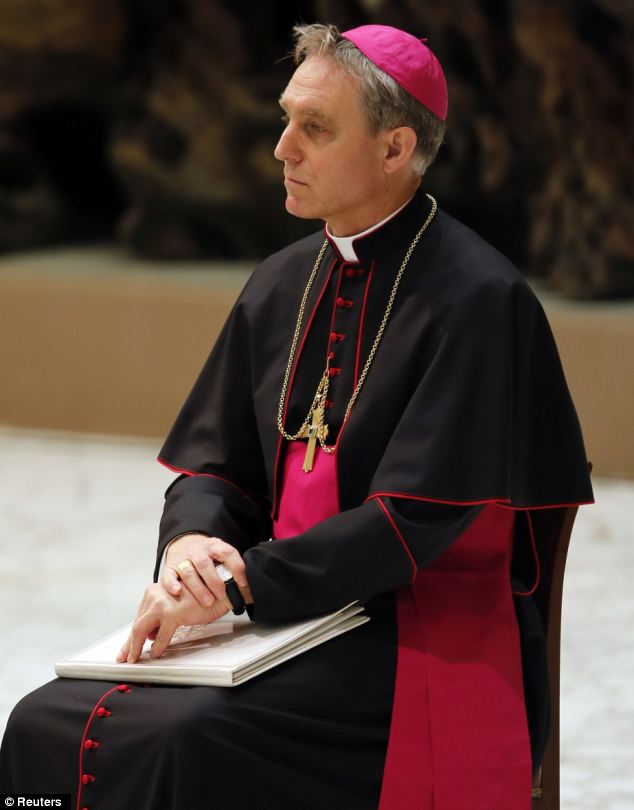
Pope Emeritus Benedict XVI had stayed at Castel Gandolfo since his retirement as reigning Pope of the Church on 28 February 2013, 2 months earlier. He will be staying in the former Mater Ecclesiae monastery which was originally a cloister for nuns, and now vacated to accomodate the Pope Emeritus and his assistants, which include the current Prefect of Papal Household, Archbishop Georg Ganswein, who is also Pope Emeritus Benedict XVI’s private secretary.

This will make the work better for Archbishop Ganswein as in his capacity as both the private secretary to the Pope Emeritus and the Prefect of Papal Household, he had to travel daily between the Vatican and Castel Gandolfo.

Image

(Above : Archbishop Georg Ganswein, current Prefect of the Papal Household and private secretary to Pope Emeritus Benedict XVI)

May God bless our dear Pope Emeritus, bless him with good health, that he will continue to pray for our Church, and that the reforms that he had begun in the liturgy, worship, and new evangelisation can continue to flourish and grow.

My personal thoughts on the election of Pope Francis I and the current state of the Church

I can only hope that Msgr. Guido Marini, the Master of Pontifical Liturgical Celebrations (Papal MC) can indeed stay where he is, as many uttered their concern whether he will still stay as papal MC given the apparent change in this new Pope.

As this is just the first day, I do not know much yet about the direction that our new Pope, Francis I, will bring us all, but I hope that he will not overemphasize inculturation and liberation for the sake of evangelisation, as what was once done under Archbishop Marini, the previous papal MC, but rather focus and renew the spirit of the liturgy as was done by Pope Emeritus Benedict XVI when he was Pope, with the help of Monsignor Marini as the chief liturgical reformer.

There is a need to balance between tradition and innovation, and not to tilt too far to the other side. Already these past few years we had seen a great rebound in the number of seminarians joining the seminary, and also the growing accustomisation among many people all over the world of the use of Latin in the Mass, despite of course emphasis remaining on the vernacular language.

Already, many apparently made comments (as I do) on his choice of not wearing the mozzetta and the stole upon making his first appearance, despite the proper winter papal mozzetta had been prepared for the new Pope. These are little things, but I hope this won’t be a precedent, which if not carefully handled, may undo many of the great things and reforms of the reform of Vatican II that had been painstakingly done in the past few years, and have begun to bear fruit in the Church today.

Balance is important. Already we have seen in many cases after Vatican II, churches and groups going too far towards innovation and liberal thoughts that ended up losing their very Catholic identity. What we need is to preserve our tradition, and yet remain open for innovations that can help new evangelisation, and evangelisation must also be carried in the spirit of the preservation of Apostolic teachings and traditions, and not conform to what the world think, that is relativism.

Social media like twitter, Facebook, blogs, and many others are these great innovations that can help spread the teachings of the Church, and yet let us not be like many Catholics, particularly in the USA, which had been commented as being ‘market Catholics’ where they pick and choose what they want to believe in, as long as it suits them, and reject those that they feel don’t fit with them. No, to be a Catholic means accepting the whole teaching as a whole, and not taking just those parts that you like, and discard the rest.

I need to add that going into extremes into the other direction is also abhorred, as what was made obvious by the SSPX Society, which continued to linger in their ultra-conservatism, and refused to take in several important modifications made by Vatican II.

Just some examples : We no longer blame Jews for the death of Christ, and instead they are our elder brothers in faith, having been chosen and called by God first among all nations.

Then, although indeed I firmly believe in salvation only through the One Church of Christ, but I also believe in the Universal Call to Holiness (by Blessed Pope John Paul II), and there are righteous people outside the Church, who do God’s will, but lacking only the necessary faith in Christ, but that doesn’t mean that they are immediately condemned to hell for that. It is our task to bring the Good News and salvation to them, which can be done through new evangelisation, rooted firmly in tradition and prayer.

However, one wish that I want to make is that, I hope Pope Francis I can thoroughly reform the Roman Curia, to purge from it all ties to corruptions and evil, and to purify our Holy Church that it will once again be immaculate and pure as it should always be, as the One, and only Church God had established in this world, through Peter the Apostle.

And I am touched by his selection of name, Francis, which honoured both St. Francis of Assisi, whom I held in high regard, and St. Francis Xavier, the great missionary and co-founder of the Jesuits (with St. Ignatius Loyola) whom Pope Francis I is a member of. St. Francis Xavier is close to my heart as he is also the patron saint of my early education, and which helped me to learn about the faith, and eventually welcomed into the Church.

I am also deeply touched by his humility, especially when he asked that the people pray for him, and even bowed down to show his humility, which does remind me to another Pope, John Paul I, whose motto is Humilitas, but as history went, he did not have the time to accomplish much. Therefore I hope, the legacy of Pope John Paul I can be continued in Pope Francis I, who had the same quality and personality as Pope John Paul I.

However, humility and simplicity must not lead to the simplification of our faith, but rather let these be tools to further deepen our ties to our faith, and understand more about it.

I noted that Pope Francis I is deeply devoted to the Virgin Mary, whose name is part of his personal name, Jorge Maria Bergoglio. He will be another Marian Pope in the likelihood of Blessed Pope John Paul II. It is important for us to have a strong devotion to the Virgin Mary, as she is the best helper that we can have, in guiding our way towards the Lord, and ensuring that we do not go astray from our path.

May God bless our new Pope Francis I, and at this important juncture at the beginning of the new Pontificate, I hope that the Holy Spirit that has elected him to carry this task, will also guide him, that he will make correct choices that will continue the good works that began with Blessed Pope John Paul II, and was accelerated by Pope Benedict XVI, now Pope Emeritus.