Today also marks the Papal Inauguration of the 266th and current Pope, Pope Francis
Romans 4 : 13, 16-18, 22
If God promised Abraham, or rather his descendants, that the world would belong to him, this was not because of his obeying the Law, but because he was just and a friend of God through faith.
For that reason, faith is the way and all is given by grace; and the promises of Abraham are fulfilled for all his descendants, not only for his children according to the Law, but also for all the others who have believed.
Abraham is the father of all of us, as it is written : “I will make you father of many nations.” He is your father in the eyes of Him who gives life to the dead, and calls into existence what does not yet exist, for this is the God in whom he believed.
Abraham believed and hoped against all expectation, thus becoming father of many nations, as he had been told : “See how many will be your descendants.” This was taken into account for him to attain righteousness.
“I thank the Lord that I can celebrate this Holy Mass for the inauguration of my Petrine ministry on the solemnity of Saint Joseph, the spouse of the Virgin Mary and the patron of the universal Church. It is a significant coincidence, and it is also the name-day of my venerable predecessor: we are close to him with our prayers, full of affection and gratitude.
I offer a warm greeting to my brother cardinals and bishops, the priests, deacons, men and women religious, and all the lay faithful. I thank the representatives of the other Churches and ecclesial Communities, as well as the representatives of the Jewish community and the other religious communities, for their presence. My cordial greetings go to the Heads of State and Government, the members of the official Delegations from many countries throughout the world, and the Diplomatic Corps.
In the Gospel we heard that “Joseph did as the angel of the Lord commanded him and took Mary as his wife” (Mt 1:24). These words already point to the mission which God entrusts to Joseph: he is to be the custos, the protector. The protector of whom? Of Mary and Jesus; but this protection is then extended to the Church, as Blessed John Paul II pointed out: “Just as Saint Joseph took loving care of Mary and gladly dedicated himself to Jesus Christ’s upbringing, he likewise watches over and protects Christ’s Mystical Body, the Church, of which the Virgin Mary is the exemplar and model” (Redemptoris Custos, 1).
How does Joseph exercise his role as protector? Discreetly, humbly and silently, but with an unfailing presence and utter fidelity, even when he finds it hard to understand. From the time of his betrothal to Mary until the finding of the twelve-year-old Jesus in the Temple of Jerusalem, he is there at every moment with loving care. As the spouse of Mary, he is at her side in good times and bad, on the journey to Bethlehem for the census and in the anxious and joyful hours when she gave birth; amid the drama of the flight into Egypt and during the frantic search for their child in the Temple; and later in the day-to-day life of the home of Nazareth, in the workshop where he taught his trade to Jesus.
How does Joseph respond to his calling to be the protector of Mary, Jesus and the Church? By being constantly attentive to God, open to the signs of God’s presence and receptive to God’s plans, and not simply to his own. This is what God asked of David, as we heard in the first reading. God does not want a house built by men, but faithfulness to his word, to his plan. It is God himself who builds the house, but from living stones sealed by his Spirit. Joseph is a “protector” because he is able to hear God’s voice and be guided by his will; and for this reason he is all the more sensitive to the persons entrusted to his safekeeping. He can look at things realistically, he is in touch with his surroundings, he can make truly wise decisions. In him, dear friends, we learn how to respond to God’s call, readily and willingly, but we also see the core of the Christian vocation, which is Christ! Let us protect Christ in our lives, so that we can protect others, so that we can protect creation!
The vocation of being a “protector”, however, is not just something involving us Christians alone; it also has a prior dimension which is simply human, involving everyone. It means protecting all creation, the beauty of the created world, as the Book of Genesis tells us and as Saint Francis of Assisi showed us. It means respecting each of God’s creatures and respecting the environment in which we live. It means protecting people, showing loving concern for each and every person, especially children, the elderly, those in need, who are often the last we think about. It means caring for one another in our families: husbands and wives first protect one another, and then, as parents, they care for their children, and children themselves, in time, protect their parents. It means building sincere friendships in which we protect one another in trust, respect, and goodness. In the end, everything has been entrusted to our protection, and all of us are responsible for it. Be protectors of God’s gifts!
Whenever human beings fail to live up to this responsibility, whenever we fail to care for creation and for our brothers and sisters, the way is opened to destruction and hearts are hardened. Tragically, in every period of history there are “Herods” who plot death, wreak havoc, and mar the countenance of men and women.
Please, I would like to ask all those who have positions of responsibility in economic, political and social life, and all men and women of goodwill: let us be “protectors” of creation, protectors of God’s plan inscribed in nature, protectors of one another and of the environment. Let us not allow omens of destruction and death to accompany the advance of this world! But to be “protectors”, we also have to keep watch over ourselves! Let us not forget that hatred, envy and pride defile our lives! Being protectors, then, also means keeping watch over our emotions, over our hearts, because they are the seat of good and evil intentions: intentions that build up and tear down! We must not be afraid of goodness or even tenderness!
Here I would add one more thing: caring, protecting, demands goodness, it calls for a certain tenderness. In the Gospels, Saint Joseph appears as a strong and courageous man, a working man, yet in his heart we see great tenderness, which is not the virtue of the weak but rather a sign of strength of spirit and a capacity for concern, for compassion, for genuine openness to others, for love. We must not be afraid of goodness, of tenderness!
Today, together with the feast of Saint Joseph, we are celebrating the beginning of the ministry of the new Bishop of Rome, the Successor of Peter, which also involves a certain power. Certainly, Jesus Christ conferred power upon Peter, but what sort of power was it? Jesus’ three questions to Peter about love are followed by three commands: feed my lambs, feed my sheep. Let us never forget that authentic power is service, and that the Pope too, when exercising power, must enter ever more fully into that service which has its radiant culmination on the Cross. He must be inspired by the lowly, concrete and faithful service which marked Saint Joseph and, like him, he must open his arms to protect all of God’s people and embrace with tender affection the whole of humanity, especially the poorest, the weakest, the least important, those whom Matthew lists in the final judgment on love: the hungry, the thirsty, the stranger, the naked, the sick and those in prison (cf. Mt 25:31-46). Only those who serve with love are able to protect!
In the second reading, Saint Paul speaks of Abraham, who, “hoping against hope, believed” (Rom 4:18). Hoping against hope! Today too, amid so much darkness, we need to see the light of hope and to be men and women who bring hope to others. To protect creation, to protect every man and every woman, to look upon them with tenderness and love, is to open up a horizon of hope; it is to let a shaft of light break through the heavy clouds; it is to bring the warmth of hope! For believers, for us Christians, like Abraham, like Saint Joseph, the hope that we bring is set against the horizon of God, which has opened up before us in Christ. It is a hope built on the rock which is God.
To protect Jesus with Mary, to protect the whole of creation, to protect each person, especially the poorest, to protect ourselves: this is a service that the Bishop of Rome is called to carry out, yet one to which all of us are called, so that the star of hope will shine brightly. Let us protect with love all that God has given us!
I implore the intercession of the Virgin Mary, Saint Joseph, Saints Peter and Paul, and Saint Francis, that the Holy Spirit may accompany my ministry, and I ask all of you to pray for me! Amen.”
God, the Lord of the Universe, who through Jesus Christ Your Son, has brought salvation upon this world. Hear me now I pray, with Your holy angels and holy saints as witness before Your Holy throne in Heaven.
I promise and offer my full and unconditional obedience on Franciscus, our Pope Francis, whom through the Holy Spirit You have inspired the Cardinals to elect, as the one to continue the mission of Peter, Your Apostle, upon whom You entrusted the keys to Your Kingdom, and upon whom You built Your very own Church, that is Your Most Precious Body, in union with all who believes in You, now led by Francis, as one indivisible union, the One, Holy, Catholic, and Apostolic Church.
I call upon the angels and the saints as witness on this promise, and I ask them too to pray for our Holy Father, that he will be strengthened in his new ministry, not just as the Bishop of Rome, but also the Successor of St. Peter, the Prince of the Apostles, as the leader of the Universal Church, all over the world.
May he be strengthened in faith, hope, and love, and exercise great charity as his namesake St. Francis of Assisi had done, and at the same time, profess to defend the Sacred Tradition of the Holy Apostles, and the orthodox Catholic faith, as it is, unchanging, since the beginning, now, and ever shall be, forever and ever! Amen!
On this Holy Gospel I make solemn my oath and promise, and I hope that not only that I will remain faithful to it, but also help our dear Holy Father, Pope Francis, in his mission to evangelise the Word of God to all corners of this world, through whatever means I can, including this humble blog of mine.
Ad multos annos, Papa Franciscus! Pontifex maximus et Beati Petri Apostolorum Principis succesori, Episcopus Romanus.
Tu es Petrus et super hanc petram aedificabo Ecclesiam meam, et portae inferi non praevalebunt adversus eam, et tibi dabo claves regni caelorum. Quodcumque ligaveris super terram, erit ligatum et in cælis, et quodcumque solveris super terram, erit solutum et in cælis.
(You are Peter, and on this Rock, I will build My Church, and the gates of hell will not prevail against It, and I will give you the keys of the kingdom of heaven. Whatever you bind on this earth, it will be bound in heaven, and whatever you loosen on this earth, it will be loosened in heaven).
+Peter Canisius Michael David Kang
(Ut Omnes Unum Sint, ad Maiorem Dei Gloriam – That they all may be One, for the greater glory of God)
Today, Tuesday, 19 March 2013, our new Pope will be solemnly inaugurated to begin his Pontificate. He is already our Pope, ever since he accepted the rightful election in the Conclave, but the Inauguration ceremony affirms and completes that process, with the imposition of the symbols of the authority of the Pope, as the leader of the entire Universal Church.
There will be some changes to the liturgy this year, as the imposition of the Pallium and the Ring of the Fisherman will take place just before the Mass starts, instead of being within the Mass itself, as the impositions are seen as more of an extra-liturgical event.
The Pope will pray with the leaders of the Eastern Catholic Churches, the Patriarchs and Major Archbishops at the Tomb of St. Peter underneath the main altar of St. Peter’s Basilica, where the pallium and the ring had been placed since the night before.
The Pope will then proceed with all the other concelebrating Cardinals and prelates outside to the Altar at St. Peter’s Square, which in the meanwhile the Laudes Regia hymn or ‘Laud to the King (Christ)’, that is a glorious rendition of the Litany of the Saints, with the new innovation of the inclusion of part asking the past Popes who had been canonised as saints for the new Pope, their successor, beginning from Pope St. Linus to Pope St. Pius X.
Following after this is the imposition of the papal pallium, which is different from the pallium worn by the Metropolitan Archbishops. Pope Francis’ pallium will be the same in appearance with that of Pope Benedict XVI’s pallium, with red crosses instead of black ones, representing the wounds of Christ, with three gold pins on three of the crosses, representing the nails that bound both hands and the legs of Christ onto the cross. The pallium symbolises the authority the Pope has over the entire Universal Church. The pallium will be imposed by the senior Cardinal of the order of Priest in the Cardinal-electorate, Cardinal Godfried Danneels.
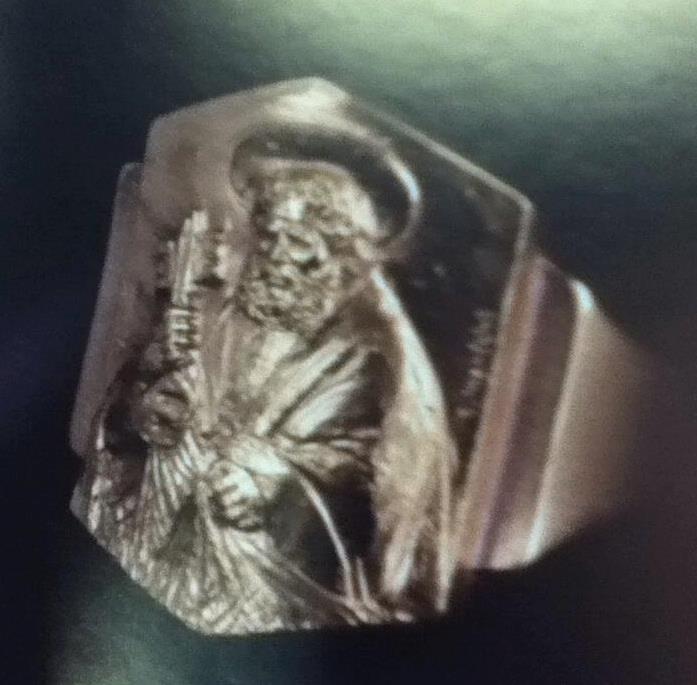
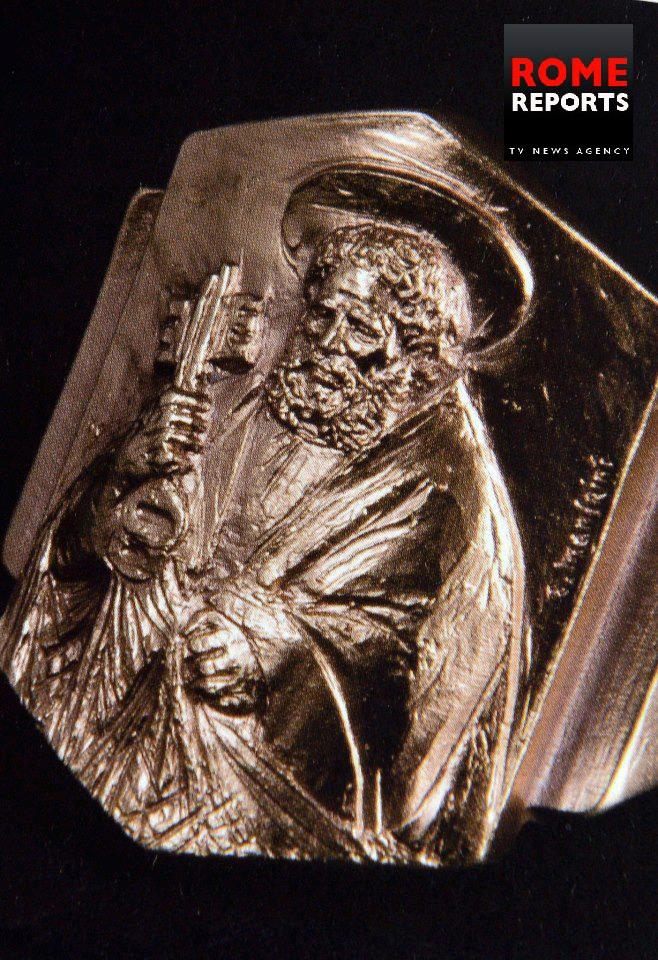
The Ring of the Fisherman will be given after this, which signifies the bond between the Pope and God’s Church, and as the image on the ring depicts, that of St. Peter holding the keys on a boat, while fishing, as a fisher of man, it symbolises the Pope’s role as the successor of St. Peter the Apostle, and also as the current holders of the keys of the kingdom of Heaven, entrusted by Christ to Peter. The ring will be presented to the Pope by the senior Cardinal Deacon, Cardinal Jean-Louis Tauran.
Six Cardinals representing the rest of the Cardinals will pay homage to the Pope, and will give their obedience to him, following the imposition of the pallium and the Ring of the Fisherman.
The Mass follows as usual, and the readings will be done in different languages, English, Spanish, and most notably the Gospel in Greek, to highlight the universal nature of the Church, encasing both the Western and Eastern tradition of Christendom. The whole liturgy of the Mass itself will be conducted in solemn Latin and beautiful Gregorian chants.
The booklet for the Mass is available at the link below, in English, Italian, and Latin :
Here is a summary of Pope Francis’ schedule between his Papal Inauguration on Tuesday, 19 March 2013, to the beginning of the Holy Week on Palm Sunday, 24 March 2013 :
1. Tuesday, 19 March 2013 at 9.30 am Rome time : Papal Inauguration Mass at St. Peter’s Square, estimated to be attended by more than 1 million people from all over the world, and many foreign dignitaries, heads of states, and leaders. Mark the full beginning of Pope Francis’ Pontificate with a solemn inauguration with the imposition of both the pallium and the Ring of the Fisherman. First to be attended by the Ecumenical Patriarch of Constantinople, currently Bartholomew I, since the Great Schism in 1054.
2. Wednesday, 20 March 2013 : Reception of the delegations from different Christian churches and representatives at Clementine Hall (Sala Clementina). No General Audience will be held on this day.
3. Friday, 22 March 2013 : Reception of accredited diplomatic representatives to the Holy See in the Regia Hall (Sala Regia).
4. Saturday, 23 March 2013 : Meeting with his predecessor, Pope Emeritus Benedict XVI, at Castel Gandolfo, where the Pope Emeritus is residing.
5. Sunday, 24 March 2013 at 9.30 am Rome time : Palm Sunday Mass at St. Peter’s Square, beginning the Holy Week celebrations.
Pope Francis’ Ring of the Fisherman, which is one of the symbol of the authority as the Pope, as both a bishop (episcopal ring) and the Successor of St. Peter the Apostle, leader of the entire Universal Church. It will be given to Pope Francis at the celebration of the Papal Inauguration Mass, on the Feast of St. Joseph, Tuesday, 19 March 2013, together with another symbol, that is the pallium.
The ring’s image closely follow that of Pope Benedict XVI’s Ring of the Fisherman, with slight difference in the shape of the ring, and the ring being made of gold-plated silver instead of gold. Depicted on the ring is the image of St. Peter holding onto the keys of the kingdom of heaven, and fishing, as he was a fisherman, but called by God to be a ‘fisher of man’.
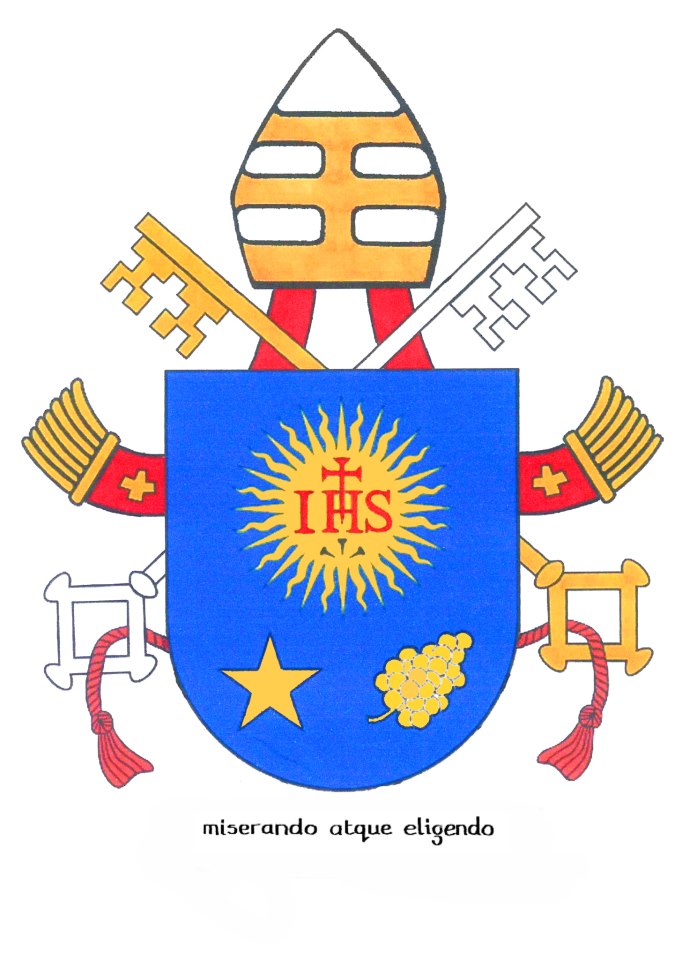
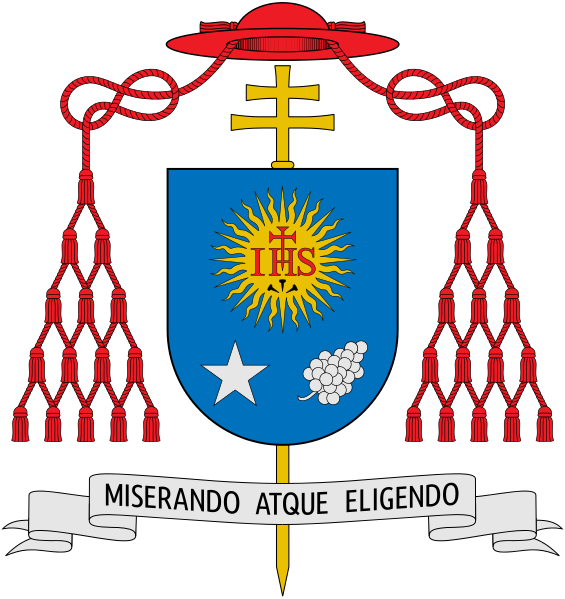
The official coat-of-arms of Pope Francis, which followed closely the model established by Pope Benedict XVI, in placing the ‘three-tiered’ ‘papal mitre’ instead of the papal tiara, and following the same shield model as that of his Cardinalate and episcopal coat-of-arms, but with altered colours for the star and the grapes, from silver to gold.
Pope Francis used his episcopal motto “Miserando atque Eligendo” which means “Lowly but chosen” in English, in line with his views and outlook on humility.
The Cardinal’s fifteen red tassels and the galero on top of it, is replaced by the papal arms standard including the three-tiered papal mitre and the crossed keys of the kingdom of heaven (silver and gold).
The symbols that appeared on the shield are first, the IHS symbol surrounded with a sun-like ray is the symbol of the Jesuit order (S.J.) of which Pope Francis is a member of, and the star on the bottom-left, in conjunction with the blue colouration of the shield represents the Virgin Mary, and the grape on the bottom right represents Jesus Christ, as the grower of the vineyard of the Lord.
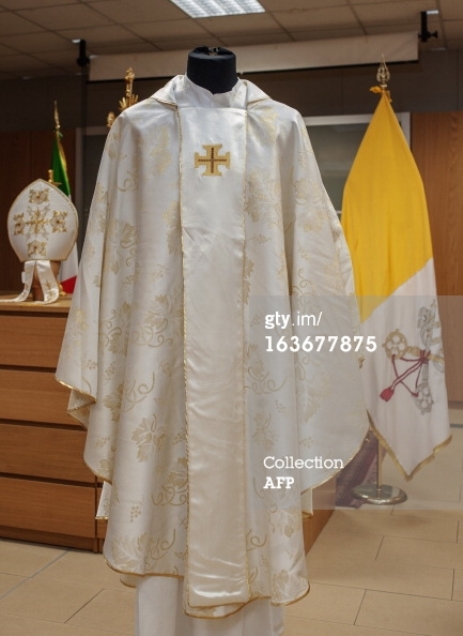
The vestments above is the vestment that Pope Francis will wear at the Papal Inauguration Mass in St. Peter’s Square, on the Feast of St. Joseph, Tuesday, 19 March 2013 at 9.30 am Rome time.
The vestments are decent and not over-simplistic, but neither overbearing, while maintaining the beauty of the vesture, which will make the liturgy of the Mass more beautiful and bring people closer to God.
(Update : It seems that Pope Francis chose to wear his personal mitre and the matching vestments that comes with his mitre (as bishop))
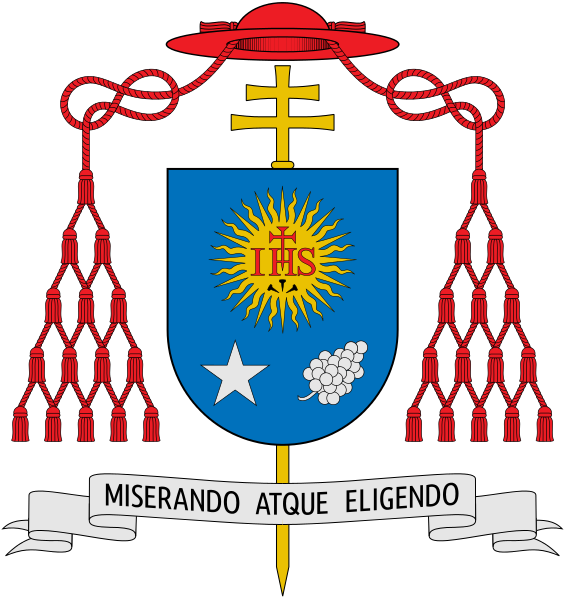
This is the coat of arms of Cardinal Jorge Maria Bergoglio, S.J., Metropolitan Archbishop of Buenos Aires, Argentina, who was elected as the 266th Pope and Bishop of Rome last Wednesday, 13 March 2013 and chosen the name Pope Francis.
Pope Francis used his episcopal motto “Miserando atque Eligendo” which means “Lowly but chosen” in English, in line with his views and outlook on humility.
The Cardinal’s fifteen red tassels and the galero on top of it will be replaced by the papal arms standard including the papal tiara/mitre and the crossed keys of the kingdom of heaven (silver and gold).
The symbols that appeared on the shield are first, the IHS symbol surrounded with a sun-like ray is the symbol of the Jesuit order (S.J.) of which Pope Francis is a member of, and the star on the bottom-left, in conjunction with the blue colouration of the shield represents the Virgin Mary, and the grape on the bottom right represents Jesus Christ, as the grower of the vineyard of the Lord.
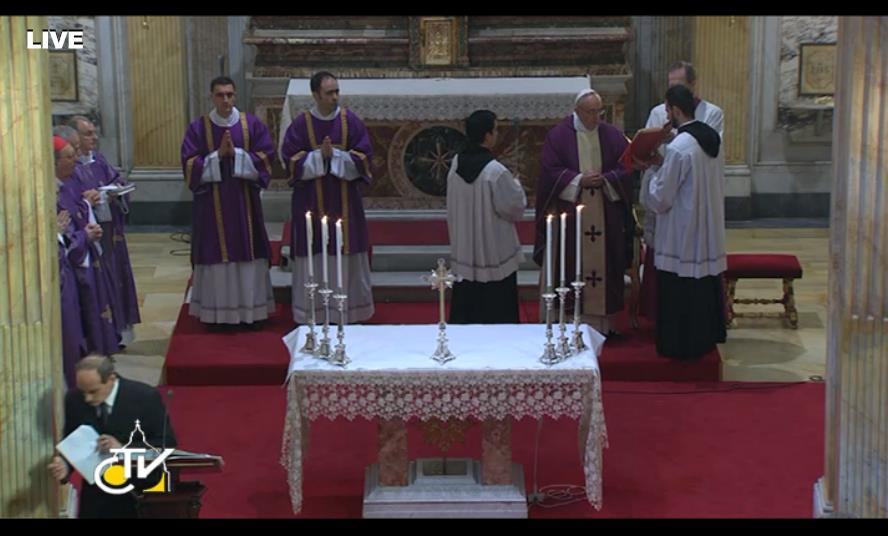
Pope Francis visited his first parish in the Diocese of Rome today, Sunday morning, 17 March 2013 and celebrated Mass there (there are more than 300 parishes in the Diocese of Rome).
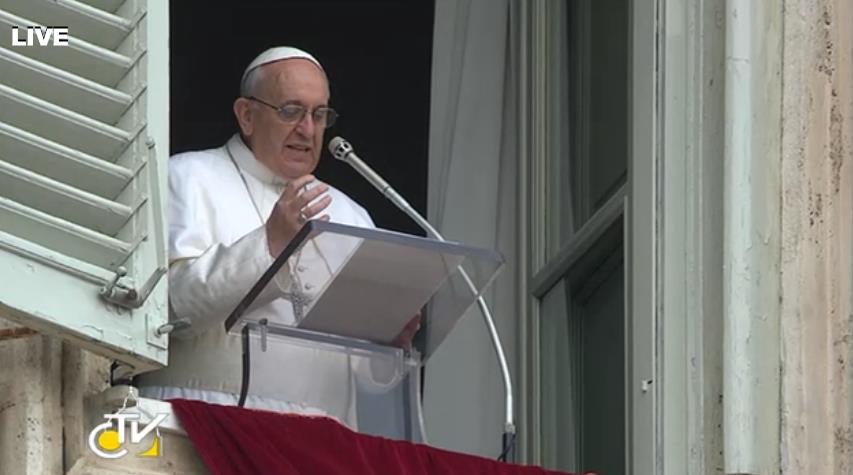
At noon, he returned to the Papal Apartments at the Vatican to deliver his very first Sunday Angelus to thousands gathered in St. Peter’s Square.

 petercanisiusmichaeldavidkang