Tuesday, 16 September 2014 : 24th Week of Ordinary Time, Memorial of Pope St. Cornelius, Pope and Martyr, and St. Cyprian, Bishop and Martyr (Homily and Scripture Reflections)

Liturgical Colour : Red

Dear brothers and sisters in Christ, today we heard about how Jesus healed the son of a widow from Naim, bringing him back from death into life, in which He showed to the people, the loving and merciful aspects of God, who truly loved and cared for all of us. He had pity on the mother who was sorrowful for having been left alone by her son, and brought them back into true joy and happiness in God.

And in the first reading, in the letter written by St. Paul to the Church and the faithful in Corinth, about the nature of the Church of God, and how in the Church, which is in fact comprised of all of us who believe in Christ the Lord, there exist a certain hierarchy of its members, which allow the Church to function as a body, just as in our body we have various organs and parts that have distinct functions working together in order to achieve certain goals and actions.

St. Paul mentioned how each members and each people in the Church have their own distinct gifts from the Lord, also known as the gifts of the Holy Spirit, which the Apostles and disciples themselves had received during the occasion of the Pentecost day. Everyone had been called by the Lord for a specific purpose and task, and one ought not to think proudly of himself or herself so as to assume that they can gain for themselves the entirety of the goodness and the gifts of the Lord.

Thus, the Church of God, which is centred on our Lord Jesus Christ, the Head of the Church, and we as the members of His Body, has a specific task in order to carry out and continue the good works which Jesus had initiated in this world, that is the works of love and mercy, as He showed through the rising of the son of the widow of Naim from the dead.

The Church of God comprised of many different people, and indeed, different groups of people, from the laity to the ordained ministers, that is the sacred priesthood and those who dedicated their lives in the service of God, and everyone else, including those of us who belong to the group of those who serve the Lord and yet also still live in this world.

And even among the priesthood, we have various roles, such as the bishops and then the priests themselves. Bishops are those who have been given a greater role in the Church, as overseers of a group of priests and the laity, and they are entrusted with the sheep of the Lord’s flock, as the shepherds, who are then led by the chief shepherds on earth, that is the Pope, the Bishop of Rome and the Vicar of Christ in this world, the representation of the Chief Shepherd of all, Jesus Christ.

The bishops therefore lead the Church in the works of love and mercy, and are also entrusted with the supervision duty of the body of the faithful in the Church, and they are also entrusted with the management of the Church. That said, there are also many others who are also involved in the management of the Church, both among the laity, as well as those in the priesthood and the ordained ministry.

The priests serve the people of God in various means, that is by providing them a spiritual guidance and protection against the harms of the devil, and in some cases also by providing alms and charity works for them. Then, the deacons, as we heard in the New Testament, were appointed as those who would serve the people of God directly, aid in the works of charity of the Church, to aid the priests and the bishops, so that they can channel to the people of God, particularly the poorest and the weakest, the love of God through His Church.

Yet, it is sad indeed, that many today in the Church aspire to have everything in their greed and lack of faith. Many began to question their roles in the Church and some even fought in the name of what they described as equality. Therefore we have those who proposed such outrageous ideas such as the abolition of the sacred priesthood and the ordained ministry, as well as the ordination of women to the priesthood.

Those who proposed and supported such proposals failed to understand that each of us in the Church have our own unique roles which help to supplement each other and therefore, it makes the Church stronger. To go against this natural law of order would in fact mean to destroy the unity and strength of the holy Church of God and undermine its authority in this world. Every one has been given a specific and particular gift which enables us to have our own roles in the Church to carry out what the Lord had planned for us.

Brothers and sisters, today we celebrate together as the Church the feast day of two great saints, whose life will inspire us to appreciate the beauty of the order and hierarchy in the Church, namely that of Pope St. Cornelius and St. Cyprian, both holy martyrs of the faith, at the time of the persecutions of the Roman Empire.

Pope St. Cornelius was the Pope and the Vicar of Christ in the middle of the third century after the birth of Christ, during the reign of the Emperor Decius, the great persecutor of the faithful. Then St. Cyprian was his contemporary, as the Bishop of Carthage and the supporter of Pope St. Cornelius’ view regarding the faithful.

The two saints lived in a difficult time, when Christians and all who believed in the Lord were persecuted heavily and when their very lives were threatened by the Roman authorities. And amidst those persecutions, there were those among the faithful who submitted to the will of the state and the Emperor, and gave offering to the pagan idols, essentially an act of apostasy, or leaving the Church of God, who should be thereafter be treated the same as the pagans.

However, some of them repented their sins and returned to the embrace of the Holy Mother Church, and were received back among the faithful as long as they were sincere in their repentance. But, there were those in the Church who were opposed to the return of these so called traitors and apostates and demanded much stricter regulations to even allow them to be readmitted into the Church.

St. Cyprian and Pope St. Cornelius were the champions of those in the Church who would allow the faithful who had gone astray to return to the Church as long as their repentance was sincere. They worked hard among the faithful and among those who had gone astray to bring them back towards the Lord and to heal them from the afflictions of their souls. The laity themselves also played their own parts and supported the works of their shepherds, while they also kept their faith alive and strong despite even great persecutions.

Brothers and sisters in Christ, these saints, Pope St. Cornelius and St. Cyprian, who were both eventually martyred for their faith, had showed us the model of their faith, which showed love and mercy for the least of the society, those who were rejected because of the stigma of their status as apostates and betrayer of their faith. They showed that while in the Church itself there were already many different groups of people, there would always be a space for those who realised their errors and repented for their sins.

Let us all therefore reflect on the Scripture readings of this day, and grow to find in our hearts, the role that we can play as part of the Church of God. Let us all work together to continue the good works of Christ, to bring God’s love to all the peoples, and to heal many from their afflictions, both physical, and even more importantly, to heal the spiritual aspects of many people.

May Almighty God, together with the intercession of the holy saints, Pope St. Cornelius and St. Cyprian, bless us this day and guide us, so that we may also follow in their footsteps, to serve the people of God and love one another in the Lord. God bless us all and bring us into His light. Amen.
Tuesday, 16 September 2014 : 24th Week of Ordinary Time, Memorial of Pope St. Cornelius, Pope and Martyr, and St. Cyprian, Bishop and Martyr (Gospel Reading)

Liturgical Colour : Red

Luke 7 : 11-17

A little later Jesus went to a town called Naim. He was accompanied by His disciples and a great number of people. As He reached the gate of the town, a dead man was being carried out. He was the only son of his mother, and she was a widow; there followed a large crowd of townspeople.

On seeing her, the Lord had pity on her and said, “Do not cry.” Then He came up and touched the stretcher, and the men who carried it stopped. Jesus then said, “Young man, I say to you, wake up!” And the dead man sat up and began to speak, and Jesus gave him to his mother.

A holy fear came over them all, and they praised God saying, “A great Prophet has appeared among us; God, has visited His people.” This news spread throughout Judea and the surrounding places.

Tuesday, 16 September 2014 : 24th Week of Ordinary Time, Memorial of Pope St. Cornelius, Pope and Martyr, and St. Cyprian, Bishop and Martyr (Psalm)

Liturgical Colour : Red

Psalm 99 : 2, 3, 4, 5

Serve the Lord with gladness; come before Him with joyful songs.

Know that the Lord is God; He created us and we are His people, the sheep of His fold.

Enter His gates with thanksgiving, His courts with praise. Give thanks to Him and bless His Name.

For the Lord is good; His love lasts forever and His faithfulness through all generations.

Tuesday, 16 September 2014 : 24th Week of Ordinary Time, Memorial of Pope St. Cornelius, Pope and Martyr, and St. Cyprian, Bishop and Martyr (First Reading)

Liturgical Colour : Red

1 Corinthians 12 : 12-14, 27-31a

As the body is one, having many members, and all the members, while being many, form one body, so it is with Christ. All of us, whether Jews or Greeks, slaves or free, have been baptised in one Spirit to form one body and all of us have been given to drink from the one Spirit.

The body has not just one member, but many. Now, you are the Body of Christ and each of you individually is a member of it. So God has appointed us in the Church. First Apostles, second prophets, third teachers. Then come miracles, then the gift of healing, material help, administration in the Church and the gift of tongues.

Are all Apostles? Are all prophets? Are all teachers? Can all perform miracles, or cure the sick, or speak in tongues, or explain what was said in tongues? Be that as it may, set your hearts on the most precious gifts.

Tuesday, 29 April 2014 : 2nd Week of Easter, Memorial of St. Catherine of Siena, Virgin and Doctor of the Church (Scripture Reflections)

Liturgical Colour : White

Share your goods with one another, be with those among you who are lonely, sick, in trouble, or downtrodden, and comfort one another. Assure them that Christ is with them, through your actions. That is the essence of the lives of the early Christian communities, where the earliest converts to the cause of the Lord lived together in perfect harmony and in accordance to the will of God.

In doing what they had done, these predecessors of our faith has eliminated the temptations of this world, in the temptations of money, wealth and power, so that their lives might be completely dedicated to the cause of the Lord, as they had shown in how they lived and treated one another as brothers and sisters, children of the same God.

In essence, what these disciples of Christ had done is true communism and socialism, unlike what had been attempted by those we know as the communists and socialists of our days. They failed miserably, because they lacked God in their system, and they were unable to prevent human desire and intentions from interfering in their attempt to achieve true communism as the disciples of Christ had done.

This of course does not mean that what we have today is bad, or systems like capitalism is bad. It is unbridled capitalism, the desires and hunger for money and more money that is harmful, for it leads us to disregard for our fellow brethren especially those who are in need, and we are in the position where we are able to help them.

In reality of this world, what has been known as communism and socialism is nothing better than the tyranny of the minority and the powerful, that is in the name of championing equality and common good, certain people had taken advantage of the situation and ended up benefitting from what they had done. And these people are those in the positions of power, that is those who have the greatest access to many resources shared by the people, and ended up embezzling them for their own benefits and to the suffering of the people.

Greed, jealousy, fear, dishonesty, and many other vices we know well off are the many problems that mankind commonly face, and these are the main cause behind the problems that prevented the true implementation of common good for all mankind as the early Christian communities had done. That was why so many of the so-called communist and socialist states had failed miserably in achieving their aims, and instead became places where people suffer greatly.

On the other hand, however, we should also not take whatever is in the Scriptures literally. It does not mean that because the early Christian communities had lived as they did, sharing their goods with one another and selling their possessions to be shared, then we too must do the same. Indeed, in this era, in our world today, doing so would merely do more harm than good and it will also hinder us from having the opportunity to help those who are less fortunate.

Having possessions is in fact a great opportunity for us to give help to those who are in need. These possessions can be shared and yet we still have enough for ourselves. Remember that we should not impoverish ourselves to help others, as in fact this may hinder our ability to help them in the long run. What is the most important is that we have the heart for sharing, that is the heart to love another and the giving of ourselves to those who are in need.

It is the attitude that is important for us all, that we open our hearts to God and allow His love to fill us, and from us to the people around us, our brethren. We have to share this love and through the graces that God has given us, some of us have more and some have less, we should share it genuinely and sincerely, without coercion, unlike what those communist states had tried to do, and as what they are doing now in places like North Korea.

Today, we celebrate the feast of St. Catherine of Siena, a renowned saint, religious and mystic well-known for her deep faith in God, her holiness and her visions of the Lord. St. Catherine of Siena and her numerous works and writings are essential for the growth of faith in many of those who read them, and she also inspired countless others who followed in her footsteps, with some becoming saints eventually, like her.

St. Catherine of Siena desired that her life be one that is completely on tune with God in complete and total dedication, to the point of even declaring her perpetual dedication to Christ as His spouse. St. Catherine of Siena led a very holy and dedicated life, in deep prayers and fasting, which is often at odds with the society at the time, even clashing with her own family and their desires and plans for her.

St. Catherine of Siena threw far away her pride and human desires, seeking instead the solace and happiness that she could find in God alone, and she was among those called to be the instruments of God’s favour and love for mankind. Through her visions and works, she brought forth numerous writings that exemplified the excellence of her faith, that it shone out of her persona, and in her writings, God made His presence in this world known.

The holiness of St. Catherine of Siena and her dedication to the Lord, which at one point even brought her to be the one to convince the Pope to return to Rome to end the terrible and bitter schism which had divided the Church at that time, is our inspiration, and should indeed empower us to follow her footsteps and become more and more like her in our deeds and actions.

May the Lord continue to guide us in our lives, that we may dispel the superficial and the lies of Satan, and instead seek the truth in God as St. Catherine of Siena had once done. May God be with us, that we may be more and more like Him and when the time comes, may we all be found worthy of life everlasting. God bless us all. Amen.

Tuesday, 13 August 2013 : 19th Week of Ordinary Time, Memorial of Saints Pontian, Pope and Martyr, and Hippolytus, Priest and Martyr (Scripture Reflection)

Liturgical Colour : Green or Red (Martyrs)

Dear brothers and sisters in Christ, the Lord our God is a loving and merciful God, who is quick to forgive and slow to anger. He cares deeply for all of His children that is all of us. He gave His all to save His lost ones, likened by Christ Himself as the shepherd who went out to seek for the one lost sheep. Yes, brethren, so great is God’s love for all of us, that He was willing to come down to us, as a man, to be one of us, that He may save us all through His great sacrifice, a sacrifice for all our sins and our unworthiness.

The good shepherd gives his life for his sheep and is willing to die in exchange for the life of his sheep. That was exactly what Christ had done for the sake of us all, that is to die on the cross for us, to give up His life, that we may have life in us, through Him and through His action in His saving Passion. In order to look for us, the lost sheep, He was willing to go through painful suffering and rejection, so that He may find us, and not just find us, but also gather all of us, and return us into His most loving embrace.

We have been lost ever since our ancestors disobeyed the will of God and forsook His love, preferring the devil and the pleasures of this world instead of the love of our God. If our God does not love us or care for us, then He could have easily blasted us into oblivion, erasing us from existence. Remember, He is the Almighty God, who is all-powerful and almighty, and He is the God who created the universe. Just as easily as He created us, He can as easily erase us from creation, and therefore eliminate the evils present within us.

Yes, we have been dirtied by the evils within us, and the evils of this world, that we are unworthy for the Lord who is all good and perfect. Yet, He troubled Himself and went all the way, even to incarnate Himself as one of us, through the Blessed Virgin Mary, that He became one of us, sharing our sufferings, sharing our troubles and pains, even though He certainly was not obliged to do that. He was truly like a shepherd who shared the sufferings and experiences of his sheep, be it in the sun or in the rain, in safe times or in times of danger, when wolves are threatening to eat the sheep the shepherd is guarding.

Our loving God protects us from harm and shield us from pitfalls and from our enemies. That was evident in His great providence to His people, Israel. He blessed them, smote their enemies, and gave them food to eat and drinks to satiate their thirst. He brought them through the desert into the land He promised all of them. In His love and kindness, He had poured His love to His people, and protected them as He always had. Yet, the people lacked gratitude, and they made complaints after complaints against the Lord, chiding that He had not done enough good for them.

God kept His patience and continued without end to provide help to His people, by sending them His prophets and messengers. The people hardened their hearts and they rejected God’s messengers, casting them out of their cities and even killed them in cold blood. The Lord thundered His wrath on the rebellious ones and casted them out of His presence, but He kept on hoping in us mankind, that we will find our way back to Him our Father and our Good Shepherd.

To this end He sent us a great new hope, in Jesus Christ, part of the Most Holy Trinity, who became our connector to the Lord our Father, as the bridge that bridged the uncrossable and infinite chasm created as a result of our rebellion against God and His love. Christ is that shepherd who went out of his way to look for the lost sheep, and when the lost ones are found, great rejoicing happens, to the shepherd and the whole flock of the sheep, because the lost ones are no longer lost, but reunited as one once again, with the saved ones.

We have been saved, brothers and sisters in Christ, because we have believed in Jesus our Lord and Saviour, and accepting His offer to salvation, which He granted freely to all who trust in Him and all who put their faith in Him. We have been saved because we have been joined to that One Body of Christ that is the Church, the One and only Church that God had established, to be the united body of His faithful ones, that is the flock of the Lord’s sheep. We have been baptised in the Name of the Most Holy Trinity, and we have been taken away from this world and its evils, and brought together with other faithful ones, into the One, Holy, Catholic, and Apostolic Church, out of which there is no salvation.

Today, brethren, we commemorate the feast of two great saints and martyrs of the early Church, namely Pope St. Pontian or St. Ponziano, Bishop of Rome and successor of St. Peter the Apostle as the Vicar of Christ, and St. Hippolytus, a priest of the Church of God, also known as St. Hippolytus of Rome. Pope St. Pontian lived through the turbulent times of the third century Rome, when the Roman Empire went through a series of military and political upheavals. Pope St. Pontian initially led the Church in a relatively peaceful state, but soon faced a tough persecution of the faithful when a new Emperor came into power and began to persecute Christians once again.

St. Hippolytus lived in the same era, a contemporary of Pope St. Pontian, and in fact they clashed over certain issues during the time prior to their martyrdom. They were bitter rivals, and their rivalry even threatened to split the Church under factions led by each of them respectively. However, over time, they reconciled their differences, and worked together to bring back the lost sheep of the Lord caused by the divisions in the Church and among the faithful. Both St. Hippolytus and Pope St. Pontian were captured and exiled together by the Emperor who persecuted Christians harshly.

Eventually both of them met their end in death, in sacred martyrdom, in the defense of their faith, and in their courageous and vibrant love, which they showed to their fellow men, the flock of the Lord that they have been appointed as shepherds for. They did not fear death, because the Lord who had conquered death through His own death on the cross, has been triumphant, and death will not have the last word. Through their actions and deeds, many of the lost sheep of the Lord, and those who have yet to hear the Lord’s word were inspired to seek the Lord and find His truth, bringing to them the salvation of our Lord.

Brothers and sisters in Christ, even though both Pope St. Pontian and St. Hippolytus had died a long time ago, but the spirit of their hearts and their works are still evident even until today. They have inspired all of us to also be shepherds for one another, to take care for one another, dissolving the differences between us, and seeking for what unites rather than what divides.

Let us seek our God the Good Shepherd, and if we are lost, let us find He who looks for us day and night. Let us not to forget to ask the assistance and help from His faithful servants, the saints, Pope St. Pontian and St. Hippolytus, all the other saints and martyrs, and the holy angels of the Lord. Last but not least, let us also seek the help of the greatest saint of all, the mother of our Lord, the Blessed Virgin Mary. Let us continue to walk in the path of the Lord, and not to be led astray by the temptations of evil, that we will be reunited by the Lord our God in complete and eternal happiness. God bless us all. Amen.

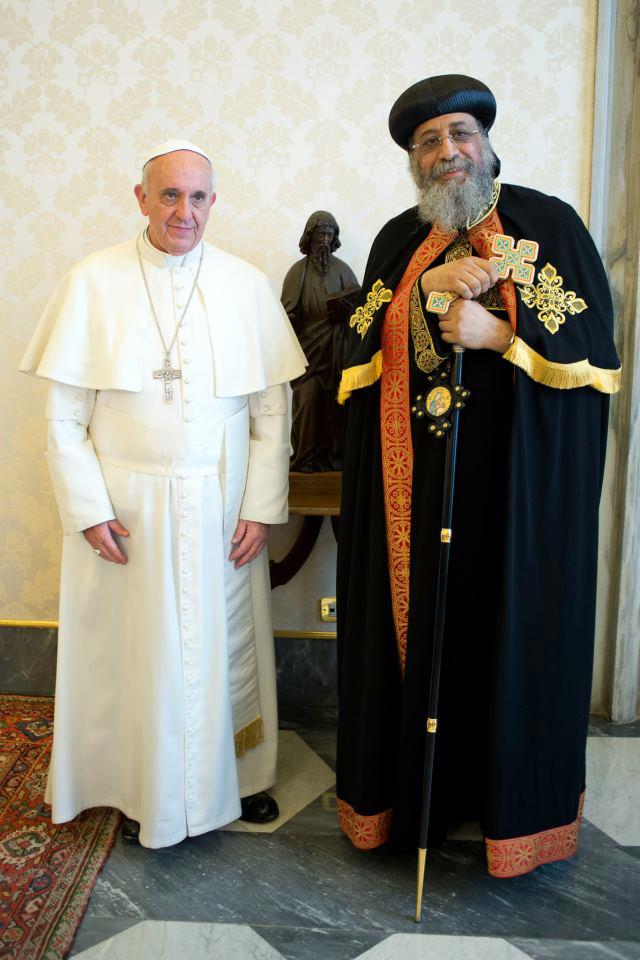
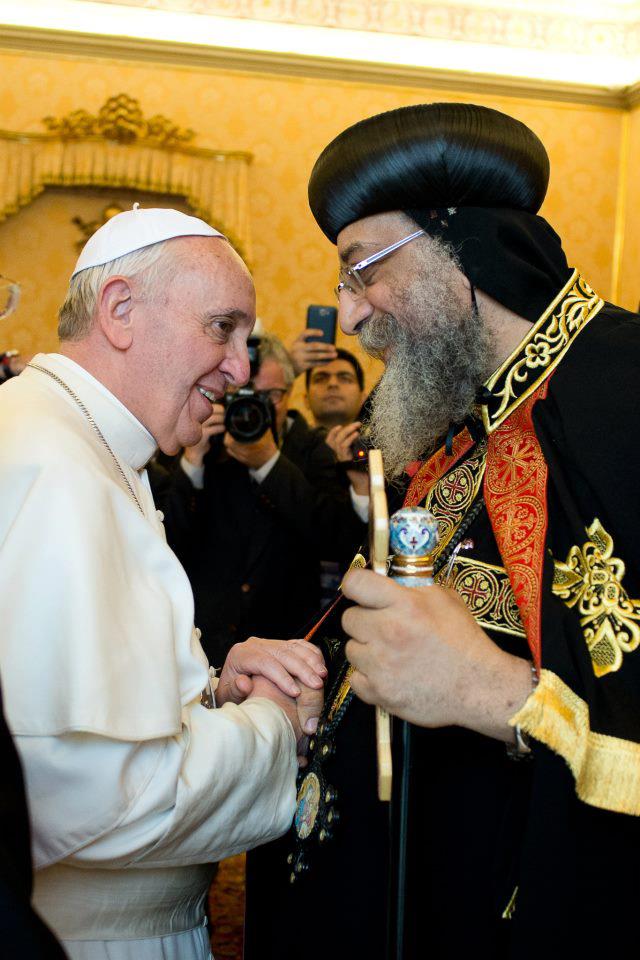
Historic visit by Pope and Patriarch of Alexandria, Pope Tawadros II to the Pope of the Church, Pope Francis

Image

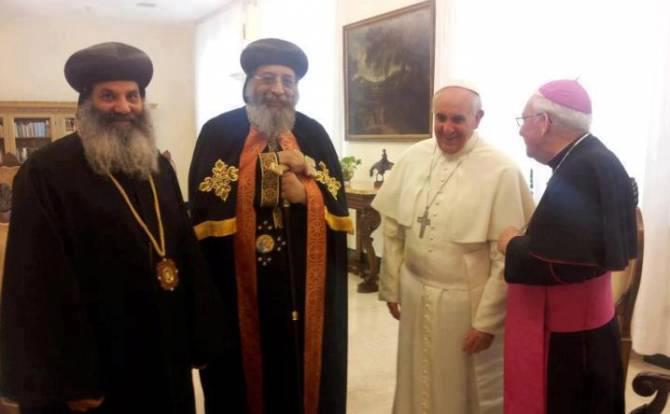
Pope Tawadros II (Theodore II) of Alexandria, the head of the Coptic Church, Successor of St. Mark the Evangelist, first Bishop of Alexandria, is visiting Rome to pay a visit to the Pope and Supreme leader of the Universal Church and Successor of St. Peter the Prince of the Apostles, Pope Francis.

Image

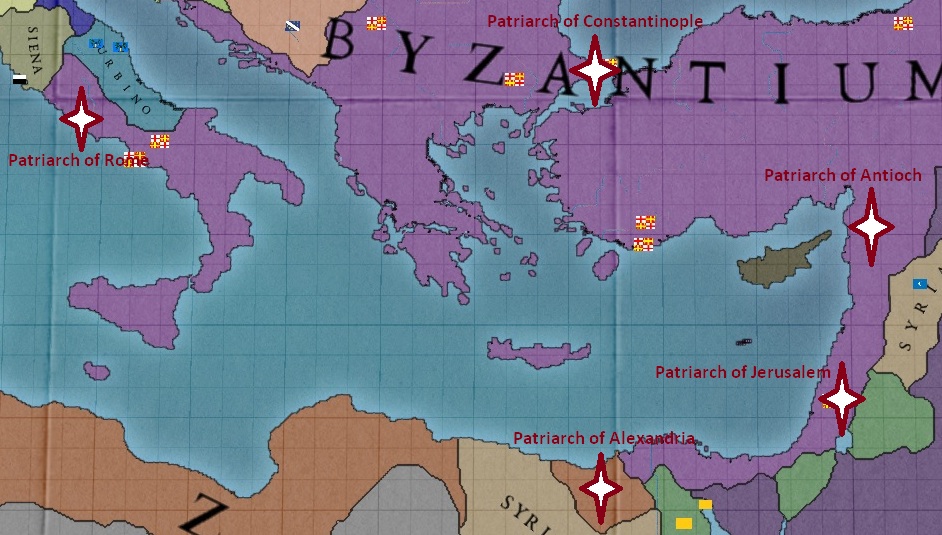
The Coptic Church is the direct descendant of the Patriarchate of Alexandria of the early Christian Pentarchy (Rome, Constantinople, Alexandria, Antioch, and Jerusalem), which broke apart from Rome and the Universal Church due to the disagreement in the Council of Chalcedon of 451, on the true nature of Christ.

Image

This disagreement is more due to misunderstanding in the nature of God, whether Christ’s human and divine persona is distinct or mixed. The initial term for non-Chalcedonians is monophysites, which is a heresy stating that both persona are mixed and indistinguishable. In fact, the Coptics and the other non-Chalcedonians in fact adopt miaphysitism, which while distinguishing the human and divine nature of Christ, but also acknowledge the mystery of the relationship between the two persona.

Image

Pope Tawadros II visits Rome in conjunction with the historic first meeting between the two Popes of Rome and Alexandria in 1973 by Pope Shenouda III, Pope Tawadros II’s predecessor, and Pope Paul VI. During that meeting a historic joint declaration of faith and friendship was announced and declared between the two Churches of God.

Image

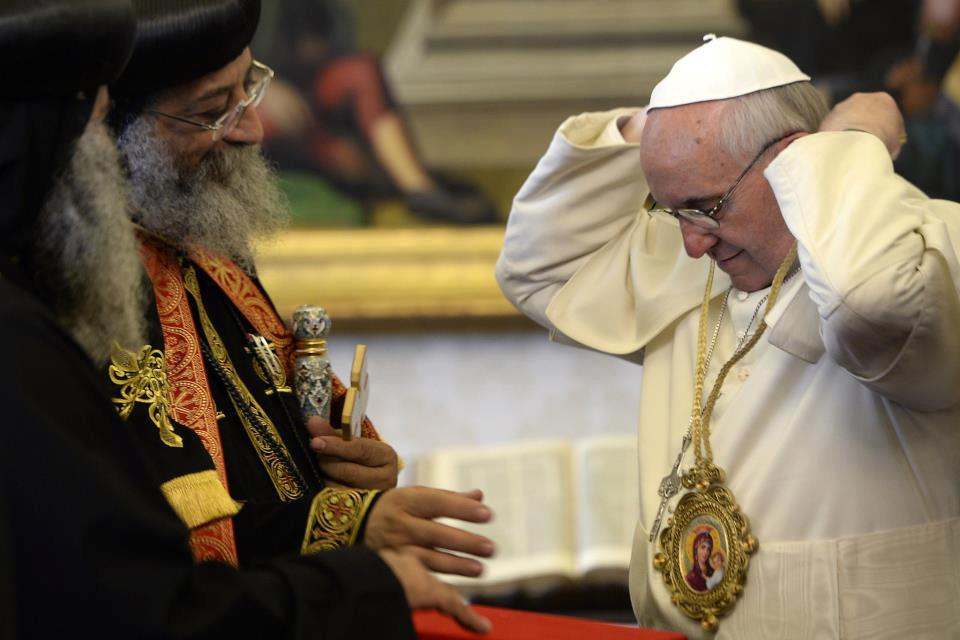
Pope Francis received a gift of an engolpion, which is a form of imagery in medallion, which is worn in the same way as pectoral cross, which are worn by the bishops of the Eastern Rite.

Image

We hope that all Christians, with the Copts and the Orthodox Churches can be reunited once again with the true and only Church, that is the Church of God, as one Body, indivisible by men and worldly ambitions, in the One, Holy, Roman, Catholic, and Apostolic Church.


Pray always for Christian Unity. That we are One, just as Christ our Lord and the Father in heaven are One.


Ut Omnes Unum Sint, ad Maiorem Dei Gloriam

(That they all may be One, for the greater glory of God)