Wednesday, 2 October 2013 : 26th Week of Ordinary Time, Memorial of the Holy Guardian Angels (Scripture Reflections)

Liturgical Colour : White

Dear brothers and sisters in Christ, today we celebrate the feast of the Holy Guardian Angels, or in short our Guardian Angels, who care for us, watch us in our daily lives and intercede for our sake before the Lord, especially when we are lost in darkness, and when we are being pulled apart by the forces of the darkness.

The Lord had not left us all in this world empty-handed and without guidance. Just as He gave us His helpers through His disciples, who passed down their authority to our priests and bishops, who minister to us, He had also sent even His angels to each one of us, to be our protector, companion, and guide. That is what the meaning of the Guardian Angels is about.

An angel created by the Lord had rebelled against Him in his pride, in his arrogance. That is Lucifer, now known as Satan. Once the most brilliant and the mightiest of the angels, he had been thrown down and fell so low that he is the most disgusting of all creations, as the great Enemy, the deceiver. And with him, came down many angels who followed him into his rebellion against God. These are the fallen angels.

Satan and his fallen angels were certainly not pleased of their failed rebellion and were committed to destroy the ones that God loves, that is His creation, particularly in mankind. He came down as the snake at the gardens of Eden, to deceive Eve and Adam, our ancestors. He successfully did so, and mankind fell into sin.

God certainly did not remain silent, but He sent His help over the generations through the prophets and messengers to help bring His beloved creations back to Him, by shunning their lives of sin and embrace instead the love of God. But mankind is easily tempted, by the allures of the pleasures that are in the world, and by the temptations of Satan himself, who sent his fallen angels daily to tempt mankind and sow darkness in the hearts of each one of them.

That is where the Guardian Angels, our Guardian Angels come in. They are in constant spiritual battle against the fallen Angels Satan had sent to us, in battle for our soul, for salvation over damnation of this soul we have in us. The Guardian Angels is at the forefront of this daily spiritual battle, as is all of us. We are always barraged daily with the forces of evil, through temptations and deceit, and we must be strong if we want to persevere through this challenge to the end.

The Lord does not want us to fall into sin and into hell, which He did not prepare for us, but for the devil and his angels. That is why He sent us His angels to protect us and to help prevent us from falling to that fate. These angels, our Guardian Angels are truly noble beings, committed to our salvation, working tirelessly day and night to ensure that this happens.

Therefore, brothers and sisters in Christ, have we all then, appreciate what the Lord had done for us, all these while, through His angels that He stationed around us for our sake? Have we listened to their advice and follow their guidance? Or have we rather followed our own desires and the temptations of the evil one? We have a choice in this, brothers and sisters, and it is up to us to decide.

Let us, together with our guardian angels, persevere and fight on against the forces of evil, supporting one another in this daily struggle of the faith. We cannot be idle, but we must be proactive, reaching out at our brethren, especially those who are struggling in their faith, those who have fallen into the state of sin, and those whose life is filled with all forms of evils and corruptions of Satan.

May the Lord continue to watch over us, through His angels that He had sent for us, to be our protectors, that they will continue to pray for our sake, interceding for our purpose. May we continue to be loving in our actions, that we will remain in God’s favour, and also reject Satan and all of his approaches and persuasions. Let us continue to fight a good battle with our Guardian Angels and give thanks to them for their commitment, and to God for having sent them. Amen.

Saturday, 27 July 2013 : 16th Week of Ordinary Time (Scripture Reflection)

Dear brothers and sisters in Christ, we who believe in Christ had been marked by the Lord our God, with a special mark, for each one of us, to distinguish us from those who do not believe and do not have faith and love for the Lord. That mark is none other than His own Precious Blood, the Blood of the Lamb of God, which He gave to us to mark His faithfulness and love for us, to mark the New Covenant He has established with all of us, with all mankind, a covenant that will never be broken.

The Blood of the covenant of Christ reminds us of the first reading today, when Moses sealed the covenant between the people of Israel and the Lord their God with the blood of animals, the blood of lambs and goats sacrificed on the altar made to God. The blood sealed the promise that God had made with their father Abraham, that his descendants would prosper and enjoy God’s blessing and be led to the Land of Promise.

On the other hand, the covenant involve a two-way promise and vow, and therefore, just as the Lord has vowed to bless His people and care for them, so the people too must keep their part of the covenant, to obey the laws of the Lord, and live according to His will. If they remain faithful to their part in the covenant, their lives will truly be happy and blessed, and they will receive the fullness of their covenant with God.

But if they break their part of the covenant, by disobeying the Lord and doing wicked things not in conjunction with the Lord’s will, then they will not receive the blessings that the Lord had promised them, and instead, they will truly suffer for having turned their back on the Lord and His covenant, the covenant of love He had offered freely to Abraham and his descendants that they will be blessed.

That was exactly what many of the people of Israel did, even just after Moses had sprinkled the blood of the covenant on them, as they complained against Moses and the Lord for having brought them in the journey through the desert to the Promised Land.

They complained because they did not keep themselves strong enough in the faith that the devil could come to them and sow the seeds of discord and evil in their hearts, and the seeds of desire and greed, desiring ever more things from the Lord, complaining to the Lord when they did not receive enough, even though the Lord had fed them with bread from heaven, the manna, and with quails and birds for them to eat, and also provide them with sweet and clear spring water to drink.

No, brothers and sisters in Christ, this is not the way that we should follow, the rebelliousness and the hard-hearted people of Israel during their sojourn in the desert. We must instead follow the path of Christ, of love and dedication, which we should give to the Lord and to our fellow men, and also thanksgiving to the Lord when it is due. That is because the Lord had given us much, very much indeed, that He gave us nothing else more precious, nor that there will ever be anything that is to be more precious, than His own Son, Jesus Christ, to be our Saviour, and new hope of life eternal.

We must fortify ourselves, brethren, in our hearts and minds, that we will not succumb to the evil one. Prevent the sower of evil from sowing seeds of evil and sin within our hearts. Do not let him to reign free over us, and enslave us to the chains of sin and death. The devil will always try and utilise everything that is within his power to corrupt us and turn us from the path of the Lord, that is salvation, towards the path to hell and eternal damnation.

We must have a strong and healthy prayer life, that our heart will be defended from the assaults of the evil one. In doing so, our faith and dedication to the Lord will be complete.” But remember, brothers and sisters in Christ, that faith cannot stand on its own, and without good and positive acts in our words, deeds, and actions, our faith will be dead and empty. Yes, as empty as that of the people of Israel in the desert. They had been given manna, the bread from heaven and quails as food during their desert journey, and yet they still complained and blasphemed against His Name.

Our Lord is faithful, just as He is loving, brothers and sisters in Christ. He loves us all so much, that He shed His own Body and His own Blood, through the cross, that all of us be redeemed in a new covenant that He established by His own sacrifice, for our sake. This is no blood of the lambs and goats that die, brothers and sisters, but here is the Blood of the Lamb of God who lives, the Lamb who has triumphed and conquered Satan and evil. This Blood, the divine blood given to us out of the Lord’s own will, is the blood that purifies and cleanses, washing our beings white and pure again from all the filth and darkness of sin within us.

We receive this Blood and the Body, in the Eucharist, which the priests turned from the humble bread and wine, into the very Being of our Lord and Saviour, who died as the lamb of sacrifice, the True Lamb, who is the only one worthy to redeem us from all the weights of our faults and evil, all the horrible things we had committed, things abhorred by the Lord our God. He established this new covenant, a covenant not only with the people of Israel of old, but with all mankind, without exception. He established this new covenant, especially for sinners. The greater the sin that a sinner has, the more the Lord wants to come to redeem him or her from their fate that is death and hell.

He paid for this new covenant and sealed it with His own Blood, not blood of any animals, but the most precious Blood possible, the divine blood of the Lord, poured down on us from the cross, given to us to drink in the Eucharist, in the form of wine transubstantiated into His Blood. We who partake in this divine gift is sealed in the new covenant with God, through Christ, and as long as we remain faithful to God, we will ever be in God’s grace, and we will receive the gift of eternal life Christ had promised all those who believe in Him.

Our Lord loves us so much and He wants all of us saved, from our fate of certain death in sin. He has given His best and His all in His part on the covenant. But as I have mentioned, a covenant is made between two parties, in which both parties have to commit to the covenant that it is made valid and true. Therefore, brothers and sisters in Christ, are we ready to commit ourselves to Christ, to His love? Are we ready to take up our own crosses and follow Christ, so that we will make whole the new covenant of the Lord?

Are we ready to commit ourselves to the Lord present in the Most Holy Eucharist? In His Body and Blood that He gave us that He may be in us and we in Him? Let us from now on strive to be the loving partner of our God in that holy covenant, and play our part, that is following the Lord’s commandments that is love. Love our God and love our fellow brethren as we love ourselves. For God is love! Amen.

Wednesday, 26 June 2013 : 12th Week of Ordinary Time (Psalm)

Psalm 104 : 1-2, 3-4, 6-7, 8-9

Give thanks to the Lord, call on His Name; make known His works among the nations. Sing to Him, sing His praise, proclaim all His wondrous deeds.

Glory in His Holy Name; let those who seek the Lord rejoice. Look to the Lord and be strong; seek His face always.

You descendants of His servant Abraham, you sons of Jacob, His chosen ones! He is the Lord our God; His judgments reach the whole world.

He remembers His covenant forever, His promise to a thousand generations, the covenant He made with Abraham, the promise He swore to Isaac.

Wednesday, 26 June 2013 : 12th Week of Ordinary Time (First Reading)

Genesis 15 : 1-12, 17-18

After this the word of YHVH was spoken to Abram in a vision : “Do not be afraid, Abram, I am your shield; your reward will be very great!”

Abram said, “My Lord YHVH, where are Your promises? I am still childless and all I have will go to Eliezer of Damascus. You have given me no children, so a slave of mine will be my heir.”

Then the word of YHVH was spoken to him again, “Eliezer will not be your heir, but a child born of you, your own flesh and blood, will be your heir.” Then YHVH brought him outside and said to him, “Look up at the sky and count the stars if you can. Your descendants will be like that.”

Abram believed YHVH who, because of this, held him to be an upright man. And He said, “I am YHVH who brought you from Ur of the Chaldeans to give you this land as your possession.” Then Abram asked, “My Lord, how am I to know that it shall be mine?” YHVH replied, “Bring Me a three-year-old heifer, a three-year-old goat, a three-year-old ram, a turtle dove, and a young pigeon.”

Abram brought all these animals, cut them in two, and laid each half facing its other half, but he did not cut the birds in half. The birds of prey came down upon them, but Abram drove them away. As the sun was going down, a deep sleep came over Abram, and a dreadful darkness took hold of him.

When the sun had set and darkness had fallen, a smoking firepot and a flaming torch passed between the halves of the victims. On that day YHVH made a covenant with Abram, saying, “To your descendants I have given this country from the river of Egypt to the Great River, the Euphrates.”

Friday, 24 May 2013 : 7th Week of Ordinary Time, World Day of Prayer for the Church in China (Scripture Reflection)

Brothers, and sisters in Christ! Today, I announce to you a great news of great joy, especially for the Church in Singapore. For as of 18 May 2013, the Coadjutor Archbishop of Singapore had succeeded as the new Archbishop of Singapore, Archbishop William Goh Seng Chye. He was installed today at the cathedra of the Cathedral of the Good Shepherd, the mother church of Singapore, and today also marked his inauguration as the ordinary of the Archdiocese, beginning the full extent of his ministry as bishop to the flock entrusted to him by the Lord in Singapore.

How is this then relevant to what we heard in the readings today, brothers and sisters in Christ? In fact, today’s readings are perfect for the occasion, because, today’s reading, in the Gospel in particular, deal with the intimacy of relationships between peoples. In the first reading, we heard about friendship and the type of friends we have and we can encounter in our daily lives.

In the Gospel then, we heard about another type of relationship, one that is even closer than friendship, that is marriage, which is a union between two persons, male and female, as ordained by God, that men should leave their parents and join with women, that they become one body, and from this union, spring forth new life, through procreation and birth of new children.

But there is yet still another, even more noble kind of relationship, one that is not explicitly mentioned in the Gospel today, but in fact has very large degree of similarity to it. That is the relationship that those in the Holy Orders with both God and with the Church which they serve, and which they lead. Those in the Holy Orders include all those who had been ordained by the authority passed down through the Apostles from Christ Himself, from our pope, to our bishops, and to our priests and deacons.

All are relationships that are sanctified by God, particularly in the case of marriage and the Holy Orders, in which we should always remember the words of Christ that, whatever God has made into one, no man and no angel should separate. No one may undo the union that God has sanctified and sealed, in the holy sacrament of matrimony and priesthood.

First then, let us begin with friendship. We may not have a sacrament of friendship, unlike marriage and priesthood, but true friendship itself is also holy, because true friendship must be based on love and purity of hearts and intention between the friends. Today’s first reading explained to us the different kinds of friends, because friends may indeed look superficially from outside like a good friend to us, but in fact, this ‘friend’ of ours is only using us up, either because we have material wealth or something that keeps this friend to remain at our side.

As long as we have this something, money, possession, or some other thing, this ‘friend’ will remain, but once we run out of this something, they will leave us, and sometimes do not be surprised that the ‘friend’ may even become an enemy. This is one of the thing warned by the first reading we heard today. We have to also take note of the parable of the prodigal son, where when the son has all the properties that he inherited from his father, he made many friends in the foreign land, and lived a happy but wasteful life. But those friends are not his true friends, because once his money dries up, they leave him and do not lift even their fingers to help him, until he has to work as a pig handler and even be tempted to eat the pig’s food due to his hunger. He has no friend!

What is true friendship then? True friends are friends who stand by us in times of joy, but even more importantly, they also stand by our side at our times of greatest sorrow. Not many people indeed will become our true friends, but once we have true friends in our life, true friendship, as long as we have love in ourselves, will last forever. Because true friendship is based not on material goods and possessions, or even human greed, but it is based on love, care, and compassion.

Thus, value the friendships we have and look beyond the veil of possessions and greed, in order to find out who are our true friends in life. True friends are not always those who join us in fun and happy things, in parties and celebrations, but are those who also care for us and protect us in our time of troubles and whenever we are downtrodden. All being said, we ourselves then too should strive to become true friends to those around us, particularly to those whom we love, and of course to our God.

Yes, Christ, our Lord and Saviour is also our friend, and He is friend to all mankind, to all the children of God, for remember that He Himself had said to His disciples that there is no greater love than that of a friend who gives up his life for the sake of his friend. And Jesus, our Saviour did just exactly that, because He died for all of us, giving up His life, and even though He was blameless and pure, He accepted damnation to death that through His death, we may gain a new life in Him, through His glorious resurrection.

Maintain this friendship and relationship that we have with Christ, with God, dear brothers and sisters in Christ. And how do we do that? Exactly by ensuring that we remained in God’s love and that ourselves and our hearts are always filled with God’s love, and in our actions, we always reflect Christ, our Lord, and become witnesses to His death and resurrection. And we also can help those among us who are least, weakest, ostracised, and abandoned, and in doing so, we are the friends of Jesus, and He is dear to us, just as we are dear to Him.

Then, after we have talked about friendship, let us continue on with a greater degree of relationship, that is marriage, which must be sealed in the sanctity of the sacrament of marriage. Marriage is only once in life and is eternal, between a man and a woman, as God ordained since the beginning of time, when He created Adam and Eve, the progenitor of all mankind.

Marriage is not merely physical relationship between two persons, that is filled with lust and desire. This kind of union is not marriage, but merely the fulfillment of human desires that may be corrupted by the evil one for his own purposes, and result in what we have seen in our world today, in the form of deviant form of ‘marriages’ that so many people champion, without realising that marriage is not something they should trifle with.

This is because marriage is ultimately about love, and again the love that I refer to over here, does not mean physical lust and sexual relationship between two persons, as these may form some part of marriage, but without true love, instead of a holy union of marriage, what we have is a perversion and sin before the eyes of God, essentially fornication and defilement of our own bodies, the Temple of the Holy Spirit.

Marriage is about love, that is the spiritual relationship, both between the two persons, male and female, united in love, caring for one another, committed in times of joy and sorrow, united in body and spirit, sealed by God Himself. And marriage is also about the spiritual relationship between the couple with God, because with God as their anchor, love will always remain within the sacred marriage union of the married couple.

Marriage itself must also breath out love, and produce love. Because the fruit of marriage is in fact children, and children are the fruits of love between the man and woman united by God in the sacred and inviolable union. Children receive love from both of their respective parents, which then ultimately have its source in God. That is the key to having a functioning and loving family, that this love that is within the couple is shared and poured to others, particularly in the child, whom the couple have responsibility for, and as the fruit of their marriage.

Therefore, marriage must never be manipulated and falsified by modern innovations and inventions, which bar the ultimate purpose of marriage, that is to produce the fruits of love, that is the children, just as the Lord commands mankind, to be fruitful and multiply, and to be Lord over all the earth. Men and women He created them for this purpose, that they multiply and prosper, sharing love with one another.

Sadly, too many modern innovations, especially through scientific discoveries, had made marriage no longer life-producing, and instead, even cause death in certain cases. The use of contraceptives and birth-control mechanisms had transformed marriage such that marriage is no longer solely based on love, and on producing the fruits of love, but has moved it such that mankind now focus on the more immediate and worldly aspect of marriage, submitting themselves to their desire and lust, and seeking pleasure instead of love in marriage.

Abortion and other life-destroying actions, continue to destroy both the sanctity of marriage, and the sanctity of life, for in abortion, we destroy the very life and fruit of love which is the fruit of marriage. Many abortions also resulted from extramarital affairs and relations, which signify the importance of marriage as the necessary step in the union between man and woman, for anything that is conceived outside of marriage, is not sealed by God, and therefore, becoming much more prone to human weakness and evil, which leads to irresponsible acts such as abortion.

Divorce is yet another great evil, that destroys both marriage, and the family which are split and destroyed by this other, irresponsible act. Marriage should be based on love, and the children, the fruits of marriage and love, must get love from their parents. Divorce, which destroys this union between the husband and the wife, ruins not just the two persons involved, but also the children, who suffer even more from the separation between their parents. This is also in direct violation against what God has revealed through Christ, His Son, that whatever God had joined into one, through the sacred sacrament of matrimony, should never be divided by men.

Therefore, brothers and sisters in Christ, those among us who are couples in holy marriage, strive to empower your married life, that the Lord remains in it, and love remains the heart of your marriage, that the marriage will not become empty, and end in painful and sinful divorce, or extramarital affairs. Rather, as a family, all of you must be functional and do your part as members of the family, to love one another and love the Lord your God, that He will give you guidance through your married life.

Pray together often, and have your meals together often too. Bring your children together with you, and raise him or her together, as husband and wife, sharing with them the love that is between both of you, the love that originates from God Himself, that they too will have love within themselves. Prayer especially is important, because prayer will strengthen your faith, and it can strengthen the anchor of love you have in God, and in one another.

Time maybe scarce, brothers and sisters, in our busy modern world, with all its noises, and with all the careers and works we have taken upon ourselves. But, brethren, try your best to spend your time together as a family, especially with the children, so that your marriage will remain loving and happy, and will last for eternity.

Then, finally, let us go into the most special relationship that those in the Holy Orders have, particularly the bishop, and today, especially as those in Singapore commemorate the inauguration of the ministry of the new Archbishop, Archbishop William Goh, it is most appropriate to look into the intimate nature of the relationship that the bishop has, both with God, and with the Church.

Those in the Holy Orders, and those committing themselves to pious, religious life, do not marry, not because they disobey the Lord, but because they commit themselves to God and His people so much that, they are in fact married to God and His Church. They had become the bride of the Church upon their entry into the Holy Orders.

Does this relationship then bring about love and life? just as marriage does? Yes! definitely! For a priest, a bishop, and any ordained ministers, and those who commit themselves to God, share fully in the love of God, and through their ministry, they share this love with all the faithful in the Church, to whom they made themselves as conduits of God’s love, and also of God’s life.

They bring life through their ministry, through their words and actions, because they bring healing to those who are sick, maybe not physically, but most importantly spiritually. Many of us have become dead spiritually, because our hearts are empty. The priests recharge our dead spiritual selves and allow us to be alive again, through the life that God has granted us. Through evangelisation too, priests bring life, to those who listen to the Word of God and believe, that they receive new life through the waters of baptism.

For them, the Lord and the Church are their sole care, the people of God. They choose not for themselves any particular partner, so that they can make themselves available, to share the love of God, to all mankind, rather than to be limited in the family. But this does not mean that the family cannot share its love with others, only that those in the family will certainly need to put the priority of love, first and foremost, to the fruits of their marriage, that is their children, and the love they have for one another as husband and wife.

A bishop is even more intimately in a loving relationship with God and with His Church, because a bishop is like a chief shepherd, who loves all the sheep entrusted to him by the Chief of all shepherd, that is God. He must love the priests that have been placed under his care, just as he needs to love the people, the laity that had been entrusted to him. They are married to him, just as he too is married to the Lord, to be his most humble and dedicated servant, in the evangelisation of the Good News to all.

Therefore, brothers and sisters in Christ, let us inspire one another, and build good relationships among ourselves. Forgo our hatred and fear, and allow love and joy of companionship build up in all our hearts. Build healthy and strong relationships, be it friendship, or higher degree ones such as marriage or Holy Orders for those who chose either, and anchor them in love, and our faith in God. God will then surely bless all of us, with everlasting love and abundant blessings.

Finally, today, we also mark the World Day of Prayer for the Church in China, which falls annually on 24 May. We show our care for the oppressed and persecuted faithful in China, by building concrete bridges of love, to reach out to them, and care for them, and pray for them especially, that they may be strong, to resist the temptations of the world, and that those who suffer will receive their due reward for their unfailing faith.

We are one Church, one Body in Christ, my brothers and sisters in Christ, from all over the world we had come, and into one we have become, that is one in the Church of God, the Universal Church He established on Peter, His apostle. No human power, no government, no form of oppression or persecution, will be able to separate what God has made into one, not even in the case of China. Therefore, pray hard, brothers and sisters in Christ, that liberation will soon come, not only for those oppressed in China for their faith, but also in North Korea, and other places, where injustice, and prejudices against the faith in God is still rampant, even till today.

Our Lady of Sheshan, protector of the faithful ones in China, pray for them, and pray for all of us. God be with us all, through joy and sorrow, and through this darkened world, and may He bring us into the light of salvation. Amen.

Wednesday, 22 May 2013 : 7th Week of Ordinary Time, Memorial of St. Rita of Cascia, Religious (Scripture Reflection)

Dear brothers and sisters in Christ, today we heard in the Gospel reading that we should not hamper the works of those, while not belonging to our group, but they work in the Holy Name of the Lord. Jesus Himself said that it is impossible for those who do not belong to Him and use His authority to be able to perform such miracles as what they had performed.

And in addition to that, I am sure that we had heard some people thinking that this means that, we do not need to belong to the Church to do the work of God, is it not? We can then just be ourselves, so long as we believe in God or some kind of greater being up there, and doing what is good in our lives, then we all can be saved, is it not? Why then bother to join the Church and be troubled by the numerous rules and regulations as laid down by the teachings of the Church?

That is because, while mankind indeed has the capacity to do good, because mankind indeed was created by God who is good, but this kind of goodness that is in them is imperfect. Without the presence of God, goodness remains just superficial, and although they may seem to be real goodness, but they lack the necessary ingredient to make them perfect, and this crucial component is none other than God.

There are those who also quote someone who said that Jesus redemption is for everyone, even for atheists. Who are atheists, my brothers and sisters? Atheists are different from agnostics in that while agnostics believe in the presence of certain superior, ‘supernatural’ being, but atheists reject the notion of this supreme being and God in its entirety.

There had been many atheistic movements rising in our societies in the past decades and centuries, like humanism, and scientific atheism. Many too are their champions, with the most prominent ones being Christopher Hitchens and Richard Dawkins, who adopted a very aggressive approach in relation to religion. Particularly Dawkins who had been very confrontational in the matter of religion and he even launched a suit to bring the Pope to trial!

Of course, atheists, agnostics, and all the people who do not yet belong to the Church are all belonging to mankind too, brethren, and they are our brothers and sisters too. Even among our own family members, our friends, our relatives and acquaintances, I am sure we will meet many of them, each with beliefs of their own.

And indeed, Jesus may indeed die on the cross in Calvary, for the sake of all mankind, including even those who had persecuted Him and His disciples, and even the chief priests and the Jewish people who had condemned Him to death and cried out for His blood. He forgave them on the cross, especially asking the Father to forgiveness because in their ignorance, the people did not know what they had done, that is killing the Messiah of the Most High God, and the Son of God Himself.

Christ forgave them, and therefore also offered His redemptive death on the cross to all of them, to those who love Him, and also to those who hated Him. Christ certainly did not choose or prefer one over the other, and offered His salvation to everyone. Remember, brethren, that all of us, His children, are equal before Him, and our ranks, our degrees matter no more before Him. But there must be a clear distinction made between redemption and salvation, and this is indeed ought to be misinterpreted by many of the people, especially those not in the Church, but even by many in the Church, especially indeed because the Pope himself had made the utterance.

Misunderstanding the teachings of the Church can be fatal, brethren, because, the Church had been the continuous font of light of Christ, since it was established by Jesus Christ Himself upon Peter, His apostle, and which grew amidst tribulations and happy times, to become the Church as we know it today. The teachings of the Church are not there just to be trifled with, and neither are the teachings to be ignored, since it has been passed down to us, by the Apostles and the early Fathers of the Church themselves, to guide us in the path of salvation.

What then, is the difference between redemption and salvation? Both of them may mean the same thing in the English language, and terms are indeed very confusing at times, but in order to make it clear, let me elaborate that, while Christ offers salvation to all mankind through His death on the cross, by the outpouring of His Most Precious Blood, the blood of the Paschal Lamb of God, but few would eventually receive Him and accept Him and the salvation that He has offered in its fullness. Fewer still, even among those who had accepted Him, would truly do His will and do what is good in His eyes. Of course not to forget, as I mentioned earlier, those who do good in their life, but do not receive Christ and did not take up the offer of salvation that Christ had freely offered to everyone.

When Christ died on the cross, His death and His blood redeems all mankind from their sins, their original sins. This is what redemption is about. Original sins are the sins that remain with us and become a taint in our soul, ever since our ancestors, the first mankind, Adam and Eve, disobeyed the Lord’s commands by falling into the devil’s temptation, and ate the fruit of the tree of knowledge of good and evil.

Therefore, when Christ died, He who came as the new Adam, to make a new covenant between God and mankind, which first had been made at creation, but broken by the rebellion of the first mankind, a new covenant was made, and Christ became the source of redemption to all mankind, all who are descended from Adam and his wife, Eve, erasing from them the taint of sin, and releasing them from the slavery of Satan.

But this is where it is important to distinguish between salvation and redemption, my brothers and sisters in Christ. Why do I keep referring to all of you as my brothers and sisters, my brethren, in Christ? In Christ because, through our baptism we have become the children of God, and we have therefore become one body, united by Christ, and this one body is our Church. Brethren, salvation is different from just redemption because, salvation requires that necessary step, that is baptism, and entry into the Church of God, which can only be done through baptism.

Why is baptism so important? Because, at baptism, we place ourselves humbly before God, and ask Him for forgiveness, and at the same time, mark ourselves with the eternal mark of baptism, which sealed us in the Name of the Father, the Son, and the Holy Spirit, essentially sealing us as a children of God in the Holy Trinity.

Therefore, brethren in Christ, if anyone who does not belong to the Church and the faith asks you, if we can just be good people and do good in this world, in the absence of God, why then do we even need to bother with joining the Church at all? Why then do we need to be Catholics and follow the teachings of the Church if we can just be good person, be a good man, and doing good to our brethren?

No, brothers and sisters in Christ, that is the first word you should tell them, and that while goodness is indeed possible for those not within the Church, as indeed Adam and Eve had eaten from the tree of knowledge of good and evil is it not? Therefore, they would have been able to identify what is evil from what is good, and capable therefore of doing good, just as they were able of doing what is evil. The same therefore also applies to us living in this world today.

Thus, goodness and doing good alone is not enough. That is why, while our salvation comes not from faith alone, as some would have it, but neither is our salvation from good works and service alone. Anyone can be good and does good service to the poor, to all mankind, if they wish to, but that does not give them salvation, because, although Christ redeemed them through His death on the cross, they did not accept the salvation He offered, by having faith in Him.

Neither can then, that we just have faith in Christ without doing anything good at all. Many Christians in fact are ‘do-nothing’ Christians, Sunday Christians, and passive Christians, because they do not make use of the gifts of the Holy Spirit that had been granted them. Our faith must be made alive through action, and through service that is grounded in love. Without love, we are dead, and if we do not make use of the love that is in us, and keep it to ourselves, we will also perish.

Thus, brothers and sisters in Christ, we need to step up evangelisation, to ensure that the many good people in the world out there, who does good things and service for the sake of their fellow mankind, can gain true salvation by accepting Christ as their Lord, their God, and their Saviour, through baptism, when they, like all of us once, will be sealed with the Lord’s seal of the Holy Trinity’s Name.

And of course not to forget those Christians who had grown complacent and cool in their faith, that through our action, we can reawaken the flames of the Holy Spirit once again in them, and allowing them to truly make use of the gifts they have in them, and do good things for the sake of God, and for their fellow men.

Finally, today, brothers and sisters in Christ, we also commemorate the feast of St. Rita of Cascia, a religious sister who was made a saint out of her great piety and endurance for the faith, despite being abused and hurt by her former husband before she joined the religious profession. Her life was truly exemplary to all of us, through her loving actions in ensuring that her family remained in the love of God, and her teaching of the value of forgiveness and kindness to her son. Through her actions, she made great peace between the feuding families of her hometown, which had resulted in her husband’s assassination.

St. Rita of Cascia is therefore, brethren, a perfect example of what we need to learn today, that we need both faith and good works in order to gain greatness, glory of God, and salvation. St. Rita of Cascia’s strong and inviolable faith in the Lord enabled her to endure her suffering and anchored her against the hatred and corruption of the world, and as a result, transformed those around her, and this, coupled with her numerous good works, are great examples of faith lived through action, of faith made alive and vibrant through good deeds, and not mere words and devotions.

Dear brothers and sisters in Christ, therefore, today, let us reflect on ourselves, whether we have already done what the Lord wants us to do, that is to fully accept Him as our Lord and God, and to accept His teachings that are reflected in the teachings of the Church, that is our faith, and whether we have already implemented this faith in the reality of the world, through service and good deeds to others. And not to forget also, that we need to accomplish the mission God has placed on us, that is to make disciples of all nations, and seal them with baptism in the Name of the Most Holy Trinity.

Remember, redemption through the sacrifice of Christ on the cross is not enough for salvation, for in that redemption, Christ freely offered Himself to us, and if we do not accept Him, we can have no part in Him, and we will be condemned, even if we have done good things in our life, because we often do it not for God, but for ourselves, for our own pride and glory. And be careful not to misinterpret the Scripture, and hence, learn the Scripture through credible and authoritative source, that is the Church. That man who performed miracles in the Name of Christ, did those miracles because he has faith in Christ, and therefore belonging to Christ, in the same way as baptism marks us as children of God, and the saved ones, so long as we also do good in the practice of our faith.

Hence, brothers and sisters in Christ, pray, and pray hard that more and more people will come and see the light of Christ, especially through our own actions, that reflect Christ, that more people who are good, and who do good things, but have yet to believe and accept Christ, can truly be saved, through the waters of baptism. God bless us all. Amen.

My Guide to the Papal Conclave : Part I (From before the Conclave to its beginning)

What will happen inside the Conclave, from before the Cardinal-electors enter the Sistine Chapel and be sealed from the outside world, until a new Pope had been elected? Follow the proceedings of the Conclave step-by-step as I explained them here in three parts (Part I, Part II, and Part III) :


1. Before the Conclave, the Cardinals gather in the General Congregations, or meetings where they will raise issues and discuss these matters pertaining to the Church, its governance, and many other matters they may want to bring up to attention to the whole College of Cardinals.

Of great importance is also the necessary and wanted qualities in the next Pope, which will therefore allow the Cardinals to make an informed decision on who to elect. Then finally, the General Congregation also decides the date of the Conclave, when they will actually enter the Sistine Chapel and begin the Conclave officially.

The Conclave can begin only after 15 days of the vacancy of the Apostolic See, but must not begin later than 20 days after the vacancy according to the rules governing the Conclave as written in the Apostolic Constitution Universi Dominici Gregis. However, the provision provided by the Motu Proprio Normas Nonnullas allow the Cardinals to begin the Conclave less than 15 days from the date when the Apostolic See became vacant, providing that all the Cardinal-electors that will take part in the Conclave had all arrived in Rome by then.

The Cardinal-electors will also be assigned their rooms in their residence throughout the Conclave period, the Domus Sancta Marthae by the means of random lots.


2. Particular Congregations also meet during this period before the Conclave, led by Cardinal leaders elected every 3 days, to discuss issues within specific groups within the College of Cardinals, and to complement the General Congregation meetings.

Unlike the General Congregation meeting which can be attended by Cardinal-electors and non-electors (those above the age of 80) alike, Particular Congregations are only attended by Cardinal-electors, and unlike General Congregation which meets before the Conclave, the Particular Congregations continue into the Conclave.


3. Before the Conclave begins, the Cardinals gather and celebrate together the Mass for the Election of the Roman Pontiff or the Missa pro Eligendo Pontifice in St. Peter’s Basilica, to pray for the successful election of the new Pope in the Conclave.


4. Then the Cardinals gather in the Pauline Chapel just before the start of the Conclave in complete choir dress (biretta and mozzetta), and then lead by the Cardinal Dean of the College of Cardinals (currently Cardinal Angelo Sodano, who is a non-elector, and therefore he will not join the Conclave after that) or the most senior Cardinal Bishop who is an elector (Cardinal Giovanni Batista Re), they proceed into the Sistine Chapel while singing together the Hymn Veni Creator Spirit, to invoke the Holy Spirit, and also the Litany of the Saints to ask the prayer from the holy Saints of God on the Cardinal-electors in the election of the new Pope.

The Cardinals will proceed in reverse order of precedence, beginning with the most junior Cardinal Deacon, to the most senior Cardinal Deacon, and then the most junior Cardinal Priest, and to the most senior Cardinal Priest, and then the most junior Cardinal Bishop to the most senior Cardinal Bishop. The last will be the Master of Pontifical Liturgical Celebrations (Monsignor Guido Marini) and the Cardinal Dean (In 2013 conclave, as the Cardinal Dean, Cardinal Angelo Sodano is over 80 and thus is not an elector, he was replaced with the most senior Cardinal Bishop who is an elector, in this case, Cardinal Giovanni Batista Re).


5. Once in the Sistine Chapel, the Cardinal-Dean or the senior Cardinal Bishop-elector will then read out aloud the oath that all the Cardinals have to take, according to the formula written in the Apostolic Constitution, Universi Dominici Gregis, and with the modifications made by the Motu Proprio Normas Nonnullas, all the other personnels involved in the Conclave, and sealed inside the Conclave also have to take the same oath. Then the Cardinal-electors by their order of precedence, march one by one to an open Book of the Gospels, to make the oath by touching their hands on the Gospels and solemnly vow to keep the oath.


The oath in Latin :

Ego N. N. promitto et iuro me inviolate servaturum esse secretum absolutum cum omnibus quotquot participes non sunt Collegii Cardinalium electorum, hoc quidem in perpetuum, nisi mihi datur expresse peculiaris facultas a novo Pontifice electo eiusve Successoribus, in omnibus quae directe vel indirecte respiciunt suffragia et scrutinia ad novum Pontificem eligendum.

Itemque promitto et iuro me nullo modo in Conclavi usurum esse instrumentis quibuslibet ad vocem transmittendam vel recipiendam aut ad imagines exprimendas quovis modo aptis de iis quae tempore electionis fiunt intra fines Civitatis Vaticanae, atque praecipue de iis quae quolibet modo directe vel indirecte attinent ad negotia coniuncta cum ipsa electione. Declaro me editurum esse ius iurandum utpote qui plane noverim quamlibet eius violationem adducturam esse excommunicationis mihi poenam latae sententiae Sedi Apostolicae reservatae.

Sic me Deus adiuvet et haec sancta Dei Evangelia, quae manu mea tango.

The oath in English :

I, N.N., promise and swear that, unless I should receive a special faculty given expressly by the newly-elected Pontiff or by his successors, I will observe absolute and perpetual secrecy with all who are not part of the College of Cardinal electors concerning all matters directly or indirectly related to the ballots cast and their scrutiny for the election of the Supreme Pontiff.

I likewise promise and swear to refrain from using any audio or video equipment capable of recording anything which takes place during the period of the election within Vatican City, and in particular anything which in any way, directly or indirectly, is related to the process of the election itself.

I declare that I take this oath fully aware that an infraction thereof will incur the penalty of automatic (‘latae sententiae’) excommunication reserved to the Apostolic See.

So help me God and these Holy Gospels which I touch with my hand.

6. After all the Cardinal-electors and the personnel locked inside the Conclave had taken their oath, the Master of Pontifical Liturgical Celebrations (Monsignor Guido Marini) will stand at the door of the Sistine Chapel, and all the people not sealed in the Conclave are asked to leave, with the traditional pronouncement, “extra omnes” that means “All/Everybody else, out!”


7. The Master of the Pontifical Liturgical Celebrations, Monsignor Marini will stay behind for a while, while the second meditation is delivered by the ecclesiastic chosen to do so (Cardinal Prosper Grech, Cardinal non-elector from Malta) to the Cardinal-electors.

After the second meditation is completed, both the Master of Pontifical Liturgical Celebrations and the ecclesiastic will leave the Sistine Chapel, and the Conclave will officially begin, and the Sistine Chapel closed off to all except the Cardinal-electors and those sealed with them during the duration of the Conclave.


Continue to Part II here : https://petercanisiusmichaeldavidkang.com/2013/03/09/my-guide-to-the-papal-conclave-part-ii-from-the-beginning-to-the-election-of-the-new-pope/

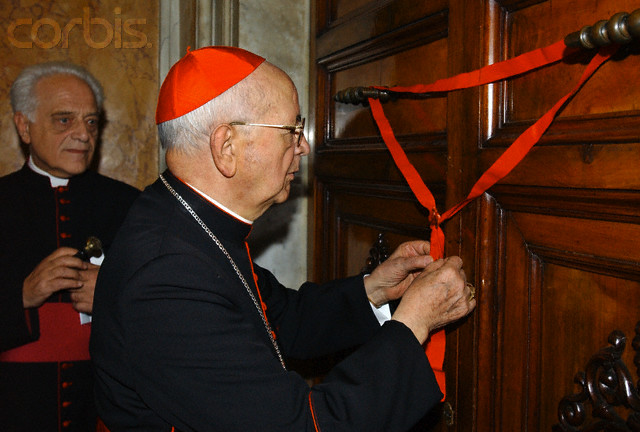
Sealing of the Pope’s Apartment : Not to be opened until the new Pope has been elected

The private residence of the Pope in the Vatican City, that is his apartment in the Apostolic Palace beside the Basilica of St. Peter is left vacant upon the death of the Pope, or in this case, the retirement of the reigning Pope, which began the sede vacante, during which no Pope is present.

Therefore, in order to avoid fraud and manipulation of papal documents of the previous Pope, and to prevent release of items that can only be done by the new Pope, the Pope’s Apartment is sealed, by a special officer of the Roman Curia, that is the Camerlengo (Chamberlain) of the Holy Roman Church, who is now Cardinal Tarcisio Bertone, who is also the Secretary of State of the Holy See.

The Camerlengo is the leader of the sede vacante transition period, and working in conjunction with the Dean of the College of Cardinals. His duties include sealing the Pope’s apartment and the destruction of the Pope’s Ring of the Fisherman, both of which meant to ensure no fraud documents can be released in absence of the Pope.

The sealing is done as soon as the Pope passed away or stepped down, and done in the presence of the Vice-Camerlengo, who is now Archbishop Pier Luigi Celata, and sealed with a silk string tied and sealed with a wax seal to ensure no one can enter the room, with the unbroken wax seal as evidence.

The room will only be opened again and the seal broken after the conclave is completed and a new Pope is elected.

Image below – from 2005 after the death of Blessed Pope John Paul II, then Camerlengo, Cardinal Eduardo Martinez Somalo sealing the Pope’s apartment

Image