Monday, 3 February 2014 : 4th Week of Ordinary Time, Memorial of St. Blaise, Bishop and Martyr, and St. Ansgar, Bishop (Psalm)

Liturgical Colour : Green or Red (Martyrs) or White (Bishops)

Psalm 3 : 2-3, 4-5, 6-7

O Lord, how great in number are my foes! How numerous are they who rise against me! How many are they who say of my soul : “There is no help for him in God!”

But You are my Shield, o Lord, my Glory, You lift up my head. Aloud I cry to the Lord, and from His holy hill He answers me.

If I lie down to sleep, again I awake, for the Lord supports me; no fear of the thousands standing against me.

Tuesday, 19 November 2013 : 33rd Week of Ordinary Time (Psalm)

Liturgical Colour : Green

Psalm 3 : 2-3, 4-5, 6-7

O Lord, how great in number are my foes! How numerous are they who rise against me! How many are they who say of my soul : “There is no help for him in God!”

But You are my shield, o Lord, my glory, You lift up my head. Aloud I cry to the Lord, and from His holy hill He answers me.

If I lie down to sleep, again I awake, for the Lord supports me; no fear of the thousands standing against me.

Sunday, 17 November 2013 : 33rd Sunday of Ordinary Time (Second Reading)

Liturgical Colour : Green

2 Thessalonians 3 : 7-12

You know how you ought to follow our example : we worked while we were with you. Day and night we laboured and toiled so as not to be a burden to any of you. We had the right to act otherwise, but we wanted to give you an example.

Besides, while we were with you, we said clearly : If anyone is not willing to work, neither should that one eat. However we heard that some among you live in idleness – busybodies, doing no work. In the Name of Christ Jesus our Lord we command these people to work and earn their own living.


Sunday, 3 November 2013 : 31st Sunday of Ordinary Time (Scripture Reflection)

Liturgical Colour : Green

Dear brothers and sisters in Christ, we hear today how the Lord loves all, even the rich, the privileged, and the sinners. He cares for everyone without distinction of class or rank. What matters to Him is, how dedicated we can be to Him, giving all of our very beings, committed to Him in prayer.

Today, we heard the story of Zaccheus the dwarf, who was a tax collector and a rich man. He climbed the tree despite the obvious difficulty he faced because of his height, just so that he can see Jesus who came to visit the area. The Lord praised him and his faith, particularly in front of those who slander him and Jesus Himself for interacting with a person widely considered as a traitor and a great sinner at the time of Jesus.

This was because, at that time, the place where Jesus conducted His ministry, the present day Israel and Palestine, was under the rule and authority of the Roman Empire, as the province of Judea. The Romans imposed taxes on all their provinces and territories, and in this, they employed the local merchants and agents to conduct the tax collection.

Those people then became wealthy, as they were well paid by their Roman employers, but they became the objects of scorn by their own people, seeing them as traitors who sold their race and their nation to the Romans and get profits and much money from doing so. This is of course not true, but it is what most people believed in, and as such, they developed stereotypes against the tax collectors like Zaccheus and dissociated themselves from these ‘wicked’ people.

That was why the people sneered when Jesus said to Zaccheus that He wanted to have a meal at his place and eat together with him. They did so because they must have thought, how can a teacher and a prophet (to them) like Jesus be mingling together with such sinners, traitors in fact no less. This is compared to the Pharisees who were well respected in the Jewish society, who disdained sinners and considered themselves holy above all others.

It is their pride that became their downfall. They pride themselves in their holiness and great piety, which they had achieved through prayer and rituals they went through every day. But in fact, in their hearts, they do not have God. God was absent from their hearts, and His love did not take root in them. Instead, it is in ‘sinful’ man like Zaccheus, where the Lord truly resided, and made his heart His residence.

Our Lord and God is truly loving and merciful, brothers and sisters, because He is willing to forgive the sins of even great sinners like Zaccheus, providing that they come and seek His mercy and love in humility. And that was precisely what Zaccheus had done. He surrendered himself, baring his sins to God, and made a public proclamation of faith to God. He was sinful, yes, and yet through his humility and love for God, he was forgiven and given glory, while those who slandered sinners and did not acknowledge their sins were rebuked.

God gives mankind many chances to repent, to acknowledge their sinfulness, abandon their old lifestyle of sin, and embrace His laws and precepts, that is basically love, following what Christ had told us in His ministry. Yet, to many of us, it is not easy for us to look away from our sins and instead focus ourselves towards God. We have often been so immersed in our sins, that we have been ensnared deeply by them. Yet, that does not mean that we have no hope.

Indeed, as I always would like to say, the greater the sinner is, the more likely that one is to be aware and to be ashamed of his or her sins. The greater a sinner is, the more that the person can be aware of how evil his or her actions, words, and deeds had been, and consequently approach closer and closer towards the throne of the Divine Mercy, that is God.

This is of course not for everyone, as not many will come to realisation of their sins, or have the desire to repent from those sins. Regardless of how great and how many the sins we have committed, it is often that we either ignore the sins we have committed or commit even more sins. As such, we fall deeper and deeper into the path towards damnation, and away from God our loving Father.

We have to be more like Zaccheus, for despite his sinfulness and how he was slandered in the society for their perception of him, he did not shy himself from meeting the Lord and making the effort to come and see Him, again despite his short stature which made it difficult for him to do so. We ought to be more like him, in making that effort, to seek the Lord, remorseful and shameful of our own sins, and make the same commitment as Zaccheus, to do what is good from then on. Either as an act of charity as Zaccheus had done, or through even simple acts of love to others in need.

Another thing that we have been taught today is, not to become like the people who slandered Zaccheus and Jesus our Lord, simply because of their prejudices and bias, formed by preformed concepts they had on Zaccheus as the ‘traitorous’ tax collector. We should not be quick to judge others for what they are, and indeed we must not judge, as Jesus, in other instances had taught us so.

Why so? That is because if we judge others, then we too can be judged, and often that we who did not notice our own sins, will be judged more than the one whom we had judged. We should never form any prejudice or preconceptions in our minds about anyone, and even if the person has shortcomings in him or her. Rather, what we should do is that we should encourage and help each other, supporting each other on the path towards salvation.

Therefore, let us today aspire to become more like Zaccheus, seeking the Lord in our lives, and vow to change our ways for the better. May the Lord who loves us continue to watch over us, bless us, and empower us always. Amen.

Saturday, 26 October 2013 : 29th Week of Ordinary Time (Scripture Reflection)

Liturgical Colour : Green or White (Mass of our Lady)

Brethren, bear fruit and be bountiful in all our actions and graces. That is what the Lord wants from all of us, when He told us through His disciples, on the parable of the fig tree. We should not be barren and unproductive, as the fig tree that was barren.

Yes, we are the fig trees, and we have been given much ‘nutrients’ that is the love and the Spirit of the Lord, and this love within us has grown much, and then, comes what is expected from us, that we bear fruits from ourselves. The Lord can be likened to a farmer or a landlord, and this world, His field. We are then the seeds that the Lord had planted in this world, and in time, as we are nurtured in faith and love, we grow tall as a majestic plant, and in time, bear flowers and hence much fruits.

However, it does not mean that we can just remain idle. If we remain idle and do nothing, then we will never bear fruit. Although the Lord can be likened to the farmer of the field, we too are in a sense farmers of the field of the Lord, for we have to toil and labour for the sake of the plants that are ours, that they will grow healthy and bear bountiful products.

Plants can indeed grow without assistance, and even so, they can also bear fruit, but the results are usually not good, and the plant will likely look sick and weak. There are many threats to the healthy growth of a plant, especially for crop plants, such as weeds, diseases, lack of nutrients due to barren soil, heat and dryness, and many other factors. Equally so, there are many factors that help these plants to grow better, such as water, fertiliser, insecticides, and many others.

Therefore, by using these farming examples, just as Christ had done, let us take time to reflect on ourselves and on the actions we have taken in the past. When we look back at what we had done, especially in the past one week or so, have we noticed what we had done for the healthy growth of our faith? You may ask what is the relationship between the farming story and our own real lives, but they are indeed very clear, brethren.

For the plants indeed reflect ourselves and our own nature, the faith that is in us, the faith we have towards the One and True God. The plants cannot grow well or even die, if it is choked by weeds, or being competed out by the roots of those weeds, lacking nutrients for growth, and if the soil itself is lacking in the aforementioned nutrients. In human terms, this can be equated to the entanglement of sin, temptations of the world, and an environment without love.

In this world, brothers and sisters, it is getting more difficult for us, in order to ensure the healthy growth of our faith, that eventually it will bear fruits. This world offers us too much temptations at times, for many of us to be able to persevere, and we often give in to our desires. We become ensnared by the threads spun by the devil, and fell into state of sin. We also often live in environments not conducive for the development of healthy faith in God.

This is where, we need our fertilisers, insecticides, and basically everything fhat makes plants grow healthy, strong, and fruitful. Our fertiliser is our prayers, made in deep love, devotion, and faith in God our Lord. A good prayer life nurture our spiritual development, and we will also then be made ever closer to the Lord our God. Without prayer, we will not be able to get closer to God, and we will be more prone to the power of the devil and his temptations.

Therefore, brethren, let us begin from now on, to develop an ever more intimate relationship with God, especially by nurturing a healthy and deeply spiritual life, that our hearts will be ever filled with the love of God, thus helping us to grow strong in our faith, and ultimately to be fruitful, producing plenty of fruits. Yes, the fruits of the Holy Spirit are what we will richly produce from ourselves, in the love, hope, wisdom, and faith that pour out from the deepest depth of our hearts.

May the Lord who planted the seeds of faith and love in us continue to guide us, that we can nurture what is good inside us, that we can truly be fruitful, producing the richness of love, that we will be found worthy by the Lord our God when He comes again. God bless us all. Amen.

Thursday, 12 September 2013 : 23rd Week of Ordinary Time, Memorial of the Most Holy Name of Mary (First Reading)

Liturgical Colour : Green or White

Colossians 3 : 12-17

Clothe yourself, then, as is fitting for God’s chosen people, holy and beloved of Him. Put on compassion, kindness, humility, meekness, and patience to bear with one another and forgive whenever there is any occasion to do so. As the Lord has forgiven you, forgive one another.

Above all, clothe yourselves with love which binds everything together in perfect harmony. May the peace of Christ overflow in your hearts; for this end you were called to be one body. And be thankful.

Let the word of God dwell in you in all its richness. Teach and admonish one another with words of wisdom. With thankful hearts sing to God psalms, hymns, and spontaneous praise. And whatever you do or say, do it in the Name of Jesus, the Lord, giving thanks to God the Father through Him.

Alternative Reading (From the Mass of the Most Holy Name of Mary)


Galatians 4 : 4-7

But when the fullness of time came, God sent His Son. He came born of woman and subject to the Law, in order to redeem the subjects of the Law, that we might receive adoption as children of God. And because you are children, God has sent into your hearts the Spirit of His Son which cries out : ‘Abba!’ that is ‘Father!’

You yourself are no longer a slave but a son or daughter, and yours is the inheritance by God’s grace.

Alternative Reading (From the Mass of the Most Holy Name of Mary)


Ephesians 1 : 3-6, 11-12

Blessed be God, the Father of Christ Jesus our Lord, who in Christ has blessed us from heaven with every spiritual blessing. God chose us in Christ before the creation of the world to be holy and without sin in His presence.

From eternity He destined us in love to be His adopted sons and daughters through Christ Jesus, thus fulfilling His free and generous will. This goal suited Him : that His loving-kindness which He granted us in His Beloved might finally receive all glory and praise.

By a decree of Him who disposes all things according to His own plan and decision, we, the Jews, have been chosen and called, and we were awaiting the Messiah, for the praise of His glory.

Sunday, 1 September 2013 : 22nd Sunday of Ordinary Time (First Reading)

Liturgical Colour : Green

Sirach 3 : 19-21, 30-31

The greater you are, the more you should humble yourself and thus you will find favour with God. For great is the power of the Lord and it is the humble who give Him glory. Do not seek what is beyond your powers nor search into what is beyond your ability.

As water extinguishes the burning flames, almsgiving obtains pardon for sins. The man who responds by doing good prepares for the future, at the moment of his downfall he will find support.

Tuesday, 27 August 2013 : 21st Week of Ordinary Time, Memorial of St. Monica (First Reading)

Liturgical Colour : White

1 Thessalonians 2 : 1-8

You well know, brothers and sisters, that our visit to you was not in vain. We had been ill-treated and insulted in Philippi but, trusting in our God, we dared announce to you the message of God, and face fresh opposition. Our warnings did not conceal any error or impure motive, nor did we deceive anyone.

But as God had entrusted His Gospel to us as to faithful ministers, we were anxious to please God who sees the heart, rather than human beings. We never pleased you with flattery, as you know, nor did we try to earn money, as God knows. We did not try to make a name for ourselves among people, either with you or anybody else, although we were messengers of Christ and could have made our weight felt.

On the contrary, we were gentle with you, as a nursing mother who feeds and cuddles her baby. And so great is our concern that we are ready to give you, as well as the Gospel, even our very lives, for you have become very dear to us.

Peter’s Pence Collection, Solemnity of Saints Peter and Paul, Apostles

Peters Pence

In case any of you are wondering what is Peter’s Pence, which is collected every Sunday nearest to the Solemnity of Saints Peter and Paul, Apostles, which falls on 29 June every year (Therefore this year Peter’s Pence is collected on Sunday, 30 June 2013, 13th Sunday of Ordinary Time), Peter’s Pence is a special collection in which the collection will not go into the local church or parish fund, but gathered from all over the world and sent to Rome, to the Holy See. Thus, the collection made during the offertory this Sunday will go directly to Rome.

What is the purpose of the Peter’s Pence collection? Exactly to support the numerous charitable activities and organisations managed by the Holy See, by our Church, all over the world. There are thousands, tens of thousands of charity under the supervision of the Church, and to be able to continue with the action, funds are definitely necessary to provide a solid backing. That is why, Peter’s Pence is done once every year, on the Sunday nearest to the Solemnity of Saints Peter and Paul.

1045213_354782624625355_1349576998_n

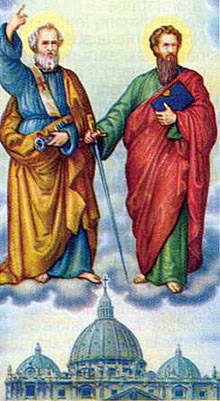
Why Solemnity of Saints Peter and Paul? That is because on that day lie the great celebration of the two great saints and apostles that defined our Church, because they met their martyrdom in Rome. St. Peter, the Prince and leader of all the Apostles, whom the Pope is the successor of today, met his martyrdom in what is now Vatican City, through crucifixion, and St. Paul, the Apostle to the Gentiles, and author of the Epistles in the New Testament, met his martyrdom in Rome, through beheading.

Peter’s Pence itself had its origins in the late dark ages and early medieval period, particularly from England, where it got the name Peter’s ‘Pence’. Pence is the unit of money still in use until today in the United Kingdom and the related monetary units. ‘Peter’ simply point to the fact that the collection or ‘pence’ is intended to be sent to Rome, to the Pope, in order to support various Church activities.

Saturday, 22 June 2013 : 11th Week of Ordinary Time, Memorials of St. Paulinus of Nola, Bishop, Saints John Fisher, Bishop and Thomas More, Martyrs (First Reading)

2 Corinthians 12 : 1-10

It is useless to boast; but if I have to, I will go on to some visions and revelations of the Lord. I know a certain Christian : fourteen years ago he was taken up to the third heaven. Whether in the body or out of the body, I do not know, God knows. But I know that this man, whether in the body or out of the body – I do not know, God knows – was taken up to Paradise where he heard words that cannot be told : things which humans cannot express.

Of that man I can indeed boast, but of myself I will not boast except of my weaknesses. If I wanted to boast, it would not be foolish of me, for I would speak the truth. However, I better give up lest somebody think more of me than what is seen in me or heard from me.

Lest I become proud after so many and extraordinary revelations, I was given a thorn in my flesh, a true messenger of Satan, to slap me in the face. Three times I prayed to the Lord that it leave me, but He answered, “My grace is enough for you; My great strength is revealed in weakness.”

Gladly, then, will I boast of my weakness that the strength of Christ may be mine. So I rejoice when I suffer infirmities, humiliations, want, persecutions : all for Christ! For when I am weak, then I am strong.