
Saturday, 18 October 2014 : 28th Week of Ordinary Time, Feast of St. Luke the Evangelist (Homily and Scripture Reflections)

Liturgical Colour : Red

Brothers and sisters in Christ, today we celebrate with the entire Universal Church, the feast of one of the four great Evangelists, that is the four writers of the Holy Gospels. Today is thus the feast of St. Luke the Evangelist, who wrote the Gospel accorded with his name, the Gospel of St. Luke. As a background, St. Luke was once a renowned physician, who became one of the faithful and followed St. Paul in some of his journeys, including what St. Paul wrote in the letter he wrote to Timothy, another faithful disciple of the Lord.

As we can see from what St. Paul shared with Timothy, St. Luke remained faithful and devoted to the tasks entrusted to him. Yes, this is true even though his fellow journeymen had left to pursue their own interests or for various other reasons. They encountered difficulties along the way, and not all the people they were sent to welcomed them. There were indeed instances when they were welcomed and accepted gladly, but more often than not, they literally had the doors slammed on their faces.

This is exactly what Jesus mentioned as He sent His group of seventy-two disciples, who were meant to help both Jesus Himself and His Apostles in the ministries and works they were doing. Jesus mentioned how they would be sent like lambs among wolves. They would not encounter easy works and acceptance easily, but will be constantly subjected to difficulties and suffering. The lambs rightly represent the disciples and the Apostles, while the wolves represent the various people of God, from which a great majority refused to listen to the Word of God.

Remember that in the other occasion in the Gospels, Jesus also mentioned how that as He who is the Lord and Master of all would suffer rejection and suffering at the hands of mankind, the very people of God to whom He had been sent, then His disciples and Apostles, as well as all those who follow Him and walk in His path will also suffer the same fate. Thus, it explained the fate which St. Paul and St. Luke the Evangelist met during their journeys.

But did they stop on their path? No! That is what made them different from those others who gave up along the way, who could not endure the difficulties and challenges and preferred the comfort of their old lives, settling for the less worthy. What can indeed be more worthy than the Lord and to live to proclaim the Lord’s words to the nations? And St. Luke, together with the other saints continued courageously to defend their faith and to continue the hard works for which they are admired and adored now.

Remember what the Lord had said in the Gospel today, in the Gospel written by St. Luke himself, so that we may know it and hear it as if it was spoken directly by the Lord Jesus Himself to us? Yes, that the harvest is plentiful but the labourers and workers are few. So what did Jesus then tell His disciples? Exactly, that they should ask the Lord of the harvest to send more labourers and workers to tend to the harvest. This truly makes sense, as more labourers will help the Lord of the harvest to bring in even more harvest and bring about more bountiful returns.

But what does this mean, brothers and sisters in Christ? This means exactly that the harvest is truly plentiful in our world, and the harvest refers to the people of God, who are ripe for picking and salvation in God, are awaiting for the labourers and workers who serve the Lord, to pick mankind for the Lord of the harvest, that is the Lord our God.

The field itself refers to this world. This world is filled with much difficulties and uncertainties, but it also offers much opportunities and chances for the crops grown in the field of this world. The pests and the weeds that threaten the crops refer to the forces of darkness that is led by Satan, the father of lies and evil, who always try their best to seduce mankind and make them to follow him instead of the Lord.

The rich harvest is a very tempting thing to the pests and weeds, who will definitely try to snatch and destroy the good harvest from the hands of those who collect these rich harvests to the Lord of the harvest. Thus, the same applies to us, as Satan and his fellow fallen angels is out there trying to turn us mankind, by appealing to our human desires and weaknesses, so that we may fall along our path towards the Lord, and then into damnation with them.

The labourers and the workers of the harvest refer to the servants of God, the disciples of Christ and the Apostles, who like St. Luke the Evangelist and many other saints, worked hard and courageously, like lambs among wolves, to ensure that the harvest of the Lord is collected amidst all the pests and the weeds, that is amidst the challenges and difficulties. Their successors, our priests and bishops, and all who devoted themselves to the service of God, continued their hard works even until this very day.

But this does not mean that the works of the Lord are limited to them only. In fact, brothers and sisters in Christ, we too are the workers and servants of the Lord. How is this so? That is because all of us who believe in the Lord and had received the revelation of truth through the Holy Scriptures and the Church, and have been baptised and accepted into the Church of God have the responsibility to spread the Good News of the Lord.

If St. Luke the Evangelist wrote one of the four Holy Gospels and through it countless souls had been saved, then we too can do it in our own way, by showing the faith through our own actions, that show our sincere and genuine faith, which is not in mere words but also through real actions, so that all those who see us, may know that we belong to the Lord, and therefore hopefully they too will seek salvation in God.

Therefore, brothers and sisters in Christ, inspired by the examples of St. Luke the Evangelist and other holy saints of God, and remembering always the words of the Lord, how the harvest is plentiful but the labourers are few, let us all pray sincerely and fervently, so that we may truly know and understand what we can do in order to help the works of God in the salvation of mankind.

May Almighty God bless us all and strengthen us, that we may courageously take up the cross and bear the mission entrusted to us, so that we may help the works of God, saving many others who await God’s salvation and who still live in the darkness of the world, and so that those of us who are called, we may embrace our calling and devote our lives in the full and complete service of the Lord. God bless us all. Amen.

Saturday, 18 October 2014 : 28th Week of Ordinary Time, Feast of St. Luke the Evangelist (Gospel Reading)

Liturgical Colour : Red

Luke 10 : 1-9

At that time, the Lord appointed seventy-two other disciples, and sent them two by two ahead of Him to every town and place, where He Himself was to go. And He said to them, “The harvest is plentiful, but the workers are few. So you must ask the Lord of the harvest to send workers to His harvest.”

“Courage! I am sending you like lambs among wolves. Set off without purse or bag or sandals; and do not stop at the homes of those you know. Whatever house you enter, first bless them, saying, ‘Peace to this house!’ If a friend of peace lives there, the peace shall rest upon that person. But if not, the blessing will return to you.”

“Stay in that house, eating and drinking at their table, for the worker deserves to be paid. Do not move from house to house. When they welcome you to any town, eat what they offer you. Heal the sick who are there, and say to them : ‘The kingdom of God has drawn near to you.'”

Saturday, 18 October 2014 : 28th Week of Ordinary Time, Feast of St. Luke the Evangelist (Psalm)

Liturgical Colour : Red

Psalm 144 : 10-11, 12-13ab, 17-18

All Your works will give You thanks; all Your saints, o Lord, will praise You. They will tell of the glory of Your kingdom and speak of Your power.

That all may know of Your mighty deeds, Your reign and its glorious splendour. Your reign is from age to age; Your dominion endures from generation to generation.

Righteous is the Lord in all His ways, His mercy shows in all His deeds. He is near those who call on Him, who call trustfully upon His Name.

Saturday, 18 October 2014 : 28th Week of Ordinary Time, Feast of St. Luke the Evangelist (First Reading)

Liturgical Colour : Red

2 Timothy 4 : 10-17b

You must know that Demas has deserted me for the love of this world : he returned to Thessalonica. Crescens has gone to Galatia and Titus to Dalmatia. Only Luke remains with me. Get Mark and bring him with you, for he is a useful helper in my work. I sent Tychicus to Ephesus.

Bring with you the cloak I left at Troas, in Carpos’ house and also the scrolls, especially the parchments. Alexander the metalworker has caused me great harm. The Lord will repay him for what he has done. Distrust him for he has been very much opposed to our preaching.

At my first hearing in court no one supported me; all deserted me. May the Lord not hold it against them. But the Lord was at my side, giving me strength to proclaim the Word fully, and let all the pagans hear it.

Monday, 30 September 2013 : 26th Week of Ordinary Time, Memorial of St. Jerome, Priest and Doctor of the Church (Scripture Reflections)

Liturgical Colour : White

Dear brothers and sisters in Christ, today we listened to a lesson on humility, and its importance, when we become the disciples of Christ, not to boast of our own glory, but rather boast of the glory of God, made evident in Jesus the Christ. That is because it is indeed the Lord who is worthy of all praise and glory, for His might, and even more importantly for the extent of the love that He had shown us through Christ.

The Lord wanted to teach His disciples, and through them, all of us, on the value and importance on humility and being humble, as the way to be a good and upright person, a good child of God. And Christ did not just preach and do nothing about what He taught, because in fact He truly practiced what He had preached.

How so? Jesus is truly humble and unassuming, although He is truly great, as the King of all kings. He is divine and omnipotent, and all creation is under His power and authority, as the Lord of all the universe, and yet, for our sake and our salvation from death, He is willing to make Himself small and insignificant, as small and unworthy as we are, to be man like one of us, although without sin.

In His humility too, He was born in a small stable, rejected by others, from inns and houses, that He had to be born among the animals and shepherds. He lived as a carpenter’s son and was ridiculed by His own people, the people of Nazareth, when He revealed the truth about Himself to them. He was humble in all of His ways and loving in all of His actions.

There is nothing that exemplifies His humility better than that of His ultimate sacrifice on the cross. That He lowered Himself to die a death of a slave, the death on the cross, condemned to death despite His innocence, for the sake of all of us. But that is also where the Lord’s words came true even more. That is because the symbol of the cross was transformed forever, from the symbol of shame to be a symbol of hope and victory.

Christ rose up from the dead in glory on the third day after His death, and He took His rightful place as the Lord of all things, having saved mankind through His death, that they will not die but live. On the other hand, the prideful and arrogant Satan was cast down in great shame, and forever he is condemned to the punishment prepared for him, for his prideful rebellion against the Lord.

With humility, we will go a long way, because with humility in our heart, we will be more ready to open it to the love of God, to the wisdom of God, and to His saving power. We will be more ready to listen to Him and take in all the teachings that He had told us, the commandments that He had given us to follow, that we become truly faithful and obedient to He who created us.

Humility allows one to understand one’s faults and weaknesses more readily, and also the understanding, that one’s sins had prevented one from reaching the Lord and eternal joy in heaven. That this will likely make one to atone for one’s own sins and do things that help to overcome those sins as well as doing good for others. That is how important humility truly is.

Without humility, we tend to be prone to fall into our own pride, and end up shutting the Lord and even our other beloved ones from our heart. We will tend to build up our ego, to the point that we think only about ourselves, and not for others, at all. We tend to do things for our own glory, and praising ourselves for our own greatness, without realising that, without God we are really nothing.

Today, brethren, we celebrate the feast of St. Jerome, a great writer of the early Church, and one of the greatest Doctors of the Church, as one of the original Four, together with St. Augustine, St. Gregory Nazianzen and St. as strong pillars of the Church. St. Jerome lived at a time when the faith has begun to take hold over the entire Roman Empire after it was no longer persecuted.

St. Jerome’s contribution to the Church is truly great, especially to the Church in the western parts of the Empire. The Roman Empire was a vast Empire spanning from Britain and the Atlantic Ocean all the way to the Middle East and Egypt, encompassing the entire Mediterranean Sea basin. The western part of that Empire spoke primarily Latin and its dialectic derivatives, the official language of the Empire.

The eastern part however, spoke primarily Greek and a variety of other ancient languages, and because the faith came and arose from that region, much of the Scripture that we know today was written in Greek or in the other eastern languages. It is St. Jerome who opened the doorway to the Scripture in the west, and therefore to us, by being the first to translate the Septuagint, that is the Greek Scripture, into the Vulgate, the Latin Scripture, written by St. Jerome himself.

St. Jerome also courageously defended the true and orthodox faith, defending it against every kind of aberrations and heresies that threatened to split the Church apart at that time. Through his writings and other works, St. Jerome kept the Apostolic faith alive and strong even in difficult times.

Therefore, brothers and sisters in Christ, today, as we celebrate the feast of this great saint, St. Jerome, let us also strive to be more like him. St. Jerome is an ascetic, one who withdrew from the pleasures of the world and reject worldly glories, putting the Lord above everything else. He is also humble, and he did his work with great humility, and yet he bore much fruits.

That is why, brethren, we too should emulate him, in doing good works in our own ways, even in small little ways. Because even in little things, good can eventually come in abundance. In humility too, we can become great, not in the way that the world sees it, but instead in the eyes of the Lord. Humility bears love, and that love will bear much good. Even in his ‘humble’ work as a writer, St. Jerome’s good works still affect us even until this day. All the Bibles that we read today eventually had their roots from the works of St. Jerome.

May St. Jerome intercede for us and pray always for us sinners, that we can remain in the grace of God, and receive His heavenly blessings. May God be with us and remain with us always. Amen.

Wednesday, 12 June 2013 : 10th Week of Ordinary Time (Scripture Reflection)

Dear brothers and sisters in Christ, Christ is our Lord and Messiah. His coming was told in the numerous prophecies by the prophets as written throughout the Old Testament of the Scripture. His coming was indeed not to destroy the Law as written in the Scripture, and not to abolish the teachings of the prophets and the Law and commandments that God has given to Moses, but to fulfill and complete all the prophecies made about Him.

In the first reading today, we also heard about how the ‘text’ of the Law brings death, while the Spirit brings life, and it also seemingly criticise those who minister to the Law. In this we can clearly see, that in his letter to the faithful in Corinth, he was referring to the chief priests and the Pharisees, whom Christ repeatedly called hypocrites, and whom repeatedly had caused troubles during the Lord’s earthly ministry.

Therefore, brothers and sisters, today we are called to live out the Law of God, the Law which God had given to Moses, and then perfected and completely fulfilled by Christ, His Son, that we do not become slaves to the Law, but become alive due to that Law, which is, according to Christ, is all about love, for God Himself is love.

The chief priests and the Pharisees had grown so accustomed and so attached to the Law, that they had entirely forgotten the Spirit of the Law, that is love, and they had entirely misunderstood the meaning of the Law, and its purpose, becoming instead mindless slaves to their own human traditions, which their ancestors established in rituals and traditions to worship the Lord, but over time, becoming corrupted with worldly desires and impurities.

Rituals and observations of the Law had become empty, and prayers had become stale, and lacking the freshness of the Spirit of the Lord. That was what Christ had criticised, when the Pharisees went praying in the public places, showcasing their piety for all to see. That they love human glory instead of seeking heavenly glory of God and praising God, and instead of using the Law as it is intended, they had abused it to their own purposes.

That is why Christ came into our world, not just to be our Saviour, but also to perfect the Law of God, and to explain them clearly to the people of God, that they would no longer misinterpret the Law and therefore sin in the eyes of the Lord. He revealed to those whom He had chosen and those who were willing to listen to His word.

The same too, brothers and sisters in Christ, applies to our Church today. We have our own Law in the Church, that is the Canon Law, to regulate matters pertaining to the Church and the faithful in God, and also the liturgical laws to regulate the way we worship the Law with its rituals and observations, much like that observed by the priests of Israel of old, and during Jesus’ time.

We have to obey these laws and norms, my brothers and sisters in Christ, particularly regarding the Mass and the liturgy, because in the Mass we worship the Lord Himself, and we have to do it worthily. Sadly, there are many today who simply do not care about the liturgy and the proper worship of the Mass as written in the Law of the Church, as are evident in the numerous liturgical abuses in the Masses all around the world.

What is important is, not that we should not obey these laws, nor should we disregard them, but to understand them, by proper preparation and explanations, just as Christ Himself once had done regarding the Laws of Moses, which were given by God. A proper understanding of our Church laws and the liturgical norms in the Mass is a must, brothers and sisters, for improper understanding will certainly lead us astray from God.

But on the other hand, neither should we be so fixated on the rules and the Law that we end up doing everything just for the sake of obeying the Law. Then in that case we are no better than the Pharisees and the chief priest of Jesus’ time. We should not follow the rules simply for the sake of obeying the rules and looking good in the eyes of others.

A simple example would indeed be, the obligation for all of us to attend the Sunday Mass. While it may seem to be trivial, but how many of us actually come to the Mass because we want to come to the Mass and worship the Lord, as all of us should be? I am certain that many of us came to the Mass because we feel that it is an obligation to do so, and being good Catholics, we ‘obeyed’. But, this is not good, because if we do it this way, our heart will not be fully in the Mass, not fully attuned to the worship of the Lord, because our mind and our heart are elsewhere, in our businesses, our other occupations, and not focused towards the Lord.

No, when we come for the Mass, my brothers and sisters in Christ, let us make sure that we truly come to be with God, to love our God, and to praise Him and give thanks to Him for all the good graces and blessings that He had given us. Seek to understand more about our faith and about the Mass from those who have the knowledge and are qualified to teach about the faith to others. Remember, obey the Law because we love the Law and understand it, not just for the sake of obedience, or worse, as a symbol of self-gratification and self-glorification. Amen.

Wednesday, 12 June 2013 : 10th Week of Ordinary Time (First Reading)

2 Corinthians 3 : 4-11

This is how we are sure of God, through Christ. As for us we would not dare consider that something comes from us : our ability comes from God. He has even enabled us to be ministers of a new covenant no longer depending on a written text but on the Spirit. The written text kills, but the Spirit gives life.

The ministry of the Law carved on stones brought death; it was nevertheless surrounded by glory and we know that the Israelites could not fix their eyes on the face of Moses, such was his radiance, through fleeting. How much more glorious will the ministry of the Spirit be!

If there is greatness in a ministry which uses to condemn, how much more will there be in the ministry that brings holiness? This is such a glorious thing that in comparison the former’s glory is like nothing. That ministry was provisory and had only moments of glory; but ours endures with a lasting glory.

Saturday, 23 February 2013 : 1st Week of Lent (Scripture Reflection)

God loves all, and He loves everyone, without exception. Not even the worst sinners can escape from His love. However, all of us, who truly love God in return, and keep His teachings and commandments, enjoy even greater love, and also He has made us His people, His children, and promise us every graces and blessings in our lives.

It is easy to love your friends, those who also love you, and your family, and those whom you know. It is easy to be with them and also live happily with them. But indeed, if we are all indeed called by God to be His missionaries to all the world, can we just stay content in being within our own sphere of safety? within our own comfort zone?

No! Indeed, as the Lord said to us, “Love our enemies” and “Pray for those who persecutes you”, we have to reach out to those who hate us, and especially to those whom because of the hate in our hearts, have hated too. It is natural for us humans to hate, as since the days of the fall of Adam and Eve, sin has entered the hearts of men, and therefore with it, came hatred, prejudice, and jealousy. It is natural for us to hate someone who hated us first, and it is natural for us to covet the possession of others, especially those who are more fortunate than us. However, remember that through our baptism in God, and through the Sacred Scripture that we read and listened to, we have all become the children of God, and have been made better than what our human natures allow us to be.

For as the children of God, we too should follow in God’s footsteps. No better example at this, that Christ, the Son of God, whose in His death throes on the cross, showed how great God’s love is to all peoples. For Christ Himself had said, “There is no greater love, than that of those who gave their life for their friends. To Christ, all of us are His friends, does not matter whether king or poor, big or small, saints or sinners. Even to those whom had handed Him the death penalty by shouting “Crucify Him!”, Christ also consider them as friends, and He gave His life for them. These were His enemies, but out of His great love, He forgave them, and asked the Father not to punish them, because they do not know what they were doing.

This was one example Christ gave why we should love our enemies. Not to die like Him for our enemies, but because, these enemies of ours are after all, also the children of God, whom God loves, despite of their sins, just like God loves us, despite of our sins. Therefore, we should love one another, even our enemies, that they too, may learn love, and in doing so, shed off their hatred and sinful ways, and join us in salvation. There are many who also persecute us, especially the faithful, as we have often heard happening all over the world. But how do we face this? Do we face them with hatred and more violence, or do we face them with love? with prayer? For if we face them with hatred, and violence, not only would they be condemned, but we too, since in doing so, we let ourselves fall to the snares of evil, and by bringing more hatred and violence, we prevent the works and love of God from being manifest.

Rather, let us indeed do what the Lord told us, to end the cycle of hatred, the cycle of evil, and steadfastly refuse the temptations of the devil. Bring back our separated brethren, who are separated from us by hatred, prejudice, and jealousy, and therefore, bring ourselves together into the Light, and made our world a better place, just as the Lord wishes for us, whom He loves dearly. Let us pray, that all of us will be strong, and will be able to carry out our mission, and in that mission, to reach out to those who hate us, our enemies, to be able to forgive them and the pains and sufferings they have inflicted on us, and to love all who had persecuted us. Let us make this world a better world, based in love, peace, compassion, and harmony, instead of hatred, evil, and death. Amen.

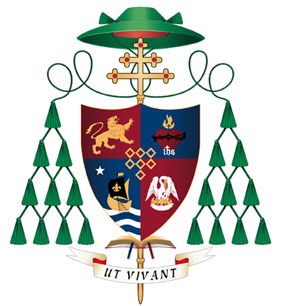
Coadjutor Archbishop of Singapore, Msgr. William Goh’s coat of arms

http://www.catholicnews.sg/index.php?option=com_content&view=article&id=8343:coadjutor-archbishop-elects-coat-of-arms&catid=328:episcopal-ordination&Itemid=147

ArchWGCoatofarmsfinal

The coat of arms of an archbishop has four ranks of interlinked tassels, totalling 10 tassels on each sides of the central arms, surmounted by the traditional hat for the clergy, the galero, coloured green for bishops and archbishops.

Double-barred cross also topped the arms, symbolising the rank of Archbishop, who leads an Archdiocese, a larger and more important diocese.

The symbols of the arms include the lion of Singapore, star that represents the Virgin Mary, the boat that travels across oceans with a fleur-de-lys on the mast, that represents the journey of faith guided by Mary in the star to lead all to Jesus. The fleur-de-lys symbolises the connection Singapore Archdiocese had to the French missionaries, who founded the modern Catholic Church in Singapore in mid-1800s.

Sacred Heart represents love of God and mankind, as a basis of our Coadjutor Archbishop’s ministry, and seven hollow mascles at the centre of the arms representing St. William of York, the Coadjutor Archbishop’s patron.

The arms is supported by the Bible, which as the holy Word of God, becomes the basis and duty of the Coadjutor Archbishop’s ministry to teach and live the Word of God.

The motto is “Ut Vivant” or “That they may live”, symbolising the Good Shepherd who lays down his life for his sheep, in honour of St. Laurent Imbert, who gave Cathedral of the Good Shepherd an inspiration for its name, by his ready embrace of martyrdom, to save the faithful under his care from death.

For greater details, please visit the link to view the coat of arms and get a more detailed explanation on the coat of arms’ symbols. Please also pray for our soon-to-be ordained Coadjutor Archbishop!

(Addition : I believe that Coadjutor Archbishops are not given any titular see, which is the case for Auxiliary bishops, as Coadjutor Archbishops are immediately tied to the See which they will succeed, so in our case, Msgr. William Goh will be known as Coadjutor Archbishop of Singapore, and not of any titular see.)

(Example of titular see : Castellum Medianum, which was held by Auxiliary Bishop of Sibu, Bishop Joseph Hii, before he was chosen as the new Bishop of Miri)

Thank you to all the visitors! Pray for me and this blog. 500 views has been reached.

My blog posts have been viewed more than 500 times in the past 11 days by visitors from various countries. Thank you for visiting my humble blog. Pray for me that I will continue to be strong and faithful to write on about the faith, about His Scripture, and about the Lord Himself.

Total views : 517

Distribution by country (Total recorded : 500)

1. Singapore : 169

2. United States of America : 139

3. Philippines : 47

4. United Kingdom : 36

5. Canada : 17

6. Malaysia : 13

7. Italy : 10

8. Ireland : 8

9. Australia : 7

10. India : 5

11. Trinidad and Tobago : 4

12. Indonesia : 4

13. Belgium : 4

14. Germany : 4

15. Poland : 4

16. Argentina : 3

17. Namibia : 2

18. Malta : 2

19. Mexico : 2

20. France : 2

21. Switzerland : 2

22. Colombia : 2

23. Laos : 2

24. Brazil : 2

25. Kenya : 1

26. Macau : 1

27. Croatia : 1

28. Timor Leste : 1

29. Chile : 1

30. Hong Kong : 1

31. South Korea : 1

32. Spain : 1

33. Denmark : 1

34. United Arab Emirates : 1

+Ut Omnes Unum Sint, ad Maiorem Dei Gloriam+

(That they all may be One, for the greater glory of God)