Wednesday, 2 October 2013 : 26th Week of Ordinary Time, Memorial of the Holy Guardian Angels (Gospel Reading)

Liturgical Colour : White

Matthew 18 : 1-5, 10

At that time, the disciples came to Jesus and asked Him, “Who is the greatest in the kingdom of heaven?”

Then Jesus called a little child, set the child in the midst of the disciples, and said, “I assure you that, unless you change and become like little children, you cannot enter the kingdom of heaven. Whoever becomes lowly like this child is the greatest in the kingdom of heaven, and whoever receives such a child in My Name receives Me.”

“See that you do not despise any of these little ones, for I tell you : their angels in heaven continually see the face of My heavenly Father.”

Wednesday, 2 October 2013 : 26th Week of Ordinary Time, Memorial of the Holy Guardian Angels (Psalm)

Liturgical Colour : White

Psalm 90 : 1-2, 3-4, 5-6, 10-11

You who dwell in the shelter of the Most High, who rest in the shadow of the Almighty, say to the Lord, “My stronghold, my refuge, my God in whom I trust!”

He will rescue you from the fowler’s snare and from the deadly pestilence. He will cover you with His pinions and give you refuge under His wings.

You shall not fear the terror of the night nor the arrows that fly by day, nor the pestilence that stalks by night, and the plague that destroys at noonday.

No harm will come upon you, no disaster will draw near your home. For He will command His angels to guard you in all your ways.

Wednesday, 2 October 2013 : 26th Week of Ordinary Time, Memorial of the Holy Guardian Angels (First Reading)

Liturgical Colour : White

Exodus 23 : 20-23

See, I am sending an Angel before you to keep you safe on the way and bring you to the place I have made ready. Be on your guard in His presence and listen to Him; do not resist Him for He will not pardon your wrong-doing, for My Name is in Him.

If you listen to Him and do what I say, I will be enemy to your enemies and the opponent of your opponents. My Angel will go before you and bring you to the land of the Amorites, the Hittites, the Perizzites, the Canaanites, the Hivites and the Jebusites; all these I will destroy.

Tuesday, 1 October 2013 : 26th Week of Ordinary Time, Solemnity of St. Therese of the Child Jesus, Virgin and Doctor of the Church (Scripture Reflections)

Liturgical Colour : White

Dear brothers and sisters in Christ, as per the theme of the readings yesterday, today we once again listen to the words of Jesus, on the importance of humility in our lives, in all our dealings with God and with one another. That humility is one of the key elements necessary for the salvation of one, because with humility, many of the necessary attitudes needed for one to be saved can be achieved.

It is too often that we are so preoccupied with ourselves, and immersed in our sense of pride and our natural arrogance that we fail to realise our own shortcomings and our sinfulness. That is why many of us tend to continue to dwell in the world of sin and darkness instead of seeking the light in God. We close ourselves and our hearts to the Lord, all because we think of ourselves as great and beyond reproach.

That was the reason of the fall of many, who put their trust in their own strengths and disregarded any advice that the Lord had given to them through various sources. Pride leads to arrogance, and arrogance leads to even more pride. And in our pride, we forget about God, we forget about those around us, and even those who are dear to us, and we tend to care only for ourselves.

Ever since we have fallen into sin, we have been prone to any kind of sins and evils, including pride. It is also how the devil fell, as Lucifer the lightbringer, who was enraptured by his own beauty and might, as the greatest angel, turned to pride and then jealousy and hatred against God. That is how pride brings down even the mighty and the powerful. Indeed, those who are mighty are more prone to pride than those who are weak, but that does not mean that all of us can be complacent.

The way to greatness is truly through humility, as through humility, we tend to be better able to express ourselves in love, in gentleness, and in faith to God. The Lord who sees us doing these things, will truly reward us and glorify us, just as He had glorified Christ our Lord, His Son, whose sacrifice in perfect humility, brought about the salvation of mankind.

Through His own humility, Christ showed the love that is within Him to all those whom He touched and met. He lowered Himself in great humility so that He can love us all more perfectly. To the extent, that He gave His own life, so that we may live and not die. He sets the example with His own actions, the saving power of His eternal love.

Jesus also told His disciples to be more like little children. Why so? That is because it is the faith of little children that is the purest, the purest faith and love towards God. Very often, we as adults, are so preoccupied with the things and matters of the world, that we forget what is more important in our lives, that is love, gentleness, hope, and God Himself.

If we can just be more like children in our faith, then we will certainly be better persons, with faith untainted by the concerns and corruptions of this world. We ought not to forget our true calling in this life, that is to love, and to love tenderly, especially to those who are unloved, we can truly be like those children, whose faith and dedication to God are pure and total.

That is what was echoed by the saint whose feast day we celebrate today, namely St. Therese of the Child Jesus, also known as St. Therese Lisieux. St. Therese Lisieux was well-known for her great humility, her piety, and her deep spirituality and devotion for the Lord, that she showed in her short life, as she died early in her early twenties, and yet in that short life, she had really done much for the sake of the Lord and His people.

St. Therese Lisieux joined the religious life and devoted herself fully to the Lord, and received series of visions and revelations through her life. She dedicated herself to her life of prayer in simplicity and perfect obedience to the will of God. Through her numerous writings, she communicated her feelings and beliefs, in the life dedicated to God.

It is through her extensive writings, poems, and other works, that St. Therese Lisieux influenced many of us even to this day. Although she had lived only a short life in this world, through her works and writings, she lived on forever, inspiring and strengthening many in their own paths towards the Lord. She is now up there, as one of the saints, interceding endlessly for our sake, we who are sinners still living in this darkened world of pride and evil.

Therefore, brothers and sisters in Christ, after we hear the examples set by St. Therese Lisieux and that of many other saints, let us emulate their virtues, their piety and humility, realising the depths of our own sins, and asking the Lord for His pardon out of His eternal love for us. Let us also be proactive in love, that we love tenderly, love sincerely, and love generously, both to God and to our fellow men.

May the Lord continue to shower us with His love and that we will come to ever greater realisation of our own unworthiness before Him, and therefore come ever closer to reach out to the throne of mercy, asking Him to show His infinite mercy to us, and forgiveness for our innumerable sins. God bless us all and watch over us always. Amen.

Tuesday, 1 October 2013 : 26th Week of Ordinary Time, Solemnity of St. Therese of the Child Jesus, Virgin and Doctor of the Church (Gospel Reading)

Liturgical Colour : White

Matthew 18 : 1-5, 10

At that time, the disciples came to Jesus and asked Him, “Who is the greatest in the kingdom of heaven?”

Then Jesus called a little child, set the child in the midst of the disciples, and said, “I assure you that, unless you change and become like little children, you cannot enter the kingdom of heaven. Whoever becomes lowly like this child is the greatest in the kingdom of heaven, and whoever receives such a child in My Name receives Me.”

“See that you do not despise any of these little ones, for I tell you : their angels in heaven continually see the face of My heavenly Father.”

Tuesday, 1 October 2013 : 26th Week of Ordinary Time, Solemnity of St. Therese of the Child Jesus, Virgin and Doctor of the Church (Psalm)

Liturgical Colour : White

Psalm 130 : 1-3

O Lord, my heart is not proud nor do I have arrogant eyes. I am not engrossed in ambitious matters, nor in things too great for me.

I have quieted and stilled my soul like a weaned child on its mother’s lap; like a contented child is my soul.

Hope in the Lord, o Israel, now and forever.

Tuesday, 1 October 2013 : 26th Week of Ordinary Time, Solemnity of St. Therese of the Child Jesus, Virgin and Doctor of the Church (First Reading)

Liturgical Colour : White

Isaiah 66 : 10-14

“Rejoice for Jerusalem and be glad for her, all you who love her. Be glad with her, rejoice with her, all you who were in grief over her, that you may suck of the milk from her comforting breasts, that you may drink deeply from the abundance of her glory.”

For this is what YHVH says : ‘I will send her peace, overflowing like a river; and the nations’ wealth, rushing like a torrent towards her. And you will be nursed and carried in her arms and fondled upon her lap. As a son comforted by his mother, so will I comfort you.’

‘At the sight of this, your heart will rejoice; like grass, your bones will flourish. For it shall be known that YHVH’s hand is with His servant, but His fury is upon His enemy.’

Monday, 30 September 2013 : 26th Week of Ordinary Time, Memorial of St. Jerome, Priest and Doctor of the Church (Scripture Reflections)

Liturgical Colour : White

Dear brothers and sisters in Christ, today we listened to a lesson on humility, and its importance, when we become the disciples of Christ, not to boast of our own glory, but rather boast of the glory of God, made evident in Jesus the Christ. That is because it is indeed the Lord who is worthy of all praise and glory, for His might, and even more importantly for the extent of the love that He had shown us through Christ.

The Lord wanted to teach His disciples, and through them, all of us, on the value and importance on humility and being humble, as the way to be a good and upright person, a good child of God. And Christ did not just preach and do nothing about what He taught, because in fact He truly practiced what He had preached.

How so? Jesus is truly humble and unassuming, although He is truly great, as the King of all kings. He is divine and omnipotent, and all creation is under His power and authority, as the Lord of all the universe, and yet, for our sake and our salvation from death, He is willing to make Himself small and insignificant, as small and unworthy as we are, to be man like one of us, although without sin.

In His humility too, He was born in a small stable, rejected by others, from inns and houses, that He had to be born among the animals and shepherds. He lived as a carpenter’s son and was ridiculed by His own people, the people of Nazareth, when He revealed the truth about Himself to them. He was humble in all of His ways and loving in all of His actions.

There is nothing that exemplifies His humility better than that of His ultimate sacrifice on the cross. That He lowered Himself to die a death of a slave, the death on the cross, condemned to death despite His innocence, for the sake of all of us. But that is also where the Lord’s words came true even more. That is because the symbol of the cross was transformed forever, from the symbol of shame to be a symbol of hope and victory.

Christ rose up from the dead in glory on the third day after His death, and He took His rightful place as the Lord of all things, having saved mankind through His death, that they will not die but live. On the other hand, the prideful and arrogant Satan was cast down in great shame, and forever he is condemned to the punishment prepared for him, for his prideful rebellion against the Lord.

With humility, we will go a long way, because with humility in our heart, we will be more ready to open it to the love of God, to the wisdom of God, and to His saving power. We will be more ready to listen to Him and take in all the teachings that He had told us, the commandments that He had given us to follow, that we become truly faithful and obedient to He who created us.

Humility allows one to understand one’s faults and weaknesses more readily, and also the understanding, that one’s sins had prevented one from reaching the Lord and eternal joy in heaven. That this will likely make one to atone for one’s own sins and do things that help to overcome those sins as well as doing good for others. That is how important humility truly is.

Without humility, we tend to be prone to fall into our own pride, and end up shutting the Lord and even our other beloved ones from our heart. We will tend to build up our ego, to the point that we think only about ourselves, and not for others, at all. We tend to do things for our own glory, and praising ourselves for our own greatness, without realising that, without God we are really nothing.

Today, brethren, we celebrate the feast of St. Jerome, a great writer of the early Church, and one of the greatest Doctors of the Church, as one of the original Four, together with St. Augustine, St. Gregory Nazianzen and St. as strong pillars of the Church. St. Jerome lived at a time when the faith has begun to take hold over the entire Roman Empire after it was no longer persecuted.

St. Jerome’s contribution to the Church is truly great, especially to the Church in the western parts of the Empire. The Roman Empire was a vast Empire spanning from Britain and the Atlantic Ocean all the way to the Middle East and Egypt, encompassing the entire Mediterranean Sea basin. The western part of that Empire spoke primarily Latin and its dialectic derivatives, the official language of the Empire.

The eastern part however, spoke primarily Greek and a variety of other ancient languages, and because the faith came and arose from that region, much of the Scripture that we know today was written in Greek or in the other eastern languages. It is St. Jerome who opened the doorway to the Scripture in the west, and therefore to us, by being the first to translate the Septuagint, that is the Greek Scripture, into the Vulgate, the Latin Scripture, written by St. Jerome himself.

St. Jerome also courageously defended the true and orthodox faith, defending it against every kind of aberrations and heresies that threatened to split the Church apart at that time. Through his writings and other works, St. Jerome kept the Apostolic faith alive and strong even in difficult times.

Therefore, brothers and sisters in Christ, today, as we celebrate the feast of this great saint, St. Jerome, let us also strive to be more like him. St. Jerome is an ascetic, one who withdrew from the pleasures of the world and reject worldly glories, putting the Lord above everything else. He is also humble, and he did his work with great humility, and yet he bore much fruits.

That is why, brethren, we too should emulate him, in doing good works in our own ways, even in small little ways. Because even in little things, good can eventually come in abundance. In humility too, we can become great, not in the way that the world sees it, but instead in the eyes of the Lord. Humility bears love, and that love will bear much good. Even in his ‘humble’ work as a writer, St. Jerome’s good works still affect us even until this day. All the Bibles that we read today eventually had their roots from the works of St. Jerome.

May St. Jerome intercede for us and pray always for us sinners, that we can remain in the grace of God, and receive His heavenly blessings. May God be with us and remain with us always. Amen.

The need to return to ‘Ad Orientem’ celebration

00056_15042010

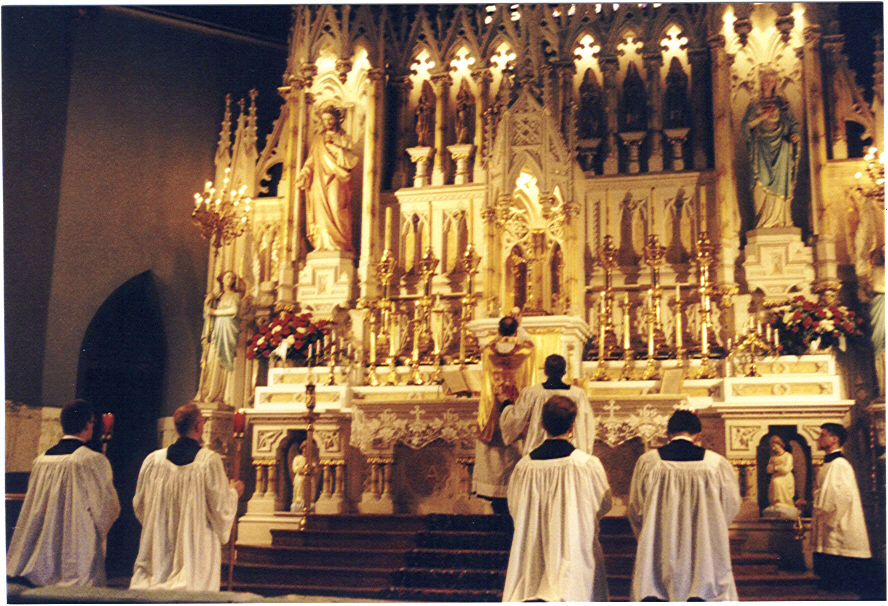
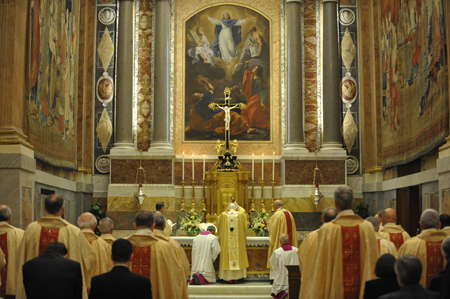
Let us return to the ad orientem celebration! That is facing the Lord TOGETHER with the people, instead of facing the people (ad populum).

The Mass is not a political gathering or a party where everyone faces each other and look at each other. The Mass is about the Holy Sacrifice of Jesus Christ, and we ALL ought to look at Him crucified. Therefore, everyone, including the priest, MUST face the Lord, and ad orientem is the best way.

Elevation

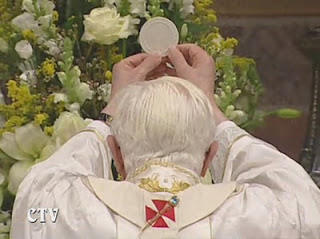
The focus of the Mass is the Lord, not the priest as a person. The priest is Alter Christus, Christ personified in the priest, and when he lifts up that bread turned into the Most Precious Body, It is like Christ lifted up high between the heaven and the earth, offering Himself as a sacrificial victim, to absolve and save all the world from death and sin. When the priest lifts up that chalice with wine, transformed into the Most Precious Blood, it is the Blood of Christ, Jesus Christ Himself we are looking at, His Blood pouring down the cross to us, to wash us from our iniquities and our sins, making our garments white again in the Blood of the Lamb.

Monstrance Baroque

And even the ones who crucified Him, looked at Him “And they shall look at the One whom they pierced”. It is therefore imperative, that we keep our focus at the Lord, as One people, One Church, during and throughout the Mass. The focus is not in the dances and the upbeat songs now often used to arouse people’s attention and interest in the Mass, and neither is the focus on the priest dancing, singing, or the people’s performances, but the focus is Christ.

When the priest faces the people, this fact is quickly and easily lost in both the people, AND the priest. Eye contact is very important in relationships, and eye contact between the priest and the people while can be beneficial (during the homily) it can easily distract our attention from the Lord in the Eucharist, very easily.

In this way too, we take the best from both of the two Form of the Latin Rite we have in the Church, that is the Extraordinary Form (Tridentine) and the Ordinary Form (Novus Ordo), and end the numerous liturgical abuses that had arisen ever since ad populum celebration became commonplace, and many did them inappropriately and without due honour to our Lord Jesus Christ.

papal ad orientem 2010 4

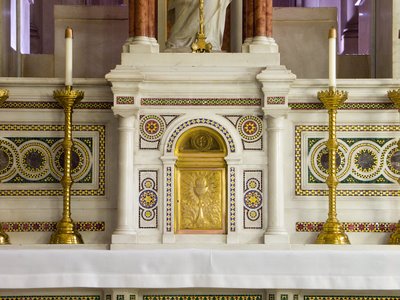
And lastly, it is time to return the Tabernacle with the Most Holy Eucharist back to its place of primary honour behind the Altar, that is where all the people and the priests focus at during the Mass, and not relegated somewhere at the side or a less-than-honorary place in the church building. There can be another Tabernacle for use especially during the Transfer of the Eucharist on Holy Thursday, but the Tabernacle itself should and indeed, must be restored to its position of honour at the Altar!

Cathedral Basilica of Saint Louis, in Saint Louis, Missouri - All Saints Chapel - tabernacle

Ad orientem celebration helps this, as the priest no longer need to show his back all the time to the Lord throughout the Mass if ad populum celebration is done.

Tuesday, 20 August 2013 : 20th Week of Ordinary Time, Memorial of St. Bernard, Abbot and Doctor of the Church (Scripture Reflection)

Liturgical Colour : White

Dear brothers and sisters in Christ, today we heard about the story of the calling of Gideon, whom God called to be His judge over Israel, and to be their liberator from their oppression by the Midian people, who lived south of the land of Israel. God showed His mercy and love for His people despite of their constant and regular transgressions, betrayal, and rebellion against His will.

The path to salvation is difficult, brothers and sisters in Christ, and many are tempted or swayed away from the path that they fell into damnation, because they were bought over by the power of Satan, the temptations and the pleasures of the world, which come in many forms, including sexual pleasures, material wealth, possessions, and many others, things that we easily desire within our hearts, the things that divert our attention from the Lord, or worse still, worship as the pagan idols within our own hearts.

These are what made it difficult for people with much possessions, wealth, and privileges, such as the rich class, to get to the kingdom of God, where salvation lies. But be very careful here, brethren, because Jesus did not condemn the rich nor wealth nor possession when He made His example of the rich man and the camel to His disciples. He did say that it is indeed more difficult for a rich man to enter the kingdom of heaven than a camel to enter the eye of a needle, but He did not in fact condemn the rich people as a class.

We have to first look into the context of what Jesus was speaking about, the time when He was walking in our world, more than two thousand years ago. Just as today, the society can roughly be divided along many lines, not least of which along monetary lines, between those who were more fortunate and those who were less fortunate. Wide gap existed between them, just as the gap is still present in our modern day world.

Yet again, Jesus did not condemn the rich, exactly because not all rich people were bad or evil, and not all of them hoarded their wealth and turned a blind eye to the plight of the poor. In fact, quite a few people with rich material wealth were well known for their philanthropy, and not few of them did so out of their genuine concern for the poor, for the love of their less fortunate brethren, exactly as what God commanded all of us to do.

To condemn the rich because they are rich is in fact self-defeating, because it condemns even the good among the rich. Even among the poor, they ought to share among them the bountiful gifts God had given them, that is love and mercy, even though they are poor in wealth, but they are rich in spirit. Yet, even among the poor, there are those who selfishly kept their love and the gift God had given them, and in some instances, even oppress those who are even less fortunate than them.

What God condemns is the fixation on wealth and possession, that we seek the futile treasure of this world that is temporary, and abandon the true wealth and treasure that we have in heaven, that is none other than the Lord our God Himself, and the eternal life He had promised all of us who believe in Him and accepted Him. When we are too fixated and bound to those things, we tend to exclude God and others from our heart. Remember that the Lord Himself had said, that where our treasure lies, there lies our heart too.

Today, we mark the commemoration of the feast of St. Bernard, also better known as St. Bernard of Clairvaux, a religious and holy man living in the Medieval Europe during the era of the Crusaders. St. Bernard lived at the time when Europe was in the High Middle Ages, where he joined the religious group, the Cistercians, and worked hard to spread the faith among many and strengthen its hold on the faithful across Europe.

St. Bernard of Clairvaux lived in a time of divisions in the Church, when heresies spread rampant across Europe, and many fell to such heresies and became detached from the salvation of the Lord in the Church. Even the Pope himself, as the leader of the Church faced rivals in his mission on earth, with even antipopes claiming authority over the Universal Church. St. Bernard had a tough task ahead of him, and yet he did not give up and preached in many places as well as brokering peaceful solutions in reuniting the factions of the faithful, that everyone returns to the one true faith in the One True God.

St. Bernard lived at a time when the rich oppressed the poor, and the rich lived lavishly while the poor languished in suffering and hunger. He approached the poor and showed them his dedication and love, just as much as he was dedicated and loving towards his God. He showed many others that all of us, the children of God, must truly follow God’s commandment and obey His will, by loving Him more than anything else, even the things and wealth of this world, and also love one another, especially those who are in need.

St. Bernard showed us how to dedicate ourselves to God and love Him with all our hearts, our beings, and all of our strength. He showed that no matter everything else in this world, it is our love and our actions based on love that truly matters, especially what we are doing for the sake of our less fortunate brethren. In this too, it is made clear to us that our purpose in life is to love, and to be caring for one another.

Yes, indeed, being rich is nothing wrong, and it is indeed wrong to condemn someone just because he is rich or that he does not want to relinquish all that wealth. It is only justified to condemned someone with riches if that person had not yet lifted up his fingers to help the poor, by using what he had been given, and what he had been blessed with. Like the people of Israel, who had been given much and a rich land to begin with, and yet misuse what they had been given, and worshipped the pagan gods instead of the Lord who had given them all the blessings they had. The Lord took all that away from them, and threw them to their enemies.

With the possessions and wealth we have, we have a great opportunity to show our love to one another. They can indeed be great tools for either good or evil. Let us not misuse what we have and what we have been blessed with, and let us also not remain in idleness or inactivity, when we can use our gifts and talents to make a difference in others, to give love and life to others through our words and actions.

May St. Bernard of Clairvaux pray for us before the Lord, that He will show us His mercy and love upon us, and that He may open our hearts and minds, that we will realise and understand the need for all of us to love, both our fellow men, and ultimately the Lord our God who loves us. Amen.