
Sunday, 2 November 2014 : Feast of All Souls, 31st Sunday of Ordinary Time (Psalm)

Liturgical Colour : Purple/Violet or Black

Psalm 26 : 1, 4, 7-9, 13-14

The Lord is my Light and my salvation – whom shall I fear? The Lord is the rampart of my life; I will not be afraid.

One thing I ask of the Lord, one thing I seek – that I may dwell in His house all the days of my life, to gaze at His jewel and to visit His sanctuary.

Hear my voice when I call, o Lord, have mercy on me and answer. My heart says to You, “I seek Your face, o Lord.” Do not hide Your face from me nor turn away Your servant in anger. You are my protector, do not reject me. Abandon me not, o God my Saviour!

I hope, I am sure, that I will see the goodness of the Lord in the land of the living. Trust in the Lord, be strong and courageous. Yes, put your hope in the Lord!


Homily and Reflection :

https://petercanisiusmichaeldavidkang.com/2014/11/01/sunday-2-november-2014-feast-of-all-souls-31st-sunday-of-ordinary-time-homily-and-scripture-reflections/


Alternative reading (Mass for the Dead)

Psalm 22 : 1-3, 4, 5, 6

The Lord is my Shepherd, I shall not want. He makes me lie down in green pastures. He leads me beside the still waters, He restores my soul. He guides me through the right paths for His Name’s sake.

Although I walk through the valley of the shadow of death, I fear no evil, for You are beside me : Your rod and Your staff comfort me.

You spread a table before me in the presence of my foes. You anoint my head with oil; my cup is overflowing.

Goodness and kindness will follow me all the days of my life. I shall dwell in the house of the Lord as long as I live.

Alternative reading (Mass for the Dead)

Psalm 24 : 6 and 7bc, 17-18, 20-21

Remember Your compassion, o Lord, Your unfailing love from of old. Remember not the sins of my youth, but in Your love remember me.

Free my heart of bitterness; relieve me of this distress. See my pain and sufferings, and forgive all my sins.

Deliver me from them; let me not be put to shame, for I have trusted You. Let integrity and uprightness be my protection, for all my hope, o Lord, is in You.

Alternative reading (Mass for the Dead)

Psalm 41 : 2, 3, 5cdef and Psalm 42 : 3, 4, 5

As a deer longs for flowing streams, so my soul longs for You, o God.

My soul thirsts for God, for the living God. When shall I go and see the face of God?

How I used to lead the faithful in procession to the house of God, amid shouts of joy and thanksgiving, among the feasting throng.

Send forth Your light and Your truth; let them be my guide, let them take me to Your holy mountain, to the place where You reside.

Then I will go to the altar of God, to God, my gladness and delight. I will praise You with the lyre and harp, o God, my God.

Why are you so downcast, my soul, why so troubled within me? Hope in God, for again I will praise Him – my Saviour and my God.

Alternative reading (Mass for the Dead)

Psalm 62 : 2, 3-4, 5-6, 8-9

O God, You are my God, it is You I seek; for You my body longs and my soul thirsts, as a dry and weary land without water.

Thus I have gazed upon You in the sanctuary, to see Your power and Your glory. Your love is better than life, my lips will glorify You.

I will bless You as long as I live, lift up my hands and call on Your Name. As with the richest food my soul will feast; my mouth will praise You with joyful lips.

For You have been my help; I sing in the shadow of Your wings. My soul clings to You, Your right hand upholds me.

Alternative reading (Mass for the Dead)

Psalm 102 : 8 and 10, 13-14, 15-16, 17-18

The Lord is gracious and merciful, abounding in love and slow to anger. He does not treat us according to our sins, nor does He punish us as we deserve.

As a father has compassion on his children, so the Lord pities those who fear Him. For He knows how we are formed, He remembers that we are dust.

The days of mortals are like grass; they bloom like a flower of the field; but the wind passes over it, and it is gone, his field will not see him again.

But the Lord’s kindness is forever with those who fear Him; so is His justice, for their children’s children, for those who keep His covenant and remember His commands, for those who put them into practice.

Alternative reading (Mass for the Dead)

Psalm 115 : 5, 6, 10-11, 15-16ac

Gracious and righteous is the Lord; full of compassion is our God.

The Lord protects the simple : He saved me when I was humbled.

I have kept faith even when I said, “I am greatly afflicted.” I have said in my dismay, “To hope in humans is vain.”

It is painful to the Lord to see the death of His faithful. O Lord, I am Your servant, You have freed me from my bonds.

Alternative reading (Mass for the Dead)

Psalm 121 : 1-2, 4-5, 6-7, 8-9

I rejoiced with those who said to me, “Let us go to the house of the Lord!” And now we have set foot within your gates, o Jerusalem!

There the tribes go up, the tribes of the Lord, the assembly of Israel, to give thanks to the Lord’s Name. There stand the courts of justice, the offices of the house of David.

Pray for the peace of Jerusalem : “May those who love you prosper! May peace be within your walls and security within your citadels!”

For the sake of my relatives and friends I will say, “Peace be with you!” For the sake of the house of our Lord, I will pray for your good.

Alternative reading (Mass for the Dead)

Psalm 129 : 1-2, 3-4, 5-6ab, 6c-7, 8

Out of the depths I cry to You, o Lord. O Lord, hear my voice! Let Your ears pay attention to the voice of my supplication.

If You should mark our evil, o Lord, who could stand? But with You is forgiveness, and for that You are revered.

I waited for the Lord, my soul waits, and I put my hope in His word. My soul expects the Lord more than the watchmen the dawn.

O Israel, hope in the Lord, for with Him is unfailing love and with Him full deliverance.

He will deliver Israel from all its sins.

Alternative reading (Mass for the Dead)

Psalm 142 : 1-2, 5-6, 7ab and 8 ab, 10

O Lord, hear my prayer, listen to my cry for mercy; answer me, You who are righteous and faithful. Do not bring Your servant to judgment, for no mortal is just in Your sight.

I remember the days of long ago; I meditate on what You have done and consider the work of Your hand. I stretch out my hands to You, and thirst for You like a parched land.

O Lord, answer me quickly : my spirit is faint with yearning. Let the dawn bring me word of Your love, for in You alone I put my trust.

Teach me to do Your will, for You are my God. Let Your Spirit lead me on a safe path.
Wednesday, 22 October 2014 : 29th Week of Ordinary Time, Memorial of Pope St. John Paul II, Pope (Gospel Reading)

Liturgical Colour : Green or White (Popes)

Luke 12 : 39-48

At that time, Jesus said to His disciples, “Pay attention to this : If the master of the house had known at what time the thief would come, he would not have let his house be broken into. You also must be ready, for the Son of Man will come at an hour you do not expect.”

Peter said, “Lord, did You tell this parable only for us, or for everyone?” And the Lord replied, “Imagine, then, the wise and faithful steward, whom the master sets over his other servants to give them wheat at the proper time. Fortunate is this servant if his master on coming home, finds him doing his work. Truly, I say to you, the master will put him in charge of all his property.”

“But it may be that the steward thinks, ‘My Lord delays in coming,’ and he begins to abuse the male servants and the servant girls, eating and drinking and getting drunk. Then the master will come on a day he does not expect, and at an hour he does not know. He will cut him off, and send him to the same fate as the unfaithful.”

“The servant who knew his master’s will but did not prepare and do what his master wanted, will be soundly beaten; but the one who does unconsciously what deserves punishment, shall receive fewer blows. Much will be required of the one who has been given much, and more will be asked of the one who has been entrusted with more.


Alternative reading (Mass for Popes)

John 21 : 15-17

At that time, after Jesus and His disciples had finished breakfast, Jesus said to Simon Peter, “Simon, son of John, do you love Me more than these?” He answered, “Yes, Lord, You know that I love You.” And Jesus said, “Feed My lambs.”

A second time Jesus said to him, “Simon, son of John, do you love Me?” And Peter answered, “Yes, Lord, You know that I love You.” Jesus said to him, “Look after My sheep.”

And a third time He said to him, “Simon, son of John, do you love Me?” Peter was saddened because Jesus asked him a third time, “Do you love Me?” and he said, “Lord, You know everything; You know that I love You.” Jesus then said, “Feed My sheep!”

Monday, 20 October 2014 : 29th Week of Ordinary Time (Psalm)

Liturgical Colour : Green

Psalm 99 : 2, 3, 4, 5

Serve the Lord with gladness; come before Him with joyful songs.

Know that the Lord is God; He created us and we are His people, the sheep of His fold.

Enter His gates with thanksgiving, His courts with praise. Give thanks to Him and bless His Name.

For the Lord is good; His love lasts forever and His faithfulness through all generations.

Sunday, 12 October 2014 : 28th Sunday of Ordinary Time (Psalm)

Liturgical Colour : Green

Psalm 22 : 1-3a, 3b-4, 5, 6

The Lord is my Shepherd, I shall not want. He makes me lie down in green pastures. He leads me beside the still waters, He restores my soul.

He guides me through the right paths for His Name’s sake. Although I walk through the valley of the shadow of death, I fear no evil, for You are beside me : Your rod and Your staff comfort me.

You spread a table before me in the presence of my foes. You anoint my head with oil; my cup is overflowing.

Goodness and kindness will follow me all the days of my life, I shall dwell in the house of the Lord as long as I live.

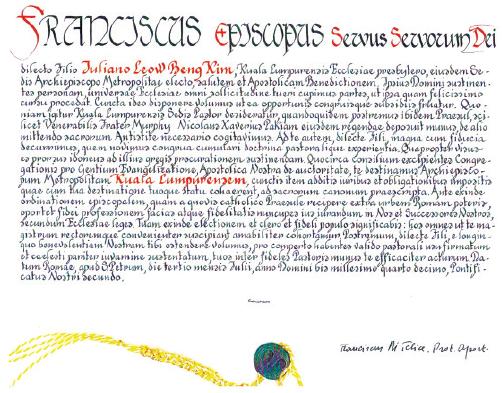
Full Video of the Episcopal Ordination of Archbishop Julian Leow Beng Kim, Metropolitan Archbishop of Kuala Lumpur (Malaysia)

On Monday, 6 October 2014, on the feast of St. Bruno, by the grace and authority of the Apostolic See and the Successor of St. Peter, through Archbishop Joseph Salvador Marino, the Apostolic Nuncio to Malaysia,  Fr. Julian Leow Beng Kim was ordained to the episcopal order by Metropolitan Archbishop John Ha Tiong Hock of Kuching, after he was appointed as the new Metropolitan Archbishop of Kuala Lumpur on 3 July 2014.

The episcopal ordination took place at the Church of the Holy Family at Kajang, Metropolitan Archdiocese of Kuala Lumpur.

http://www.gcatholic.org/dioceses/diocese/kual0.htm#56850

Metropolitan Archbishop Julian Leow Beng Kim is the fourth Metropolitan Archbishop of Kuala Lumpur, and as the shepherd of the largest diocese in Malaysia and the diocese of the capital city, he is also unofficially the Primate of Malaysia. He has as his suffragan bishops, the Bishops of Penang and Melaka-Johor.

11792273901412591832

We wish Archbishop Julian Leow Beng Kim all the best in his new calling as the shepherd of souls in Kuala Lumpur. May he remain faithful and devoted to the orthodox and pure teachings of the Faith and the Church, making no compromises against the forces of darkness arrayed against the Church even as we speak today. May he also be devoted to the sheep he had been entrusted to, and lead them to the true, unblemished and orthodox faith. Amen.

Saturday, 20 September 2014 : 24th Week of Ordinary Time, Memorial of St. Laurent Imbert, Bishop and Martyr; St. Jacques Chastan, Priest and Martyr; St. Andrew Kim Taegon and Companions, Martyrs (Homily and Scripture Reflections)

Liturgical Colour : Red

Dear brothers and sisters in Christ, in today’s readings we heard two great exhortations, by St. Paul in his letter to the faithful and the Church in Corinth on the nature of the resurrection of the faithful and then the parable of the sower and the seeds by Jesus who told them what happened to the various seeds that ended up in different conditions.

In the two readings, we can see a great link and similarity, as both of them refer to the growth and the sowing of seeds, and what are these seeds? They are none other than the seeds of faith, hope and love, the three cardinal virtues of Christian life, as these have been planted in us, within our hearts and souls. And the purpose for these seeds are so that we may truly be transformed from our sinful, mortal and earthly bodies, to be truly worthy of our Lord and God, in a new spiritual body as mentioned by St. Paul, that is a body filled with the wonderful flowers and fruits of faith, of hope and of love.

But Jesus our Lord mentioned in His parable of the sower, that this would not be an instantaneous, automatic or easy process. He clearly highlighted the problems, dangers and great challenges that line up against us, to prevent us from achieving that state of spiritual maturity and worthiness, that we end up to continue living in sin and darkness rather than be accepted into the light.

Mankind had lived in this world and as such are bound to the ways of this world, that is the way of the flesh, and the ways of the world. That had been the way of mankind ever since the days of our first ancestors, after they had sinned and been cast away from the presence of God, and had to endure the sufferings of the earth. Ever since then, mankind had lived on earth and obeyed the ways of the world rather than the ways of the Lord.

What we need in order to escape this bonds and prison of the world is by cultivating and growing the seeds of faith, hope and love which God had planted in us, through His Spirit. It is however, as mentioned, not going to be an easy path. The parable of the sower in fact showed us that the devil is always at work in order to prevent us from ever achieving salvation in God, and instead perish with him together in hell.

Jesus mentioned that the seeds fell on first the roadside and got eaten by the birds. In this case, He also explained how Satan is always at work as he desired our total annihilation, as a form of his vengeance and continuous rebellion against God. As we mankind are God’s greatest and most beloved creation, there is indeed nothing more sinister and evil for Satan to commit his defiance against God other than by subverting mankind and bringing them into sin.

And Satan has much in his possession in order to execute this extremely well. This is because many of us are like the seeds that fall on the rocky ground. We listened to the word of God and we received the words of the Good News of Christ, but these did not take root in our hearts. It is like we heard these words from our ears, but it then remains just a superficial attachment in any, and indeed, in our actions, in our own words and deeds, they represent nothing that the Lord had taught us.

This is a fertile ground for Satan to make his attack upon us, and it is easy for him to sow the seeds of dissent and unfaithfulness in our hearts. And indeed, the same also applies to the kind of those who are like the seeds that grow on the soil with thistles. Thistles are plants that can spread and grow on the surfaces of other plants, taking precious nutrients as a parasite to the host plant, which then eventually is suffocated, impoverished and therefore die.

This is one main way through which Satan made his attacks, that is through the pleasures of the flesh, and the desires of men. He made his attack on us through these, so as to ensnare us on our way to reach the Lord, and therefore fail to reach salvation in God. The thistle represents the temptations and the corruptions which Satan is trying very hard to impose on us, so that we may obey him instead of God.

For us to truly be able to achieve salvation, we have to take heed of what Jesus and St. Paul had conveyed to us on this day. This is namely that we have to abandon our earthly ways, and all the things we used to do in this world, which are not in accordance with the will of God, which He had revealed through Jesus His Son. In this manner, then we can have that rich soil in us, upon which the Word of God and the seeds of faith, hope and love in us may form deep roots and grow strong.

And perhaps, by sharing the lives of the saints which feast we are celebrating today will inspire us even more to follow God with all of our hearts. Today, we celebrate the feast day of St. Laurent Imbert, Vicar Apostolic of Korea, one of the first shepherds of the Church and the faithful in Korea, and also St. Jacques Chastan, another missionary to Korea, with his many companions in martyrdom, both missionary, laity and priests alike, the Martyr Saints of Korea.

Korea at that time, as it had been for about two hundred years, ever since the Faith first came there, was truly a very hostile place for the Church and the faithful. There were open and state-led persecution of the Christian faithful, who were seen as disloyal, traitors and enemies of the state. Many were made to choose between keeping their faith and death. Many abandoned Christ, but there were also many of those who remained faithful to the Lord and suffered holy martyrdom.

St. Laurent Imbert was the Vicar Apostolic of Korea, a missionary part of the French mission to Korea. He faithfully worked in shepherding the people entrusted under his care, and more and more come to believe in Christ and achieved salvation through his dedication. St. Laurent Imbert however, heard that the persecution of the faithful might cease, if he and the other leaders of the faithful would surrender themselves to the authorities.

The suffering of the faithful at the time was really great, and many were brought to martyrdom every day. Thus, in the spirit of the words of Jesus, St. Laurent Imbert, who was in hiding at the time, told his people, that he would surrender himself to the authorities, in exchange for the safety and protection of his flock. He mentioned the good shepherd, where Jesus mentioned that the good shepherd lay down his life for his sheep.

St. Laurent Imbert followed the example of Jesus and in his love and faith for his flock, he thought only of the best for them. Thus, he even willingly surrendered himself, even while knowing that his fate most likely would be death. He thus gave a great example to the faithful, which we too should follow and emulate in our lives. Even though the martyrdom and persecution would continue even after the martyrdom of St. Laurent Imbert, as the authorities reneged on their promises, the blood and faith of these holy martyrs continued to cause more and more faith to blossom and prosper among the persecuted people of God.

Therefore, brothers and sisters in Christ, let us all come to a greater realisation of how great is the amount of effort and work that we should input into our lives, so that we may grow deeper and stronger in our faith, our hope and our love, that we may indeed bear fruit, that is the fruits of the Holy Spirit.

May all of us be ever more faithful and devoted to our Lord, so that our Lord may find us worthy of Himself and reunite us with Him together in the company of St. Laurent Imbert, St. Jacques Chastan, St. Andrew Kim Taegon and all the holy martyr saints of Korea, and together with the other holy men and women, as well as the angels. God bless us all. Amen.

Saturday, 20 September 2014 : 24th Week of Ordinary Time, Memorial of St. Laurent Imbert, Bishop and Martyr; St. Jacques Chastan, Priest and Martyr; St. Andrew Kim Taegon and Companions, Martyrs (Gospel Reading)

Liturgical Colour : Red

Luke 8 : 4-15

As a great crowd gathered, and people came to Jesus from every town, He began teaching them with a story : “The sower went out to sow the seed. And as he sowed, some of the seed fell along the way, was trodden on, and the birds of the sky ate it up. Some seed fell on rocky ground, and no sooner had it come up than it withered, because it had no water.

Some seed fell among thorns; the thorns grew up with the seed and choked it. But some seed fell on good soil and grew, producing fruit, a hundred times as much!” And Jesus cried out, “Listen then, if you have ears to hear!”

The disciples asked Him, “What does this story mean?” And Jesus answered, “To you it has been given to know the mystery of the kingdom of God. But to others it is given in the form of stories, or parables, so that seeing they may not perceive, and hearing they may not understand.”

“Now, this is the point of the parable : The seed is the word of God. Those along the wayside are people who hear it, but immediately the devil comes and takes the word from their minds, for he does not want them to believe and be saved. Those on rocky ground are people who receive the word with joy, but they have no root; they believe for a while, and give way in time of trial.”

“Among the thorns are people who hear the word, but, as they go their way, they are choked by worries, riches, and the pleasures of life; they bring no fruit to maturity. The good soil, instead, are people who receive the word, and keep it in a gentle and generous mind, and persevering patiently, they bear fruit.”

Saturday, 20 September 2014 : 24th Week of Ordinary Time, Memorial of St. Laurent Imbert, Bishop and Martyr; St. Jacques Chastan, Priest and Martyr; St. Andrew Kim Taegon and Companions, Martyrs (Psalm)

Liturgical Colour : Red

Psalm 55 : 10, 11-12, 13-14

My enemies turn back when I call on You for help; now I know that God is for me.

In God whose word I praise, in God I trust without fear. What can mortals do against me?

I am bound to You by vows, o God; I shall offer my thanksgiving. For You have rescued my soul from death and my feet from stumbling, that I might walk in God’s presence in the light of the living.

Saturday, 20 September 2014 : 24th Week of Ordinary Time, Memorial of St. Laurent Imbert, Bishop and Martyr; St. Jacques Chastan, Priest and Martyr; St. Andrew Kim Taegon and Companions, Martyrs (First Reading)

Liturgical Colour : Red

1 Corinthians 15 : 35-37, 42-49

Some of you will ask : How will the dead be raised? With what kind of body will they come? You fools! What you sow cannot sprout unless it dies. And what you sow is not the body of the future plant but a bare grain of wheat or any other seed.

It is the same with the resurrection of the dead. The body is sown in decomposition; it will be raised never more to die. It is sown in humiliation, and it will be raised for Glory. It is buried in weakness, but the resurrection shall be with power. When buried it is a natural body, but it will be raised as a spiritual body.

For there shall be a spiritual body as there is at present a living body. Scripture says that Adam, the first man, became a living being; but the last Adam has become a life-giving Spirit.

The Spirit does not appear first, but natural life, and afterwards comes the Spirit. The first man comes from the earth and is earthly, while the second One comes from heaven. As it was with the earthly one, so is it with the earthly people. As it is with Christ, so with the heavenly. This is why, after bearing the image of the earthly one, we shall also bear the image of the heavenly One.

Friday, 19 September 2014 : 24th Week of Ordinary Time, Memorial of St. Januarius, Bishop and Martyr (Homily and Scripture Reflections)

Liturgical Colour : Green or Red (Martyrs)

Dear brothers and sisters in Christ, today we hear about the followers of Jesus, and in particular, the women who followed Jesus through His ministry, some of them, who were once sinners such as Mary Magdalene, healed from her affliction of seven demons, and the wife of Herod’s steward. There were of course other women that also accompanied Jesus which were not included in what we heard today in the Gospel.

Then in the first reading today, in the letter which St. Paul wrote to the faithful and the Church in Corinth, in which he highlighted the belief in the resurrection of Jesus and why those who believe in it will not be disappointed, but will indeed receive their rich rewards at the end, when the Lord comes again in glory to save His people and bring them into the eternal glory of heaven.

Our Lord had shown us the way to escape the trap and the dangers of death, through His own glorious resurrection from the dead. He who had given up His life through suffering, bearing the weight of our sins and our original sins, had opened up a new hope and a new path for us by His rising from the dead. If Christ had indeed remained dead as other men do, then there is no hope for us. But as the facts showed it, that Christ is truly risen, and the proof is none other than in the Church.

For our Church and our faith was founded on Christ Himself, and on the truth of His resurrection from the dead, such that He had triumphed against death and evil forevermore. And upon this solid foundation the Church had remained strong even against numerous assaults and attacks the evil one had marshalled against it through the world.

The holy women who followed Jesus had forsaken their old lives of sin, and they embraced the faith in Jesus, that they placed their trust in the Saviour of all. They followed Him as they knew that He is the One who would save them from their fate that was death and brought them into a new life in God. And that was what Jesus exactly had done unto them, as He brought them from the depths of their sins into new life filled with the joy and love of Christ.

And those who placed their trust in Jesus will not be disappointed indeed, for He had promised all His faithful ones, that He will raise all of us up on the last day, when He will judge us among the righteous ones and receive our due reward. God never disappoints, brethren, because it is in fact we are the ones who always disappoint our Lord, through our rebelliousness and disobedience, and through our unwillingness to listen to Him.

Today, we also celebrate the feast of St. Januarius, a bishop and martyr of the faith, whose life and examples would truly inspire us to put our trust in the Lord and believe in Him totally and completely without any doubt. St. Januarius, also known as San Gennaro, was the Bishop of the Diocese of Naples, which covers the modern day city of Naples, and the famous devotion to his miraculous event takes place there every year.

At the Cathedral of Naples, there exists a holy relic of St. Januarius, which consists of a vial filled with his blood, which has congealed and hardened throughout the long time since his death over seventeen centuries ago. This vial of blood liquefies exactly at every celebration of the saint’s feast day, that is this day, the nineteenth day of September.

St. Januarius himself lived during the late era Roman Empire, at the time when being a faithful is difficult, as challenges and persecutions against them were rampant. Nevertheless, St. Januarius continued to faithfully serve His beloved people, and guided them as their shepherd on their way towards their loving Lord and God. He lived on through the worst years of what is to be known as the Diocletian persecutions, after the Emperor who had persecuted the people of God at that time.

St. Januarius continued to minister to the people of God, even those who had been imprisoned, despite the obvious dangers to himself. He did them out of his great love for God and for His sheep, who had been entrusted to his care as the Bishop. He was indeed eventually captured and imprisoned, and then martyred for his faith. Indeed, though, the Lord never abandons those who are faithful to Him, as He granted this holy and devoted man a place in heaven, and miracles abounded after his death through his holy relics.

Brothers and sisters in Christ, the examples of St. Januarius remind us to keep our faith strongly in the Lord and make sure that we practice them in our lives, despite whatever the world is plotting against us. St. Januarius showed us that as the faithful ones of God, we should be courageous in proclaiming our faith in the Lord Jesus, the One and True God, who had died for us and through whose resurrection He had made us whole once again.

May Almighty God therefore continue to bless us this day, and strengthen our faith, so that we may walk in the footsteps of St. Januarius and the other holy saints, in following Jesus our Lord and Saviour, bringing the Good News of salvation to many, so that they too can be saved and together, with all the saints and angels of heaven, praise our Lord together as one people, and one Church. Amen.