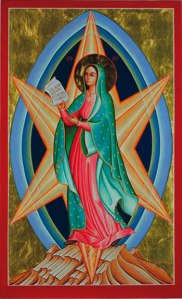
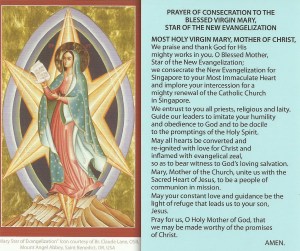
Prayer of Consecration to the Blessed Virgin Mary, Star of the New Evangelisation

marystarofevanglisationicon

On 7 October 2014, on the Feast of our Lady of the Rosary, His Excellency Archbishop William Goh Seng Chye, the Archbishop of Singapore dedicated and consecrated the Archdiocese of Singapore and all the efforts of the New Evangelisation in Singapore to the Blessed Virgin Mary, Star of the New Evangelisation.

Although this refers to the Archdiocese of Singapore, I believe that everyone else in the world, within the Church of God may also pray the same prayer for the sake of evangelisation of the Good News everywhere in this world.


Here is the text of the prayer, to be prayed daily from 7 October 2014 to 7 October 2015, the Feast of our Lady of the Rosary.


10669256_842249659148292_6829732685043142899_o

Most Holy Virgin Mary, Mother of Christ.

We praise and thank God for His mighty works in you. O Blessed Mother, Star of the New Evangelisation; we consecrate the New Evangelisation for Singapore to your Most Immaculate Heart and implore your intercession for a mighty renewal of the Catholic Church in Singapore. We entrust to you all priests, Religious and laity. Guide our leaders to imitate your humility and obedience to God and to be docile to the promptings of the Holy Spirit.

May all hearts be converted and re-ignited with love for Christ and inflamed with evangelical zeal, so as to bear witness to God’s loving salvation. Mary, Mother of the Church, unite us with the Sacred Heart of Jesus, to be a people of communion in mission.

May your constant love and guidance be the light of refuge that leads us to your son, Jesus. Pray for us, O Holy Mother of God, that we may be made worthy of the promises of Christ. Amen.

Monday, 6 October 2014 : 27th Week of Ordinary Time, Memorial of St. Bruno, Priest (Homily and Scripture Reflections)

Liturgical Colour : Green or White (Priests)

Brothers and sisters in Christ, in today’s readings from the Holy Scripture and the Gospel, we heard about how the Lord through His servant Paul the Apostle wanted to remind us to remain true to our faith, and that we should keep strongly to the faith which we have received through the Church, that is the true and orthodox faith, and reject all forms of heresies and heterodoxies that is present in our society and all around us, the falsehoods and lies which Satan spread to try to divide the Church of God.

For there exists in our society, false prophets and false teachers trying to proclaim the word of God in a twisted manner, to serve their own purposes, and also to serve the purposes of Satan, the evil one, for these false prophets and teachers indeed belong to Satan and his allies, as the ones who tried so desperately to wrench control over us from the Lord and to themselves.

And the sad fact is that many mankind, our own brothers and sisters willingly heard their words and went over to their side, and therefore becoming corrupted and unworthy, many were lost to us and to the Lord, condemned for eternity together with the false prophets, with Satan and his fellow fallen angels, the demons. Some did repent and return to the faith, but the damage had indeed been done to the unity of the Church.

Over the centuries, numerous false prophets and teachers of the faith sprung up, causing various heresies and divisions in the Body of the Church of God, and while some of these were healed and brought back into the truth of the Holy Mother Church, many remained lost to us, and in turn, they led even more people to be lost from the salvation which God had promised through His Church.

And to those who believe in ‘new’ revelations supposedly proclaimed and brought through the means of angels, and in one, even claiming that the Archangel Gabriel himself brought the ‘new’ revelation, they have to all beware, that unless it affirms the faith in the Lord, and in our Lord Jesus Christ, who has died for us, and who has risen in glory and majesty, then it is no angel, but Satan and his evil spirits that came to deceive mankind with their lies.

Brothers and sisters in Christ, we should rebuke Satan and reject all of his empty and false promises. We should also ignore and not heed the false teachings and the lies of the false prophets who taught falsehood instead of the truth of the Lord. Instead, we should follow the true way of the Lord, as Jesus His own Son, who came into the world, had revealed to us.

If the false prophets often appealed to our sense of self-preservation and satisfaction of our self, and our needs and wants, then the Lord showed that the true way to the Lord is through love, and this is none other than through loving God and loving one another, to think less of the self and the ego, and grow deeper and stronger in the love that is in our heart.

We cannot truly love God without having love for our brethren and all those around us who are always in need of our love. Similarly, we cannot truly love one another with full sincerity and genuine nature, without love for God. Love without either or both of the love we ought to have for God and others is imperfect love, and it may lead to harm rather than good.

And Jesus showed that it is important for us to take heed on how to love. He showed it through the story we all know, on the actions of the Good Samaritan, who went all the way to tend to the robbed and wounded man, taking care of him with genuine love and care, as an example of what love is, and what love should be. The Good Samaritan, as compared to the supposedly pious and respected Levite and the priest, is the one who had gotten the essence of love.

Samaritans as we all know, were highly discriminated against at the time of Jesus, in the territory of Judea in particular, where the robbing incident took place between Jerusalem and Jericho. They were seen as pagans and barbarians who did not follow the way of the Jews and did not worship and believe in the one true God. Yet, when Jesus came into the world, they were among the first to believe Him while the Jews doubted and rejected Him.

The actions and the deeds of the Jews did not represent what they professed to believe in. Their actions, as represented by the priests and the Levites were not representative of what they said they have faith in. All said, it is not all of the Jews that were in the wrong, as there were also many among them who followed Christ, such as His family and His disciples, but the problem truly lay with the prejudice with which the Jews in general held against the Samaritans.

Brothers and sisters in Christ, therefore, all of us should learn from the readings of the Holy Scripture and the Gospel today, from the actions of the Good Samaritan, who went the extra mile to help the unfortunate man. We should also therefore do the same, not just to those whom we loved, but also to everybody, including to those who are even against us and those who are not among those who we normally care for.

And we do not have to accomplish big and extensive things in order to do this. Even in simple things, like helping anyone, even strangers around us who are in need of even simple help, will do it just nicely. Therefore, brothers and sisters in Christ, let us all commit ourselves to a new life filled with love, both for God and for our fellow brothers and sisters, in real action, that in everything we do, we may show love, and through that love we may find justification for our faith.

Today, we celebrate the feast of St. Bruno, a priest and a contemporary of many other saints of the tenth and eleventh century Middle Ages Europe. He was the founder of the Carthusian religious order, and he was a great intellectual and a great educator. Many of those whom he had educated and influenced in life eventually became great saints themselves, as well as great and influential leaders of the Church, including even Pope Urban II, who initiated the First holy Crusade against the infidels.

St. Bruno, even though he was influential and well-respected, he remained humble and dedicated to his works, to advance the cause of the Faith in the world and to save souls. He refused the opportunity to be appointed and made a bishop, and he rather renounced himself from all worldliness, that he might focus much more of his abilities and time to help those who need his help, just as the Good Samaritan had once done.

May Almighty God put in us the spirit of love, that we may be more like the Good Samaritan, who devoted himself in love to his suffering brethren in need, and that we may also follow in the footsteps of St. Bruno of Cologne. May we grow less dependent and free from our ego, our desire and our selfishness, that we may truly be found righteous and just in the sight of our Lord and our God. God be with us always, and may His blessings and graces always be abundant in our lives. Amen.

Monday, 6 October 2014 : 27th Week of Ordinary Time, Memorial of St. Bruno, Priest (Gospel Reading)

Liturgical Colour : Green or White (Priests)

Luke 10 : 25-37

Then a teacher of the Law came and began putting Jesus to the test. And he said, “Master, what shall I do to receive eternal life?” Jesus replied, “What is written in the Scripture? How do you understand it?”

The man answered, “It is written : ‘You shall love the Lord your God with all your heart, with all your soul, with all your strength and with all your mind. And you shall love your neighbour as yourself.'” Jesus replied, “What a good answer! Do this and you shall live.” The man wanted to justify his question, so he asked, “Who is my neighbour?”

Jesus then said, “There was a man going down from Jerusalem to Jericho, and he fell into the hands of robbers. They stripped him, beat him and went off, leaving him half-dead. It happened that a priest was going along that road and saw the man, but passed by on the other side.”

“Likewise a Levite saw the man, and passed by on the other side. But a Samaritan also was going that way, and when he came upon the man, he was moved with compassion. He went over to him, and cleaned his wounds with oil and wine, and wrapped them in bandages. Then he put him on his own mount, and brought him to an inn, where he took care of him.”

“The next day he had to set off; but he gave two silver coins to the innkeeper, and said, ‘Take care of him, and whatever you spend on him, I will repay when I return.'”

Jesus then asked, “Which of these three, do you think, made himself neighbour to the man who fell into the hands of robbers?” The teacher of the Law answered, “The one who had mercy on him.” And Jesus said, “Then go and do the same.”

Monday, 6 October 2014 : 27th Week of Ordinary Time, Memorial of St. Bruno, Priest (Psalm)

Liturgical Colour : Green or White (Priests)

Psalm 110 : 1-2, 7-8, 9 and 10c

Alleluia! I thank the Lord with all my heart in the council of the just, in the assembly. The works of the Lord are great and pondered by all who delight in them.

The works of His hands are faithful and just, trustworthy are all His precepts, ordained to last forever, bearers of truth and uprightness.

He has sent His people deliverances and made with them a covenant forever. His Holy Name is to be revered! To Him belongs everlasting praise.

Monday, 6 October 2014 : 27th Week of Ordinary Time, Memorial of St. Bruno, Priest (First Reading)

Liturgical Colour : Green or White (Priests)

Galatians 1 : 6-12

I am surprised at how quickly you have abandoned God who called you according to the grace of Christ, and have gone to another gospel.

Indeed, there is no other gospel but some people who are sowing confusion among you want to turn the Gospel of Christ upside down. But even if we ourselves were giving you another gospel different from the one we preached to you, or of it were an angel from heaven, I would say : let God’s curse be on him!

As I have said I now say again : if anyone preaches the Gospel in a way other than you received it, fire that one. Are we to please humans or obey God? Do you think that I try to please people? If I were still trying to please people, I would not be a servant of Christ.

Let me remind you, brothers and sisters, that the Gospel we preached to you is not a human message, nor did I receive it from anyone, I was not taught of it but it came to me as a revelation from Christ Jesus.

Tuesday, 30 September 2014 : 26th Week of Ordinary Time, Memorial of St. Jerome, Priest and Doctor of the Church (Homily and Scripture Reflections)

Liturgical Colour : White

Dear brothers and sisters in Christ, today we heard how Job, the rich man who encountered great calamities because of the works of Satan to tempt him and test his faith in God, lamented about the sufferings which he had endured, and cursed that life which he had been brought to difficulties in, even to the point of cursing and regretting his own birth, a great lamentation and sorrow indeed.

But to all those who are familiar and know the Book of Job well, even though Job complained and complained about many things, and questioned about many things, but in no way that he was being directly disrespectful or insulting against God. Job also in the end realised the love which God had for him and all mankind, and was truly very sorry and repentant for all the abuses and curses which he had uttered.

And in the Gospel according to St. Luke, we heard how Jesus was proceeding to Jerusalem to embrace His mission as the Saviour of mankind, and then when He was passing by a Samaritan village, He asked for a lodging and dwelling, and was rejected because the people heard and knew that He was going to Jerusalem, the capital city of Judea and where the Jews have their centre of power.

We all should know that the Jews and the Samaritans at that time, as it had been for centuries before the coming of Christ, had been at odds and relationship between them had been stormy at best. The Samaritans feared the Jews because the Jews often mistreated them and have strong prejudice against them, and at times they had also suffered under the rule of the Jews, while the Jews themselves, puritan in nature, particularly the Pharisees, strongly condemned and looked down at the Samaritans as pagans and barbarians.

Therefore, it was likely that the Samaritans in the village refused to accept Jesus, not because of any hostile intent or malice, as what was shown by the Pharisees and the people of Israel themselves towards Jesus, but rather because of fear, uncertainty and doubt about what would happen to them, if they were to accept Jesus into their midst. Surely they were also aware that the Jews were particularly not at friendly terms with Jesus and His disciples at the time. It was after all, moments just before Jesus would carry on with His Passion and suffer death at their hands.

And notably, we should see that, Jesus did not punish them, and He even rebuked the Apostles for suggesting that the Lord should punish them for their apparent rejection of Him. This is in fact the same as what happened to Job, when his friends, fellow faithful ones of the Lord, counselled him and in a sense, persuaded him to be admonished, because they thought that Job was a sinner, and it was because of sin that he was punished. The truth was that Job was special, and he suffered not because of his sins, but rather, because he was truly faithful.

Today, we also celebrate the feast of St. Jerome, one of the great early Church fathers, and one of those who initiated the translation of the Bible from the original Greek version, the Septuagint, into a Latin version, which was more comprehensible to the Latin speaking world of the western portion of the Roman Empire, and eventually how we all know the Scriptures we have today, which are further translations from the Latin Bible written by St. Jerome, the Vulgate Bible.

St. Jerome himself once lived a pleasurable and debauched life early in his life, but soon his experiences, especially as he studied the occurrences of death in catacombs awakened him to the realities of hell to come. Thus, he atoned for his sins, and turned his energy into intellectual pursuits, working hard to study the teachings of the Lord and the teachings of His Church.

St. Jerome was indeed quite a scholar and writer, and his contributions to the Church was indeed immense. He wrote extensively, and his writings, together with his contemporary, St. Augustine of Hippo, another Doctor of the Church and important pillar of the Western Christendom, they formed the strong foundation and basis for the development of the faith and the Church in the subsequent years, including up to today.

Brothers and sisters in Christ, the fact highlighted here very clearly, after we heard the Scripture and Gospel readings, as well as the life of St. Jerome, we should all realise how our Lord is great, loving and merciful. God does not desire our destruction and suffering, but rather our prosperity and happiness. That is why He will never punish us without good reason, and more often than not, the suffering we encounter in life, was because of the works of Satan and his agents, as well as from ourselves.

It is indeed our wickedness and our lack of faith which caused us to suffer, because these separate us from the love and harmony of God, and we end up to dwell in the darkness of sin and evil, and it is this darkness that cause us suffering, and if we are not careful, we risk losing ourselves completely and fall into eternal damnation together with Satan and his angels.

Clearly this is not what we want. Therefore, let us all today vow to renew our faith to the Lord, and show it through concrete action, so that through our words and deeds, we may bring glory to God and show all those who see us, how great and loving is our God, and how merciful He is to forgive us from all our sins. May all of us be freed from the suffering of evil and this world, and be led into a new life in perfect happiness and joy of the Lord. Amen.

Tuesday, 30 September 2014 : 26th Week of Ordinary Time, Memorial of St. Jerome, Priest and Doctor of the Church (Gospel Reading)

Liturgical Colour : White

Luke 9 : 51-56

As the time drew near when Jesus would be taken up to heaven, He made up His mind to go to Jerusalem. He sent ahead of Him some messengers, who entered a Samaritan village to prepare a lodging for Him.

But the people would not receive Him, because He was on His way to Jerusalem. Seeing this, James and John, His disciples, said, “Do You want us to call down fire from heaven to reduce them to ashes?” Jesus turned and rebuked them, and they went on to another village.

Tuesday, 30 September 2014 : 26th Week of Ordinary Time, Memorial of St. Jerome, Priest and Doctor of the Church (Psalm)

Liturgical Colour : White

Psalm 87 : 2-3, 4-5, 6, 7-8

O Lord, my God, I call for help by day; before You I cry out by night. May my prayer come to You; incline Your ear to my cry for help.

My soul is deeply troubled; my life draws near to the grave. I am like those without strength. Counted among those going down into the pit.

I lie forsaken among the dead, like those lying in the grave, like those you remember no more, cut off from your care.

You have plunged me into the darkest depths of the pit. With Your wrath heavy upon me, You have battered me with all Your waves.

Tuesday, 30 September 2014 : 26th Week of Ordinary Time, Memorial of St. Jerome, Priest and Doctor of the Church (First Reading)

Liturgical Colour : White

Job 3 : 1-3, 11-17, 20-23

At length it was Job who spoke, cursing the day of his birth. This is what he said : “Cursed be the day I was born, and the night which whispered : a boy has been conceived. Why did I not die at birth, or come from the womb without breath? Why the knees that received me, why the breasts that suckled me?”

“For then I should have lain down asleep and been at rest with kings and rulers of the earth who built for themselves lonely tombs; or with princes who had gold to spare and houses stuffed with silver.”

“Why was I not stillborn, like others who did not see the light of morning? There the trouble of the wicked ceases, there the weary find repose. Why is light given to the miserable, and life to the embittered? To those who long for death more than for hidden treasure? They rejoice at the sight of their end, they are happy upon reaching the grave.”

“Why give light to a man whose path has vanished, whose ways God blocks at every side?”

Saturday, 27 September 2014 : 25th Week of Ordinary Time, Memorial of St. Vincent de Paul, Priest (Homily and Scripture Reflections)

Liturgical Colour : White

Dear brothers and sisters in Christ, today we heard about the reality of how we are insignificant before the Lord our God, and how limited our minds and intellect are before the Lord, whose will and plans are often not what we want in our lives. Thus, this was why the Apostles and the disciples of Christ did not comprehend the reason why Jesus spoke of His death and His suffering at the hands of the Pharisees and the elders of the people.

Our minds and thoughts are limited, and we are often not aware of what we are doing in our actions. In fact, we often act before thinking. We often jump into action not knowing that we should first carefully consider them, or else we risk consequences for our actions, which are more often than not, negative and harmful rather than positive.

And thus if we dwell always in our pride and our desires, then we are bound to worry, and worry and worry even more, because it is in our nature to worry and to care for our own well-being, to the point that we are deep in our own selfishness and self-preserving attitude, that we even are capable of deeds that cause discomfort and pain to others, so that we may preserve our own benefits and supposedly our happiness.

The disciples themselves still thought in the same way, and worked in the same way. They followed Jesus because they saw first in Him, a great Prophet and miracle worker of God, through whom many people were healed and made whole, had their demons exorcised and cast out of them, and even the feeding of a numerous multitude of four and five thousand men, and many more women and children. And in the end, they even witnessed how Jesus raised dead people back to life.

And in the Transfiguration, we knew how St. Peter, with St. James and St. John were brought by Jesus to the peak of the Mount Tabor, where they witnessed the glory and the true nature of Christ’s divinity, and how they were so joyful and buoyed by the happiness there, that they wanted to remain there forever, asking even Jesus that they ought to pitch tents there to stay on.

That is how mankind are like, as we always prefer the easy path and easy ways, and as much as possible, we tend to prefer to avoid ways of difficulties and challenges. And that was why the three Apostles pleaded with Jesus that they might stay in that place, in the glory of the Lord. But Jesus reminded them with a rebuke, that the reality and the plan of the Lord for us all, is not always a rosy one. He went down the mountain, away from His glory, and eventually, to strip Himself voluntarily from all of His glory and majesty, to suffer and die like a common prisoner and slave on the cross.

Brothers and sisters in Christ, this is also the reality about our faith and our lives as the children of God and part of His Church. At times we will encounter challenges and difficulties, and then we will truly be tested on our faith, on whether we ought to keep our own beings first before others and thus succumb to the temptations of our flesh and being, or to listen to the will of God, and do things as He had once done.

And perhaps, the life of the saint whose life we commemorate today will inspire us to do more in our faith, and this saint is in particular, known for his charitable works and even until today is still the patron saints of charitable actions and organisations. He is St. Vincent de Paul, a priest who lived in the late Renaissance era Europe and were renowned as the Great Apostle of Charity.

St. Vincent de Paul was once caught and enslaved by the infamous Berber Muslim pirates, who forced him to work as a slave on rowing ships and eventually was sold from one master to another. One of his master was a lapsed Christian who had converted into the religion of the heretics and apostates, and it was through the patience and hard works of St. Vincent de Paul, that he and his family was converted back into the true faith, and at the same time, St. Vincent de Paul gained his freedom.

St. Vincent de Paul worked hard throughout his life, dedicating himself to the poorest and the weakest in the society. Challenges and persecutions, opposition and hardships were common part of his life, but just as he had suffered even slavery and hardships earlier, he did not give up, and through his works, he became renowned for his great faith and charity, becoming a great source of inspiration to many who followed in his example.

Therefore, brothers and sisters in Christ, today as we reflect on the readings of the Holy Scriptures and the Gospels, let us all also take note of the examples and perseverance of St. Vincent de Paul. And we too ought to follow in his footsteps, exercising charity and love in all of our actions, casting away all of the pride and selfishness in us. Instead, let us all follow the way which our Lord Jesus Christ had set up before us, that is to love one another just as He had once loved us first.

May Almighty God thus also awaken the spirit of love and charity inside each one of us, that we may do something to help our brethren in need, especially those who are weak and poor, that the Lord who sees all and knows all, will approve of our actions and justify us in our faith and in our actions. God be with us all, brethren in Christ. Amen.