Tuesday, 31 December 2013 : Seventh Day of the Christmas Octave, Memorial of Pope St. Silvester I, Pope (Gospel Reading)

Liturgical Colour : White

John 1 : 1-18

In the beginning was the Word. And the Word was with God and the Word was God; He was in the beginning with God. All things were made through Him, and without Him nothing came to be. Whatever has come to be, found life in Him; life, which for human beings, was also light, light that shines in darkness, light that darkness could not overcome.

A man came, sent by God; his name was John. He came to bear witness, as a witness to introduce the Light, so that all might believe through him. He was not the Light, but a witness to introduce the Light; for the Light was coming into the world, the true Light that enlightens everyone.

He was in the world, and through Him the world was made, the very world that did not know Him. He came to His own, yet His own people did not receive Him; but to all who received Him, He empowers to become children of God, for they believe in His Name. These are born, but not by seed, or carnal desire, nor by the will of man : they are born of God.

And the Word was made flesh and dwelt among us; and we have seen His glory, the glory of the only Son of the Father : fullness of truth and loving-kindness. John bore witness to Him openly, saying, “This is the One who comes after me, but He is already ahead of me, for He was before me.”

From His fullness we have all received, favour upon favour. For God had given us the Law through Moses, but Truth and Loving-kindness came through Jesus Christ.

No one has ever seen God, but God-the-only-Son made Him known : the One, who is in and with the Father.

Tuesday, 31 December 2013 : Seventh Day of the Christmas Octave, Memorial of Pope St. Silvester I, Pope (Psalm)

Liturgical Colour : White

Psalm 95 : 1-2, 11-12, 13

Sing to the Lord a new song, sing to the Lord, all the earth! Sing to the Lord, bless His Name; proclaim His salvation day after day.

Let the heavens be glad, the earth rejoice; let the sea and all that fills it resound; let the fields exult and everything in them; let the forest, all the trees, sing for joy.

Let them sing before the Lord who comes to judge the earth. He will rule the world with justice and the peoples with fairness.

Tuesday, 31 December 2013 : Seventh Day of the Christmas Octave, Memorial of Pope St. Silvester I, Pope (First Reading)

Liturgical Colour : White

1 John 2 : 18-21

My dear children, it is the last hour. You were told that an antichrist would come; but several antichrists have already come, by which we know that it is now the last hour.

They went out from us though they did not really belong to us. Had they belonged to us, they would have remained with us. So it became clear that not all of us were really ours. But you have the anointing from the Holy One, so that all of you have true wisdom.

I write to you, not because you lack knowledge of the truth, but because you already know it, and lies have nothing in common with the truth.

Friday, 27 December 2013 : Feast of St. John the Evangelist, Apostle (Gospel Reading)

Liturgical Colour : White

John 20 : 2-8

Mary of Magdala ran to Peter, and the other disciple whom Jesus loved, and she said to them, “They have taken the Lord out of the tomb and we do not know where they have laid Him.”

Peter then set out with the other disciple to go to the tomb. They ran together, but the other disciple outran Peter and reached the tomb first. He bent down and saw the linen cloths lying flat, but he did not enter.

Then Simon Peter came, following him, and entered the tomb; he, too, saw the linen cloths lying flat. The napkin, which had been around His head, was not lying flat like the other linen cloths, but lay rolled up in its place.

Then the other disciple, who had reached the tomb first, also went in; he saw and believed.

Monday, 18 November 2013 : 33rd Week of Ordinary Time, Memorial of the Dedication of the Basilica of St. Peter and the Basilica of St. Paul Outside the Walls (First Reading)

Liturgical Colour : Green or White (Dedication of Basilica)

1 Maccabees 1 : 10-15, 41-43, 54-57, 62-64

From the kings who followed Alexander (the Great), from their descendants there came a godless offshoot, Antiochus Epiphanes, son of King Antiochus, who had been held as hostage in Rome. He became king in the one hundred and thirty-seventh year of the Greek era (175 B.C.).

It was then that some rebels emerged from Israel, who succeeded in winning over many people. They said, “Let us renew contact with the peoples around us for we had endured many misfortunes since we separated from them.”

This proposal was well-received and some eagerly went to the king. The king authorised them to adopt the customs of the pagan nations. With his permission, they built a gymnasium in Jerusalem in the pagan style. And as they wanted to be like the pagans in everything, they made artificial foreskins for themselves and abandoned the Holy Covenant, sinning as they pleased.

Antiochus issued a decree to his whole kingdom. All the peoples of his empire had to renounce their particular customs and become one people. All the pagan nations obeyed and respected the king’s decree, and even in Israel many accepted the imposed cult. They offered sacrifices to idols and no longer respected the Sabbath.

On the fifteenth day of the month of Chislev, in the year one hundred and forty-five, Antiochus erected the “abominable idol of the invaders” on the altar of the Temple. Pagan altars were built throughout the whole land of Judea; incense was offered at the doors of their houses and in the squares. There wicked men tore up the books of the Law they found and burned them. They killed anyone they caught in possession of the book of the Covenant and who fulfilled the precepts of the Law, as the royal decree had ordered.

But in spite of all this, many Israelites still remained firm and determined not to eat unclean food. They preferred to die rather than to make themselves unclean with those foods prohibited by the Law, that violated the Holy Covenant. And Israel suffered a very great trial.

Alternate Reading (Mass for Dedication of the Basilicas)


Acts 28 : 11-16, 30-31

After three months, we boarded a ship that had spent the winter at the island. It belonged to an Alexandrian company and carried the figurehead of Castor and Pollux as insignia. We sailed for Syracuse, staying there for three days and, after circling the coast, we arrived at Rhegium.

On the following day, a south wind began to blow, and at the end of two days we arrived at Puteoli, where we found some of our brothers who invited us to stay with them for a week. And that was how we came to Rome.

There the brothers and sisters had been informed of our arrival and came out to meet us as far as the Appian Forum and the Three Taverns. When Paul saw them, he gave thanks to God and took courage.

Upon our arrival in Rome, the captain turned the prisoners over to the military governor, but permitted Paul to lodge in a private house with the soldier who guarded him.

Paul stayed for two whole years in a house he himself rented, where he received without any hindrance all those who came to see him. He proclaimed the kingdom of God and taught the truth about Jesus Christ, the Lord, quite openly and without any hindrance.

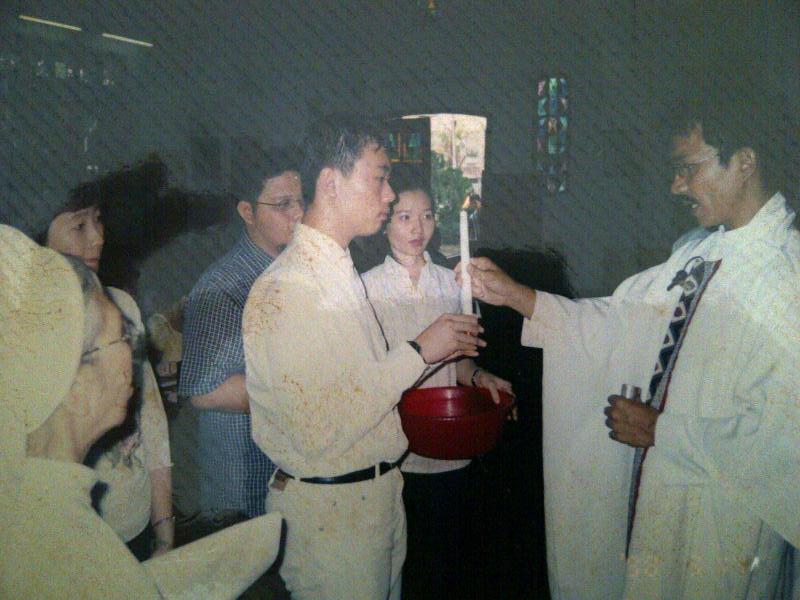
9th Anniversary of my baptism and entry into the Church of God (19 September 2004 – present)

9 years ago, on the Feast of St. Januarius, 19 September 2004, I was received into the Church through the Sacrament of Baptism.

As St. Paul before me, I have been called from the darkness into the light. Once a sinner, God had called me to be one of His children, unworthy as I am.

May my patron saints, St. Peter Canisius and St. Peter my namesake, and St. Michael the Archangel who strengthens me, continue to pray for me, and pray for all the other children of God in this world! That they will especially pray for those who are still on the journey to seek the Lord and in the process to enter the Church of God!

Image

(I baptise you in the Name of the Father, and the Son, and the Holy Spirit)

Image

(As Christ was anointed Priest, Prophet, and King, so may you live always as a member of His Body, sharing everlasting life)

Image

(Receive the light of Christ!)


Pray for me always, brethren! And pray for our brethren in need of our love too!

My oath of obedience to our new Pope, Pope Francis. God bless our Pope!

God, the Lord of the Universe, who through Jesus Christ Your Son, has brought salvation upon this world. Hear me now I pray, with Your holy angels and holy saints as witness before Your Holy throne in Heaven.

I promise and offer my full and unconditional obedience on Franciscus, our Pope Francis, whom through the Holy Spirit You have inspired the Cardinals to elect, as the one to continue the mission of Peter, Your Apostle, upon whom You entrusted the keys to Your Kingdom, and upon whom You built Your very own Church, that is Your Most Precious Body, in union with all who believes in You, now led by Francis, as one indivisible union, the One, Holy, Catholic, and Apostolic Church.

I call upon the angels and the saints as witness on this promise, and I ask them too to pray for our Holy Father, that he will be strengthened in his new ministry, not just as the Bishop of Rome, but also the Successor of St. Peter, the Prince of the Apostles, as the leader of the Universal Church, all over the world.

May he be strengthened in faith, hope, and love, and exercise great charity as his namesake St. Francis of Assisi had done, and at the same time, profess to defend the Sacred Tradition of the Holy Apostles, and the orthodox Catholic faith, as it is, unchanging, since the beginning, now, and ever shall be, forever and ever! Amen!

On this Holy Gospel I make solemn my oath and promise, and I hope that not only that I will remain faithful to it, but also help our dear Holy Father, Pope Francis, in his mission to evangelise the Word of God to all corners of this world, through whatever means I can, including this humble blog of mine.

Ad multos annos, Papa Franciscus! Pontifex maximus et Beati Petri Apostolorum Principis succesori, Episcopus Romanus.

Tu es Petrus et super hanc petram aedificabo Ecclesiam meam, et portae inferi non praevalebunt adversus eam, et tibi dabo claves regni caelorum. Quodcumque ligaveris super terram, erit ligatum et in cælis, et quodcumque solveris super terram, erit solutum et in cælis.

(You are Peter, and on this Rock, I will build My Church, and the gates of hell will not prevail against It, and I will give you the keys of the kingdom of heaven. Whatever you bind on this earth, it will be bound in heaven, and whatever you loosen on this earth, it will be loosened in heaven).


+Peter Canisius Michael David Kang

(Ut Omnes Unum Sint, ad Maiorem Dei Gloriam – That they all may be One, for the greater glory of God)

Details on the Papal Inauguration Mass and ceremony of Pope Francis, 266th Pope and Bishop of Rome

Mass appeal: some details of tomorrow’s papal inauguration—UPDATED

Today, Tuesday, 19 March 2013, our new Pope will be solemnly inaugurated to begin his Pontificate. He is already our Pope, ever since he accepted the rightful election in the Conclave, but the Inauguration ceremony affirms and completes that process, with the imposition of the symbols of the authority of the Pope, as the leader of the entire Universal Church.

There will be some changes to the liturgy this year, as the imposition of the Pallium and the Ring of the Fisherman will take place just before the Mass starts, instead of being within the Mass itself, as the impositions are seen as more of an extra-liturgical event.

The Pope will pray with the leaders of the Eastern Catholic Churches, the Patriarchs and Major Archbishops at the Tomb of St. Peter underneath the main altar of St. Peter’s Basilica, where the pallium and the ring had been placed since the night before.

The Pope will then proceed with all the other concelebrating Cardinals and prelates outside to the Altar at St. Peter’s Square, which in the meanwhile the Laudes Regia hymn or ‘Laud to the King (Christ)’, that is a glorious rendition of the Litany of the Saints, with the new innovation of the inclusion of part asking the past Popes who had been canonised as saints for the new Pope, their successor, beginning from Pope St. Linus to Pope St. Pius X.

Following after this is the imposition of the papal pallium, which is different from the pallium worn by the Metropolitan Archbishops. Pope Francis’ pallium will be the same in appearance with that of Pope Benedict XVI’s pallium, with red crosses instead of black ones, representing the wounds of Christ, with three gold pins on three of the crosses, representing the nails that bound both hands and the legs of Christ onto the cross. The pallium symbolises the authority the Pope has over the entire Universal Church. The pallium will be imposed by the senior Cardinal of the order of Priest in the Cardinal-electorate, Cardinal Godfried Danneels.

The Ring of the Fisherman will be given after this, which signifies the bond between the Pope and God’s Church, and as the image on the ring depicts, that of St. Peter holding the keys on a boat, while fishing, as a fisher of man, it symbolises the Pope’s role as the successor of St. Peter the Apostle, and also as the current holders of the keys of the kingdom of Heaven, entrusted by Christ to Peter. The ring will be presented to the Pope by the senior Cardinal Deacon, Cardinal Jean-Louis Tauran.

Six Cardinals representing the rest of the Cardinals will pay homage to the Pope, and will give their obedience to him, following the imposition of the pallium and the Ring of the Fisherman.

The Mass follows as usual, and the readings will be done in different languages, English, Spanish, and most notably the Gospel in Greek, to highlight the universal nature of the Church, encasing both the Western and Eastern tradition of Christendom. The whole liturgy of the Mass itself will be conducted in solemn Latin and beautiful Gregorian chants.

The booklet for the Mass is available at the link below, in English, Italian, and Latin :

Click to access 20130319_inizio-ministero-petrino.pdf

Wednesday, 13 March 2013 : 60th Birthday Anniversary of the Apostolic Nuncio to Singapore, Archbishop Leopoldo Girelli

Yesterday, besides being the day when our new Pope, Pope Francis was elected the 266th Pope and the 265th Successor of St. Peter the Apostle, was another joyous day.

http://www.gcatholic.org/dioceses/nunciature/nunc152.htm#8848

This is because, Archbishop Leopoldo Girelli, Apostolic Nuncio to Singapore, who was born on 13 March 1953, celebrated his 60th anniversary yesterday.

Let us pray together for Archbishop Girelli, that God will continue to shower him with His love and strength, that he will continue to faithfully carry out the mission that has been entrusted to him as the representative of the Holy See to Singapore, Vietnam, and to ASEAN.

Ad multos annos, Your Excellency!

Papal Inauguration Mass of the Pontificate of Pope Francis I, Bishop of Rome

http://www.romereports.com/palio/inauguration-mass-for-pope-francis-i-scheduled-for-feast-day-of-st-joseph-english-9411.html

The Papal Inauguration Mass of the Pontificate of Pope Francis I, Jorge Maria Bergoglio, who was the Metropolitan Archbishop of Buenos Aires, Argentina, and elected the 266th Pope on Wednesday, 13 March 2013, will be held on :


Feast of St. Joseph, Spouse of the Blessed Virgin Mary, Tuesday, 19 March 2013, at 9.30 am Rome time (CET/UTC+1)


The timing in other timezones are :

1. UTC : Tuesday, 19 March 2013 at 8.30 am

2. EDT : Tuesday, 19 March 2013 at 4.30 am

3. PDT : Tuesday, 19 March 2013 at 1.30 am

4. WIB / UTC+7 : Tuesday, 19 March 2013 at 3.30 pm

5. Singapore / UTC+8 : Tuesday, 19 March 2013 at 4.30 pm