At that time, that same day, Jesus left the house and sat down by the lakeside. Many people gathered around Him. So He got into a boat, and sat down, while the crowds stood on the shore; and He spoke to them in parables about many things.
Jesus said, “The sower went out to sow; and, as he sowed, some seeds fell along the path; and the birds came and ate them up. Other seeds fell on rocky ground, where there was little soil, and the seeds sprouted quickly, because the soil was not deep. But as soon as the sun rose, the plants were scorched; and they withered, because they had no roots.”
“Again, other seeds fell among thistles; and the thistles grew and choked the plants. Still, other seeds fell on good soil and produced a crop : some a hundredfold, others sixty, and others thirty. If you have ears, then hear!”
The Israelites left Elim and the entire community reached the desert of Sin, between Elim and Sinai, on the fifteenth day of the second month after leaving Egypt. In the desert the whole community of Israel grumbled against Moses and Aaron and said to them, “If only we had died by the hand of YHVH in Egypt when we sat down to caldrons of meat and ate all the bread we wanted, whereas you have brought us to this desert to let the whole assembly die of starvation!”
YHVH then said to Moses, “Now I am going to rain down bread from heaven for you. Each day the people are to gather what is needed for that day. In this way I will test them to see if they will follow My Teaching or not. On the sixth day when they prepare what they have brought in, they will find that there is twice as much as they gather each day.”
Then Moses directed Aaron to say to the whole community of Israel, “Draw near to YHVH for He has heard your complaints.” It happened that as Aaron was speaking to the full assembly of Israel, they turned towards the desert and saw the Glory of YHVH in the midst of the cloud.
Then YHVH spoke to Moses, “I have heard the complaints of Israel. Speak to them and say : Between the two evenings you will eat meat, and in the morning you will have bread to your heart’s content; then you shall know that I am YHVH, your God!”
In the evening quails came up and covered the camp. And in the morning, dew had fallen around the camp. When the dew lifted, there was on the surface of the desert a thin crust like hoarfrost. The people of Israel upon seeing it said to one another, “What is it?” for they did not know what it was. Moses told them, “It is the bread that YHVH has given you to eat.”
Dear brothers and sisters in Christ, today as we listened to the words of the Scripture, we are called to reflect on our faith in the Lord and what it means to be Christians, as those whom God had called and chosen to be His own people. He has called us to walk in His path and to trust in Him, and as long as we are faithful, we have nothing to fear, for God Himself will always be by our side. If God has always been faithful even when we have been unfaithful, then how much more blessed we shall be then, if we are faithful?
In our first reading today, we heard the moment when the Lord delivered His people, the people of Israel, from the hands of the Egyptians and their Pharaoh, as He led them through the Red Sea, safe and sound, walking on the dry seabed as He opened the sea before them. And we heard from the Book of Exodus today, the moment of the final triumph as the Lord delivered the Egyptian chariots and armies into the sea, crushing them before Him.
The sea engulfed and destroyed all those who had pursued the Israelites across the sea, and finally the people of Israel were truly free, as they would no longer be under the tyranny or rule of the Egyptians and the Pharaoh. The Lord Who loved them and had compassion on them had shown them the undeniable truth and proof of His enduring and ever generous love for them. He rescued them from their great sufferings and restored hope to them.
Through this, all of us are yet again reminded of all the great and wonderful things that the Lord had done for our sake. Just as He has blessed and taken good care of the Israelites, thus, He has done the same for us, and will continue to do the same for us. However, it is we ourselves who often disobey Him and disregard Him, ignoring Him and preferring to follow our own paths rather than to trust in the Lord and His path. And in this day’s Gospel passage, we heard the Lord reminding all of us that those who follow the Lord and obey His will, they are all beloved and blessed by God, as those considered to be His own brothers and sisters, as intimate part of the family of the faithful.
All of us are therefore reminded of the need for us all to have faith in the Lord and to walk courageously and faithfully in His path, remembering all that He had done for the sake of His beloved people. We have to keep this faith alive in us, and grow ever stronger in our commitment to the Lord, and be role models for one another in how we are living our lives so that we may help more and more people to turn towards the Lord with renewed faith. Let us all not be easily swayed by doubt or fear, or by any other temptations that often prevented us from truly finding our way to the Lord.
Today, we also celebrate the feast of St. Apollinaris, a famous bishop and martyr of the faith, who was the Bishop of Ravenna in today’s Italy. According to Church tradition, he was made the Bishop of Ravenna by none other than St. Peter himself, the Bishop of Rome and first Pope. St. Apollinaris of Ravenna was appointed as the shepherd of the growing flock of the faithful in Ravenna, caring for their spiritual well-being and needs, and leading them through the challenging times of the earliest days of the Church there. St. Apollinaris laboured hard for the sake of the Lord and His Church, establishing firm foundation for the Church and the population of Christians under his care grew rapidly.
It was told that the miracles he performed during his ministry inspired many to turn towards the Lord and became Christians. This however also led to fierce opposition by the pagans who viewed the growth in the Christian faith and Church as great threat to themselves. As such, St. Apollinaris and his flock were persecuted, with the bishop himself attacked and made to suffer, enduring difficult trials and challenges, suffering from wounds and torture, sent into exile and prison. Yet, St. Apollinaris endured all these obstacles and strove to do his best to remain firmly faithful to the Lord.
Through to his eventual martyrdom, St. Apollinaris inspired many Christians that came after him, and many others who chose to turn to the Lord because of his examples, which strengthened and encouraged many other Christians to do the same, and become beacons of God’s light among the people of this world. How about us then, brothers and sisters in Christ? Are we not inspired in the same way as well? Are we not ashamed that while so many others had been inspired and moved by the Lord’s love and by the faith showed from His faithful servants, yet we are still unfaithful and lacking in commitment and love for the Lord?
Brothers and sisters in Christ, let us all therefore turn towards the Lord with renewed vigour and zeal, and rediscover that love and faith that we ought to have in the Lord, and for the Lord. May the Lord bless us all and may He guide us all in our journey, efforts and good endeavours that we may ever be closer to God and conform ever more to the path that He has set before us all. May God be with us all, now and always, forevermore. Amen.
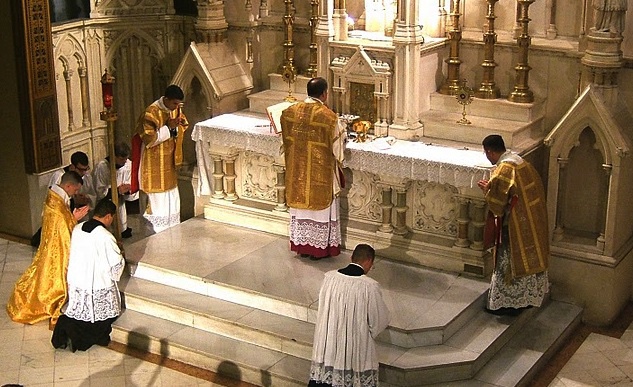
Brothers and sisters in Christ, I am sure that many of you are left with questions and even disappointments after listening to the publication of the new Motu Proprio ‘Traditionis Custodes’ (Custodians of Tradition) by His Holiness Pope Francis on 16 July 2021 regarding the rules and regulations on the celebration of the Holy Mass in the Roman Rite using the 1962 Missal, also known as the Extraordinary Form of the Roman Rite or Usus Antiquior.
There are undoubtedly many different responses from all segments of the Church, from utter dismay and anger by those who felt betrayed and oppressed by the new stricter regulations, to those who are rejoicing and exuberant because they had long opposed and were vocal critics of the ancient Mass and tradition. Unfortunately, the nature of these responses is exactly why the release of this Motu Proprio is an opportunity for the entire Church to reflect carefully on what our faith and our authentic liturgical expression is all about.
First of all, Traditionis Custodes does not equate the banning or attempt to make the Extraordinary Form of the Roman Rite illegal, unlike what quite a few individuals and groups had been saying. Unsurprisingly, these are the same groups and individuals that had been the very reason why Traditionis Custodes had been promulgated and published in the first place. These are the clear minority among those who treasure faith and tradition, and yet, are the most vocal and radical in their viewpoints, which unfortunately led to the broad characterisation and prejudice against the entire communities of the faithful favourable to the Extraordinary Form and tradition as a whole.
On the other extreme, we also have those who will not stop at anything to ‘change’ the Church and its teachings, a relativistic attitude to conform to worldly preferences and desires, to change the Church teachings and ways to suit the comforts and conveniences of men. These are also usually the same ones who are most jubilant and happy at the imposition of strict regulations as stipulated in the Motu Proprio Traditionis Custodes. In any case, these people who represent extreme attitudes are incompatible with the Universal Church, and were the ones that caused divisions within our Church and the communities of the faithful.
As such, we have to first of all appreciate that the ultimate goal of Popes since the efforts of Pope St. John Paul II in liberalising the use of the Extraordinary Form through the Motu Proprio Ecclesia Dei in 1988 and Pope Benedict XVI with Summorum Pontificum in 2007, is to bring together all the faithful in one expression of faith through the liturgy, encompassing both the liturgical reforms of the Second Vatican Council while appreciating the riches of the tradition of the ancient liturgy, from which the Ordinary Form ultimately also stemmed from.
What the Popes intended is for all the faithful communities to benefit mutually from the best of each liturgies, the theology and the rich symbolism of the ancient Extraordinary Form, its adherence to the rubrics and emphasis on the Sacrificial nature of the Holy Mass, while also appreciating the beauty and outreach of the vernacular and the more widespread use of the Scriptures and its contents in the Ordinary Form, which remained faithful in all to the true essence of the Mass, that is the celebration of the Lord’s one and only Sacrifice at Calvary.
Unfortunately, there were those who continued to be stubborn and refused to acknowledge, respect or accept the reforms of the Second Vatican Council. Although indeed there were abuses and grave errors in how some interpreted the Council and how they took the liturgy to the extent of liturgical abuse, but it can’t be denied that the actions of those who refused to accept the decisions, documents and developments of the Second Vatican Council have led to division within the united Church, the Body of Christ, with some even insisting on more extreme ideologies, rejecting even the Pope and other teachings of the Church.
That is why as we continue moving on forward as one united Body of Christ, the Church, we must make sure that the provisions of the Motu Proprio Traditionis Custodes are adhered to and followed. We have to trust in the Lord and the Holy Spirit, that the bishops to whom the authority had been entrusted in the management of the celebration of the Holy Mass in the Extraordinary Form, will exercise prudence and sound judgment, charity and generosity in extending the permission to celebrate to all those who have been deemed suitable to celebrate with reverence, the Extraordinary Form of the Roman Rite, for the benefit of all the faithful.
We also pray that the Lord will continue to bring us to true unity, that we will no longer be divided by our ideologies, and especially not by our liturgical preferences. The Holy Mass is after all, the same, valid and worthy, regardless whether it is done in the Ordinary Form or in the Extraordinary Form. What is important is the need for us to be reverent in our celebration of the Holy Mass, to be inclusive in our worship and to put God first and foremost in all things, especially in our worship above all else. That is why we should neither discriminate or be prejudiced against either the Ordinary or Extraordinary Form, or to be lacking in proper reverence and respect of the Lord, as some of the worst liturgical abuses had done in the past decades.
Let us all look deep into our faith and the traditions that our forefathers had upheld, and together with the Pope, our bishops and priests, and as one Universal Church, be more united to the Lord through prayer, and resolve to commit ourselves to better and ever more perfect unity through Him, that we may benefit from the riches of both Forms of our most noble Roman Rite, and grow ever stronger in our faith, with each and every passing moment. Let us all grow ever stronger in charity and compassion towards others, and develop a most loving and inclusive community of the faithful, united in the Lord, in purpose and mission, in our love and reverence to the Lord.
At that time, while Jesus was talking to the people, His mother and His brothers wanted to speak to Him, and they waited outside. So someone said to Him, “Your mother and Your brothers are standing outside; they want to speak with You.”
Jesus answered, “Who is My mother? Who are My brothers?” Then He pointed to His disciples and said, “Look! Here are My mother and My brothers. Whoever does the will of My Father in heaven is My brother and sister and mother.”
At the blast of Your nostrils the waters piled up, the surging waters stood firm in a heap; the deeps congealed in the heart of the sea. The enemy said, “I will give chase and overtake, I will divide the spoil and make a feast of it. I shall draw my sword and my hand will destroy them.”
A breath of Yours and the sea covered them; they sank like lead in the mighty waters. You stretched out Your right hand; the earth swallowed them.
You will bring them in and plant them on the mountain of Your inheritance, the place You chose to dwell in, o YHVH, the sanctuary prepared by Your hands.
Moses stretched out his hand over the sea. At daybreak the sea returned to its place. As the Egyptians tried to flee, YHVH swept them into the sea. The waters flowed back and engulfed the chariots and horsemen of the whole army of Pharaoh that had followed Israel into the sea. Not one of them escaped. As for the Israelites they went forward on dry ground in the middle of the sea, the waters forming a wall on their right and their left.
On that day YHVH delivered Israel from the power of the Egyptians and Israel saw the Egyptians lying dead on the seashore. They understood what wonders YHVH had done for them against Egypt, and the people feared YHVH. They believed in YHVH and in Moses, His servant. Then Moses and the people sang this song to YHVH : “I will sing to YHVH, the Glorious One, horse and rider He has thrown into the sea.”
Dear brothers and sisters in Christ, today as we listened to the words of the Scripture, we are called to have faith in the Lord, to believe in Him and to trust in Him, that each and every one of us may grow in our faith in Him and not to be easily swayed by doubt and fear, or by worldly temptations and pressures among other things. The readings of the Scripture that we have heard today from the Book of Exodus on the moment of Israel’s liberation from the Egyptians, and the Lord’s words to the Pharisees and the teachers of the Law ought to serve as good examples of this.
In our first reading today we heard of the time when the Israelites were already journeying away from the land of Egypt to the shores of the Red Sea, when the Pharaoh changed his mind about letting the Israelites go free, and sent his forces, his army and chariot to go after all of them. The people became afraid and panicked after they saw the Egyptians and their chariots coming for them, trapping them between the chariots and the Sea. They were desperate and began to blame Moses and the Lord for having brought them out of Egypt.
This was the example of how we let our fears and insecurities to rule over us and cloud our judgments, leading us to lose our faith in the Lord, just as we did not have strong faith in Him from the very beginning. We placed our trust more in our own strength and capabilities, and when these failed us, we gave in to despair and desperate actions, that actually brought us even further away from God and fell deeper into sin and into the clutches of the evil ones. Too often we worry and are concerned excessively because we have no trust and faith in the Lord.
And therefore, just as on that day on the shores of the Red Sea, when the armies and the chariots of the Egyptians and their Pharaoh were bearing down on the Israelites, many among the people of God lost heart and grumbled against the Lord instead of entrusting themselves to Him, despite having seen for themselves how God had intervened on their behalf, in sending ten great plagues that struck Egypt, the Egyptians and their Pharaoh so hard that these all forced the latter to agree to let the people of Israel to go free. They had seen so much, and yet, failed to believe, because they had not allowed the Lord to enter into their hearts yet.
This is therefore can be compared to the attitudes of the Pharisees and the teachers of the Law who in our Gospel passage today were mentioned as asking the Lord to give then signs so that they might believe in Him. They had in fact seen so many of the Lord’s miracles and wonders as they relentlessly pursued the Lord and hounded Him throughout His ministry, as they followed Him from place to place, seeking to find evidence against Him. They had seen all these, and yet still refused to believe in the Lord, and even dared to ask Him for more signs.
Why did the Pharisees and the teachers of the Law did these things, brothers and sisters in Christ? That is because they had hardened their hearts and minds, and closed them against the Lord, Who had ceaselessly and patiently knocked against the doors of their hearts and minds. They fell to the temptations of their worldly desires, of their pride and ego, their ambition and also want for power and influence, for fame and worldly glory, all of which led to their downfall, as they continued to resist the Lord’s good works and disobeyed Him, again and again.
No amount of miracles and signs would be enough to sway them all as long as they allowed themselves to be bought over by worldly desires and temptations. They saw the Lord as great rival of their own power, prestige and influence, and thus, that was why they worked so hard against Him, to the consternation of the Lord and His disciples. But the Lord remained patient and loving even towards them, and revealed how He would give them the ultimate Sign, as He was to be laid on the Altar of the Cross, to suffer death and then to rise again from the dead into glory on the third day, while alluding to the story of the prophet Jonah.
Through that, the Lord wanted to remind them and also all of us, that when we encounter challenges and trials, difficulties and hardships, we must not lose faith in Him. On the contrary, in fact we have to redouble our faith and commitment to Him, seeking Him with ever greater sincerity and zeal. This is what each and every one of us are supposed to do, and what all of us are called to do as Christians, to be those people who trust in the Lord with all of our hearts and might, and dedicate ourselves each and every moment of our lives to glorify the Lord.
May the Lord be with us and may He strengthen us, reminding us of how He has rescued His people by the shores of the Red Sea, opening the sea before them, leading them through and crushing the armies and the chariots of the Pharaoh and the Egyptians, showing them and all of us, that in the end, if we stay faithful to the Lord, we shall triumph and if we remain in His grace, we shall gain eternal life and true joy, through Him. May God bless us and our good endeavours and efforts, now and always. Amen.
At that time, some teachers of the Law and some Pharisees spoke up, “Teacher, we want to see a sign from You.” Jesus answered them, “An evil and unfaithful people want a sign; but no sign will be given them except the sign of the prophet Jonah. In the same way, as Jonah spent three days and three nights in the belly of the whale, so will the Son of Man spend three days and three nights in the heart of the earth.”
“At the judgment, the people of Nineveh will rise with this generation, and condemn it; because they reformed their lives at the preaching of Jonah, and here, there is greater than Jonah. At the judgment, the Queen of the South will stand up and condemn you. She came from the ends of the earth to hear the wisdom of Solomon; and here, there is greater than Solomon.”



 petercanisiusmichaeldavidkang