
A Brief State of the Church in China – a Church in Trial and Persecution, a Church of Martyrs, a Church of Hope

The Church in China (1949) consisted of :

20 Archdioceses

85 Dioceses

39 Apostolic Prefectures

3,080 Missionaries

2,557 Chinese priests (Total : 5,637 priests)

4 million Catholics


The Church in China (2014) consists of :

20 Archdioceses

94 Dioceses

34 Apostolic Prefectures

1 Apostolic Exarchates

3,500 priests (approximate)

12 million Catholics (both open and underground)


Looking at the above comparisons, we can see a wary future for the Church in China, which had been in official and unofficial persecution for the past six and a half decades since 1949, the year when the Communist Party of China took over power in China. Since then, the Church in China, which was once among the most vibrant and fastest growing in the world, had been in great tribulation and period of persecution. Especially during the Cultural Revolution years in the 1960s, there were great attacks against the faithful and the faith throughout the country.

On one side, it seems that there had been a growth in the number of Catholics and in terms of the growth in the number of the dioceses. However, if we look deeper into the reality of the Church and the faith, there had been a great trouble that threatened many of the faithful, especially being divided between the ‘official’ government-sanctioned ‘church’ and the underground ‘loyal’ Church.

Many of the Archdioceses and dioceses are vacant, or that their bishops are not recognised as valid and legitimate, having often been government-picked, and more of a loyal men to the government rather than true and good shepherds for the faithful. Many of the bishops were picked by the government-sanctioned Chinese Patriotic Catholic Association or CPCA, whose leaders have often been noted to be not just laymen, but even non-baptised people.

There had been much grievances and controversies in the recent years in the illegitimate and illegal election and ordination of bishops by the CPCA and the Chinese government which were not approved by the Holy See. On some occasions, the bishops did receive blessing from both parties, but in many other cases, it was the contrary. This further deepened the division among the faithful in China.

Many of China’s priests and bishops are underground, that is they remain faithful and loyal to the completeness of the faith in the Church, and unaffected by the pressure from the government to obey them. There had been great persecution against them and the faithful under their care, such that imprisonments and forced labour are not uncommon.
Ma_Daqin_2_(600_x_450)

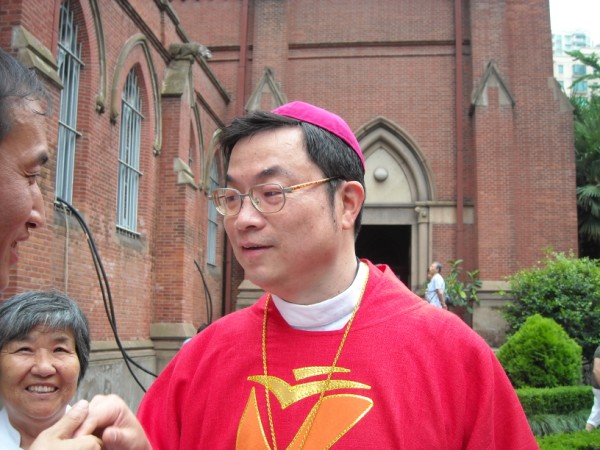
And recently, just almost two years ago, the then newly appointed Auxiliary Bishop of Shanghai, Bishop Thaddeus Ma Daqin bravely and courageously announced his resignation from the CPCA, the official ‘church’ of China at his own episcopal ordination, which was done with the blessing of the Holy See and the Pope. This resignation triggered a massive response from the government which resulted in his incarceration for the past two years, and he had greatly suffered for this. His episcopal motto is clear and indeed clearly highlighted his wish for the unity of the Church in China with the Universal Church, free from any external intervention. His motto is “Ut Sint Unum ad Maiorem Dei Gloriam” or “That they may be One, for the greater glory of God.”

The Church in China still grows, and more and more people hunger for the truth that Christ can offer them. There are many opportunities at evangelisation, and many brave and courageous ministers of the Lord’s Gospel went forth even against the challenges that await them. The recent attacks by the government on the Christian faith, as shown by the demolition of a church building in Wenzhou show how much the authoritarian government fears the power and influence that the Church and the faith may have in bringing about their downfall. The downfall of Communism and the authoritarian governments in Eastern Europe must still be fresh in the minds of the autocrats in Beijing, and they fear their own demise if they allow the faith to grow unchecked.

There is still great hope in the Church in China, and there is genuine faith in the people, who desire to be reunited completely with their brethren in faith, all of us, in the Universal Church, and be freed from any form of pressure or external domination, which are unjust and uncalled for. But they need our prayers, our support and our encouragement.
a2b631b0

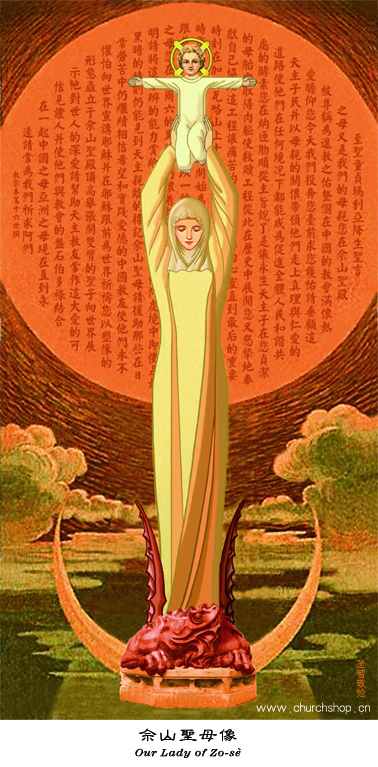
Let us ask for the intercession of the Blessed Mother of our Lord, Mary, the Help of Christians, who in the above picture is depicted as our Lady of Zose or Sheshan, from a famous pilgrimage site in Sheshan near Shanghai. Let us ask for her intercession for the Church in China and for the faithful there, our brethren in faith. Just as once the Lord had done His great works through Pope St. John Paul II, another great saint, to cast down the tyranny of atheism and unbelief in the states of Eastern Europe and Russia, may our Lady of Sheshan also intercede for the sake of our brethren in faith in China, a great nation and a great civilisation and yet is filled with worldly hatred of the devil who hates the Church and all its faithful.

We also pray that there will be a new spirit of dialogue and renewal, and that those entrusted with power at the top of the Chinese government hierarchy will finally realise the futility and the inhumane nature of their attempts to control the Church and the faithful. We hope that there will be an amicable and peaceful solution, that the Church in China may be completely reunited once again with the Universal Church, free from all the current issues and dilemmas, and free from any political arguments and intrusions by any external forces.

May the Lord be with His people always, protect them, bless them, and guide them to the light of Christ. May He give them rest and grace, after all the difficulties and challenges that they have faced, in the courageous and zealous defense of their faith in Him. Amen.

Saturday, 24 May 2014 : 5th Week of Easter, Memorial of Mary Help of Christians and our Lady of Sheshan in China, World Day of Prayer for the Church in China (Gospel Reading)

Liturgical Colour : White

John 15 : 18-21

If the world hates you, remember that the world hated Me before you. This would not be so if you belonged to the world, because the world loves its own. But you are not of this world, since I have chosen you from the world; because of this the world hates you.

Remember what I told you : the servant is not greater than his master; if they persecute Me, they will persecute you, too. If they kept My word, they will keep yours as well. All this they will do to you for the sake of My Name, because they do not know the One who sent Me.

Thursday, 1 May 2014 : 2nd Week of Easter, Memorial of St. Joseph the Worker (Scripture Reflections)

Liturgical Colour : White

Brothers and sisters in Christ, today we celebrate the feast day of St. Joseph the Worker, which also falls on the same day as the day set aside for the celebration of the right of workers and labourers around the world, commonly known as either the Labour Day or May Day. On this day, workers around the world celebrate their right to equal pay, treatment and rights, as well as even protesting to demand for more, if they did not receive enough.

Today we celebrate the memory of St. Joseph, the foster-father of Jesus, who was also a very diligent worker as a carpenter in the village of Nazareth. St. Joseph is the role model for all workers, not only that he is so diligent and hardworking, but he is also very upright in his actions and did not do things that were in opposition to the Law of God and the teachings of the prophets.

St. Joseph reminded all of us, not just the workers of who we are, namely the children and most beloved of all the creations of the Lord. We were created last by the Lord in creation, and we were made in His image, and as if that is not enough, He also endowed us with His own Spirit that bears life inside each one of us. And yet, we are at the same time, as the first reading from the Book of Genesis mentioned, also made of dust, which the Lord used to craft our mortal bodies of flesh and blood.

Thus the well-known saying that ‘We are dust, and to dust we shall return, which the priest utters every Ash Wednesday as he applies the ash onto our forehead. This is to remind us of our humanity, fragility and mortality, which should keep us to realise that we are in this world as its caretakers and everything that we do, we ought not to do it for our own sake and benefits, but for the sake of the Lord and all our brethren around us.

St. Joseph showed that above all, we should be the bearers of the good will of the Lord, and walk always in the way of God, be righteous in all of our actions and deeds, not turning left or right, or be persuaded or tempted by the world’s persuasions and temptations. As we work, we should always remember to have good work attitudes and openness to suggestions and advice, and not to close ourselves off from cooperating with others.

A truly major problem with our world and its working force is that we no longer work for the good of one another, but we ended up to be in the sole pursuit of one thing, that is money and even other forms of material possessions. As I have often mentioned, money is not necessarily evil, and indeed, it is perfectly neutral and is completely not a vice that we should avoid. The evil lies in us, that is in how we attempt to gain it, how we gain it, and eventually how we use it, and what we use it for.

This world has increasingly become a commercialised and materialistic world, where you can almost literally say that money is king, for those who have more will not just tend to have even more, but that they also are likely to have a better and more enjoyable life. For many of us, working and our actions in work had become nothing more than literally slaving away our lives and our precious time for money, and more money.

We forget that when we work we should be more like St. Joseph, who worked with great simplicity and humility, and while being serious and dedicated to his works, he dedicated it out of love towards God and to his fellow men. As a carpenter, he certainly did not earn much from his works, but certainly from every single furniture he crafted for those who ordered them from him, he gained much gladness and satisfaction, seeing the happiness on their faces seeing the completed product.

Surely we all can visualise and imagine how St. Joseph had worked hard to help provide for the Holy Family, for Jesus our Lord and Mary His mother. It is this kind of simple and yet genuine devotion to one’s work based in love that is the kind of work attitude that we need to have and follow. Sadly the truth is indeed that we have been so caught up in our busy life schedules and careers that we end up forgetting what is the most important thing in our lives.

As St. Joseph has shown us, we cannot discount God out of our lives, as without God our lives will be meaningless and empty, and this is also the reason why so many of us lost our true purpose as we work, that we no longer work for the benefits of others around us, and instead, for our own benefit, that is for our own selves, in our great ego, desire and greed.

It is easy these days to be tempted, brethren, for the temptations of goodness of this world is basically all around us, from all the promotions and commercials that we are exposed to every single day of our lives, that we really cannot escape but notice how much good that this world can grant us. Therefore we are prone to fall into this trap of materialism and commercialism, where we desire more and more the goods of this world, while forgetting that the true purpose we have in this world is to love and to dedicate ourselves completely to the Lord.

Brothers and sisters in Christ, as we celebrate today’s occasion on the feast of St. Joseph the worker and the day of celebration of labour, let us always be reminded that we should not be working for the sake of working and to seek for more and more material goods. Instead, as we work, let us have a good purpose to it, especially praising and glorifying the Lord our God.

St. Joseph the worker, the foster-father of our Lord, pray for us all, that we will seek less of our own glory and pleasure when we so something or work, that we do not become creature of ego or the servant of material possessions. Help us through your prayers that we may instead work for the good of one another, and be dedicated to our work just as you had been dedicated to yours. May God be with us all and bless our work at all times. Amen.

Wednesday, 30 April 2014 : 2nd Week of Easter, Memorial of Pope St. Pius V, Pope (First Reading)

Liturgical Colour : White

Acts 5 : 17-26

The High Priest and all his supporters, that is the party of the Sadducees, became very jealous of the Apostles; so they arrested them and had them thrown into the public jail. But an angel of the Lord opened the door of the prison during the night, brought them out, and said to them, “Go and stand in the Temple court and tell the people the whole of this living message.”

Accordingly they entered the Temple at dawn and resumed their teaching. When the High Priest and his supporters arrived, they called together the Sanhedrin, that is the full Council of the elders of Israel. They sent word to the jail to have the prisoners brought in.

But when the Temple guards arrived at the jail, they did not find them inside, so they returned with the news, “We found the prison securely locked and the prison guards at their post outside the gate, but when we opened the gate, we found no one inside.”

Upon hearing these words, the captain of the Temple guard and the high priests were baffled, wondering where all of this would end. Just then someone arrived with the report, “Look, those men whom you put in prison are standing in the Temple, teaching the people.”

Then the captain went off with the guards and brought them back, but without any show of force, for fear of being stoned by the people.

Friday, 18 April 2014 : Good Friday of the Lord’s Passion, Easter Triduum (Passion Reading)

Liturgical Colour : Red

John 18 : 1 – John 19 : 42

When Jesus had finished speaking, He went with His disciples to the other side of the Kidron Valley. There was a garden there, which Jesus entered with His disciples.

Now Judas, who betrayed Him, knew the place, since Jesus had often met there with His disciples. So Judas took soldiers and some servants from the chief priests and Pharisees, and they went to the garden with lanterns, torches and weapons.

Jesus knew all that was going to happen to Him; He stepped forward and asked, “Who are you looking for?” They answered, “Jesus the Nazarene.” Jesus said, “I am He.” Judas, who betrayed Him, stood there with them. When Jesus said, “I am He,” they moved back and fell to the ground.

He then asked for a second time, “Who are you looking for?” and they answered, “Jesus the Nazarene.” Jesus replied, “I told you that I am He. If you are looking for Me, let these others go.” So what Jesus had said came true : “I have not lost one of those You gave Me.”

Simon Peter had a sword; he drew it and struck Malchus, the High Priest’s servant, cutting off his right ear. But Jesus said to Peter, “Put your sword into its sheath; shall I not drink the cup which the Father has given Me?”

The guards and the soldiers, with their commander, seized Jesus and bound Him; and they took Him first to Annas. Annas was the father-in-law of Caiaphas, who was the High Priest that year; and it was Caiaphas who had told the Jews, “It is better that one Man should die for the people.”

Simon Peter with another disciple followed Jesus. Because this disciple was known to the High Priest, they let him enter the courtyard of the High Priest along with Jesus, but Peter had to stay outside at the door. The other disciple, who was known to the High Priest, went out and spoke to the maidservant at the gate and brought Peter in.

Then this maidservant on duty at the door said to Peter, “So you are also one of His disciples?” But he answered, “I am not.”

Now the servants and the guards had made a charcoal fire and were standing and warming themselves, because it was cold. Peter was also with them warming himself.

The High Priest questioned Jesus about His disciples and His teaching. Jesus answered him, “I have spoken openly to the world; I have always taught in places where the Jews meet together, either at the assemblies in synagogues or in the Temple. I did not teach secretly. Why then do you question Me? Ask those who heard Me, they know what I said.”

At this reply one of the guards standing there gave Jesus a blow on the face, saying, “Is that the way to answer the High Priest?” Jesus said to him, “If I have spoken wrongly, point it out; but if I have spoken rightly, why do you strike Me?”

Then Annas sent Him, bound, to Caiaphas, the High Priest. Now Simon Peter stood there warming himself. They said to him, “Surely you also are one of His disciples.” He denied it, and answered, “I am not.” One of the High Priest’s servants, a kinsman of the one whose ear Peter had cut off, asked, “Did I not see you with Him in the garden?” Again Peter denied it, and at once the cock crowed.

Then they led Jesus from the house of Caiaphas to the headquarters of the Roman governor. It was now morning. The Jews did not go inside, lest they be made unclean by entering the house of a pagan, and therefore not allowed to eat the Passover meal. So Pilate came out and asked, “What charge do you bring against this Man?”

They answered, “If He were not a criminal, we would not be handing Him over to you.” Pilate said, “Take him yourselves and judge him according to your own law.” But they replied, “We ourselves are not allowed to put anyone to death.”

It was clear from this what kind of death Jesus was to die, according to what Jesus Himself had foretold. Pilate then entered the court again, called Jesus and asked Him, “Are You the King of the Jews?” Jesus replied, “Does this word come from you, or did you hear it from others?”

Pilate answered, “Am I a Jew? Your own nation and the chief priests have handed You over to me. What have You done?” Jesus answered, “My Kingship does not come from this world. If I were a king, like those of this world, My guards would have fought to save Me from being handed over to the Jews. But. My Kingship is not of this world.”

Pilate asked Him, “So You are a King?” And Jesus answered, “Just as you say, I am a King. For this I was born and for this I have come into the world, to bear witness to the truth. Everyone who is on the side of truth hears My voice.” Pilate said, “What is truth?”

Pilate then went out to the Jews again and said, “I find no crime in this Man. Now, according to custom, I must release a prisoner to you at the Passover. With your agreement I will release to you the king of the Jews.” But they insisted and cried out, “Not this Man, but Barabbas!” Now Barabbas was a robber.

Then Pilate had Jesus taken away and scourged. The soldiers also twisted thorns into a crown and put it on His head. They threw a cloak of royal purple around His shoulders; and they began coming up to Him and saluting Him, “Hail, King of the Jews!” And they struck Him on the face.

Pilate went outside yet another time and said to the Jews, “Look, I am bringing Him out, and I want you to know that I find no crime in Him.” Jesus then came out wearing the crown of thorns and the purple cloak, and Pilate pointed to Him, saying, “Here is the Man!”

On seeing Him the chief priests and the guards cried out, “Crucify Him! Crucify Him!” Pilate replied, “Take Him yourselves and have Him crucified, for I find no case against Him.”

The Jews then said, “We have a Law, and according to the Law this Man must die because He made Himself Son of God.” When Pilate heard this he was more afraid. And coming back into the court he asked Jesus, “Where are You from?” But Jesus gave him no answer. Then Pilate said to Him, “You will not speak to me? Do You know that I have power to release you, just as I have power to crucify You?”

Jesus replied, “You would have no power over Me unless it had been given you from above; therefore the one who handed Me over to you is more guilty.” From that moment Pilate tried to release Him, but the Jews cried out, “If you release this Man, you are no friend of Caesar. Anyone who makes himself a king is defying Caesar.”

When Pilate heard this, he had Jesus brought outside to the place called the Stone Floor – in Hebrew – Gabbatha – and sat down in the judgment seat. It was the day of preparation for the Passover, about noon. Pilate said to the Jews, “Here is your King.” But they cried out, “Away! Take Him away! Crucify Him!” Pilate replied, “Shall I crucify your King?” And the chief priests answered, “We have no king but Caesar!”

Then Pilate handed Jesus over to them to be crucified. They took charge of Him. Bearing His own cross, Jesus went out of the city to what is called the Place of the Skull, in Hebrew Golgotha. There He was crucified, and with Him two others, one on either side, and Jesus in the middle.

Pilate had a notice written and fastened to the cross, which read : Jesus the Nazorean, the King of the Jews. Many Jewish people saw this title, because the place where Jesus was crucified was very close to the city; and the title was written in Hebrew, Latin and Greek.

The chief priests said to Pilate, “Do not write ‘The King of the Jews’; but, ‘This Man claimed to be King of the Jews.'” Pilate answered them, “What I have written, I have written.”

When the soldiers crucified Jesus, they took His clothes and divided them into four parts, one part for each of them. But as the tunic was woven in one piece from top to bottom, they said, “Let us not tear it, but cast lots to decide who will get it.”

This fulfilled the words of Scripture : They divided My clothing among them; they cast lots for My garment. This was what the soldiers did. Near the cross of Jesus stood His mother, His mother’s sister Mary, who was the wife of Cleophas, and Mary of Magdala. When Jesus saw the mother, and the disciple whom He loved, He said to the mother, “Woman, this is your son.” Then He said to the disciple, “There is your mother.” And from that moment the disciple took her to his own home.

Jesus knew all was now finished and, in order to fulfill what was written in Scripture, He said, “I am thirsty.” A jar full of bitter wine stood there; so, putting a sponge soaked in the wine on a twig of hyssop, they raised it to His lips. Jesus took the wine and said, “It is accomplished.” Then He bowed His head and gave up the Spirit.

As it was Preparation Day, the Jews did not want the bodies to remain on the cross during the Sabbath, for this Sabbath was a very solemn day. They asked Pilate to have the legs of the condemned men broken, so that the bodies might be taken away.

The soldiers came and broke the legs of the first man and of the other man, who had been crucified with Jesus. When they came to Jesus, they saw that He was already dead, so they did not break His legs. One of the soldiers, however, pierced His side with a lance, and immediately there came out Blood and water.

The one who saw it, has testified to it, and his testimony is true; he knows he speaks the truth, so that you also might believe. All this happened to fulfill the words of Scripture : Not one of His bones shall be broken. Another text says : They shall look on Him whom they have pierced.

After this, Joseph of Arimathea approached Pilate, for he was a disciple of Jesus, though secretly, for fear of the Jews. And he asked Pilate to let him remove the Body of Jesus. Pilate agreed, so he came and took away the Body.

Nicodemus, the man who at first had come to Jesus by night, also came and brought a jar of myrrh mixed with aloes, about a hundred pounds. They took the Body of Jesus and wrapped it in linen cloths with the spices, following the burial customs of the Jews.

There was a garden in the place where Jesus had been crucified, and, in the garden, a new tomb in which no one had ever been laid. And therefore, because the sepulchre was nearby, and the Jewish day of preparation was coming to a close, they placed the Body of Jesus there.

Monday, 14 April 2014 : Monday of Holy Week (Psalm)

Liturgical Colour : Purple/Violet

Psalm 26 : 1, 2, 3, 13-14

The Lord is my light and my salvation – whom shall I fear? The Lord is the rampart of my life; I will not be afraid.

When the wicked rush at me to devour my flesh, it is my foes who stumble, my enemies fall.

Though an army encamp against me, my heart will not fail; though war break out against me, I will still be confident.

I hope, I am sure, that I will see the goodness of the Lord in the land of the living. Trust in the Lord, be strong and courageous yes, put your hope in the Lord!

Friday, 11 April 2014 : 5th Week of Lent, Memorial of St. Stanislas, Bishop and Martyr (First Reading)

Liturgical Colour : Purple/Violet

Jeremiah 20 : 10-13

I hear many people whispering, “Terror is all around! Denounce him! Yes, denounce him!” All my friends watch me to see if I will slip : “Perhaps he can be deceived,” they say; then we can get the better of him and have our revenge.”

But YHVH, a mighty warrior, is with me. My persecutors will stumble and not prevail; that failure will be their shame and their disgrace will never be forgotten. YHVH, God of hosts, You test the just and probe the heart and mind.

Let me see Your revenge on them, for to You I have entrusted my cause. Sing to YHVH! Praise YHVH and say : He has rescued the poor from the clutches of the wicked!

Wednesday, 2 April 2014 : 4th Week of Lent, Memorial of St. Francis of Paola, Hermit (Scripture Reflections)

Liturgical Colour : Purple/Violet

Brothers and sisters in Christ, today we hear about how everything that Jesus did, He did them in accordance with the will of God the Father, and thus, He did them out of the love He has for all of us without exception. That was the very purpose of why Jesus, the Son of God Most High was sent into this world, that He who was divine and with the Father, was willing to come down and to be born as one of us, as Man.

He came in accordance with the will of God, that He wanted all of us who had been separated from Him due to our disobedience and that of our ancestors’ disobedience, so that we may be brought back to Him, and be forgiven in new life sanctified in God. That was why the Lord who loves us so much, sent us His only beloved Son, to be our Saviour.

How fortunate we are indeed, that our Lord Himself had lowered Himself to come upon us and show us what new hope and salvation are truly about. Jesus is the hope for all mankind, the light which pierces through the darkness, both within us and which surround all our beings in this world. In Jesus is our compass, the north reference point, to which all of us should look towards and go to.

Brothers and sisters in Christ, Jesus came to us as our shepherd, to guide us on our way towards the Lord, that we may not be lost, but gain eternal glory and rewards at the end of time. We are the lost sheep of the Lord, who had been spread across the land, and covered in the darkness of this world. The Lord is our light, and He enlightens our path, and with His staff and rod, He guides us to the eternal rest He had prepared for us.

But as all shepherds do, He calls upon us, and He knows each of us, by name. He truly knows all that we do in secret, as He is the Lord of all, omniscient and all-knowing. There is nothing that he did not know of. He calls us, but we as the lost sheep, have all the choice and free will to either heed His call or to ignore and reject Him.

God offered us His guidance and help through Jesus His Son. Like a loving shepherd He guides each and every one of His sheep that they may find their way, our way, to reach towards salvation. Yet we may choose to follow Him or follow the false shepherd, that is the devil. The devil also calls upon us, pretending to be the true shepherd, tricking us to follow him instead of the Lord, the true and good shepherd.

Brothers and sisters in Christ, this is why we have to discern things carefully, in what we do, and in what we follow, that we will not fall into committing what is evil in the eyes of the Lord and fall into condemnation and destruction that awaits  Satan and his followers, the fallen sheep, at the end of time. We have to discern on our lives and our actions, that we will walk in the light and not darkness.

Today we celebrate the feast of St. Francis of Paola, a hermit who lived in Italy during the era of the Renaissance. St. Francis of Paola was a very devout and upright individual even since his early youth, and he modelled himself much after his patron, St. Francis of Assisi, the founder of the Franciscan religious order. St. Francis of Paola modelled his life after his namesake and patron, and founded a religious order with similar kind of dedication to the Lord.

Yes, brethren, St. Francis of Paola gave all of his life in dedication to the Lord his shepherd. He did not veer left or right in his ways, and remained true to the Lord until the end of his life. St. Francis of Paola is the example of how a sheep who desires to find his shepherd, and his Lord, that he gave it his all, in total and complete dedication to the will of God.

Brothers and sisters in Christ, we can learn many things from the holiness and greatness of St. Francis of Paola. He was great not because he was powerful or mighty in the eyes of men, but because he did not budge even against the forces of this world, and neither did he fear any worldly oppressions or repercussions, that he even challenged kings of the world and rebuked them for their wickedness and transgressions despite themselves professing as Christians.

We too should follow in his footsteps, that we may dedicate ourselves more and more to the Lord, and at the same time also learn to follow His ways and make our lives a reflection of the Lord’s will and teachings, that just like St. Francis of Paola, we may be holy and justified, and the Lord will keep us always in His favour and grace.

St. Francis of Paola, pray for us sinners, that we may overcome our fear of the Lord and come seek Him like sheep looking for their shepherd, that together with you, we may praise the Lord and serve Him for eternity. God bless us all. Amen.


Saturday, 15 March 2014 : 1st Week of Lent (Scripture Reflections)

Liturgical Colour : Purple/Violet

Brothers and sisters in Christ, we all belong to God, just as He had mentioned it in the first reading we heard today. Just as He had claimed Israel to be His chosen ones, to be His chosen people, we too, in the new covenant that Jesus had established with all mankind, have been made to be the people of God, and consecrated to Him in His love.

And as He Himself mentioned, that those who belong to Him ought to be like Him in our actions, words and deeds, that we may reflect Him in all the things that we do. And therefore, we should follow all of His commandments and laws He had revealed to us through the prophets as written in the Scriptures, and through Jesus His Son.

We are God’s children, and like all children do, we ought to follow what our parents are doing, imitating them in their actions, deeds and thoughts. And as God our Father and Lord is Love Himself, we too have to love then, and love just as God loved us. And the commandments of God itself is love, designed to help us to be able to better love one another and to love and dedicate ourselves to God.

And in love, this love is not the kind of love that we often know in this world. There are many kinds and forms of love, but true and genuine love does not equate with lust and desire for pleasure, and neither can it be associated entirely with the love that someone express for another, between a man and a woman, or love that exists between those who had already loved one another in the first place.

Instead, true and genuine love means to love without discrimination and conditions. It is an unconditional love which we offer to all. Genuine love means to do what Christ had told us to do, that is to love even our enemies and pray for them, that they too may know love through the power of our prayer and the example of our unconditional and genuine love.

Yes, brethren, too often we have tried to fight fire with fire, and adding even more fuel to the fire, which ends up in everything being destroyed. And that is what usually happens, when we try to confront hatred and violence with even more violence. Everything will be destroyed and crushed in the end. That is what will happen if we response to someone’s hatred and enmity with even more enmity and hatred from our side.

Brothers and sisters in Christ, that is why it is important for us to instead fight the fire with water, to cool down the fire and let it die down, that in the end everything may be calm again, and through the water, the barren and burnt ground may once again hold life in it. The same therefore, we should practice in our own faith. We have to confront hatred and enmity with love, even if the other side does not yet love us.

Counter their curses with blessings, and show them that we can bring to them a valuable piece of truth, that hatred and violence does not solve everything, and instead will bring things to complete disarray and destruction. Love is the way out of things, as well as peace. We have to always remember this whenever we act.

Make peace with one another and love, and let us all come together in devotion to God in love. Let us show those who still linger in darkness and in the shadow of hatred, that love is the way, and may our actions based in love and forgiveness, help them to get out of the darkness and into the light that together, we may be saved. God be with us all, to the end of time. Amen.

Saturday, 15 March 2014 : 1st Week of Lent (Gospel Reading)

Liturgical Colour : Purple/Violet

Matthew 5 : 43-48

You have heard that it was said : Love your neighbour and do not do good to your enemy. But this I tell you : love your enemies, and pray for those who persecute you, so that you may be children of your Father in Heaven. For He makes His sun rise on both the wicked and the good, and He gives rain to both the just and the unjust.

If you love those who love you, what is special about that? Do not even tax collectors do as much? And if you are friendly only to your friends, what is so exceptional about that? Do not even the pagans do as much?

As for you, be righteous and perfect in the way your heavenly Father is righteous and perfect.