
Monday, 2 June 2014 : 7th Week of Easter, Memorial of St. Marcellinus and St. Peter, Martyrs (Scripture Reflections)

Liturgical Colour : White or Red (Martyrs)

Brothers and sisters in Christ, we indeed believe in God and we put our trust in Him. However, as we all witnessed in our own lives, and in today’s Scripture readings, we know that things are not always good and nice to us all the time. There will be moments of difficulties and challenges that we will need to overcome, and opposition and resistance will always be a part and parcel of our lives.

Today we celebrate the feasts of two saints and martyrs of the faith, who are truly renowned in the Church, that of St. Marcellinus and St. Peter, both of whom received their martyrdom in the early fourth century, three hundred years after the birth of Christ. They went through one of the most intense period of persecution of the faithful, done by the Roman Emperor Diocletian, the last of the systematic and thorough persecution of the faithful people of God.

Although not much informations from their era remained to tell us greater and more about their tales and life stories, but through the Church, which preserved the knowledge about them, the two saints and martyrs were faithful servants of God, as both a preacher and for the case of St. Peter, an exorcist who cast out demons and evil spirits. They went around proclaiming the Good News through words, deeds and actions.

However, at that time, the Roman Empire had not yet accepted Christianity, and to live as a Christian at that time, and in many of the preceding years, decades and centuries, it was best to keep it secret and well-hidden the fact that someone was a Christian, or else from various quarters, persecutions and oppositions against them, often ending in violent deaths, would happen.

These martyrs lived at a time when the most infamous and destructive of the persecutions happened, the Diocletian persecution, when Christians were literally hunted throughout the Empire for maintaining their faith. These persecutions occurred in waves of intensive and efficient hunt for the faithful, destroying their Scriptures wherever they can be found.

That was indeed a tough and trying time to be faithful and to be identified as such, but St. Marcellinus and St. Peter remained true to their calling, and continued to serve the people of God despite the obvious threats to their lives. They did not fear death or persecution, because they know that God is with them and ultimately that their lives belong to God.

They did not fear death or evil, also because the Lord through His Holy Spirit is in them. They received the Holy Spirit through baptism and the laying of the hands on their heads by the successors of the Apostles of Christ, and this empowered them to go on with their arduous and challenging ministry. Yet they did not give up because the Spirit gave them strength.

We too, brothers and sisters in Christ, have received the Holy Spirit and the grace of God through our baptism and our confirmation in the faith, and we therefore have been similarly empowered to be ministers of the Gospel and His servants in this world much like St. Marcellinus and St. Peter, who had ministered without fear and doubt, even when faced with persecution and certain death.

Brethren, the devil hates us all, and he will certainly do everything within his power to strike at us, just as he had once done to the holy martyrs both in Rome and in other places where the faithful faced grievous persecutions. Let us all be strong and be inspired by the examples of St. Marcellinus and St. Peter, who had courageously defended their faith before God and before His people.

May God strengthen us, guide us, and be with us always, that we may bring glory to Him and save many souls from the darkness of the evil one in this world and together reach out to salvation in the Lord. God bless us all. Amen.
Sunday, 1 June 2014 : Seventh Sunday of Easter, World Communications Sunday (Second Reading)

Liturgical Colour : White

1 Peter 4 : 13-16

Instead, you should be glad to share in the sufferings of Christ because, on the day His glory is revealed, you will also fully rejoice. You are fortunate if you are insulted because of the Name of Christ, for the Spirit of glory rests on you.

I suppose that none of you should suffer for being a murderer, a thief, a criminal or an informer; but if anyone suffers on account of being a Christian, do not consider it a disgrace; rather let this Name bring glory to God.

Saturday, 31 May 2014 : Feast of the Visitation of the Blessed Virgin Mary (Scripture Reflections)

Liturgical Colour : White

Brothers and sisters in Christ, today we celebrate the roughly three months period after the Blessed Virgin Mary, the mother of Jesus our Lord was visited by the Archangel Gabriel, when she conceived Jesus by the power of the Holy Spirit.  Today’s feast of the visitation to Elizabeth by Mary and its relative date is based on the Gospels, through which we know that at the third month since the annunciation, the Blessed Virgin Mary visited her cousin, Elizabeth who was then heavily pregnant with John the Baptist.

Mary is the culmination of the Lord’s long-planned plan for the salvation of all mankind, God’s beloved creations, and it is through her, that the Lord exercised His power and made available a new hope for all of us, through Jesus, the Son of God, and also Son of Man through Mary His mother, the fulfillment and perfection of the Law and the prophecies of the prophets about the Lord and Messiah who would come to save His people.

Remember in the Book of Genesis, early in the history of Creation when God created mankind and they disobeyed Him by listening to Satan instead of Him? God did not destroy mankind nor did He abandon them entirely even though they had been unfaithful. God foretold the coming of salvation which would come through the descendant of men, and also foretold is that while Satan the snake would latch to the feet of the sons and daughters of man, the woman would crush Satan the snake under her feet.

This woman is Mary, the mother of Jesus our Lord. Through her the salvation of all men came forth, and with her obedience and complete surrender to the will of God, mankind was saved. Satan had indeed had a great dominion and mastery over mankind for a very long time, and he reigned over fallen mankind with absolute tyranny and impunity. But in Mary, he knew that he would meet his end, and there he would be defeated in a total finality. Thus he feared Mary.

Brothers and sisters in Christ, Elizabeth and the baby inside her, St. John the Baptist knew this truth about Mary and the Son inside her, Jesus, the Son of God Most High. Elizabeth and John the Baptist were the ones who had been appointed and chosen by God to be the harbinger and the proclaimer of the Lord’s coming into the world as its Saviour.

If John the Baptist paved the way for Christ and introduced Him to the world, then Elizabeth his mother, as we heard in today’s reading, was the first to proclaim Mary the mother of our Lord, as well as Jesus her Son, to the world. Nevertheless, sadly, just as the people, in particular the Pharisees and the elders disregarded the call of John the Baptist to repentance and to welcome the Lord, nobody regarded Mary the mother of our Lord at that time either.

Such was indeed the situation and the simplicity with which our Lord came into the world. The elders and the Pharisees by their human wisdom and limited understanding failed to understand that the Messiah when He came would not be some sort of an all-conquering Lord who would judge all and bring glory to Israel. These people were looking at nothing sort of a miraculous appearance of a King who would liberate them from the Romans, but they missed entirely the gist of the plan of salvation.

For in the Lord, salvation means as we know it, the complete giving and surrender of Himself and His divinity to come down to us as a humble Man, born of Mary the virgin, the woman whom the Lord had promised to be the one to bear salvation for mankind from the hands and dominion of Satan. And Satan realise that with her, his days in power was numbered, and his doom was waiting for him.

We all, therefore, should rejoice just as Mary had rejoiced, filled with the Holy Spirit, in her song, which we now know as the Magnificat, a song filled with pure joy and praise for God who had made all things happen. And for Mary, and for us, there is no greater reason to celebrate than because of all these, we have been granted a new hope, a new light that pierced away the darkness that used to fill our hearts and our world, giving us a fighting chance to gain everlasting happiness in God.

Let us all renew our commitment to God, rejoice in Him who had come upon this world and saved it through His death. God is kind and loving, and He has shown His favour upon us. We need to return His love and kindness, brethren, that we will all remain in God’s grace and be worthy of the salvation which He had made available for us.

Let us also pray and ask for His beloved mother Mary, to intercede for us and help us that we too may be like her in the obedience and dedication that she had shown. Let us be dedicated in our faith and no longer be complacent in our lives. May God show His mercy and grace to us, and keep us always in His love. Amen.

Prayer to our Lady of Sheshan, World Day of Prayer for the Church in China (24 May)

Virgin Most Holy, Mother of the Incarnate Word and our Mother, venerated in the Shrine of Sheshan under the title “Help of Christians”, the entire Church in China looks to you with devout affection.

We come before you today to implore your protection. Look upon the people of God and, with a mother’s care, guide them along the paths of truth and love, so that they may always be a leaven of harmonious coexistence among all citizens.

When you obediently say “yes” in the house of Nazareth, you allowed God’s eternal Son to take flesh in your virginal womb and thus to begin in history the work of our redemption.

You willingly and generously cooperated in that work, allowing the sword of pain to pierce your soul, until the supreme hour of the Cross, when you kept watch on Calvary, standing beside your Son, who died that we might live.

From that moment, you became, in a new way, the Mother of all those who receive your Son Jesus in faith and choose to follow in His footsteps by taking up His Cross.

Mother of hope, in the darkness of Holy Saturday you journeyed with unfailing trust towards the dawn of Easter. Grant that your children may discern at all times, even those that are darkest, the signs of God’s loving presence.

Our Lady of Sheshan, sustain all those in China, who, amid their daily trials, continue to believe, to hope, to love. May they never be afraid to speak of Jesus to the world, and of the world to Jesus.

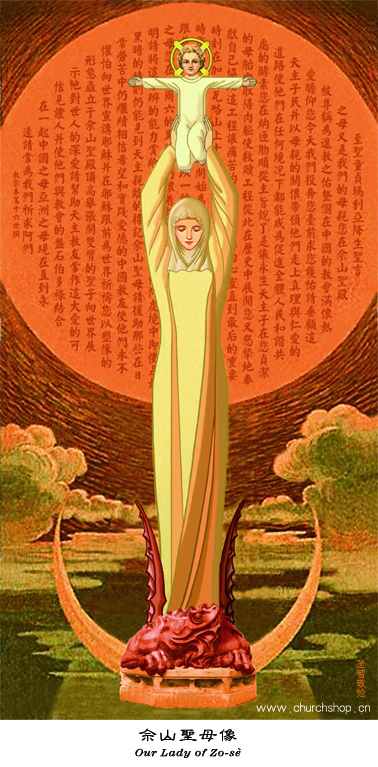
In the statue overlooking the Shrine you lift your Son on high, offering Him to the world with open arms in a gesture of love. Help Catholics always to be credible witnesses of this love, ever clinging to the rock of Peter on which the Church is built.

Mother of China and all Asia, pray for us now and forever. Amen!

A Brief State of the Church in China – a Church in Trial and Persecution, a Church of Martyrs, a Church of Hope

The Church in China (1949) consisted of :

20 Archdioceses

85 Dioceses

39 Apostolic Prefectures

3,080 Missionaries

2,557 Chinese priests (Total : 5,637 priests)

4 million Catholics


The Church in China (2014) consists of :

20 Archdioceses

94 Dioceses

34 Apostolic Prefectures

1 Apostolic Exarchates

3,500 priests (approximate)

12 million Catholics (both open and underground)


Looking at the above comparisons, we can see a wary future for the Church in China, which had been in official and unofficial persecution for the past six and a half decades since 1949, the year when the Communist Party of China took over power in China. Since then, the Church in China, which was once among the most vibrant and fastest growing in the world, had been in great tribulation and period of persecution. Especially during the Cultural Revolution years in the 1960s, there were great attacks against the faithful and the faith throughout the country.

On one side, it seems that there had been a growth in the number of Catholics and in terms of the growth in the number of the dioceses. However, if we look deeper into the reality of the Church and the faith, there had been a great trouble that threatened many of the faithful, especially being divided between the ‘official’ government-sanctioned ‘church’ and the underground ‘loyal’ Church.

Many of the Archdioceses and dioceses are vacant, or that their bishops are not recognised as valid and legitimate, having often been government-picked, and more of a loyal men to the government rather than true and good shepherds for the faithful. Many of the bishops were picked by the government-sanctioned Chinese Patriotic Catholic Association or CPCA, whose leaders have often been noted to be not just laymen, but even non-baptised people.

There had been much grievances and controversies in the recent years in the illegitimate and illegal election and ordination of bishops by the CPCA and the Chinese government which were not approved by the Holy See. On some occasions, the bishops did receive blessing from both parties, but in many other cases, it was the contrary. This further deepened the division among the faithful in China.

Many of China’s priests and bishops are underground, that is they remain faithful and loyal to the completeness of the faith in the Church, and unaffected by the pressure from the government to obey them. There had been great persecution against them and the faithful under their care, such that imprisonments and forced labour are not uncommon.

Ma_Daqin_2_(600_x_450)

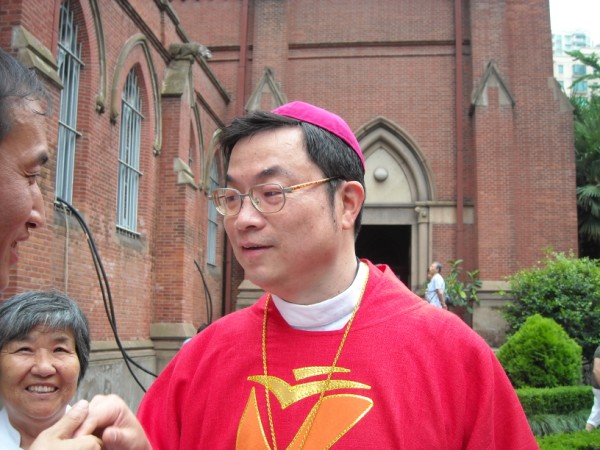
And recently, just almost two years ago, the then newly appointed Auxiliary Bishop of Shanghai, Bishop Thaddeus Ma Daqin bravely and courageously announced his resignation from the CPCA, the official ‘church’ of China at his own episcopal ordination, which was done with the blessing of the Holy See and the Pope. This resignation triggered a massive response from the government which resulted in his incarceration for the past two years, and he had greatly suffered for this. His episcopal motto is clear and indeed clearly highlighted his wish for the unity of the Church in China with the Universal Church, free from any external intervention. His motto is “Ut Sint Unum ad Maiorem Dei Gloriam” or “That they may be One, for the greater glory of God.”

The Church in China still grows, and more and more people hunger for the truth that Christ can offer them. There are many opportunities at evangelisation, and many brave and courageous ministers of the Lord’s Gospel went forth even against the challenges that await them. The recent attacks by the government on the Christian faith, as shown by the demolition of a church building in Wenzhou show how much the authoritarian government fears the power and influence that the Church and the faith may have in bringing about their downfall. The downfall of Communism and the authoritarian governments in Eastern Europe must still be fresh in the minds of the autocrats in Beijing, and they fear their own demise if they allow the faith to grow unchecked.

There is still great hope in the Church in China, and there is genuine faith in the people, who desire to be reunited completely with their brethren in faith, all of us, in the Universal Church, and be freed from any form of pressure or external domination, which are unjust and uncalled for. But they need our prayers, our support and our encouragement.

a2b631b0

Let us ask for the intercession of the Blessed Mother of our Lord, Mary, the Help of Christians, who in the above picture is depicted as our Lady of Zose or Sheshan, from a famous pilgrimage site in Sheshan near Shanghai. Let us ask for her intercession for the Church in China and for the faithful there, our brethren in faith. Just as once the Lord had done His great works through Pope St. John Paul II, another great saint, to cast down the tyranny of atheism and unbelief in the states of Eastern Europe and Russia, may our Lady of Sheshan also intercede for the sake of our brethren in faith in China, a great nation and a great civilisation and yet is filled with worldly hatred of the devil who hates the Church and all its faithful.

We also pray that there will be a new spirit of dialogue and renewal, and that those entrusted with power at the top of the Chinese government hierarchy will finally realise the futility and the inhumane nature of their attempts to control the Church and the faithful. We hope that there will be an amicable and peaceful solution, that the Church in China may be completely reunited once again with the Universal Church, free from all the current issues and dilemmas, and free from any political arguments and intrusions by any external forces.

May the Lord be with His people always, protect them, bless them, and guide them to the light of Christ. May He give them rest and grace, after all the difficulties and challenges that they have faced, in the courageous and zealous defense of their faith in Him. Amen.

Wednesday, 21 May 2014 : 5th Week of Easter, Memorial of St. Christopher Magallanes, Priest and Companions, Martyrs (Scripture Reflections)

Liturgical Colour : White or Red (Martyrs)

Brothers and sisters in Christ, today’s readings emphasizes on unity, that is the unity of our faith with the Lord, and in keeping a true, orthodox and living faith. Jesus our Lord symbolised this with the likeness and parallel of the vine and its branches. Jesus spoke in this way so that His message can get through to the people, who were mostly farmers and shepherds in that time.

Jesus liked to speak in parables because He used them to help bring across His teachings, and yet some people still did not get it. Jesus as the vine is the source of all life and all things, and we are the branches. All the creations of God are the branches. If we imagine the relationship as that of a plant, God is the Creator of all, and He is like the root.

Yes, God is the root of all things, and just as a plant cannot live and survive without their roots, we cannot survive without God either, for He is the source of our lives. Remember that we were made from dust, from the earth. God breathed life into us, and His Spirit came into us and we received life and therefore we are now counted among the living.

God did these things together as One, the Holy Trinity. The Father created and willed all things into creation, and the Holy Spirit is the source of all life. But without the Son, who is the Word of God, creation would not have taken place. If we remember in the Book of Genesis, God spoke His words and things came to be. As such, it is through the Son, who is Word, that is Christ, that we were all created by the Lord.

Therefore, Christ is the vine through which the Father channels His works, power and authority to us. In this also we can see an important tenet of our faith. We believe that the Father sent the Holy Spirit through His Son, Jesus Christ, just as He said that the Father will send, through Him, the Helper or the Advocate, who is the Holy Spirit to His disciples and therefore to all mankind.

Without this connection to the vine, that is Christ, we are not connected to the Father and therefore do not receive the power and grace of the Holy Spirit. If we are separated from the Lord, we will not be able to survive, and we will eventually perish. He is the One from whom all blessings and graces flow from. We have to keep this connection to the Lord at all times.

Brothers and sisters in Christ, we have to make sure that we keep the unity in the Church, both in love and purpose. All that we do should ultimately be aligned with that of the Lord and His precepts. We should see the example shown in the first reading to be our guide in all things. The disciples in Antioch argued on the need to follow and adhere to the complex set of laws instituted by Moses and which was greatly expanded on by the elders of Israel over many generations.

The Jews who believed in Christ, or the Jewish Christians kept all the observations of the Law as they had done before they believed in Christ. They added to their faith, the belief in Christ as the Lord and Saviour, and therefore, in a way it can be understood why they link salvation of mankind with the Law and precepts of Moses that they had kept and observed so well.

But among the Christians, in the growing faith, there are increasingly more and more those who were not of Jewish origins who followed the Lord and changed their ways to that of the Way of God. There are those who were of Greek and Roman origins, or the Gentiles, according to the Jews, who became the believers of Christ. They genuinely sought the Lord and sought to listen to God’s will, which He had revealed through Jesus, and from Him, to them through the Apostles.

The Jewish laws, if you are not familiar with it, consists of numerous rules and regulations, that apparently total about six hundred and thirteen commandments and rules, which covered very meticulously many aspects of Jewish culture and way of life. These were very distinct and different from the cultures and the habits possessed by the Romans and the Greeks.

As such, if they were to be asked to follow the way of the Jews, it would indeed bring them great troubles and difficulties, having to adjust to the incredibly different way of life, and not to point out that some of the Jewish customs were abhorred and looked down upon by the Greek-Roman civilisation at that time, especially regarding circumcision.

Hence, brothers and sisters in Christ, that is why the Apostles took the fateful decision that is both wise and prudent, that what is important, as Jesus had often mentioned, is not the purity of the exterior, which most of the Jewish laws are dealing on, but instead on the purity of our interior, that is our heart and soul, which is the essence and the heart of the Law, often forgotten by those who were so set on fulfilling the laws and the rigorous enforcement of its regulations, that they forgot the true meaning of the Law.

Today we celebrate the feast of St. Christopher Magallanes and his companions, who were martyrs of the faith. He was a priest in Mexico, who was very involved in missionary and evangelising work among the people, and working hard to minister to the people of God and evangelise the Good News to many native and indigenous populations, in many areas of the country. He was also a holy and dedicated parish priest.

St. Christopher Magallanes preached against rebellion and armed insurgency against the military government and dictatorship at the time, as Mexico in the early years of the twentieth century was in great turmoil and conflict between the government and its people, resulting in numerous rebellions and uprisings. However, the government mistakenly accused St. Christopher Magallanes and some other priests and people of God of inciting and supporting the rebellion.

As a result, St. Christopher Magallanes was martyred with his companions, and they together represented the beginning of difficult times for the Church in Mexico, as anti-clergy and anti-Church opinions and attitudes in the government expanded to reach a boiling point. They were raised to the altar and now venerated as saints for their preaching of the truth of God and dedication to that truth.

Brothers and sisters in Christ, we all have to follow in their examples, as they put their trust in God and draw their strength from Him, just like branches that are attached firmly to the stem and to the roots. They also did not discriminate between peoples, and as St. Christopher Magallanes had done, he persevered to bring the Good News and the word of God to the indigenous peoples of Mexico yet untouched by the light of Christ.

Therefore, let us all pray, that we may ever be strong in faith and never be separated from Christ, and may our actions, words and deeds are all according to the Lord and His way, and let us never divide or judge, but instead helping each other to reach closer to God, supporting one another as equal children of God, same before the eyes of the Lord. Amen.

Friday, 2 May 2014 : 2nd Week of Easter, Memorial of St. Athanasius, Bishop and Doctor of the Church (Scripture Reflections)

Liturgical Colour : White

Brothers and sisters in Christ, today we heard of the story of Jesus feeding the multitudes of five thousand people with five loaves of bread and two fishes, and in a great miracle, these few food items managed to satisfy all of them till full and with twelve baskets of leftovers just for the bread alone.

We also heard how the respected leader of the elders of Israel, the Rabbi Gamaliel, counseled patience and caution to the rest of the elders in dealing with the Apostles who were proclaiming the greatness of Christ and taught the teachings of Jesus to the people, and hence rivalling the authority of the Pharisees and the chief priests.

All that we heard today, testify to the one singular fact, that is, we have One Man who came upon us from heaven, sent with power, by the Power Himself, that is none other than Jesus, the Son of the Most High God. Today we celebrate the very nature of Christ who is Son, and who is sent by the Father and bear the power of the Holy Spirit with Him, truly the concept of a Godhead with Three distinct persons yet perfectly in unity, the Holy Trinity.

Today we celebrate also the feast of a saint, a great and holy man, whose life had been given in its entirety to defend this basic and holy truth, the fact that quite a few people of this saint’s time refuse to acknowledge and believe in, and instead they believed in the lies of Satan spread through the heretical teachings of a man called Arius, from whom the Arian heresy got its name from.

Arius and his followers denied the divinity of Christ, by teaching and speculating that the divine and human nature of Christ is separate, and that Jesus Christ who was in this world is merely human created and not equal with the Father, who is God Almighty and all-powerful. For them, it may be unthinkable that God should go through all the humiliating and not-so-good experiences that Jesus had encountered, culminating with the crucifixion and death of Jesus.

They claimed that Jesus is mere man and mere creation of God, albeit One that is special among all other creations. In essence, the view of those who adopted the Arian heresy is not much different from the views espoused by the Muslims who also stressed especially that Jesus is not God in their so-called ‘Scripture’. As such, there had been some people who deemed that the two might be related, and the two heresies might indeed had the same origin.

Nevertheless, all of them were mistaken greatly because they failed to understand the mystery and the sublime nature of God in our faith, that is so great that it begs a better understanding from us. And even with our limited wisdom and knowledge, we are not likely to be able to understand the fullness of God and His mysteries. And that is why our deposit of faith in the Sacred Tradition is so important.

For denying the divinity of Christ is in fact the same as denying the greatness of God Himself, no matter what these people do to justify their ideas and viewpoints born out of mistaken view of the Word of God. They denied the works of salvation carried out by Jesus, for they denied not just Jesus as divine, but also because of that, they denied the salvation that can be offered only by the worthy Lamb of God, Jesus Christ, whose blood made all of us pure and worthy.

If Jesus is not God as Arius and others have claimed, then we have no hope, because the blood of a man alone will not be able to atone for our sins. The blood of Christ saves us exactly because He is divine, both God and man at the same time, one divine person but having two natures, divine and man. This is what we are celebrating today’s saint for, that is in the defense of this truth about the faith, the hard work of St. Athanasius of Alexandria.

St. Athanasius of Alexandria was the Patriarch and leader of the See of Alexandria, which with Rome was the five most preeminent dioceses and centres of the Christian world at the time. St. Athanasius was a great defender of the faith, and despite the popular and provocative teachings of Arius, which brought many people to fall into heresy, he managed to hold on to the firm foundation of faith established since the Apostles, and despite opposition and ridicule by his enemies, St. Athanasius remained firm and faithful.

The hard works of St. Athanasius earned him the faith of the people and the perseverance of many in the face of heresy, and many stood strong for the Lord and did not turn towards the erroneous teachings of Arius. St. Athanasius stood strong for the Lord’s true divine and human nature, and championed the indivisibility of the Most Holy Trinity. He was truly a faithful servant, like that of the Apostles of old.

Remember, brethren, that if Jesus is not God, it will be precisely as what Gamaliel said in the first reading, that the endeavours of man will eventually perish and be gone, but if it is the endeavour of the Lord, not even the greatest force or opposition can make it go away. The Lord will triumph in glory in the end, and this is a fact that we know.

Brothers and sisters in Christ, hence, inspired by the life of St. Athanasius and his actions, shall we walk in the same way as he had walked? Shall we resolve to make a difference in the lives of our fellow men, in a way that we bring the truth of God to them? Shall we bring the light of God to our brethren who are still in darkness, and to those who have been trapped and lured in by the lies of the devil?

May God guide us in our endeavour and our actions, that in all the things that we do, we will always be faithful, strong and completely dedicated to the Lord in all of our days, and show it through our actions and deeds. God bless us all. Amen.

Friday, 18 April 2014 : Good Friday of the Lord’s Passion, Easter Triduum (Second Reading)

Liturgical Colour : Red

Hebrews 4 : 14-16 and Hebrews 5 : 7-9

We have a great High Priest, Jesus, the Son of God, who has entered heaven. Let us, then, hold fast to the faith we profess. Our High Priest is not indifferent to our weaknesses, for He was tempted in every way just as we are, yet without sinning. Let us, then, with confidence approach the throne of grace; we will obtain mercy and, through His favour, help in due time.

Christ, in the days of His mortal life, offered His sacrifice with tears and cries. He prayed to Him who could save Him from death, and He was heard because of His humble submission. Although He was Son, He learnt through suffering what obedience was, and once made perfect, He became the source of eternal salvation for those who obey Him.

Saturday, 12 April 2014 : 5th Week of Lent (Scripture Reflections)

Liturgical Colour : Purple/Violet

God desires the love of mankind, and He loves them very much. That is why He gave us all of His attention and focus, and He offered Himself to them to open for them the pathway to salvation. In a sense, He had granted them great favour, only for them to refuse Him and reject Him, and even reject the salvation which He had freely offered them.

In today’s first reading God promised His beloved people that He will love them and care for them, freeing them from the grip of death and sin, and will provide for them once again as He had once had. We can see indeed how great is God’s love for us, that He gave us chance after chance, and opportunity after opportunity. He gave us hope even when we are in the greatest darkness.

Yet mankind were selfish, and are still indeed selfish even today. We thought only for ourselves and for our own benefits and we complain when things do not go our way. That is our nature, and we often succumb to it. The Pharisees rejected Jesus because of His teachings and ways that oppose their own authority and positions of privilege and honour within the society.

How about the people then? They also rejected Christ because they were reluctant to abandon their former way of life and follow what Christ taught them, and they were also easily swayed by the offer of money and goods of the world, that we can easily see in tomorrow’s Palm Sunday Gospel and Passion readings, how the same people who cheered for Jesus as King when He proceeded into Jerusalem, within less than one week would be condemned to death by the same people. Yes, the same people who acclaimed Jesus as King also cried out for His death.

And it is a fault that we have as we tend to blame the Jews on what happened to Jesus, in how they condemned Him to death and rejected Him and His offer of salvation, because it is always convenient and easy to blame someone else. We think of the Jews to be the ones to blame for the death of Christ, but we conveniently forgot that Jesus Himself was and is a Jew, born son of David, the heir of David and the descendant of Abraham.

And Jesus when He suffered and died on the cross, He did so for all of us, and also including the Jews, both those who had no part in His death and those who had hated Him and condemned Him. He Himself remembered them even in His suffering, asking the Father to forgive them and overlook their sins for their ignorance and lack of knowledge of who He truly was.

God Himself had forgiven them, and He had forgiven us. So for those among us who thought to blame the Jews, the very people the Lord had chosen to be born into, and to those of us who like to put the blame on others, let us from now on reflect on our own actions first. Before we even judge or condemn others, have we been sufficiently pure and worthy in our own actions that we will not be judged? We often forget that when we judge others, we therefore also open the door for us to be judged ourselves.

God did not wish to punish anyone, as indeed, He wanted all of us to be reunited with Him in love. He wishes for us to be perfected in love, that we may leave behind our past sinfulness and wicked behaviour, and become more like Him and be more loving as He is. That was why He sent Jesus to be with us, to be both our Saviour, to break the chains of sin and death, and at the same time also show us how to love, like God has loved us.

Therefore, brothers and sisters in Christ, as we approach the pinnacle of our preparation, as we proceed towards the holiest week of all our celebrations, the Holy Week of Jesus’ Passion, let us resolve to be more like God, in becoming more loving and forgiving, in being more inclusive and compassionate, helping one another to approach the Lord rather than condemning or judging each other. Let us reserve no place for Satan in our hearts! For it is in a darkened heart that Satan is happy to dwell in. Let the light of God instead be within us, that He may also guide our ways, that our ways will always be pleasing to God.

May the Lord forgive us our sins and show us how to love Him just as He had loved us first. Let us never be separated again from You, o Lord our God. Be with us always, till the end of time. Amen.

Wednesday, 2 April 2014 : 4th Week of Lent, Memorial of St. Francis of Paola, Hermit (Scripture Reflections)

Liturgical Colour : Purple/Violet

Brothers and sisters in Christ, today we hear about how everything that Jesus did, He did them in accordance with the will of God the Father, and thus, He did them out of the love He has for all of us without exception. That was the very purpose of why Jesus, the Son of God Most High was sent into this world, that He who was divine and with the Father, was willing to come down and to be born as one of us, as Man.

He came in accordance with the will of God, that He wanted all of us who had been separated from Him due to our disobedience and that of our ancestors’ disobedience, so that we may be brought back to Him, and be forgiven in new life sanctified in God. That was why the Lord who loves us so much, sent us His only beloved Son, to be our Saviour.

How fortunate we are indeed, that our Lord Himself had lowered Himself to come upon us and show us what new hope and salvation are truly about. Jesus is the hope for all mankind, the light which pierces through the darkness, both within us and which surround all our beings in this world. In Jesus is our compass, the north reference point, to which all of us should look towards and go to.

Brothers and sisters in Christ, Jesus came to us as our shepherd, to guide us on our way towards the Lord, that we may not be lost, but gain eternal glory and rewards at the end of time. We are the lost sheep of the Lord, who had been spread across the land, and covered in the darkness of this world. The Lord is our light, and He enlightens our path, and with His staff and rod, He guides us to the eternal rest He had prepared for us.

But as all shepherds do, He calls upon us, and He knows each of us, by name. He truly knows all that we do in secret, as He is the Lord of all, omniscient and all-knowing. There is nothing that he did not know of. He calls us, but we as the lost sheep, have all the choice and free will to either heed His call or to ignore and reject Him.

God offered us His guidance and help through Jesus His Son. Like a loving shepherd He guides each and every one of His sheep that they may find their way, our way, to reach towards salvation. Yet we may choose to follow Him or follow the false shepherd, that is the devil. The devil also calls upon us, pretending to be the true shepherd, tricking us to follow him instead of the Lord, the true and good shepherd.

Brothers and sisters in Christ, this is why we have to discern things carefully, in what we do, and in what we follow, that we will not fall into committing what is evil in the eyes of the Lord and fall into condemnation and destruction that awaits  Satan and his followers, the fallen sheep, at the end of time. We have to discern on our lives and our actions, that we will walk in the light and not darkness.

Today we celebrate the feast of St. Francis of Paola, a hermit who lived in Italy during the era of the Renaissance. St. Francis of Paola was a very devout and upright individual even since his early youth, and he modelled himself much after his patron, St. Francis of Assisi, the founder of the Franciscan religious order. St. Francis of Paola modelled his life after his namesake and patron, and founded a religious order with similar kind of dedication to the Lord.

Yes, brethren, St. Francis of Paola gave all of his life in dedication to the Lord his shepherd. He did not veer left or right in his ways, and remained true to the Lord until the end of his life. St. Francis of Paola is the example of how a sheep who desires to find his shepherd, and his Lord, that he gave it his all, in total and complete dedication to the will of God.

Brothers and sisters in Christ, we can learn many things from the holiness and greatness of St. Francis of Paola. He was great not because he was powerful or mighty in the eyes of men, but because he did not budge even against the forces of this world, and neither did he fear any worldly oppressions or repercussions, that he even challenged kings of the world and rebuked them for their wickedness and transgressions despite themselves professing as Christians.

We too should follow in his footsteps, that we may dedicate ourselves more and more to the Lord, and at the same time also learn to follow His ways and make our lives a reflection of the Lord’s will and teachings, that just like St. Francis of Paola, we may be holy and justified, and the Lord will keep us always in His favour and grace.

St. Francis of Paola, pray for us sinners, that we may overcome our fear of the Lord and come seek Him like sheep looking for their shepherd, that together with you, we may praise the Lord and serve Him for eternity. God bless us all. Amen.