(Usus Antiquior) Eighteenth Sunday after Pentecost (II Classis) – Sunday, 12 October 2014 : Epistle

Lectio Epistolae Beati Pauli Apostoli ad Corinthios – Lesson from the Epistle of Blessed Paul the Apostle to the Corinthians

1 Corinthians 1 : 4-8

Fratres : Gratias ago Deo meo semper pro vobis in gratia Dei, quae data est vobis in Christo Jesu : quod in omnibus divites facti estis in illo, in omni verbo et in omni scientia : sicut testimonium Christi confirmatum est in vobis : ita ut nihil vobis desit in ulla gratia, exspectantibus revelationem Domini nostri Jesu Christi.

Qui et confirmabit vos usque in finem sine crimine, in die adventus Domini nostri Jesu Christi.

English translation

Brethren, I give thanks to my God always for you, for the grace of God that is given to you in Jesus Christ, that in all things you are made rich in Him, in all utterance and in all knowledge, as the testimony of Christ was confirmed in you, so that nothing is wanting to you in any grace, waiting for the manifestation of our Lord Jesus Christ.

He who will also confirm you unto the end without crime, in the day of the coming of our Lord Jesus Christ.

(Usus Antiquior) Eighteenth Sunday after Pentecost (II Classis) – Sunday, 12 October 2014 : Introit and Collect

Introit

Ecclesiastes 36 : 18 and Psalm 121 : 1

Da pacem, Domine, sustinentibus Te, ut prophetae Tui fideles inveniantur : exaudi preces servi Tui et plebis Tuae Israel.

Laetatus sum in his, quae dicta sunt mihi : in domum Domini ibimus.

Response : Gloria Patri et Filio et Spiritui Sancto, sicut erat in principio, et nunc, et semper : et in saecula saeculorum. Amen.

English translation

Give peace, o Lord, to those who patiently wait for You, that Your prophets may be found faithful. Hear the prayers of Your servant, and of Your people Israel.

I rejoiced at the things that were said to me. We shall go into the house of the Lord.

Response : Glory be to the Father and to the Son and to the Holy Spirit, as it was in the beginning, is now, and ever shall be, world without end. Amen.

Collect

Dirigat corda nostra, quaesumus, Domine, Tuae miserationis operatio : quia tibi sine Te placere non possumus. Per Dominum…

English translation

Let the operation of Your mercy, we beseech You, o Lord, direct our hearts. For without You we cannot please You. Through our Lord…

Saturday, 11 October 2014 : 27th Week of Ordinary Time, Memorial of Pope St. John XXIII, Pope (Homily and Scripture Reflections)

Liturgical Colour : Green or White (Saturday Mass of our Lady and Popes)

Brothers and sisters in Christ, today we are presented with the message of the Lord, through the Holy Scriptures and the Gospels, on the nature of our faith and salvation, and how we can attain that salvation through what we are doing in this life, not just based on any race or other passive benefits or factors, but through the commitment of actions that make our faith truly alive in God.

In the first reading today, St. Paul in his letter to the faithful and the Church in Galatia showed how while in the past, God revealed His Law to His people to guide them and prevent them from going astray from the path towards salvation, but the coming of Christ, the Messiah and Saviour of all, gave mankind a new focus of their faith and devotion. For God Himself had come down upon us, in our humble form, to save us from our fate that was death and oblivion.

There was also to be no more division and prejudice, or any difference in treatment between those in the society, based on either race or birth, based no longer on either status or wealth or possessions. What matters is truly whether one believes in the Lord Jesus Christ, and if one believes, and lives according to that faith which they have, then they are guaranteed salvation in Jesus Christ our Lord.

That was because, the Jews, who were descendants of Abraham, the faithful servant of God, with whom He had made His covenant with, were proud and prejudiced against their neighbours, thinking that as the heirs and sons of Abraham, they alone deserved salvation, and the others, the Gentiles, namely the Greeks, the Samaritans, Romans, Arabs, Canaanites, and others whom they considered as pagans and barbarians deserved eternal damnation.

Yet, Jesus made it clear in the Gospel, that blessing is upon those who follow the will of God, who walk in His ways, and who practice their faith in the real life, showing that their faith is truly real, concrete and dynamic. Yes, not the dead and stagnant faith shown by lack of action, by mere lip service of faith, and not by prejudicing against others or condemning others or glorifying oneself thinking that one is worthy of salvation, while others do not.

Therefore, today we are all called to reflect on our own lives, whether in all things we do, we have been truly faithful to the Lord, not just by mere faith or words, but also through actions founded in faith, filled with hope, and blessed and graced by love. This is what is necessary for us to attain our salvation, and blessed we are indeed if we listen to Jesus and what He had said, instead of following our own desires and wants.

Today, we celebrate together with the whole Universal Church, the feast of Pope St. John XXIII, the successor of St. Peter the Apostle, and one of the great and holy Popes of the twentieth century after the birth of Christ. Pope St. John XXIII, who was also called the ‘Good Pope’, was chiefly remembered for his role in convoking and gathering the latest Ecumenical Council of the Holy Roman Church, that is the Second Vatican Council, which lasted from 1962 to 1965, but in fact, his holiness stemmed not just from that act, but also from the actions which he had taken for the entire course of his life.

The life and examples of Pope St. John XXIII, the Good Pope, il Papa Buono, can be an inspiration for us all, as ever since he was born of a poor peasant family in the village and commune of Sotto il Monte, in the province of Bergamo in northern Italy as Angelo Giuseppe Roncalli, he had led a very faithful and devoted life to God. He was poor, just as his family was poor, but together they as a family lovingly devoted themselves to God.

At a certain moment in his youth, the young Angelo encountered experience in faith, by those whom he met, including his uncle, which encouraged him to consider giving himself to the service of God. As his family was poor, and peasant youths were considered important assets to help out in work, his parents were reluctant to let him to go and join the seminary.

Nevertheless, in the end, God had His way, and Angelo managed to join the seminary, studying intently and eventually was ordained a priest of the Diocese of Bergamo. He eventually became the secretary of the local ordinary, Bishop Radini-Tedeschi, who was a relatively obscure individual compared to his later famous protege, but the one who had great influence on Angelo and his later great works.

Bishop Radini-Tedeschi encountered a great workers and union strike in accordance to the poor living conditions and treatment of workers by the government of that era, in the early twentieth century, and Bishop Radini-Tedeschi faithfully and tenderly exercised his works as the shepherd of his flock, calling for restraint and restoration of order while calling for reforms and great improvement in the treatment of workers. He even donated his own personal wealth to help the poor workers made their ends meet.

All these inspired the young Angelo Roncalli, the later Pope St. John XXIII, as he later was made Archbishop and appointed as the Apostolic Delegate to Bulgaria, and later to Greece and Turkey. During his diplomatic missions in the service of the Church, Archbishop Roncalli did many great works, establishing links and friendship with the separated brethren of faith in the Eastern Orthodox Church, and during his mission in Greece and Turkey, even saved many Jews from the actions of the German NAZI who was bent on annihilating them as a race in the holocaust.

In his later mission as the Apostolic Nuncio to France, Archbishop Roncalli continued to do many good works, establishing links and relationship with the French government, including dealing with the difficult leader of France, Charles de Gaulle, who wanted to reduce the influence of the Church of Rome in the affairs of the Church in France.

And eventually, as the Patriarch of Venice and a Cardinal of the Holy Roman Church, Cardinal Angelo Roncalli continued to exercise the good works which he had done earlier in his earlier posts and ministries, and which eventually he continued when he was elected Pope in 1958 to succeed the great Pope Pius XII, the Pastor Angelicus, or the Angelic Pope.

Pope St. John XXIII continued to lead the Church faithfully, and he was particularly concerned with the restoration of relations with the Eastern Church, as he had experienced earlier during his time in Bulgaria, Greece and Turkey, in the relationships he had made with the prelates and faithful of the Eastern Church at the time. And then he was also concerned about the state of the Church, and the need for a continuation of the unfinished works of the First Vatican Council, which was prematurely ended due to the events at that time.

Thus, Pope St. John XXIII convoked the gathering of the Second Vatican Council, which commenced in 1962, and which sessions was started and opened by the Pope himself, which meeting was to continue until 1965, and concluded by Pope Paul VI, his successor as Pope St. John XXIII passed away in 1963, before the conclusion of the Ecumenical Council which he had initiated.

Pope St. John XXIII also was renowned for his role in helping to reduce tension between the superpowers, namely the United States of America and the Soviet Union, which almost ended up in a major war, during the Cuban Missile Crisis in 1962. One of the last major acts of Pope St. John XXIII was the peace which he helped broker between the two sides, and which was the major reason behind the Papal encyclical he released in 1963, the famous Pacem in Terris, or ‘Peace on earth’.

Brothers and sisters in Christ, as I have mentioned, that the actions of Pope St. John XXIII are examples to all of us, and through them, we should also be inspired to follow in his footsteps, that our faith may grow stronger and that in our devotion, we may be found justified in our faith by the Lord our God. Remember, brethren, that we have to have a living faith in us, so that our faith will not be just empty, but be real and concrete.

May Almighty God, who sees the faith and commitment which Pope St. John XXIII, also see the faith that is in us, and therefore may grant us the inheritance and reward which He promised us through Jesus Christ His Son. May we all come ever closer to His loving embrace, seeking His mercy and be made righteous once again. God bless us all. Amen.

Saturday, 11 October 2014 : 27th Week of Ordinary Time, Memorial of Pope St. John XXIII, Pope (Gospel Reading)

Liturgical Colour : Green or White (Saturday Mass of our Lady and Popes)

Luke 11 : 27-28

At that time, as Jesus was speaking, a woman spoke from the crowd and said to Him, “Blessed is the one who gave You birth and nursed You!”

Jesus replied, “Truly blessed are those who hear the word of God, and keep it as well.”

Saturday, 11 October 2014 : 27th Week of Ordinary Time, Memorial of Pope St. John XXIII, Pope (Psalm)

Liturgical Colour : Green or White (Saturday Mass of our Lady and Popes)

Psalm 104 : 2-3, 4-5, 6-7

Sing to the Lord, sing His praise, proclaim all His wondrous deeds. Glory in His Holy Name; let those who seek the Lord rejoice.

Look to the Lord and be strong; seek His face always. Remember His wonderful works, His miracles and His judgments.

You descendants of His servant Abraham, you sons of Jacob, His chosen ones! He is the Lord our God; His judgments reach the whole world.

Saturday, 11 October 2014 : 27th Week of Ordinary Time, Memorial of Pope St. John XXIII, Pope (First Reading)

Liturgical Colour : Green or White (Saturday Mass of our Lady and Popes)

Galatians 3 : 22-29

But the Scriptures have declared that we are all prisoners of sin, so the only way to receive God’s promise is to believe in Jesus Christ.

Before the time of faith had come, the Law confined us and kept us in custody until the time in which faith would show up. The Law then was serving as a slave to look after us until Christ came, so that we might be justified by faith. With the coming of faith, we are no longer submitted to this guidance.

Now, in Christ Jesus, all of you are sons and daughters of God through faith. All of you who were given to Christ through baptism, have put on Christ. Here there is no longer any difference between Jew or Greek, or between slave or freed, or between man and woman : but all of you are one in Christ Jesus.

And because you belong to Christ, you are of Abraham’s race and you are to inherit God’s promise.

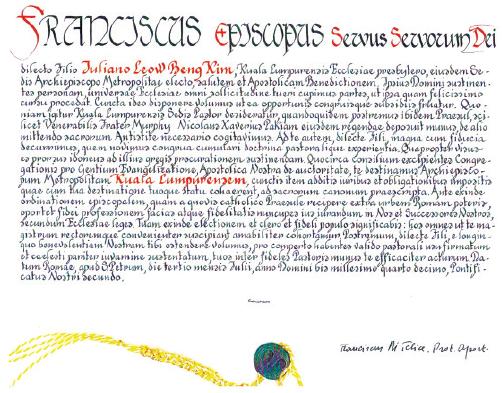
Full Video of the Episcopal Ordination of Archbishop Julian Leow Beng Kim, Metropolitan Archbishop of Kuala Lumpur (Malaysia)

On Monday, 6 October 2014, on the feast of St. Bruno, by the grace and authority of the Apostolic See and the Successor of St. Peter, through Archbishop Joseph Salvador Marino, the Apostolic Nuncio to Malaysia,  Fr. Julian Leow Beng Kim was ordained to the episcopal order by Metropolitan Archbishop John Ha Tiong Hock of Kuching, after he was appointed as the new Metropolitan Archbishop of Kuala Lumpur on 3 July 2014.

The episcopal ordination took place at the Church of the Holy Family at Kajang, Metropolitan Archdiocese of Kuala Lumpur.

http://www.gcatholic.org/dioceses/diocese/kual0.htm#56850

Metropolitan Archbishop Julian Leow Beng Kim is the fourth Metropolitan Archbishop of Kuala Lumpur, and as the shepherd of the largest diocese in Malaysia and the diocese of the capital city, he is also unofficially the Primate of Malaysia. He has as his suffragan bishops, the Bishops of Penang and Melaka-Johor.

11792273901412591832

We wish Archbishop Julian Leow Beng Kim all the best in his new calling as the shepherd of souls in Kuala Lumpur. May he remain faithful and devoted to the orthodox and pure teachings of the Faith and the Church, making no compromises against the forces of darkness arrayed against the Church even as we speak today. May he also be devoted to the sheep he had been entrusted to, and lead them to the true, unblemished and orthodox faith. Amen.

Tenth Anniversary of Holy Sacrament of Baptism : My Profession of Faith

Friday, 19 September 2014 marked the exact ten years since I received the Holy Sacrament of Baptism on Sunday, 19 September 2004.

With this, I renewed my profession of faith before the Holy Gospels, and I ask that all of you will pray for me, that I will continue to grow stronger and deeper in faith, in hope and in love.

IMG-20140919-WA004

‘I baptise you in the Name of the Father, the Son and the Holy Spirit’


IMG-20140919-WA000

‘The almighty God, Father of our Lord Jesus Christ, has caused you to be born over again of water and the Holy Spirit and pardoned you all your sins. May He now anoint you with the chrism that sanctifies in Christ Jesus our Lord, and bring you to everlasting life.’


IMG-20140919-WA001

‘Take this burning candle as a reminder to keep your baptismal innocence. Obey God’s commandments, so that when our Lord comes for the joyous wedding feast you may go forth to meet Him with all the saints in the halls of heaven, and be happy with Him forevermore.’

Message to the Faithful and Reflections on the Scripture Readings on the Occasion of the Solemnity of the Assumption of the Blessed Virgin Mary into Heaven

Liturgical Colour : White

Dear brothers and sisters in Christ, today we celebrate the Mass of an important occasion and an important part of our faith, that is celebrating the Assumption of our Blessed Virgin Mary, the Mother of our Lord Jesus Christ into heaven by the power and the will of God. This is the dogma and definitive teaching of the Church, declared by the great Pope Pius XII on this day, sixty-four years ago, on the fifteenth day of August of the year of our Lord one thousand nine hundred and fifty.

The Blessed Virgin Mary, as the mother of our Lord Jesus Christ has long been the subject of veneration and respect for many generations since the beginning days of the Church. Mary as the mother of Jesus, who is the Son of God, the Divine Word incarnate into flesh, has been considered as the Theotokos, or the Mother of God ever since the Ecumenical Council at Nicaea in the year of 325 of our Lord. This is because she was the vessel through which our Lord and Saviour was born into this world.

If you had noticed, that the readings today, the songs from the psalms and the Gospel itself talk about the Ark of God, or the Ark of the Covenant, which contained the two slabs of stone on which God had written in stone His laws and commandments for His people, and for mankind to be kept faithfully for all eternity. That Ark of the Covenant came to be considered as the Holy Presence of God among men, as God Himself resided in the world, among His people through the Ark.

That was why in the Scripture Reading from the Book of Chronicles today, we are told of the meticulous and very detailed preparations for the carrying of the Ark of God into the Holy City of Jerusalem, that it may be brought from the wilderness where the Ark had resided, to the Tent which the king David of Israel had prepared for the Ark of the Lord. This is because the Ark itself represents the dwelling of God among men, and therefore, later on, it was to be enshrined in the holiest part of the Temple of Jerusalem, in what is called the Holy of holies.

So sacred is that Ark, that indeed, before the occurrence of what is in the First Reading today, what happened was that the Ark had been attempted to be moved to the city of Jerusalem earlier on, but one of the priests of the Levites tribe accidentally touched the Ark when it slipped along the way, and the offending priest was cast down immediately by God for the accidental touching of the Ark. The meticulous preparation was indeed partly because no one, and no human hands should ever touch the Holy Ark of God.

And how is this relevant to what we are celebrating today? That is because the Blessed Virgin Mary is herself an Ark of the Covenant, and in fact, she is the Ark, the one and true Ark, of a covenant that had been established anew by the Lord, the new covenant of Jesus Christ our Lord, the Lord of lords and the King of kings. As she bore the Lord and Saviour in her womb, she essentially became the new Ark of the new covenant which Jesus was to establish and seal by His death on the cross.

And as the Blessed Virgin Mary bore the Lord in herself, she has become the new Ark, that is indeed truly equally sacred and holy in all ways, the same as the old Ark had been. For truly, it must be inconceivable that for the Lord to be born into the world through physical attachments corrupted by sin. That is why, today’s feast is essentially inseparable from that of the feast of the Immaculate Conception of the Blessed Virgin herself, which means that the Mother of our Lord was conceived without sin, pure and immaculate.

This dogma truly had the background in this purity and holiness of the Ark of God, which was then made anew through Mary, who was to bear the Lord and Saviour of all creation, and no longer just merely the two slabs of stone on which was written the laws and commandments of God. Mary was therefore prepared and made special, pure and immaculate, free from all forms of sin and evil. And therefore, just as in her birth, where she was without sin like her Son, it was truly also inconceivable that death should have any power over her.

This is why the Assumption, in which the Lord brought His own earthly mother into heaven, to show that for she was without sin, pure and immaculate, death has no power over her. Assumption is the proof that God showed men, using the example of His own mother, that death has no final say on us. Instead, He Himself by His sacrifice on the cross had conquered death, and death no longer bound us to itself, and we now have a new hope of life eternal in God.

In the Assumption of the Blessed Virgin Mary, we honour and look up to Mary, who is both the Mother of our Lord Jesus Christ and also the foremost and greatest among all saints, as the one whose examples inspire all of us to do better and aim for the better for ourselves. Mary gives us hope that we too may one day be like her, receiving the gift of heavenly glory and our everlasting inheritance as part of the promise and hope which our God had given us.

However, on this sacred and joyful day, we also have to remember that we have our duties and obligations as well. Why is this so? Because all of us who believe in the Lord and who have accepted Him into ourselves, with our God becoming a part of us, and we as a part of the Lord as one Body, we too become the Arks of the Lord’s new covenant. And what is this covenant, exactly? We have to remember what Jesus said at the Last Supper, that the covenant He made was sealed by the giving of His Body and Blood to all mankind.

This covenant becomes ours and we are a part of the covenant when we receive the Lord who is present in the Most Holy Eucharist. Therefore, whenever we receive the Lord in the Holy Communion, we truly become like Mary, to bear the Lord unto ourselves, for the bread and wine are truly transformed completely into the very essence of our Lord, that He is truly present in us, and we become His Ark, or also known as what is called the Temple of God, or the Temple of the Holy Spirit.

And therefore it is very important for us to take note that as the Ark is holy and sacred, and as the Blessed Virgin Mary is holy and blessed, we too must also aspire and work towards having a holy and sacred Ark in ourselves, which means to avoid all sorts of fornications or sins that taint the body, or the soul or both body and soul.

If we are not able to do this, we will not be worthy bearers of the Lord, and we will be punished and cast out from our intended inheritance, and we will not share in the glory of Mary, whom God had brought body and soul into heaven for her role in the plan of God’s salvation of mankind. She is our role model and our hope, for through her God had made it clear to us, that death will not have any power over us, unless if we allow it to rule us again when we succumb to the temptations of sin and defile our bodies and our souls, unworthy of the Lord.

Brothers and sisters in Christ, today let us all reflect on this occasion, and on God’s loving presence among us, and within us. Let us from now on, whenever we attend the Holy Sacrifice of the Mass, work harder and be more intent on keeping ourselves holy and worthy to receive our Lord into ourselves. Surely, we are all sinners and delinquents before God, but if we make the effort to keep ourselves holy and devoted to Him, He will grant us His favour.

May the Blessed Virgin Mary, assumed into heaven body and soul by the power and favour of our Lord Jesus Christ, continue to pray for us and intercede for our sake, that we too may also experience the same glory she had received, and join her with all the other saints and holy people of God, to be with God for eternity and where death no longer has any power or say over us. God be with us all, forever and ever. Amen.

(Usus Antiquior) Feast of the Assumption of the Blessed Virgin Mary (I Classis) – Friday, 15 August 2014 : Offertory Prayer, Secret Prayer of the Priest, Communion and Postcommunion Prayer

Offertory Prayer

Inimicitias ponam inter te et Mulierem, et semen tuum et Semen illius.

English translation

I will put enmities between you and the Woman, and between your seed and her Seed.

Secret Prayer of the Priest

Ascendat ad Te, Domine, nostrae devotionis oblatio, et, beatissima Virgine Maria in caelum assumpta intercedente, corda nostra, caritatis igne succensa, ad Te jugiter adspirent. Per Dominum…

English translation

May the offering of our devotion ascend to You, o Lord, and through the intercession of the most Blessed Virgin Mary, who was taken up into heaven, may our hearts be inflamed with the fire of love, and continually long for You. Through our Lord…

Communion

Beatam me dicent omnes generationes, quia fecit mihi magna qui potens est.

English translation

All generations shall call me blessed, because He who is mighty had done great things to me.

Postcommunion Prayer

Sumptis, Domine, salutaribus sacramentis : da, quaesumus; ut, meritis et intercessione beatae Virginis Mariae in caelum assumptae, ad resurrectionis gloriam perducamur. Per Dominum…

English translation

Now that we have received, o Lord, the Sacrament of salvation, grant, we beseech You, that through the merits and the intercession of the Blessed Virgin Mary, who was taken up into heaven, we may be brought to the glory of the resurrection. Through our Lord…