
Saturday, 7 December 2013 : 1st Week of Advent, Memorial of St. Ambrose, Bishop and Doctor of the Church (Scripture Reflections)

Liturgical Colour : Purple/Violet or White (Bishops)

Brothers and sisters in Christ, today we celebrate mission and the fruits of the mission that Jesus Himself, our Lord, has commissioned the disciples to do. The Lord sent out His call to repentance and salvation to all the nations, and through His disciples, in the missions He gave them, He offered all peoples, literally all mankind, the opportunity to be saved and to be made whole again, through Christ.

He made salvation readily available to all the nations, and through His disciples as His mouthpiece and as His representatives in the world, He spread the seeds of faith, hope, and love in this world. And those seeds that they spread in this world grow tall and strong, despite oppositions and persecutions that faced the Lord and His followers. These seeds would either grow or wither, depending on how each individuals respond to the Lord and His actions.

Some of us readily responds to the seeds God has planted in us, and yet there are others who ignored these gifts or even outrightly rejected them. That is why, these seeds of faith, hope, and love, cannot be left alone to fend for its own. Most likely in that case, the seeds will not grow, or will grow and then wither. That is because we need to make sure that we are healthy in spirit if we are to receive the grace from the Lord.

We need guidance, and we need helpers. That is why Jesus commissioned His disciples, to go ahead of Him, proclaiming His coming and His teachings to the people. Firstly only to the people of Israel, which many of them listened to those words and teachings of Jesus, but they did not truly believe in Him. They abandoned Him when He was betrayed and put to death by the Jewish authorities.

Then, He sent the disciples to all the nations after His death and resurrection, and as a parting statement and mission before He ascended into heaven, He sent forth the disciples to proclaim the Good News to all nations, bringing the words about salvation to all the furthest ends of the earth. And this they did, faithfully, persevering through oppositions, oppressions, and rejections, until they met martyrdom at the end, as part of their mission.

The disciples appointed many successors, who were to continue the good works they had begun, continuing to spread the seeds of faith, hope, and love throughout the world. The world was a great, fertile ground, where those seeds may grow, grow aplenty and strong. But at the same time, great challenges also awaited in the midst of all the goodness and all the opportunities.

Firstly, as Jesus mentioned, that the harvest is plentiful but the labourers are few. These labourers are literally those who had given themselves in the service of the Lord, in spreading His Good News, following in the footsteps of the Apostles. They are today represented by our priests, bishops, our Pope and the Cardinals, all the religious priests and brothers, all missionaries, nuns, sisters, and all who devoted themselves to a life of dedication to God. Each of them devoted themselves as labourers and servants of the Lord in different ways and yet they laboured for the same purpose, that is to make disciples of all the nations as Jesus had commissioned His Apostles.

In the past, we have plenty of priests and many aspirants to the priesthood and religious life. Many people lined up to join the Seminary or religious life, in total and complete devotion to the Lord. Seminaries were full, and churches were full. Priests were in abundance, in great numbers, and even though demands of them continued to increase over time, there was no concern of shortage as we have now.

Today, our world is increasingly becoming more and more hostile to the faith, to the development of our faith, and to the dedicated life in God, in general. The temptations and challenges of this world has become greater, greater, and ever greater. The world offered increasingly more and more tempting options that lured people away from a life of devotion in God. After all, being someone who is affluent in the world offers much greater opportunities and easier life as compared to those who dedicated themselves as the labourers of the Lord, as the servants of the Good News, the missionaries, priests, and so on and so forth.

The call of the Lord for more people to come and serve Him and help Him in bringing the people of God together towards Him, as harvesters seeking the harvest awaiting harvest, increasingly becoming more and more subdued behind the screen of noise of the world. Life as a servant of God becomes more and more of a challenge, as in every corner, the servants of the Lord face numerous obstacles, be it opposition, rejection, temptation, or lack of inner self-discipline and self-control.

And then, in the end, we ourselves have often are to blame ourselves too, whenever we fail to do our part to help, or we may even hinder the process of salvation. That is because, the Lord also calls upon all of us to also play a part in the mission He had commissioned the Apostles for, that is to continue proclaiming the word of God in all the nations. We like to remain idle, and do not profess the Lord in our actions and words. Indeed, we often show things contrary to the teachings of the Lord in our behaviour, that in fact keep people away from truly believing in God.

After all, how can they believe if they see that we ourselves do not believe and do not put complete and pure faith in what we believe in? And today, we celebrate the feast of a great saint, one who did not make compromises about the faith, and one who truly act what he preached, and as a result, gained bountiful harvests for the Lord through the salvation of many souls of the people of God.

Today is the feast of St. Ambrose, the well-known Bishop of Milan in the fourth century after the birth of Christ. St. Ambrose was well-known for his piety, his devotion to the Lord, his exemplary faith, and his unyielding and unbending faith, and his fearlessness to stand up against even the authorities especially when they had subverted and corrupted the faith to suit their own purposes, as I will explain soon.

St. Ambrose lived at a time of turbulence, when the Roman Empire is gradually heading to its ultimate demise, especially in the west, where St. Ambrose had his bishopric, that is the Diocese of Milan, the most important diocese besides Rome in the West, and which is still one of the most important see in the world today. St. Ambrose was an exemplary leader and shepherd of God’s people that few people could hope to equal.

St. Ambrose began his life as a layperson, who was appointed as governor of the region where Milan was in, and he was very well-liked by the people, due to his piety, his character, and the devotion that he had showed the people entrusted under his rule. This made him the clear favourite when the election of the Bishop of Milan took place, and St. Ambrose, while still a layperson, was literally called in to serve the people of God as their shepherd, their bishop.

St. Ambrose did a very good job, and as immediately as he began his tenure as the Bishop of Milan, he set out to root out heresies there, particularly the aberrant teachings of Arianism, which doubted the divinity of Christ. St. Ambrose went on hard on the heresy, persuading and pleading many of those who had left their faith in God, so that they may return to the Lord in the true and pure faith, untainted by heretical teachings such as Arianism.

Not only that, St. Ambrose himself also censured the Empress, because she herself believed in the heretical teachings of Arianism, and tried to destroy the presence of the true faith in Milan and in the Empire, and bend them to conform to the will of the Empress, following her heretical thoughts. St. Ambrose openly condemned the Empress without fear, knowing that heresy has no place in the hearts of the faithful.

St. Ambrose eventually won the day, and the true faith prevailed. And on another occasion, with the another Emperor, Theodosius I, St. Ambrose in fact censured the Emperor himself, by denying him from receiving communion, because he had razed and destroyed the lives of innocent peoples, when they rebelled against him asking for help and assistance. Instead, they were brutally assaulted and executed.

St. Ambrose did not fear at all even to censure the most powerful man on earth, and he stood his ground until the Emperor eventually came to him in sackcloth and in the spirit of repentance, asking the Lord for forgiveness for the sins he had committed in God’s eyes. The Emperor had to publicly acknowledge his sins in public and wore sackcloth and mourning clothes until he had shown his public act of repentance, only after which he was received back into the Church by St. Ambrose. It can be seen here, how exemplary St. Ambrose was, in daring to stand up to authorities in order to defend our faith.

So, after we heard the case of St. Ambrose of Milan and that of his persistence and zeal which made the faith in God truly concrete and real, through the zeal he had in His ministry, he was truly a very good and inspiring servant of God. But is this limited only to the holy men and women? No! All of us in fact also have a role to play. We are the agents of the Lord just as much as the disciples were.

We may not have to go to the extent of what St. Ambrose had done, and it may indeed be difficult to replicate what he had done. What we can do is indeed, starting from simple things, such as through our own deeds. If our faith in God is truly genuine, as that of St. Ambrose’s, and if our hearts are touched by the love that God has given us, I assure you that, we will bring rich harvests to the Lord, and the Lord will reward us with kindness and justice.

Therefore, brothers and sisters in Christ, today, as we reflect on the life of St. Ambrose of Milan, and coupled with what was said in the Holy Scriptures today, let us resolve to seek to advance the cause for evangelisation, and for the conversion of many nations to the Lord. We should also resolve take part in the process, and not just standing in the sidelines, watching and doing nothing.

Remember, brothers and sisters in Christ, idleness does not reward us with anything. If anything at all, we will be scrutinised for our failure to act according to what the Lord had instructed us to do, through His disciples. Follow in the footsteps of the Apostles, and in the footsteps of St. Ambrose. We may not be able to do much, but it is the intention which counts. We ought to take part and support evangelisation where possible, and as much as within our capabilities.

Be brave, be courageous, and be fearless as St. Ambrose was! Do not worry for the Lord is with us, behind us, supporting us, in all the things that we do in His Name. May God bless us all, and bring more and more souls towards salvation. Amen.
Monday, 16 September 2013 : 24th Week of Ordinary Time, Memorial of St. Cornelius, Pope and Martyr, and St. Cyprian, Bishop and Martyr (First Reading)

Liturgical Colour : Red

1 Timothy 2 : 1-8

First of all I urge that petitions, prayers, intercessions, and thanksgiving be made for everyone, for rulers of states and all in authority, that we may enjoy a quiet and peaceful life in godliness and respect. This is good and pleases God. For He wants all to be saved and come to the knowledge of truth.

As there is one God, there is one mediator between God and humankind, Christ Jesus, Himself human, who gave His life for the redemption of all. This is the testimony, given in its proper time, and of this, God has made me apostle and herald. I am not lying. I am telling the truth : He made me teacher of the nations regarding faith and truth.

I want the men in every place to lift pure hands in prayer to heaven without anger and dissension.

Tuesday, 10 September 2013 : 23rd Week of Ordinary Time (Scripture Reflection)

Liturgical Colour : Green

Brothers and sisters in Christ, today we realise that the Lord our God loves us and He is willing to call us from the depth of our sins and the depth of our iniquities, to be with Him and to rejoice with Him in salvation. He did this through Christ His Son, who had descended into the world to be among us and to be the source of our salvation.

He cares for us and wants us to leave behind our world of sin that leads to death and damnation. That was why He offered all of us His enduring love, love that He carried through all the way to the cross on Calvary. He willed us to live, and that was why He did not hesitate even to give His own life for us that we may live.

He called the Apostles, the chosen twelve among His disciples, to be the primary helpers of His good works during His ministry in this world and even after He had departed it. They helped Him to administer the people and become the listening ear to His many teachings, through which He revealed much about Himself and God’s plan of salvation for mankind.

He offered them and all, a new hope in Himself, that all those who believe in Him and place their trust in Him will not suffer death and punishment for their sins and iniquities. Instead, it was indeed Christ who had undergone much suffering, pain, and eventually death in our place. The Body and Blood He offered us, through His pierced Body and the Blood outpouring from His wounds on the cross, become the gate into this new life.

Yes, brethren, and those who walk through this gate, will receive eternal life in God. The Body of Christ we receive in the Communion bread and the Blood in the wine bring Christ into ourselves, and thereafter, He dwells within us, becoming a light within our hearts. However, not everyone can just receive the Lord without due consideration.

We must first be welcomed into the Church of God, that is the entire community of the faithful ones in God, and become one body with all the faithful, as part of the one living Church, that is through the waters of baptism. Baptism marks that clear break between us and our past, the sinful lives and idol worshipping lives we had once led, and be purified in the Lord, to be made worthy to receive the salvation offered freely by the Lord.

That was why those who had not yet been received into the Church, may not receive the Lord because they are unworthy and had not yet placed their hearts and their beliefs fully in God. For those of us who had been received into the Church and receive the Lord into ourselves, we have accepted the Lord as our Lord and Saviour, just as the Apostles had done before.

However, it is not that we must be stagnant and be idle after we have been received into the Church. Otherwise we would be condemned by the Lord, just as He had done to the Pharisees, who had not done what was asked of them, and instead slandering the prophets and the Lord Himself. Constant vigilance and cultivation of that opportunity God has given us is therefore necessary and indeed, expected of us.

The Apostles themselves did not remain idle, even though after their baptism of fire, they can be certain of salvation. Yes, the Apostles received their baptism of fire by the Holy Spirit, on the day of the Pentecost, that truly marked the beginning of their ministry after the departure of Jesus from this world. The Apostles. They faced much opposition and rejection, just as they were received by many. Yet they did not fear, for God is with them, and they even gave their lives in the end, for the sake of the Gospel of Christ.

Dear brothers and sisters, today we are also called, to be the apostles of our modern day world. Let us therefore strive to follow in the footsteps of the Apostles, we who had been called and received into the Church. We must never be idle but we must be proactive and take the initiative to be the active disciples of Christ, spreading the Good News to all the people.

May the Lord guide us and protect us as we embark on this journey of evangelisation, that we may be fruitful and great, in our works for the sake of the Lord. God bless us all. Amen.

Tuesday, 10 September 2013 : 23rd Week of Ordinary Time (Gospel Reading)

Liturgical Colour : Green

Luke 6 : 12-19

At this time Jesus went out into the hills to pray, spending the whole night in prayer with God. When day came, He called His disciples to Him, and chose twelve of them, whom He called ‘apostles’ : Simon, whom He named Peter, and his brother Andrew, James and John; Philip and Bartholomew; Matthew and Thomas; James son of Alpheus and Simon called the Zealot; Judas son of James, and Judas Iscariot, who would be the traitor.

Coming down the hill with them, Jesus stood in an open plain. Many of His disciples were there and a large crowd of people, who had come from all parts of Judea and Jerusalem, and from the coastal cities of Tyre and Sidon. They gathered to hear Him and to be healed of their diseases. And people troubled by unclean spirits were cured. The entire crowd tried to touch Him, because of the power that went out from Him and healed them all.

Ordination of New Priests of the Archdiocese of Singapore : Fr. Edward Seah and Fr. Benedict Chng

Image

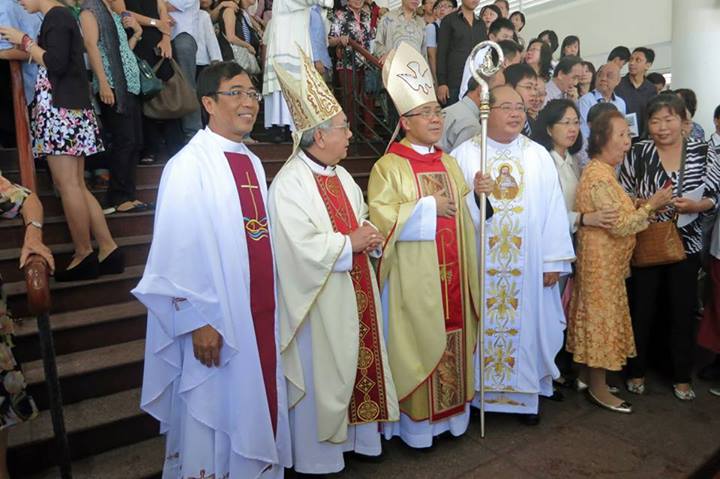
Today, Tuesday, 8 August 2013, two new priests of the Roman Catholic Archdiocese of Singapore has been ordained by the Archbishop of Singapore, His Excellency Archbishop William Goh Seng Chye. Also present was the Archbishop Emeritus of Singapore, His Excellency Archbishop Nicholas Chia.

The ordination Mass was held at Church of the Holy Family earlier this morning. Let us pray for Fr. Edward Seah (left of the Archbishops) and Fr. Benedict Chng (right of the Archbishops), that in their new positions as the priests of God’s Church and shepherds of God’s people, they will always remain dedicated and committed to the people of God and remain holy and loving as God is.

God bless Fr. Edward Seah and Fr. Benedict Chng! Ad multos annos!

My Prayer Intention for Monday, 5 August 2013

1. For Monsignor Konrad Krajewski, who was appointed the new Almoner of His Holiness the Pope. May the Lord bless him in his new position and his new role, in managing the Pope’s charitable activities, that he will do his work dutifully for the sake of God’s Church and God’s people. We also thank You for giving him to us, through his excellent services as the Assistant Master of Pontifical Liturgical Celebrations, ensuring that we have wonderful Papal Masses that bring all of us as one in worshipping You through the Holy Mass.

2. For the people in positions of governance and responsibility to the people. May the Lord plant in them the seeds of responsibility and devotion to their position as people entrusted with others under their care. May they know to put those entrusted to them first before themselves, and dedicate themselves fully in the service to those given to them. May they become truly good shepherds that the people, the sheep of the flock of God, may look up to and follow. May they never be engulfed in their own selves and selfishness, and put love in all their actions, and not to be corrupted or tempted by the power and authority given to them.

3. For people who are in hunger, both for physical food, or for spiritual food of love. May the Lord satiate them and their hunger, through our own actions, their brothers and sisters. May we all learn to share with one another what we have more, what we have that may alleviate their hunger, their hunger for love, and their hunger for food. May we know that in sharing our love, and in sharing what we have, we will have more and not less, because we share them in happiness and joy, with our brethren in need.

May the Lord who is merciful and kind, look upon us His children who are suffering, who are in the darkness of sin, that our plight and petitions may be lifted up, and reach His presence in heaven, that He may show His love and mercy to us. God bless us all. Amen.

My Prayer Intention for Wednesday, 31 July 2013

1. For Jesuits around the world and all those affiliated to the Society of Jesus as a whole, including our Pope Francis. May the Lord bless them and protect them as they embark on their daily journeys of work amongst God’s people and ministering to those who are least, weakest, and abandoned in our society. May the Lord work His power through them and strengthen the faith and love we have for Him through their work. May the Jesuits continue to serve the Lord and His people for the Lord’s own greater glory, in line with the motto of their founder, St. Ignatius Loyola, that is ‘Ad Maiorem Dei Gloriam’ – ‘For the greater glory of God’

2. For all priests around the world, religious and diocesan. May they always recall their calling in life, and their total commitment to the Lord, as His bride, and the bride of the Church, the leaders and shepherds of the people of God. May they remain faithful to their calling and their vocation, and may they always exercise the power and authority that God had granted them with care, and full of love and compassion, especially to those who are without love, and to those who still live in the darkness of evil. May the Lord ever strengthen the faith, love, and hope in their hearts.

3. For all those aspiring to the priesthood and religious life. May the Lord who calls them to His service strengthen their devotion and resolution to His cause, and the cause of His beloved people, that they will be able to make a carefully thought decision, and that they will be able to commit to the choices they are to make, so that in all the things they do, they will always remain in the grace of God and bring the blessings of the Lord to all around them. Keep their faith and dedication in the Lord strong and ever living, despite the challenges and the temptations that await them along the way.

4. For victims of prejudice and persecution of all kinds. May the Lord be with all of them, and protect them, strengthen them with His love, that they will persevere. And most importantly that they will not keep grudge or hatred against their enemies, but be resolved to forgive them with all sincerity of heart. May the Lord end all forms of injustice, prejudice, hatred, and persecution in our world.

May the Lord accept all these humble prayers that we lift up to Him in heaven. May the angels bring these petitions and may the saints intercede always for us sinners still walking on this earth. Amen.

On Homosexuality, Pope Francis’ comments, our Church teachings and our Priests

Regarding homosexuality and priesthood, I just have a simple answer to that.

If heterosexual people choose priesthood as their vocation in life, they have to abandon all sexual desires with the opposite sex and any kind of relationships henceforth all their life. So, the same too must apply to homosexual people who choose priesthood as their vocation in life.

It is really simple, but the problem is, many people, regardless whether they are heterosexual or homosexual, they cannot let go, and they give in to the temptations of the devil.

Yes, I agree that “I am not the one to judge”, and indeed, we must love the sinner, but not love the sin. The Church stance remains the same, and the teachings remain the same.

It is that we must not discriminate against those who may seem to be different, but what is important is that, we must make sure that all priests, no matter what orientation they have, must be pure and 100% focused on the Lord in celibate life, without any attachment, be it to the same or opposite gender, since the day they enter the seminary, the day of their ordination, till the day the Lord calls them back into His embrace in heaven.

It is a great sin, to turn one’s back to the Lord and embrace the devil, once he had committed himself fully to the Lord, and became His bride, in the sacred ordination, the moment when the priest is wed to God and His people, to be their servant, to be the leader and shepherd of God’s people.

So yes, sexual abuse by priests is no no, and no to married priests either, regardless of the needs of the diocese, and no to any sexual acts or perversion by priests whatsoever, with anyone, after they had committed themselves and made that choice.

If they cannot commit themselves 100% to the Lord, till the end of their life, then they cannot be priests. Priests are always tempted daily by the devil, but they must persevere. That is why it is so important for us to pray for our priests and support them!

And make sure to inculcate from early on the love for God and His people in our children and our youths, that if there are those who choose to follow the path of a priest, they will have a solid faith and rock-solid foundation, that will help them better to fight the assaults of the devil.

Remember that the Lord Himself had said that in the parable of the two houses, that a wise man builds his house on a solid ground, while a fool builds his house on sand, and when the wind and waves come and blow on them, only the one with solid foundation will remain standing. Therefore, our priests and our potential future priests too must always ensure that they have strong foundations, that is strong and unassailable faith in God, that no evil can shake and topple.

Monday, 8 April 2013 : Solemnity of the Annunciation of the Lord (Scripture Reflection)

Dear brothers and sisters in Christ. Today we commemorate the day when the angel Gabriel appeared to Mary, the Mother of God, and announced to her, the great news of joy, that the Lord had finally made true His promises, that He would come and then save the people of Israel and all mankind. It is through Jesus Christ our Lord, who was born through Mary, His mother, that the salvation of the world came into fruition, the culmination of God’s long-conceived plan since the day of our fall into sin and death.

That day was indeed a glorious day, because the angel announced the arrival of the Messiah, who was to be none other than Son of God Himself, Jesus, born into man, incarnate from His divinity and took up the mortal man’s body though without sin. But the greater is the joy and glory because of what Mary did on that day, for her faith and obedience to the Lord was so great and perfect, that through her humble acceptance of that great mission to bear Christ in herself, and through her humility, that the salvation of the world and all mankind was possible.

Without Mary’s full obedience and acceptance of her mission in delivering Christ into this world, the coming of the Messiah would not have happened. It is her attitude towards the vocation that God had placed in her, which earned her our praise and adoration, the first and greatest of all the saints in heaven, and none other than the mother of our Lord Himself, to whom our Lord would listen, just as at the wedding in Cana.

We all had deserved death since the beginning of time, since when our ancestors, from the time of Adam, succumbed to the temptations and the lies of the evil one, preferring worldly pleasures to God and His love, rebelling against His great kindness. Through this act of treason, we deserved death, but yet, our God, with His great love for us, was keen to show us His mercy, and throughout time, through countless prophets, He had made His intentions clear for all to see and listen, that He would send a deliverer, the Messiah, who would correct all things once again, and made the world into a perfection once again, cleansed from all the taints of evil.

So great was God’s love that He gave us His only Son, Jesus Christ, our Lord, that through Him, all of mankind and all creation have hope of a new life, an eternal life with God, and no longer be separated from the very God who loves us very much. To make all these possible, Christ would have to lower Himself, to be as men are, but unblemished, without the taints of sin. Pure as crystal and white as snow, and that is who Christ was. Because He was to give Himself up, not as mere burnt or sin offering and sacrifices, but as the true Lamb of God, our paschal lamb of sacrifice, whose purity and unblemished nature was the only one in all creation worthy of redeeming all of us from our unavoidable fate, that is death.

While the blood of goats and bulls was only able to cleanse sin temporarily, and that people would still die after those offerings, those cleansed by the Precious Blood of our Saviour Jesus Christ would no longer experience death, that is eternal death. For through the offering of His Body and Blood, Christ had given each of us a new lease of life, a life that is filled with the glory and love of God. In baptism, that we received, either as a baby or as an adult, we received this new life. We were dead to our old life, and we shared in this death, the death of Christ on the cross, that we die to ourselves and our sins, and with the Risen Lord, we too are resurrected to begin a new life in God.

It is not easy to obey God’s commandment and will, especially in the case of what God had entrusted to Mary, and to no other person. For Mary was born without sin as well, immaculate, just as her Son is, because, to be the vessel through whom God would be incarnate as Man into this world, no vessel that is tainted with sin would be worthy. Mary’s obedience made her role in our faith ever greater, since her obedience became a great role model to all of us. She obeyed despite the difficulties, and the implications of her acceptance would have on her.

Remember that what happened after Joseph found out that Mary was pregnant. He wanted to divorce her, though with honour, so that she would not be treated as an adulterous woman, since she was a virgin, and yet with child. This was the implication that would happen to Mary, all the difficulties she had to endure, by accepting the will of God, to bear Christ in herself, that through her holy womb, Christ was brought forth as Jesus, her Son. Yet she obeyed without conditions, and submitted fully to the will of God, gladly embracing the role that she is to play in the history of salvation.

As we commemorate this great event, let us reflect this fact, and whether we too can be as courageous, faithful, and obedient as Mary was, in bravely and gladly answering the call of God, that all the great works of our Saviour would be possible. Can we begin today, to strive to be more like her, and to follow her example? We may not have to bear Christ and give birth to Him like Mary did, but in our own surroundings and in our own lives, we have our own missions and callings by God, and the things God had entrusted upon us.

Therefore, brothers and sisters in Christ, today, let us pray, that we would be able to follow after the example of Mary, the Mother of God, that we can also say yes, to our Lord, and accept His will, and the mission He had entrusted upon all of us with great humility and great joy. May God bless all of us, and make our faith stronger, that we will always live in the favour of God, filled with His love. Amen.

Homily of Pope Francis at the Papal Inauguration Mass, Tuesday, 19 March 2013


Text  from Rome Reports :

http://www.romereports.com/palio/popes-homily-during-inauguration-mass-protect-one-another-english-9484.html#.UUg6O1cVZp4

Dear Brothers and Sisters,
 
“I thank the Lord that I can celebrate this Holy Mass for the inauguration of my Petrine ministry on the solemnity of Saint Joseph, the spouse of the Virgin Mary and the patron of the universal Church. It is a significant coincidence, and it is also the name-day of my venerable predecessor: we are close to him with our prayers, full of affection and gratitude.
I offer a warm greeting to my brother cardinals and bishops, the priests, deacons, men and women religious, and all the lay faithful. I thank the representatives of the other Churches and ecclesial Communities, as well as the representatives of the Jewish community and the other religious communities, for their presence. My cordial greetings go to the Heads of State and Government, the members of the official Delegations from many countries throughout the world, and the Diplomatic Corps.
In the Gospel we heard that “Joseph did as the angel of the Lord commanded him and took Mary as his wife” (Mt 1:24). These words already point to the mission which God entrusts to Joseph: he is to be the custos, the protector. The protector of whom? Of Mary and Jesus; but this protection is then extended to the Church, as Blessed John Paul II pointed out: “Just as Saint Joseph took loving care of Mary and gladly dedicated himself to Jesus Christ’s upbringing, he likewise watches over and protects Christ’s Mystical Body, the Church, of which the Virgin Mary is the exemplar and model” (Redemptoris Custos, 1).
How does Joseph exercise his role as protector? Discreetly, humbly and silently, but with an unfailing presence and utter fidelity, even when he finds it hard to understand. From the time of his betrothal to Mary until the finding of the twelve-year-old Jesus in the Temple of Jerusalem, he is there at every moment with loving care. As the spouse of Mary, he is at her side in good times and bad, on the journey to Bethlehem for the census and in the anxious and joyful hours when she gave birth; amid the drama of the flight into Egypt and during the frantic search for their child in the Temple; and later in the day-to-day life of the home of Nazareth, in the workshop where he taught his trade to Jesus.
How does Joseph respond to his calling to be the protector of Mary, Jesus and the Church? By being constantly attentive to God, open to the signs of God’s presence and receptive to God’s plans, and not simply to his own. This is what God asked of David, as we heard in the first reading. God does not want a house built by men, but faithfulness to his word, to his plan. It is God himself who builds the house, but from living stones sealed by his Spirit. Joseph is a “protector” because he is able to hear God’s voice and be guided by his will; and for this reason he is all the more sensitive to the persons entrusted to his safekeeping. He can look at things realistically, he is in touch with his surroundings, he can make truly wise decisions. In him, dear friends, we learn how to respond to God’s call, readily and willingly, but we also see the core of the Christian vocation, which is Christ! Let us protect Christ in our lives, so that we can protect others, so that we can protect creation!
The vocation of being a “protector”, however, is not just something involving us Christians alone; it also has a prior dimension which is simply human, involving everyone. It means protecting all creation, the beauty of the created world, as the Book of Genesis tells us and as Saint Francis of Assisi showed us. It means respecting each of God’s creatures and respecting the environment in which we live. It means protecting people, showing loving concern for each and every person, especially children, the elderly, those in need, who are often the last we think about. It means caring for one another in our families: husbands and wives first protect one another, and then, as parents, they care for their children, and children themselves, in time, protect their parents. It means building sincere friendships in which we protect one another in trust, respect, and goodness. In the end, everything has been entrusted to our protection, and all of us are responsible for it. Be protectors of God’s gifts!
Whenever human beings fail to live up to this responsibility, whenever we fail to care for creation and for our brothers and sisters, the way is opened to destruction and hearts are hardened. Tragically, in every period of history there are “Herods” who plot death, wreak havoc, and mar the countenance of men and women.
Please, I would like to ask all those who have positions of responsibility in economic, political and social life, and all men and women of goodwill: let us be “protectors” of creation, protectors of God’s plan inscribed in nature, protectors of one another and of the environment. Let us not allow omens of destruction and death to accompany the advance of this world! But to be “protectors”, we also have to keep watch over ourselves! Let us not forget that hatred, envy and pride defile our lives! Being protectors, then, also means keeping watch over our emotions, over our hearts, because they are the seat of good and evil intentions: intentions that build up and tear down! We must not be afraid of goodness or even tenderness!
Here I would add one more thing: caring, protecting, demands goodness, it calls for a certain tenderness. In the Gospels, Saint Joseph appears as a strong and courageous man, a working man, yet in his heart we see great tenderness, which is not the virtue of the weak but rather a sign of strength of spirit and a capacity for concern, for compassion, for genuine openness to others, for love. We must not be afraid of goodness, of tenderness!
Today, together with the feast of Saint Joseph, we are celebrating the beginning of the ministry of the new Bishop of Rome, the Successor of Peter, which also involves a certain power. Certainly, Jesus Christ conferred power upon Peter, but what sort of power was it? Jesus’ three questions to Peter about love are followed by three commands: feed my lambs, feed my sheep. Let us never forget that authentic power is service, and that the Pope too, when exercising power, must enter ever more fully into that service which has its radiant culmination on the Cross. He must be inspired by the lowly, concrete and faithful service which marked Saint Joseph and, like him, he must open his arms to protect all of God’s people and embrace with tender affection the whole of humanity, especially the poorest, the weakest, the least important, those whom Matthew lists in the final judgment on love: the hungry, the thirsty, the stranger, the naked, the sick and those in prison (cf. Mt 25:31-46). Only those who serve with love are able to protect!
In the second reading, Saint Paul speaks of Abraham, who, “hoping against hope, believed” (Rom 4:18). Hoping against hope! Today too, amid so much darkness, we need to see the light of hope and to be men and women who bring hope to others. To protect creation, to protect every man and every woman, to look upon them with tenderness and love, is to open up a horizon of hope; it is to let a shaft of light break through the heavy clouds; it is to bring the warmth of hope! For believers, for us Christians, like Abraham, like Saint Joseph, the hope that we bring is set against the horizon of God, which has opened up before us in Christ. It is a hope built on the rock which is God.
To protect Jesus with Mary, to protect the whole of creation, to protect each person, especially the poorest, to protect ourselves: this is a service that the Bishop of Rome is called to carry out, yet one to which all of us are called, so that the star of hope will shine brightly. Let us protect with love all that God has given us!
I implore the intercession of the Virgin Mary, Saint Joseph, Saints Peter and Paul, and Saint Francis, that the Holy Spirit may accompany my ministry, and I ask all of you to pray for me! Amen.”