Tuesday, 18 November 2014 : 33rd Week of Ordinary Time, Memorial of the Dedication of the Basilica of St. Peter and the Basilica of St. Paul Outside the Walls (Homily and Scripture Reflections)

Liturgical Colour : Green or White (Dedication of the Basilicas)

Dear brothers and sisters in Christ, today we celebrate together with the whole universal Church, the feast of the dedication of two of the four greatest churches in the whole world. These four churches are the primary church buildings of the entire Christendom, and they are the Papal Basilicas, each of which was dedicated to important patron saints of the Church.

The first, head and mother of all the churches of Rome and the whole world is dedicated to our Lord Himself, the Most Holy Saviour of all, and also to St. John the Baptist and St. John the Evangelist, the Lateran Archbasilica, which feast we had just celebrated a few days ago. It is the Cathedral of the Pope, and the centre and heart of the whole Christendom.

And then after that, in importance and primacy, we have the greatest church in Christendom, the Papal Basilica of St. Peter, which is probably the most well known church in the whole world, as not only that it is the most elaborate but also because the Pope celebrates the majority of his celebrations in that great basilica. St. Peter himself was martyred at the site of the great basilica, the former Vatican hills, and his bones can be found there in its necropolis.

And then we also have the Basilica of Santa Maria Maggiore, or also known as the Papal Basilica of St. Mary Major, dedicated to the Mother of our Lord and the Protector of the city and people of Rome. And lastly, we have the Papal Basilica of St. Paul Outside the Walls, or San Paulo fuori le mura, named as such because it was located outside the historical walls of the city of Rome, dedicated to St. Paul the Apostle, who was beheaded in Rome in holy martyrdom.

Today we celebrate the day of the consecration and dedication of two of these four great basilicas, dedicated to none other than St. Peter the Apostle, the Prince of the Apostles, Vicar of Christ and the leader of the Universal Church, and St. Paul the Apostle, the Apostle to the Gentiles and the writer of the many holy Epistles. Both of these greatest two pillars of the Church died in martyrdom in the Holy city of Rome, made holy because of their blood shed in that city, and the two basilicas were built over their respective tombs.

Most importantly, on this day, by looking at the life and examples set by these two saints, St. Peter and St. Paul, all of us are also called to share in their experiences and to emulate them in their actions. They too were once sinners and weak human beings, but through the Lord and their own faith, they changed themselves to be truly faithful and devoted servants of God.

God did not call the perfect and those who are already awesomely good in life to be His disciples, as they are likely to be already saved and secure in their lives in the world to come. Instead, He empowers those who are weak and fragile, and also calls those who are sinners and unworthy, who by His grace and power, are transformed to be holy tools and servants of His will.

Indeed, is it not better that those who were sinners and unworthy, by the works and graces of God be made to be worthy and just? And that was exactly God had done, wit two of His principal Apostles, the two greatest pillars of the Faith and the Church. St. Peter was a simple, poor fisherman, whose faith was often weak and he often trembled in doubt, while St. Paul was an overzealous and extreme Pharisee, who was hell bent on destroying the Church and the faithful.

St. Peter was called by Jesus from the shores of the lake of Galilee, together with his brother, St. Andrew, who was the first to be called among the Twelve Apostles. St. Peter was a humble and simple fisherman who made his living by catching fishes from the lake. Jesus called him to be a fisher of men instead, and he left behind his net and boat, and followed Him.

Yet during his period of service to God, St. Peter often encountered many difficult moments. Today we heard in the Gospel, of the moment when he and the other Apostles were in the middle of the lake going through a great storm, and the Lord came to them walking on the water. St. Peter was the one who offered to test the Lord to find out if it was truly Him on the water, and when the Lord asked him to come towards Him, he went forth.

But for his lack of a solid faith without doubt, seeing the power of the storm and the waves, he began to falter and sink. Thus, the Lord rebuked him for his doubts after He helped him. And we know of how Peter denied Jesus three times during His Passion. It was also because of the same doubt and uncertainty, which led to fear of the retribution of the world and its powers, which led to Peter to do such things.

But the quality of Peter comes in that, he was courageous and brave, ready to take the initiative, as we know that out of all the Apostles, he was the only one in the boat to seek to walk towards the Lord, even proposing that if He is indeed the Lore, he, Peter would be able to walk on the water. Such an act, does require an incredible amount of courage and faith. Indeed, that faith was to be shaken, but it was there indeed.

And Peter eventually made the thrice profession of faith, after Jesus had risen from the dead, and when He asked him, whether he loved Him more than anyone else. In that profession of faith and love, Peter knew that he was forgiven for his denial of Jesus, and in that also, we can see the kind of faith and love which he had for the Lord, and that was why, he was made to be the Vicar of Christ on earth, and the leader of the entire Universal Church.

Meanwhile, St. Paul was once known as Saul, as a great enemy of the Church and the faithful, as some sort of an executioner, who belonged to the caste of the Pharisees, young and overly zealous, that he was blinded by his rage and youthful pursuits, seeking to destroy the Church and kill as many believers as possible. Thus, he brought the Church and the Lord much sorrow and sadness.

Yet, he was transformed from such a sinner and great enemy, into the greatest champion of the Faith, and into a figure so important and crucial to the growth of the Church and the spreading of the Good News in the early years of the Church. St. Paul as Saul encountered the Lord speaking directly to him and rebuking him for his actions on the way to Damascus, and ever since then, he repented and was converted to the Faith.

St. Paul thereafter became a great evangeliser, who went on many journeys to different cities and places to spread the Good News, and for his works and efforts to spread the Faith to the Gentiles, he was then appropriately titled as the Apostle to the Gentiles. And together with St. Peter, they went on to Rome, the capital city of the Empire, and there they were martyred for their faith. The locations where they were martyred and buried then became the two great Basilicas we know today.

Therefore, brothers and sisters in Christ, today’s celebration of the dedication of the Basilicas of St. Peter and St. Paul is a reminder to all of us, that God seeks our salvation, and He calls us all to return to Him, all of us sinners that we may be, like St. Peter and St. Paul before us, turn from our sinfulness and path of darkness, into the light and become holy servants following the examples of the two great saints whose memory we remember today.

May Almighty God therefore, with the intercession of St. Peter and St. Paul, be hearkened to strengthen our zeal and faith, so that we may become ever faithful and loving in our lives, that eventually, at the end of the days, when He comes again, He may congratulate us for our dedication and welcome us into His eternal kingdom. God bless us all. Amen.


First Reading :

https://petercanisiusmichaeldavidkang.com/2014/11/16/tuesday-18-november-2014-33rd-week-of-ordinary-time-memorial-of-the-dedication-of-the-basilica-of-st-peter-and-the-basilica-of-st-paul-outside-the-walls-first-reading/


Psalm :

https://petercanisiusmichaeldavidkang.com/2014/11/16/tuesday-18-november-2014-33rd-week-of-ordinary-time-memorial-of-the-dedication-of-the-basilica-of-st-peter-and-the-basilica-of-st-paul-outside-the-walls-psalm/


Gospel Reading :

https://petercanisiusmichaeldavidkang.com/2014/11/16/tuesday-18-november-2014-33rd-week-of-ordinary-time-memorial-of-the-dedication-of-the-basilica-of-st-peter-and-the-basilica-of-st-paul-outside-the-walls-gospel-reading/

(Usus Antiquior) Twenty-Third Sunday after Pentecost (II Classis) – Sunday, 16 November 2014 : Epistle

Lectio Epistolae Beati Pauli Apostoli ad Philippenses – Lesson from the Epistle of Blessed Paul the Apostle to the Philippians

Philippians 3 : 17-21 and Philippians 4 : 1-3

Fratres : Imitatores mei estote, et observate eos, qui ita ambulant, sicut habetis formam nostram. Multi enim ambulant, quos saepe dicebam vobis (nunc autem et flens dico) inimicos Crucis Christi : quorum finis interitus : quorum Deus venter est : et gloria in confusione ipsorum, qui terrena sapiunt.

Nostra autem conversatio in caelis est : unde etiam Salvatorem exspectamus, Dominum nostrum Jesum Christum, qui reformabit corpus humilitatis nostrae, configuratum corpori claritatis suae, secundum operationem, qua etiam possit subjicere sibi omnia.

Itaque, fratres mei carissimi et desideratissimi, gaudium meum et corona mea : sic state in Domino, carissimi. Evodiam rogo et Syntychen deprecor idipsum sapere in Domino. Etiam rogo et te, germane compar, adjuva illas, quae mecum laboraverunt in Evangelio cum Clemente et ceteris adjutoribus meis, quorum nomina sunt in libro vitae.

English translation

Brethren, may all of you be my followers, and observe those who walk so as you have our model. For many walk, of whom I have often told you (and now tell you weeping) that they are enemies of the Cross of Christ; whose end is destruction, whose God is their belly, and whose glory is in their shame, who mind earthly things.

But our conversation is in heaven; from where we also look for the Saviour, our Lord Jesus Christ, who will reform the body of His glory, according to the operation whereby He is also able to subdue all things unto Himself.

Therefore, my brethren, dearly beloved, and most desired, my joy and my crown, so stand fast in the Lord, my dearly beloved. I beg of Evodia, and I beseech Syntyche to be of one mind in the Lord, and I entreat you also, my sincere companion, help those women who have laboured with me in the Gospel with Clement and the rest of my fellow labourers, whose names are in the book of life.


Homily and Reflection :

https://petercanisiusmichaeldavidkang.com/2014/11/14/usus-antiquior-twenty-third-sunday-after-pentecost-ii-classis-sunday-16-november-2014-homily-and-scripture-reflections/

Monday, 10 November 2014 : 32nd Week of Ordinary Time, Memorial of Pope St. Leo the Great, Pope and Doctor of the Church (First Reading)

Liturgical Colour : White

Titus 1 : 1-9

From Paul, servant of God, Apostle of Christ Jesus, at the service of God’s chosen people, so that they may believe and reach the knowledge of truth and godliness. The eternal life we are waiting for was promised from the very beginning by God who never lies, and as the appointed time had come, He made it known through the message entrusted to me by a command of God, our Saviour.

Greetings to you, Titus, my true son in the faith we share. May grace and peace be with you from God the Father and Christ Jesus our Lord. I left you on Crete because I wanted you to put right what was defective and appoint elders in every town, following my instructions.

They must be blameless, married only once, whose children are believers and not open to the charge of being immoral and rebellious. Since the overseer (or bishop) is the steward of God’s house, he must be beyond reproach : not proud, hot-headed, over-fond of wine, quarrelsome or greedy for gain.

On the contrary, he must be hospitable, a lover of what is good, wise, upright, devout and self-controlled. He must hold to the message of faith just as it was taught, so that, in his turn, he may teach sound doctrine and refute those who oppose it.


Homily and Reflection :

https://petercanisiusmichaeldavidkang.com/2014/11/09/monday-10-november-2014-32nd-week-of-ordinary-time-memorial-of-pope-st-leo-the-great-pope-and-doctor-of-the-church-homily-and-scripture-reflections/

Monday, 3 November 2014 : 31st Week of Ordinary Time, Memorial of St. Martin de Porres, Religious (First Reading)

Liturgical Colour : Green or White (Religious)

Philippians 2 : 1-4

If I may advise you in the Name of Christ and if you can hear it as the voice of love; if we share the same Spirit and are capable of mercy and compassion, then I beg of you, make me very happy : have one love, one Spirit, one feeling, do nothing through rivalry or vain conceit.

On the contrary let each of you gently consider the others as more important than yourselves. Do not seek your own interest, but rather that of others.


Homily and Reflection : 
https://petercanisiusmichaeldavidkang.com/2014/11/03/monday-3-november-2014-31st-week-of-ordinary-time-memorial-of-st-martin-de-porres-religious-homily-and-scripture-reflections/

Thursday, 30 October 2014 : 30th Week of Ordinary Time (First Reading)

Liturgical Colour : Green

Ephesians 6 : 10-20

Finally, be strong in the Lord with His energy and strength. Put on the whole armour of God to be able to resist the cunning of the devil. Our battle is not against human forces but against the rulers and authorities and their dark powers that govern this world. We are struggling against the spirits and supernatural forces of evil.

Therefore put on the whole armour of God, that in the evil day, you may resist and stand your ground, making use of all your weapons. Take truth as your belt, justice as your breastplate, and zeal as your shoes to propagate the Gospel of peace. Always hold in your hand the shield of faith to repel the flaming arrows of the devil. Finally, use the helmet of salvation and the sword of the Spirit, that is, the Word of God.

Pray at all times as the Spirit inspires you. Keep watch, together with sustained prayer and supplication for all the holy ones. Pray also for me, so that when I speak, I may be given words to proclaim bravely the mystery of the Gospel. Even when in chains I am an ambassador of God; may He give me the strength to speak as I should.


Homily and Reflection : https://petercanisiusmichaeldavidkang.com/2014/10/29/thursday-30-october-2014-30th-week-of-ordinary-time-homily-and-scripture-reflections/

Wednesday, 22 October 2014 : 29th Week of Ordinary Time, Memorial of Pope St. John Paul II, Pope (Homily and Scripture Reflections)

Liturgical Colour : Green or White (Popes)

Dear brothers and sisters in Christ, today we celebrate together for the very first time, the feast of a great saint, and one whose memory is certainly still very clear in the minds of most of us, except for the very youngest ones among us. If we are at an age of adulthood or above, that is eighteen or beyond, we would have remembered how we once know of Pope John Paul II as our Pope, and thus as the Vicar of Christ and the Successor of St. Peter the Apostle.

And just earlier this year in April, that together with another great Pope of the last century, Pope John XXIII, the Pope who initiated the Second Vatican Council that they were together raised to the glory of the Altar of God as the holy saints of the Church, worthy of heaven, of praise and also worthy of being asked for intercessions from, to pray for us sinners still in this world.

To many of us, Pope St. John Paul II was our Pope, the Pope who had filled so much of our faith life. His very long reign, the second longest among the verified reigns of Popes, third if St. Peter himself is included, the reign of twenty-seven years certainly is of a very significant to the whole Universal Church. Many of us did not even know any other Pope than this saint, until he passed away just less than a decade ago.

However, even though many of us knew him, and even though many of us think that he was a great man and a great Pope, how many of us actually knew who he was and what he had done for the Church and for the faithful people of God? It is likely that many of us do not have the full image and idea of who he really was and what he has done. And many of us might have wrong impressions about him through misinformations and miscommunications of the world and the media.

That is why, let me share a bit first on who Pope St. John Paul II was. He was a Pole, the first ever Pope to originate from Poland, an Eastern European country, which at that time had the unfortunate fate of being overrun by the two great powers that were its neighbours. Pope St. John Paul II was born Karol Jozef Wojtyla in Krakow, Poland, just two years after Poland regained its independence from the Russian Empire after a period of more than a century.

But as the life of Pope St. John Paul II would testify, Poland was to be subjected to a series of unfortunate and very grim events, subjugation first by the forces of the NAZI Germany and then later under the dominance and hegemony of the Communist Soviet Union. Nevertheless, the one fact most if not all of us knew well was that the central role which Pope St. John Paul II would play in bringing down the dreaded Communism, not just in Poland, but also in almost the whole world.

Pope St. John Paul II himself did not have an easy life, as his mother died young when the then Karol Wojtyla was still very young, and he quickly lost his siblings to various reasons, including his elder brother whom he respected a lot, to a disease. His father passed away just at the start of the great miseries to befell Poland, and Pope St. John Paul II, Karol Wojtyla was left all alone in the world, without a family, but yet with God and His Blessed Mother at his side.

If we are wondering why Pope St. John Paul II chose the motto which would be famously accredited and associated to him, then we do not need to look further from the fact how he had persevered through many sufferings and difficulties, left all alone in the world, but he made it through the help and the intercession of the Blessed Virgin Mary, Mother of God.

His motto was Totus Tuus, the abbreviation of the full motto of Totus Tuus suum Maria, or ‘Blessed Virgin Mary, I am all yours’. This motto showed the great devotion which Karol Wojtyla, later Pope St. John Paul II had for Mary, and he was indeed known as one of the great Marian Popes who highly promoted the veneration and devotions to the Blessed Virgin.

This is the same kind of attitude which we should also have in our faith life and in our lives in general. We have to devote ourselves to the Lord and also to His Blessed Mother Mary, fully and completely if we are to allow God to come and work His wonders in us, and through us He can indeed do many things for the benefit of the world and for His people, as He had shown through how He worked through the person of Pope St. John Paul II, who should indeed be the role model for all of us in living our faith.

He endured difficulties after difficulties, persecutions after persecutions, and he frequently brushed closely with death. Yet, God had indeed had a plan for him, and every time, the Lord and His Blessed Mother guided him and delivered him from harm’s path. He suffered indeed, but he knew that he suffered for the sake of the Lord, who would indeed be bound to listen to the pleas of His people and take action.

He stood up for the faithful, when he, as the Metropolitan Archbishop of Krakow, one of the most influential and outspoken Archbishops and prelates in Poland and in Communist-dominated Eastern Europe, defended the right of his sheep, the flock of God for a place to worship God, a church to be built in the vicinity of the city of Krakow, at a locale known as Nowa Huta, the new city, supposedly the hallmark in the Communist government’s project to establish a utopian Communist city without a church building.

The then Archbishop Karol Wojtyla led the faithful people of Nowa Huta in a defiant rally and celebration of the Holy Mass, commemorating the establishment of a church building in that city championed by the Communists as the model of a utopian society without the faith. He gave the people the foundation stone of the church building, originating from the catacombs of St. Peter the Apostle, the rock upon whom the Lord had established His Church, and blessed by Pope Paul VI, now known as Blessed Pope Paul VI, beatified just last Sunday by our current Pope, Pope Francis.

Even after he was elected to the Papacy, to succeed as the Vicar of Christ and the Successor of St. Peter the Apostle, Karol Wojtyla, then on known as Pope John Paul II, continued his works for the good of the Church as he had always done, defending the orthodox and true teachings of the faith, and also to help the people of God suffering persecution in the Communist regimes of Eastern Europe.

We knew how Pope St. John Paul II had survived an assassination attempt, although he was grievously injured by it, on the day of our Lady of Fatima’s apparition in 1981. He attributed his survival to the ever caring and loving Mother of God, to whom he had devoted himself fully to, and to His Son, that he was again brought from the brink of death to continue to serve the people of God. We also knew how he forgave the one who tried to assassinate him.

And even to the end of his life, suffering from Parkinson’s disease which increasingly debilitated him and made it very difficult for him to continue to work as the leader of the Universal Church, he persevered on, and in his suffering, through which he share the suffering of Christ, he became a source of priceless inspiration for countless numbers of the faithful.

Brothers and sisters in Christ, after that summary of the life and the actions and contributions of Pope St. John Paul II, how are they relevant to the readings we had heard today, and how ultimately does do they relate to our own lives? It is in fact quite obvious that while every one, every single children of God will encounter different things on their respective journeys to God, but the actions of Pope St. John Paul II, Karol Wojtyla can indeed be a model and inspiration for all of us.

In the First Reading, St. Paul in his letter to the Church and the faithful in Ephesus revealed what had been entrusted to him in the graces and wisdom of God, that he might enlighten and show that wisdom to the people of God, so that all those who heard his words may be moved within their hearts and souls, and decide to seek the Lord their God with all of their hearts’ devotion.

In the same way therefore, Pope St. John Paul II, his predecessors and successors, the bishops and priests who had given themselves completely to the service of God, also received the same graces and wisdom to teach the Lord’s words and laws to His people, so that through them, many would be saved. But this does not mean that they alone are the ones who can do this.

Yes, brothers and sisters in Christ, each one of us at our own baptism, when we were welcomed into the Church of God, and now as a member of that one and only Church, we all have our own parts to play in the salvation of souls and in the good works of evangelisation done by the Church. We have been given the same graces, wisdom and blessing, and indeed it is part of our responsibility to bring the people of God, especially those who still live in darkness, into the light of Christ.

This is also what Christ had done, by bringing together the separated people of God, and grant them His peace. Ever since mankind had disobeyed God and followed their own desires, they had walked their own paths and in contrary to each other, each following their own hearts’ desires and inevitably leading to conflicts, violence and many other evils. Ever since the day of the Tower of Babel, mankind had been divided against one another and peace as well as harmony were lost.

It was therefore the peace of Christ, which He made by His works and His sacrifice on the cross, which offered mankind a new hope, that they may abandon their old lives of sin and darkness, of disobedience and injustice, of hatred, fear and violence, so that they may receive the love and peace of the Lord, by following Jesus and walking in the path He had prepared for them.

And in the Gospel, this responsibility which we have as members of the Church is reiterated yet once again by the parable of Jesus our Lord, on the master and the steward. This parable tells us clearly that we are indeed stewards appointed by God, and with a certain purpose, that is to love one another, and to spread the Good News which had been given to us by God, to those who still have yet to hear it.

That is what the faithful servants will do, unlike the unfaithful servants, which examples are the Pharisees and the teachers of the Law, when they failed not only to lead the people in faith by example, but they have cast obstacles in the path of the people of God, and in their selfishness, they abused their power and authority, like the unfaithful and bad servants. And when the Master comes back, that is the Lord, He will rebuke them without mercy and cast them out of His presence, precisely what He did with those Pharisees and hypocrites.

Therefore, this is a stern and clear reminder for us to avoid following the path of those Pharisees and avoid succumbing to our human desires, greed, pride, arrogance, hatred, lack of love, unfaithfulness, sloth and many others. Instead, we should open wide the doors of our heart to Christ our Lord, inspired by the words of Pope St. John Paul II, ‘Aprite le porte a Christo!’ which means, ‘Open wide the doors to Christ!’.

When we open wide the doors of our hearts to Christ, in essence we allow Him to enter into our hearts and transform us from within, allowing His love to fill us up, and therefore, it will affect our actions and deeds, which will then be based no longer on our own selfish desires, but instead upon the love of God. We must not be afraid to seek the Lord for help, and indeed we should entrust everything we have to God and to His Blessed Mother Mary just as Pope St. John Paul II had done.

Do not tarry and do not delay, for as much as God is merciful and loving, and as much as He desires to embrace us with His love and forgive us our sins, nothing good will come until we take the initiative and embrace His mercy first. Therefore, it is imperative that we realise that God hates sin and all wickedness, and if we delay and wait, and wait and wait, eventually time will catch up to us, and at the time that we do not know, the Lord will decide that our time is up, then no amount of regret or even repentance will help.

Therefore, brothers and sisters in Christ, let us help one another, working with one another to take care of ourselves, that we do not open ourselves to sin and evil, and so that we may allow the Lord to come into us, and to transform us with His love and grace. May Almighty God bless us, empower us and strengthen us, and through the intercession of Pope St. John Paul II, may all souls come eventually to salvation in God, with the help of His Blessed Mother Mary, the Mediatrix of all graces. Amen.

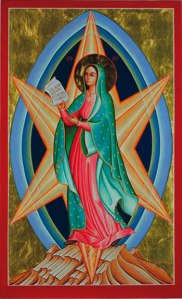
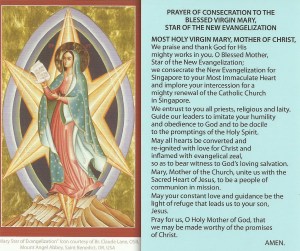
Prayer of Consecration to the Blessed Virgin Mary, Star of the New Evangelisation

marystarofevanglisationicon

On 7 October 2014, on the Feast of our Lady of the Rosary, His Excellency Archbishop William Goh Seng Chye, the Archbishop of Singapore dedicated and consecrated the Archdiocese of Singapore and all the efforts of the New Evangelisation in Singapore to the Blessed Virgin Mary, Star of the New Evangelisation.

Although this refers to the Archdiocese of Singapore, I believe that everyone else in the world, within the Church of God may also pray the same prayer for the sake of evangelisation of the Good News everywhere in this world.


Here is the text of the prayer, to be prayed daily from 7 October 2014 to 7 October 2015, the Feast of our Lady of the Rosary.


10669256_842249659148292_6829732685043142899_o

Most Holy Virgin Mary, Mother of Christ.

We praise and thank God for His mighty works in you. O Blessed Mother, Star of the New Evangelisation; we consecrate the New Evangelisation for Singapore to your Most Immaculate Heart and implore your intercession for a mighty renewal of the Catholic Church in Singapore. We entrust to you all priests, Religious and laity. Guide our leaders to imitate your humility and obedience to God and to be docile to the promptings of the Holy Spirit.

May all hearts be converted and re-ignited with love for Christ and inflamed with evangelical zeal, so as to bear witness to God’s loving salvation. Mary, Mother of the Church, unite us with the Sacred Heart of Jesus, to be a people of communion in mission.

May your constant love and guidance be the light of refuge that leads us to your son, Jesus. Pray for us, O Holy Mother of God, that we may be made worthy of the promises of Christ. Amen.

Saturday, 18 October 2014 : 28th Week of Ordinary Time, Feast of St. Luke the Evangelist (First Reading)

Liturgical Colour : Red

2 Timothy 4 : 10-17b

You must know that Demas has deserted me for the love of this world : he returned to Thessalonica. Crescens has gone to Galatia and Titus to Dalmatia. Only Luke remains with me. Get Mark and bring him with you, for he is a useful helper in my work. I sent Tychicus to Ephesus.

Bring with you the cloak I left at Troas, in Carpos’ house and also the scrolls, especially the parchments. Alexander the metalworker has caused me great harm. The Lord will repay him for what he has done. Distrust him for he has been very much opposed to our preaching.

At my first hearing in court no one supported me; all deserted me. May the Lord not hold it against them. But the Lord was at my side, giving me strength to proclaim the Word fully, and let all the pagans hear it.

Saturday, 11 October 2014 : 27th Week of Ordinary Time, Memorial of Pope St. John XXIII, Pope (Homily and Scripture Reflections)

Liturgical Colour : Green or White (Saturday Mass of our Lady and Popes)

Brothers and sisters in Christ, today we are presented with the message of the Lord, through the Holy Scriptures and the Gospels, on the nature of our faith and salvation, and how we can attain that salvation through what we are doing in this life, not just based on any race or other passive benefits or factors, but through the commitment of actions that make our faith truly alive in God.

In the first reading today, St. Paul in his letter to the faithful and the Church in Galatia showed how while in the past, God revealed His Law to His people to guide them and prevent them from going astray from the path towards salvation, but the coming of Christ, the Messiah and Saviour of all, gave mankind a new focus of their faith and devotion. For God Himself had come down upon us, in our humble form, to save us from our fate that was death and oblivion.

There was also to be no more division and prejudice, or any difference in treatment between those in the society, based on either race or birth, based no longer on either status or wealth or possessions. What matters is truly whether one believes in the Lord Jesus Christ, and if one believes, and lives according to that faith which they have, then they are guaranteed salvation in Jesus Christ our Lord.

That was because, the Jews, who were descendants of Abraham, the faithful servant of God, with whom He had made His covenant with, were proud and prejudiced against their neighbours, thinking that as the heirs and sons of Abraham, they alone deserved salvation, and the others, the Gentiles, namely the Greeks, the Samaritans, Romans, Arabs, Canaanites, and others whom they considered as pagans and barbarians deserved eternal damnation.

Yet, Jesus made it clear in the Gospel, that blessing is upon those who follow the will of God, who walk in His ways, and who practice their faith in the real life, showing that their faith is truly real, concrete and dynamic. Yes, not the dead and stagnant faith shown by lack of action, by mere lip service of faith, and not by prejudicing against others or condemning others or glorifying oneself thinking that one is worthy of salvation, while others do not.

Therefore, today we are all called to reflect on our own lives, whether in all things we do, we have been truly faithful to the Lord, not just by mere faith or words, but also through actions founded in faith, filled with hope, and blessed and graced by love. This is what is necessary for us to attain our salvation, and blessed we are indeed if we listen to Jesus and what He had said, instead of following our own desires and wants.

Today, we celebrate together with the whole Universal Church, the feast of Pope St. John XXIII, the successor of St. Peter the Apostle, and one of the great and holy Popes of the twentieth century after the birth of Christ. Pope St. John XXIII, who was also called the ‘Good Pope’, was chiefly remembered for his role in convoking and gathering the latest Ecumenical Council of the Holy Roman Church, that is the Second Vatican Council, which lasted from 1962 to 1965, but in fact, his holiness stemmed not just from that act, but also from the actions which he had taken for the entire course of his life.

The life and examples of Pope St. John XXIII, the Good Pope, il Papa Buono, can be an inspiration for us all, as ever since he was born of a poor peasant family in the village and commune of Sotto il Monte, in the province of Bergamo in northern Italy as Angelo Giuseppe Roncalli, he had led a very faithful and devoted life to God. He was poor, just as his family was poor, but together they as a family lovingly devoted themselves to God.

At a certain moment in his youth, the young Angelo encountered experience in faith, by those whom he met, including his uncle, which encouraged him to consider giving himself to the service of God. As his family was poor, and peasant youths were considered important assets to help out in work, his parents were reluctant to let him to go and join the seminary.

Nevertheless, in the end, God had His way, and Angelo managed to join the seminary, studying intently and eventually was ordained a priest of the Diocese of Bergamo. He eventually became the secretary of the local ordinary, Bishop Radini-Tedeschi, who was a relatively obscure individual compared to his later famous protege, but the one who had great influence on Angelo and his later great works.

Bishop Radini-Tedeschi encountered a great workers and union strike in accordance to the poor living conditions and treatment of workers by the government of that era, in the early twentieth century, and Bishop Radini-Tedeschi faithfully and tenderly exercised his works as the shepherd of his flock, calling for restraint and restoration of order while calling for reforms and great improvement in the treatment of workers. He even donated his own personal wealth to help the poor workers made their ends meet.

All these inspired the young Angelo Roncalli, the later Pope St. John XXIII, as he later was made Archbishop and appointed as the Apostolic Delegate to Bulgaria, and later to Greece and Turkey. During his diplomatic missions in the service of the Church, Archbishop Roncalli did many great works, establishing links and friendship with the separated brethren of faith in the Eastern Orthodox Church, and during his mission in Greece and Turkey, even saved many Jews from the actions of the German NAZI who was bent on annihilating them as a race in the holocaust.

In his later mission as the Apostolic Nuncio to France, Archbishop Roncalli continued to do many good works, establishing links and relationship with the French government, including dealing with the difficult leader of France, Charles de Gaulle, who wanted to reduce the influence of the Church of Rome in the affairs of the Church in France.

And eventually, as the Patriarch of Venice and a Cardinal of the Holy Roman Church, Cardinal Angelo Roncalli continued to exercise the good works which he had done earlier in his earlier posts and ministries, and which eventually he continued when he was elected Pope in 1958 to succeed the great Pope Pius XII, the Pastor Angelicus, or the Angelic Pope.

Pope St. John XXIII continued to lead the Church faithfully, and he was particularly concerned with the restoration of relations with the Eastern Church, as he had experienced earlier during his time in Bulgaria, Greece and Turkey, in the relationships he had made with the prelates and faithful of the Eastern Church at the time. And then he was also concerned about the state of the Church, and the need for a continuation of the unfinished works of the First Vatican Council, which was prematurely ended due to the events at that time.

Thus, Pope St. John XXIII convoked the gathering of the Second Vatican Council, which commenced in 1962, and which sessions was started and opened by the Pope himself, which meeting was to continue until 1965, and concluded by Pope Paul VI, his successor as Pope St. John XXIII passed away in 1963, before the conclusion of the Ecumenical Council which he had initiated.

Pope St. John XXIII also was renowned for his role in helping to reduce tension between the superpowers, namely the United States of America and the Soviet Union, which almost ended up in a major war, during the Cuban Missile Crisis in 1962. One of the last major acts of Pope St. John XXIII was the peace which he helped broker between the two sides, and which was the major reason behind the Papal encyclical he released in 1963, the famous Pacem in Terris, or ‘Peace on earth’.

Brothers and sisters in Christ, as I have mentioned, that the actions of Pope St. John XXIII are examples to all of us, and through them, we should also be inspired to follow in his footsteps, that our faith may grow stronger and that in our devotion, we may be found justified in our faith by the Lord our God. Remember, brethren, that we have to have a living faith in us, so that our faith will not be just empty, but be real and concrete.

May Almighty God, who sees the faith and commitment which Pope St. John XXIII, also see the faith that is in us, and therefore may grant us the inheritance and reward which He promised us through Jesus Christ His Son. May we all come ever closer to His loving embrace, seeking His mercy and be made righteous once again. God bless us all. Amen.

Tuesday, 7 October 2014 : 27th Week of Ordinary Time, Memorial of Our Lady of the Rosary (Gospel Reading)

Liturgical Colour : White

Luke 1 : 26-38

In the sixth month, the angel Gabriel was sent from God to a town of Galilee called Nazareth. He was sent to a young virgin, who was betrothed to a man named Joseph, of the family of David; and the virgin’s name was Mary.

The angel came to her and said, “Rejoice, full of grace, the Lord is with you.” Mary was troubled at these words, wondering what this greeting could mean. But the angel said, “Do not fear, Mary, for God has looked kindly on you. You shall conceive and bear a Son, and you shall call Him Jesus.”

“He will be great, and shall rightly be called Son of the Most High. The Lord God will give Him the kingdom of David, His ancestor; He will rule over the people of Jacob forever, and His reign shall have no end.”

Then Mary said to the angel, “How can this be, since I am a virgin?” And the angel said to her, “The Holy Spirit will come upon you and the power of the Most High will overshadow you; therefore, the Holy Child to be born of you shall be called Son of God. Even your relative Elizabeth is expecting a son in her old age, although she was unable to have a child; and she is now in her sixth month. With God nothing is impossible.”

Then Mary said, “I am the handmaid of the Lord, let it be done to me as you have said.” And the angel left her.