Monday, 22 April 2024 : 4th Week of Easter (First Reading)

Liturgical Colour : White

Acts 11 : 1-18

News came to the Apostles and the brothers and sisters in Judea that even foreigners had received the Word of God. So, when Peter went up to Jerusalem, these Jewish believers began to argue with him, “You went to the home of uncircumcised people and ate with them!”

So Peter began to give them the facts as they had happened, “I was at prayer in the city of Joppa when, in a trance, I saw a vision. Something like a large sheet came down from the sky and drew near to me, landing on the ground by its four corners. As I stared at it, I saw four-legged creatures of the earth, wild beasts and reptiles, and birds of the sky.”

“Then I heard a voice saying to me : ‘Get up, Peter, kill and eat!’ I replied, ‘Certainly not, Lord! No common or unclean creature has ever entered my mouth.’ A second time the voice from the heavens spoke, ‘What God has made clean, you must not call unclean.’ This happened three times, and then it was all drawn up into the sky. At that moment three men, who had been sent to me from Caesarea, arrived at the house where we were staying.”

“The Spirit instructed me to go with them without hesitation; so these six brothers came along with me and we entered into the man’s house. He told us how he had seen an Angel standing in his house and telling him : ‘Send someone to Joppa and fetch Simon, also known as Peter. He will bring you a message by which you and all your household will be saved.”

“I had begun to address them when suddenly the Holy Spirit came upon them, just as it had come upon us at the beginning. Then I remembered what the Lord had said : ‘John baptised with water, but you shall be baptised with the Holy Spirit.’ If, then, God had given them the same gift that He had given us when we believed in the Lord Jesus Christ, who was I to resist God?”

When they heard this they set their minds at rest and praised God saying, “Then God has granted life-giving repentance to the pagan nations as well.”

Thursday, 9 August 2018 : 18th Week of Ordinary Time, Memorial of St. Teresa Benedicta of the Cross, Virgin and Martyr (Gospel Reading)

Liturgical Colour : Red

Matthew 16 : 13-23

At that time, Jesus came to Caesarea Philippi. He asked His disciples, “Who do people say the Son of Man is?” They said, “For some of them, You are John the Baptist; for others Elijah, or Jeremiah, or one of the prophets.”

Jesus asked them, “But you, who do you say I am?” Peter answered, “You are the Messiah, the Son of the living God.” Jesus replied, “It is well for you, Simon Barjona, for it is not flesh or blood that has revealed this to you, but My Father in heaven.”

“And now I say to you : You are Peter; and on this Rock I will build My Church; and never will the powers of death overcome it. I will give you the keys of the kingdom of heaven : whatever you bind on earth shall be bound in heaven; and whatever you unbind on earth shall be unbound in heaven.”

Then He ordered His disciples not to tell anyone that He was the Christ. From that day, Jesus began to make it clear to His disciples that He must go to Jerusalem; that He would suffer many things from the Jewish authorities, the chief priests and the teachers of the Law; and that He would be killed and be raised on the third day.

Then Peter took Him aside and began to reproach Him, “Never, Lord! No, this must never happen to You!” But He turned and said to Peter, “Get behind Me, Satan! You are an obstacle in My path. You are thinking not as God does, but as people do.”

Wednesday, 22 February 2017 : Feast of Chair of St. Peter the Apostle (Homily and Scripture Reflections)

Liturgical Colour : White
Dear brothers and sisters in Christ, on this day all of us celebrate together the great Feast of the Chair of St. Peter the Apostle. We may be wondering why is it that we celebrate the feast of a chair, but this chair mentioned here is not just a mere physical object, not just merely a chair, but even more importantly, it is the seat of authority of the Apostle St. Peter, whom God had appointed to be the leader of all of His disciples, and to whom He had entrusted the governance and authority over His entire Church.

The Chair of St. Peter refers to the Cathedra of St. Peter, or Cathedra Sancti Petri, the seat of the Episcopal authority of St. Peter as the first Bishop of Rome. And like that of the other bishops, the seat of the bishop or the Cathedra is the symbol of the authority which has been granted over the bishop over the entire flock in the diocese entrusted to his care. But for St. Peter, this authority granted to him is unique in a sense that as the Bishop of Rome, he and his many successors, that is the Popes throughout the ages have been given the authority not just over the Diocese of Rome, but also over the entire Church.

Thus today’s feast has a special significance, as it reminds us of the unity that all of us Christians have with the entire Church, anchored on the person of the Pope, the Vicar of Christ, who is the successor of St. Peter the Apostle, on whom God had established His Church. God had established His Church upon the solid rock foundation of St. Peter, whose name Cephas or Kepha in Aramaic, and Petros in Greek means rock.

We may think that God chose great and intellectual men, people with great capabilities and seemingly superhuman abilities. But that is not the way how God chose His servants and those whom He had deemed to be worthy. Men may have all the plans they prepared, and they may have all sorts of things in their mind, but it was not mankind who chose themselves before God, but God Who chose His people. He called those whom He had deemed to be worthy, not by any human standards, but by His standards.

St. Peter and the other members of the Twelve Apostles of our Lord Jesus were a diverse group of people, hailing from different origins and had different character and upbringing. Yet, most if not all of them are similar in one thing, that they, in the sight and opinion of mankind, are those who we commonly least expect to be those who were chosen for such important position.

Some of the Apostles were simple men, some holding positions that brought little prestige and acknowledgement then, even until today, such as fishermen and poor people of little renown. Most of the Apostles were illiterate and uneducated, a fact which we ourselves read in the Book of the Acts of the Apostles, when the Pharisees and the elders were astounded at the great wisdom and eloquence at which the supposedly uneducated Apostles carried out the defence and witnessing of their faith.

St. Peter most important of all was a simple fisherman, who if we read the Gospels, is not a particularly faithful person. At times, there were moments when he faced challenges, doubts and weakness in his faith to the Lord. He was among the first of whom Jesus had called and chosen, and throughout his journey with our Lord, we heard of how, he stumbled when he tried to cross to Jesus walking on the water, as he doubted and his faith faltered, and started to sink before Jesus rescued him.

St. Peter also stumbled at Mount Tabor during the Transfiguration, when he wanted to convince Jesus to remain there on top of the mountain, awed by the glory of the Lord revealed to him there, and not wanting to go down to the lands below, to what Jesus had mentioned that He was to face great persecution, to be handed over to the chief priests and suffer death, and His disciples would suffer with Him.

And certainly all of us knew how St. Peter and the other Apostles fell asleep during the time when Jesus told them to stay on guard with Him at the Garden of Gethsemane during His time of agony and suffering, waiting for the betrayer Judas to come and take Him to the chief priests. He was chided with the other Apostles by Jesus, Who told them that while the spirit is willing, but the flesh is weak.

Finally, we all know how St. Peter denied Jesus three times during the time when He was incarcerated in the High Priest’s residence. In his fear, St. Peter denied Jesus not just once, but three times when the people around him accused him of being among those who followed Jesus. At that time, when Jesus had been arrested and were undergoing false charges of blasphemy, it was a very difficult time to be found out as those who followed Him, and St. Peter faltered.

Then all of must be wondering as to why Jesus chose St. Peter above all else, to be the one to whom He entrusted His entire Church, the entire body of all His faithful and beloved people to. Should God not have chosen better? Surely there are many more people who are more worthy of the task? This is exactly where what I have spoken about came to apply. It is not what man sees that God sees, and God sees faith and goodness where we may have failed to see it.

Even though his faith was weak, wavering, unsteady and shaken at many times, God saw in St. Peter, a heart and soul filled with genuine love and dedication, which is a trait also shared by the other Apostles, save that of Judas Iscariot the betrayer. All of them wavered in their faith, and had shaky belief in the Lord, but they all persevered through and did not give up, unlike Judas Iscariot. They showed the same qualities shared by the many other saints and martyrs of our Church.

God saw the goodness in them, and He forgave them their trespasses and failures, just as how Jesus forgave St. Peter three times after He had risen from the dead. It was a clear sign how Jesus had forgiven St. Peter and his denial, and his previous shortcomings. He knew just how much St. Peter loved Him, and just how far he would give himself to stand up and defend his faith in Him.

He gave him and the other Apostles His Holy Spirit, the Helper and strength through which He transformed these humble, uneducated and seemingly inconsequential and insignificant people, into steadfast and solid rocks of faith, the principal one which was the great faith of St. Peter, whom the Lord appointed to be the leader over all of the other Apostles, and by the virtue of that leadership, and the command which Jesus had given him, to take care of all the flock of the Lord.

Through all of these things which we have listened and pondered on this day, all of us can see how, first of all, God chose seemingly ordinary and insignificant man and woman, to be those whom He had chosen and blessed. He chose even sinners and those considered by many to be worthless and wicked, knowing that if these people repent, not only that they would be capable of truly great deeds, but at the same time, more soul would return to the Lord and be reconciled with Him.

Many saints were themselves great sinners, and they were called through repentance and much grief, having regretted their sins and wickedness, and therefore became the new parts of the Church, enriching it with their newfound faith and zeal. In the footsteps of the Apostles they have walked and toiled to make sure that the works which God had begun through His Apostles would be continued, that is the conversion of all mankind and the salvation of all souls. Through all of these, all of their contributions and works, they have glorified God and became examples for us all to follow.

Thus, all of us today need to continue the works of the Apostles, and united under the leadership of the Pope, who is the successor of St. Peter the Apostle, we need to continue to bring the Church through this modern day and time, and continue to preach the Good News of God, and call many others to repentance. The Lord had established His firm foundation on St. Peter, who was a simple man with wavering faith, but whom God had affirmed and strengthened, and thereafter became the solid rock foundation of the Church.

Let us all grow stronger in faith, by placing our complete trust in the Lord, and obey Him in all of His laws, commandments and precepts. Let us uphold the entirety of the teachings of the Church, through which we obediently follow the commandments of the Lord, just as He had taught these to His own Apostles and disciples. Let us all pray also for the intention of the entire Universal Church, and also for the Pope, our Vicar and leader, the Vicar of Christ on earth.

May the Lord bless us all, His Church on earth, and also our Pope, bishops, priests and all who had given themselves to the service of the Gospel and for the salvation of all mankind. May He strengthen our faith, that even though we may falter as St. Peter once did, but having put together our hope and faith in the Lord, we may grow stronger in faith, and become immovable like a rock, with steadfast and undying devotion as St. Peter and the other Apostles had in their Lord and Master, our God. St. Peter the Apostle, Vicar of Christ and Shepherd of all God’s people, pray for us and for God’s Church. Amen.

Wednesday, 22 February 2017 : Feast of Chair of St. Peter the Apostle (Gospel Reading)

Liturgical Colour : White
Matthew 16 : 13-19

At that time, Jesus came to Caesarea Philippi. He asked His disciples, “Who do people say the Son of Man is?” They said, “For some of them You are John the Baptist, for others Elijah, or Jeremiah, or one of the prophets.”

Jesus asked them, “But you, who do you say I am?” Peter answered, “You are the Messiah, the Son of the living God.” Jesus replied, “It is well for you, Simon Bar-Jona, for it is not flesh or blood that has revealed this to you, but My Father in heaven.”

“And now I say to you : You are Peter, and on this rock I will build My Church; and never will the powers of death overcome it. I will give you the keys of the kingdom of heaven : whatever you bind on earth shall be bound in heaven, and whatever you unbind on earth shall be unbound in heaven.”

Wednesday, 22 February 2017 : Feast of Chair of St. Peter the Apostle (Psalm)

Liturgical Colour : White
Psalm 22 : 1-3a, 3b-4, 5, 6

The Lord is my Shepherd, I shall not want. He makes me lie down in green pastures. He leads me beside the still waters. He restores my soul.

He guides me through the right paths for His Name’s sake. Although I walk through the valley of the shadow of death, I fear no evil, for You are beside me : Your rod and Your staff comfort me.

You spread a table before me in the presence of my foes. You anoint my head with oil; my cup is overflowing.

Goodness and kindness will follow me all the days of my life. I shall dwell in the house of the Lord as long as I live.

Wednesday, 22 February 2017 : Feast of Chair of St. Peter the Apostle (First Reading)

Liturgical Colour : White
1 Peter 5 : 1-4

I now address myself to those elders among you; I, too, am an elder and a witness to the sufferings of Christ, hoping to share the Glory that is to be revealed.

Shepherd the flock which God has entrusted to you, guarding it not out of obligation but willingly for God’s sake; not as one looking for a reward but with a generous heart; do not lord it over those in your care, rather be an example to your flock.

Then, when the Chief Shepherd appears, you will be given a crown of unfading glory.

Tuesday, 27 May 2014 : 6th Week of Easter, Memorial of St. Augustine of Canterbury, Bishop (Scripture Reflections)

Liturgical Colour : White

Brothers and sisters in Christ, today we are faced once again with the reality of our world, both past, today, and also what it will be in the future. We know that this world does not belong to the Lord but to the devil, for the evil one has his dominion over the world, and we are all under his power which he exercised through the world.

With Christ and His death on the cross, and His glorious resurrection from the dead, He had liberated us from the thrall and dominion of Satan, in that he no longer has any direct power or control over us, and eternal life has been promised and assured to us, providing that we follow the Lord and always walk in His ways.

But the devil still has his ways in this world, and he remains very capable of tempting us and leading us astray from the path that we walk on towards the Lord and His salvation. He has many ways and tools through the world, and his weapons are plenty. Just like when Satan tempted our Lord Jesus with all the things at his disposal, including the wealth and temptations of the world, he will do so to us too, to make us falter.

Why is this so crucial, brethren? And why do I bring this matter up today? That is because today we celebrate the feast of the missionary who brought the faith to the land of England, which that time was filled with mostly the Anglo-Saxon invaders and some native Britons, around the end of the sixth century, more than a thousand years ago. He is St. Augustine of Canterbury, the founder and the progenitor of the Church in England, which is now known as the United Kingdom.

And you all know that there was a great tragedy of the faith, when heresy, an immense heresy and unworthiness brought so great a destruction for the faithful, which remains even until today, and the great repercussions continue to affect even to the rest of the world. Truly, the devil was busy, and is busy causing havoc among the faithful and in God’s Church!

What am I talking about then? It is about the so-called ‘Church of England’, the ‘Anglican Communion’, the product of the devil and his cultivation of division among the faithful, the product of the King of England five hundred years ago, King Henry VIII, who in his futile and desperate attempts to seek a male heir, resulted in him choosing to follow the path to damnation and brought many down with him, rather than submitting to the will of God.

Let me fill you in with some background, beginning from St. Augustine himself, the founder of the Church in England. St. Augustine was a priest and missionary from Rome, who was the personal confidant of Pope St. Gregory the Great and a holy and pious person, dedicated to the works of the Lord. He was well renowned for his great piety and exemplary lifestyle, and as such he was chosen to evangelise the Good News to the heathens in England.

England was once a province of the Roman Empire, and the faith had made its way to that country, and ever since the Emperor Constantine made the faith legal,  the Church there had grown, but with the downfall of the Roman Empire in the West, the society in England broke down, and with the invasion of the Germanic Anglo-Saxons from what is now northern Germany, the faith in England floundered and for many years, the people there lived in darkness.

Pope St. Gregory the Great who was elected Pope in 590 AD was a great worker and dedicated reformer, who was very dedicated to the evangelisation of the word of God among the many people who still were ignorant of the faith, and he sent many missionaries, including to England, whom he sent St. Augustine of Canterbury to.

St. Augustine of Canterbury was known as such because he founded the see of Canterbury in the southernmost part of England where he landed after his trip from Rome. The see of Canterbury eventually grow to become the first or the primate seat of all England and the isles there, and that is why now the supposed successor to St. Augustine of Canterbury is the Archbishop of Canterbury, but the one who now holds that seat is illegitimate and unworthy of such a position, ever since the King, Henry VIII sundered the Church in England from the obedience to the Pope, the entire rebellious episcopate and priesthood in England had been rendered invalid.

King Henry VIII was a great and mighty king of England, great in all things especially in his willpower and desire, but he is seriously lacking in one thing. He lacked a male heir, which was all-important especially for monarchs and rulers who always sought for ways to secure their rule and reign, even to that of their descendants’. His first and lawful marriage to Catherine of Aragon provided a daughter but no son.

Hence, Henry VIII was desperate and tried to have his marriage to Catherine annulled, or in short, to divorce her so that he can marry another woman to provide him with a male heir. He petitioned the Pope in Rome to be allowed to do so, but as we all know that divorce is sinful and terrible, for it tramples upon the sanctity of marriage life, which we know is a Sacrament, and a union by God which no man should divide.

The Pope refused to give his permission and sanction, and king Henry VIII in his obstinence, decided to break relations with Rome instead, and established the so-called ‘Church of England’, a national church with the king at its head. It is an act of desperation, and an act of wickedness, done without greater regards for the good of the faithful people of God, casting many souls into eternal damnation and deny them salvation by leading them into heresy.

St. Augustine would truly be sad had he lived to see such degradations and wickedness that his successors at the throne of Canterbury had allowed to happen, as the bishops conspired and followed the king and his successors into sin and wickedness, and therefore hell is assured for them.

And even more lamentable is that, king Henry VIII in his desperation and insanity, even went on to marry a total of six times, a marriage that produced only one male heir, who was sickly and died not long after king Henry VIII himself, ultimately a punishment from God for his debauchery and great sin of causing a split in the Church of God and the faithful.

Today, as we remember St. Augustine of Canterbury and ask for his intercession, let us ask him to pray for the Anglican ‘churches’, that these may see the error of their ways, abandon their sinful rebelliousness and return to the Holy Mother Church, expunging from themselves the mortal sins of Henry VIII and embrace total and complete repentance.

May God guide them, and also all of us, to be able to walk the true path, the path towards salvation in God, and be reunited as one people, and believe in Him without the taint of the corruption of Satan. Let us not be like those who have rebelled against God, like king Henry VIII and his supporters, who put ahead human and worldly concerns, as well as their private desires ahead of God’s love and truth. God bless us all. Amen.

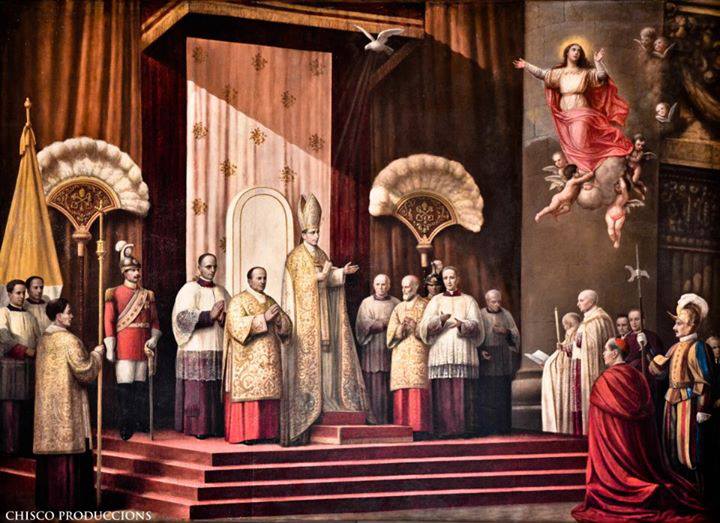
The Promulgation of the Dogma of the Assumption of the Blessed Virgin Mary into heaven in 1950 by Pope Pius XII

Image

The image of the scene when Pope Pius XII proclaimed the Dogma of the Assumption of the Blessed Virgin Mary into heaven in 1950, through his Apostolic Constitution ‘Munificentissimus Deus’ released on 1 November 1950.

This proclamation is made ‘ex cathedra’ or from the authority of the Seat of St. Peter as the Vicar of Christ, as a binding Church teaching, in conjunction with the tradition of the faith, of both the West and East, that the Blessed Virgin Mary, being the mother of our Lord and Saviour, Jesus Christ, who conquered death through His resurrection, did not die but was brought bodily into heaven.

563342_346600692139400_676496786_n

Saturday, 13 July 2013 : 14th Week of Ordinary Time, Memorial of St. Henry (Scripture Reflection)

Brothers and sisters in Christ, we should indeed not fear evil nor sin, and neither should we be afraid of Satan and his forces of deception in this world, for all of us are the children of God, the children of the true Light. The Lord Jesus Christ, our Lord and Saviour is always on our side, if we remain in His love and remain faithful to Him. Satan has no hold over us, because our soul that is the Spirit of the Lord is eternal. He can only touch our bodies, through the corruptions that he tried to impose on us through the world, but in no way that he can harm our soul.

Our Lord and God is the only One who can harm our soul, because He is the Great Judge of all things, that on the day of the Last Judgment, He would judge all beings living and dead, and separating the upright and righteous ones from those who are wicked. To those whom He shows His favour and love, He will reward with heaps of glory and happiness, to be in eternity in perfect union with Him, our Lord, our Creator, never to be separated again, in perfect love, unity, and harmony.

But to those whom He shows His wrath because of their wickedness and apathy towards love, He would condemn for eternity in hell. No, not hell of fire, but an eternal separation from God, and therefore, the soul is condemned for eternity, a dead soul, since the Spirit will no longer remain with them. That is why only the Lord can harm us bodily and also our souls, because He has all the authority in the universe to praise the righteous and condemn the evil and wicked ones. The same fate awaits the devil too, in the manner of the wicked.

The Lord who is loving had shown us His care, protection, provision, and compassion throughout time, ever since creation. He showed His love for Israel, who is Jacob, blessing him with twelve sons and other children, just as He had shown His love for Abraham, His servant, and made an everlasting covenant with him. He showed His love for Joseph, whom He brought away from slavery and made the Governor of Egypt, in charge of all the preparations for the years of famine.

Yet He is also forgiving for those who had wronged Him, for us sinners who had repeatedly disobeyed Him and betrayed Him to the devil, the way that Judas Iscariot had done. Just as Joseph forgave his brothers for having sold him to slavery and their hatred and jealousy for him, so the Lord also forgave those who had wronged Him through sin and evil, ever since the time of Adam and Eve, the first ones that He created amongst mankind.

He showed His mercy to the people of Israel repeated times, when they continuously rebelled against His will, and even abandoned Him to the pagan gods of the people of Canaan. He led them to the land of ever-flowing milk and honey, and continued to watch over them, even as they rebelled against Him. And when the people of Israel came under great suffering under the tyranny of the Babylonians, He sent them deliverance through Cyrus, the first Persian Emperor, who liberated them and allowed them to return to their own lands.

But none of this can be compared to the Lord’s greatest act of love and mercy, that is, in His great love, sending His own Son, the very part of Himself, the Holy Trinity, into the world, that the Word of God became flesh and walked on this world, that the world that has been tainted with evil and sin, may have hope of new life through Jesus Christ, the world’s Saviour.

The Lord sent Jesus to be our Redeemer, to save us from our fate that is death, and to reconcile us to Himself. Christ had become the great bridge, that crosses the infinite chasm of sin separating us from God, ever since Adam and Eve first disobeyed the Lord. Only in Christ lie our salvation, and only in Him that we have hope of new and eternal life. The Lord had shown His love and mercy for us in no lesser way, none other than by suffering insults and rejection, lashes and blows, and ultimately the death on the cross for us.

Today, we celebrate the feast of St. Henry, also known as Henry II, Holy Roman Emperor, the great divine ordained of the successor of Rome in the West, as the secular Vicar of Christ, under the jurisdiction of the Pope, as the Bishop of Rome and the true Vicar of Christ. St. Henry made great efforts to strengthen the Church and pried power away from the hands of the secular nobles into the Emperor’s hand and the jurisdiction of the Church.

In doing so, St. Henry had laid a stable foundation for the growth of the faith, and the cultivation of the faith amongst many throughout the world. He greatly strengthened the cause of the Lord, and built the work of salvation over the power of the power-hungry and wealth-hungry secular nobles, who constantly warred amongst themselves for wealth, reputation, and land.

St. Henry acted as the champion of the faith, as the champion of the Church, and indeed, as the champion of the Lord, who brought the Lord closer to many ordinary people, and his works enabled more to be in contact with the Lord who loves us and who wants to save us through Christ, His Son. St. Henry never gave up the struggle despite opposition from the nobles, and his efforts rewarded him with the glory of heaven, as the only Holy Roman Emperor and German monarch ever named saint.

We too, brothers and sisters in Christ, can follow in the footsteps of St. Henry, and also many other inspiring saints, to bring the Word of God closer to many who have yet to receive it, and to bring the Lord’s salvation and love ever closer to those who seek it. Let us also defend our faith, our faith in the Lord who loves us, and who redeemed us through His death and bring us new life through His Resurrection from the dead. Let us be zealous and devoted to our faith in God, through the Church, and obey the teachings of the Church, that is none other than the teachings of the Apostles, and therefore, the teachings of the Lord Himself.

May the Lord, accompanied by His faithful servant, St. Henry, and multitudes of holy men and women of the Lord and the angels, bless all of us with love, hope, and faith, and give us the Spirit to love, the Spirit to be compassionate, the Spirit of forgiveness and mercy, that all of us will be worthy of our Lord, who is Love and mercy. God bless us all. Amen.