Si ambulavero in medio tribulationis, vivificabis me, Domine : et super iram inimicorum meorum extendes manum Tuam, et salvum me faciet dextera Tua.
English translation
If I shall walk in the midst of tribulation. You will quicken me, o Lord, and You will stretch forth Your hand against the wrath of my enemies, and Your right hand shall save me.
Secret Prayer of the Priest
Haec munera, quaesumus, Domine, quae oculis Tuae majestatis offerimus, salutaria nobis esse concede. Per Dominum…
English translation
Grant, we beseech You, o Lord, that these gifts, which we offer up in the sight of Your majesty, may be salutary unto us. Through our Lord…
Communion
Psalm 118 : 4, 5
Tu mandasti mandata Tua custodiri nimis : utinam dirigantur viae meae, ad custodiendas justificationes Tuas.
English translation
You had commanded Your commandments to be kept most diligently. O that my ways may be directed to keep Your justifications.
Post-Communion Prayer
Tua nos, Domine, medicinalis operatio, et a nostris perversitatibus clementer expediat, et Tuis semper faciat inhaerare mandatis. Per Dominum…
English translation
Let Your healing power, o Lord, in mercy deliver us from our waywardness and cause us ever to cleave to Your commandments. Through our Lord…
Sequentia Sancti Evangelii secundum Matthaeum – Continuation of the Holy Gospel according to St. Matthew
Matthew 22 : 1-14
In illo tempore : Loquebatur Jesus principibus sacerdotum et pharisaeis in parabolis, dicens : Simile factum est regnum caelorum homini regi, qui fecit nuptias filio suo. Et misit servos suos vocare invitatos ad nuptias, et nolebant venire.
Iterum misit alios servos, dicens : Dicite invitatis : Ecce, prandium meum paravi, tauri mei et altilia occisa sunt, et omnia parata : venite ad nuptias.
Illi autem neglexerunt : et abierunt, alius in villam suam, alius vero ad negotiationem suam : reliqui vero tenuerunt servos ejus, et contumeliis affectos occiderunt. Rex autem cum audisset, iratus est : et, missis exercitibus suis, perdidit homicidas illos et civitatem illorum succendit.
Tunc ait servis suis : Nuptiae quidem paratae sunt, sed, qui invitati erant, non fuerunt digni. Ite ergo ad exitus viarum et, quoscumque inveneritis, vocate ad nuptias. Et egressi servis ejus in vias, congregaverunt omnes, quos invenerunt, malos et bonos : et impletae sunt nuptiae discumbentium.
Intravit autem rex, ut videret discumbentes, et vidit ibi hominem non vestitum veste nuptiali. Et ait illi : Amice, quomodo huc intrasti non habens vestem nuptialem? At ille obmutuit. Tunc dixit rex ministris : Ligatis manibus et pedibus ejus, mittite eum in tenebras exteriores : ibi erit fletus et stridor dentium.
Multi enim sunt vocati, pauci vero electi.
English translation
At that time, Jesus spoke to the chief priests and the Pharisees in parables, saying, “The kingdom of heaven is likened to a king, who made a marriage for his son, and he sent his servants, to call those who were invited to the marriage, and they would not come.”
“Again he sent other servants, saying, ‘Tell them that they were invited. Behold, I have prepared my dinner; my cows and fatlings are killed, and all things are ready, all of you come to the marriage.”
“But they neglected, and went their ways, one to his farm, and another to his merchandise, and the rest laid hands on his servants, and having treated them with contempt, put them to death. But when the king had heard of it, he was angry, and sending his armies, he destroyed those murderers, and burnt the city.”
“Then he said to his servants, ‘The marriage indeed is ready, but those who were invited were not worthy. Therefore, go to the highways and find as many as you can find, and call them to the marriage.’ And his servants going forth into the ways, gathered together all who they found, both bad and good, and the marriage was filled with guests.”
“And the king went in to see the guests, and he saw there a man who had not worn a wedding garment, and he said to him, ‘Friend, how did you come in, not having a wedding garment?’ But he was silent. Then the king said to the waiters, ‘Bind his hands and feet, and cast him into the exterior darkness, there shall be weeping and gnashing of teeth.”
Lectio Epistolae Beati Pauli Apostoli ad Ephesios – Lesson from the Epistle of Blessed Paul the Apostle to the Ephesians
Ephesians 4 : 23-28
Fratres : Renovamini spiritu mentis vestrae, et induite novum hominem, qui secundum Deum creatus est in justitia et sanctitate veritatis. Propter quod deponentes mendacium, loquimini veritatem unusquisque cum proximo suo : quoniam sumus invicem membra.
Irascimini, et nolite peccare : sol non occidat super iracundiam vestram. Nolite locum dare diabolo : qui furabatur, jam non furetur; magis autem laboret, operando manibus suis, quod bonum est, ut habeat, unde tribuat necessitatem patienti.
English translation
Brethren, may you be renewed in the spirit of your mind, and put on the new man, who according to God is created in justice and holiness of truth. Wherefore, putting away lies, may you speak the truth to every man with his neighbour, for we are members to one another.
Be angry, and do not sin. Do not let the sun to go down upon your anger. Do not give place to the devil. He who stole, let him now steal no more; but rather let him labour, working with his hands the thing which is good, that he may have something to give to him that all who suffered need.
Salus populi ego sum, dicit Dominus : de quacumque tribulatione clamaverint ad me, exaudiam eos : et ero illorum Dominus in perpetuum.
Attendite, popule meus, legem meam : inclinate aurem vestram in verba oris mei.
Response : Gloria Patri et Filio et Spiritui Sancto, sicut erat in principio, et nunc, et semper : et in saecula saeculorum. Amen.
English translation
“I am the salvation of the people,” says the Lord, “In whatever tribulation they shall cry to Me, I will hear them; and I will be their Lord forever.”
“Attend, o My people, to My Law; incline your ears to the words of My mouth.”
Response : Glory be to the Father and to the Son and to the Holy Spirit, as it was in the beginning, is now, and ever shall be, world without end. Amen.
Collect
Omnipotens et misericors Deus, universa nobis adversantia propitiatus exclude : ut mente et corpore pariter expediti, quae tua sunt, liberis mentibus exsequamur. Per Dominum…
English translation
Almighty and merciful God, in Your loving kindness You keep us from all things that wage war against us, that, being unhampered alike in soul and in body, we may with free minds perform the works that are Yours. Through our Lord…
Jesus enters Jerusalem. The crowd of disciples accompanies him in festive mood, their garments are stretched out before him, there is talk of the miracles he has accomplished, and loud praises are heard: “Blessed is the King who comes in the name of the Lord. Peace in heaven and glory in the highest!” (Lk 19:38).
Crowds, celebrating, praise, blessing, peace: joy fills the air. Jesus has awakened great hopes, especially in the hearts of the simple, the humble, the poor, the forgotten, those who do not matter in the eyes of the world. He understands human sufferings, he has shown the face of God’s mercy, and he has bent down to heal body and soul.
This is Jesus. This is his heart which looks to all of us, to our sicknesses, to our sins. The love of Jesus is great. And thus he enters Jerusalem, with this love, and looks at us. It is a beautiful scene, full of light – the light of the love of Jesus, the love of his heart – of joy, of celebration.
At the beginning of Mass, we too repeated it. We waved our palms, our olive branches. We too welcomed Jesus; we too expressed our joy at accompanying him, at knowing him to be close, present in us and among us as a friend, a brother, and also as a King: that is, a shining beacon for our lives. Jesus is God, but he lowered himself to walk with us. He is our friend, our brother. He illumines our path here. And in this way we have welcomed him today. And here the first word that I wish to say to you: joy! Do not be men and women of sadness: a Christian can never be sad! Never give way to discouragement! Ours is not a joy born of having many possessions, but from having encountered a Person: Jesus, in our midst; it is born from knowing that with him we are never alone, even at difficult moments, even when our life’s journey comes up against problems and obstacles that seem insurmountable, and there are so many of them! And in this moment the enemy, the devil, comes, often disguised as an angel, and slyly speaks his word to us. Do not listen to him! Let us follow Jesus! We accompany, we follow Jesus, but above all we know that he accompanies us and carries us on his shoulders. This is our joy, this is the hope that we must bring to this world. Please do not let yourselves be robbed of hope! Do not let hope be stolen! The hope that Jesus gives us.
The second word. Why does Jesus enter Jerusalem? Or better: how does Jesus enter Jerusalem? The crowds acclaim him as King. And he does not deny it, he does not tell them to be silent (cf. Lk 19:39-40). But what kind of a King is Jesus? Let us take a look at him: he is riding on a donkey, he is not accompanied by a court, he is not surrounded by an army as a symbol of power. He is received by humble people, simple folk who have the sense to see something more in Jesus; they have that sense of the faith which says: here is the Saviour. Jesus does not enter the Holy City to receive the honours reserved to earthly kings, to the powerful, to rulers; he enters to be scourged, insulted and abused, as Isaiah foretold in the First Reading (cf. Is 50:6). He enters to receive a crown of thorns, a staff, a purple robe: his kingship becomes an object of derision. He enters to climb Calvary, carrying his burden of wood. And this brings us to the second word: Cross. Jesus enters Jerusalem in order to die on the Cross. And it is precisely here that his kingship shines forth in godly fashion: his royal throne is the wood of the Cross! It reminds me of what Benedict XVI said to the Cardinals: you are princes, but of a king crucified. That is the throne of Jesus. Jesus takes it upon himself… Why the Cross? Because Jesus takes upon himself the evil, the filth, the sin of the world, including the sin of all of us, and he cleanses it, he cleanses it with his blood, with the mercy and the love of God. Let us look around: how many wounds are inflicted upon humanity by evil! Wars, violence, economic conflicts that hit the weakest, greed for money that you can’t take with you and have to leave. When we were small, our grandmother used to say: a shroud has no pocket. Love of power, corruption, divisions, crimes against human life and against creation! And – as each one of us knows and is aware – our personal sins: our failures in love and respect towards God, towards our neighbour and towards the whole of creation. Jesus on the Cross feels the whole weight of the evil, and with the force of God’s love he conquers it, he defeats it with his resurrection. This is the good that Jesus does for us on the throne of the Cross. Christ’s Cross embraced with love never leads to sadness, but to joy, to the joy of having been saved and of doing a little of what he did on the day of his death.
Today in this Square, there are many young people: for twenty-eight years Palm Sunday has been World Youth Day! This is our third word: youth! Dear young people, I saw you in the procession as you were coming in; I think of you celebrating around Jesus, waving your olive branches. I think of you crying out his name and expressing your joy at being with him! You have an important part in the celebration of faith! You bring us the joy of faith and you tell us that we must live the faith with a young heart, always: a young heart, even at the age of seventy or eighty. Dear young people! With Christ, the heart never grows old! Yet all of us, all of you know very well that the King whom we follow and who accompanies us is very special: he is a King who loves even to the Cross and who teaches us to serve and to love. And you are not ashamed of his Cross! On the contrary, you embrace it, because you have understood that it is in giving ourselves, in giving ourselves, in emerging from ourselves that we have true joy and that, with his love, God conquered evil. You carry the pilgrim Cross through all the Continents, along the highways of the world! You carry it in response to Jesus’ call: “Go, make disciples of all nations” (Mt 28:19), which is the theme of World Youth Day this year. You carry it so as to tell everyone that on the Cross Jesus knocked down the wall of enmity that divides people and nations, and he brought reconciliation and peace. Dear friends, I too am setting out on a journey with you, starting today, in the footsteps of Blessed John Paul II and Benedict XVI. We are already close to the next stage of this great pilgrimage of the Cross. I look forward joyfully to next July in Rio de Janeiro! I will see you in that great city in Brazil! Prepare well – prepare spiritually above all – in your communities, so that our gathering in Rio may be a sign of faith for the whole world. Young people must say to the world: to follow Christ is good; to go with Christ is good; the message of Christ is good; emerging from ourselves, to the ends of the earth and of existence, to take Jesus there, is good! Three points, then: joy, Cross, young people.
Let us ask the intercession of the Virgin Mary. She teaches us the joy of meeting Christ, the love with which we must look to the foot of the Cross, the enthusiasm of the young heart with which we must follow him during this Holy Week and throughout our lives. May it be so.
“I thank the Lord that I can celebrate this Holy Mass for the inauguration of my Petrine ministry on the solemnity of Saint Joseph, the spouse of the Virgin Mary and the patron of the universal Church. It is a significant coincidence, and it is also the name-day of my venerable predecessor: we are close to him with our prayers, full of affection and gratitude.
I offer a warm greeting to my brother cardinals and bishops, the priests, deacons, men and women religious, and all the lay faithful. I thank the representatives of the other Churches and ecclesial Communities, as well as the representatives of the Jewish community and the other religious communities, for their presence. My cordial greetings go to the Heads of State and Government, the members of the official Delegations from many countries throughout the world, and the Diplomatic Corps.
In the Gospel we heard that “Joseph did as the angel of the Lord commanded him and took Mary as his wife” (Mt 1:24). These words already point to the mission which God entrusts to Joseph: he is to be the custos, the protector. The protector of whom? Of Mary and Jesus; but this protection is then extended to the Church, as Blessed John Paul II pointed out: “Just as Saint Joseph took loving care of Mary and gladly dedicated himself to Jesus Christ’s upbringing, he likewise watches over and protects Christ’s Mystical Body, the Church, of which the Virgin Mary is the exemplar and model” (Redemptoris Custos, 1).
How does Joseph exercise his role as protector? Discreetly, humbly and silently, but with an unfailing presence and utter fidelity, even when he finds it hard to understand. From the time of his betrothal to Mary until the finding of the twelve-year-old Jesus in the Temple of Jerusalem, he is there at every moment with loving care. As the spouse of Mary, he is at her side in good times and bad, on the journey to Bethlehem for the census and in the anxious and joyful hours when she gave birth; amid the drama of the flight into Egypt and during the frantic search for their child in the Temple; and later in the day-to-day life of the home of Nazareth, in the workshop where he taught his trade to Jesus.
How does Joseph respond to his calling to be the protector of Mary, Jesus and the Church? By being constantly attentive to God, open to the signs of God’s presence and receptive to God’s plans, and not simply to his own. This is what God asked of David, as we heard in the first reading. God does not want a house built by men, but faithfulness to his word, to his plan. It is God himself who builds the house, but from living stones sealed by his Spirit. Joseph is a “protector” because he is able to hear God’s voice and be guided by his will; and for this reason he is all the more sensitive to the persons entrusted to his safekeeping. He can look at things realistically, he is in touch with his surroundings, he can make truly wise decisions. In him, dear friends, we learn how to respond to God’s call, readily and willingly, but we also see the core of the Christian vocation, which is Christ! Let us protect Christ in our lives, so that we can protect others, so that we can protect creation!
The vocation of being a “protector”, however, is not just something involving us Christians alone; it also has a prior dimension which is simply human, involving everyone. It means protecting all creation, the beauty of the created world, as the Book of Genesis tells us and as Saint Francis of Assisi showed us. It means respecting each of God’s creatures and respecting the environment in which we live. It means protecting people, showing loving concern for each and every person, especially children, the elderly, those in need, who are often the last we think about. It means caring for one another in our families: husbands and wives first protect one another, and then, as parents, they care for their children, and children themselves, in time, protect their parents. It means building sincere friendships in which we protect one another in trust, respect, and goodness. In the end, everything has been entrusted to our protection, and all of us are responsible for it. Be protectors of God’s gifts!
Whenever human beings fail to live up to this responsibility, whenever we fail to care for creation and for our brothers and sisters, the way is opened to destruction and hearts are hardened. Tragically, in every period of history there are “Herods” who plot death, wreak havoc, and mar the countenance of men and women.
Please, I would like to ask all those who have positions of responsibility in economic, political and social life, and all men and women of goodwill: let us be “protectors” of creation, protectors of God’s plan inscribed in nature, protectors of one another and of the environment. Let us not allow omens of destruction and death to accompany the advance of this world! But to be “protectors”, we also have to keep watch over ourselves! Let us not forget that hatred, envy and pride defile our lives! Being protectors, then, also means keeping watch over our emotions, over our hearts, because they are the seat of good and evil intentions: intentions that build up and tear down! We must not be afraid of goodness or even tenderness!
Here I would add one more thing: caring, protecting, demands goodness, it calls for a certain tenderness. In the Gospels, Saint Joseph appears as a strong and courageous man, a working man, yet in his heart we see great tenderness, which is not the virtue of the weak but rather a sign of strength of spirit and a capacity for concern, for compassion, for genuine openness to others, for love. We must not be afraid of goodness, of tenderness!
Today, together with the feast of Saint Joseph, we are celebrating the beginning of the ministry of the new Bishop of Rome, the Successor of Peter, which also involves a certain power. Certainly, Jesus Christ conferred power upon Peter, but what sort of power was it? Jesus’ three questions to Peter about love are followed by three commands: feed my lambs, feed my sheep. Let us never forget that authentic power is service, and that the Pope too, when exercising power, must enter ever more fully into that service which has its radiant culmination on the Cross. He must be inspired by the lowly, concrete and faithful service which marked Saint Joseph and, like him, he must open his arms to protect all of God’s people and embrace with tender affection the whole of humanity, especially the poorest, the weakest, the least important, those whom Matthew lists in the final judgment on love: the hungry, the thirsty, the stranger, the naked, the sick and those in prison (cf. Mt 25:31-46). Only those who serve with love are able to protect!
In the second reading, Saint Paul speaks of Abraham, who, “hoping against hope, believed” (Rom 4:18). Hoping against hope! Today too, amid so much darkness, we need to see the light of hope and to be men and women who bring hope to others. To protect creation, to protect every man and every woman, to look upon them with tenderness and love, is to open up a horizon of hope; it is to let a shaft of light break through the heavy clouds; it is to bring the warmth of hope! For believers, for us Christians, like Abraham, like Saint Joseph, the hope that we bring is set against the horizon of God, which has opened up before us in Christ. It is a hope built on the rock which is God.
To protect Jesus with Mary, to protect the whole of creation, to protect each person, especially the poorest, to protect ourselves: this is a service that the Bishop of Rome is called to carry out, yet one to which all of us are called, so that the star of hope will shine brightly. Let us protect with love all that God has given us!
I implore the intercession of the Virgin Mary, Saint Joseph, Saints Peter and Paul, and Saint Francis, that the Holy Spirit may accompany my ministry, and I ask all of you to pray for me! Amen.”
Today, Tuesday, 19 March 2013, our new Pope will be solemnly inaugurated to begin his Pontificate. He is already our Pope, ever since he accepted the rightful election in the Conclave, but the Inauguration ceremony affirms and completes that process, with the imposition of the symbols of the authority of the Pope, as the leader of the entire Universal Church.
There will be some changes to the liturgy this year, as the imposition of the Pallium and the Ring of the Fisherman will take place just before the Mass starts, instead of being within the Mass itself, as the impositions are seen as more of an extra-liturgical event.
The Pope will pray with the leaders of the Eastern Catholic Churches, the Patriarchs and Major Archbishops at the Tomb of St. Peter underneath the main altar of St. Peter’s Basilica, where the pallium and the ring had been placed since the night before.
The Pope will then proceed with all the other concelebrating Cardinals and prelates outside to the Altar at St. Peter’s Square, which in the meanwhile the Laudes Regia hymn or ‘Laud to the King (Christ)’, that is a glorious rendition of the Litany of the Saints, with the new innovation of the inclusion of part asking the past Popes who had been canonised as saints for the new Pope, their successor, beginning from Pope St. Linus to Pope St. Pius X.
Following after this is the imposition of the papal pallium, which is different from the pallium worn by the Metropolitan Archbishops. Pope Francis’ pallium will be the same in appearance with that of Pope Benedict XVI’s pallium, with red crosses instead of black ones, representing the wounds of Christ, with three gold pins on three of the crosses, representing the nails that bound both hands and the legs of Christ onto the cross. The pallium symbolises the authority the Pope has over the entire Universal Church. The pallium will be imposed by the senior Cardinal of the order of Priest in the Cardinal-electorate, Cardinal Godfried Danneels.
The Ring of the Fisherman will be given after this, which signifies the bond between the Pope and God’s Church, and as the image on the ring depicts, that of St. Peter holding the keys on a boat, while fishing, as a fisher of man, it symbolises the Pope’s role as the successor of St. Peter the Apostle, and also as the current holders of the keys of the kingdom of Heaven, entrusted by Christ to Peter. The ring will be presented to the Pope by the senior Cardinal Deacon, Cardinal Jean-Louis Tauran.
Six Cardinals representing the rest of the Cardinals will pay homage to the Pope, and will give their obedience to him, following the imposition of the pallium and the Ring of the Fisherman.
The Mass follows as usual, and the readings will be done in different languages, English, Spanish, and most notably the Gospel in Greek, to highlight the universal nature of the Church, encasing both the Western and Eastern tradition of Christendom. The whole liturgy of the Mass itself will be conducted in solemn Latin and beautiful Gregorian chants.
The booklet for the Mass is available at the link below, in English, Italian, and Latin :
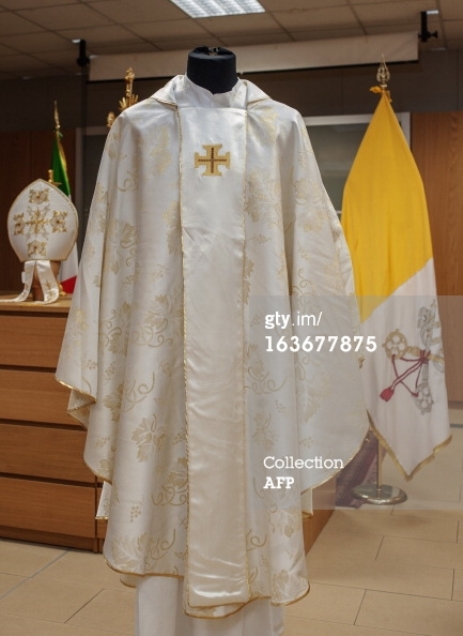
The vestments above is the vestment that Pope Francis will wear at the Papal Inauguration Mass in St. Peter’s Square, on the Feast of St. Joseph, Tuesday, 19 March 2013 at 9.30 am Rome time.
The vestments are decent and not over-simplistic, but neither overbearing, while maintaining the beauty of the vesture, which will make the liturgy of the Mass more beautiful and bring people closer to God.
(Update : It seems that Pope Francis chose to wear his personal mitre and the matching vestments that comes with his mitre (as bishop))
As for God’s gifts, to some He gave to be apostles, to others prophets, or even evangelists, or pastors and teachers. So He prepared those who belong to Him for the ministry, in order to build up the Body of Christ, until we are all united in the same faith and knowledge of the Son of God. Thus, we shall become the perfect Man, upon reaching maturity and sharing the fullness of Christ.
Then no longer shall we be like children tossed about by any wave or wind of doctrine, and deceived by the cunning of people who drag them along into error. Rather, speaking the truth in love, we shall grow in every way towards Him who is the Head, Christ. From Him, comes the growth of the whole body to which a network of joints gives order and cohesion, taking into account and making use of the function of each one.

 petercanisiusmichaeldavidkang