Final document of the 2014 Extraordinary Synod on the Family

(Update : The official final Synod document is still in processing and will be released soon. Below document is the summary by the Synod Fathers)

The 2014 Extraordinary Synod on the Family had been concluded, and we give thanks to God for helping His Church to defend the true Faith, and that He did not allow those who wished to see our Faith compromised and destroyed to have their way. May the Lord continue to watch over His Church as we await the second part of the Synod of the Family in 2015.

The Church is the guardian of the Tradition of the Faith and the Deposit of the Faith, and no one may alter the teachings of the Church which came down to us from the Apostles and thus from Jesus Christ our Lord. We can help sinners to return to the Faith but not to offer false mercy. The sanctity of the Sacrament of Holy Matrimony is inviolable, and marriage is between one man and one woman, made one by the Lord and no man should divide. Remember that Jesus had said that those who divorce and remarry commit adultery and thus live in a state of grave sin.

The same state of sin also apply to all others in unnatural order outside of Christian marriage, and until they repent from their sins and make their penance, they should indeed abstain from receiving the Most Precious Body and Blood of Christ, lest they sin against the Holy Spirit. Let us help them by welcoming them back and guiding them to repentance, that one day they may once again receive the Lord with full faith.

I also recommend all of you to read the Papal Encyclical Humanae Vitae by Blessed Pope Paul VI and the Theology of the Body by Pope St. John Paul II, as well as the Catechism of the Catholic Church.

The text of the final summary document of the 2014 Extraordinary Synod on the Family can be found below.

http://press.vatican.va/content/salastampa/en/bollettino/pubblico/2014/10/18/0768/03043.html


III EXTRAORDINARY GENERAL ASSEMBLY

OF THE SYNOD OF BISHOPS


MESSAGE

            We, Synod Fathers, gathered in Rome together with Pope Francis in the Extraordinary General Assembly of the Synod of Bishops, greet all families of the different continents and in particular all who follow Christ, the Way, the Truth, and the Life. We admire and are grateful for the daily witness which you offer us and the world with your fidelity, faith, hope, and love.

Each of us, pastors of the Church, grew up in a family, and we come from a great variety of backgrounds and experiences. As priests and bishops we have lived alongside families who have spoken to us and shown us the saga of their joys and their difficulties.

The preparation for this synod assembly, beginning with the questionnaire sent to the Churches around the world, has given us the opportunity to listen to the experience of many families. Our dialogue during the Synod has been mutually enriching, helping us to look at the complex situations which face families today.

We offer you the words of Christ: “Behold, I stand at the door and knock. If anyone hears my voice and opens the door, I will enter his house and dine with him, and he with me” (Rev 3:20). On his journeys along the roads of the Holy Land, Jesus would enter village houses. He continues to pass even today along the streets of our cities. In your homes there are light and shadow. Challenges often present themselves and at times even great trials. The darkness can grow deep to the point of becoming a dense shadow when evil and sin work into the heart of the family.

We recognize the great challenge to remain faithful in conjugal love. Enfeebled faith and indifference to true values, individualism, impoverishment of relationships, and stress that excludes reflection leave their mark on family life. There are often crises in marriage, often confronted in haste and without the courage to have patience and reflect, to make sacrifices and to forgive one another. Failures give rise to new relationships, new couples, new civil unions, and new marriages, creating family situations which are complex and problematic, where the Christian choice is not obvious.

We think also of the burden imposed by life in the suffering that can arise with a child with special needs, with grave illness, in deterioration of old age, or in the death of a loved one. We admire the fidelity of so many families who endure these trials with courage, faith, and love. They see them not as a burden inflicted on them, but as something in which they themselves give, seeing the suffering Christ in the weakness of the flesh.

We recall the difficulties caused by economic systems, by the “the idolatry of money and the dictatorship of an impersonal economy lacking a truly human purpose” (Evangelii gaudium 55) which weakens the dignity of people. We remember unemployed parents who are powerless to provide basic needs for their families, and youth who see before them days of empty expectation, who are prey to drugs and crime.

We think of so many poor families, of those who cling to boats in order to reach a shore of survival, of refugees wandering without hope in the desert, of those persecuted because of their faith and the human and spiritual values which they hold. These are stricken by the brutality of war and oppression. We remember the women who suffer violence and exploitation, victims of human trafficking, children abused by those who ought to have protected them and fostered their development, and the members of so many families who have been degraded and burdened with difficulties. “The culture of prosperity deadens us…. all those lives stunted for lack of opportunity seem a mere spectacle; they fail to move us” (Evangelii gaudium 54). We call on governments and international organizations to promote the rights of the family for the common good.

Christ wanted his Church to be a house with doors always open to welcome everyone. We warmly thank our pastors, lay faithful, and communities who accompany couples and families and care for their wounds.

***

There is also the evening light behind the windowpanes in the houses of the cities, in modest residences of suburbs and villages, and even in mere shacks, which shines out brightly, warming bodies and souls. This light—the light of a wedding story—shines from the encounter between spouses: it is a gift, a grace expressed, as the Book of Genesis says (2:18), when the two are “face to face” as equal and mutual helpers. The love of man and woman teaches us that each needs the other in order to be truly self. Each remains different from the other that opens self and is revealed in the reciprocal gift. It is this that the bride of the Song of Songs sings in her canticle: “My beloved is mine and I am his… I am my beloved’s and my beloved is mine” (Song of Songs 2:16; 6:3).


This authentic encounter begins with courtship, a time of waiting and preparation. It is realized in the sacrament where God sets his seal, his presence, and grace. This path also includes sexual relationship, tenderness, intimacy, and beauty capable of lasting longer than the vigor and freshness of youth. Such love, of its nature, strives to be forever to the point of laying down one’s life for the beloved (cf Jn 15:13). In this light conjugal love, which is unique and indissoluble, endures despite many difficulties. It is one of the most beautiful of all miracles and the most common.

This love spreads through fertility and generativity, which involves not only the procreation of children but also the gift of divine life in baptism, their catechesis, and their education. It includes the capacity to offer life, affection, and values—an experience possible even for those who have not been able to bear children. Families who live this light-filled adventure become a sign for all, especially for young people.

This journey is sometimes a mountainous trek with hardships and falls. God is always there to accompany us. The family experiences his presence in affection and dialogue between husband and wife, parents and children, sisters and brothers. They embrace him in family prayer and listening to the Word of God—a small, daily oasis of the spirit. They discover him every day as they educate their children in the faith and in the beauty of a life lived according to the Gospel, a life of holiness. Grandparents also share in this task with great affection and dedication. The family is thus an authentic domestic Church that expands to become the family of families which is the ecclesial community. Christian spouses are called to become teachers of faith and of love for young couples as well.

Another expression of fraternal communion is charity, giving, nearness to those who are last, marginalized, poor, lonely, sick, strangers, and families in crisis, aware of the Lord’s word, “It is more blessed to give than to receive” (Acts 20:35). It is a gift of goods, of fellowship, of love and mercy, and also a witness to the truth, to light, and to the meaning of life.

The high point which sums up all the threads of communion with God and neighbor is the Sunday Eucharist when the family and the whole Church sits at table with the Lord. He gives himself to all of us, pilgrims through history towards the goal of the final encounter when “Christ is all and in all” (Col 3:11). In the first stage of our Synod itinerary, therefore, we have reflected on how to accompany those who have been divorced and remarried and on their participation in the sacraments.

We Synod Fathers ask you walk with us towards the next Synod. The presence of the family of Jesus, Mary, and Joseph in their modest home hovers over you. United to the Family of Nazareth, we raise to the Father of all our petition for the families of the world:

            Father, grant to all families the presence of strong and wise spouses who may be the source of a free and united family.

            Father, grant that parents may have a home in which to live in peace with their families.

            Father, grant that children may be a sign of trust and hope and that young people may have the courage to forge life-long, faithful commitments.

            Father, grant to all that they may be able to earn bread with their hands, that they may enjoy serenity of spirit and that they may keep aflame the torch of faith even in periods of darkness.

            Father, grant that we may all see flourish a Church that is ever more faithful and credible, a just and humane city, a world that loves truth, justice and mercy.

Sunday, 19 October 2014 : 29th Sunday of Ordinary Time, Mission Sunday and Memorial of St. John de Brebeuf and St. Isaac Jogues, Priests and Martyrs; and St. Paul of the Cross, Priest (Homily and Scripture Reflections)

Liturgical Colour : Green

Brothers and sisters in Christ, today we celebrate together the love of God for us in the Eucharist through which He gave us all His own Body and Blood, so that we who share in them, we may receive salvation in our God, and be freed from the bondage of sin and death. And we are reminded of this fact in the readings from the Holy Scriptures which we read today.

In the first reading, taken from the Book of the prophet Isaiah, the Lord revealed to Isaiah His servant, of the coming of salvation for the people of Israel, in the person of Cyrus, the King and Emperor of the Persian Empire, who would deliver the people of God the salvation which they would come to await for. For a background understanding, I will share with you the significance of this passage from the Book of Isaiah by telling you the historical background behind it.

At the time the revelation was made to the prophet Isaiah, it was at the time just as the northern kingdom of Israel fell to the conquering power of the Assyrian Empire. The people of the northern kingdom was unfaithful and were engrossed in wickedness and in the worship of the pagan gods. As such, they were handed over to the hands of their enemies and brought away as slaves and exiles from the lands promised and given to their ancestors.

Meanwhile, in the kingdom of Judah, the southern kingdom, the people of God there were also not always faithful. They also from time to time rebelled against the will of God, preferring to follow their own ways and disobeyed the Lord’s instructions. At the time of the prophet Isaiah, during the reign of King Hezekiah of Judea, the consequences for these were not so apparent yet, but then soon they too would suffer the same fate as their northern brethren, the kingdom of Israel.

They too would be defeated, conquered and exiled, as well as into slavery by the rising power of the Neo-Babylonian Empire, under the famous king Nebuchadnezzar, who brought siege to Jerusalem, the Holy City of God, and brought it to ruin. The Temple of Solomon was destroyed and the Ark of the Covenant was lost in the chaos. This represented the end of the southern kingdom of Judah and the rule of the kings as a whole, and also marked the beginning of what would be called the Babylonian exile.

During this period of exile, the people of Judah were also uprooted and cast away from the land promised and given to their ancestors, and brought in chains to the foreign lands. There they suffered indignation and much humiliation, and they were made to work hard and experienced the bitter pills of difficulties of the world for a period of time, when, according to the word of God through the prophets, that they were humbled among the nations.

Yet, God did not leave them alone with that fate for long. He promised them deliverance, precisely through the prophet Isaiah, that the King of Persia, Cyrus the Great, who conquered many kingdoms in the known world at that time, would conquer Babylon and then liberated all the people of God from their bondage and slavery, allowing them to return home to their ancestral lands of Israel, freed at last from their bonds and exile.

God called Cyrus from among the nations, and gave him His blessings and grace, even though he did not know Him. Such was the Lord’s will and plan, and how He put all of His desires and will into effect. He never retracted His promises, nor is He ever being unfaithful. He fulfilled His promises through Cyrus, who just like Moses, brought the people of God out of suffering, bondage and slavery into freedom and God’s renewed promise and covenant.

But at the time of Jesus, the nation of the Jews have endured many cycles of persecutions, oppressions and enslavement by other, more powerful nations, and the latest to be added to the list at the time was the Roman Empire, which ruled over most of the known world, and was known for the first regular and organised ruling imperium in the world, with a meticulous system of taxation, both to maintain control and to obtain revenue for the Roman state.

However, the imposition of taxes also represented the symbol of Roman dominance and mastery over the world, and over the peoples of the Mediterranean at the time, including the Jews, who lived in the Roman province of Judea, which constituted roughly the old Promised Land which they had been given, together with the provinces of Galilee and Decapolis.

The imposition of the taxes were hated and disliked by the people, who viewed them as first the symbol of their submission to the Romans and their Emperor, the Caesar in Rome, as well as the symbol of their renewed enslavement and the end of their freedom which they had often fought hard for and gained for. It also burdened them economically, and thus they were resented by the people as a whole. This was also why the tax collectors were so hated by the people, and they were considered outcasts and traitors, as they were seen as serving the hated Romans in imposing their hated taxes.

The Roman taxes were paid with the Roman currency, that is the Roman coins, most commonly the silver variant, the denarius. On the denarius, just as all the other Roman coins, the face portrait of the Emperor were printed, such that to the extent of the Romans and the peoples of the Empire recognised their Emperor by the coins they released.

This represented a problem, and a rather serious one, in the view of the Jews, as the Roman Emperors at the time, beginning with the Emperor Augustus, and even his pre-Imperial predecessor, Julius Caesar, were deified and worshipped in the Empire as gods or descendants of the gods. Thus, for the Jews, particularly to the Pharisees, the act of paying the taxes with the Roman coins represent a potentially dangerous and serious sin.

Yes, that is the offering to the idols, as equated by the ‘offering’ of the Roman coins with the Emperor’s portrait to the Empire, and thus to the Emperor himself, the deified entity, the pagan god patron of the Empire. Thus, the Pharisees and the elders of Israel wanted to trap Jesus with the question, and had He answered that they should pay the taxes, then they could whip up the masses’ opinion against Jesus and accuse Him of collaboration with the Romans, essentially a traitor to the nation.

On the other hand, if He had answered that they should not pay the taxes, then the Pharisees and the elders, with their links to the Roman establishment could claim that Jesus wanted to lead the people in rebellion against the Roman rule, by refusing to pay the taxes due for them. But Jesus knew all that they had plotted against Him with, and He gave them the answer which none of them had predicted.

Give to God what belongs to God, and give to the Caesar, the Emperor of Rome, what belongs to him, namely the coins and the wealth of the world. Jesus wanted to remind us, just as He wanted to rebuke His opponents, that the wealth and the materials of this world belong to the world and ought to be returned back to them. Thus, money and possessions that we have and gained in this life, is no more than the means for us to live a good and sufficient life, enough for us to sustain ourselves, but they should not be the focus of our life.

Yes, for God is the Creator of all of us, the most beloved ones of all His creations. We were made by God with love, given life by His Spirit and intended for greatness and goodness, and despite our waywardness and disobedience, in the end, we still belong to God, and nothing and noone can deny this very fact. Hence, whatever we are and whoever we are, we ought to give it to the Lord, as we truly belong to God and not to this world.

And hence, we should avoid all the evils of this world and keep ourselves pure, and the Lord had already warned against these sinful ways, namely the sins of the Pharisees, who preached what they believed in, but they did not practice what they had preached. That is why they were called hypocrites, and rightly so, for their faith in the Lord was superficial, and all that they cared about was their own vanity and pride.

Brothers and sisters in Christ, what God wants from us is our love, that is what we ought to give to Him, after He Himself had loved us all first. We should also keep ourselves away from the vices and evils of the Pharisees. Think not about bringing harm and plotting against others, but think rather of love, and how we can better love one another, as well as forgiving those who had sinned against us, as Jesus Himself had taught us.

And today in our world, as it had been in the past, there are still many people who live in the darkness of the world, following the ways of the Pharisees and have yet to see the love of the Lord and have yet to understand His ways. And thus, today, in which we also celebrate the occasion of the Mission Sunday, we have to remind ourselves of the responsibilities and the obligations which we have been given by the Lord when we became the member of His Church.

God desires not the destruction of mankind, just as He did not desire the condemnation of His people, Israel. This was why He sent them deliverers, beginning from Moses and then Cyrus, and finally Jesus Himself, His own Son, the One who would deliver not just the Jews but all mankind from the greatest of their bondage and slavery.

Yes, all of us who have sinned and under the whim of sin are enslaved and bonded to sin. And the chains of sin that bind us will eventually and inevitably lead to death, the punishment and ultimate consequence for sin. And not just any death, but eternal death, which will separate us from the love of God, the suffering of hell for eternity, where we are completely and entirely devoid of that love which God lavishes on us.

We can just begin to imagine the kind of suffering when we lack and are denied the wonderful love which God has for us. The pain and suffering far dwarfs the kind of physical and mental suffering which the people in exile and slavery had suffered. And this is exactly what God does not want to happen to us, and thus He also sent His people more deliverers, and who are they? They are none other than each one of us, who have been received into His Church, and have been endowed with the faith.

Let me share with you the inspiring lives of the saints who we also commemorate today, that is St. Jacques Chastan and St. Isaac Jogues, as well as St. Paul of the Cross. For the case of St. Jacques Chastan and St. Isaac Jogues, they were French martyrs, who were part of the French missionaries, the Mission Estrangeres de Paris, the M.E.P. priests who were specialised in the missions to the far ends of the world, spreading the word of God to those who have yet to hear the Good News of the Lord.

St. Jacques Chastan was sent to the missions in Asia, to Thailand, then called Siam, and to Macao, and finally to Korea, where he met his death with faith, in a holy martyrdom. Through his works there and with the collaboration of many other missionaries, many souls were called to the Lord, and heeding the call of conversion, they gave themselves to be baptised and to be part of the Church of God.

The Korean authorities were strongly opposed to the efforts of the missionaries, and they did everything they could to prevent the spread of the faith. Many people, including St. Jacques Chastan were martyred in the defense of their true faith, refusing to renounce the faith and salvation which they had received. After all, when one had been liberated and delivered from slavery, who would want to be enslaved again? To do so would condemn oneself to an eternity of suffering.

Meanwhile, St. Isaac Jogues was a French missionary who was sent to the wild and undiscovered regions of North America, then known as the New World. He worked for the Lord among the many tribes of the North American indigenous populations. Life was indeed difficult for him, and the wars and conflicts between the tribes made it even more difficult. Nevertheless, St. Isaac Jogues persevered and continued to minister to them, spreading the Good News and converting many of them, urging them to abandon their old ways and learn the ways of the Lord.

St. Isaac Jogues was also martyred for his faith, while he was on his mission. He never gave up until the end, and as a result, together with him, many people who were enslaved by sin and darkness, were made free and gain salvation together in God. Such was the role model which actions we can and that we indeed should follow in life.

Lastly, St. Paul of the Cross, the Italian priest of the early modern era who was particularly devoted to the memory of the Holy Passion of our Lord Jesus Christ, in the remembrance of that singular act of ultimate love of God, through which mankind were delivered from the chains and the tyranny of sin into true freedom. Through his works and devotion to the Holy Passion of our Lord, St. Paul of the Cross bring many of the faithful into greater and deeper understanding of their faith, and how all of us too have our own roles to play in helping one another to reach out to God’s salvation.

Therefore, brothers and sisters in Christ, heeding the call of the Lord which He had made through the Scriptures and the Gospels which we had heard today, let us all be renewed in our faith and zeal for the Lord. Let us all realise the great love which God has for all of us, that He does not want to see us remain chained to sin and darkness, and for that He had sent us Jesus, to be the One true Saviour of all, in the mould of Moses and Cyrus, but He did even greater things than these two had done.

Why so, brethren? That is because sin is a greater slavery than anything else that may affect our body. Sin enslaves both our body and soul, our heart and mind, and all that comprise us. And thus, through Christ, by believing in Him and in His love, and in His death on the cross, through which He showed us the act of ultimate love, offering Himself in exchange for us as a ransom for death, the consequence of our sins, we have been made free.

Hence, on this occasion of Mission Sunday, inspired by the examples of the saints whom we remember today, let us all also imitate the love which Christ had shown us, and let us imitate this love and show the same love in our own actions and deeds in life, that we may come to realise the great potential within us, and also in the many others who still live in darkness and sin.

May Almighty God bless us and our efforts, the missionary works which we ought to take on, in order to spread the Word of God and the Good News of the Gospels to all the nations, especially those still under the thrall of sin, so that we may truly be what Jesus had asked of us, to give to the Lord what belongs to Him, that is all of us, our hearts and our minds, our entire being. May God bring more and more souls to Him and rescue them, and free them from the shackles of sin and into the everlasting life in true joy which He had promised us all. God be with us, forever and ever. Amen.

Gospel : https://petercanisiusmichaeldavidkang.com/2014/10/17/sunday-19-october-2014-29th-sunday-of-ordinary-time-mission-sunday-and-memorial-of-st-john-de-brebeuf-and-st-isaac-jogues-priests-and-martyrs-and-st-paul-of-the-cross-priest-gospel-reading/

Second Reading : https://petercanisiusmichaeldavidkang.com/2014/10/17/sunday-19-october-2014-29th-sunday-of-ordinary-time-mission-sunday-and-memorial-of-st-john-de-brebeuf-and-st-isaac-jogues-priests-and-martyrs-and-st-paul-of-the-cross-priest-second-reading/

First Reading : https://petercanisiusmichaeldavidkang.com/2014/10/17/sunday-19-october-2014-29th-sunday-of-ordinary-time-mission-sunday-and-memorial-of-st-john-de-brebeuf-and-st-isaac-jogues-priests-and-martyrs-and-st-paul-of-the-cross-priest-first-reading/

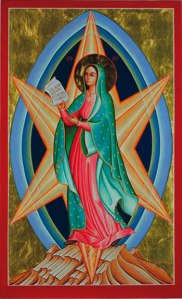
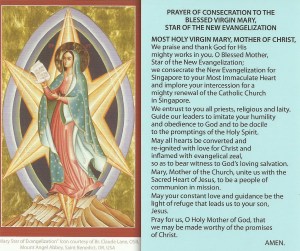
Prayer of Consecration to the Blessed Virgin Mary, Star of the New Evangelisation

marystarofevanglisationicon

On 7 October 2014, on the Feast of our Lady of the Rosary, His Excellency Archbishop William Goh Seng Chye, the Archbishop of Singapore dedicated and consecrated the Archdiocese of Singapore and all the efforts of the New Evangelisation in Singapore to the Blessed Virgin Mary, Star of the New Evangelisation.

Although this refers to the Archdiocese of Singapore, I believe that everyone else in the world, within the Church of God may also pray the same prayer for the sake of evangelisation of the Good News everywhere in this world.


Here is the text of the prayer, to be prayed daily from 7 October 2014 to 7 October 2015, the Feast of our Lady of the Rosary.


10669256_842249659148292_6829732685043142899_o

Most Holy Virgin Mary, Mother of Christ.

We praise and thank God for His mighty works in you. O Blessed Mother, Star of the New Evangelisation; we consecrate the New Evangelisation for Singapore to your Most Immaculate Heart and implore your intercession for a mighty renewal of the Catholic Church in Singapore. We entrust to you all priests, Religious and laity. Guide our leaders to imitate your humility and obedience to God and to be docile to the promptings of the Holy Spirit.

May all hearts be converted and re-ignited with love for Christ and inflamed with evangelical zeal, so as to bear witness to God’s loving salvation. Mary, Mother of the Church, unite us with the Sacred Heart of Jesus, to be a people of communion in mission.

May your constant love and guidance be the light of refuge that leads us to your son, Jesus. Pray for us, O Holy Mother of God, that we may be made worthy of the promises of Christ. Amen.

Tuesday, 14 October 2014 : 28th Week of Ordinary Time, Memorial of Pope St. Callistus I, Pope and Martyr (Homily and Scripture Reflections)

Liturgical Colour : Green or Red (Martyrs)

Brothers and sisters in Christ, today we heard in the Holy Scriptures and the Gospel about the nature of the Law of God, and how we ought to keep it in faith, and how important it is to understand what the Law is all about, and how to best apply it in our lives. It also highlighted the hypocrisy of the Pharisees and the teachers of the Law, who kept a superficial vigil and observance over the Law, but not understanding the true intent and meaning of the Law.

As is with any forms of laws, the Law of God is often bound to be misinterpreted and misused, especially when its meaning and purpose are not fully understood by those who enforce these laws. It is imperative that the people of God understand what the Law is all about, that is about love, and not just any forms of love, but the love which comes from the source of all love itself, that is God.

The Law is meant as the symbol and representation of love of God for us mankind, by giving us this set of guidance and pointers to help us to orientate ourselves in this world filled with temptations, darkness, evils, and impurities. The ultimate aim of the Law is indeed ultimately to keep us in God’s grace, and to bring us back to His love all of us who have sinned and walked away from Him.

But when those who were tasked to safeguard and apply the Law erred in their judgments and refused to listen to what the Lord had to say about them, then the Law lost its purpose, and ended up becoming a chore and a tedious thing for the people of God to maintain and keep. As a result, that was why Jesus criticised the Pharisees and the teachers of the Law who were obsessed with the external applications of the Law rather than the holistic applications of the Law.

Being too engrossed in the external and superficial application of the Law is dangerous, as this ended up in the Pharisees and the teachers of the Law adopting an excessively strict and burdensome interpretation of the Law, which brought a great burden on the people of God, and sadly that this is done not in the spirit of true understanding of the purpose of the Law, ending in the observance of the Law just for the sake of observing it, which will bring no benefit but instead condemnation.

Brothers and sisters in Christ, therefore today we are all urged to turn deep into the Law of God, all the rules and observances which we have known in the Church, and begin to appreciate them in complete fullness and find the true meaning and purpose of the Law, that is the love of God for us, and His great desire to reunite us with Himself, so that we may be free from sin and unworthiness, and gain the eternal inheritance He had planned for us.

Today we celebrate together as the Church, the feast of Pope St. Callistus I, also known as Pope St. Callixtus I, the leader of the early Church and a martyr of the faith under the persecution of the Roman authorities at the time. Pope St. Callistus I was once a slave, who managed to escape his slavery and eventually became a servant of the Lord and His Church. He suffered many times for his Christian faith, and he was sent to many punishments by the authorities for that.

Nevertheless, eventually when Pope St. Callistus I was chosen as the Bishop of Rome and the successor of St. Peter the Apostle, and as the Vicar of Christ, he extended a new outreached hand towards those sinners and those who had erred in their path, committing adultery and fornication, allowing them to return to the Church to seek God’s mercy.

There were indeed serious oppositions to this policy, and some including the Saint Hippolytus were firmly opposed to the policies of Pope St. Callistus I who was seen as being too lenient against the sinners. St. Hippolytus was thus elected as a rival Bishop of Rome and Pope, in opposition to Pope St. Callistus I. But despite the differences and the rivalry between them, God continued to exercise His good intentions upon the world through them, as they continued to minister to the people of God in faith. Eventually both of them would also meet their end in martrydom, in the defense of their faith.

Brothers and sisters in Christ, the examples of the saints and the messages from the Holy Scriptures which we heard today, all call for us to reassess our own lives as well as our own actions and deeds. We have to remember that first, God is loving and merciful, and through the Law and rules which He had given us, He wants to bring us back to Him and be renewed in love, so that our sins may be cleansed, and we renewed and purified, may find justification and salvation in God.

However, at the same time, we cannot turn a blind eye on our sins and defects indeed. We cannot ignore them or to bypass them in our attempts to seek the Lord and find His mercy. For God hates and rejects sin and evil just as much as He loves and be merciful to all of us. Welcoming sinners is indeed important, and we should make it a priority to help sinners to come back to the Lord through Faith. However, this cannot be done at the expense of condoning sin or to reduce our contempt of sin.

Instead, brothers and sisters in Christ, from today onwards, if we have not done so before, let us all help one another so that we may remind ourselves of the sins we have committed, that we may repent from them and find our way to the Lord, seeking His mercy and forgiveness. Let us also from now on seek to understand the true meaning, purpose and intention of the Law of God, so that by obeying the Law in all its full meaning, we may gain the favour and the blessings of the Lord.

May Almighty God guide us always in life, and help us so that we may become ever better disciples and followers, rooted in love and abundant in charity and faith. God bless us all. Amen.

(Usus Antiquior) Eighteenth Sunday after Pentecost (II Classis) – Sunday, 12 October 2014 : Homily and Scripture Reflections

Dear brothers and sisters in Christ, today we come together to celebrate the love of God and to listen to His words as written and recorded in the Holy Scriptures. And St. Paul in his letter to the Church and the faithful in Corinth praised the people of God for their faith in God, and how the Lord Jesus affirmed the faith of all those who believed in Him, so that all of them will be justified at the end of time and not perish.

And in the Gospel, we heard about the healing of the paralytic man, that is a man who cannot move or walk due to the paralysis of the body, and Jesus healed him to show His power and authority over all things, all sins and diseases, both those of the body and those of the soul. Yes, that is why Jesus came into the world, to show the power of God by the healing of the sick, but more than just the body, as more important is the healing of the soul.

Jesus is the Lord, the God of all creations. One and only God, not created but existing and with the Father before all ages and before the beginning of the reckoning of time, and before creation. He was with the Father and the Holy Spirit, as a trinity of Godhead, Three separate and equal brings, but one in nature. This is our faith and this is what we believe in, in the Most Holy Trinity, Three Godhead but One in perfect unity of love, the One True God, whom the people of Israel also believed in.

And thus, He who is the Word of God, who created heaven and earth and all the creatures and creations in them, was willing to come down upon us, to be with us and to walk among us, taking in humility our humble human form, not that of a king but the lowly Son of a carpenter of Nazareth, that through Him, what God had planned for the salvation of mankind might proceed and be fulfilled completely.

Brothers and sisters in Christ, we know that men often fall sick, suffering from the disease of the body. We know now of many diseases, both those that are contagious and non-contagious. We know of the recent outbreak of Ebola virus in Africa, of which many thousands have died, and many thousands more suffered from the disease. And we know how many millions are affected by dengue fever, malaria, polio, smallpox and many other diseases, which many of these cause not just suffering and pain, but eventually even death.

And death comes especially when the disease is left untreated, either because the sufferers are unable to afford the fees needed to cure their respective illnesses, or that the disease itself has yet to be curable, namely no cure has yet to be found. Some disease like HIV, diabetes, cancer and others have not yet been curable, and hence what doctors can do, is mostly to reduce the suffering, or in the case of cancer, that is to excise and cut out the cancerous cells to remove them from the body, or to use chemicals to kill and destroy them.

But all these bodily diseases, illnesses and afflictions pale in comparison to the disease of our heart and soul, namely sin. Sin is indeed a disease, since it attacks us in the depth of our own beings, and not just our soul and heart can be affected, but even our body, for the body obeys the will of our heart and soul. And if sin corrupts our heart and soul, our body will likely also be corrupted by the same sin.

And sin is more dangerous and harmful than the effects of the bodily diseases that I mentioned earlier on. It does not mean that those bodily diseases are trivial, but considering their seriousness and the sufferings they can inflict on us, then we should be even more aware of the kind of harm which sin can cause to us. Remember that Jesus said, that we do not need to fear those that can bring about the destruction of the body, but we ought to worry indeed, those that can bring about the destruction of the soul.

One of the intentions of Jesus is indeed that, we should not fear the devil and his agents. We have seen how scary and destructive they may seem to look, but they have no power over us. They may strike at our body, but they cannot harm our soul. The One who can bring about the destruction of our soul is indeed God Himself, the Lord and Master of all, who has the authority over all things. We know of the Last Judgment, and how the righteous will be separated from the wicked, and while the righteous will enjoy the fruits of God’s promise and love, the wicked will suffer for eternity. What will they suffer for? For their sins indeed!

Yes, so we need to indeed be wary of sin, and how it can bring about our destruction, and how it can harm us both in this life, and the life that is to come. That is why our Lord Jesus is the One with the power and authority to forgive sins. He is the One with the power to heal us from all of our afflictions, body and soul. That is why He rebuked the Pharisees when they doubted His ability to forgive sins, and even accused Him of blasphemy.

Why so? This is because they failed to recognise Christ, when it was so clear that the prophets from all ages had spoken about the Messiah who was to come. And in Jesus all of their prophecies, and all the promises of God were fulfilled. He is the Lamb of God, who takes away the sins of the world, and all who believe in Him will gain life eternal, and total liberation from the sins that have chained us mankind to death.

That marked the difference between the paralytic man and the Pharisees. Both of them were afflicted, with sin and darkness in their hearts. But the paralytic man listened to the Lord and allowed Him to work His wonders in him, healing him from all of His afflictions. Thus, if we follow the Lord and remain completely faithful to Him, we will gain healing through Him and be made justified through our faith, and thus eligible of eternal life.

On the other hand, if we act like the Pharisees, thinking that we are perfectly alright and have no need for healing, then the pride, greed, arrogance and wickedness in our hearts, just as they were in the hearts of the Pharisees and the scribes will be our undoing. Is this what we want for ourselves? Certainly not. Therefore, it is imperative that we take heed of what our Lord Jesus had done and what He had taught and shown us through our Faith and through the Scriptures.

May Almighty God therefore guide us, heal us from our afflictions, empower us, and grant us strength, as well as humility, so that we may have the courage and will to ask Him humbly to heal us and to make us whole again, that we sinners, filled with the sins of our ancestors and the sins of our own daily lives, may be made pure like snow, white and pure as a diamond, and be cleansed from all the diseases of our body and soul. That in the end, after excising all that is evil from our beings, and after decisively rebuking Satan, we are precious and worthy, and are welcome into the eternal life God had prepared for us all. Amen.

Saturday, 11 October 2014 : 27th Week of Ordinary Time, Memorial of Pope St. John XXIII, Pope (First Reading)

Liturgical Colour : Green or White (Saturday Mass of our Lady and Popes)

Galatians 3 : 22-29

But the Scriptures have declared that we are all prisoners of sin, so the only way to receive God’s promise is to believe in Jesus Christ.

Before the time of faith had come, the Law confined us and kept us in custody until the time in which faith would show up. The Law then was serving as a slave to look after us until Christ came, so that we might be justified by faith. With the coming of faith, we are no longer submitted to this guidance.

Now, in Christ Jesus, all of you are sons and daughters of God through faith. All of you who were given to Christ through baptism, have put on Christ. Here there is no longer any difference between Jew or Greek, or between slave or freed, or between man and woman : but all of you are one in Christ Jesus.

And because you belong to Christ, you are of Abraham’s race and you are to inherit God’s promise.

Friday, 10 October 2014 : 27th Week of Ordinary Time (Psalm)

Liturgical Colour : Green

Psalm 110 : 1-2, 3-4, 5-6

Alleluia! I thank the Lord with all my heart in the council of the just, in the assembly. The works of the Lord are great and pondered by all who delight in them.

Glorious and majestic are His deeds, His righteousness endures forever. He lets us remember His wondrous deeds; the Lord is merciful and kind.

Always mindful of His covenant, He provides food for those who fear Him. He shows His people the power of His arm by giving them the lands of other nations.

(Usus Antiquior) Seventeenth Sunday after Pentecost, Memorial of St. Placidus and Companions, Martyrs (II Classis) – Sunday, 5 October 2014 : Epistle

Lectio Epistolae Beati Pauli Apostoli ad Ephesios – Lesson from the Epistle of Blessed Paul the Apostle to the Ephesians

Ephesians 4 : 1-6

Fratres : Obsecro vos ego vinctus in Domino, ut digne ambuletis vocatione, qua vocati estis, cum omni humilitate et mansuetudine, cum patientia, supportantes invicem in caritate, solliciti servare unitatem spiritus in vinculo pacis.

Unum corpus et unus spiritus, sicut vocati estis in una spe vocationis vestrae. Unus Dominus, una fides, unum baptisma. Unus Deus et Pater omnium, qui est super omnes et per omnia et in omnibus nobis. Qui est benedictus in saecula saeculorum. Amen.

English translation

Brethren, I, a prisoner of the Lord, beseech you that you walk worthy of the vocation in which you are called. With all humility and mildness, with patience, supporting one another in charity, be careful to keep the unity of the spirit in the bond of peace.

One body and one spirit, as you are called in one hope of your calling. One Lord, one faith, one baptism. One God and Father of all, who is above all, and through all, and in us all, who is blessed forever and ever. Amen.

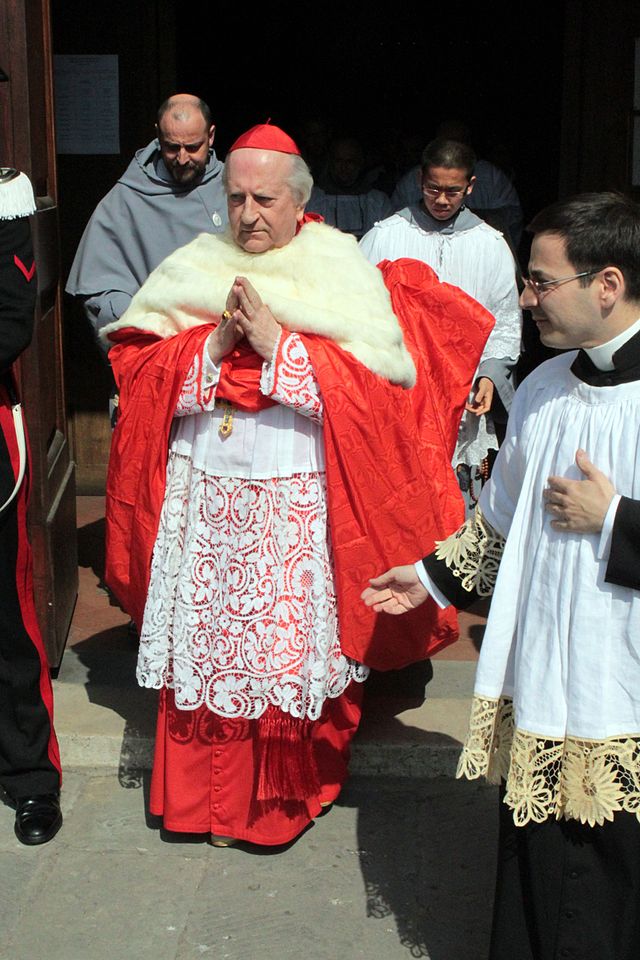
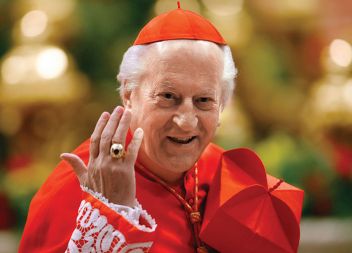
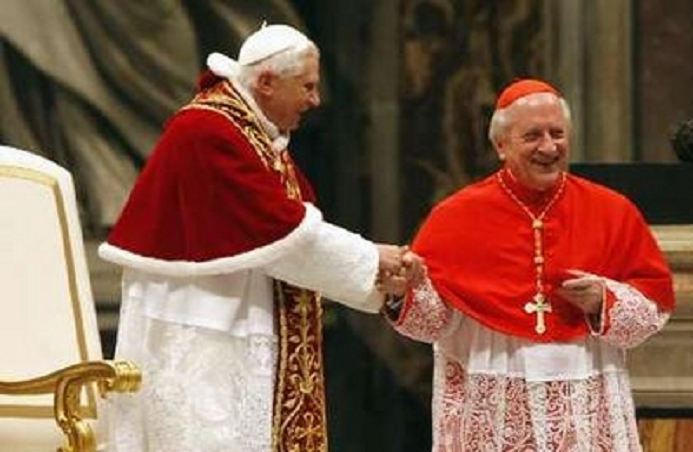
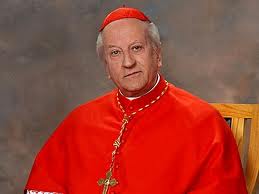
Cardinals Update : Cardinal Franc Rode, C.M., Prefect Emeritus of the Congregation for Institutes of Consecrated Life and for Societies of Apostolic Life (Slovenia), turned 80, ceases to be a Cardinal-elector

640px-Cardeal_franc_rodé

On Tuesday, 23 September 2014, Cardinal Franc Rode, C.M., Cardinal-Deacon of S. Francesco Saverio alla Garbatella, Prefect Emeritus of the Congregation for Institutes of Consecrated Life and for Societies of Apostolic Life (Slovenia), turned 80, and therefore, according to the rules written in the Apostolic Constitution Universi Dominici Gregis, he lost his right to vote in any future conclave. Cardinal Franc Rode was born in Ljubljana, Slovenia on 5 September 1934.

rode_franc_ap

Cardinal Rode was made Cardinal-Deacon of S. Francesco Saverio alla Garbatella by Pope Benedict XVI in the 2006 Consistory of Cardinals on 24 March 2006, the first Consistory of his pontificate. Cardinal Rode was made a Cardinal in honour of his position as the Prefect Emeritus of the Congregation for Institutes of Consecrated Life and for Societies of Apostolic Life, the branch of the Roman Curia in charge of all religious orders and all matters pertaining to religious life and profession, a position he held from 2004 to 2011. Before that, Cardinal Rode was the Metropolitan Archbishop of Ljubljana (Slovenia), the greatest and largest see in the country of Slovenia, from 1997 to 2004.

0202relig1pi7

http://www.gcatholic.org/hierarchy/data/cardB16-1.htm#695

May God bless His Eminence Cardinal Rode with a blessed old age and health. May he remain strong in the faith and hopefully can perhaps still continue to work great graces and good works of love and peace just as he had once done in his long service to the Church, particularly his contributions as a member of the Roman Curia in helping the actions of the Holy See and the Pope.

images

The College of Cardinals now stands at 210 members in total, with 113 Cardinal-electors and 97 Cardinal non-electors. There are now a vacancy of 7 Cardinal-elector as compared to the maximum number of electors allowed in the Conclave of 120.

Next Cardinal-elector to age out (80) will be Cardinal Tarcisio Bertone, S.D.B. (Italy), the Cardinal Secretary of State Emeritus of the Secretariat of State and the current Chamberlain of the Holy Roman Church of the Apostolic Camera on 2 December 2014.

Tuesday, 23 September 2014 : 25th Week of Ordinary Time, Memorial of St. Pius of Pietrelcina (Padre Pio) (Gospel Reading)

Liturgical Colour : White

Luke 8 : 19-21

Then the mother of Jesus and His relatives came to Him, but they could not get to Him because of the crowd. Someone told Him, “Your mother and Your brothers are standing outside and wish to meet You.”

Then Jesus answered, “My mother and My brothers are those who hear the word of God and do it.”