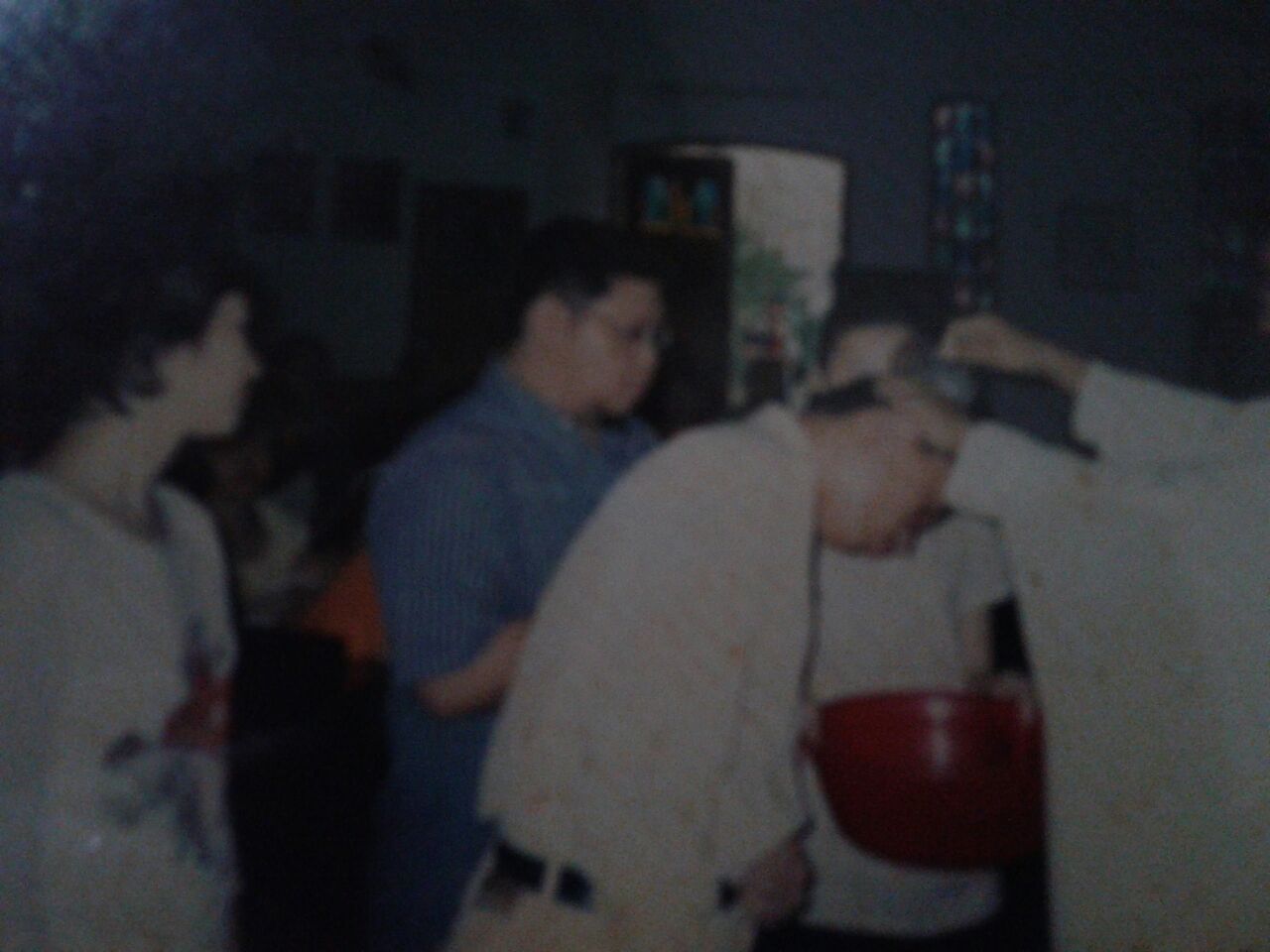
Tenth Anniversary of Holy Sacrament of Baptism : My Profession of Faith

Friday, 19 September 2014 marked the exact ten years since I received the Holy Sacrament of Baptism on Sunday, 19 September 2004.

With this, I renewed my profession of faith before the Holy Gospels, and I ask that all of you will pray for me, that I will continue to grow stronger and deeper in faith, in hope and in love.

IMG-20140919-WA004

‘I baptise you in the Name of the Father, the Son and the Holy Spirit’


IMG-20140919-WA000

‘The almighty God, Father of our Lord Jesus Christ, has caused you to be born over again of water and the Holy Spirit and pardoned you all your sins. May He now anoint you with the chrism that sanctifies in Christ Jesus our Lord, and bring you to everlasting life.’


IMG-20140919-WA001

‘Take this burning candle as a reminder to keep your baptismal innocence. Obey God’s commandments, so that when our Lord comes for the joyous wedding feast you may go forth to meet Him with all the saints in the halls of heaven, and be happy with Him forevermore.’

Tuesday, 16 September 2014 : 24th Week of Ordinary Time, Memorial of Pope St. Cornelius, Pope and Martyr, and St. Cyprian, Bishop and Martyr (First Reading)

Liturgical Colour : Red

1 Corinthians 12 : 12-14, 27-31a

As the body is one, having many members, and all the members, while being many, form one body, so it is with Christ. All of us, whether Jews or Greeks, slaves or free, have been baptised in one Spirit to form one body and all of us have been given to drink from the one Spirit.

The body has not just one member, but many. Now, you are the Body of Christ and each of you individually is a member of it. So God has appointed us in the Church. First Apostles, second prophets, third teachers. Then come miracles, then the gift of healing, material help, administration in the Church and the gift of tongues.

Are all Apostles? Are all prophets? Are all teachers? Can all perform miracles, or cure the sick, or speak in tongues, or explain what was said in tongues? Be that as it may, set your hearts on the most precious gifts.

Sunday, 14 September 2014 : 24th Sunday of Ordinary Time, Feast of the Exaltation of the Holy Cross (Homily and Scripture Reflections)

Liturgical Colour : Red

Dear brothers and sisters in Christ, today is truly a great feast day of the Church, of such a great importance for us, as in it lie one of the greatest aspect of our faith itself. And this is none other than the exaltation and the glorification of the Holy Cross, on which our Saviour and Lord Jesus Christ had hung upon as He went on His mission of salvation to save us all from death because of our sins.

The Holy Cross is not just any cross, but it has been made holy and sacred because it was on that wooden cross, made from a tree, that Jesus had emptied Himself completely from His divinity, and suffered a grievous and horrendous pain as He laid dying, hanging from that cross. The Holy Cross is a reminder for all of us, of He who once hung there out of His love for us, so that we may have new hope in this life, and that we may look beyond death that is once our fate.

The cross was the favourite punishment method by the Romans, the conqueror of the known world at the time, where they used it to punish rebels against the Roman authority, as one of the most severe methods of punishment, reserved only for those who brought about great harm and threat to the Roman state. The victims of crucifixions were left to hang on the cross, made from a tree and carved to form a cruciform plank, so that the victims were left to hung between the heaven and the earth.

This punishment was both designed to bring the greatest amount of suffering to the victim, by denying the victim a quick death, giving them a slow and increasingly painful suffering, and also to give the greatest humiliation possible, as the victims were stripped to mere loincloth or even naked, stretched wide on that cross, often on the roadsides and high places like hills, so that many would be able to see the humiliation and suffering of those who dared to test the might of Rome.

Thus, the cross was a symbol of ultimate humiliation and suffering for all who see them at the time of Jesus, during the peak of the Roman Empire. But yet, many centuries prior to the time of the Romans, the prophets have foretold of the suffering Messiah, namely through the prophet Isaiah, who prophesied how the Messiah would come and bear the suffering for all of mankind. It was also mentioned how He would suffer, even long before the time when the punishment was common.

For in crucifixions, the victim would either be tied to the cross or in especially serious and severe occasions, the victims would be nailed upon the cross. The latter method would be more grievous and painful, and even more humiliating, and was indeed reserved only for the worst enemies and the greatest of punishments for the enemies of Rome.

And the prophet Isaiah mentioned that the Messiah would be pierced, and that piercing indeed represented how Jesus, the Lord and Messiah would be nailed on the cross. He would also be lifted up high, like when Moses lifted high up the bronze serpent in the desert. This too is a premonition of what was to come when the Lord came to save His people from destruction and death.

When the people of God, the Israelites were saved from their slavery in Egypt, they went through a long Exodus and journey through the desert in their progress to reach the land promised to them through their ancestors. In that journey, which was not an easy one, God was with them along the way, and He blessed His people, giving them great providence and food along the way.

Yes, if we read through the Book of Exodus, Numbers and Deuteronomy, we should all realise how blessed this people had been. God destroyed their enemies and all those who went on to fight against them were crushed and have their forces utterly beaten, and God gave them into the hands of His people. And we all should be aware that God Himself freed them from the chains of the Egyptians with great might, with ten plagues, each of which were of terrible ferocity.

God even sent His people the bread from heaven to eat, in the form of manna, and large birds for them to catch and eat as well. He gave them clear and sweet water to drink, and we have to imagine that, having crystal clear and good water to drink in the middle of the desert is no mere small feat. Nothing is of course impossible for the Lord, and He loves us beyond anything else.

And it is that love that prevented Him from totally and completely annihilating that people which had risen up against Him, despite all He had given them and blessed them with. Having been given and endowed with so much graces, the people of God made complaints after complaints of their supposedly ‘miserable’ existence and life in the desert, and even longed for the ‘good’ life in Egypt where they once lived in slavery.

They spurned His love and kindness, complaining even against what they have been given to eat, bread from heaven itself. This was why, eventually, God took action against them, to remind them that He is Lord over all, and that those who constantly defy Him and oppose Him will meet their end in eternal suffering and destruction. He sent them therefore, fiery and poisonous serpents that attacked them, struck them and killed many of them.

But we have to always remember and take note that it is not God who desired our destruction, as it had happened with the Israelites. In fact, it was the people’s own stubbornness and refusal to return to the light of God which had caused their own destruction. The serpents represented the suffering and the punishment that the people must endure for their sins, and the ultimate effect is indeed none other than death.

Ever since mankind had first disobeyed against the Lord, they have sinned against the Lord in their hearts and in their bodies, such that they were no longer worthy of the Lord. The consequence of sin is death, as sin separates one from the Lord. The Lord who is all good and perfect cannot tolerate the imperfections caused by evil to be in His presence, and therefore, naturally, sin led mankind to death, and if nothing had been done, then all mankind would have faced death eternal, and eternal separation from the love of God.

And that is hell. Hell is the total separation of a creation of God from the very love of the Creator and Lord of all. And this total separation is final and unchangeable. Thus, this is what hell is truly about, not the fires and the images of hell that we are commonly exposed to, but the suffering in hell is far greater than we can ever imagine, since it means that the total separation from God’s love, that should be unimaginable to us all, because it was God’s love that is everything to us, how we live and why we live in the first place, and we are able to walk and enjoy this life on earth because of God’s love that is with us and in us.

Hell is what is due to mankind as the punishment for our sins, and in hell, it is the despair and the state of total hopelessness which is the greatest suffering, as all the souls in hell know that there is absolutely no hope of escaping that state, eternally damned and separated from God’s love, and it is this eternal and constantly repeating despair, hopelessness and guilt of having betrayed the Lord which brought about the greatest suffering for the souls in hell.

But is this what God intends for us? Is this what He intended for the people He loved and which He had created in His own image, as the pinnacle and the greatest of all His creations? No! This is exactly why He wants to save us, and so great was His desire, that the very truth was laid bare for all to see and hear, as we often heard in the famous phrase from the Gospel of St. John, chapter 3 verse 16, namely that God loved the world and His people so much, that He sent His only Son into the world, so that all those who believe in Him would not be lost and perish, but gain eternal life.

This is the very essence of what we are celebrating on this day, that is the glory and the mystery of the Holy Cross of our Lord and Saviour, Jesus Christ, the Son of God, whom the Lord Himself had sent, a part of Himself, His own Word made incarnate into flesh as one of us, and to walk among men, so that He might exercise His power and bring salvation to all those who believe in Him. And the way how He did that, was through the cross of suffering, which He transformed into the cross of glory and triumph.

As I had mentioned much earlier on in this homily and reflection, that the use of crucifixion and the punishment of the cross was indeed to punish and to bring the greatest suffering on the sufferer, and also to humiliate the sufferer, and in this case, this suffering One is Jesus, the Messiah and Saviour of all. Even though He was guiltless, blameless and without sin, He offered Himself freely as part of God’s long planned salvation for His people, so that through His death, He might open a new path for them, into salvation and eternal grace.

To those who observed His death and especially among those who followed Him during His ministry would indeed question, why would such a holy Man and the Messiah no less, suffer such a humiliation and suffering so great if He was indeed chosen by the Lord. And we know that even throughout history and until today, there are still many those who refused to believe in the crucifixion of Christ because they deemed it impossible and unreasonable for such a great One to suffer such a humiliating death.

Yet we know that Jesus Christ, Son of God, Messiah and Lord of all, chose this way because indeed, He loves us all very dearly, and He would not want us to be sundered forever from His love, that is hell. He does not desire for us to inhabit hell, simply because, that was not His intention for us. His intention is for us to live happily with Him in love and harmony. And that was why He chose to come into this world, that is to bring all peoples to Himself.

But sin lays between God and us, as a great and seemingly insurmountable barrier that prevent us from returning to God our Lord. Therefore, if we read the Book of Leviticus, we know that there is such a thing as sin and burnt offering, where animals such as lamb were slaughtered and then burnt on the altar, and the blood together with the animal constituted a worthy offering to God, who then accepted it as the partial reparation and remission for the sins committed by God’s people.

But the people of God remained in sin, and also they inherited the original sin of their forefathers, ever since they rebelled against the will of God and followed Satan into his rebellion instead. This original sin and other sins that mankind committed kept them separated from the love of God, and due to the immensity of the sins of mankind combined together, no amount of sacrifice would be able to redeem mankind from their sins, save for one.

Yes, the one sacrifice and the only one, when the Lamb of God, our Lord Jesus Christ Himself offered His own Body and Blood as the only worthy sacrifice for the immensity of the combination of our sins together. Only He who is perfect, perfectly unblemished and pure, without any taints of sin, and He who is Lord of all, had the worthy offering to make in order to save us from our sins.

And thus He suffered, all the sufferings and humiliations He endured, all the spittle and the mockery from the people He endured, and the cross of suffering He carried on His back, enduring lashes after lashes and mockery after mockery as He made His journey towards Calvary. Yet He did not give up. We cannot even comprehend the kind of suffering which Jesus endured for our sake.

Why so? This is because the suffering He endured was much more than just the apparent physical suffering, even as great as that suffering was. He endured the weight and the consequences of our sins, and all of this bore down on Him as a great weight beyond any other weight. He was blameless, and yet He was crushed for our sins. This was also yet another fulfillment of the prophecy of the prophets.

But Jesus endured all of them with perfect obedience and perfect love for us. He is truly the new Adam, as St. Paul had said, as the One who went to correct all the wrongs that began with Adam, the old Adam, our forefather who sinned against God. Just as Mary His mother is the new Eve, whose obedience and faith, rebuking Satan and his lies, Jesus is the new Adam through which God renewed mankind.

Jesus therefore changed that symbol of ultimate shame, the cross, designed as such by the Romans, into a symbol of hope and glory. He turned the cross from a symbol of death and destruction into a symbol of salvation and liberation from sin, from the slavery of the forces of evil, and the guarantee of life eternal as promised by the Lord. Thus, the essence of the cross and the crucifix we have today signify this important turning point, which Christ had made the cross into our hope, through His death on the cross for our salvation.

Sadly indeed, despite all that the Lord had done for us, many of us mankind still acted like the people of Israel of old, disregarding the love of God and even ignoring Him altogether. How many of us actually realised the love that God had for us? Every single step He took on His passion journey towards His death, He did it out of His love for us. He did not want us to perish, but it is many of us who chose perishing in the world rather than embracing God’s love.

Remember, that in Jesus we have been saved, out of God’s love. He wants to forgive us our sins, but this is only possible if we too play our part, and believe in Him. We can start this through our own actions and our own daily lives. Have we acted in accordance what our Lord had taught us? Have we practiced our faith and what we believe in our lives? Have we loved our brothers and sisters as much as we love ourselves?

We have much work to do in front of us, brothers and sisters in Christ. Our lives will indeed be difficult, if we choose to follow the Lord and walk in His path. But our Lord had made His cross a sign of victory and triumph, the Holy Cross, that even Satan and his forces will tremble and flee from. Satan knows that the cross was his ultimate undoing. His defeat lay at the cross that had liberated mankind from the burden of their sins. He knows that his doom is coming, and he cannot avoid that final defeat.

However, Satan will grow desperate and he will do all he can to stall as many souls as possible on his way to doom. Remember that he has all the power in this world to tempt and persuade us to divert our path from the path of salvation into the path of doom. Temptations of the evil one is plenty in this world saturated with materialism, consumerism and love of the self. Selfishness and violence is on the rise, brethren, and if we do not guard ourselves against Satan’s advances, we will fall.

Therefore, let us all work together, brothers and sisters in Christ! We who have been saved by the suffering and sacrifice of our Lord Jesus Christ must be strong in our faith and in our dedication to God, so that Satan will not stand against us. Remember the Holy Cross and Jesus our Lord whenever temptations of Satan come to prevent us from seeking the Lord. Proclaim the Holy Name of Jesus and staunchly rebuke Satan for his attempts to tempt us.

Jesus has indeed been given the Name which is above every other names, for first He is God made flesh, and thus, it is the Name of God Himself, Master of all the universe and over all creations. Then, through His perfect love and obedience, He had become an example for all mankind and for all creation, and no one in creation can do anything other than to obey this Lord and Master who had given His all to save His beloved ones. And even Satan had to obey the Lord, with fear and great trembling on his knees. Such is the power of the Name of Jesus Christ. Do not use His Name in vain!

And even in the Roman Empire, which was pagan and idol worshipping, the Lord also gained a final victory. Many Emperors of Rome persecuted the Christians, the faithful ones in the Lord, but their prayers and the blood of the martyrs eventually triumphed, the triumph of the Holy Cross, when the Lord made them strong and grow in might, so that more and more people would come to listen to the words of salvation in the Gospels and the Scriptures.

Ultimately, the famed Emperor Constantine saw a bright sign of the Lord, Christ Himself in His insignia, as the victorious and conquering King, and went on to win a great victory that eventually led to the repentance and conversion of the Roman Empire into a great, Christian Empire belonging to God. Thus, the Cross had triumphed against the enemies of the Lord, led by Satan and his fallen angels.

Therefore, let us all take an opportunity, every day in our lives to look at the cross, at the crucifix on which lie the Body of Jesus our Lord, as a reminder that He died out of His infinite and enduring love for us, so that we who have seen Him and believed, will not die but live a new life everlasting, just as Moses lifted the bronze serpent and all who had been bitten and saw the bronze serpent did not die but live.

We have been bitten by the serpent, Satan, and his poison is threatening to destroy us, that is sin. But if we trust in the Lord Jesus, and look at the victorious cross, the Holy Cross of Christ, we will not die but live too! Let us carry together our crosses in life with Christ, so that just as He told His disciples, that we may have a share in His resurrection, and therefore be granted new life eternal, freed from all vestiges of sin and evil, and rejoice for eternity with our loving God. May Almighty God bless us this day and every day of our lives, that we will always be faithful and dedicated to the Cross of Christ! Amen.

Saturday, 13 September 2014 : 23rd Week of Ordinary Time, Memorial of St. John Chrysostom, Bishop and Doctor of the Church (Homily and Scripture Reflections)

Liturgical Colour : White

Dear brothers and sisters in Christ, today we celebrate the feast of a great saint of the Church, one of the Four Great Doctors of the Church, and one of the most brilliant minds ever to come from the Church in the Eastern parts of the Roman Empire at the time. St. John Chrysostom is this saint, who was the Archbishop of the great See of Constantinople, capital of the Eastern Roman Empire during the early fifth century after the birth of Christ.

St. John Chrysostom was born from a relatively unknown parentage, and it was disputed whether his mother was a pagan or a Christian. In any case, St. John Chrysostom was baptised when he entered adulthood, and it was discovered that he had a great intellectual mind, and he easily went through his studies of literature and philosophy.

However, as time progressed, St. John Chrysostom turned more and more towards the Lord and dedicated his life to His service. His sermons and speeches were greatly influential and inspirational, based on the deep understanding and comprehension of the Gospels and the fundamentals of faith, through which he gained his title of Chrysostomus, which literally means ‘golden-mouthed’.

St. John Chrysostom preached in many parts of the Empire, and in one occasion his sincere and passionated plea to the pagans who were accused of the defilement of the statues of the Emperor in the city of Antioch brought thousands and more to see the error of their ways, and thus, they were received into the Church and was spared both the punishment and persecution by the Emperor, and even more importantly, they evaded the punishment and destruction of the soul by receiving the salvation in Jesus Christ our Lord.

Even after St. John Chrysostom had been appointed as the Archbishop of Constantinople, one of the most prominent position in the Church, in fact just second after the Pope in Rome himself, St. John Chrysostom remained humble and dedicated in his service to the people of God, the sheep entrusted to him. St. John Chrysostom rejected the extravagant and lavish ways of the society at the time and pushed for a true Christian community founded on love.

He did not fear even to oppose the mighty and the powerful. When the Empress Aelia Eudoxia lived extravagantly, he greatly criticised her for her way of life and actions. Together with his enemies, the Empress plotted together and managed to cast St. John Chrysostom into exile, which would indeed have ended his works for the Church, but the people of God were incensed, and divine wrath itself soon manifested in a great earthquake and fire that devastated many parts of the capital.

But even after St. John Chrysostom was recalled back to his mission in the Church, the Empress continued to defy the way of the Lord, as she continued to live extravagantly and even installed a silver statue of herself near the cathedral of St. John Chrysostom, purposely to provoke him into action. And indeed, St. John Chrysostom denounced the Empress again, and as her punishment, she died during childbirth.

But St. John Chrysostom continued to suffer as his enemies continued to plot against him and persecuted him. He was sent again into exile and died before he was able to return to shepherd his sheep again at Constantinople. Nevertheless, his legacies lasted long after him, even until today. He was credited for his many works and sermons that inspired many of the faithful and even many saints who came after him.

And his works also resulted in one of the rites used in the Eastern Church even until today, as the Divine Liturgy of St. John Chrysostom, one of the most solemn liturgical rites of the Church, designed solely for the glorification of the Lord. Thus, this holy man and servant of God is the one whose life and actions we celebrate on this day as we gather together.

How is this related to the readings of the day? Very much related indeed. This is because as Jesus said in the Gospel, that good fruits can only be produced by good and healthy trees, vice versa. Bad and rotten trees can only produce bad and rotten fruits. Thus, St. John Chrysostom, that good tree, produce only good fruits for the benefits of the faithful. Similarly this is also the case for the other saints, the holy servants of God.

And he listened to the word of God intently, placing them into the depths of his heart, and most importantly, he acted on them, and from there brought about much good for the Church and for the faithful ones in the Lord. Thus, his actions were the representation of the man who built his house on solid rock foundation, and therefore had no need to fear the storms or any forces arrayed against it.

On the other hand, those who refused to listen to the word of God were like those who built their houses on unstable ground, on weak foundations that are easily swept away by winds and waves, and therefore representing the actions of the wicked ones opposed to the works of St. John Chrysostom, namely the Empress and his rivals, who were engrossed so much in the ways of the Lord, that they failed to even see that what they were doing was their own undoing.

And St. Paul in his letter to the faithful in the city of Corinth clearly and zealously stated that we who are faithful ought not to have any share in the communion with demons, that is with Satan and his allies, the forces of darkness in the world. Instead, we who are the children of God should be like St. John Chrysostom, in how he worked hard with zeal to bring the word of God to many of God’s people so that they may achieve salvation.

How do we know if we have made a communion with the Lord or with the evil one? It is basic and simple indeed. We have to first be aware that all of us who are in the Church of God are part of one Body, that is the Body of Christ, which is the union of all who shared in the Body and Blood of Christ, who had worthily become part of the Body of Christ, Christ is in them and they are in the Lord. It is inconceivable that a part of the Body of Christ should be flawed with the darkness of evil.

Thus if we commit evil, just as what those people mentioned earlier had done, in preserving their own vanity, concerned only for their own prosperity and in slandering others, worse that is to even put an obstacle on the works of the servant of God. In doing these evils, they committed sin before the Lord, and therefore entered into communion with the devil. For the devil too, rebelled against the Lord because of his pride and vanity.

Therefore, as we are part of the Church of God, and we have become the children of God, let us all realise that all of us must act therefore as how a child of God should behave. Listen to the Lord, work on what we believe in and practice our faith in our lives. Love one another and love the Lord just as much as we love ourselves. If we do all these, we will be surely be granted favour by the Lord.

May Almighty God therefore grant us His grace, that He may empower us to live according to what St. John Chrysostom had once done. Let us all treasure this communion we share with one another, the communion and unity as the one Body of Christ, those who have received the Most Precious Body and Blood of our Lord Jesus Christ. Keep us, Lord, on the path towards salvation, and let us not to fall into evil. Amen.

Tuesday, 9 September 2014 : 23rd Week of Ordinary Time, Memorial of St. Peter Claver, Priest (First Reading)

Liturgical Colour : Green or White (Priests)

1 Corinthians 6 : 1-11

When you have a complaint against a brother, how dare you bring it before pagan judges instead of bringing it before God’s people? Do you not know that you shall one day judge the world? And if you are to judge the world, are you incapable of judging such simple problems?

Do you not know that we will even judge the angels? And could you not decide every day affairs? But when you have ordinary cases to be judged, you bring them before those who are of no account in the Church! Shame on you! Is there not even one among you wise enough to be the arbiter among believers?

But no. One of you brings a suit against another one, and files that suit before unbelievers. It is already a failure that you have suits against each other. Why do you not rather suffer wrong and receive some damage? But no. You wrong and injure others, and those are your brothers and sisters. Do you not know that the wicked will not inherit the Kingdom of God?

Make no mistake about it : those who lead sexually immoral lives, or worship idols, or who are adulterers, perverts, sodomites, or thieves, exploiters, drunkards, slanderers or embezzlers will not inherit the kingdom of heaven. Some of you were like that, but you have been cleansed and consecrated to God and have been set right with God by the Name of the Lord Jesus and the Spirit of our God.

Sunday, 7 September 2014 : 23rd Sunday of Ordinary Time (Homily and Scripture Reflections)

Liturgical Colour : Green

Dear brothers and sisters in Christ, as we come together to be with the Lord on this holy day of His, we are called together as the members of the Church of God to be responsible, loving and caring for one another, so that each one of us may help one another in our effort to seek our Lord and God, and so that all of us may be saved and be freed from the tyranny of sin.

Brothers and sisters in Christ, the Scripture readings of this day called us to ponder and reflect on the attitude we adopt in this life, and in how we live our faith in this life. Mankind are by nature a social creature, and we often need others around us as we live and as we face the daily challenges and opportunities presented before us, and how we behave would certainly be greatly affected by who we interacted with and what we did together with others around us.

That is why today in the readings, the main theme that we heard is in fact on the nature of the Church, and on how the Church should work together to ensure the salvation of all of its members, that means all of us gathered here this day, and also many others who have fallen along the way. The Church here does not refer to just the buildings and the institution of the Church as we know it. The Church of God as a whole, is the assembly and the gathering of all the faithful ones in Christ, united to His Body, as a member of the same Body by which we are made one, and made righteous in the Blood of the Lamb of God.

That is why in the Church, the whole Church refers to the entire body of the faithful, all over the world, from the greatest to the least, from the Pope to the common layman, from the ordained ministers and the religious brothers and sisters to all common faithful ones like us, and from the youngest ones to the oldest, and both the newly baptised and those who had been long counted among the faithful.

Following the tradition and teachings established by Jesus as we read in the Gospel today, the Church indeed rightly should be concerned on the fate of the faithful and the salvation of their souls. Why is this so? This is because mankind are by nature disobedient, restless and easily manipulated, and we are also easily tempted by our own personal ego, pride and other emotions, which in many cases likely resulted in us drifting away further and further from God and into damnation.

That was why over the course of the past two millenia, since the establishment of the Church and the faith, countless peoples have tried to subvert the faith and to corrupt it to suit their own purposes. And worse still, they did so not just for themselves, but they also spread their false ideas and teachings to many others around them and thus condemning and risking not just themselves, but also many others who are around them and even those entrusted to their care.

Among these could be counted the ranks of princes, kings, lords, even priests, bishops and the top hierarchy of the Church at times, and also among the laity, the educated, the rich and the poor. What they have thought about, spoke about and taught about were incompatible to the faith and what Jesus had taught to His disciples. In time, the Church came up with varieties of words to describe their actions, that is anathema, heresy and many others.

Those who studied the history of the Church and the faith must have been surprised by the staggering number of times the punishment and measure known best as excommunication, had been used. And in fact, excommunication remains to be used this day to correct the behaviour and awaken the spirit of repentance of those whose ideas and teachings are in direct or indirect contradiction to the faith and to the teachings of the Church.

Many detractors of this measure had argued and even became violently opposed to the actions of the Church both in the past and in the present, so that they criticised the use of excommunications as a tool to remove opposition to the Church and to gain more influence for itself. And some even alleged that the Church used them to silence the voice of those who wanted for reform or change in the Church.

Yes, it is true indeed that sometimes, excommunication had been used inappropriately, but in most cases, they have been intended not to punish, but to awaken the spirit of repentance and genuine desire to seek forgiveness from the Lord, which is that desire to admit their errors and return to the full embrace of the loving God through His Church.

We have to first understand the history of how excommunication come about, using what we know from the Scriptures and from what we heard today in the readings, especially from what Jesus mentioned in the Gospel today. In the past, during the time of the people of Israel, after the Exodus, God gave them His laws, commandments and precepts through Moses.

In that Law, some dealt with how certain people should be treated. Those who were found to have the disease of leprosy were obliged to leave their houses and the community of the faithful, and they have to wander outside the community, in the barrens and the desert until they are healed or cured. And when this was so, they had to show themselves to the priests who would certify them to return once more to the society.

Indeed, it was inevitable that those who contracted leprosy at that time to be ostracised and intimidated against by the rest of the society. They were considered to be uncleaned and as leprosy can spread from one person to another, this helped the exclusion and the bad treatment of the leprosy patients, even after they had been cured from their afflictions. But God did not intend for this to happen.

And in a similar spirit, the Lord Jesus told us through His disciples precisely how to deal with those among us in the Church who had contracted the same ‘leprosy’. This leprosy no longer refers to the physical disease that affects the body, but in fact refers to the leprosy of the soul, that is the degeneration of the state of our faith and soul to the point that we become defiant and unwilling to listen and to obey the teachings of the Church and the fundamentals of our faith.

We have many peoples such as these, and what I am going to mention to you are not the only ones there are out there. The Gnostics of the second century after the birth of Christ mixed the teachings of the faith with the contemporary pagan religions, idols and philosophical pursuits that ended up as a syncretic movement and faith totally incompatible with our true faith.

Then came the Arians, the Donatists, the Monophysites and others who taught doctrines incompatible against the faith, and who tried to subvert the faithful to their cause, telling them lies and inaccurate statements about the faith, on the nature of Jesus our Lord Himself, so that the people who were confused were easy to lure into their corrupting hold. As such, many were led away from salvation in God and into damnation, despite the best efforts by those in the Church to resist and fight back against their corrupting influences.

Then we have many others like the the Albigensians or the Cathars, the Hussians, the Bogomils, Paulicians, Iconoclasts who taught numerous lies and confused theology to the faithful, ending up in corrupting the people in the same way, pulling them away from salvation in the Church into damnation and eternal suffering in hellfire. Those people were misguided by many who thought that their human wisdom were better than the teachings of the Lord preserved in the traditions of the Church and the faith.

Then lastly came the great heresy of the Protestant ‘reformation’, where many of the faithful came to take it on themselves to rebel against the authority of the Church and by willingly splitting themselves from the Church, a rebellion which continues even to this day. Yes, we have so many Protestant denominations, to the point that it may not be wrong to say that there are as many denominations, or splinter groups as there are heads.

People like King Henry VIII, Martin Luther, John Calvin, Zwingli and many other prominent persona of the Protestant ‘reformations’ like many others before them, Arian, Jan Hus, and others were truly the one mentioned by Jesus as the brethren who refused to listen to reason and chose to break away from the Church. They walked their own path, in open rebellion against God and the Church, leading and guiding many people into their rebellion and thus condemned countless souls to damnation.

The effects of their actions can still be felt today. Many remained separate from the Church and thus from the grace of God, and the lies perpetuated by those leaders mentioned earlier and their successors continued to poison their thoughts and that is why many remained with great contempt to the Church and all it represented.

The Church excommunicated them as well as many of the earlier members of the Church, who even included high ranking nobles and clergymen, and even kings, as they have erred in their path. However, as I have mentioned earlier, the purpose of this move was not to punish those afflicted, but rather to make them realise of the gravity of their errors, so that they may come to understand how their actions had caused grief wounds on the fabric of the Church and the faithful.

And thus, many of those who had been excommunicated had returned to the Church in penitence and seeking God’s forgiveness. A famous example would be that of the excommunication of Emperor Theodosius I of the Roman Empire, who was cut off from the communion of the Church by the famous St. Ambrose, the Bishop of Milan, for the Emperor’s implicit and direct role in a massacre of the city of Thessalonica, where thousands of the faithful were ruthlessly murdered and the city ransacked.

The meaning of excommunication itself was to exclude the person afflicted from the Communion of the Church, and if this word sounds familiar, that is indeed what we receive in the Holy Communion, which is none other than the Most Precious Body and Blood of our Lord Jesus Christ, in the Real Presence of the Most Holy Eucharist. All of us in the Church belongs to the Church, that is the Body of Christ precisely because all of us received the same Eucharist and thus are united to each other through our unity with the Lord.

And when a person is excommunicated, like that of the Emperor Theodosius and many others, they were severed from this unity and communion, and thus they were not able to receive the Eucharist, as they were also in a state of sin, and they were not able to exercise anything pertinent to the faith. Thus, that was why Jesus mentioned that those ought to be treated like a pagan or a publican, that means outside the Church, just like the lepers of old.

However, once again, the focus here is on mercy, and on the desire to see these people attaining forgiveness and justification, becoming once again a member of the Church and thus capable of attaining salvation once again. And to wrap up the story on the Emperor Theodosius, the Emperor went on to make a public display of humility and penance, wearing sackcloth to the Church and was once again welcomed into the Church by Bishop St. Ambrose.

That is, brothers and sisters in Christ, the purpose and intention of excommunication. Not as a punishment, but as a means through which the wayward ones and the staunchly rebellious among us may find our way back to God through the Church, through sincere repentance and penitence. Sadly, of course, many of those names and groups mentioned earlier never repented their sins and continued in their rebellions, some of which continued even today.

Therefore, brothers and sisters in Christ, as we reflect on these readings of today, let us recall the words of God to the prophet Ezekiel, how the faithful are tasked with the guardianship of the faith of one another, which means that we should be ready to intervene whenever we see around us there are those who begin to veer away from the path of the Lord.

It is only then if the person persisted in their rebelliousness, then we should refer it to the Church as a whole, and if he or she continued to persist to disobey the Lord, only then they should be cast out of the assembly of the faithful, in what we know as the excommunication, hoping that the person may in that time that remains for him or her, found his or her way back to the Lord and repent.

Brothers and sisters in Christ, let us all therefore work together to maintain the unity and the faith in the Church. May Almighty God guide us in our endeavours and help us to keep this faith alive and well. Let us all renew our commitment to the Lord and awaken in one another the love we truly should have for God, casting away all impurities and unworthiness. Let us all not reject and condemn those who have sinned and erred, and those who had been excommunicated, for indeed, many saints too were once sinners and excommunicants, who returned to the Lord and be reconciled with the Church. May God bless us all. Amen.

Sunday, 7 September 2014 : 23rd Sunday of Ordinary Time (Gospel Reading)

Liturgical Colour : Green

Matthew 18 : 15-20

Jesus said, “If your brother has sinned against you, go and point out the fault, when two of you are in private, and if he listens to you, you have won your brother. If he does not listen to you, take with you one or two others, so that the case may be decided by the evidence of two or three witnesses.”

“And if he refuses to listen to them, tell it to the assembled Church. But if he does not listen to the Church, then regard such a one as a pagan, or a publican.”

“I say to you : whatever you bind on earth, heaven will keep bound; and whatever you unbind on earth, heaven will keep unbound. In like manner, I say to you : if, on earth, two of you are united in asking for anything, it will be granted to you by My heavenly Father; for where two or three are gathered in My Name, I am there among them.”

Thursday, 4 September 2014 : 22nd Week of Ordinary Time (Homily and Scripture Reflections)

Liturgical Colour : Green

Dear brothers and sisters in Christ, today we come and listen to the words of the Scriptures, as we heard how Jesus our Lord met and recruited the disciples to His cause, calling them from their former worldly professions into their new work and vocation for the sake of mankind and for the greater glory of God. They left behind their possessions so that they gained a greater reward in God, that is a possession that lasts forever.

Today we heard about how those humble fishermen of the lake of Galilee, Peter and Andrew his brother, and the sons of Zebedee, James and John, were called, from their boats and nets, that they would no longer just catch fishes in the lake to be sold in the market and to feed themselves, but instead they would become the fishers of men, to bring mankind back to the Lord their God.

And we have to take note how the Lord did not call the great and powerful, nor the righteous and holy ones to be His disciples, as He could easily have done so, and His works would have been so much easier. No, the Lord did not do that. Instead, He called on the sinners and the weak, those who have low standing in the society, such as fishermen, a simple and menial job, as well as others, including tax collectors such as Levi, later known as Matthew.

The idea here is clearly stated in the first reading, where St. Paul in his letter to the faithful in Corinth rebuked those who assumed that they were wise and great, and he therefore those who immersed themselves in their pride, thinking only about themselves and their achievements, and thinking that because of their wisdom, influence or other abilities and deeds, they were rightful in gloating over others’ supposed inferiority. This, as St. Paul said, would bring about their doom.

Yes, indeed, the Lord called sinners and simple people to be His disciples, not only because He truly came into this world to save the sinners and those whose souls were sick, but He also knew that those who were not burdened with the many concerns of the world and the taint of power and glory, would have been much better disciples and servants of the will of God, as they are likely to have less ego and pride than those who are powerful and great in the world.

God desires not our death and destruction, but in fact He seeks for our redemption from sin. And this is by delivering His Good News and the truth about Himself to mankind, and this is akin to the net being cast out from the ship to catch the various fishes in the sea. And like the net, those who listen to the word of God will be ensnared in that net, and thus, they would be able to continue to listen to the word of God and hence be saved.

The ship itself represents the Church of God, which God had established Himself in this world, to bring His people to safety and towards His kingdom which is to come. And the Apostles whom Jesus had called from among the people are indeed like the fishermen, who steered the ship that is the Church of God, in order to ensure that the Church can sail safely amidst any storms in the sea. Those storms represent the challenges and the oppositions which Satan and his allies, the forces of sin and darkness, which often bar our path and prevent us from truly seeking God.

Yet, with the guidance of the Apostles and the disciples, whose successors continue to do the good works of steering the Church of God, namely through the successor of St. Peter, the fisherman, who is our Pope now, the Church remains a great destination for many of the people lost in the darkness, and it becomes a beacon of light for them to find their way to God. And the fishermen, the successors of the Apostles and disciples of Christ, our priests and bishops worked to bring the people of God back to Him, as the fishers of men.

Brothers and sisters in Christ, however we cannot be idle ourselves, as our priests and bishops cannot possibly do everything on their own without our help and support. If they are the fishers of men, the ones on the ship who handle the net and the fish, then we are like those helpers and workers who keep the ship steady and strong even when it is battered by a strong wind and gale, as well as strong waves of the sea.

And God also challenged us all to do more, by saying to His disciples, ‘Duc in Altum’, which is the phrase translated to Latin, and then to our language today as ‘To go into the deep’. And this highlighted to us all the very fact that fishes mostly lie far into the sea and deep within the ocean waters, and many live far from the surface. Therefore, in order to get more fish, the fishers have to go to deeper waters and cast their nets to deeper waters.

This means that, we cannot just lie in our comfort zone and wait for the people of God to come to us in repentance. The many tricks and ways of the devil to confound mankind are simply able to prevent many souls from ever reaching the Lord through the Church, because the lies and the machinations of Satan would be able to close their hearts and their senses from ever being opened to receive the Lord.

Brothers and sisters in Christ, therefore let us all think about what had happened in our own lives. Have we done our part as the disciples of our Lord Jesus Christ? Have we been proactive in our faith, taking the initiative to seek our lost brothers and sisters who are still engulfed in the darkness of the world and languished under the tyranny and power of Satan?

Therefore, let us all ‘go into the deep’, and work hard to help one another, especially those who truly need it, so that more and more souls, the ‘fishes’ of the Lord may be saved and that mankind may all come to the Lord and praise Him together as one people lifted up from sin and darkness into the light. May Almighty God guide us in our works and in our endeavours, and protect us so that we may continue to do our best to help each other in seeking the Lord. God bless us all. Amen.

Sunday, 24 August 2014 : 21st Sunday of Ordinary Time, Lay Apostolate Sunday (Gospel Reading)

Liturgical Colour : Green

Matthew 16 : 13-20

After that, Jesus came to Caesarea Philippi. He asked His disciples, “Who do people say the Son of Man is?”

They said, “For some of them You are John the Baptist, for others Elijah, or Jeremiah, or one of the prophets.”

Jesus asked them, “But you, who do you say I am?” Peter answered, “You are the Messiah, the Son of the living God.” Jesus replied, “It is well for you, Simon Bar-Jona, for it is not flesh or blood that has revealed this to you, but My Father in heaven.”

“And now I say to you : You are Peter, and on this rock I will build My Church; and never will the powers of death overcome it. I will give you the keys of the kingdom of heaven : whatever you bind on earth shall be bound in heaven, and whatever you unbind on earth shall be unbound in heaven.”

Then He ordered His disciples not to tell anyone that He was the Christ.

Friday, 15 August 2014 : Solemnity of the Assumption of the Blessed Virgin Mary (First Reading)

Liturgical Colour : White

Revelations 11 : 19a and Revelations 12 : 1-6a, 10ab

Then the sanctuary of God in the heavens was opened, and the Ark of the Covenant of God could be seen inside the sanctuary.

A great sign appeared in heaven : a woman, clothed with the sun, with the moon under her feet and a crown of twelve stars on her head. She was pregnant and cried out in pain, looking to her time of delivery.

Then another sign appeared : a huge, red dragon with seven heads and ten horns and wearing seven crowns on its heads. It had just swept along a third of the stars of heaven with its tail, throwing them down to the earth.

The dragon stood in front of the woman who was about to give birth, so that it might devour the Child as soon as He was born. She gave birth to a male Child, the One who is to rule all the nations with an iron sceptre; then her Child was seized and taken up to God and to His throne while the woman fled to the desert where God had prepared a place for her.

Then I heard a loud voice from heaven : “Now has salvation come, with the power and the kingdom of our God.”