Sunday, 23 November 2014 : 34th Sunday of Ordinary Time, Solemnity of our Lord Jesus Christ, King of the Universe, Memorial of Pope St. Clement I, Pope and Martyr, and St. Columban, Abbot (Homily and Scripture Reflections)

Liturgical Colour : White

Dear brothers and sisters in Christ, today we celebrate the great feast day and solemnity of the Church, that is the Solemnity of our Lord Jesus Christ the King, King of all creation and of all the universe. This celebration also marks the ending of our liturgical year, as next Sunday we will begin the season of Advent in preparation for Christmas, and this Sunday is the last great celebration of a liturgical year in the calendar of the Church celebrations.

And the theme of the Kingship of Christ ties closely to the future promised coming of our Lord Jesus into this world. The readings for this period, including the readings for today’s solemn occasion therefore is a reflection of this truth and this fact, that God will come again at a time He has appointed, and He will come again to judge all the living and the dead, as we believe in our Faith. In this we hope, as He will come again to gather us from the nations and bring us to His eternal love and glory.

As the Lord mentioned in the first reading, taken from the Book of the prophet Ezekiel, even though mankind and the people of God had sinned and therefore suffered its consequences, being torn apart as a people and scattered through the nations, He did not abandon them, but still loved them all the same. At the time of the prophet Ezekiel, the northern kingdom of Israel had been destroyed by the Assyrians and its people brought into slavery and exile. The same had also happened to the southern kingdom of Judah, which population was brought to Babylon in a period known as the Babylonian captivity.

While those things had happened because of the sins of the people, who were not faithful to the covenant of the Lord, but it does not mean that God did not give them a second chance. If only that they would repent and change their sinful and evil ways, and adopt the ways of the righteous, then the Lord who is their Lord and Shepherd will gladly welcome them back into His embrace.

The psalm today is the renowned Psalm on ‘the Lord is my Shepherd’, which shows the nature of God as our loving Shepherd, as our Guide and as the provider of everything that we will ever need. And while we follow our Shepherd, who is the Lord, we will have no need to fear anything, as neither the power of the evil one nor the powers of this world and the evils in it have any power over us if we are ever faithful and solidly attach ourselves to our Lord and our Shepherd.

This is the nature of our Lord and Master’s Kingship, that is a Shepherd Kingship, not one where the king enslaves everyone to do his bidding and will, but instead a servant leadership. Remember what Lord Jesus did on the day of the Last Supper, when He acted as a servant, washing the feet of all His disciples. He taught the Apostles that a leader should lead by giving examples and serving others entrusted under his care, and not to lord over the other or even to oppress them.

And like a shepherd, who cares gently and tenderly for his sheep, our Lord’s kingship is one of service and love. He guides His sheep, that is all of us into the right paths and provide us all that we need. We need not fear the powers of evil and death if we stick closely to our Lord, as He is the only One who can bring harm to our soul. Though the powers of this world may be able to harm our body, they cannot do anything to harm our soul.

That is because, the faithful, though persecuted and oppressed by the world, they will be greatly rewarded at the Last Judgment, and their souls will be saved. We have no need to fear, brothers and sisters, if we follow the Lord. Persevere and remain faithful. Remember that in another part of the Gospel, Jesus said that those who seek to preserve themselves in this world will lose it, but those who do not mind to lose themselves will gain eternal life?

Through Christ, we have been made justified and righteous, as He is the new Adam by virtue of His incarnation as Man, as the prime example of the faithful and the just. The first Adam, our ancestor, had been unfaithful, and he followed his own personal greed and desire, and being thus taken in by Satan’s lies, and disobeying God, he had sinned, and sin entered into the hearts of men.

Jesus therefore is the role model for all of us, as the new Adam, who led a life opposite of the first Adam. While the first Adam was unfaithful and sinful, Christ the new Adam was completely faithful and devoted to God, free of any taints of sin in life. And meanwhile the first Adam thought first about himself and succumbed to his desires, Christ the new Adam thought first not of Himself, but of the One who had sent Him into the world, and obeyed the will of His Father perfectly and fully, that He brought about our salvation from sin and death.

And thus, in the second reading today, taken from letter of St. Paul to the Corinthians, it was mentioned that for the obedience and the actions Christ had taken, as our King, and yet as a humble and servant King, God was pleased to subjugate all things and all peoples under His authority, that is precisely what He will do in the end of time, the Last Judgment, as the Judge to judge all the living and the dead.

At the end of time, our Lord Jesus will come to judge us all, and nothing that we have done or we have not done will not be uncovered. He knows everything about us, and there is nothing that we can hide from Him. Not even the deepest of our hearts’ secrets will remain hidden before God. The Book of Life and the other books mentioned in the Book of revelation and the Gospels contain all of our actions, our deeds and our words, every single things that we have committed.

Remember, brothers and sisters in Christ, that our Lord as our King, has two aspects, just as all the other kings also have. First, our King shows us mercy and love, His desire for all of us to be reunited with Him. However, as King, He also has to mete out justice and judgment, which must be impartial. Thus, while He is merciful and loving towards us, but He hates our sins, the taints and blemishes which separate us from the perfection of His love.

In the Gospel we heard how Jesus detailed on what will happen at the Last Judgment. All will come before the Lord their King, and He will judge them equally based on their actions. There were two groups of people at that judgment, and the judgment results are clear cut. It is either that they have done what is right in the eyes of God, or if they have done what is wicked, or failed to do what is right in the sight of God.

This should then bring our attention to the nature of sin. The most common sin known to us, is the sin of action, that is sins committed by doing things abhorrent and wicked before God and men, such as stealing, murder, jealousy, coveting others’ belongings, disobedience against God, fornication of the flesh and many others. However, many of us often do not realise or forget that there is another type of sin that is equally bad, and this is the sin of omission.

What is the sin of omission? As the name said, it is sin committed when we are perfectly in place and capable of doing something good, and yet we consciously choose not to do so, and instead, we often care for ourselves first, succumbing to our ego, pride and greed. Just as the first Adam, we have the tendency to be selfish, to think of ourselves first, and to satisfy our own needs first. And while he got the knowledge he wanted, he sinned.

What did Jesus say to those whom He judged to be on His left? He cursed them and condemned them because they have had many opportunities to do good things and to help the many people around them who are in need, and yet they ignored them and went on doing their own businesses, caring only about themselves. Their ignorance and refusal to lift up and raise their hands to help, had been accounted for, and these weighed in against them at the final judgment.

Therefore, brothers and sisters in Christ, on this celebration of the Solemnity of Christ the King, what we can we do to improve ourselves and to ensure our salvation? It is by following the example of our Lord Himself, who is King, Lord and Master of all the Universe, and yet, He was humble, obedient and loving in all of His actions. He served those entrusted to Him, and also loved the poor, the meek and lowly, the ostracised and the castaways of the society. He showed His mercy and love to sinners, the prostitutes and tax collectors.

In following the actions and ways of Jesus our Lord and King, we will be able to do what is right, and give to our brethren in need, the love and support which we should give to them, especially whenever we are in position to give our help and our love. Do not forget also, that we must therefore avoid the sin of omission, which means that we should not be complacent or lazy whenever we are able to commit good deeds for the sake of our brethren.

Today, we also celebrate the feast day of both Pope St. Clement I, Pope and Martyr, and also St. Columban, an abbot. The actions of these saints were in accordance to the actions of Christ, and they showed care and love for their friends and neighbours around them. Pope St. Clement I was the Pope in the early Church, one of the first direct successors of St. Peter the Apostle as the Bishop of Rome. Meanwhile, St. Columban was an abbot who lived during the early Dark Ages.

Pope St. Clement I was one of the earliest Popes, and records suggested that he was directly chosen by St. Peter to be one of his successors together with Pope St. Clement’s immediate predecessors. He was pious and devoted to God, and he tirelessly worked for the sake of the faithful. He was a man of prayer and love, often caring for those less fortunate under his care. He provided for them spiritually as well as in material, as far as he could.

It was told that he was exiled under the orders of the Roman Emperor Trajan, who sent him to the far corners of the Empire at Chersonessos, to work in a mine there. He carried out his work dutifully without fear, and when there was a draught in the mine, he prayed to God, and immediately a clear spring appeared, to the delight of his fellow exiles and workers.

It was clear from these examples, that Pope St. Clement I is another role model we can follow, as he truly practiced his faith, and when he was able to, he helped those around him by using the grace God given him, the grace of prayer and faith, which he used to bring goodness to the others poor, oppressed and exiled from their houses.

Meanwhile, St. Columban was an Irish missionary, who travel widely across Europe and Christendom at the time, spreading the faith in various locations, serving and helping others around the places during his journeys. St. Columban established many monasteries around Europe and Christendom, becoming eventually an abbot himself.

The works and dedications of St. Columban might have been different from that of Pope St. Clement I, but nevertheless, what he had done, was also done to help the least of the society, those who have been lost to the darkness, and by giving places to the faithful who sought to devote themselves more to God in prayer, he had done much great goodness for the Lord and His people.

Hence, as we end our liturgical year with this celebration of the Solemnity of Christ the King, and with the understanding that upon baptism, we too have shared in the Kingship of Christ, let us all be ever more resolute in truly living our faith, so that in all that we do, and in all that we say and in our actions, we may be loving towards our brethren, especially those who are in need of our help.

Let us be like our Lord and King, who did not boast and be proud of His authority and kingship, but rather remain humble and serve those who had been entrusted to Him. Through our baptism, we share in the kingship of Christ, and we have to realise that all of us have the responsibility to take care of one another, to keep each other in the path of the Lord. May our Lord and King watch over us always, and help us, so that we may remain ever faithful, and in the end, when He comes again, He may find us righteous and just, and thus are worthy of His eternal kingdom. God be with us all. Amen.


First Reading :

https://petercanisiusmichaeldavidkang.com/2014/11/19/sunday-23-november-2014-34th-sunday-of-ordinary-time-solemnity-of-our-lord-jesus-christ-king-of-the-universe-memorial-of-pope-st-clement-i-pope-and-martyr-and-st-columban-abbot-first-readi/


Psalm :

https://petercanisiusmichaeldavidkang.com/2014/11/19/sunday-23-november-2014-34th-sunday-of-ordinary-time-solemnity-of-our-lord-jesus-christ-king-of-the-universe-memorial-of-pope-st-clement-i-pope-and-martyr-and-st-columban-abbot-psalm/


Second Reading :

https://petercanisiusmichaeldavidkang.com/2014/11/19/sunday-23-november-2014-34th-sunday-of-ordinary-time-solemnity-of-our-lord-jesus-christ-king-of-the-universe-memorial-of-pope-st-clement-i-pope-and-martyr-and-st-columban-abbot-second-read/


Gospel Reading :

https://petercanisiusmichaeldavidkang.com/2014/11/19/sunday-23-november-2014-34th-sunday-of-ordinary-time-solemnity-of-our-lord-jesus-christ-king-of-the-universe-memorial-of-pope-st-clement-i-pope-and-martyr-and-st-columban-abbot-gospel-read/

A Brief State of the Church in China – a Church in Trial and Persecution, a Church of Martyrs, a Church of Hope

The Church in China (1949) consisted of :

20 Archdioceses

85 Dioceses

39 Apostolic Prefectures

3,080 Missionaries

2,557 Chinese priests (Total : 5,637 priests)

4 million Catholics


The Church in China (2014) consists of :

20 Archdioceses

94 Dioceses

34 Apostolic Prefectures

1 Apostolic Exarchates

3,500 priests (approximate)

12 million Catholics (both open and underground)


Looking at the above comparisons, we can see a wary future for the Church in China, which had been in official and unofficial persecution for the past six and a half decades since 1949, the year when the Communist Party of China took over power in China. Since then, the Church in China, which was once among the most vibrant and fastest growing in the world, had been in great tribulation and period of persecution. Especially during the Cultural Revolution years in the 1960s, there were great attacks against the faithful and the faith throughout the country.

On one side, it seems that there had been a growth in the number of Catholics and in terms of the growth in the number of the dioceses. However, if we look deeper into the reality of the Church and the faith, there had been a great trouble that threatened many of the faithful, especially being divided between the ‘official’ government-sanctioned ‘church’ and the underground ‘loyal’ Church.

Many of the Archdioceses and dioceses are vacant, or that their bishops are not recognised as valid and legitimate, having often been government-picked, and more of a loyal men to the government rather than true and good shepherds for the faithful. Many of the bishops were picked by the government-sanctioned Chinese Patriotic Catholic Association or CPCA, whose leaders have often been noted to be not just laymen, but even non-baptised people.

There had been much grievances and controversies in the recent years in the illegitimate and illegal election and ordination of bishops by the CPCA and the Chinese government which were not approved by the Holy See. On some occasions, the bishops did receive blessing from both parties, but in many other cases, it was the contrary. This further deepened the division among the faithful in China.

Many of China’s priests and bishops are underground, that is they remain faithful and loyal to the completeness of the faith in the Church, and unaffected by the pressure from the government to obey them. There had been great persecution against them and the faithful under their care, such that imprisonments and forced labour are not uncommon.

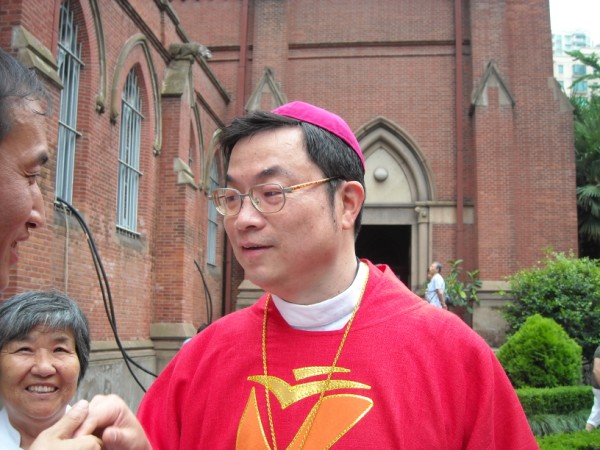
Ma_Daqin_2_(600_x_450)

And recently, just almost two years ago, the then newly appointed Auxiliary Bishop of Shanghai, Bishop Thaddeus Ma Daqin bravely and courageously announced his resignation from the CPCA, the official ‘church’ of China at his own episcopal ordination, which was done with the blessing of the Holy See and the Pope. This resignation triggered a massive response from the government which resulted in his incarceration for the past two years, and he had greatly suffered for this. His episcopal motto is clear and indeed clearly highlighted his wish for the unity of the Church in China with the Universal Church, free from any external intervention. His motto is “Ut Sint Unum ad Maiorem Dei Gloriam” or “That they may be One, for the greater glory of God.”

The Church in China still grows, and more and more people hunger for the truth that Christ can offer them. There are many opportunities at evangelisation, and many brave and courageous ministers of the Lord’s Gospel went forth even against the challenges that await them. The recent attacks by the government on the Christian faith, as shown by the demolition of a church building in Wenzhou show how much the authoritarian government fears the power and influence that the Church and the faith may have in bringing about their downfall. The downfall of Communism and the authoritarian governments in Eastern Europe must still be fresh in the minds of the autocrats in Beijing, and they fear their own demise if they allow the faith to grow unchecked.

There is still great hope in the Church in China, and there is genuine faith in the people, who desire to be reunited completely with their brethren in faith, all of us, in the Universal Church, and be freed from any form of pressure or external domination, which are unjust and uncalled for. But they need our prayers, our support and our encouragement.

a2b631b0

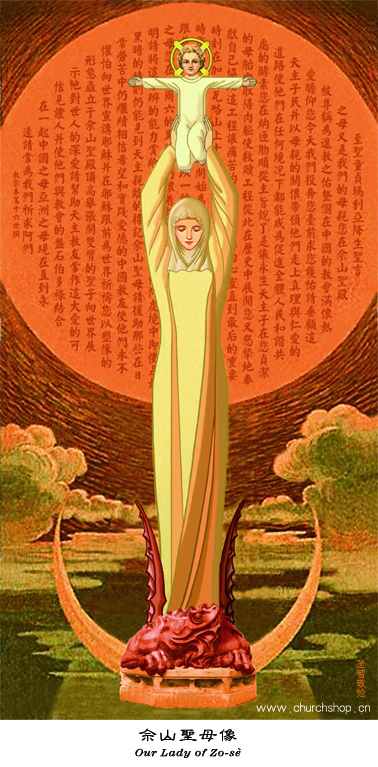
Let us ask for the intercession of the Blessed Mother of our Lord, Mary, the Help of Christians, who in the above picture is depicted as our Lady of Zose or Sheshan, from a famous pilgrimage site in Sheshan near Shanghai. Let us ask for her intercession for the Church in China and for the faithful there, our brethren in faith. Just as once the Lord had done His great works through Pope St. John Paul II, another great saint, to cast down the tyranny of atheism and unbelief in the states of Eastern Europe and Russia, may our Lady of Sheshan also intercede for the sake of our brethren in faith in China, a great nation and a great civilisation and yet is filled with worldly hatred of the devil who hates the Church and all its faithful.

We also pray that there will be a new spirit of dialogue and renewal, and that those entrusted with power at the top of the Chinese government hierarchy will finally realise the futility and the inhumane nature of their attempts to control the Church and the faithful. We hope that there will be an amicable and peaceful solution, that the Church in China may be completely reunited once again with the Universal Church, free from all the current issues and dilemmas, and free from any political arguments and intrusions by any external forces.

May the Lord be with His people always, protect them, bless them, and guide them to the light of Christ. May He give them rest and grace, after all the difficulties and challenges that they have faced, in the courageous and zealous defense of their faith in Him. Amen.

Monday, 3 February 2014 : 4th Week of Ordinary Time, Memorial of St. Blaise, Bishop and Martyr, and St. Ansgar, Bishop (First Reading)

Liturgical Colour : Green or Red (Martyrs) or White (Bishops)

2 Samuel 15 : 13-14, 30 and 2 Samuel 16 : 5-13a

A messenger came to report to David that the Israelites were siding with Absalom. Then David said to all his servants who were with him in Jerusalem, “Let us flee, for we cannot resist Absalom. Go quickly, lest he come hurriedly and overtake us. Surely he will put the city to the sword if he can bring disaster upon us.”

David himself went up the Mount of Olives, weeping. He was barefooted and had his head covered, and all the people who were with him had their heads covered and wept as they went.

When king David came to Bahurim, a man from the clan of Saul’s family named Shimei, son of Gera, came out cursing him. He threw stones at David and his officers although the king’s men and warriors flanked the king on the right and left. Shimei said as he cursed, “Go away! Go away! You bloodthirsty good-for-nothing! YHVH has brought down on your head all the blood of the family of Saul.”

“You became king in his place, but God has now placed the kingdom in the hands of your son Absalom. Ruin has come upon you because you are a bloodthirsty man.”

Then Abishai, son of Zeruiah, said to the king, “Why should this dead dog curse my lord the king? Let me go and cut his head off.” But the king said, “Why should I listen to you, sons of Zeruiah? If YHVH has ordered him to curse me, who shall ask him why he acts like this?”

Then David said to Abishai and his officers, “If my own son wants to kill me, how much more this Benjaminite! Leave him alone and let him curse me if YHVH has ordered him to do so. Perhaps YHVH will look on my affliction and turn to good things the curses heaped on me today.”

So David and his men went their way.

Sunday, 19 January 2014 : 2nd Sunday of Ordinary Time, World Day of Migrants and Refugees (First Reading)

Liturgical Colour : Green

Isaiah 49 : 3, 5-6

He said to me, “You are Israel, my servant. Through you I will be known.”

And now YHVH has spoken, He who formed me in the womb to be His servant, to bring Jacob back to Him, to gather Israel to Him. He said : “It is not enough that you be My servant, to restore the tribes of Jacob, to bring back the remnant of Israel.”

“I will make you the light of the nations, that My salvation will reach to the ends of the earth.”

Tuesday, 29 October 2013 : 30th Week of Ordinary Time (Psalm)

Liturgical Colour : Green

Psalm 125 : 1-2ab, 2cd-3, 4-5, 6

When the Lord brought the exiles back to Zion, we were like those moving in a dream. Then our mouths were filled with laughter, and our tongues with songs of joy.

Among the nations it was said, “The Lord has done great things for them.” The Lord had done great things for us, and we were glad indeed.

Bring back our exiles, o Lord, like fresh streams in the desert. Those who sow in tears will reap with songs and shouts of joy.

They went forth weeping, bearing the seeds for sowing, they will come home with joyful shouts, bringing their harvested sheaves.

Saturday, 5 October 2013 : 26th Week of Ordinary Time (First Reading)

Liturgical Colour : Green or White

Baruch 4 : 5-12, 27-29

Take courage, my people, you who preserve the memory of Israel. You have been sold to the nations but not for your destruction; because you had aroused the anger of God, you were delivered to your enemies.

For you displeased your Creator in sacrificing to demons and not to God. You have forgotten the Eternal God, the One who nourished you. You have filled Jerusalem with sadness, she who brought you up.

For she saw the anger of God fall on you and she said, “Listen, you neighbouring cities of Zion, God has sent me a great sorrow. I have seen the captivity of my sons and daughters, which the Eternal One brought on them. I had nurtured them in joy; with tears and sadness I saw them leave. Let no one rejoice on seeing me a widow and abandoned by all. Because of the sins of my children I am now alone, because they have turned away from the Law of God.”

Take courage, my children, cry out to God, for He who sent you into exile will remember you. Thus, as you distanced yourself from God, return to Him and seek Him ten times more earnestly. For He who caused these evils to fall on you will bring you salvation and eternal joy.

Monday, 30 September 2013 : 26th Week of Ordinary Time, Memorial of St. Jerome, Priest and Doctor of the Church (First Reading)

Liturgical Colour : White

Zechariah 8 : 1-8

The word of YHVH, the God of hosts was directed to me in this way, “I am intensely jealous for Zion, stirred by a burning anger for her sake. YHVH says : I will return to Zion and live in her midst. Jerusalem shall be called City of faithfulness and the Mountain of YHVH of hosts, the Mountain of holiness.”

YHVH, God of hosts speaks, “Old men and women will again sit in the squares, each with a stick in hand on account of their great age. The squares of the city will be filled with girls and boys playing.”

YHVH, God of hosts declares, “If that seems impossible in the eyes of those who have returned from exile, will it be impossible for Me as well?” – word of YHVH.

YHVH, God of hosts says, “See, I am going to save My people, bringing them from the east and from the west, and they will live in Jerusalem. They will be My people and I shall be their God in truth and in justice.”

Monday, 23 September 2013 : 25th Week of Ordinary Time, Memorial of St. Pius of Pietrelcina, Priest (Psalm)

Liturgical Colour : White

Psalm 125 : 1-2ab, 2cd-3, 4-5, 6

When the Lord brought the exiles back to Zion, we were like those moving in a dream. Then our mouths were filled with laughter, and our tongues with songs of joy.

Among the nations it was said, “The Lord has done great things for them.” The Lord had done great things for us, and we were glad indeed.

Bring back our exiles, o Lord, like fresh streams in the desert. Those who sow in tears will reap with songs and shouts of joy.

They went forth weeping, bearing the seeds for sowing, they will come home with joyful shouts, bringing their harvested sheaves.

Monday, 23 September 2013 : 25th Week of Ordinary Time, Memorial of St. Pius of Pietrelcina, Priest (First Reading)

Liturgical Colour : White

Ezra 1 : 1-6

In the first year of Cyrus, king of Persia, YHVH willed to fulfill the word He had said through the prophet Jeremiah, so He moved the spirit of Cyrus, king of Persia, to issue the following command and send it out in writing to be read aloud everywhere in his kingdom.

Thus speaks Cyrus, king of Persia : “YHVH, the God of heavens, who has given me all the kingdoms of the earth, has ordered me to build Him a Temple in Jerusalem, in the land of Judah. To everyone belonging to His people, may his God be with him! Let them go up to Jerusalem with the help of their God and there build the House of YHVH, the God of Israel, the God who is in Jerusalem.”

“In every place where the rest of the people of YHVH live, let the people of those places help them for their journey with silver, gold, and all kinds of goods and livestock. Let them also give them voluntary offerings for the House of YHVH which is in Jerusalem.”

Then they rose up – the heads of the families of Judah and Benjamin, the priests and the Levites, and all those whose spirit God had stirred up – and they decided to go and build the House of YHVH. And all of their neighbours gave them all kinds of help : gold, silver, livestock, and precious objects in great quantity, besides every kind of voluntary offering.

Friday, 13 September 2013 : 23rd Week of Ordinary Time, Memorial of St. John Chrysostom, Bishop and Doctor of the Church (Scripture Reflection)

Liturgical Colour : White

Brothers and sisters in Christ, today Christ continued to remind us of the great need to remain humble and loving in our lives, avoiding all sorts of vices, and do only what is in line with the will of God. He cares for us very much, and wants us to be righteous and worthy of Him. He protects and provides for all of us, in the same way that a father cares for his children, and way more than that.

He gave second chances to those who repent, to those who realised the depth of their sins and iniquities as He had done with St. Paul, once the great enemy of the faithful and the Church, and the great persecutor of saints and martyrs, turned into the great champion and defender of the faith, the great missionary of the Lord. Therefore, sinners are great in the eyes of the Lord, because the Lord loves them and cares for them, and wants them to return to Him.

Even saints and holy men and women of God now in heaven were once sinners, great or small. What matters is that they had learnt to manage their human weaknesses and tendency for sin, and overcome the sins they had done, with the help of God and one another, with the love they have in their hearts, and with the faith that they have.

We must therefore not be quick to condemn others or judge on others, especially on their faults or shortcomings, as we have to remember that none of us are perfect or completely filled with good things. All of us have weakness one way or another. We are imperfect, ever since sin has entered mankind’s heart. Yet, some of us would not realise of our own faults, thinking highly of ourselves and our own achievements, and look down on others whom we perceive to be inferior to us.

That was what the Pharisees did, as well as the chief priests and the teachers of the Law did, looking down on others because they thought highly of themselves. They prayed in loud voice and wonderful gestures, and followed the rules of the Law strictly, observing everything to the most minute details, and yet, behind all that, lay a huge problem, a huge fault with them. They have not the Lord in their heart, not even deep within their hearts.

They condemned others and sought faults in others, while they themselves were even more faulty in themselves. That was exactly what Christ condemned them for, their failure to do what the Lord truly asked of them, and even worse that as the leaders of the people, they misled the people and brought them to ruin instead of salvation.

Today, we celebrate the feast of St. John Chrysostom, one of the original four great Doctors of the Church, as one of the most brilliant minds of the Church, the leader of the faithful in Constantinople, St. John Chrysostom was truly an upright man, who lived piously and with deep faith in the Lord their God. He preached often of the need to live in charity and love, that is to show love to one another, especially the ones in need, and he truly practice what he preached.

St. John Chrysostom did not have it easy, as he did face many oppositions, especially from those who followed the heretical teachings, like Arianism, Monophysitism, Nestorianism, and many others. He faced them with firm faith and dedication to God. He was fully aware of his own sins and weaknesses, and therefore he wanted to bring souls to salvation in God, showing his care as a fellow sinner who had been called to guide his lost brethren to the Father in heaven.

St. John Chrysostom did not even shy away or fear of rebuking the Roman Emperor, Arcadius at the time, for the improper behaviour of his wife, the Empress Eudoxia, who resented St. John Chrysostom so much that he was banished from Constantinople and from his post. Immediately God set out to punish those who had conspired against the servant of God, and the Roman capital faced terrible catastrophe. Not even the imperial family was spared, with the Empress dying from childbirth and the Emperor himself a few years later.

Dear brothers and sisters in Christ, we should try to emulate St. John Chrysostom in his actions, in his life, and in his examples, that we should really look into ourselves first before we judge others, and reflect on our lives whether our words and actions had reflected God’s love in them. If we had not done so, then truly now is a good time to do so, while we still have the opportunity in this life. Let us have no fear and keep a steadfast faith like that of St. John Chrysostom, whom in his righteousness rebuked even an emperor and empress who went astray from the Lord.

Let us be always faithful to God, be loving both to Him and our brethren, and finally let us strive to give more of ourselves for the sake of others, the last, the lost, and the lonely, as St. John Chrysostom had done. Pray for us St. John Chrysostom! May God bless us always. Amen.