Monday, 8 December 2014 : Solemnity of the Immaculate Conception of the Blessed Virgin Mary (Psalm)

Liturgical Colour : White

Psalm 97 : 1, 2-3ab, 3bc-4

Sing to the Lord a new song, for He has done wonders; His right hand, His holy arm, has won victory for Him.

The Lord has shown His salvation, revealing His justice to the nations. He has not forgotten His love nor His faithfulness to Israel.

The farthest ends of the earth all have seen God’s saving power. All you lands, make a joyful noise to the Lord, break into song and sing praise.


Homily and Reflection :

https://petercanisiusmichaeldavidkang.com/2014/12/06/monday-8-december-2014-solemnity-of-the-immaculate-conception-of-the-blessed-virgin-mary-homily-and-scripture-reflections/

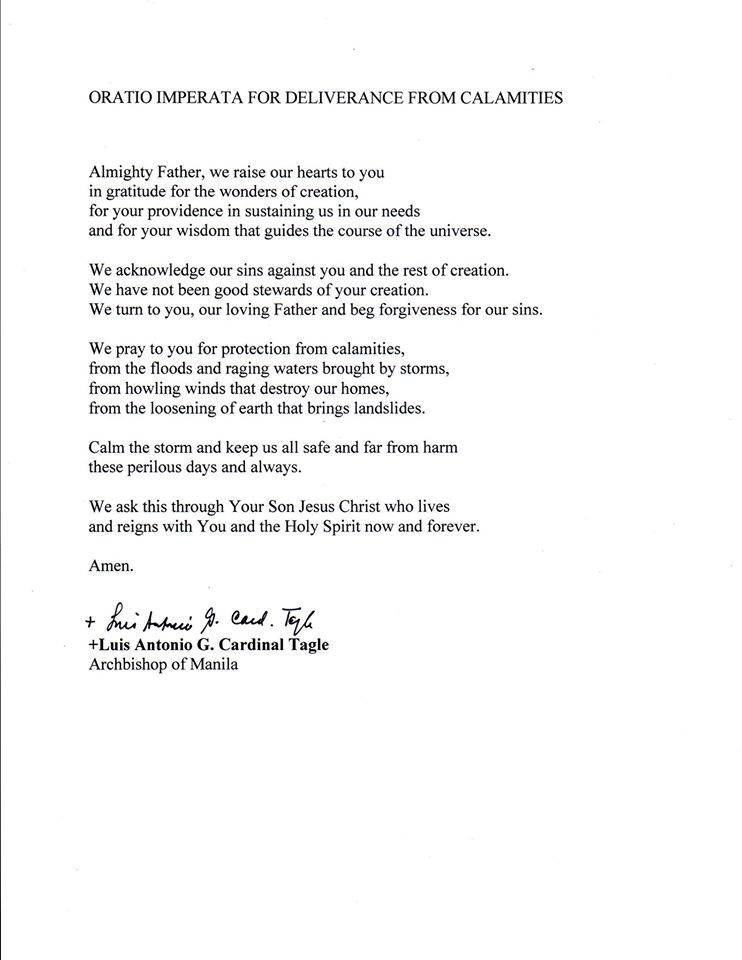
Request of Prayer for the People of the Philippines asking for the Lord’s protection from Typhoon Hagupit

Dear brothers and sisters, just as November last year brought the Super Typhoon Haiyan (Yolanda) to the Philippines, which devastated many regions in Central Philippines and causing numerous death, displacement and sufferings, this month of December, we witness yet another Super Typhoon, Hagupit, on the same path as Haiyan and it has the potential to wreck even more damage and suffering to those who are still suffering from the effects of the last year Super Typhoon.

10704276_860556690632554_6421548426968326468_o

The above prayer is a prayer for deliverance from the calamities, especially from the typhoon as given by His Eminence Cardinal Luis Antonio Tagle, the Metropolitan Archbishop of Manila. Let us all pray together as one people and one Church of God, that the Lord may show His mercy and love on His beloved people, those suffering, in the Philippines and also in the other parts of the world.

Pray, brethren, pray and devote our wishes to the Lord!

Sunday, 7 December 2014 : Second Sunday of Advent, Memorial of St. Ambrose, Bishop and Doctor of the Church (Homily and Scripture Reflections)

Liturgical Colour : Purple or Violet

Dear brothers and sisters in Christ, today we continue through the second Sunday of the Advent season, and we go deeper into the preparation we are carrying out this Advent, to prepare ourselves for the coming of our Lord Jesus Christ. Today’s readings serve as a further reminder of the eventual coming of our Lord in triumph, just as He had once come into the world as one of us, as Jesus Christ the Son of Man.

Today’s readings spoke about the servant and messenger of God’s will, John the Baptist, the one who was sent by God ahead of Himself, to prepare the way for His coming and to prepare the people so that when He Himself came, they would be ready and more prepared to listen to His message and be called to salvation. This in itself, also carries the same meaning of ‘preparation’ which Advent is truly about, the preparation for the coming of Christ.

We can see that the Lord had planned everything well in advance, and indeed, the coming of John the Baptist had been prophesied long earlier by the prophet Isaiah and the other prophets, who spoke of him as the second coming of the prophet Elijah into this world, and as God’s messenger to open up His path. Indeed, John the Baptist had been prepared for this mission from the very beginning, just as his conception and birth was special.

The prophet Elijah, if we read the Old Testament in the Book of Kings, was the faithful servant of God and prophet, who strived to bring the people of God who had erred in their ways and rebelled against the Lord, to return to the way of the Lord and be reconciled to Him. The authorities, the kings of Israel and their servants often made his works difficult, and it was often that he was hounded and pursued for his faith to God.

Yet, the prophet Elijah never gave up nor did he abandon his calling. He ministered faithfully to the people of God, and he endured all the difficulties, calling on the people of God to repent and change their ways, and many responded to his call, although equally many of them rejected his call and continued in their sinful ways. He was then, at the end of his mission, brought up to heaven on flaming chariots, and was hidden from the view of men ever since, until his coming again into the world as John.

John was born with the spirit of Elijah on him, and thus he was prepared to continue the same ministry which God had entrusted to Elijah. Even many centuries after the first coming of Elijah, and after the terrible experiences of the Babylonian exile, the people of God was still filled with sin, and they were still following the wicked ways of their ancestors. Thus, what Elijah had once done to bring the people of God back, needed to be done again.

The Lord had, for a long time, promised his people that He will come to save them and bring them back to Himself. He had promised His salvation through the Messiah that He would send into the world. But in a world still filled with so much sin and wickedness, especially even among the people of God, the people of Israel and Judea, the coming of the Messiah would have been made much more difficult if it had not been well prepared beforehand.

Thus, God sent his servant John, the second coming of Elijah, into the world so that he might straighten the path for the Messiah, or the Christ when He came. And that was what St. John the Baptist did, he laboured in thankless works, reviled and rejected by the Pharisees, who criticised him and questioned and doubted the authority and authenticity of his actions.

Yes, just as the people and the kings of Israel rejected Elijah and persisted in their sins, the same too occurred to John the Baptist. The Pharisees and the elders refused to see their sinfulness and refused to repent, thus later on they would prove to be great enemies and stumbling blocks for our Lord as well. Nevertheless, many people responded to John’s call, giving themselves to be baptised in the Jordan and repented from their sins.

Today, we also celebrate the feast of a saint, whose life and ministry would closely resemble what St. John the Baptist had gone through. St. Ambrosius or St. Ambrose, known better as St. Ambrose of Milan, through his position as the Bishop of Milan, was a great saint, a great pillar of the Church, a holy servant of God, one of the original Doctors of the Church, and ultimately, a fierce and fearless defender of the true Faith.

St. Ambrose was born during the late era of the Roman Empire, and he lived during a time when the Faith had been accepted as part of the Empire, and was being followed by more and more of the people of the Empire. However, many of the faithful at that time were misled by the numerous heresies and perversions of the Faith, leading them into wicked sins, which St. Ambrose would help to counter.

Despite being known as the Bishop of Milan, one of the most influential posts at the time in the Church, St. Ambrose was not originally meant for a life in the episcopate or even priesthood. St. Ambrose was a very influential and intelligent person, and his great intellect helped him to master many learnings and he was soon appointed as the Imperial Governor of the region of Aemilia-Liguria, and he was a very popular governor, as he was truly very competent and dedicated.

There was a great division in the Church at Milan at the time, the capital of Ambrose’s governorate, and after the bishop of Milan at the time, who was one of the heretics, died, the succession was filled with great bitterness and feud. St. Ambrose went to the church where the election was held, to prevent fighting and chaos from breaking out.

There, he was acclaimed by all present to be the new Bishop of Milan, regarding to his piety and popularity among the people, his righteousness and upright nature. He was immediately then ordained as a priest and the episcopate. Immediately, as the Bishop, he forbade all the teachings of heresies in his domains, and he strived hard to spread the true teachings of the Faith to the people entrusted under his care.

St. Ambrose did not have it easy, as there were many oppositions and challenges which he had to endure and counter against throughout his ministry. In particular, the Dowager Empress and the young Emperor under her care were heretics and influenced by the teachings of heresy. St. Ambrose tried hard to bring them and many others to see the Light of the true Faith, and many repented, but not the Empress and many others.

St. Ambrose publicly denounced even the Emperor, the Dowager Empress and the other heretical accomplices they had. This indeed reminds us of what St. John the Baptist had done, brothers and sisters? He who opposed and denounced the Pharisees publicly as brood of vipers and evil. And also Elijah, who condemned kings who caused the people to turn against the Lord their God.

And St. Ambrose did not even fear to excommunicate a powerful and mighty Emperor of the mightiest Empire in the world. The famous Roman Emperor Theodosius the Great, who vanquished his enemies and gained supreme power over the whole of the Empire, even though he was pious and true to the orthodox faith, but he was implicated in his part in the great massacre of the civilians and innocents in the great city of Thessalonica.

St. Ambrose excommunicated the Emperor and condemned him greatly in public for his involvement in the massacre. Only after the Emperor repented and in great humility, taking off his Imperial garments, wearing sackcloth and making public confession for his sins and reaffirmation of his faith in God, then St. Ambrose forgave his sins, and welcomed him back into the Church of God.

Brothers and sisters in Christ, what are the significance of what I have shared with you, on this Sunday’s readings, on the lives of Elijah, St. John the Baptist and St. Ambrose of Milan? All of them are about that all of us ought to make ample and sufficient preparation to prepare for the coming of our Lord. We cannot be complacent and unprepared, for remember, in the second reading today, St. Peter in his letter reminded us yet again, that the coming of the Lord will be like a flash, fast and unpredictable. If we do not prepare thoroughly, then we will be caught unaware and unprepared, and grim is our fate if that is the case.

How do we then prepare ourselves? We have to follow the examples of the holy and devoted servants of God, which we have already just heard. We have to stand up for our faith and truly practice it in our own lives. And then, we should not be afraid to point out the truth of Christ to others. After all, through our baptism, we have been called to be the witnesses of the Lord in this world, and as witnesses, it is only fitting that all of us do our part to evangelise the Good News, through our actions, so that all who see us may know the Lord through us and come to believe in Him.

It is important that all of us are prepared thoroughly for the coming of Christ, and thus it is also fitting that we should help one another in our preparations. We mist safeguard each other and keep one another in the faith in Christ, and in order to do so, we too should be prepared ourselves. Therefore, learn about the Faith we have in God, strengthen our devotion for the Lord and read always the Holy Scriptures with understanding.

Brothers and sisters in Christ, may this Advent be a great opportunity for us to renew ourselves, in our commitment to serve the Lord, and in our commitment to live our faith faithfully and genuinely, with love both for Him and for our fellow men. Let us follow the examples of the prophet Elijah, St. John the Baptist and St. Ambrose of Milan in their great courage to be witnesses of the faith. We too can be like them, and it is important that when the Lord comes again, as He had promised, He finds us ready, prepared, alert and awake!

May all of us become like the holy servants of God, and preparing the way for our Lord, just as those holy servants had done in the past. Let us bring the Good News of God and become witnesses of His to all the world by our actions, filled with faith and love, so that we may bring more souls to salvation, and make ready this world for the future coming of our Lord in glory, and He will reward us on the last day. God bless us all. Amen.


First Reading :

https://petercanisiusmichaeldavidkang.com/2014/12/05/sunday-7-december-2014-second-sunday-of-advent-memorial-of-st-ambrose-bishop-and-doctor-of-the-church-first-reading/


Psalm :

https://petercanisiusmichaeldavidkang.com/2014/12/05/sunday-7-december-2014-second-sunday-of-advent-memorial-of-st-ambrose-bishop-and-doctor-of-the-church-psalm/


Second Reading :

https://petercanisiusmichaeldavidkang.com/2014/12/05/sunday-7-december-2014-second-sunday-of-advent-memorial-of-st-ambrose-bishop-and-doctor-of-the-church-second-reading/


Gospel Reading :

https://petercanisiusmichaeldavidkang.com/2014/12/05/sunday-7-december-2014-second-sunday-of-advent-memorial-of-st-ambrose-bishop-and-doctor-of-the-church-gospel-reading/


Epistle (Usus Antiquior) :

https://petercanisiusmichaeldavidkang.com/2014/12/05/usus-antiquior-second-sunday-of-advent-and-feast-of-st-ambrose-bishop-and-doctor-of-the-church-i-classis-sunday-7-december-2014-epistle/


Gospel (Usus Antiquior) :

https://petercanisiusmichaeldavidkang.com/2014/12/05/usus-antiquior-second-sunday-of-advent-and-feast-of-st-ambrose-bishop-and-doctor-of-the-church-i-classis-sunday-7-december-2014-holy-gospel/

(Usus Antiquior) Second Sunday of Advent and Feast of St. Ambrose, Bishop and Doctor of the Church (I Classis) – Sunday, 7 December 2014 : Offertory, Secret Prayer of the Priest, Communion and Post-Communion Prayer

Liturgical Colour : Purple or Violet

Offertory

Psalm 84 : 7-8

Deus, Tu conversus vivificabis nos, et plebs Tua laetabitur in Te : ostende nobis, Domine, misericordiam Tuam, et salutare Tuum da nobis.

English translation

O God, turning, You will bring us life, and Your people shall rejoice in You. Show us, o Lord, Your mercy, and grant us Your salvation.

Secret Prayer of the Priest

Placare, quaesumus, Domine, humilitatis nostrae precibus et hostiis : et, ubi nulla suppetunt suffragia meritorum, Tuis nobis succurre praesidiis. Per Dominum…

English translation

Be appeased, we beseech You, o Lord, by the prayers and offerings of our lowliness, and where no support of merits is at hand, do You hasten to us with Your aid. Through our Lord…

Communion

Baruch 5 : 5 and Baruch 4 : 36

Jerusalem, surge et sta in excelso, et vide jucunditatem, quae veniet tibi a Deo tuo.

English translation

Arise, o Jerusalem, and stand on high, and behold the joy that comes to you from your God.

Post-Communion Prayer

Repleti cibo spiritualis alimoniae, supplices Te, Domine, deprecamur : ut, hujus participatione mysterii, doceas nos terrena despicere et amare caelestia. Per Dominum…

English translation

Filled with the food of spiritual nourishing, we humbly beseech You, o Lord, that by our partaking of this mystery You would teach us to condemn earthly and love heavenly things. Through our Lord…

(Usus Antiquior) Second Sunday of Advent and Feast of St. Ambrose, Bishop and Doctor of the Church (I Classis) – Sunday, 7 December 2014 : Gradual and Alleluia

Liturgical Colour : Purple or Violet

Psalm 49 : 2-3, 5 and Psalm 121 : 1

Ex Sion species decoris ejus : Deus manifeste veniet.

Response : Congregate illi sanctos ejus, qui ordinaverunt testamentum ejus super sacrificia.

Alleluja, Alleluja.

Response : Laetatus sum in his quae dicta sunt mihi : in domum Domini ibimus. Alleluja.

English translation

Out of Sion the loveliness of His beauty, God shall come manifestly.

Response : Gather all of you together His saints to Him, who have set His covenant before sacrifices.

Alleluia, Alleluia.

Response : I rejoiced at the things that were said to me. We shall go into the house of the Lord. Alleluia.

(Usus Antiquior) Second Sunday of Advent and Feast of St. Ambrose, Bishop and Doctor of the Church (I Classis) – Sunday, 7 December 2014 : Introit and Collect

Liturgical Colour : Purple or Violet

Introit

Isaiah 30 : 30 and Psalm 79 : 2

Populus Sion, ecce, Dominus veniet ad salvandas gentes : et auditam faciet Dominus gloriam vocis suae in laetitia cordis vestri.

Qui Regis Israel, intende : qui deducis, velut ovem, Joseph.

Response : Gloria Patri et Filio et Spiritui Sancto, sicut erat in principio, et nunc, et semper : et in saecula saeculorum. Amen.

English translation

People of Sion, behold, the Lord shall come to save the nations, and the Lord shall make the glory of His voice to be heard in the joy of your heart.

Give ear, o You who rules Israel. You who leads Joseph like a sheep.

Response : Glory be to the Father and to the Son and to the Holy Spirit, as it was in the beginning, is now, and ever shall be, world without end. Amen.

Collect

Excita, Domine, corda nostra ad praeparandas Unigeniti Tui vias : ut, per ejus adventum, purificatis Tibi mentibus servire mereamur : Qui Tecum…

English translation

Stir up our hearts, o Lord, to prepare the ways of Your only begotten Son, that through His coming we may be worthy to serve You with purified minds. Who lives…

Saturday, 6 December 2014 : First Week of Advent, Memorial of St. Nicholas, Bishop (Homily and Scripture Reflections)

Liturgical Colour : Purple/Violet or White (Bishops)

Dear brothers and sisters in Christ, the readings of the Holy Scriptures today have one clear theme, that is healing and reconciliation. The Lord our God came into the world as our Messiah, to release us from our bondage to sin, which is the disease and sickness of our soul, corrupting it and preventing us from sharing the joy in the Lord. Therefore, He came Himself, into the world out of His great love for us, to heal us from this affliction.

Indeed we have been sinful and wicked in our actions. Sin separates us from God, and it is the reason for mankind’s downfall from grace. Our ancestors, our forefathers and all of us, all mankind were created with love by God, not to suffer and die, but to live forever in complete harmony, joy and bliss with the Lord our God, to enjoy forever all of God’s wonderful creations. It was our pride, our greed and our sinfulness that caused us to disobey God, sin and therefore had to endure the punishment for our sins.

And yet, God did not intend to punish us forever for our sins. This is because, just as much as He hates our sins and all the wickedness which we have committed in our lives, He still loves us as much as He hates our sins. After all we are the most beloved of all His creations, created in His very own image. But this is where He wants us all to know His intentions, that is for us all to be healed from our afflictions, to be lost no more, and to return back to His loving embrace.

Yes, that means, while God loves us all, it does not mean that He condones our sinful ways, and He does not want us to remain in sin. Remember, what is at stake is none other than the salvation of our souls. If we do not make a difference and change our ways, then we are truly in great danger of losing our souls to eternal damnation and the suffering in eternal hell.

Brothers and sisters in Christ, that is why in the Gospel today, very importantly, we heard how Jesus commissioned His disciples and the Twelve Apostles to go out and be the witnesses and preachers of the Good News of the Lord. It was indeed just as what He had witnessed, that the people were like lost sheep, directionless, confused and confounded, like sheep without a shepherd. It is therefore our Lord’s priority to bring a new and clear direction to all the people, to guide them so that they will no longer be lost.

Today we celebrate the feast of St. Nicholas, also known by the name of St. Nicholas of Myra, who was a bishop in the approximately fourth century after the birth of Christ in Anatolia, what is now the Asian part of Turkey. St. Nicholas of Myra is also much more famously known as the source of inspiration for the ubiquitous Santa Claus, the elderly figure with red and white winter sweater, whom we know as the one who gives children numerous gifts at Christmas time.

Yet, what we think of Santa Claus, or Father Christmas, was truly a distortion, manipulated version of what St. Nicholas of Myra had once done. It was told that St. Nicholas of Myra loved children and often blessed them and gave them gifts. This seems to be where the legend of St. Nicholas of Myra evolved to what we now know as Santa Claus. Yet, unfortunately, what we have today is a false representation of the bishop and an attempt by the world to tempt us with materialism and human desires.

Christmas celebrations which we have now in our world, in the society around us is a celebration centred on human desires, on the culture of waste and excess. Christ is no longer at the centre of the celebrations but instead, what we have money and wealth at the centre of our joy. The perpetuation of the false image of St. Nicholas also helped to fuel our human desires, by promoting a culture of excess among us, and a culture of entitlement.

By feeding on our desires, the world is trying to fuel more and more demands for our greed and desire, and therefore helping to create a materialistic nature, where everything is done in order to satisfy our demands and our wishes, and a place where our greatest concern is how to satisfy ourselves. This is part of the sin which have separated us from our Lord and condemn us to a life in eternal suffering unless we change our ways.

Remember, brethren, our ancestors sinned before God because they were not able to restrain themselves and their desires. They chose to satisfy their curiosity and desire rather than to obey the Lord and therefore they were cast down from heaven. Hence, it is important for us to use this opportunity provided for us in life, particularly in this special season of Advent, the season of preparation for the coming of Christ, to change our sinful ways, sin no more and embrace the fullness of God’s love and mercy.

Do you know, brothers and sisters, that St. Nicholas of Myra once punched a heretic directly in the face for spreading his heresies? Yes, brethren, just as much as he loved children and was gentle towards them, he showed no mercy to those who had tried to mislead the people of God and lead them towards darkness. As a bishop, he had a great responsibility for the souls of the faithful entrusted to him, and that was exactly he did in order to fulfill that great responsibility.

Therefore, brothers and sisters in Christ, as we proceed further into the season of Advent, let us all realise that we are sinners, and we have not deserved the goodness of God, and yet He came to save us all and heal us from the afflictions of our sins. And therefore, let us all be thankful and be grateful for all that our Lord had done for us. Let us accept His generous offer of healing and mercy, and most importantly, sin no more and live in His grace from now on always.

And let us also realise, that all of us have the responsibility, as the followers of Christ, just as Christ sent His Apostles and disciples to the nations to preach the Good News to them and to find all the lost sheep and those lost to the darkness, therefore, all of us can also play our part in the Lord’s plan of salvation for all mankind.

Hence, that is why we need to be role models of the faith, by first changing our ways and abandoning all the wickedness we had done. We have to practice and live out our faith sincerely and devoutly, so that all those who see us may believe in the Lord and be saved together with us. Let us ask the Lord for the gift of courage and strength, so that inspired by the faith and examples of St. Nicholas of Myra, emulating his love and charity for others, and also his steadfastness in faith, we too may be worthy to receive eternal glory in Him. God bless us all. Amen.


First Reading :

https://petercanisiusmichaeldavidkang.com/2014/12/04/saturday-6-december-2014-first-week-of-advent-memorial-of-st-nicholas-bishop-first-reading/


Psalm :

https://petercanisiusmichaeldavidkang.com/2014/12/04/saturday-6-december-2014-first-week-of-advent-memorial-of-st-nicholas-bishop-psalm/


Gospel Reading :

https://petercanisiusmichaeldavidkang.com/2014/12/04/saturday-6-december-2014-first-week-of-advent-memorial-of-st-nicholas-bishop-gospel-reading/

Saturday, 6 December 2014 : First Week of Advent, Memorial of St. Nicholas, Bishop (Gospel Reading)

Liturgical Colour : Purple/Violet or White (Bishops)

Matthew 9 : 35 – Matthew 10 : 1, 5a, 6-8

At that time, Jesus went around all the towns and villages, teaching in their synagogues and proclaiming the Good News of the kingdom, and He cured every sickness and disease.

When He saw the crowds, He was moved with pity, for they were harassed and helpless like sheep without a shepherd. Then He said to His disciples, “The harvest is abundant, but the workers are only few. Ask the Master of the harvest to send workers to gather His harvest.”

Then He called His twelve disciples to Him, and gave them authority over the unclean spirits, to drive them out and to heal every disease and sickness. Jesus sent these twelve on mission with the instruction : “Go to the lost sheep of the people of Israel. Go and proclaim this message : ‘The kingdom of heaven is near.’ Heal the sick, bring the dead back to life, cleanse the lepers, and drive out demons. You received this as a gift, so give it as a gift.”


Homily and Reflection :

https://petercanisiusmichaeldavidkang.com/2014/12/04/saturday-6-december-2014-first-week-of-advent-memorial-of-st-nicholas-bishop-homily-and-scripture-reflections/

Friday, 5 December 2014 : First Week of Advent (Homily and Scripture Reflections)

Liturgical Colour : Purple or Violet

Dear brothers and sisters in Christ, the reading today espoused the facts that as long as we believe in the Lord our God and be courageous to ask Him for what we need, He will listen to us and not abandon us in the darkness. He will answer us if we call, and He will give us what we need, just as the two blind men who sincerely asked for His mercy got what they asked for, and they were healed.

Those who in humility seek the Lord for His mercy will indeed be richly rewarded, namely all those who have realised the gravity of their sinfulness and the perilous state of their souls, and were committed to changing their ways so that they would no longer sin but live righteously from then on. This is what the first reading, taken from the book of the prophet Isaiah, told us about. The mighty and the powerful will be brought down, not because of their power, but because it is likely that their pride got the better of them, and it is likely to prevent them from seeking the mercy of the Lord.

The readings of today are reminders for us that our pride is often our undoing, and it often also serves as a great stumbling block on our path towards salvation. Take for example the Pharisees and the chief priests, who boasted in their dedication and observance of the numerous rituals and laws of Moses, that they thought that they alone would be worthy of God’s salvation and grace.

Yet, they were wrong. In their boasting and in their pride, in their search for human praise and worldly glory, they had not only failed to realise that they have not done what the Lord had wanted from them, but worse, that in their pride, they had not just condemned themselves but in fact also the many others who had been entrusted under their care, and those others who have been influenced by their worldly and corrupted ways.

They thought of themselves as being good and just, and they thought of themselves as deserving of honour and respect for such faith that they have. But what they ought is all about themselves, and God had no place in their hearts. At the Day of Judgment therefore, God would say to them, ‘Get lost, all of you the condemned ones, for all you ever thought of was yourselves, and you had no love for Me or for your brethren. Thus your place is among the fallen angels, with Satan to be punished for eternity.’

Pride is a disease of the soul, the same reason why Satan fell from grace, from being once as the mightiest and most wonderful of the angels, but because of his pride, he rebelled against God and fell into damnation. Where is he now? Is he exalted high above the heavens and the angels as he had boasted? No! He was cast down and his name was forever associated with those who in their pride, and destroyed themselves.

How is this important for us, brothers and sisters in Christ? This is because all of us are sinners, and we have been afflicted with sin, that is the disease of our soul. We may be physically healthy, but all of us inside us have been afflicted with sin, diseased and wicked, be it small or big, the nature of this sin. And sin is a veil which covers our eyes, preventing us from recognising the good in others and also the wickedness which we have committed in our lives.

The commitment of sin desensitised us, brethren, and the more we commit sin, the tendency is for us to feel less and less guilty about it. That is why it is just like the two blind men for us all. Indeed, they were blind in the eyes and were unable to see the world around them, but it is also the same for us all, in failing to recognise our own sinfulness and shortcomings, and instead we often acted like the Pharisees, indulging in self-praise and boasting of our so-called accomplishments, and not giving glory to God.

Brothers and sisters in Christ, we should all imitate the action of the two blind men. Even though they were not able to see with their eyes, yet they were able to recognise Jesus and who He is. Therefore, we too should recognise the presence of the Lord around us, in all that He had done for us. We too should recognise our Lord who has come into this world and offered Himself so that we may be forgiven and be healed from our sickness of these sins.

Therefore, let us all, brothers and sisters in Christ, commit ourselves to be humble and meek, seeking the Lord’s forgiveness for all of our sins and wickedness. Our Lord had come into this world to seek the salvation of sinners, and that is what we should make use of, by genuinely and sincerely believing in Jesus our Lord, be forgiven for our sins, and most importantly, to stop sinning and sin no more from now on.

May our Lord Jesus bless us and guide us, so that in this season of Advent, we may come to greater realisation about ourselves, and about how sinful we have been, and how urgent it is indeed for us to seek the Lord’s mercy and forgiveness, so that when He comes again, He may find us worthy and righteous to receive His blessing and the inheritance He had promised us all. God bless us all. Amen.


First Reading :

https://petercanisiusmichaeldavidkang.com/2014/12/04/friday-5-december-2014-first-week-of-advent-first-reading/


Psalm :

https://petercanisiusmichaeldavidkang.com/2014/12/04/friday-5-december-2014-first-week-of-advent-psalm/


Gospel Reading :

https://petercanisiusmichaeldavidkang.com/2014/12/04/friday-5-december-2014-first-week-of-advent-gospel-reading/

Friday, 5 December 2014 : First Week of Advent (Gospel Reading)

Liturgical Colour : Purple or Violet

Matthew 9 : 27-31

At that time, as Jesus moved on from His hometown, two blind men followed Him, shouting, “Son of David, help us!”

When He was about to enter the house, the blind men caught up with Him, and Jesus said to them, “Do you believe that I am able to do what you want?” They answered, “Yes, Sir!”

Then Jesus touched their eyes and said, “As you have believed, so let it be.” And their eyes were opened. Then Jesus gave them a stern warning, “Be careful that no one knows about this.” But as soon as they went away, they spread the news about Him through the whole area.


Homily and Reflection :

https://petercanisiusmichaeldavidkang.com/2014/12/04/friday-5-december-2014-first-week-of-advent-homily-and-scripture-reflections/